
The present work aimed to explore the molecular mechanisms and candidate genes associated with fat metabolism in Anqingliubai (obese) and Yorkshire (lean) pigs. The transcriptome profiling of backfat between Anqingliubai and Yorkshire pigs was carried out by RNA-sequencing technology. The sum of clean reads were 288.3 and 365.3 million which was obtained from the RNA sequencing data in the Anqingliubai and Yorkshire pigs, respectively. Most reads were located in exonic region, while less reads were located in intergenic and intronic regions. There were 2601 upregulated genes, but 284 downregulated genes in Yorkshire pigs compared with those in Anqingliubai pigs. The top 10 most significant Gene Ontology (GO) terms included catalytic activity, binding, cell, cytoplasm, positive regulation of multicellular organismal process, biological regulation, cellular process, etc. There were 54 significant Kyoto Encyclopedia of Genes and Genomes (KEGG) pathways including cytokine-cytokine receptor interaction, biosynthesis of unsaturated fatty acids, fatty acid metabolism, regulation of lipolysis in adipocytes, glycerolipid metabolism, etc. The results of differentially expressed genes from sequence were highly reliable by qRT-PCR confirmation. The present work will help understanding of the different mechanisms involved in fat deposition between lean and obese pigs.
Research Article · Volume 53, Issue 1, 17 December 2020 · Open Access
Comparative Transcriptome Profiling of Backfat in Anqingliubai and Yorkshire Pigs
· · · · · · · · · · · ·
Affiliations & Notes ⌄
- 1Anhui Provincial Laboratory of Local Animal Genetic Resource Conservation and Bio-Breeding, College of Animal Science and Technology, Anhui Agricultural University, Hefei, Anhui 230036, China 2College of Animal Science, Anhui Science and Technology University, Fengyang, Anhui 233100, People’s Republic of China Hong Hu and Li Qian contributed equally to this work. , * Corresponding author: dingyueyun@ahau.edu.cn
- 2yinzongjun@ahau.edu.cn
Article Info ⌄
- Journal:
- Pakistan Journal of Zoology
- Published:
- 17 December 2020

From the article
- The present study represented the mRNA profiles in the backfat between Anqingliubai and Yorkshire pigs by employing RNA-seq technology.
- Among DEGs, 2601 genes were upregulated, while 284 genes were downregulated in the Yorkshire pigs compared with those in the Anqingliubai pigs.
- Identification of the DEGs in the present work will contribute to the understanding of the different mechanisms involved fat deposition between lean and obese pigs.
Selected from the article's own text.
Abstract
INTRODUCTION
Fat deposition in pig, directly affecting production efficiency, pork quality, reproductive performance and consumers’ choice, is an important economic trait ; . Adipose is the organ for fatty acid synthesis, fat and energy storage, and adipocytokine secretion and plays an important role in fat deposition and metabolism regulation in vivo of livestock. Importantly, adipose tissues also secrete adiponectin, leptin, resistin and so on, which are closely associated with obesity, diabetes, cardiovascular and other metabolic diseases ; . Fat deposition and distribution are closely related to meat yield, backfat thickness, intermuscular fat content, and meat quality (such as tenderness, juicy, smell and taste).
Body fat deposition rate depends on adipocyte genesis, differentiation, proliferation, and lipid metabolism ; . Modern molecular biology studies have proven that the biological process occurring in adipocytes are regulated by various key genes ; ; . In particular, the adipocyte-regulated genes are an interactive and mutually restricted equilibrium system. Therefore, the key genes affecting fat deposition not only provide a theoretical basis for improving pig meat quality, but also provide an abundant gene source for transgenic breeding of meat quality traits.
RNA sequencing (a transcriptome sequencing technique) can measure a large number of mRNAs, and the entire gene-wide transcriptome map was obtained by comparing these sequences with reference genomes ; ; . Recently, RNA sequencing technology has been widely used in a variety of domestic animals at the transcriptome level and has been proven to be one of the most effective methods for the large-scale study of transcriptome ; . Anqingliubai pig (a famous Chinese local lard-pig breed), has higher body fat rate and meat quality . While, the Yorkshire pig (a European lean-type pig) has high lean meat percentage and growth rates . There were significant differences in fat metabolism between Anqingliubai and Yorkshire pigs. However, few studies have focused on the relationship of the adipose tissue transcriptome between both breeds. In the present work, the transcriptome analysis in the backfat of the two breeds was carried out by RNA sequencing technique. The results of sequencing, sequence alignment, transcription prediction and differential gene screening will provide a molecular basis for fat metabolism in swine.
MATERIALS AND METHODS
Animals and backfat sample
The animal experiment was carried out based on the guidelines for the care and use of experimental animals of the Ministry of Science and Technology of the People’s Republic of China (No. 2006-398) and approved by Animal Care Advisory Committee of Anhui Agricultural University. Three purebred castrated male Anqingliubai pigs and three purebred castrated male Yorkshire pigs (about 100 kg) were selected from farm of Anhui Agricultural University. After slaughter, the backfat samples were quickly put into liquid nitrogen and stored at - 70 ˚C refrigerator.
Total RNA extraction, library preparation and sequencing
The total RNA of the backfat was extracted by Qiagen RNA Isolation Kit (Germany) and detected by Nanodrop 2000 spectrophotometer (Thermo Scientific, USA) and Bioanalyzer 2100 system (Agilent Technologies, USA). The 6 libraries were constructed by NEB RNA Library Prep Kit (UK) following manufacturer’s instructions. The cDNA libraries were amplified by PCR and then sequenced on Illumina Hiseq3000 platform.
Sequence data analysis
The clean reads obtained by removing low quality date were used to analyze. The clean reads were mapped to pig reference genome (Sscrofa10.2). The mRNA expression level was calculated by RPKM. The mRNA with |log2 Fold Change|>1 and q value < 0.01 was considered as differentially expressed gene (DEG).
Gene Ontology (GO) and Kyoto Encyclopedia of Genes and Genomes (KEGG) analysis
The differentially expressed genes were submitted to the GO and KEGG databases for enrichment analysis. In all tests, the P-value was determined using Fisher Exact Test, and P value < 0.05 was considered as significant pathway.
The mRNA validation by quantitative RT-PCR (qRT-PCR)
The DEGs from backfat RNA of the Anqingliubai (n=6) group and Yorkshire (n=6) group were checked. The qRT-PCR was used to measure the mRNA expression level of 8 randomly selected DEGs by TaKaRa SYBR Premix Taq (Japan) with PCR primers (Table I). The thermal cycling program was 95 ˚C for 300 s, and 40 cycles of 95 °C for 5 s and 60 ˚C for 30 s. The β-actin gene was selected as reference gene. The mRNA expression level was calculated using 2-ΔΔCT method .
Table I. The primers used in this study.
Statistical analysis
Experiment data was subjected to statistical analysis by SPSS 18.0 software. Student’s t-test was performed to determine the statistical differences between Anqingliubai and Yorkshire pigs. P < 0.05 was regarded as significant difference.
RESULTS AND DISCUSSION
Overview of sequencing data
As shown in the Table II, the sum of clean reads were 288.3 and 365.3 million which were obtained from the RNA sequencing data in the Anqingliubai and Yorkshire pigs, respectively. Most reads were located in exonic region (66.55% - 81.33%), while less reads were located in intergenic (4.38% - 13.53%) and intronic (11.51% - 24.35%) regions. These results suggested that these reads were available to
Table II. Summary of sequencing data.
| Sample | Yorkshire | Anqingliubai | ||||
| 1 | 2 | 3 | 1 | 2 | 3 | |
| 117,307,576 | 125,999,096 | 121,966,536 | 93,914,658 | 100,543,632 | 93,820,672 | |
| 66.55% | 79.46% | 70.63% | 81.33% | 78.46% | ||
| 11.64% | 13.53% | 9.03% | 5.02% | 4.38% | 9.81% | |
| Intronic, % | 20.91 | 19.92% | 11.51% | 24.35% | 14.29% | 11.73% |
1Anqingliubai1, Anqingliubai2, Anqingliubai3, Yorkshire1, Yorkshire2, and Yorkshire3 are replicate from the Anqingliubai and Yorkshire breeds.
Table III. Results of qPCR validation.
| Gene | log2 (Fold change) | qRT-PCR results log2 (Fold change) | P value | Confirmed results of sequence |
| 5.57 | 1.31 | 0.027 | Yes | |
| 2.15 | 1.32 | <0.01 | Yes | |
| ACAN | 3.58 | 0.76 | 0.041 | Yes |
| DKK3 | 1.85 | 0.70 | 0.028 | Yes |
| -2.29 | -0.91 | 0.015 | Yes | |
| AARD | -2.15 | 0.21 | 0.585 | No |
| FRRS1L | -3.11 | -1.12 | 0.021 | Yes |
| FKBP5 | -1.69 | -0.91 | 0.023 | Yes |
Student’s t-test was performed to detect the differences between Anqingliubai and Yorkshire pigs, and P < 0.05 was considered as significant differences. (n=6).
compare the transcriptomes from backfat of Anqingliubai and Yorkshire pigs. The data were submitted to NCBI SRA (SRP127699).
DEGs between Anqingliubai and Yorkshire pigs
A total of 31694 mRNAs were obtained in the present study. A total of 2885 genes were differentially expressed between Anqingliubai and Yorkshire pigs (Supplementary Table I). There were 2601 upregulated genes, but 284 downregulated genes in Yorkshire pigs compared with those in Anqingliubai pigs. (Supplementary Table I and Fig. 1).
Pig fat deposition is closely related to the growth performance, pork quality, reproductive traits and disease resistance, all of which seriously affect pig production efficiency. Compared with other model animals, pig is an ideal human model because of their similar physiological conditions, fat deposition, body size, feeding patterns, etc ; . Anqingliubai and Yorkshire pigs are belonged to lard and lean types, respectively ; . Backfat thickness is an important parameter used to measure fat deposition .
Many reports have demonstrated that there is breed-specific gene expression among different breeds ; . The present work found a series of differentially expressed genes such as ACACA (acetyl-coenzyme A carboxylase), LEPR (leptin receptor), LEP (leptin), SCD (stearoyl-CoA desaturase), ACOX1 (acyl-CoA oxidase 1), etc. involved in important fat deposition. ACACA catalyzes the conversion of acetyl coenzyme A to malonyl coenzyme A, which is the key rate-limiting enzyme in the de novo fatty acid synthesis . LEPR and LEP negatively regulate body weight by reducing feed intake and increasing oxidation of fatty acids and glucose . SCD, the rate-limiting enzyme of unsaturated fatty acids, regulates the accumulation and storage of glycerol in the liver . The differentially expressed genes reported here are involved in various aspects of de novo fatty acid synthesis including its direct and indirect regulation.
GO enrichment analysis
GO which can be divided into three major categories (Molecular Function, Cellular Component and Biological Process) are widely used in transcriptional data analysis of pigs . There were 640 significant enrichment items in GO enticement analysis, including 47 significant enrichment items related to cell components, 79 significant enrichment items related to molecular function, and 514 significant enrichment items related to biological processes (Supplementary Table II, III and IV). As shown in the Figure 2, the top 10 most significant GO terms included catalytic activity, binding, cell, cytoplasm, positive regulation of multicellular organismal process, biological regulation, cellular process, etc. Results shown in Supplementary Table II, III and IV suggested that the differentially expressed genes involved in catalytic activity, oxidoreductase activity, positive regulation of cellular process, regulation of metabolic process, and transition metal ion binding could regulate the lipid metabolism . It can be inferred that DEGs labelled with molecular function, cellular component and biological process play an important role in the different lipid metabolism between Anqingliubai and Yorkshire breeds.
KEGG pathway analysis
KEGG database includes the function of genes and their interaction network . The analysis of KEGG pathway is contributed to further understand the biological function of genes. In the present work, there were 54 significant KEGG pathways (Supplementary Table V). Figure 3 showed the top 30 significant KEGG pathways.
Generally, the fat deposition ability of lard pig is stronger than that of lean pig . In the KEGG pathway analysis, some pathways including cytokine-cytokine receptor interaction, biosynthesis of unsaturated fatty acids, fatty acid metabolism, regulation of lipolysis in adipocytes, glycerolipid metabolism, and so on were closely related to lipid metabolism ; . Many DEGs (LEPR, LEP, TNFSF4, ACOX1, PECR; SCD5, SCD, PTPLA, ACSL3,
MCAT, ACADSB, ACACA, LPIN1) significantly enrich above signaling pathways ; ; . These results suggested that genes responsible for lipid metabolism in the backfat significantly differ between Anqingliubai and Yorkshire pigs. Further studies should focus on the functional determination of differentially expressed genes to identify key candidate which influence the fat traits in swine.
The qRT-PCR confirmation
Eight genes among the DEGs were selected for qRT-PCR confirmation from bcakfat RNA of Anqingliub and Yorkshire pigs. As shown in Table III, the TNMED, BCO2, ACAN and DKK3 genes were upregulated (P<0.05), while CYP3A29, FRRS1L, and FKBP5 genes were downregulated (P<0.05) in the Yorkshire pigs compared with those in the Anqingliubai pigs. However, the mRNA expression of AARD was not significantly different between both breeds. Consequently, the results of DEGs from sequence were statistically verified for 87.5% of the detected genes by qRT-PCR. These results suggested that the gene expression in the RNA-seq was highly reliable.
CONCLUSIONS
The present study represented the mRNA profiles in the backfat between Anqingliubai and Yorkshire pigs by employing RNA-seq technology. Among DEGs, 2601 genes were upregulated, while 284 genes were downregulated in the Yorkshire pigs compared with those in the Anqingliubai pigs. There were many DEGs including ACACA, LEPR, SCD, ACOX1, etc. that were relevant to the fat metabolism in the swine. Identification of the DEGs in the present work will contribute to the understanding of the different mechanisms involved fat deposition between lean and obese pigs.
ACKNOWLEDGMENTS
This work was supported by the planning subject of ‘the twelfth five-year-plan’ in national science and technology for the rural development in China (2015BAD03B01), the Natural Science Foundation of Anhui Province (1508085QC52), the key subject of study and research of Anhui province (1704a07020085, 1704a07020090), the Open project supported by State Key Laboratory of Genetic Resources and Evolution, Kunming Institute of Zoology, Chinese Academy of Sciences (GREKF15-03), the National Natural Science Foundation of China (31572377,31371258, 31402037), Anhui Provincial Science and Technology Major Project (17030701008, 17030701061), Anhui Academy of Agricultural Sciences Key Laboratory Project (18S0404), the Open Fund of Anhui Province Key Laboratory of Local Livestock and Poultry, Genetical Resource Conservation and Breeding (AKLGRCB2017003), and the Anhui Provincial Modern Industrial Technology System of Swine (AHCYJSTX-05).
Supplementary material
There is supplementary material associated with this article. Access the material online at: https://dx.doi.org/10.17582/journal.pjz/20190406120436
Statement of conflict of interest
Authors have declared no conflict of interest.
Figures
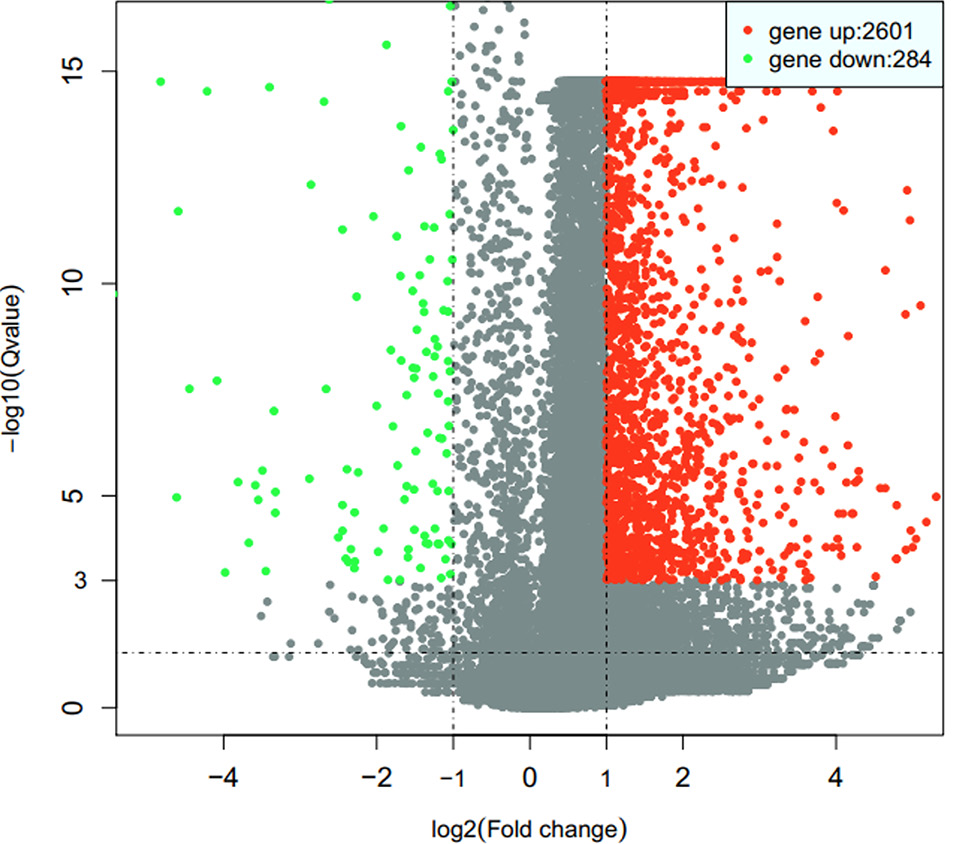
Volcano plot displaying of differentially expressed genes between Anqingliubai and Yorkshire pigs. The red points: the upregulated genes; The blue points: the downregulated genes; The gray points: the non-significant differentially genes.
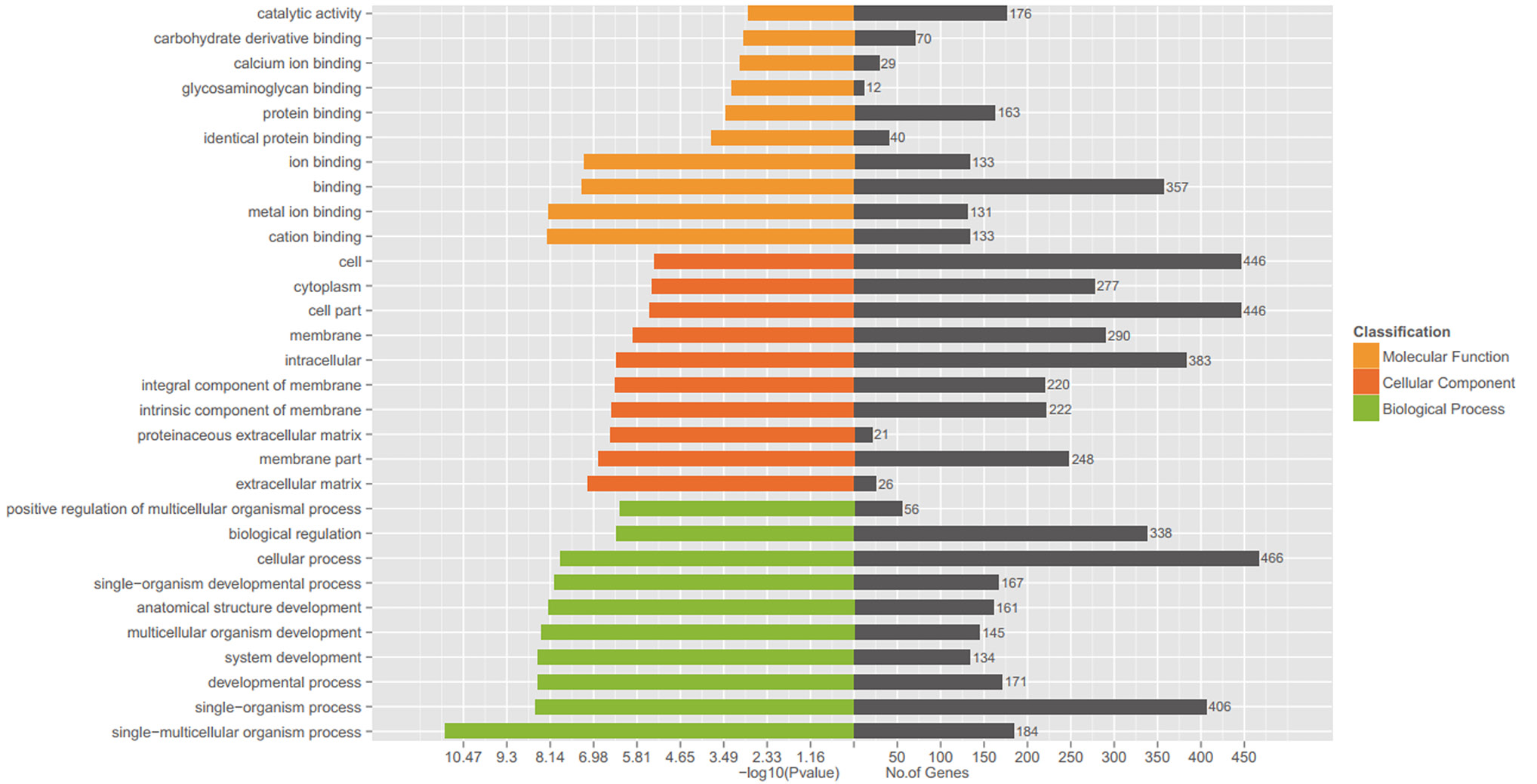
The top 10 most significantly enriched GO terms from differentially expressed genes.
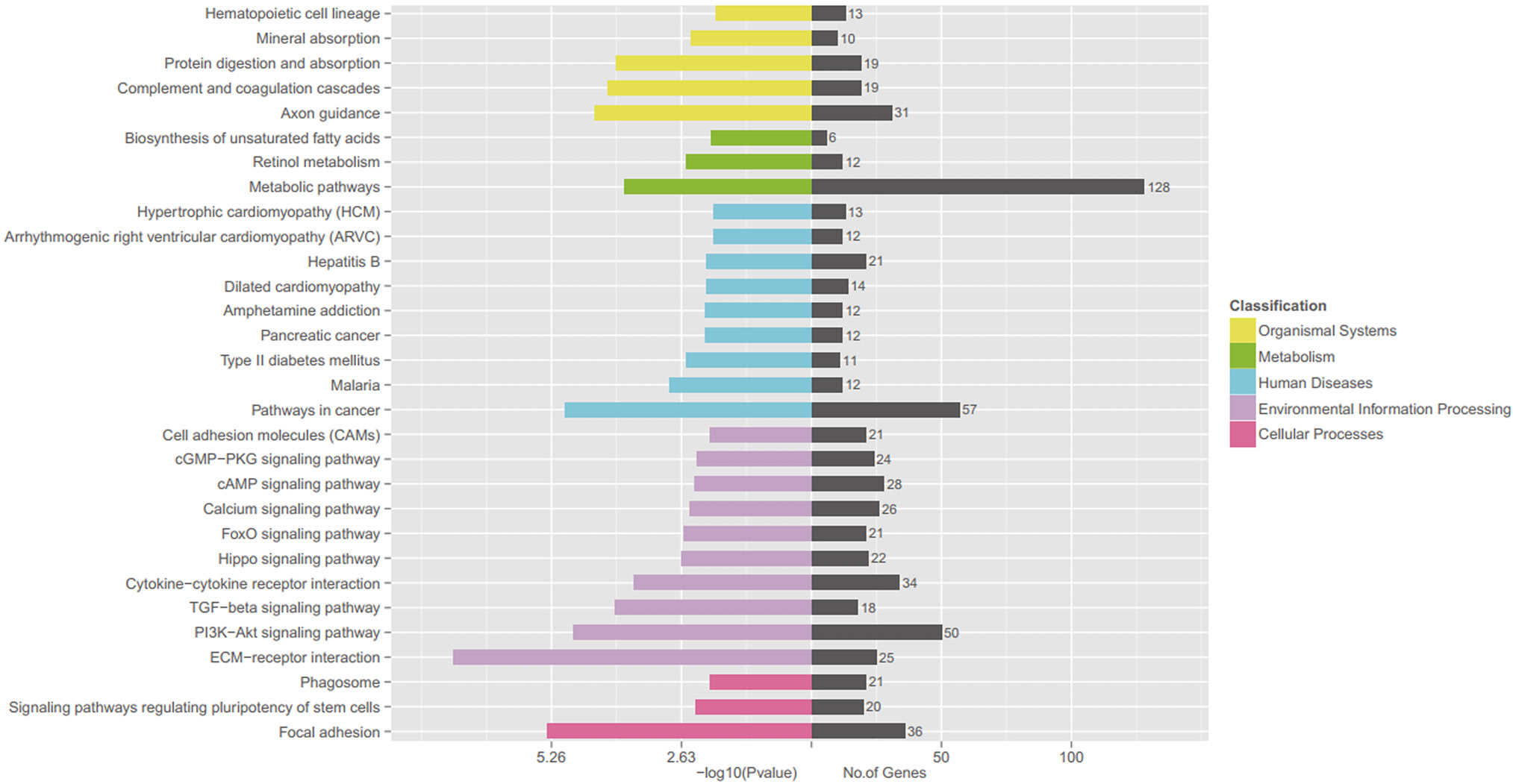
The top 30 significantly KEGG pathways from differentially expressed genes.
References
- Cristancho, A.G. and Lazar, M.A., 2011. Forming functional fat: a growing understanding of adipocyte differentiation. Nat. Rev. Mol. Cell. Biol., 12: 722-734. https://doi.org/10.1038/nrm3198[CrossRef]
- Corominas, J., Ramayo-Caldas, Y., Puig-Oliveras, A., Estellé, J., Castelló, A., Alves, E., Pena, R.N., Ballester, M. and Folch, J.M., 2013. Analysis of porcine adipose tissue transcriptome reveals differences in de novo fatty acid synthesis in pigs with divergent muscle fatty acid composition. BMC Genom., 14: 843. https://doi.org/10.1186/1471-2164-14-843[CrossRef]
- De Pergola G., 2000. The adipose tissue metabolism: role of testosterone and dehydroepiandrosterone. Int. J. Obesity., 24: 59-63. https://doi.org/10.1038/sj.ijo.0801280[CrossRef]
- Dobrzyn, P., Pyrkowska, A., Jazurek, M., Szymanski, K., Langfort, J. and Dobrzyn, A., 2010. Endurance training-induced accumulation of muscle triglycerides is coupled to upregulation of stearoyl-CoA desaturase 1. J. appl. Physiol., 109: 1653-1661. https://doi.org/10.1152/japplphysiol.00598.2010[CrossRef]
- Furman, M., Malovrh, A.L. and Levart Kovač, M., 2010. Fatty acid composition of meat and adipose tissue from Krškopolje pigs and commercial fatteners in Slovenia. Arch. Anim. Breed., 53: 73-84. https://doi.org/10.5194/aab-53-73-2010[CrossRef]
- Georgescu, S.E., Manea, M.A., Dinescu, S. and Costache, M., 2014. Comparative study of leptin and leptin receptor gene expression in different swine breeds. Genet. mol. Res., 13: 7140-7148. https://doi.org/10.4238/2014.February.14.15[CrossRef]
- Ibáñez-Escriche, N., Magallón, E., Gonzalez, E., Tejeda, J.F. and Noguera, J.L., 2016. Genetic parameters and crossbreeding effects of fat deposition and fatty acid profiles in Iberian pig lines. J. Anim. Sci., 94: 28-37. https://doi.org/10.2527/jas.2015-9433[CrossRef]
- Jensen, M.D., Haymond, M.W., Rizza, R.A., Cryer, P.E. and Miles, J.M., 1989. Influence of body fat distribution on free fatty acid metabolism in obesity. J. clin. Invest., 83: 1168-1173. https://doi.org/10.1172/JCI113997[CrossRef]
- Koskinen-Kolasa, A., Vuolteenaho, K., Moilanen, T. and Moilanen, E., 2016. Adipokines leptin, adiponectin and resistin and their associations to MMPS, IL-6, COMP and radiographic severity of OA. Osteoarthr. Cartil., 24: S78. https://doi.org/10.1016/j.joca.2016.01.167[CrossRef]
- Kogelman, L.J., Cirera, S., Zhernakova, D.V., Fredholm, M., Franke, L. and Kadarmideen, H.N., 2014. Identification of co-expression gene networks, regulatory genes and pathways for obesity based on adipose tissue RNA Sequencing in a porcine model. BMC Med. Genom., 7: 57. https://doi.org/10.1186/1755-8794-7-57[CrossRef]
- Kojima, M., Nakajima. I., Arakawa, A., Mikawa, S., Matsumoto, T., Uenishi, H. and Taniguchi, M., 2018. Differences in gene expression profiles for subcutaneous adipose, liver, and skeletal muscle tissues between Meishan and Landrace pigs with different backfat thicknesses. PLoS One, 13: e0204135. https://doi.org/10.1371/journal.pone.0204135[CrossRef]
- Kanehisa, M., Sato, Y., Kawashima, M., Furumichi, M. and Tanabe, M., 2015. KEGG as a reference resource for gene and protein annotation. Nucl. Acids Res., 44: 457-462. https://doi.org/10.1093/nar/gkv1070[CrossRef]
- Liu, Y., Kong, X., Jiang, G.., Tan, B., Deng, J.P., Yang, X.J., Li, F.N., Xiong, X. and Yin, Y.L., 2015. Effects of dietary protein/energy ratio on growth performance, carcass trait, meat quality, and plasma metabolites in pigs of different genotypes. J. Anim. Sci. Biotechn., 6: 36. https://doi.org/10.1186/s40104-015-0036-x[CrossRef]
- Lim, K.S., Le,e K.T., Park, J.E., Chung, W.H., Jang, G.W., Choi, B.H., Hong, K.C. and Kim, T.H., 2017. Identification of differentially expressed genes in longissimus muscle of pigs with high and low intramuscular fat content using RNA sequencing. Anim. Genet., 48: 166-174. https://doi.org/10.1111/age.12518[CrossRef]
- Li, X.J., Zhou, J., Liu, L.Q., Qian, K. and Wang, C.L., 2016. Identification of genes in longissimus dorsi muscle differentially expressed between Wannanhua and Yorkshire pigs using RNA-sequencing. Anim. Genet., 47: 324-333. https://doi.org/10.1111/age.12421[CrossRef]
- Livak, K. and Schmittgen, T.D., 2001. Analysis of relative gene expression data using real-time quantitative PCR and the 2−ΔΔCT method. Methods, 25: 402-408. https://doi.org/10.1006/meth.2001.1262[CrossRef]
- Lunney, J.K., 2007. Advances in swine biomedical model genomics. Int. J. Biol. Sci., 3: 179-184. https://doi.org/10.7150/ijbs.3.179[CrossRef]
- Metzker, M.L., 2010. Sequencing technologies-the next generation. Nat. Rev. Genet., 11: 31-46. https://doi.org/10.1038/nrg2626[CrossRef]
- Roura, E., Koopmans, S.J., Lallès, J.P., Le Huerou-Luron, I., De Jager, N., Schuurman, T. and Val-Laillet, D., 2016. Critical review evaluating the pig as a model for human nutritional physiology. Nutr. Res. Rev., 29: 60-90. https://doi.org/10.1017/S0954422416000020[CrossRef]
- Shen, Y.F., Mao, H.G., Huang, M., Chen, L., Chen, J., Cai, Z., Wang, Y. and Xu, N., 2016. Long noncoding RNA and mRNA expression profiles in the thyroid gland of two phenotypically extreme pig breeds using ribo-zero RNA sequencing. Genes, 7: 34. https://doi.org/10.3390/genes7070034[CrossRef]
- Takashima, S., Nishii, N., Kato, A., Matsubara, T., Shibata, S. and Kitagawa, H., 2016. Molecular cloning of feline resistin and the expression of resistin, leptin, and adiponectin in the adipose tissue of normal and obese cats. J. Vet. med. Sci., 78: 23-28. https://doi.org/10.1292/jvms.15-0233[CrossRef]
- Wang, Z., Li, Q., Chamba, Y., Zhang, B., Shang, P., Zhang, H. and Wu, C., 2015. Identification of genes related to growth and lipid deposition from transcriptome profiles of pig muscle tissue. PLoS One, 10: e0141138. https://doi.org/10.1371/journal.pone.0141138[CrossRef]
- Wang, Z., Gerstein, M. and Snyder, M., 2009. RNA-Seq: a revolutionary tool for transcriptomics. Nat. Rev. Genet., 10: 57-63. https://doi.org/10.1038/nrg2484[CrossRef]
- Wood, J.D., Enser, M., Fisher, A.V., Nute, G.R., Sheard, P.R., Richardson, R.I. Hughes, S.I. and Whittington, F.M., 2008. Fat deposition, fatty acid composition and meat quality: A review. Meat Sci., 78: 343-358. https://doi.org/10.1016/j.meatsci.2007.07.019[CrossRef]
- Xing, K., Zhu, F., Zhai, L.W., Liu, H., Wang, Y., Wang, Z. Chen, S., Hou, Z., and Wang, C., 2015. Integration of transcriptome and whole genomic resequencing data to identify key genes affecting swine fat deposition. PLoS One, 10: e0122396. https://doi.org/10.1371/journal.pone.0122396[CrossRef]
- Yang, L., Bian, G., Su, Y. and Zhu, W., 2014. Comparison of faecal microbial community of lantang, bama, erhualian, meishan, xiaomeishan, duroc, landrace, and yorkshire sows. Asian Austral. J. Anim. Sci., 27: 898-906. https://doi.org/10.5713/ajas.2013.13621[CrossRef]
- Yu, J., Yin, P., Liu, F., Cheng, G., Guo, K., Lu, A., Zhu, X., Luan, W. and Xu, J., 2010. Effect of heat stress on the porcine small intestine: a morphological and gene expression study. Comp. Biochem. Physiol. A., 156: 119-128. https://doi.org/10.1016/j.cbpa.2010.01.008[CrossRef]
- Zhang, X.D., Zhang, S.J., Ding, Y.Y., Feng, Y.F., Zhu, H.Y., Huang, L., Wu, T., Zhou, J. and Yin, Z.J., 2015. Association between ADSL, GARS-AIRS-GART, DGAT1, and DECR1 expression levels and pork meat quality traits. Genet. mol. Res., 14: 14823-14830. https://doi.org/10.4238/2015.November.18.47[CrossRef]
Supplementary material
Services
Article usage statistics
Loading…