Special Issue: Emerging and Re-Emerging Animal Health Challenges in Low and Middle-Income Countries · Volume 13, Issue 1, 30 January 2026 · Open Access
Comparative Analysis of Phylogenetic Trees of Otodectes cynotis Isolated from Cats in Babil Province
·
Affiliations & Notes ⌄
1College of Veterinary Medicine, Al-Qasim Green University, Iraq. *Correspondence | Zahraa Kadhim Al-Khafaji, College of Veterinary Medicine, Al-Qasim Green University, Iraq
In this study, we amplified the Heat Shock Protein (HSP), 28S rRNA, and Cytochrome c oxidase subunit I (COX1) genes from 100 Otodectes cynotis genomic DNA samples.
The closeness of Otodectes cynotis to wild cats in the phylogenetic trees for the ribosomal gene and the heat shock protein (HSP) gene may be attributed to adaptation to the environmental conditions in Iraq.
The difference in the phylogenetic trees between our samples of Otodectes cynotis in pet and stray cats is attributed to the occurrence of mutations in the DNA, as stated in the multiple sequence alignment mentioned in our results.
In conclusion, this study significantly expands the understanding of the genetic structure of O. cynotis in the Middle East and underscores the importance of integrating molecular epidemiology with regional surveillance to develop precise and effective control strategies.
Selected from the article's own text.
Abstract
Otodectes cynotis is a microscopic ectoparasite that inhabits the external auditory canal of cats, causing otitis externa. The parasite is common in both pet and stray cats and pose risk to several animals. To assess the prevalence and genetic diversity, one hundred samples suspected for Otodectes cynotis were taken from stray and pet cats. After microscopic identification, molecular and genetic analysis was performed using three different genes (heat shock protein, HSP, 28S rRNA, and cytochrome C oxidase subunit I, COX1). PCR-based amplification followed by comparative genetic analysis of three genes showed Otodectes cynotis differed significantly depending on the nature of the gene. This suggests that phylogenetic trees represent the gene itself, not the organism. The cytochrome c oxidase subunit I (COX1) gene appeared the best representative of the phylogenetic tree compared to the large subunit ribosomal RNA gene and the heat shock protein gene, respectively. These finding highlight not only the presence of Otodectes cynotis in pets but also guide on the selection of gene for the phylogenetic analysis of Otodectes cynotis.
Keywords | Otodectes cynotis, Phylogenetic analysis, Pet cats, Stray cats
INTRODUCTION
Mites are microscopic ectoparasites belonging to the phylum Arthropoda and class Arachnida. They infest a wide range of hosts, including mammals and birds, by feeding on skin or bodily fluids, often causing irritation and severe pathological conditions . Among these, Otodectes cynotis is one of the most common mite species inhabiting the external auditory canal of cats and dogs, and it is a leading cause of otitis externa worldwide in felines .
Otodectes cynotis is primarily transmitted through direct contact between pet and stray cats. Its relatively short life cycle of approximately three weeks facilitates rapid spread in densely populated environments . Clinical manifestations include intense pruritus, dark brown to black ear discharge, foul odor, and secondary bacterial infections . Early diagnosis combined with accurate genetic identification is essential for effective control and prevention strategies.
Phylogenetic analyses enable tracing parasite distribution patterns, elucidating connections between local and global isolates, and investigating environmental or host-related factors driving genetic diversity . This molecular approach plays a critical role in supporting surveillance, diagnostics, and control programs, especially in regions where molecular data remain scarce .
Materials and Methods
Animal sample collection and preparation for molecular analysis
A total of 100 samples of Otodectes cynotis ear mites were collected from 100 cats in Babylon province, with 50 from stray cats and 50 from pet cats, during the period from October 2024 to March 2025. Samples were taken from animals, immediately preserved in 70% ethanol to ensure integrity, and carefully transferred to the Veterinary Medicine Laboratory for DNA extraction. After extraction, PCR was done . PCR technology was performed for three different genes, and then gel electrophoresis was done. PCR products of positive samples (10 samples from each gene) were sent to Macrogen (Korea) by DHL service for DNA sequencing by Sangar sequencing service. After receiving the sequences, the generated sequences were trimmed from noisy signals and submitted to NCBI for accession numbers.
Primers
Three primers were used in this study targeting the ribosomal gene, COX1 gene, and heat shock protein encoded gene (Table 1).
Phylogenetic tree
Phylogenetic analysis of the obtained sequences with their corresponding accession numbers were compared with other global isolates. The phylogram was constructed by Molecular Evolutionary Genetics Analysis version 10 (Mega x) software and the alignments were carried out by Clustal W meanwhile the analyzed sequences were compared using NCBI blast n server.
Results
Conventional PCR
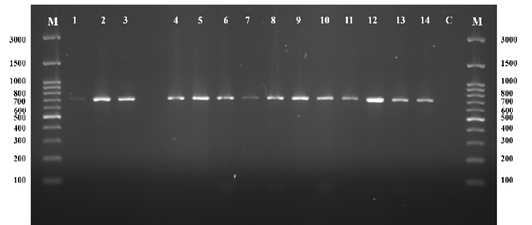
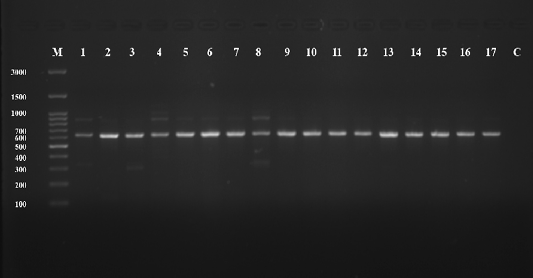
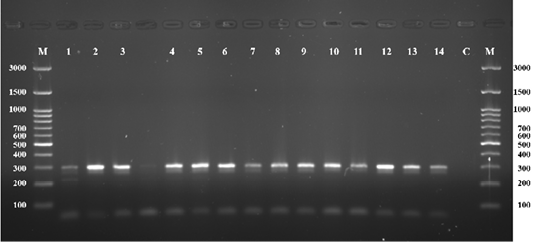
Conventional PCR was performed to amplify three target genes: The heat shock protein (HSP) gene, the ribosomal RNA gene, and the cytochrome c oxidase subunit 1 (COX1) gene. The amplification results showed product sizes of approximately 722 base pairs for the HSP gene, 632 base pairs for the ribosomal gene, and 303 base pairs for the COX1 gene, as illustrated in Figures 1, 2 and 3.
Table 1: Primers used to amplify heat shock protein, ribosomal gene, and mitochondrial gene.
Primer name
Sequence (5’-3’)
Target gene
Size
Reference
Forward
GGTGAAAGATTAGTTGGCA
Partial HSP gene
722 bp
Hu et al., (2019
Reverse
GCAGCATCCATAGTCAAATA
Forward
CCTCAGATCAAGCGAGATTACC
Partial 28S rRNA
632 bp
This study
Reverse
CAAAGATCTGACGGGCACCT
Forward
TGAAGAGGAATGTTGGGGACT
COI
303 bp
This study
Reverse
ACCAGTACCAACACCTGAACC
Phylogenetic tree
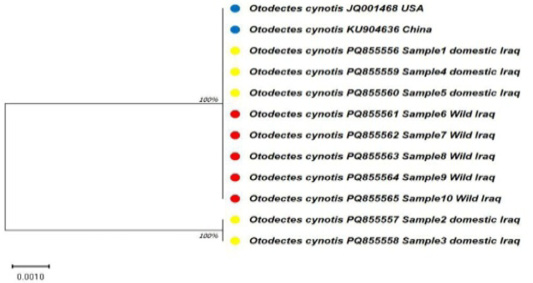
Phylogenetic tree of heat shock protein gene, a level of similarity was observed among the isolates with accession number PQ855556 to PQ855565, showing clear genetic relatedness to the USA and China isolates. All wild samples clustered closely whereas the domestic formed another and distinct cluster PQ855557 and PQ855558 shown in Figure 4.
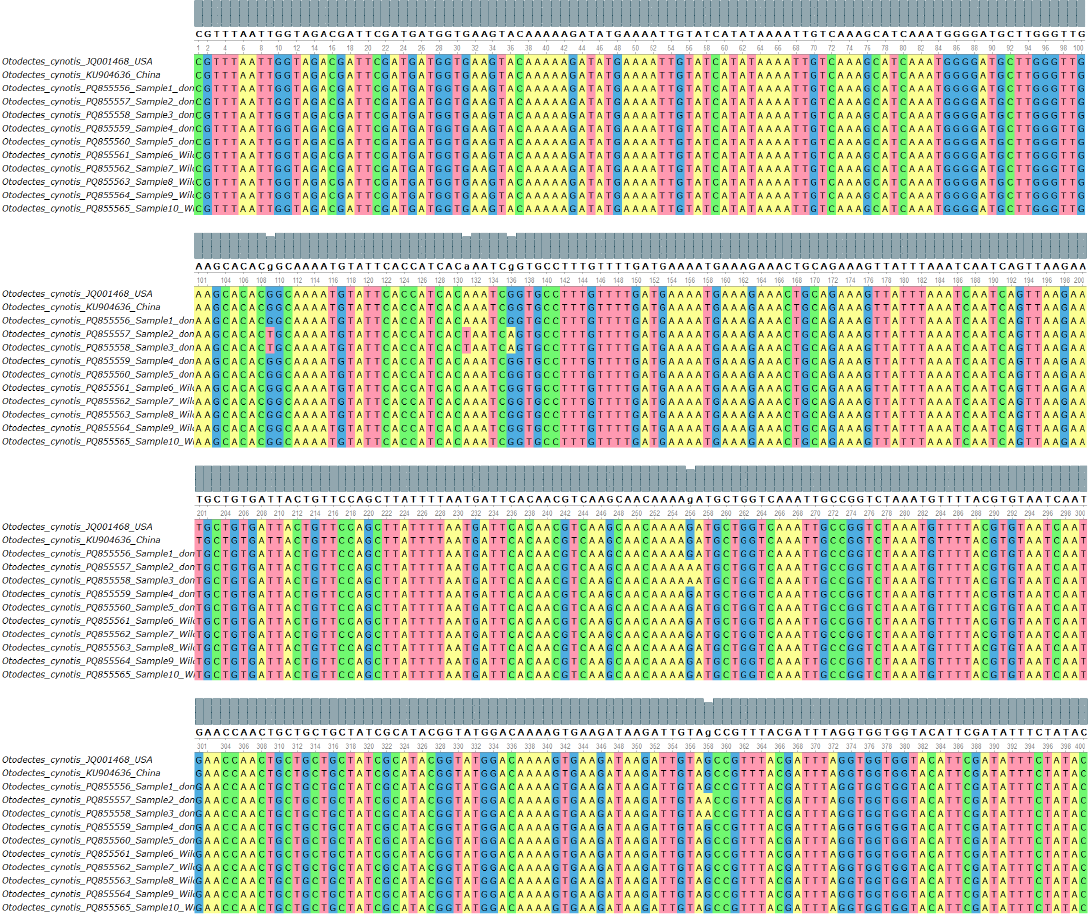
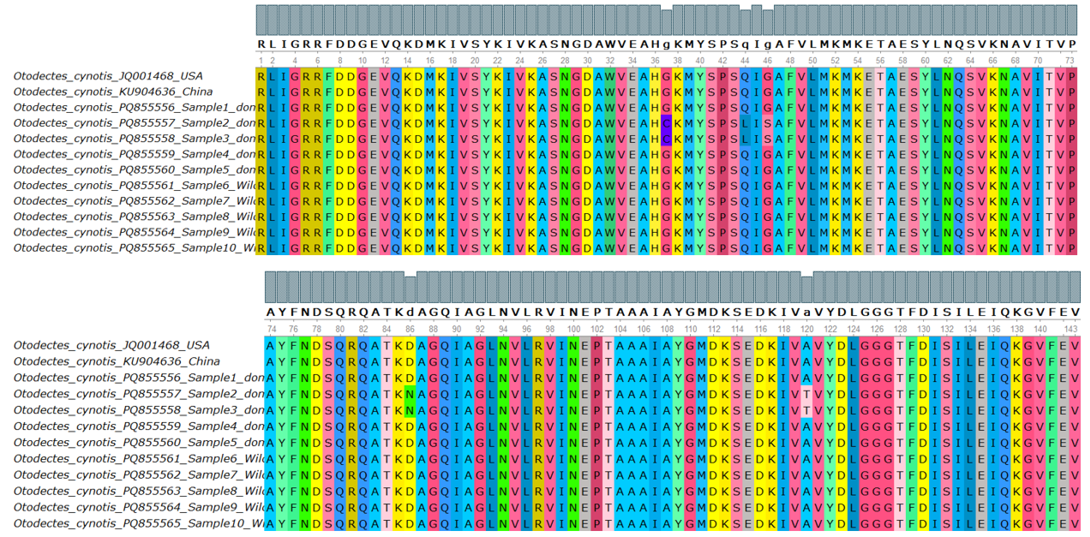
This divergence in the phylogenetic tree can be attributed to mutations, as shown in multiple sequence alignment) Figure 4). Multiple sequence alignment results of the identified Otodectes cynotis targeting the partial HSP gene showed that there are differences in some bases between some local isolates and global isolates, as shown in the Figures 5 and 6.
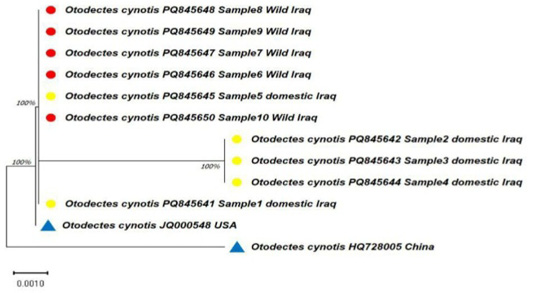
Phylogenetic tree of the ribosomal gene, a low level of similarity was observed among the isolates with accession number PQ845641-PQ845650. The tree showed that there was a high convergence (homogeneity) between isolates PQ845645 to PQ845650, while isolates PQ845642 to PQ845644 had less divergence (less homogeneity) with the previous isolates, and there was a high divergence (less homogeneity) for isolate PQ845641 in comparison with the rest of the isolates mentioned previously. The phylogenetic tree there showed similarity with the USA isolation JQ000548 and the China isolation HQ728005., as shown in Figure 7.
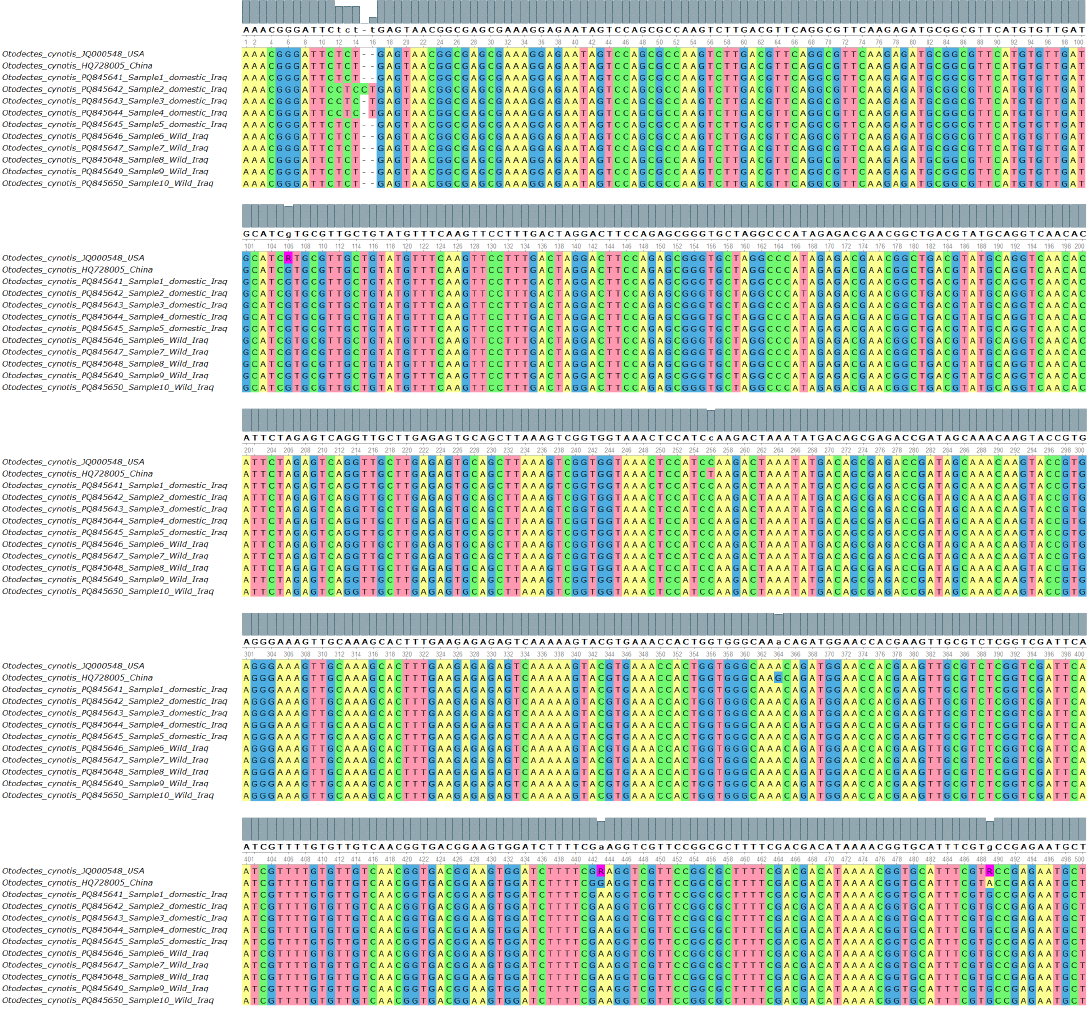
All stray cat samples clustered closely whereas the pet cats formed another and distinct cluster PQ845641 and PQ845644 in the same tree. Multiple sequence alignment results of the identified Otodectes cynotis targeting the partial the ribosomal gene showed that there are differences in some bases between some local isolates and global isolates, as shown in the Figure 8.
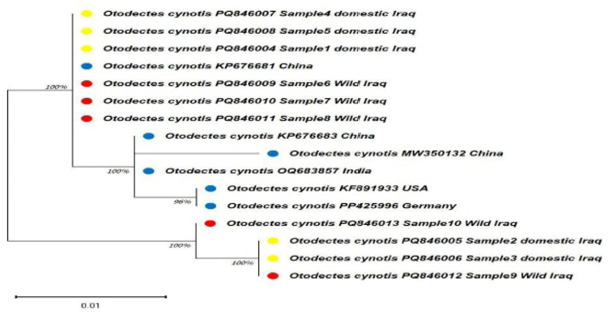
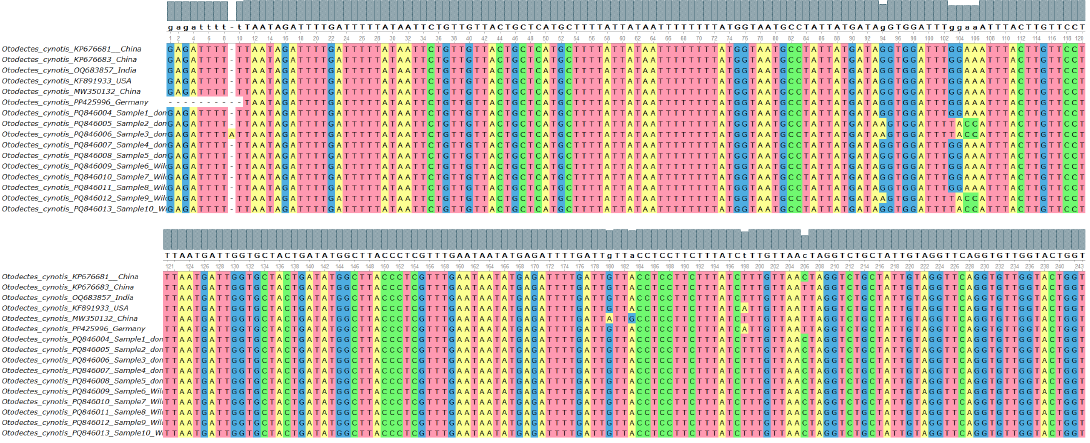
Phylogenetic tree of the cytochrome c oxidase subunit I (COX1) gene showed a low level of among the isolates with accession number PQ846004- PQ846013. The phylogenetic tree of the COX1 gene was the least homogeneous of the previous trees, as isolates PQ846007, PQ846008, PQ846004, KP678681, PQ846009, PQ846010, and PQ846011 were highly homogeneous and closely related to the Chinese isolate KP676683, the phylogenetic tree there showed relation with the USA isolate KF891933, the Germany isolate PP425996, hgu, and the India isolate OQ683857. On the other hands, isolates PQ846005, PQ846006, and PQ846012 and PQ846013 were the least homogeneous with the previous isolates. Isolate PQ846013 is the least homogeneous with isolates PQ846005, PQ846006, and PQ846012 shown in Figure 9. Multiple sequence alignment results of the identified Otodectes cynotis targeting the partial the COXI gene showed that there were differences in some bases between some local isolates and global isolates, as shown in the Figure 10.
Discussion
The phylogenetic tree helps to know how close or distant species are from each other on the genetic level, understanding evolutionary relationships and supports a more perfect classification of organisms based on evolutionary history, not just physical similarities. In this study, we amplified the Heat Shock Protein (HSP), 28S rRNA, and Cytochrome c oxidase subunit I (COX1) genes from 100 Otodectes cynotis genomic DNA samples. The NCBI-BLASTn analysis confirmed the generated sequences to be Otodectes cynotis.
This designed to conduct evolutionary and population genetic analyses of Otodectes cynotis using three genetic markers previously mentioned. These genes were chosen for their high evolutionary and mutation rates, matrilineal inheritance, and lack of recombination.
The heat shock proteins gene (HSPs) are ubiquitous and conserved protein families in both prokaryotic and eukaryotic organisms, and they maintain cellular proteostasis and protect cells from stresses . The parasite needs to control the survival of its host cells which affects its chances of development and propagation. Central to this system are heat shock proteins gene (Hsps), among which small Hsps (sHsps) play pivotal roles in maintaining proteostasis (protein homeostasis) .
The 28S ribosomal RNA gene consists of many highly conserved cores, interrupted by divergent domains that evolve rapidly with substitution rates, which are at least two orders of magnitude higher than those of core regions that create a possibility for variations in these fast-evolving divergent domains. These evolving domains are efficient to analyze the phylogenetic linkages between closely related species ; . The 28S rRNA gene have 12 divergent domains .
The DNA barcoding system using the cytochrome c oxidase subunit 1 mitochondrial gene (cox1 or COI) is highly efficient for discriminating vertebrate and invertebrate species . Cox1 appears to have a better phylogenetic signal than the other mitochondrial genes .
The COX-1 gene has conserved region and variable region, and differences are possible in the variable region. However, this mutation is most likely silent ; .
The closeness of Otodectes cynotis to wild cats in the phylogenetic trees for the ribosomal gene and the heat shock protein (HSP) gene may be attributed to adaptation to the environmental conditions in Iraq.
The difference in the phylogenetic trees between our samples of Otodectes cynotis in pet and stray cats is attributed to the occurrence of mutations in the DNA, as stated in the multiple sequence alignment mentioned in our results.
In end, three genetic markers evaluated have distinct properties, allowing us to gain a comprehensive view of the genetic relationships between and within mite’s species. Therefore, it is recommended that the unique characteristics of each gene be considered in future genetic studies.
CONCLUSION
In conclusion, this study significantly expands the understanding of the genetic structure of O. cynotis in the Middle East and underscores the importance of integrating molecular epidemiology with regional surveillance to develop precise and effective control strategies.
Acknowledgements
We acknowledge the support of time and facilities from Al-Qasim Green University for this study.
Novelty Statement
The current study introduces a new idea in terms of comparing phylogenetic tree of the same species using different genes. The current results indicate that the phylogenetic tree differs depending on the gene used.
Author’s Contribution
Al-Musawi planned the research idea and reviewed the research for errors, while Al-Khafaji collected samples and performed molecular diagnosis.
Generative AI and AI-assisted technology statement
AI didn’t used in this research paper.
Conflict of interest
The authors have declared no conflict of interest.
Figures
Figure 1:.
Agarose gel electrophoresis image (1.5 %) shows the amplicons of heat shock protein (HSP) gene (size = 722 bp) of Otodectes cynotis in domestic cat (1-14). C is control negative in which H2O was used instead of DNA. M is molecular marker (100-3000 bp) from GeneDirex (South Korea).
Figure 2:.
Agarose gel electrophoresis image (1.5 %) shows the amplicons of the partial 28S rRNA gene (size= 632 bp) of Otodectes cynotis in wild cat. C is control negative in which H2O was added instead of DNA. M is molecular marker (100-3000 bp) from GeneDirex (South Korea).
Figure 3:.
Agarose gel electrophoresis image (1.5 %) shows the amplicons of the partial COXI gene (size= 303 bp) of Otodectes cynotis in domestic cat. M is molecular marker (100-3000 bp) from GeneDirex (South Korea).
Figure 4:.
Evolutionary analysis by Maximum Likelihood method of Otodectes cynotis targeting partial HSP gene. The tree is drawn to scale, with branch lengths measured in the number of substitutions per site. This analysis involved 12 nucleotide sequences. There were total of 429 positions in the final dataset. Evolutionary analyses were conducted in MEGA11.
Figure 5:.
Multiple sequence alignment of the identified Otodectes cynotis targeting the partial HSP gene. This highlights the similarity and differences between the identified sequences with four colours. This was analysed by Mega X.
Figure 6:.
Multiple sequence alignment of the identified Otodectes cynotis targeting the partial HSP amino acid encoded gene. This highlights the similarity and differences between the identified sequences with four colours. This was analysed by Mega X.
Figure 7:.
Evolutionary analysis of Otodectes cynotis targeting the ribosomal gene by Maximum Likelihood method. The tree is drawn to scale, with branch lengths measured in the number of substitutions per site. This analysis involved 12 nucleotide sequences. There were total of 552 positions in the final dataset. Evolutionary analyses were conducted in MEGA11.
Figure 8:.
Multiple sequence alignment of the identified Otodectes cynotis targeting the ribosomal gene. This highlights the similarity and differences between the identified sequences with four colours. This was analysed by Mega X.
Figure 9:.
Evolutionary analysis of Otodectes cynotis targeting the COXI gene by Maximum Likelihood method. The tree is drawn to scale, with branch lengths measured in the number of substitutions per site. This analysis involved 16 nucleotide sequences. There were total of 243 positions in the final dataset. Evolutionary analyses were conducted in MEGA11.
Figure 10:.
Multiple sequence alignment of the identified Otodectes cynotis targeting the COXI gene. This highlights the similarity and differences between the identified sequences with four colours. This was analysed using Mega X.
References
Al-Musawi AM, Awad AH, Alkhaled MJ (2022). Molecular analysis of Cryptosporidium species in domestic goat in central Iraq. Iraqi J Vet Sci., 36(4):1041-1045. https://doi.org/10.33899/ijvs.2022.132974.2155[CrossRef]
Awasthi M, Kashyap A, Serajuddin M (2016). Molecular phylogeny of four gouramis based on divergent domain D11 of 28S rRNA gene. Adv. Biol. Res., 10(6): 351–354.
Bowman DD (2020). Georgis’ Parasitology for Veterinarians (11th ed.). Elsevier.
Hu C, Yang J, Qi Z, Wu H, Wang B, Zou F, Mei H, Liu J, Wang, W, Liu Q (2022). Heat shock proteins: Biological functions, pathological roles, and therapeutic opportunities. Med. Comm., 3(3): e161. https://doi.org/10.1002/prot.26244[CrossRef]
Huelsenbeck JP, Ronquist F (2001). MRBAYES: Bayesian inference of phylogenetic trees. Bioinformatics, 17(8): 754–755. https://doi.org/10.1093/bioinformatics/17.8.754[CrossRef]
Kwochka KW (1990). Otitis externa: A disease of multifactorial etiology. Vet. Clin. North Am. Small Anim. Pract., 18(4): 731-742. https://doi.org/10.1016/S0195-5616(88)50076-1[CrossRef]
Makouloutou P, Suzuki K, Yokoyama M, Takeuchi M, Yanagida T, Sato H (2015). Involvement of two genetic lineages of Sarcoptes scabiei mites in a local mange epizootic of wild animals in Japan. J. Wildl. Dis., 51(1): 69–78. https://doi.org/10.7589/2014-04-094[CrossRef]
Olsen GJ, Woese CR (1993). Ribosomal RNA: A key to phylogeny. FASEB J., 7(1): 113–123. https://doi.org/10.1096/fasebj.7.1.8422957[CrossRef]
Penha BR, Oliveira MS, Lopes KAR, Morais FV, Campos Velho NMR (2022). 28S rRNA molecule post processing occurs in two species of planarians (Girardia tigrina and Girardia sp.) possibly due to a gap deletion. Rev. Biol., 22(1): 7-13. https://doi.org/10.11606/issn.1984-5154.v22p7-13[CrossRef]
Pentinsaari M, Salmela H, Mutanen M, Roslin T (2016). Molecular evolution of a widely-adopted taxonomic marker (COI) across the animal tree of life. Sci Rep., 6: 35275. https://doi.org/10.1038/srep35275[CrossRef]
Rodrigues MS, Morelli KA, Jansen AM (2017). Cytochrome c oxidase subunit 1 gene as a DNA barcode for discriminating Trypanosoma cruzi DTUs and closely related species. Parasit Vectors, 10(1): 488. https://doi.org/10.1186/s13071-017-2457-1[CrossRef]
Scott DW, Miller WH, Griffin CE (2001). Muller and Kirk’s Small Animal Dermatology (6th ed.). W.B. Saunders. https://www.amazon.com/Muller-Kirks-Small-Animal-Dermatology/dp/0721676189
Strüder-Kypke MC, Lynn DH (2010). Comparative analysis of the mitochondrial cytochrome c oxidase subunit I (COI) gene in ciliates (Alveolata, Ciliophora) and evaluation of its suitability as a biodiversity marker. Syst. Biodivers., 8(1): 131–148. https://doi.org/10.1080/14772000903507744[CrossRef]
Timothy FM, Zininga T (2023). Small heat shock proteins as modulators of cell death in Plasmodium falciparum parasites and its human host. Front. Cell Death, 2: 1-20. https://doi.org/10.3389/fceld.2023.1322780[CrossRef]
Wall R, Shearer D (2001). Veterinary ectoparasites: Biology, pathology and control (2nd ed.). Blackwell Science. https://doi.org/10.1002/9780470690505[CrossRef]