Research Article · Volume 14, Issue 11, 22 October 2026 · Open Access
Combined Effects of Soft Litter Flooring and Dietary Rambutan Peel Polyphenol Extract on Foot Health, Oxidative Stress, and Semen Quality in Dong Tao Roosters
· · · ·
Affiliations & Notes ⌄
1Faculty of Applied Biology, Tay Do University, 68 Tran Chien Street, Thanh My Area, Cai Rang Ward, Can Tho 900000, Vietnam. *Correspondence | Phan Nhan, Faculty of Applied Biology, Tay Do University, 68 Tran Chien Street, Thanh My Area, Cai Rang Ward, Can Tho 900000, Vietnam
Soft litter flooring and dietary supplementation with 0.5% rambutan peel polyphenol extract provided complementary benefits to mature Dong Tao roosters.
Soft litter improved the physical litter environment and foot health, whereas extract supplementation was associated with a more favorable oxidative profile and semen quality.
No statistically significant litter × extract interactions were detected; however, these findings did not establish statistical additivity or exclude smaller interaction effects.
Nevertheless, the results support further evaluation of litter management combined with dietary polyphenol supplementation as a strategy for improving foot health, oxidative balance, and semen quality in Dong Tao roosters.
Selected from the article's own text.
Abstract
Foot health, oxidative stress, and semen quality are closely connected in breeding roosters, especially in heavy-legged indigenous breeds such as Dong Tao chickens. However, integrated strategies combining welfare-oriented flooring and dietary antioxidant support remain poorly explored. This study evaluated the combined effects of soft litter flooring and dietary rambutan peel polyphenol extract supplementation on litter condition, foot health, oxidative stress, and semen quality in mature Dong Tao roosters. A total of 48 roosters aged 32–40 weeks were evaluated during a 56-day experiment using a 2 × 2 factorial design. Soft litter flooring reduced mean litter moisture from 34.2% to 25.8%, litter compaction score from 2.22 to 1.30, footpad dermatitis score from 1.95 to 1.10, and gait score from 1.28 to 0.63. The main effect of litter type was significant for litter moisture, litter compaction, and footpad dermatitis score (P < 0.001) and for gait score (P = 0.002). Dietary supplementation with 0.5% rambutan peel polyphenol extract reduced the mean heterophil-to-lymphocyte ratio from 0.67 to 0.55 and malondialdehyde concentration from 5.32 to 4.08 nmol/mL. Superoxide dismutase activity increased from 77.2 to 93.6 U/mL, while total antioxidant capacity increased from 0.89 to 1.18 mmol Trolox/L (extract effects, all P < 0.001). Roosters receiving both interventions (T4) showed the most favorable semen profile, with a sperm concentration of 3.92 ± 0.41 × 10â¹ spermatozoa/mL, motility of 86.1 ± 4.3%, live sperm of 89.4 ± 3.6%, abnormal sperm of 9.6 ± 1.9%, and hypo-osmotic swelling test (HOST)-positive sperm of 85.0 ± 4.0%. No litter × extract interaction was statistically significant (P > 0.05); however, this finding did not establish additivity or exclude smaller interaction effects. Malondialdehyde concentration was negatively associated with sperm motility (r = −0.69, P < 0.001). Soft litter flooring and dietary supplementation with 0.5% rambutan peel polyphenol extract improved foot health, oxidative status, and semen quality in mature Dong Tao roosters, although statistical additivity between the interventions was not established. Fertility and hatchability were not evaluated; therefore, the reproductive interpretation of these findings is limited to the measured semen-quality outcomes.
Reproductive efficiency in breeding roosters depends on more than genetic potential and semen collection management. The physical environment can influence foot health, physiological stress, and reproduction. This is especially relevant in breeding males maintained for prolonged production periods. In broiler breeders, footpad dermatitis and gait have been monitored from rearing to approximately 60 weeks of age, including in roosters, showing that leg health remains relevant throughout reproductive life . Comparable production-duration data are not available specifically for Dong Tao roosters. Dong Tao chickens present an especially interesting model because mature males are characterized by conspicuously enlarged legs and are commonly maintained on litter flooring. Previous studies have established baseline semen characteristics in this indigenous breed and demonstrated that both short-term storage and semen collection management can alter semen quality ; . Accordingly, evidence from commercial and other indigenous chicken populations is used here as mechanistic background rather than assumed to be quantitatively transferable to Dong Tao roosters. The role of the floor environment in their reproductive condition, however, remains poorly defined. This raises the specific question of whether modifying litter flooring, alone or together with dietary antioxidant support, can improve foot health, oxidative status, and semen quality in Dong Tao roosters.
Litter is the continuous contact surface between the rooster and the housing environment. Its capacity to absorb moisture, remain friable, and cushion mechanical loading is therefore relevant to both foot health and locomotion. Different bedding materials can modify pododermatitis and gait-related outcomes in broiler chickens, although responses also depend on age and the physical condition of the litter . In mature roosters, repeated exposure to wet, compacted, or poorly cushioning litter may increase plantar challenge. Footpad injury may affect locomotion, resting behavior, access to feed and water, and responsiveness during routine handling; these downstream effects were not measured in the present study and are therefore considered potential consequences rather than demonstrated outcomes. Evidence from broiler chickens nevertheless links poor litter condition and footpad damage with broader welfare impairment . Prolonged reproductive housing may further increase cumulative floor exposure, although breed-specific evidence for Dong Tao roosters is limited.
Housing may also influence male reproduction through physiological and oxidative stress. The heterophil-to-lymphocyte ratio is widely used as an indicator of sustained stress in chickens, although it should be interpreted together with other physiological measurements rather than as an isolated diagnostic marker. Long-term multiple stress increased the H/L ratio in laying hens, with responses varying according to challenge type, duration, and intensity . Oxidative balance is particularly important for rooster semen because sperm function depends on intact plasma membranes and efficient mitochondrial energy production. In an indigenous chicken breed, advancing reproductive age was accompanied by increased reactive oxygen species, lipid and protein oxidation, and mitochondrial dysfunction together with reduced sperm motility and membrane integrity . Reducing chronic physical challenge while strengthening antioxidant protection may therefore provide complementary physiological routes for supporting reproductive condition.
Rambutan peel was selected as the polyphenol source because it is an agricultural by-product with a well-characterized ellagitannin-rich profile, rather than because it is presumed superior to all other antioxidant sources. Chemical characterization of Nephelium lappaceum peel has identified geraniin and corilagin together with their related metabolites, including gallic acid and ellagic acid, and ellagitannin-rich fractions have shown substantial antioxidant activity . More recent profiling identified ellagitannin derivatives, geraniin isomers, and ellagic acid together with measurable inhibition of lipid oxidation . Extraction studies have identified geraniin, corilagin, rutin, ellagic acid, and quercetin ; purification can enrich geraniin and ellagic acid and strengthen antioxidant activity ; and optimized green extraction has confirmed geraniin, corilagin, ellagic acid, and gallic acid as major antioxidant-related constituents . These characteristics provide a specific chemical and by-product-valorization rationale for evaluating rambutan peel as a dietary polyphenol source.
During simulated gastrointestinal digestion and colonic fermentation, rambutan peel polyphenols undergo substantial transformation, including conversion of geraniin into corilagin, ellagic acid, and gallic acid; in vitro transport models further suggest that ellagitannin transformation may facilitate intestinal transport . However, these findings do not establish which metabolites reach systemic circulation or reproductive tissues in chickens, and plasma or tissue polyphenol metabolites were not measured in the present study. Rambutan peel phenolics have additionally demonstrated metal-chelating, DNA-protective, and anti-inflammatory activities in experimental systems, although these effects should not be interpreted as direct evidence of reproductive efficacy in chickens . The antioxidant–semen rationale is therefore supported indirectly by rooster studies. Dietary lycopene improved antioxidant status, semen quality, testicular condition, and mitochondrial function in aging breeder roosters , while gallic acid, one of the phenolic compounds associated with rambutan peel, increased sperm concentration, viability, membrane integrity, and motility and reduced sperm defects in aged roosters . Direct evidence that rambutan peel polyphenols reach systemic circulation or reproductive tissues in chickens remains unavailable, making experimental evaluation of their functional effects necessary rather than assuming efficacy from their chemical composition alone.
The studies cited above have generally examined floor-related welfare or antioxidant nutrition as separate experimental questions. Likewise, research on Dong Tao semen has concentrated mainly on semen characteristics, collection schedules, and preservation rather than on the possible connection between floor-related welfare, systemic oxidative status, and reproductive function. A factorial design can distinguish whether soft flooring primarily modifies the physical source of stress, whether dietary polyphenol supplementation modifies physiological resistance to oxidative challenge, and whether the two factors interact in their effects on sperm function. The present study evaluated the individual and combined effects of soft litter flooring and dietary rambutan peel polyphenol extract supplementation on litter condition, foot health, physiological and oxidative stress indicators, and semen quality in mature Dong Tao roosters. The association between malondialdehyde concentration and sperm motility was further examined to determine whether variation in lipid peroxidation was related to functional semen quality.
MATERIALS AND METHODS
Study animals
The study was conducted in Truong Khanh Commune, Can Tho City, Vietnam, over a 56-day period from August to October 2025. A total of 48 mature Dong Tao roosters aged 32–40 weeks, with an average age of approximately 36 weeks, were selected for the experiment. The roosters were clinically healthy, similar in body weight and reproductive status, and showed no visible signs of lameness, severe footpad lesions, external injury, or reproductive abnormalities before allocation. A veterinarian performed the pre-allocation clinical screening, including assessment of general health, locomotion, footpad condition, visible external injuries, and obvious reproductive abnormalities.
Before the experimental period, all roosters were allowed to adapt to the housing conditions, semen collection procedure, and basal diet. The adaptation period lasted 14 days, during which the roosters were acclimated to the housing environment, basal diet, routine handling, and manual semen collection procedure. Poor health status, failure to respond to semen collection, abnormal locomotion, and poor semen output were predefined exclusion criteria. All 48 roosters completed the adaptation period successfully, and none met these criteria or was excluded from the experiment.
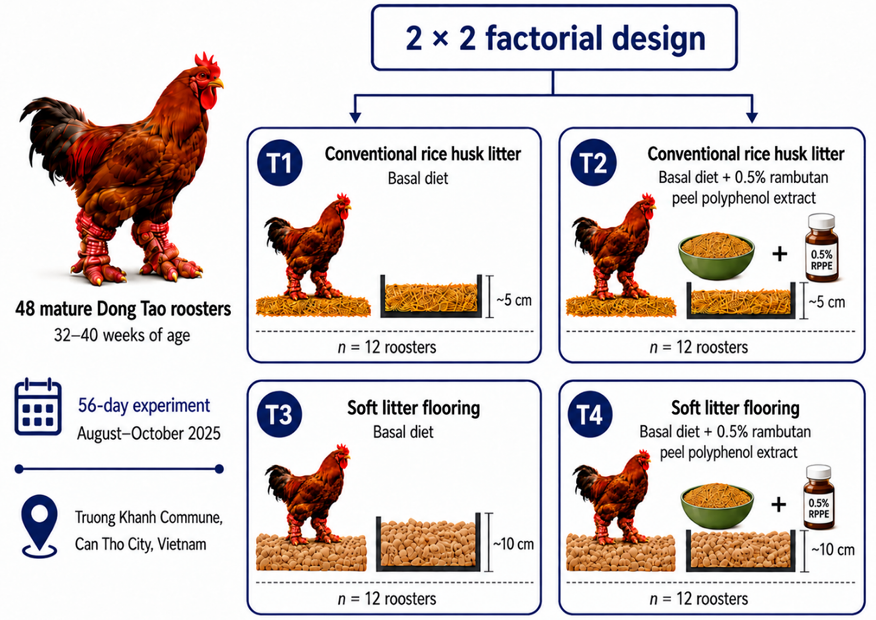
After adaptation, the 48 eligible roosters were allocated according to a 2 × 2 factorial design comprising two litter-flooring conditions and two dietary rambutan peel polyphenol extract supplementation levels. To reduce imbalance among treatments, roosters were stratified according to age and body weight before random allocation to the four experimental treatments. This restricted randomization distributed the 32–40-week age range and body-weight variation across treatments. Age was therefore not included as a separate covariate in the final statistical analysis. Each treatment consisted of 12 roosters, distributed among four replicate pens with three roosters per pen. All roosters were managed under the same feeding, watering, lighting, and general husbandry conditions throughout the experiment.
Feed and feeding
All Dong Tao roosters received the same basal diet prepared from locally available conventional feed ingredients, including maize, broken rice, rice bran, and fish meal. The diet was formulated to target approximately 16% crude protein and 3,000 kcal/kg metabolizable energy, with calcium at approximately 0.9–1.2% and available phosphorus at not less than 0.7%. These values represented formulation targets rather than chemically analyzed nutrient concentrations. The original batch-level ingredient proportions were not retained; therefore, a complete ingredient-composition table could not be reconstructed retrospectively.
The supplemented groups received rambutan peel polyphenol extract at 0.5% (w/w), equivalent to 5 g/kg feed. The extract was mixed into the basal diet before feeding. Concentrations of geraniin, corilagin, ellagic acid, and gallic acid in the experimental extract or final diet were not quantified. Feed was offered twice daily, in the morning and afternoon, and clean drinking water was available ad libitum. Feed intake was not quantitatively measured; feed residues were monitored routinely to detect marked refusal and maintain feed freshness.
Preparation of rambutan peel polyphenol extract
Fresh rambutan peels were collected from ripe fruits, manually separated from the edible pulp, and washed thoroughly with clean water to remove adhering pulp residues, dust, and foreign materials. The cleaned peels were sliced into small pieces and dried in a forced-air oven at 50–55°C for approximately 36 h, or until constant weight was reached. The dried peels were then ground into powder and passed through a fine sieve to obtain a uniform raw material for extraction.
Rambutan peel powder was extracted using 70% ethanol (v/v) at a ratio of 1:10 (w/v). The mixture was maintained under continuous agitation for 24 h at 25 ± 2°C and protected from direct light. It was then filtered through clean filter paper, and the extraction procedure was repeated once under the same conditions. The combined filtrates were concentrated under reduced pressure at approximately 45°C using a rotary evaporator to remove ethanol. The resulting concentrate was subsequently dried to obtain the extract powder. The dried extract was stored in sealed containers in a cool, dry place until incorporation into the experimental diets.
The extract was not standardized for total polyphenol content or individual compounds, including geraniin, corilagin, ellagic acid, and gallic acid. Extraction yield was not recorded, and specific microbial-contamination and heavy-metal analyses were not performed before dietary incorporation; therefore, the actual dietary exposure to individual phenolic compounds could not be quantified. The dietary inclusion rate of 0.5% (5 g/kg feed) referred to the amount of dried extract preparation added to the basal diet rather than a chemically standardized dose of polyphenols. Because individual feed intake was not quantified, the daily intake of the extract preparation by each rooster could not be determined.
Experimental design
The experiment was arranged as a 2 × 2 factorial design with litter-flooring condition and dietary rambutan peel polyphenol extract supplementation as the two experimental factors. The main effects of litter type and extract supplementation, together with their interaction, were evaluated for foot health, physiological and oxidative stress indicators, and semen quality in Dong Tao roosters. Litter type consisted of conventional rice husk litter and soft litter flooring, while dietary supplementation consisted of the basal diet without extract and the basal diet supplemented with 0.5% rambutan peel polyphenol extract.
The 48 mature Dong Tao roosters were assigned to four treatments, with 12 roosters per treatment. Each treatment comprised four replicate pens containing three group-housed roosters per pen. Thus, litter and dietary treatments were applied at the pen level, whereas measurements taken from individual roosters represented within-pen observations. Pen clustering was accounted for in the statistical analysis, as described in the Statistical Analysis section. The four treatments were as follows: T1, conventional rice husk litter with the basal diet; T2, conventional rice husk litter with the basal diet supplemented with 0.5% rambutan peel polyphenol extract; T3, soft litter flooring with the basal diet; and T4, soft litter flooring with the basal diet supplemented with 0.5% rambutan peel polyphenol extract. The experimental arrangement is illustrated in Figure 1.
The conventional litter treatment consisted of rice husk litter maintained at approximately 5 cm depth, whereas the soft litter treatment consisted of rice husk maintained at approximately 10 cm depth. The 10-cm depth was selected a priori as a practical management contrast to the conventional 5-cm layer, providing a deeper, more cushioning, and more friable contact surface rather than representing a previously validated threshold specific to Dong Tao roosters. Litter was inspected daily, and visibly compacted or caked areas were loosened when necessary using the same management criterion across all pens; complete litter replacement was not performed during the experiment.
Measurements
Litter condition and foot health
Footpad dermatitis and gait scores were recorded daily throughout the 56-day experimental period. Blood variables and semen quality were assessed on day 56.
Litter moisture was measured at the replicate-pen level. At each scheduled assessment on days 14, 28, 42, and 56, five subsamples were collected from standardized locations within each pen, including the resting, feeding, and drinker areas, and pooled to form one composite pen sample. The samples were mixed thoroughly, weighed fresh, and oven-dried to constant weight. Litter moisture was calculated from weight loss after drying and expressed as a percentage.
Litter compaction was assessed visually and by hand pressure using a 0–3 scoring scale. A score of 0 indicated loose, dry, and friable litter; 1 indicated slightly compacted litter with acceptable softness; 2 indicated moderately compacted litter with visible caking; and 3 indicated severely compacted or hardened litter. Compaction was scored at the same scheduled assessments using the same definitions and by the same trained evaluator for all pens. Photographs were not used for scoring, and formal intra-observer reliability was not quantified.
Footpad dermatitis score
Footpad condition was evaluated individually using a 0–4 visual scoring scale. A score of 0 represented normal footpads without visible lesions; 1, mild discoloration or superficial irritation; 2, moderate lesion formation; 3, severe lesions with inflammation or scab formation; and 4, extensive or deep lesions. Both feet were examined, and the higher score was used for analysis. For the day-56 lesion-prevalence analysis, roosters with a final footpad score ≥1 were classified as having footpad lesions.
Gait score
Locomotor ability was evaluated using a 0–3 gait scale: 0, normal walking; 1, slight walking difficulty without obvious lameness; 2, moderate gait impairment; and 3, severe lameness or reluctance to move. Gait was assessed on a flat surface before other handling procedures. Footpad and gait scoring were performed by the same trained veterinarian using the predefined scoring criteria. Complete blinding to litter treatment was not feasible because the flooring conditions were visually distinguishable.
Physiological and oxidative stress indicators
Blood samples (2 mL per rooster) were collected from the brachial vein between 07:00 and 09:00 before semen collection to minimize diurnal and handling-related variation. Blood smears were prepared immediately from fresh blood. For each coded smear, 100 leukocytes were differentiated by one trained evaluator, and the heterophil-to-lymphocyte ratio was calculated as the number of heterophils divided by the number of lymphocytes.
Serum glucose was determined using a glucose oxidase-peroxidase colorimetric kit (GOD-POD; E-BC-K234-M, Elabscience, USA). Malondialdehyde concentration was measured in serum using the thiobarbituric acid method (TBA; E-BC-K025-M, Elabscience, USA) and expressed as nmol/mL. Superoxide dismutase activity was measured using the WST-1 method (E-BC-K020-M, Elabscience, USA) and expressed as U/mL. Total antioxidant capacity was determined using the ABTS method (E-BC-K219-M, Elabscience, USA), with Trolox as the reference antioxidant, and expressed as mmol Trolox/L. All biochemical assays were performed in duplicate according to the manufacturer’s instructions, and the mean of the duplicate measurements was used. Samples for each analyte were analyzed within the same assay batch; therefore, an inter-assay coefficient of variation was not applicable. Actual intra-assay CV values were not retained. Corticosterone was not measured; accordingly, H/L ratio and glucose were interpreted as stress-related indicators rather than standalone endocrine measures of stress.
Semen quality in dong tao roosters
Semen was collected individually by manual stimulation during the same fixed period of the day to minimize diurnal variation. Ejaculates showing visible contamination with feces, urates, blood, or other debris were considered unsuitable for semen-quality analysis. However, no visibly contaminated ejaculates were observed during the experimental sampling. All 48 roosters provided analyzable semen samples on the first collection attempt. Consequently, no ejaculates were discarded, no repeat collections were required, and no roosters were excluded from the semen-quality analysis.
Semen volume was determined immediately after collection using a graduated Eppendorf tube and recorded to the nearest 0.1 mL, corresponding to the resolution of the collection tube. Semen pH was measured immediately using a pH/ion meter (WINLAB, Japan). Each sample was measured in triplicate, and the mean was used for analysis.
Sperm concentration was determined using a Thoma hemocytometer after dilution of semen 1:100 in 3% NaCl. A 10 µL aliquot was loaded into the chamber and examined at 400× magnification. Spermatozoa were counted in five medium squares, comprising four peripheral and one central square. These five squares represented a total chamber volume of 0.02 µL. After accounting for the 1:100 dilution, sperm concentration was calculated as C = N × 0.005, where C is expressed as ×10⁹ spermatozoa/mL and N is the number of spermatozoa counted. This conversion corresponds to N/0.02 µL × 100 dilution factor × 1,000 µL/mL = N × 5 × 10⁶ spermatozoa/mL, which is equivalent to N × 0.005 × 10⁹ spermatozoa/mL.
Sperm motility was assessed microscopically immediately after collection and dilution using a warmed slide. Motility was expressed as the percentage of progressively or actively motile spermatozoa. The same trained assessor evaluated all samples using coded sample identification. Computer-assisted semen analysis was not available; therefore, motility was assessed by conventional light microscopy.
Sperm viability was determined by eosin–nigrosin staining, with unstained sperm classified as live and stained sperm as dead. Abnormal sperm morphology was evaluated using methylene blue staining. Semen was diluted in 0.85% NaCl, a thin smear was prepared, air-dried, heat-fixed, stained with methylene blue for approximately 10 min, rinsed, and examined at 400× magnification. A total of 300–500 spermatozoa per sample were evaluated for head, midpiece, and tail abnormalities.
Functional membrane integrity was assessed using the hypo-osmotic swelling test (HOST). The hypo-osmotic solution contained 0.735 g sodium citrate dihydrate and 1.351 g fructose in 100 mL distilled water (approximately 150 mOsm/kg). Semen was incubated with the solution at 37°C for 30 min, and spermatozoa showing characteristic tail swelling or coiling were classified as HOST-positive.
Statistical analysis
Statistical analyses were performed using R version 4.3.2. Data are presented as mean ± standard deviation. Rooster-level continuous and score outcomes were analyzed using linear mixed-effects models, with litter type, dietary rambutan peel polyphenol extract supplementation, and their interaction as fixed effects and pen as a random effect to account for clustering of three roosters within each pen. For litter moisture and compaction, measurements obtained on days 14, 28, 42, and 56 were averaged within each pen to generate one pen-level value for factorial analysis, with pen considered the experimental unit. For footpad dermatitis and gait scores, daily observations were averaged within each rooster to obtain one rooster-level mean for factorial analysis, with pen included as a random effect. Binary footpad-lesion status at day 56 was analyzed using a binomial generalized linear mixed model with a logit link and pen as a random effect, and fixed effects were evaluated using Wald χ² tests. The litter × extract interaction was retained in all factorial models to evaluate potential effect modification within the 2 × 2 experimental design. When treatment-combination means were compared, estimated marginal means were subjected to Tukey-adjusted pairwise comparisons; interaction P-values were interpreted as tests of the null hypothesis of no interaction rather than as proof of statistical additivity. Residual diagnostics for the linear mixed models indicated no material departures from normality or homogeneity of variance, and no data transformation was required. The association between malondialdehyde concentration and sperm motility was evaluated from one paired observation per rooster (n= 48) using Pearson’s correlation and simple linear regression. Because observations from all four treatments were pooled, this analysis was interpreted as descriptive and not as evidence of a treatment-independent or causal relationship. Statistical significance was set at P < 0.05. Tukey adjustment was applied to pairwise comparisons within each outcome. No additional multiplicity adjustment was performed across outcomes from different biological domains. The study was not prospectively registered, and no dated, formal statistical analysis plan was available. Accordingly, the statistical analyses were considered exploratory, and the reported P-values were interpreted cautiously because multiple outcomes were evaluated.
RESULTS AND DISCUSSION
Litter condition and foot health
Table 1 shows that the clearest environmental response was associated with flooring rather than dietary supplementation. Factorial analysis confirmed strong main effects of litter type on litter moisture, compaction, footpad dermatitis, and gait, whereas extract supplementation did not affect litter moisture or compaction. Moisture and compaction remained similar between T1 and T2 but declined substantially in T3 and T4. Comparisons between individual treatment combinations, particularly T2 and T3, were interpreted descriptively because these groups differed in both litter and dietary supplementation; the independent contribution of each factor was therefore determined from the factorial main effects rather than from
Table 1: Effects of soft litter flooring and dietary rambutan peel polyphenol extract on litter condition and foot health in Dong Tao roosters.
Parameter
T1
T2
T3
T4
Litter
Extract
Litter × Extract
Litter moisture, %
34.6 ± 3.4ᵃ
33.8 ± 3.2ᵃ
26.2 ± 2.8ᵇ
25.4 ± 2.6ᵇ
<0.001
0.418
0.782
Litter compaction score, 0–3
2.28 ± 0.44ᵃ
2.16 ± 0.41ᵃ
1.36 ± 0.35ᵇ
1.24 ± 0.32ᵇ
<0.001
0.297
0.714
Footpad dermatitis score, 0–4
2.12 ± 0.54ᵃ
1.78 ± 0.49ᵃᵇ
1.32± 0.43ᵇᶜ
0.87 ± 0.34ᶜ
<0.001
0.018
0.526
Roosters with footpad lesions, n/N (%)
8/12 (66.7)
6/12 (50.0)
4/12 (33.3)
2/12 (16.7)
0.021
0.218
0.863
Gait score, 0–3
1.38 ± 0.46ᵃ
1.18 ± 0.39ᵃᵇ
0.78± 0.34ᵇᶜ
0.48 ± 0.25ᶜ
0.002
0.032
0.617
Values are mean ± SD, except footpad-lesion prevalence at day 56, which is presented as n/N (%). For litter moisture and compaction, values represent four pen-level observations per treatment (n = 4 pens), with each pen value averaged across assessments on days 14, 28, 42, and 56. For footpad dermatitis and gait scores, the 56-day mean for each rooster was used (n = 12 roosters per treatment). Within each continuous or score row, means sharing at least one superscript do not differ significantly in Tukey-adjusted pairwise comparisons (P ≥ 0.05). Footpad-lesion prevalence at day 56 was analyzed separately using a binomial generalized linear mixed model and was therefore not assigned superscript letters.
direct T2–T3 contrasts. For footpad dermatitis score, T2 and T3 shared the superscript b and therefore did not differ significantly in the Tukey-adjusted pairwise comparison (P ≥ 0.05). The softer and deeper litter maintained a more friable contact surface and was associated with less caking under the conditions of this experiment. Experimental work in broiler chickens has shown that changing from dry to wet litter accelerates development of footpad dermatitis, whereas returning chickens to dry litter can retard lesion progression . Wet litter has also been associated with poorer gait and broader welfare impairment in broiler chickens . Thus, the concurrent decrease in moisture, compaction, footpad damage, and gait impairment in the soft-litter treatments follows a coherent physical pathway rather than representing unrelated responses. These broiler studies provide mechanistic context rather than evidence that the magnitude of response is directly transferable to Dong Tao roosters, whose body conformation and leg morphology differ from commercial broilers.
The physical quality of the contact surface is as important as nominal litter type. Freeman et al. (2020) found that regularly renewed clean litter provided the most favorable footpad and gait outcomes among several flooring treatments, illustrating that a material only remains protective when its physical condition is maintained. Boussaada et al. (2022) likewise demonstrated differences in welfare outcomes among common bedding materials and emphasized the importance of their physicochemical characteristics. Studies using crop by-products further show that alternative bedding can modify moisture, caking, ammonia, and foot health, but the direction and magnitude of the response depend on the specific substrate . This is relevant to Dong Tao roosters because the benefit of the soft litter flooring should therefore be attributed to the functional properties achieved in the present housing system rather than to “softness” as an isolated characteristic.
Mean footpad dermatitis score across the experimental period, day-56 lesion prevalence, and mean gait score showed a progressive numerical improvement across treatments, with T4 showing the most favorable values; however, adjacent treatment combinations were not always significantly different. The environmental effect was evident from the improvement already observed in T3, whereas the additional response in T4 occurred despite litter moisture and compaction being very similar to T3. This pattern is consistent with an additional dietary contribution to foot-health outcomes but does not establish a specific tissue-protective mechanism. Skin integrity beyond the footpad score, inflammatory biomarkers, and local immune responses were not measured. The interpretation should nevertheless remain conservative. Different litter compositions do not invariably produce parallel changes in all locomotor traits; Barbosa et al. (2022), for example, found that age could contribute more strongly than bedding composition to several locomotor injuries even when pododermatitis differed among treatments. Similarly, breeder-flock data indicate that maintaining good litter quality alone does not guarantee complete prevention of footpad lesions . These observations support a multifactorial interpretation of the present foot-health response. Because day-56 lesion prevalence was based on only 12 roosters per treatment, the percentages should be interpreted as supportive categorical outcomes rather than precise estimates of population prevalence; no separate a priori power analysis was performed specifically for lesion prevalence.
From a practical perspective, bedding must provide moisture control without introducing additional physical, chemical, or microbiological hazards. Gerber et al. (2020) emphasized that alternative chicken bedding materials should be evaluated for physical properties as well as contaminant and management risks. Nutritional factors can also alter footpad risk indirectly through excreta characteristics and litter quality, but their effects are not a substitute for adequate litter management . In the present experiment, the absence of an extract effect on moisture and compaction helps separate these pathways: The flooring treatment changed the external environment, whereas the dietary treatment was associated with responses in the rooster without measurably altering these physical litter characteristics. Recent work also shows that improvements in flooring-related welfare do not necessarily produce a corresponding change in every physiological stress marker; plastic-grid flooring reduced footpad dermatitis in broiler chickens without significantly altering the H/L ratio . This distinction becomes important when interpreting the physiological results that follow.
Physiological and oxidative stress indicators
Table 2 summarizes all five physiological and oxidative indicators, showing a consistent shift toward a lower physiological and oxidative burden in T4. H/L ratio, blood glucose, and MDA were lower, whereas SOD activity and total antioxidant capacity were higher. Factorial analysis showed contributions from both litter type and extract supplementation, with no significant interaction. The H/L response is compatible with reduced sustained stress exposure, but the ratio should not be treated as a stand-alone measure of welfare. Cotter (2015) demonstrated substantial variability in H/L values and cautioned against using the index alone, while controlled stress experiments in broiler chickens have shown that hematological and biochemical variables change in concert rather than as isolated markers . Accordingly, the present H/L values were interpreted from within-study treatment differences rather than classified against a universal normal threshold. This is why the parallel movement of H/L ratio, glucose, and oxidative indicators is more informative here than any single measurement.
The stress response in chickens is also context dependent. Long-term high temperature altered several physiological and behavioral responses in laying hens, but Kim et al. (2021) concluded that H/L ratio and corticosterone did not provide the most reliable indicators under every thermal condition. Differences among local chicken breeds have likewise been observed in H/L responses to cold, heat, and water restriction . A recent study in broiler breeder roosters adds an important reproductive perspective. Caliva et al. (2026) found that H/L ratio was associated with testicular development and testosterone during the onset of sexual maturity. This suggests that the hematological index may reflect both stress responsiveness and reproductive physiology rather than functioning as a simple linear measure of adverse welfare. Accordingly, the lower H/L ratio in T4 is best interpreted together with the lower glucose and MDA and the stronger antioxidant status rather than in isolation. The same caution applies to absolute glucose values, which were therefore interpreted as relative treatment responses within the present population rather than labeled as normal or abnormal against a single cross-study reference value.
MDA is a product of lipid peroxidation and was therefore interpreted as an index of lipid peroxidation rather than as a direct measurement of total oxidative damage. The simultaneous increase in SOD and total antioxidant capacity is consistent with greater endogenous and overall antioxidant defense capacity; reactive oxygen species themselves were not measured directly. Dietary antioxidant studies in roosters provide a useful comparison. Long et al. (2022a) found that pyrroloquinoline quinone disodium enhanced antioxidant status and semen quality in aging layer breeder roosters, whereas dietary selenomethionine increased antioxidant enzyme activities and reduced MDA in plasma and reproductive tissues . These responses are biologically compatible with the antioxidant-related changes observed following supplementation with the tested rambutan peel extract, although the specific active constituents and their mechanisms were not established in the present study. Because MDA, SOD, and TAC values depend on the assay, sample matrix, age, and study population, the present values were interpreted primarily from treatment contrasts rather than against universal reference limits.
Table 2: Effects of soft litter flooring and dietary rambutan peel polyphenol extract on physiological and oxidative stress indicators in Dong Tao roosters.
Parameter
T1
T2
T3
T4
Litter
Extract
Litter × Extract
Heterophil-to-lymphocyte ratio
0.74 ± 0.08ᵃ
0.62 ± 0.07ᵇ
0.59 ± 0.07ᵇ
0.47 ± 0.06ᶜ
<0.001
<0.001
0.846
Blood glucose, mmol/L
13.7 ± 1.1ᵃ
12.8 ± 0.9ᵃᵇ
12.4 ± 1.0ᵇ
11.6 ± 0.8ᵇ
0.008
0.014
0.731
Malondialdehyde, nmol/mL
5.76 ± 0.58ᵃ
4.62 ± 0.49ᵇ
4.88 ± 0.52ᵇ
3.54 ± 0.41ᶜ
<0.001
<0.001
0.438
Superoxide dismutase, U/mL
71.8 ± 6.5ᶜ
87.4 ± 7.0ᵇ
82.6 ± 6.7ᵇ
99.8 ± 7.6ᵃ
0.006
<0.001
0.582
Total antioxidant capacity, mmol Trolox/L
0.81 ± 0.08ᶜ
1.06 ± 0.10ᵇ
0.97 ± 0.09ᵇ
1.29 ± 0.12ᵃ
0.011
<0.001
0.316
Values are mean ± SD (n = 12 roosters per treatment). Within each row, means sharing at least one superscript do not differ significantly in Tukey-adjusted pairwise comparisons (P ≥ 0.05). Superscripts are assigned according to descending numerical means within each row (a = highest mean); therefore, the lettering reflects numerical order rather than whether a higher value is biologically favorable. MDA= malondialdehyde; SOD = superoxide dismutase; TAC = total antioxidant capacity.
Table 3: Effects of soft litter flooring and dietary rambutan peel polyphenol extract on semen quality in Dong Tao roosters (Mean ± SD).
Parameter
T1
T2
T3
T4
Litter
Extract
Litter × Extract
Semen volume, mL
0.31± 0.05ᵇ
0.35± 0.06ᵃᵇ
0.36± 0.05ᵃᵇ
0.40± 0.06ᵃ
0.029
0.031
0.824
Semen pH
7.18 ± 0.09
7.20 ± 0.08
7.21 ± 0.08
7.23 ± 0.09
0.229
0.420
1.000
Sperm concentration, ×10⁹ spermatozoa/mL
3.08± 0.32ᶜ
3.46 ± 0.35ᵇ
3.52 ± 0.37ᵇ
3.92± 0.41ᵃ
<0.001
<0.001
0.876
Sperm motility, %
71.8 ± 5.4ᶜ
78.2 ± 4.8ᵇ
79.0 ± 5.0ᵇ
86.1 ± 4.3ᵃ
<0.001
<0.001
0.763
Live sperm, %
77.6 ± 4.6ᶜ
83.4 ± 4.2ᵇ
84.0 ± 4.1ᵇ
89.4 ± 3.6ᵃ
0.003
<0.001
0.814
Abnormal sperm, %
17.2 ± 3.0ᵃ
13.6 ± 2.5ᵇ
13.1 ± 2.4ᵇ
9.6 ± 1.9ᶜ
0.005
<0.001
0.859
HOST-positive sperm, %
70.8 ± 5.1ᶜ
77.4 ± 4.7ᵇ
78.1 ± 4.5ᵇ
85.0 ± 4.0ᵃ
<0.001
<0.001
0.792
Values are mean ± SD. Within each row, means sharing at least one superscript do not differ significantly in Tukey-adjusted pairwise comparisons (P ≥ 0.05). Superscripts are assigned according to descending numerical means within each row (a = highest mean). HOST = hypo-osmotic swelling test.
The interaction between environmental stress and nutritional antioxidant protection is particularly relevant. Under experimentally induced stress, dexamethasone increased seminal MDA and reduced total antioxidant capacity, sperm concentration, motility, and membrane integrity in broiler breeder roosters; dietary organic selenium attenuated several of these adverse responses . This does not establish equivalence between dexamethasone stress and floor-related discomfort, but it demonstrates that the reproductive consequences of stress can be modified by antioxidant nutrition in roosters. In the present experiment, the soft-litter treatment was associated with a lower external physical challenge, whereas rambutan peel polyphenol supplementation was associated with stronger antioxidant indices. The lowest MDA together with the strongest SOD and TAC response in T4 is therefore biologically compatible with two complementary processes: reduced environmental challenge and greater antioxidant defense. This interpretation does not imply direct measurement of ROS generation or scavenging.
The experimental extract was not chemically characterized at the batch level, and its extraction yield and microbial and heavy-metal contamination profiles were unavailable. Consequently, the observed responses to dietary supplementation were interpreted as effects associated with the tested rambutan peel extract preparation as a whole, rather than with any specific polyphenolic compound. The absence of compositional data limited the chemical reproducibility of the dietary intervention, while the lack of contaminant testing prevented verification of the microbial and heavy-metal status of the administered extract. Future studies should quantify extraction yield, total polyphenol content, and major phenolic constituents and assess potential contaminants to improve standardization and reproducibility.
Semen quality in dong tao roosters
Table 3 shows that treatment effects were concentrated mainly on functional semen traits. Semen volume increased modestly, with T4 significantly higher than T1, whereas T2 and T3 were intermediate and did not differ significantly from either T1 or T4. Semen pH remained stable among treatments. Sperm concentration was lowest in T1, intermediate and statistically similar in T2 and T3, and highest in T4. The proportion of abnormal sperm showed the opposite pattern, being highest in T1, intermediate and statistically similar in T2 and T3, and lowest in T4. Clearer treatment differences were observed in sperm motility, viability, and HOST-positive sperm. Factorial analysis showed significant main effects of both litter type and extract supplementation on these semen traits, with no significant litter × extract interaction. The stability of semen pH suggests that the reproductive response was not associated with a generalized alteration in the acid–base characteristics of the ejaculate. Within the present dataset, semen pH was also less responsive than the functional sperm traits and should therefore not be interpreted as a sensitive indicator of overall semen quality.
Breed-specific comparisons provide useful context for the present values. Previous work in Dong Tao roosters reported a semen volume of 0.42 mL per collection at a once-weekly collection frequency, while twice-weekly collection produced sperm motility of 82.3%, viability of 86.7%, and an abnormal sperm rate of 9.6% . Thus, the T1 values in the present study, including 0.31 ± 0.05 mL semen volume, 71.8 ± 5.4% motility, 77.6 ± 4.6% live sperm, and 17.2 ± 3.0% abnormal sperm, were generally less favorable than the best values reported under that collection-management protocol. These comparisons should not be interpreted as fixed normal ranges because age, collection schedule, housing, and experimental conditions differed between studies. Previous work on Dong Tao and other indigenous chickens also supports the use of semen traits to characterize reproductive quality while emphasizing their sensitivity to collection and storage conditions .
Dietary antioxidant studies in roosters also indicate that semen traits do not necessarily respond in parallel. Ghadimi et al. (2024a), for example, reported that Moringa oleifera leaf extract improved sperm concentration, motility, membrane integrity, antioxidant capacity, and fertility in aged broiler breeder roosters while semen volume remained unaffected. Behnamifar et al. (2021) similarly observed improvements in motility, viability, membrane integrity, and seminal MDA following alpha-lipoic acid supplementation without significant changes in semen volume or sperm concentration. Thus, the modest increase in semen volume in the present study should be regarded as a supporting response rather than the principal reproductive outcome.
Sperm concentration was lowest in T1, intermediate and statistically similar in T2 and T3, and highest in T4; however, this pattern should not be interpreted as direct evidence of increased spermatogenic activity. Oxidative stress within the testicular environment can interfere with germ-cell survival and the cellular processes that sustain spermatogenesis. Ye et al. (2021) demonstrated that dietary alpha-lipoic acid improved spermatogenesis and semen quality in aged breeder roosters through antioxidant and anti-apoptotic mechanisms involving testicular tissue. In the present study, however, testicular weight, histology, reproductive hormones, and testicular oxidative markers were not measured. The higher sperm concentration is therefore interpreted as a semen-quality response that is biologically compatible with a lower systemic oxidative burden, rather than evidence of a demonstrated testicular mechanism.
Motility, viability, and HOST-positive sperm showed closely aligned responses. These traits share a dependence on functional plasma membranes and adequate cellular energy supply. Long et al. (2024) reported that dietary alpha-linolenic acid increased sperm viability and density, enhanced antioxidant enzyme activity, reduced MDA, improved mitochondrial membrane potential, and reduced sperm apoptosis in aging breeder roosters. Likewise, combining vitamin E with soybean lecithin increased motility, viability, membrane integrity, semen volume, and sperm concentration while reducing MDA in Hubbard grandparent roosters . These studies support the biological plausibility of the concurrent responses in motility, viability, and membrane functionality observed here, although mitochondrial function and oxidative status were not measured directly in the spermatozoa of the present study.
The lower proportion of abnormal sperm further strengthens this interpretation. Dietary curcumin reduced seminal MDA and abnormal sperm while increasing concentration, progressive motility, membrane functionality, and fertility in broiler breeder roosters . Camphor supplementation has also been shown to modify seminal antioxidant status, sperm-motion characteristics, testosterone, and fertility in broiler breeder roosters . In native chickens, dietary selenium reduced seminal MDA and increased sperm concentration while improving post-thaw sperm quality and fertility in aged Thai roosters . Although these interventions differ chemically from rambutan peel polyphenols, their common feature is that improved redox control accompanies preservation of sperm structure or function. The present decrease in abnormal morphology therefore fits the same biological framework.
The comparison between T2 and T3 is also informative. Both treatments produced intermediate semen quality despite acting through different experimental factors. T2 altered the diet without changing the conventional litter environment, whereas T3 improved the floor environment without antioxidant supplementation. Because T2 and T3 differ in both factorial components, their direct comparison is descriptive rather than an estimate of either main effect. Nevertheless, their intermediate positions between T1 and T4 are consistent with the factorial results showing main effects of litter type and extract supplementation for several semen traits. However, the nonsignificant litter × extract interaction terms did not establish statistical additivity or exclude smaller interaction effects.
Main effects and interaction of litter type and dietary extract supplementation
Table 4 further separates the contributions of litter condition and dietary antioxidant supplementation. Litter type had a strong effect on litter moisture and compaction, whereas rambutan peel polyphenol extract had no detectable effect on these physical litter characteristics. In contrast, both experimental factors contributed to footpad dermatitis, gait score, physiological stress indicators, oxidative status, and most semen traits. None of the litter × extract interactions reached statistical significance. The interaction P-values reported in Table 4 represented model-based tests of the null hypothesis of no interaction, rather than evidence of statistical equivalence to an additive model. The T4 outcomes were therefore interpreted as observed responses to the combined treatment, without assuming that their advantages arose predominantly from additive main effects. Given the limited number of replicate pens and the absence of reported confidence intervals for interaction estimates, smaller interaction effects could not be excluded.
The absence of a significant statistical interaction does not imply that the two interventions lack biological complementarity. Although T4 showed the most favorable oxidative and semen profiles, these responses did not establish statistical additivity between flooring and dietary supplementation. No separate a priori power analysis was performed specifically for the interaction terms; therefore, small interaction effects may have remained undetected. Accordingly, the findings were interpreted as showing no statistically detected interaction rather than demonstrating that the combined responses were additive.
Table 4: Main effects of litter type, dietary rambutan peel polyphenol extract supplementation, and their interaction on selected parameters in Dong Tao roosters.
Parameter
Litter effect
Extract effect
Litter × extract interaction
Litter moisture
<0.001
0.418
0.782
Litter compaction score
<0.001
0.297
0.714
Footpad dermatitis score
<0.001
0.018
0.526
Footpad-lesion prevalence
0.021
0.218
0.863
Gait score
0.002
0.032
0.617
Heterophil-to-lymphocyte ratio
<0.001
<0.001
0.846
Blood glucose
0.008
0.014
0.731
Malondialdehyde
<0.001
<0.001
0.438
Superoxide dismutase
0.006
<0.001
0.582
Total antioxidant capacity
0.011
<0.001
0.316
Semen pH
0.229
0.420
1.000
Semen volume
0.029
0.031
0.824
Sperm concentration
<0.001
<0.001
0.876
Sperm motility
<0.001
<0.001
0.763
Live sperm
0.003
<0.001
0.814
Abnormal sperm
0.005
<0.001
0.859
HOST-positive sperm
<0.001
<0.001
0.792
Values are P-values for the fixed effects of litter type, dietary extract supplementation, and their interaction in the factorial models. For litter moisture and compaction, n = 4 replicate pens per treatment, with pen as the experimental unit. Rooster-level outcomes were based on n = 12 roosters per treatment. Footpad-lesion prevalence was analyzed using a binomial generalized linear mixed model with pen as a random effect. The interaction term was retained irrespective of statistical significance to evaluate the joint effects of litter type and dietary extract supplementation within the 2 × 2 factorial design.
The flooring treatment primarily altered measured physical litter characteristics, whereas extract supplementation was associated with changes in physiological and antioxidant indicators without altering litter moisture or compaction. These patterns are consistent with different biological routes, but the underlying pathways were not directly measured and should not be interpreted as demonstrated mechanisms. This interpretation is particularly relevant for sperm traits dependent on membrane integrity and mitochondrial function. Alipour-Jenaghard et al. (2023) reported that the mitochondria-targeted antioxidant MitoQ improved rooster sperm motility, viability, membrane integrity, and mitochondrial activity while reducing lipid peroxidation during cooled storage. Similarly, Masoudi et al. (2020a) showed that Mito-TEMPO protected cooled rooster semen by limiting mitochondrial oxidative damage. Although these in vitro studies differ from the dietary intervention used here, they support the mechanistic connection between oxidative control and preservation of sperm functional integrity.
Other antioxidant interventions provide the same mechanistic bridge. Addition of glutathione to chilled rooster semen reduced lipid peroxidation while preserving motion, viability, membrane integrity, mitochondrial activity, and fertilizing potential b). Resveratrol supplementation during rooster semen cryopreservation improved post-thaw motility and membrane integrity and reduced oxidative injury . Quercetin in a casein-based extender increased motility, membrane functionality, viability, mitochondrial activity, and endogenous antioxidant activity while lowering MDA, reactive oxygen species, and DNA fragmentation . These findings show why membrane-dependent semen traits can respond strongly when oxidative damage is constrained, even though the mode of antioxidant delivery differs from the dietary strategy used in the present experiment.
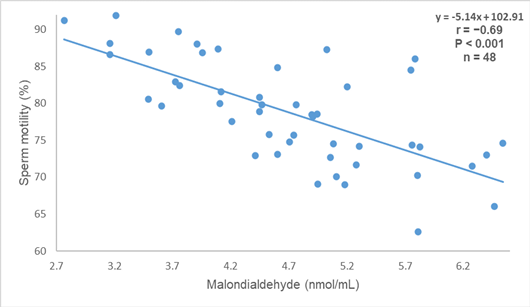
Figure 2 provides an internal link between the oxidative and reproductive datasets. MDA was moderately and negatively associated with sperm motility (r = −0.69, P < 0.001; n = 48), indicating that roosters with greater lipid peroxidation tended to have poorer sperm movement. The regression slope (−5.14 percentage points per nmol/mL) indicates that, across the pooled observations, each 1 nmol/mL increase in MDA was associated with an average decrease of approximately 5.14 percentage points in sperm motility. This represents a biologically appreciable difference in the context of the observed treatment-associated variation in motility, although the slope should be interpreted as an association rather than a causal effect. A similar relationship has been observed across exotic and indigenous chicken breeds, where higher lipid peroxidation was associated with poorer motility, viability, membrane integrity, and fertility .
The regression in the present experiment should not be interpreted as proof that MDA alone caused the reduction in motility, because both variables may respond to common physiological processes. Furthermore, the correlation pooled roosters from all four treatment groups; consequently, part of the association may reflect treatment-related shifts in both MDA and motility rather than a completely treatment-independent within-group relationship. Figure 2 is therefore interpreted as a descriptive association that is directionally consistent with, but does not independently demonstrate, a redox-mediated effect on sperm motility.
Direct antioxidant studies on rooster semen reinforce this biological interpretation. Vitamin E combined with selenium nanoparticles reduced post-thaw MDA and improved motility, viability, membrane integrity, and antioxidant status . Gamma-oryzanol nanoparticles reduced reactive oxygen species while improving motility, plasma membrane function, mitochondrial activity, live sperm, and fertility after cryopreservation . More recently, comparison of semen preservation strategies in Thai native roosters showed that antioxidant supplementation with glutathione, alone or combined with dietary selenium, improved oxidative stability, motility, and viability during cold storage . These studies are not evidence that rambutan peel extract acts identically, but they establish a consistent rooster-sperm mechanism in which limiting oxidative injury preserves membrane and motility-related functions.
The experimental pattern therefore suggested potentially complementary biological responses, but statistical additivity was not established. Soft litter was associated with improvement in the external physical environment, whereas rambutan peel polyphenol supplementation was associated with stronger antioxidant indices. The convergence of these effects was most evident in T4, which showed the most favorable oxidative status and sperm functional traits despite the absence of significant litter × extract interactions. These associations are compatible with complementary pathways but do not establish the underlying mechanisms directly. From a practical perspective, dietary antioxidant supplementation should therefore not be considered a substitute for appropriate flooring, and improved flooring alone cannot provide the antioxidant support supplied by the dietary treatment.
CONCLUSIONS
Soft litter flooring and dietary supplementation with 0.5% rambutan peel polyphenol extract provided complementary benefits to mature Dong Tao roosters. Soft litter improved the physical litter environment and foot health, whereas extract supplementation was associated with a more favorable oxidative profile and semen quality. No statistically significant litter × extract interactions were detected; however, these findings did not establish statistical additivity or exclude smaller interaction effects.
These findings should be interpreted within the scope of the study. Because the analyses were exploratory and no multiplicity adjustment was applied across different outcomes, the reported associations and treatment effects warrant confirmation in further studies. Fertility, hatchability, testicular histology, reproductive hormones, and circulating or tissue polyphenol metabolites were not measured; therefore, improved semen traits cannot be equated directly with increased reproductive output or a confirmed testicular mechanism. The economic feasibility of producing rambutan peel extract at commercial scale was also not evaluated. Furthermore, the absence of chemical standardization and contaminant testing limited the reproducibility and safety assessment of the extract preparation and prevented attribution of the observed responses to specific polyphenolic compounds. Because Dong Tao roosters have distinctive body and leg morphology, extrapolation to other chicken breeds requires further study. Nevertheless, the results support further evaluation of litter management combined with dietary polyphenol supplementation as a strategy for improving foot health, oxidative balance, and semen quality in Dong Tao roosters.
Acknowledgement
We acknowledge the support of time and facilities from Tay Do University (TDU) for this study.
Novelty Statement
This study introduces an integrated welfare–nutrition approach linking flooring management, foot health, oxidative status, and semen quality in mature Dong Tao roosters through a 2 × 2 factorial design. Unlike conventional rooster semen studies focused mainly on semen collection schedules, preservation procedures, or individual nutritional additives, the present work simultaneously evaluates a physical housing intervention and dietary polyphenol supplementation within the same experimental framework. The findings indicate that soft litter flooring and dietary rambutan peel polyphenol extract provided complementary improvements in foot-health, oxidative, and semen-quality outcomes without establishing statistical additivity between the interventions. The study also proposes rambutan peel, a tropical fruit by-product, as a dietary polyphenol source for further application in indigenous male chickens.
Author’s contribution
PN: Formal analysis, supervision, project administration, and writing review and editing. NTMP: Supervision, methodology, and data curation. NTC: Conceptualization, data curation, and writing original draft. NMT: Supervision and writing original draft. TTHM: Investigation, resources, validation, and writing original draft. All authors read and approved the final version of the manuscript.
Ethical approval
The study was retrospectively reviewed by the Faculty of Applied Biology, Tay Do University, as documented in the Certificate of Retrospective Ethical Review and Animal-Welfare Compliance (Ref. No. 59/XN-SHUD, issued on 17 September 2026). The certificate confirmed that, under the procedures applicable within the Faculty when the study was conducted (August–October 2025), the study was not subject to a separate requirement for prospective approval by an animal ethics committee. The certificate was issued after study completion and did not constitute ethical approval retrospectively effective from a date preceding the study. Procedures were limited to routine husbandry, clinical observation, small-volume blood sampling, and non-surgical semen collection. No experimental disease induction, surgery, major invasive procedure, or euthanasia for research purposes was performed. Animal health and welfare were monitored throughout the study, and veterinary care took precedence over continued data collection when clinically required. Roosters underwent a 14-day adaptation period to housing, routine handling, and semen collection, and handling was kept brief and standardized to minimize procedure-related stress. The Faculty’s review considered the animal-care and welfare procedures with reference to the humane-treatment principles of the Law on Animal Husbandry No. 32/2018/QH14 and the Law on Veterinary Medicine No. 79/2015/QH13 of Vietnam.
Funding
None.
Generative AI and AI-assisted technology statement
Generative AI tools were not used to generate any scientific content. Any AI assistance was limited to minor language editing, and all ideas, interpretations, and conclusions are solely those of the authors.
Conflict of interest
The authors have declared no conflict of interest.
Figures
Figure 1:.
Experimental design of soft litter flooring and dietary rambutan peel polyphenol extract supplementation in Dong Tao roosters.
Figure 2:.
Relationship between malondialdehyde concentration and sperm motility in Dong Tao roosters (n = 48).
References
Albuquerque BR, Pinela J, Dias MI, Pereira C, Petrović J, Soković M, Calhelha RC, Oliveira MBPP, Ferreira ICFR, Barros L (2023). Valorization of rambutan (Nephelium lappaceum L.) peel: Chemical composition, biological activity, and optimized recovery of anthocyanins. Food Res. Int., 165: 112574. https://doi.org/10.1016/j.foodres.2023.112574[CrossRef]
Appiah MO, Li W, Zhao J, Liu H, Dong Y, Xiang J, Wang J, Lu W (2020). Quercetin supplemented casein-based extender improves the post-thaw quality of rooster semen. Cryobiology, 94: 57-65. https://doi.org/10.1016/j.cryobiol.2020.04.010[CrossRef]
Authaida S, Ratchamak R, Boonkum W, Chankitisakul V (2023). Increasing sperm production and improving cryosurvival of semen in aged Thai native roosters as affected by selenium supplementation. Anim. Biosci., 36(11): 1647-1654. https://doi.org/10.5713/ab.23.0079[CrossRef]
Barbosa DK, Garcia RG, Burbarelli MFC, Komiyama CM, Gandra ERS, Przybulinski BB, Castilho VAR, Bueno JPT, Santos W (2022). Different litter compositions influence broiler chicken locomotion. Iran. J. Vet. Res., 23(2): 137-146. https://doi.org/10.22099/IJVR.2022.40936.5935[CrossRef]
Behnamifar A, Rahimi S, Karimi Torshizi MA, Sharafi M, Grimes JL (2021). Effects of dietary alpha-lipoic acid supplementation on the seminal parameters and fertility potential in aging broiler breeder roosters. Poult. Sci., 100(2): 1221-1238. https://doi.org/10.1016/j.psj.2020.10.076[CrossRef]
Boussaada T, Lakhdari K, Benatallah SA, Meradi S (2022). Effects of common litter types and their physicochemical properties on the welfare of broilers. Vet. World, 15(6): 1523-1529. https://doi.org/10.14202/vetworld.2022.1523-1529[CrossRef]
Caliva JM, Marozzi A, Nobili MC, Guidobaldi HA, Marin RH, Kembro JM (2026). Relationships between stress indicators and sexual development during onset of maturity in broiler breeder roosters. Poult. Sci., 105(2): 106278. https://doi.org/10.1016/j.psj.2025.106278[CrossRef]
Cotter PF (2015). An examination of the utility of heterophil-lymphocyte ratios in assessing stress of caged hens. Poult. Sci., 94(3): 512-517. https://doi.org/10.3382/ps/peu009[CrossRef]
de Jong IC, Gunnink H, van Harn J (2014). Wet litter not only induces footpad dermatitis but also reduces overall welfare, technical performance, and carcass yield in broiler chickens. J. Appl. Poult. Res., 23(1): 51-58. https://doi.org/10.3382/japr.2013-00803[CrossRef]
Durmuş M, Kurşun K, Polat Açık I, Tufan M, Kutay H, Benli H, Baylan M, Kutlu HR (2023). Effect of different litter materials on growth performance, the gait score and footpad dermatitis, carcass parameters, meat quality, and microbial load of litter in broiler chickens. Poult. Sci., 102(7): 102763. https://doi.org/10.1016/j.psj.2023.102763[CrossRef]
Farghly MFA, Mahrose KM, Cooper RG, Metwally KA, Abougabal MSh, El-Ratel IT (2021). Use of available crop by-products as alternative bedding materials to wheat straw for rearing broilers. Animal, 15(7): 100260. https://doi.org/10.1016/j.animal.2021.100260[CrossRef]
Freeman N, Tuyttens FAM, Johnson A, Marshall V, Garmyn A, Jacobs L (2020). Remedying contact dermatitis in broiler chickens with novel flooring treatments. Animals, 10(10): 1761. https://doi.org/10.3390/ani10101761[CrossRef]
Gerber PF, Gould N, McGahan E (2020). Potential contaminants and hazards in alternative chicken bedding materials and proposed guidance levels: A review. Poult. Sci., 99(12): 6664-6684. https://doi.org/10.1016/j.psj.2020.09.047[CrossRef]
Ghadimi M, Najafi A, Sharifi SD, Mohammadi-Sangcheshmeh A, Roostaei-Ali Mehr M (2024a). Effects of dietary Moringa oleifera leaf extract on semen characteristics, fertility, and hatchability in aged broiler breeder roosters. Poult. Sci., 103(4): 103491. https://doi.org/10.1016/j.psj.2024.103491[CrossRef]
Ghadimi M, Sharifi SD, Najafi A, Mohammadi H (2024b). Gallic acid supplementation partially ameliorates reproductive aging in rooster breeders by improving semen quality, sperm kinetics, hormones, and antioxidant status. Poult. Sci., 103(7): 103842. https://doi.org/10.1016/j.psj.2024.103842[CrossRef]
Gil MG, Gomez-Raya L, Torres O, Cigarroa-Vazquez FA, Davila SG, Rauw WM (2023). Heterophil/lymphocyte response of local Spanish breeds of laying hens to cold stress, heat stress, and water restriction. J. Therm. Biol., 113: 103542. https://doi.org/10.1016/j.jtherbio.2023.103542[CrossRef]
Kaukonen E, Norring M, Valros A (2016). Effect of litter quality on foot pad dermatitis, hock burns and breast blisters in broiler breeders during the production period. Avian Pathol., 45(6): 667-673. https://doi.org/10.1080/03079457.2016.1197377[CrossRef]
Kaya M, Dereli Fidan E, Oral Toplu HD, Karaarslan S, Türkyilmaz MK, Nazligül A (2026). Behavioral and welfare responses of broiler chickens to plastic-grid flooring, zeolite, and wood shavings litter systems. Res. Vet. Sci., 203: 106104. https://doi.org/10.1016/j.rvsc.2026.106104[CrossRef]
Kazemizadeh A, Zare Shahneh A, Zeinoaldini S, Yousefi AR, Mehrabani Yeganeh H, Ansari Pirsaraei Z, Akhlaghi A (2019). Effects of dietary curcumin supplementation on seminal quality indices and fertility rate in broiler breeder roosters. Br. Poult. Sci., 60(3): 256-264. https://doi.org/10.1080/00071668.2019.1571165[CrossRef]
Kim DH, Lee YK, Lee SD, Kim SH, Lee KW (2021). Physiological and behavioral responses of laying hens exposed to long-term high temperature. J. Therm. Biol., 99: 103017. https://doi.org/10.1016/j.jtherbio.2021.103017[CrossRef]
Kittelsen KE, Vasdal G, Thøfner I, Tahamtani F (2024). A walk through the broiler breeder life: How do footpad dermatitis and gait scores develop from rearing to slaughter? Avian Pathol., 53(3): 164-173. https://doi.org/10.1080/03079457.2024.2304005[CrossRef]
Khalil-Khalili AA, Zhandi M, Zaghari M, Mehrabani-Yeganeh H, Yousefi AR, Tavakoli-Alamooti M (2021). The effect of dietary organic selenium on reproductive performance of broiler breeder roosters under dexamethasone induced stress. Theriogenology, 161: 16-25. https://doi.org/10.1016/j.theriogenology.2020.11.016[CrossRef]
Lee C, Kim JH, Kil DY (2022). Comparison of stress biomarkers in laying hens raised under a long-term multiple stress condition. Poult. Sci., 101(6): 101868. https://doi.org/10.1016/j.psj.2022.101868[CrossRef]
Li Y, Li Z, Hou H, Zhuang Y, Sun L (2018). Metal chelating, inhibitory DNA damage, and anti-inflammatory activities of phenolics from rambutan (Nephelium lappaceum) peel and the quantifications of geraniin and corilagin. Molecules, 23(9): 2263. https://doi.org/10.3390/molecules23092263[CrossRef]
Long C, Shi YP, Wang QY, Sheng XH, Wang XG, Xiao LF, Lin ZL, Qi XL (2025). Dietary supplementation with lycopene improves semen quality and antioxidant status in breeder roosters. Poult. Sci., 104(2): 104658. https://doi.org/10.1016/j.psj.2024.104658[CrossRef]
Long C, Wang Z, Guo Y, Sheng X, Xing K, Ni H, Wang X, Xiao L, Qi X (2022a). Research note: Dietary supplementation with pyrroloquinoline quinone disodium (PQQ.Na2) improves oxidative status and semen quality in aging layer breeder roosters. Poult. Sci., 101(5): 101812. https://doi.org/10.1016/j.psj.2022.101812[CrossRef]
Long C, Yin XF, Sheng XH, Wang XG, Xiao LF, Qi XL (2024). Dietary alpha-linolenic acid supplementation enhances semen quality, antioxidant capacity, and sperm survival in aging breeder roosters. Poult. Sci., 103(12): 104252. https://doi.org/10.1016/j.psj.2024.104252[CrossRef]
Long C, Zhu GY, Sheng XH, Xing K, Venema K, Wang XG, Xiao LF, Guo Y, Ni HM, Zhu NH, Qi XL (2022b). Dietary supplementation with selenomethionine enhances antioxidant capacity and selenoprotein gene expression in layer breeder roosters. Poult. Sci., 101(11): 102113. https://doi.org/10.1016/j.psj.2022.102113[CrossRef]
Masoudi R, Asadzadeh N, Sharafi M (2020a). The mitochondriatargeted antioxidant Mito-TEMPO conserves rooster’s cooled semen quality and fertility potential. Theriogenology, 156: 236-241. https://doi.org/10.1016/j.theriogenology.2020.07.018[CrossRef]
Masoudi R, Sharafi M, Pourazadi L, Dadashpour Davachi N, Asadzadeh N, Esmaeilkhanian S, Dirandeh E (2020b). Supplementation of chilling storage medium with glutathione protects rooster sperm quality. Cryobiology, 92: 260-262. https://doi.org/10.1016/j.cryobiol.2019.10.005[CrossRef]
Mavi GK, Dubey PP, Cheema RS (2020). Association of antioxidant defense system with semen attributes vis a vis fertility in exotic and indigenous chicken breeds. Theriogenology, 144: 158-163. https://doi.org/10.1016/j.theriogenology.2020.01.003[CrossRef]
Najafi A, Daghigh-Kia H, Mehdipour M, Mohammadi H, Hamishehkar H (2022). Comparing the effect of rooster semen extender supplemented with gamma-oryzanol and its nano form on post-thaw sperm quality and fertility. Poult. Sci., 101(3): 101637. https://doi.org/10.1016/j.psj.2021.101637[CrossRef]
Nam YH, Ahn SM, Seo GJ, Kim NW, Shin SW, Nuankaew W, Murughanantham N, Pandian S, Hwang JS, Hong BN, Kang TH (2025). Optimization of NADES-based green extraction of ellagitannins from rambutan peel with enhanced antioxidant activity. Food Chem., 475: 143308. https://doi.org/10.1016/j.foodchem.2025.143308[CrossRef]
Nwaigwe CU, Ihedioha JI, Shoyinka SV, Nwaigwe CO (2020). Evaluation of the hematological and clinical biochemical markers of stress in broiler chickens. Vet. World, 13(10): 2294-2300. https://doi.org/10.14202/vetworld.2020.2294-2300[CrossRef]
Nhan P, Chuc NT, Mo TTH, Phuong NTM, Tri NM (2026). Impact of ejaculate collection interval and preservation extenders on semen traits of the indigenous Dong Tao chicken breed. Anim. Sci. Genet., 22(2): 17-28. https://doi.org/10.5604/01.3001.0055.6349[CrossRef]
Nhan P, Phuong NTM (2025). Evaluation of semen characteristics and the impact of storage time in Dong Tao and Ho indigenous chickens. Philipp. Agric. Sci., 108(3): 276-281. https://doi.org/10.62550/DBC722067025[CrossRef]
Phuong NNM, Le TT, Dang MQ, Van Camp J, Raes K (2020). Selection of extraction conditions of phenolic compounds from rambutan (Nephelium lappaceum L.) peel. Food Bioprod. Process., 122: 222-229. https://doi.org/10.1016/j.fbp.2020.05.008[CrossRef]
Raei H, Karimi Torshizi MA, Sharafi M, Ahmadi H (2021). Improving seminal quality and reproductive performance in male broiler breeder by supplementation of camphor. Theriogenology, 166: 1-8. https://doi.org/10.1016/j.theriogenology.2021.02.002[CrossRef]
Ratchamak R, Authaida S, Koedkanmark T, Saiyamanon H, Boonkum W, Chankitisakul V (2025). Optimization of rooster semen preservation: A comparative study of extender types and antioxidant supplementation strategies during cold storage. Poult. Sci., 104(6): 105137. https://doi.org/10.1016/j.psj.2025.105137[CrossRef]
Rezaie FS, Hezavehei M, Sharafi M, Shahverdi A (2021). Improving the post-thaw quality of rooster semen using the extender supplemented with resveratrol. Poult. Sci., 100(9): 101290. https://doi.org/10.1016/j.psj.2021.101290[CrossRef]
Safa S, Moghaddam G, Jafari Jozani R, Daghigh Kia H, Janmohammadi H (2016). Effect of vitamin E and selenium nanoparticles on post-thaw variables and oxidative status of rooster semen. Anim. Reprod. Sci., 174: 100-106. https://doi.org/10.1016/j.anireprosci.2016.09.011[CrossRef]
Shabani S, Mehri M, Shirmohammad F, Sharafi M (2022). Enhancement of sperm quality and fertility-related parameters in Hubbard grandparent rooster fed diets supplemented with soybean lecithin and vitamin E. Poult. Sci., 101(3): 101635. https://doi.org/10.1016/j.psj.2021.101635[CrossRef]
Świątkiewicz S, Arczewska-Włosek A, Józefiak D (2017). The nutrition of poultry as a factor affecting litter quality and foot pad dermatitis: An updated review. J. Anim. Physiol. Anim. Nutr., 101(5): e14-e20. https://doi.org/10.1111/jpn.12630[CrossRef]
Taira K, Nagai T, Obi T, Takase K (2014). Effect of litter moisture on the development of footpad dermatitis in broiler chickens. J. Vet. Med. Sci., 76(4): 583-586. https://doi.org/10.1292/jvms.13-0321[CrossRef]
Tan J, Ma Q, Li J, Liu Q, Zhuang Y (2023). Bioavailability and antioxidant activity of rambutan (Nephelium lappaceum) peel polyphenols during in vitro simulated gastrointestinal digestion, Caco-2 monolayer cell model application, and colonic fermentation. J. Agric. Food Chem., 71(42): 15829-15841. https://doi.org/10.1021/acs.jafc.3c04106[CrossRef]
Torgbo S, Rugthaworn P, Sukatta U, Sukyai P (2022). Biological characterization and quantification of rambutan (Nephelium lappaceum L.) peel extract as a potential source of valuable minerals and ellagitannins for industrial applications. ACS Omega, 7(38): 34647-34656. https://doi.org/10.1021/acsomega.2c04646[CrossRef]
Tvrdá E, Benko F, Ďuračka M, Kováčik A, Jančo I, Árvay J, Kačániová M, Vozaf J, Baláži A, Chrenek P (2026). Aging, inflammation, and oxidative stress converge on semen quality in Oravka roosters. Poult. Sci., 105(8): 107051. https://doi.org/10.1016/j.psj.2026.107051[CrossRef]
Ye N, Lv Z, Dai H, Huang Z, Shi F (2021). Dietary alpha-lipoic acid supplementation improves spermatogenesis and semen quality via antioxidant and anti-apoptotic effects in aged breeder roosters. Theriogenology, 159: 20-27. https://doi.org/10.1016/j.theriogenology.2020.10.017[CrossRef]
Zhuang Y, Ma Q, Guo Y, Sun L (2017). Purification and identification of rambutan (Nephelium lappaceum) peel phenolics with evaluation of antioxidant and antiglycation activities in vitro. Int. J. Food Sci. Technol., 52(8): 1810-1819. https://doi.org/10.1111/ijfs.13455[CrossRef]