
Callaspidia is a Holarctic genus; some species of Callaspidia attack the larvae of order Diptera and Coleoptera. Callaspidia notata (Boyer de Fonscolombe, 1832) (Hymenoptera: Figitidae: Aspicerinae) is reported with colour variations like scape, pedicel and basal part of antennal segment 3 slightly darker than remaining segments, scutellum and mesopleura mostly dark reddish with some darker areas, legs also reddish brown except tarsal segments lighter in colouration. Suspected trophic associations with Ischiodon scutellaris (F.) via Aphis nerii onCalotropis procera (Ait.) Ait and Tinocallis kahawaluokalani (Kirkaldy) on Lagerstroemia indica have been given. Studies suspected that C. notata parasitizes the immature of Ischiodon scutellaris (F.) like other reported species of this genus. Main diagnostic characters, brief description, morphometrics and illustrations are provided. Comparison of recorded species with type species has been provided. World distribution and distribution in Pakistan has been given using Arc GIS tools.
Short Communication · Volume 53, Issue 3, 3 April 2021 · Open Access
Colour and Distributional Pattern of Callaspidia notata (Boyer de Fonscolombe, 1832) (Hymenoptera: Figitidae: Aspicerinae) from Pakistan
· · · · ·
Affiliations & Notes ⌄
- 1Insect Biodiversity and Conservation Group, Department of Entomology, PMAS-Arid Agriculture University, Rawalpindi 2Department of Environmental Sciences, PMAS-Arid Agriculture University, Rawalpindi 3Fareed Biodiversity and Conservation Centre,Department of Agricultural Engineering, Khwaja Fareed University of Engineering and Information Technology, Rahim Yar Khan, Punjab 4Department of Entomology, University of Agriculture Faisalabad, Sub Campus Depalpur, Okara, Punjab 5Agricultural Linkages Pr
Article Info ⌄
- Journal:
- Pakistan Journal of Zoology
- Published:
- 3 April 2021

From the article
- Colour and Distributional Pattern of Callaspidia notata (Boyer de Fonscolombe, 1832) (Hymenoptera: Figitidae: Aspicerinae) from Pakistan.
- Studies suspected that C. notata parasitizes the immature of Ischiodon scutellaris (F.) like other reported species of this genus.
- Antenna about 2 mm, 14 segmented, light brown, scape, pedicel and 3rd antennal segment slightly darker as compared to remaining segments.
- In our observed specimens, mesosoma dark reddish brown, legs also reddish brown except tarsal segments are lighter in coloration as compared to other parts of the leg.
Selected from the article's own text.
Abstract
Materials and methods
The studies were performed during 2018-2019 in various localities of Punjab province of Pakistan. During our surveys for the collection of aphids and their parasitoids, these wasps were collected with the help of insect collection net. They were then killed and preserved in small glass vials in 70% ethanol. Some specimens were preserved dry in vials. Specimens were attached on triangular shaped card and observed under Labomed microscope (CZS6, Labo America, Inc. USA). Identification and observation of colour variations were done by using re-description given by Ros-Farré and Pujade-Villar (2009). LEICA MS 5 (Leica Microsystems (Switzerland) Ltd.) microscope attached with Amscope 18 megapixel camera (Amscope, China) was used for microphotography. Illustrations were processed in Helicon Focus 6 and Adobe Photoshope CS6 (Adobe Inc. USA). Distributional maps of the world and Pakistan were prepared with the help of ARC GIS 10.6.1 (Esri, Redlands, CA, USA) tools. Identified specimens have been deposited in Insect Museum of Department of Entomology, PMAS-AAUR, Pakistan.
Callaspidia notata
(Boyer de Fonscolombe, 1832)
Figites notata Boyer de Fonscolombe, 1832: 187; Onychia notata Reinhard, 1860: 237; Homalaspis notata (Boyer de Fonscolombe) Kieffer, 1898: 266; Tavaresia notata (Boyer de Fonscolombe) Kieffer, 1901a: 160; Callaspidia ligurica Giraud, 1860: 70; Ros-Farré & Pujade-Villar: 2009: 23; Onychia ligurica (Giraud) Förster, 1869: 362; Onychia rufithorax Cameron, 1906: 90-91; Callaspidia rufithorax (Cameron) Weld, 1952: 169; Callaspidia binghami, Hedicke, 1913; Ros-Farré & Pujade-Villar: 2009: 23; Callaspidia notata (Boyer de Fonscolombe) Graham, 1986: 39; Callaspidia dusmeti Tavares 1924: 20-24 and Ros-Farré & Pujade-Villar: 2009: 23; Callaspidia mediterranea Dalla Torre & Kieffer, 1910: 64-65; Ros-Farré & Pujade-Villar: 2009: 23.
Pronotum laterally carinated basally. Scutum with thin transverse carinae between notauli, mainly coriaceous from notauli to parascutal sulcus .
According to Ros-Farré and Pujade-Villar (2009) this species has following coloration of body parts: head black, antenna light brown, scape and pedicel slightly lighter, leg orange, mesosoma black, basally orange, scutellum and mesopleura mostly orange with some darker areas, metasoma black with some orange reflections. They stated that there is a possibility to find some specimens with colour variations ranging from black with some light brown areas to light
brown specimens with some darker areas. We found some variations of our specimens as given below.
Scape, pedicel and basal part of antennal segment 3 are slightly darker than remaining segments. Scutellum and mesopleura mostly dark reddish with some darker areas. Legs also reddish brown except tarsal segments lighter in colouration.
Female possesses bright scape and dark pedicel and first third of antennal segment 3. Specimens collected from Rawalpindi and Islamabad possessed darker coloration as compared to those collected from Layyah and Mianwali. This might be due to low temperature ranges in Rawalpindi and Islamabad.
Diagnosis: Head black male (Fig. 1E-H) with transverse carinae in dorsal half. Antennae, thorax and legs dark reddish brown, hind legs slightly darker than other pairs, gaster (abdomen) shiny black and smooth (Fig. 1C). Antenna about 2 mm, 14 segmented, light brown, scape, pedicel and 3rd antennal segment slightly darker as compared to remaining segments. Third antennal segment with outer margin distinctly curved in males. Vertex weakly rugose inside. Gena rounded behind the compound eye, almost smooth, shining and with distinct transverse carinae. Occiput shining and with clear transverse carinae. Pronotum dark reddish brown, coriaceous with a few transverse carinae basally; dorsally coriaceous, sometimes slightly rugose, rarely with weak carinae (Fig. 1A). Scutum coriaceous, with weak transverse carinae, stronger between notauli. Parascutal sulcus mostly smooth, weakly carinated posteriorly. Notauli and median mesoscutal furrow strongly to weakly carinated transversely. Mesosoma dark reddish brown, almost straight (Fig. 1B). Metasoma black. Propodeal carinae straight, sometimes slightly divergent, wider basally than apically. Central area of propodeum pubescent.
Female body ranges from 2.7 to 4.4 mm. Antennae 13 segmented. Third antennal segment straight. Head, antennae, thorax and legs reddish brown, abdomen shiny black. In other characters it is similar to male.
Measurements (mm): In male head: head length (height): 0.36-0.39; head width: 0.9-1; lateral eye diameter: 0.5-0.53; dorsal eye length: 0.36 -0.39; dorsal eye width: 0.15-0.17; distance between compound eyes: 0.46-0.48; distance between compound eye and ocelli: 0.09-0.12.
Antennae: Scape: 0.12-0.14; pedicel: 0.062 -0.072; 3rd antennal segment: 0.26-0.28; 4th antennal segment: 0.22-0.25; 5th antennal segment: 0.25-0.26; 6th antennal segment: 0.25-0.26; 7th antennal segment: 0.25-0.26; 8th antennal segment: 0.25-0.26; 9th antennal segment: 0.25-0.26; 10th antennal segment: 0.25-0.26; 11th antennal segment: 0.29-0.3.
Forewing: length: 2.8-2.9; width: 1-1.
Female head: head length (height): 0.38-0.39; head width: 0.98-0.99; lateral eye diameter: 0.4-0.5; dorsal eye length: 0.38-0.39; dorsal eye width: 0.16-0.17; distance between compound eyes: 0.45-0.48; distance between compound eye and ocelli: 0.10-0.12.
Antennae: Scape: 0.11-0.12; pedicel: 0.071-0.072; 3rd antennal segment: 0.25-0.26; 4th antennal segment: 0.22-0.20; 5th antennal segment: 0.20-0.22; 6th antennal segment: 0.18-0.19; 7th antennal segment: 0.18-0.19; 8th antennal segment: 0.13-0.14; 9th antennal segment: 0.11-0.12; 10th antennal segment: 0.11-0.12; 11th antennal segment: 0.27-0.29.
Forewing: length: 2.8-0.29; width: 1-1.1.
Pakistan: Rawalpindi (PMAS-AAUR) (33.648172N, 73.081733E, 1674 ft) 3♂, 2 ♀, 15.v.2019; Rawalpindi (Nawaz Sharif Park) (33.648608N, 73.077050E, 1686ft) 3♂, 4 ♀, 29.iv.2019; Islamabad (Kachnar Park) (3. 33.672142N, 73.080244E,1695ft) 3♂, 1 ♀, 9.iv.2019; Islamabad (Daman e koh,) (33.739597N, 73.055481E,2373ft) 3♂, 2 ♀, 10.v.2018; Layyah (30.984400N, 70.971669E, 482ft) 1♂, 4 ♀, 12.iii.2018; Layyah (30.987789N, 70.964953E, 490 ft) 2♂, 2 ♀, 27.ii.2019; Mianwali (32.585708N, 71.539928E, 697ft) 5♂, ♀, 11.iii.2016; Mianwali (32.561181N, 71.579289E, 696 ft) 3♂, 2 ♀, 19.iii.2019 (voucher specimens were deposited in Insect Museum of Department of Entomology, PMAS-AAUR, Pakistan).
Aphis nerii Fonscolombe (Hemiptera, Aphididae) on Calotropis procera (Ait.) Ait. (Asclepiadaceae) (From Layyah and Mianwali area) and Tinocallis kahawaluokalani (Kirkaldy) (Hemiptera, Aphididae) on Lagerstroemia indica L. (Lythraceae) (from Rawalpindi and Islamabad). In both associations, Ischiodon scutellaris (F.) (Diptera, Syrphidae) was suspected to be at the third trophic level. Whenever specimens were collected its maximum population was examined on both plant species. Adults of I. scutellaris (F.) were always found to be hovering along the adults of C. notata. So it may be suspected that C. notata parasitizes the immature of I. scutellaris feeding on Aphis nerii and Tinocallis kahawaluokalani. So further research is needed for the confirmation of this trophic association.
Globly this species is reported in Palaearctic and Oriental regions (Fig. 2) while in Pakistan it is available Layyah, Mianwali, Rawalpindi and Islamabad.
This species is reported for the first time from various locations of Pakistan. Specimen collected from Pakistan were compared with published description by Ros-Farré and Pujade-Villar (2009) and found to be similar excepting color variations of various body parts. In our observed specimens, mesosoma dark reddish brown, legs also reddish brown except tarsal segments are lighter in coloration as compared to other parts of the leg. Scutellum and mesopleura mostly dark reddish with some darker areas. While in type species as given by Ros-Farré and Pujade-Villar (2009) mesosoma black, basally orange; scutellum and mesopleura mostly orange with some darker areas. Similarly antenna light brown, scape and pedicel slightly lighter, legs orange.
Statement of conflict of interest
The authors have declared no conflict of interest.
Figures
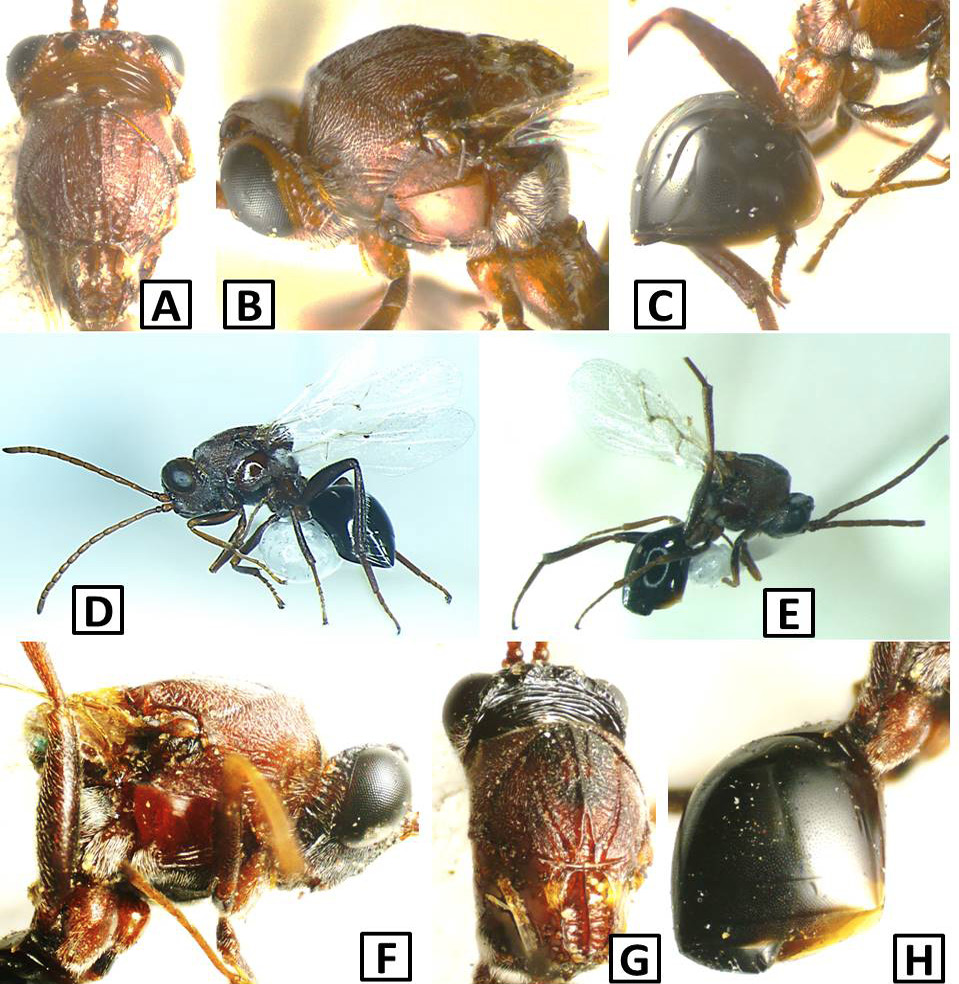
Morphology of Callaspidia notata (Boyer de Fonscolombe, 1832) female (A to D) and male (E to H). A, Dorso-lateral view of head and pronotum (Prosoma and mesosoma); B, Lateral view of mesosoma; C, Metasoma; D, Adult female; E, Adult male; F, Lateral view of mesosoma; G, Dorso-lateral view of head and pronotum (Prosoma and mesosoma); H, Metasoma.
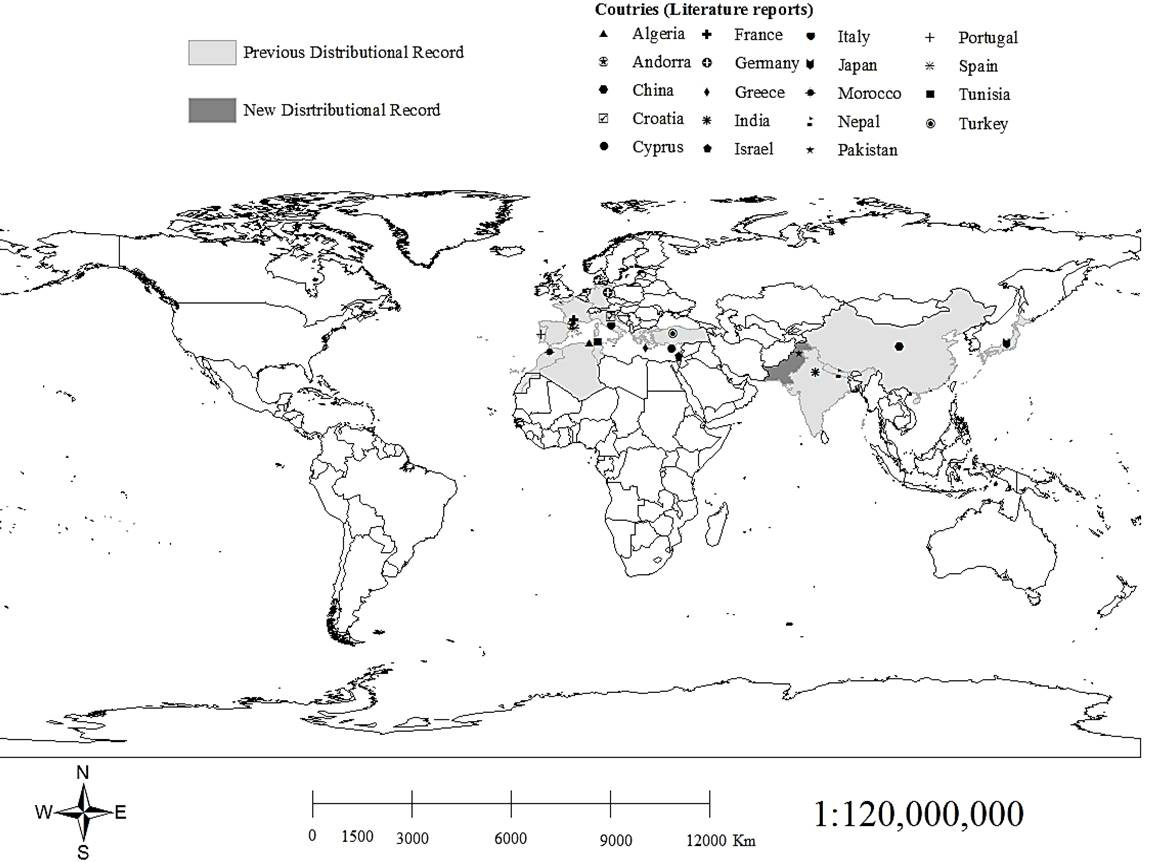
World distribution of Callaspidia notata (Boyer de Fonscolombe, 1832).
References
- Dahlbom, G., 1842. Lund, Tryckt uti Akad. Boktryckeriet, 1–16.
- Dalla-Torre, K.W. and Kieffer, J.J., 1910. Das Tierreich, 24: 891.
- Fergusson, N.D.M., 1986. Handb. Identif. Br. Insects, 8: 1-55.
- Graham, M.W.R.D.V., 1986. Bol. Mus. Municip. Funchal. 38: 28-42.
- Hedicke, H., 1913. Deut. Ent. Z., 1-6: 441-445. https://doi.org/10.1002/mmnd.48019140609[CrossRef]
- Hedicke, H., 1928. Verhandl. Naturwissensch. Unterhal. Hamburg, 27: 72-96. https://doi.org/10.1002/mmnd.48119280111[CrossRef]
- Kirchner, C., 1867. Catalogus Hymenopterorum Europae. Vienna, pp. 285.
- Rotheray, G.E., 1979. Econ. Ent., 4: 75-82. https://doi.org/10.1111/j.1365-2311.1979.tb00562.x[CrossRef]
- Ronquist, F., 1995. Syst. Ent., 20: 309-335. https://doi.org/10.1111/j.1365-3113.1995.tb00099.x[CrossRef]
- Ros-Farré, P., Ronquist, F. and Pujade-Villar, J., 2000. Zool. J. Linn. Soc., 129: 467-488. https://doi.org/10.1006/zjls.1999.0204[CrossRef]
- Ros-Farré, P., 2007. Zool. Stud., 46: 168-175.
- Ros-Farré, P. and Pujade-Villar, J., 2009. Zootaxa, 2105: 1-31. https://doi.org/10.11646/zootaxa.2105.1.1[CrossRef]
- Tavares, J.S., 1924. Broteria. Sér. Zool., 21: 5-48.
Services
Article usage statistics
Loading…