Research Article · Volume 35, Issue 1, 8 June 2020 · Open Access
First Record of Carebara raja (Forel, 1902) (Hymenoptera: Formicidae: Myrmicinae) from Pakistan
· · ·
Affiliations & Notes ⌄
1Insect Biodiversity and Conservation Group, Department of Entomology, Pir Mehr Ali Shah Arid Agriculture University, Rawalpindi, Pakistan 2Department of Environmental Sciences, Pir Mehr Ali Shah Arid Agriculture University, Rawalpindi, Pakistan. , Corresponding author: Imran Bodlah, imranbodlah@gmail.com
CarebaraWestwood (1840) is a species rich genus in subfamily Myrmicinae. Many species of this genus are reported from various parts of the world including neighbouring countries of Pakistan. Members of this genus are considered as generalized foragers and cryptic in nature. Collected material was verified using most recent and available literature provided by Bharti and Akbar (2014). Herein we report one species of this genus C. raja (Forel, 1902) based on queen for the first time from Himalayan Foothills of Pakistan. Differential diagnosis, morphometric and illustrations are provided with notes on distributional range.
Novelty Statement | Carebara raja (Forel, 1902) genus and species is recorded for the first time from Pakistan.
Introduction
The most speciose ant genus, Carebara Westwood (1840) of subfamily Myrmicinae have 250 reported species and distributed in tropical and subtropical region of the world ; ; . Ants of this genus comprise monomorphic, dimorphic, polymorphic and cryptic species, prefer to nests in dead woods and leaf material ; ; ; . Few species of Carebara are predatory in nature .
Limited information is available about the biology of Carebara species (Fernández, 2006, 2010). Genus Carebara is classified into minor and major worker along with its intermediate sub castes .
Genus Carebara has been systematically treated by various scientists viz. Fernández (2006, 2010). They provided the junior synonyms of Carebara such as Aeromyrma, Afroxyidris, Aneleus, Crateropsis, Erebomyrma, Hendecatella, Lecanomyrma, Neoblepharidatta, Nimbamyrma, Oligomyrmex, Paedalgus, Parvimyrma, Solenops, Spelaeomyrmex and Sporocleptes which have been considered as junior synonyms of genus Carebara. Pheidologeton Mayer (1862) synonymized under Carebara by Fischer et al. (2014).
As far as taxonomic studies on genus Carebara are concerned, from Oriental region significant contributions on this genus performed by Xu (2003); Guénard and Dunn (2012); Akbar and Bharti (2017). According to them, 41 species have been reported across the Oriental part of the world. Four species have been described from Taiwan . According to Karaman and Kiran (2017) only one species is recorded from Turkey. Fischer et al. (2014) reported 6 species from Sri Lanka. However, many species of genus Carebara have also been described from neighboring countries of Pakistan for example 31 species have been explored from China and 20 species from India . However, in Pakistan a limited taxonomic work on ants has been performed till date ; ; Bodlah et al., 2017a, b; ; . Prior to current study, no species of this genus has been recorded from Pakistan. The genus Carebara Westwood (1840) recorded first time from Pakistan. Based on queen C. raja (Forel, 1902) is reported for the first time from Pakistan along with its distributional range, diagnostic note and illustrations.
Materials and Methods
As a result of extensive surveys during 2015-16 specimens were collected from forest areas of district Rawalpindi (Kotlisatian) and Islamabad. Specimens were collected using mouth aspirator and killed in jar having potassium cyanide. Taxonomic analysis was conducted under Labomed microscope using keys developed by Bharti and Kumar (2013). Digital images were prepared using Labomed CZM6 microscope attached with digital camera (Amscope 18 megapixels, model number MU1803). Prepared images were cleaned by adobe Photoshop CS6 software. Identified specimens were tagged with valid name, habitat, date of collection and elevation. Identified specimens were deposited in the department of Entomology, PMAS-AAUR, Pakistan. Description method and morphometric treatment follows Fernández (2006 2010). The acronyms used for taxon is given below.
MHNG
Muséum d’Histoire Naturelle, Geneva, Switzerland.
Results and Discussion
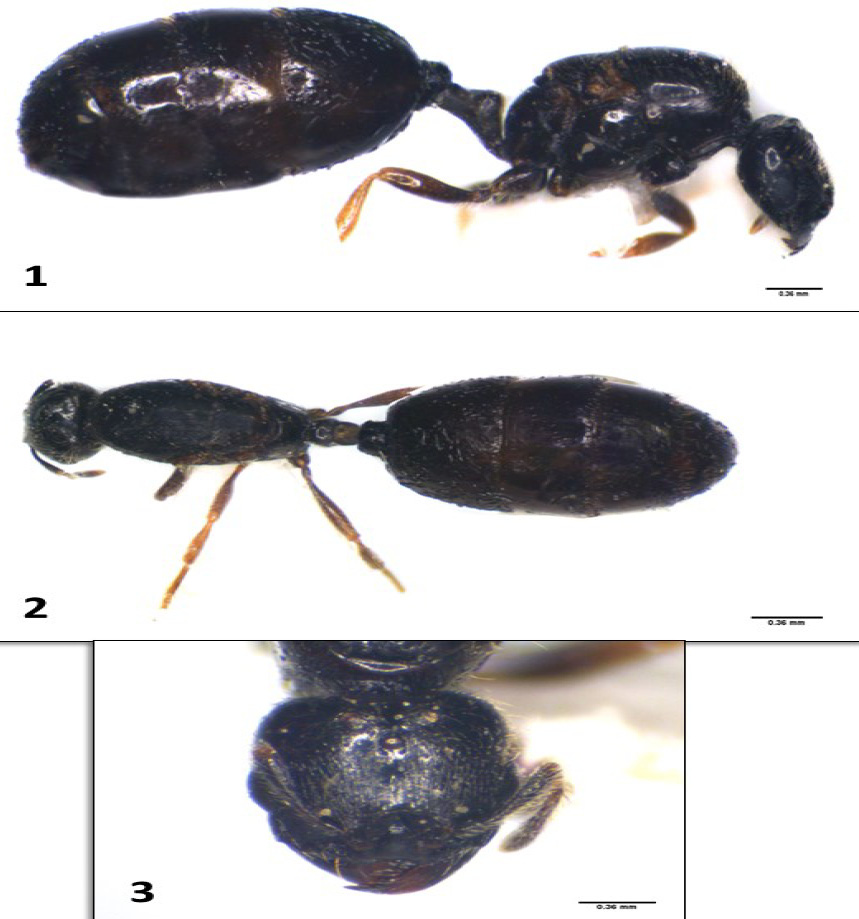
Carebara raja Forel (1902) Figure 1
Oligomyrmex raja Forel (1902): 2016 (queen). TL: India. Indomalya [Syntype: MHNG].
Description (Queen)
Head rectangular, longer than broad in frontal view, longitudinally striated. Mandibles having 5 blunt teeth. Clypeus strongly smooth, bicarinate laterally, anterior margin slightly emarginated. Nine segmented antennae along with 2-segmented club, scape smaller in length and not touching the posterior margin of vertex. Eyes slightly longer in length than width, placed laterally in middle of head. In profile view vertex with well-developed three ocelli. Dorsum of head straight in middle and slightly concave laterally. Promesonotum obsolete and forming a single convexity, mesometanotal suture distinct, in lateral view metanotum striated longitudinally while promesonotum smooth and shining, metanotal groove deeply impressed. Propodeum without any spine or teeth. Dorsum straight and slightly truncate. Petiole pedunculated, triangular with thick anterior and posterior face, postpetiole rounded but shorter than petiolar node, in dorsal view width of postpetiole more than petiole. Mesosoma and abdominal surface smooth and shining throughout, petiole punctate throughout. Pilosity: Body having erect and suberect hairs. Dense pubescence at scape of antennae and tibiae. Colour: Body very dark-brown to blackish.
C. raja belongs to C. lignata group, nine segmented antennae and major worker caste absent. Fernández (2004, 2010) described C. raja with six another Indian species. According to Bharti and Kumar (2013) C. raja closely related to C. leei and can be diagnosed on the bases of following characters; clypeus emarginated anteriorly; total body is 5-5.5 mm longer; while clypeus is not emarginated and total body is 7-8 mm longer in C. leei.
Ecology and Conservation of genus Carebara Westwood (1840)
This species was observed in rotten woods with sufficient moisture level in pine forest areas of Himalayan Foothills of district Rawalpindi and Islamabad. Worker caste was absent. Based on various studies Carebara species found to be encountered in large stone and rotten material in different forest across the world. However, Pakistan has 5.6% of forest land out of total land covered area. Moreover, total forest land drastically decreasing about 5.6-3.36% since 2000. Due to rapid urbanization, farming, overgrazing, tourism development and development of housing societies in protected areas of Pakistan may lead to serious threat of extinction to genus Carebara in Pakistan. Various preservation policies including Afforestation, establishment of National Parks and reduction of disturbance in naturally protected areas should be adopted at government level for long-term preservation of these entities.
Remarks
C. raja was originally described by Forel (1902) from Indomalya (India). Major worker caste of this species unknown to date. Based on original description and distribution of C. raja provided by Forel (1902); Bharti and Kumar (2013); Bharti and Akbar (2014); Akbar and Bharti (2017). Herein we reported this species based on queen as a new country record for the ant fauna Pakistan.
Acknowledgement
We would like to express our gratitude to Pakistan science foundation for funding under the project PSF/NSLP/P-UAAR (313) for these studies. Anonymous reviewers are greatly appreciated for their valuable comments and suggestions on earlier version of manuscript.
Conflict of interest
No potential conflict of interest was reported by the authors.
Akbar, S.A., and Bharti, H., 2017. A new species of the ant genus carebara westwood (Hymenoptera: Formicidae) from India. J. Entomol. Res. Soc., 19: 35-43.
Aldawood, A.S., Sharaf, M.R. and Taylor, B., 2011. First record of the myrmicine ant genus Carebara Westwood, 1840 from Saudi Arabia with a description of a new species, C. abuhurayri sp. n. Zookeys, 92: 61-69. https://doi.org/10.3897/zookeys.92.770Antweb, 2018. Bolton world catalog. https://www. antweb. org/project. do? name=world ants. (Accessed 15 May, 2018).[CrossRef]
Bharti, H. and Kumar, R., 2013. Six new species of Carebara Westwood (Hymenoptera: Formicidae) with restructuring of world species groups and a key to Indian species. J. Entomol. Res. Soc., 15: 47-67. https://doi.org/10.2478/vzoo-2013-0018[CrossRef]
Bharti, H. and Akbar, S.A., 2014. New additions to ant Genus Carebara Westwood (Hymenoptera: Formicidae: Myrmicinae) From India. Acta. Zool. Hung. 60: 313–324. https://doi.org/10.13102/sociobiology.v60i4.387-396[CrossRef]
Bodlah, I., Bodlah, M.A., Rasheed, M.T., Akhter, T., Aihetasham, A. and Yousaf, M., 2017a. New distributional records of psyllid, Trioza fletcheri minor Crawford, 1912 and record of its first association with two ant’s species in Pothwar. Asian J. Agric. Biol. 5: 1-6.
Bodlah, I., Rasheed, M.T. and Bodlah, M.A., 2017b. New Distributional Records of Tetraponera rufonigra (Jerdon) From Gilgit Baltistan, Pakistan. Asian J. Agric. Biol. 5: 56-59.
Bodlah, I., Rasheed, M.T., Fareen, A.G., Ajmal. M.S. and Bodlah. M.A., 2016. First record of two new species of genus Tetraponera (Hymenoptera: Pseudomyrmecinae: Formicidae) from Pakistan. J. Entomol. Zool. Stud., 4: 1028-1030.
Bolton, B., 1973. The ant genera of West Africa: a synonymic synopsis with keys (Hymenoptera: Formicidae). Bull. Br. Mus. Nat. Hist. Entomol. 54: 263-452.
Bolton, B., 2014. An online catalog of the ants of the world. Available at: http://www.antcat.org/
Fernández, F., 2004. The American species of the myrmicine ant genus Carebara Westwood. Caldasia, 26: 191-238.
Fernández, F., 2006. A new species of Carebara Westwood and taxonomic notes on the genus. Rev. Colomb. Entomol. 32: 97-99.
Fernández, F., 2010. A new species of Carebara from the Philippines with notes and comments on the systematics of the Carebara genus group (Hymenoptera: Formicidae: Myrmicinae). Caldasia 32: 191-203.
Fischer, G., 2012. Ecology, biogeography and responses to habitat degradation of a highly diverse rainforest ant community and taxonomy of Afrotropical Pheidole Westwood (Hymenoptera, Formicidae). Bonn, Rheinische Friedrich-Wilhelms-Universität Bonn, Dissertation, pp. 228.
Fischer, G., Azorsa, F. and Fisher, B.L., 2014. The ant genus Carebara Westwood (Hymenoptera, Formicidae): synonymisation of Pheidologeton Mayr under Carebara, establishment and revision of the C. polita species group. Zookeys, 438: 57-112. https://doi.org/10.3897/zookeys.438.7922[CrossRef]
Forel, A., 1902. Myrmicinae nouveaux de l’Inde et de Ceylan. Rev. Suisse Zool., 10: 165-249.
Guénard, B. and Dunn, R.R., 2012. A checklist of the ants of China. Zootaxa, 3358: 1-77. https://doi.org/10.11646/zootaxa.3558.1.1[CrossRef]
Karaman, C., and Kiran, K., 2017. First record of Carebara oertzeni Forel (Hymenoptera: Formicidae) from the European part of Turkey with worker description. Turk. J. Zool., 41: 638-644. https://doi.org/10.3906/zoo-1604-39[CrossRef]
Longino, J.T., 2004. Ants of Costa Rica. http://www. evergreen.edu/ants/genera/ Carebara Pheidologeton (Hymenoptera: Formicidae). Aust. J. Zool. 14: 73-171.
Mayr, G., 1862. Myrmecologische studien. Verhandlungen der Kaiserlich-Königlichen Zoologisch-Botanischen Gesellschaft in Wien, 12: 649-776.
Rasheed, M.T., Bodlah, I., Fareen, A.G. and Huang, X., 2018. First record of Leptogenys hysterica Forel, 1900 (Hymenoptera, Formicidae, Ponerinae) from Pakistan. J. Threat. Taxa. 10: 13032–13036. https://doi.org/10.11609/jott.4036.10.15.13032-13036[CrossRef]
Rasheed, M.T., Bodlah, I., Fareen, A.G., Wachkoo, A.A., Huang, X., and Akbar, S.A., 2019. A Checklist of Ants (Hymenoptera: Formicidae) in Pakistan. Sociobiology, 66: 426-439. https://doi.org/10.13102/sociobiology.v66i3.4330[CrossRef]
Terayama, M., Lin, C.C. and Eguchi, K., 2012. Additions to knowledge of the ant fauna of Taiwan (Hymenoptera, Formicidae, Solenopsidini): genera Anillomyrma and Carebara. Jap. J. Sys. Entomol., 18: 1-6.
Umair, M., Zia, A., Naeem, M., and Chaudhry, M.T., 2012. Species composition of ants (Hymenoptera: Formicidae) in Pothwar plateau of Punjab province, Pakistan. Pakistan J. Zool. 44: 699-705.
Westwood, J.O., 1840. Observations on the genus Typhlopone, with descriptions of several exotic species of ants. Annals Magaz. Nat. Hist., 6: 81–89.
Xu, Z., 2003. A systematic study on Chinese species of the ant genus Oligomyrmex Mayr. Acta Zootaxonomica Sin. 28: 310-322.