
Ammonia (NH₃) emissions from intensive poultry production pose significant environmental, animal welfare, and occupational health challenges, with emission dynamics markedly intensified under humid tropical climatic conditions. Although numerous NH₃ mitigation strategies have been investigated, evidence specific to humid tropical poultry systems remains fragmented. This systematic review critically synthesizes published evidence on climate-adapted NH₃ mitigation approaches for humid tropical poultry production. Literature was systematically searched across major scientific databases following PRISMA guidelines. From 225 screened publications, 50 highly relevant studies were selected using predefined inclusion criteria and a structured quality assessment framework. The evidence indicates that humid tropical conditions can increase NH₃ volatilization by up to threefold compared with temperate systems due to the combined effects of elevated temperature, high relative humidity, and litter moisture. Among mitigation strategies, litter amendments such as alum, biochar, and zeolite consistently reduced NH₃ emissions by approximately 20–60% under field conditions while frequently improving litter quality and bird performance. Advanced ventilation interventions, including floor heating integrated with heat exchangers, achieved the greatest reductions in indoor NH₃ concentrations, whereas computational modelling tools provided effective support for emission prediction and climate-specific management. However, substantial methodological heterogeneity, limited long-term field validation, and the absence of standardized measurement protocols hinder direct comparison among studies. The available evidence is also heavily concentrated in Brazil and Nigeria, with limited representation from South and Southeast Asia. Overall, effective NH₃ mitigation in humid tropical poultry production requires integrated, climate-specific strategies combining litter management, optimized ventilation, and predictive modelling. Future research should prioritize standardized monitoring protocols, long-term economic evaluations, and regional validation studies to support sustainable poultry production in humid tropical environments.
Review · Volume 12, Issue 2, 14 September 2026 · Open Access
Climate-Specific Ammonia Mitigation Strategies for Humid Tropical Regions in Poultry Production: A Systematic Review and Critical Synthesis
· · · · · ·
Affiliations & Notes ⌄
- 1Department of Physiology and Pharmacology, Gazipur Agricultural University, Gazipur-1706, Bangladesh
- 2Faculty of Veterinary Medicine and Animal Science, Gazipur Agricultural University, Gazipur-1706, Bangladesh
- 3Department of Animal Science and Nutrition, Gazipur Agricultural University, Gazipur-1706, Bangladesh
- 4Department of Microbiology and Public Health, Gazipur Agricultural University, Gazipur-1706, Bangladesh
- 5Department of Dairy and Poultry Science, Gazipur Agricultural University, Gazipur-1706, Bangladesh
- 6Department of Veterinary & Animal Sciences, University of Rajshahi, Rajshahi-6205, Bangladesh
- 7Faculty of Veterinary & Animal Sciences, University of Rajshahi, Rajshahi-6205, Bangladesh. *Correspondence | Md. Rimon Bhuiyan, MS Fellow in Veterinary Medicine, Department of Veterinary & Animal Sciences, Faculty of Veterinary & Animal Sciences, University of Rajshahi, Rajshahi-6205, Bangladesh
- 8Email: mdrimonbhuiyan1999@gmail.com, s1911168127@ru.ac.bd
Article Info ⌄
- Journal:
- Veterinary Sciences: Research and Reviews
- Published:
- 14 September 2026

From the article
- This systematic review demonstrates that ammonia mitigation strategies developed for temperate poultry production cannot be directly transferred to humid tropical production systems because climatic conditions substantially alter NH₃ generation and volatilization dynamics.
- Elevated temperature, high relative humidity, and persistent litter moisture create conditions that intensify ammonia emissions, making climate-specific management essential for environmental sustainability, poultry welfare, and worker health.
- Among the reviewed mitigation approaches, litter amendments- particularly alum, biochar, and zeolite- provide the most practical and evidence-supported interventions for reducing NH₃ emissions while often improving litter quality and production performance.
- The evidence consistently indicates that integrated approaches combining litter management, environmental control, and predictive modelling outperform single-intervention strategies.
Selected from the article's own text.
Abstract
Introduction
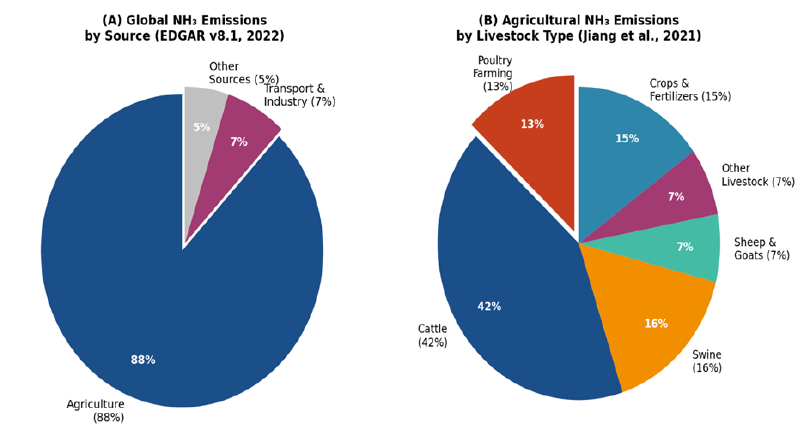
Ammonia (NH₃) emissions from intensive poultry production have emerged as a primary concern across environmental, veterinary, and occupational health disciplines. Agricultural activities account for approximately 88% of global anthropogenic NH₃ emissions (European Commission, Joint Research Centre, 2022), with chicken farming alone contributing an estimated 5.5 ± 1.2 Tg N yr⁻¹, representing approximately 13% of agriculture-derived NH₃ emissions globally . These emissions exert significant downstream consequences including ecosystem acidification, eutrophication of water bodies, formation of atmospheric particulate matter, and direct adverse effects on animal welfare and human health ;.
The challenge of NH₃ mitigation is substantially compounded in humid tropical regions. The AMCLIM-Poultry model- a process-based framework incorporating meteorological variables-demonstrates that the fraction of excreted nitrogen emitted as NH₃ can be up to three times greater in humid tropical housed systems compared to cold or dry climate counterparts .
High ambient temperatures accelerate the decomposition of uric acid to total ammoniacal nitrogen (TAN), while elevated relative humidity reduces the evaporation rate of moisture from litter, maintaining conditions that favor ammonia volatilization ; . These biophysical dynamics interact with the predominantly open-sided or curtain-sided housing typologies prevalent in tropical poultry systems, which complicate both emission quantification and control .
Global poultry production has intensified substantially over recent decades , particularly within the humid tropics. Brazil, the world’s largest broiler meat exporter, exemplifies this intensification, with open-sided housing designs now accommodating densities of 10–16 birds m⁻² . Nations across Southeast Asia, sub-Saharan Africa, and Latin America increasingly adopt intensive production models, yet management protocols largely mirror those developed for temperate, closed-housing systems, which are fundamentally ill-suited for humid tropical conditions ; .
NH₃ concentrations exceeding 25 ppm within poultry houses are associated with significant reductions in growth performance, feed conversion efficiency, egg production, respiratory health, and immune competence ; . At the environmental level, deposited NH₃-derived nitrogen contributes to biodiversity loss in sensitive ecosystems and participates in secondary aerosol formation affecting regional air quality . Despite the documented severity of these impacts, the scientific literature addressing NH₃ mitigation in humid tropical poultry contexts remains fragmented, methodologically heterogeneous, and limited in its translation to practical management frameworks.
This systematic review addresses this gap by synthesizing current evidence on climate-specific NH₃ mitigation strategies for humid tropical poultry production systems. It evaluates the efficacy and adaptability of litter amendments, ventilation engineering approaches, measurement methodologies, and predictive modelling tools under tropical climatic conditions. By integrating empirical findings with theoretical frameworks, this review aims to inform the development of standardized, climate-adapted mitigation protocols with direct applicability to tropical poultry producers, policymakers, and researchers.
Methodology of Literature Review
Literature search strategy
A systematic literature search was conducted following PRISMA (Preferred Reporting Items for Systematic Reviews and Meta-Analyses) guidelines. The primary research question- “Climate-specific ammonia mitigation strategies for humid tropical regions in poultry production”- was expanded into multiple targeted queries to ensure comprehensive coverage across disciplinary domains. Searches were conducted across Web of Science, Scopus, PubMed, Google Scholar, and CAB Abstracts from January 2005 through May 2026.
The transformed search queries encompassed: (1) climate-specific NH₃ mitigation in tropical poultry facilities; (2) innovative ammonia reduction technologies for humid tropical climates; (3) litter treatment and management techniques for tropical poultry; (4) alternative litter materials and their ammonia emission profiles; and (5) ventilation design and environmental control in open tropical poultry housing. The initial database search retrieved 101 candidate papers meeting pre-defined keyword criteria.
Inclusion and exclusion criteria
Studies were eligible for inclusion if they: (1) reported original empirical data or validated modelling approaches relating to NH₃ emissions or mitigation in poultry systems; (2) involved tropical, subtropical, or humidity-relevant climatic conditions; (3) were published in peer-reviewed journals or proceedings; and (4) were available in English, Portuguese, or Spanish with accessible abstracts. Studies exclusively pertaining to temperate, closed-housing systems without climate-specific adaptation were excluded, as were opinion pieces and grey literature without methodological transparency.
Citation chaining and relevance scoring
Backward citation chaining was applied to the core paper set to identify foundational studies informing current evidence. Forward citation chaining traced newer works that cited core papers, capturing methodological advances and emerging debates. This process identified an additional 124 papers, yielding a total pool of 225 candidate papers. Each paper was subjected to a relevance scoring protocol incorporating thematic alignment, methodological rigor, climate-specificity, and recency. Fifty papers were classified as highly relevant and form the analytical core of this review.
Quality assessment and relevance scoring protocol
To address methodological transparency, each candidate paper was evaluated against a four-criterion relevance scoring protocol, with each criterion scored on a 0–3 scale (0 = absent/not applicable, 1 = weak, 2 = moderate, 3 = strong): (1) thematic alignment with climate-specific NH₃ mitigation; (2) methodological rigor, assessed using an adapted checklist drawn from the JBI (Joanna Briggs Institute) Critical Appraisal Checklists for quasi-experimental and cross-sectional studies, covering clarity of study aims, adequacy of experimental controls, appropriateness of NH₃ measurement methods, and statistical reporting; (3) climate-specificity, reflecting explicit tropical, subtropical, or humidity-relevant conditions; and (4) recency, favouring studies published within the preceding ten years while retaining seminal older works. Papers scoring ≥9 of a possible 12 points were classified as highly relevant and retained for detailed synthesis; the fifty studies meeting this threshold form the analytical core of this review. Two reviewers independently scored a 20% random subsample to check scoring consistency (concordance = 88%), with disagreements resolved by discussion.
Rationale for narrative synthesis
Given the substantial heterogeneity in study designs (laboratory incubation, field trials, and modelling investigations), NH₃ measurement methodologies (photoacoustic spectroscopy, colorimetric methods, and CFD-derived estimates), and outcome metrics (percentage emission reduction, absolute concentration, emission factor) across the 50 included studies, a formal statistical meta-analysis with pooled effect-size estimation was judged not feasible or appropriate. This narrative synthesis approach was therefore a deliberate, a priori methodological decision rather than an ad hoc omission, consistent with recommended practice for reviews spanning highly heterogeneous experimental and observational designs. Where sufficient homogeneity existed within a mitigation category (e.g., alum-based amendments), reported effect ranges are nonetheless presented comparatively in Table 1 Table 2 Table 3 to support semi-quantitative cross-study comparison in lieu of formal statistical pooling (Figure 1).
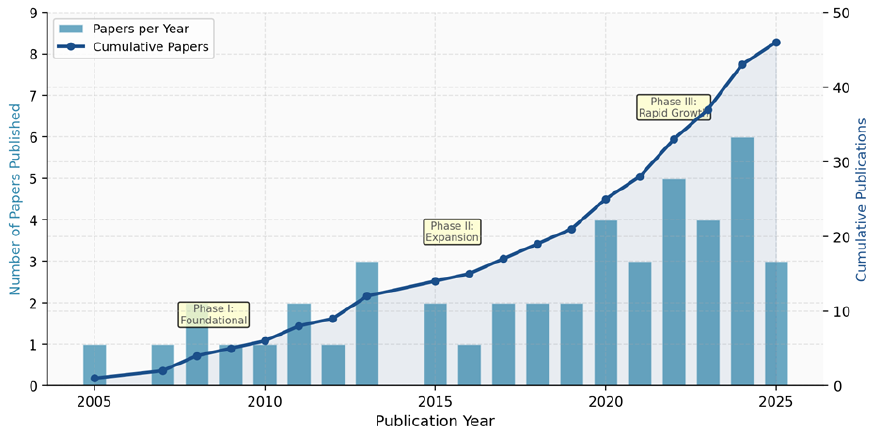
Figure 1 Chronological distribution of peer-reviewed publications on NH₃ mitigation in humid tropical poultry production systems (2005–2025). Bar heights indicate annual publication counts; the overlaid line represents the cumulative total. Research phases are annotated to reflect distinct periods of disciplinary focus.
Results
Overview of research landscape
The 50 highly relevant studies span experimental trials (n = 32), modelling investigations (n = 10), and systematic or narrative reviews (n = 8). Geographic distribution favored Brazil (n = 18), Nigeria (n = 5), Sri Lanka (n = 4), Turkey (n = 2), and the United States (n = 7), with the remaining studies drawing from Southeast Asian, European, and multi-regional contexts. This geographic concentration reflects the intensification of tropical poultry production in Latin America and West Africa but indicates a relative
under-representation of South and Southeast Asian systems. Only four of the fifty highly relevant studies originated from South or Southeast Asia (all from Sri Lanka), despite these regions collectively housing some of the largest and fastest-growing poultry industries operating under humid tropical conditions; this imbalance is carried forward as an explicit limitation and priority research need throughout this review.
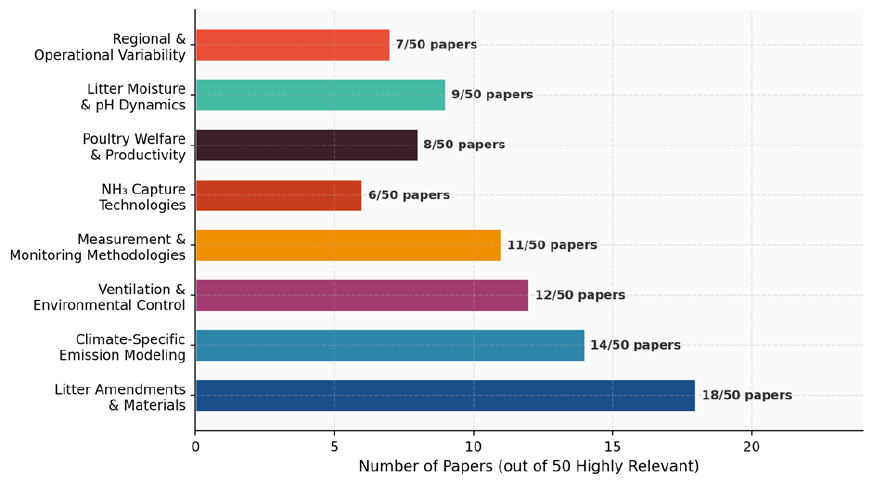
Thematically, the literature clusters around eight major domains: litter materials and amendments (18/50 papers), climate-specific emission dynamics and modelling (14/50), ventilation and environmental control (12/50), measurement and monitoring methodologies (11/50), NH₃ capture technologies (6/50), poultry welfare and productivity impacts (8/50), litter moisture and pH dynamics (9/50), and regional operational variability (7/50). Figure 5 illustrates this thematic distribution, underscoring the dominant focus on litter management as the primary mitigation lever (Figure 2).
Figure 2 Thematic distribution of the 50 highly relevant studies across major research domains in humid tropical poultry NH₃ mitigation. Values indicate the number of papers addressing each theme.
NH₃ Emission dynamics in humid tropical contexts
NH₃ generation in poultry litter proceeds through
Table 1: Comparative performance of litter amendments for NH₃ Mitigation in humid tropical poultry systems
|
Amendment |
Mechanism |
NH₃ Reduction |
Tropical Suitability |
Bird Perfor-mance |
GHG Trade-off |
Cost |
Key References |
|
Alum (Al₂(SO₄)₃) |
pH reduction via acidification |
77–96% |
High |
Neutral to positive |
Moderate N₂O increase |
Medium |
Choi & Moore 2008; Kim et al. 2012 |
|
Alum Mud (by-product) |
pH reduction |
27–52% |
High |
No adverse effects |
Similar to alum |
Low |
Anderson et al. 2020, 2021 |
|
Biochar |
Adsorption + pH buffering |
20–60% |
Moderate |
Neutral |
Negative (C seques-tration) |
Medium– High |
Pereira et al. 2024; Graves et al. 2024 |
|
Zeolite (clinoptilolite) |
NH₄⁺ cation exchange |
30–65% |
High |
Positive (growth, FCR) |
Minimal |
Low– Medium |
Nigeria trial 2022; Mohammed & ElBably 2020 |
|
Sodium Bisulfate |
Acid treatment |
40–75% |
Moderate |
Neutral to positive |
Low |
Medium |
Toledo et al. 2020; Yayli & Kilic 2025 |
|
Gypsum (CaSO₄) |
pH buffering + Ca²⁺ binding |
25–45% |
Moderate |
Positive (weight gain) |
Minimal |
Low |
Toledo et al. 2020 |
|
Enzymatic Biocatalyst |
Urease inhibition (enzymatic) |
15–40% |
Moderate |
No significant change |
Minimal |
Medium– High |
Atapattu et al. 2017 |
|
Tea Leaf Composites |
Tannin urease inhibition |
20–55% |
Promising |
Not fully assessed |
Minimal |
Low |
Tan et al. 2019 |
|
Quartzite/ Kamafugite |
pH buffering (rock powder) |
10–25% |
Emerging |
Maintained litter quality |
Minimal |
Very Low |
Carvalho et al. 2025 |
Table 2: Alternative litter substrates evaluated in humid tropical poultry production
|
Litter material |
Region studied |
NH₃ vs wood shavings |
Bird welfare outcome |
Regional availability |
Key references |
|
Coir-husk fiber |
Brazil |
Lower NH₃ emissions |
Positive outcomes |
High (S/SE Asia, Brazil) |
Linhares et al. 2022 |
|
Salvinia (dried fern) |
Sri Lanka |
Lower NH₃ emissions |
Reduced hock burn |
High (pan-tropical) |
Thennakoon et al. 2024 |
|
Rice husk (raw) |
Indonesia |
Equivalent to wood shavings |
Good litter quality |
Very high (SE Asia) |
Anggoro et al. 2025 |
|
Rice husk (HCl activated) |
Indonesia |
Non-significant reduction |
Not significant |
Moderate (processing required) |
Tugiyanti et al. 2023 |
|
Sand |
Brazil /Nigeria |
Context-dependent |
Harder on footpads |
High |
Garces et al. 2013 |
|
Tea leaf composites |
East Asia |
Lower NH₃ emissions |
Not assessed |
Moderate (tea regions) |
Tan et al. 2019 |
|
Wood shavings (baseline) |
Global |
Reference baseline |
Reference baseline |
Moderate–High |
Multiple |
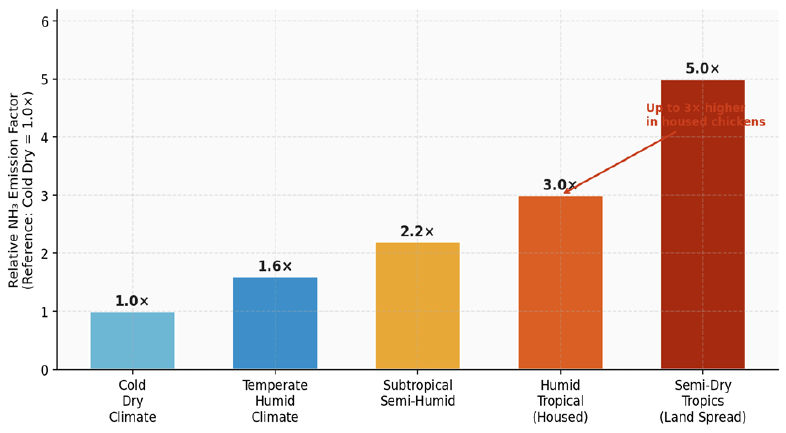
the microbial decomposition of uric acid-the primary nitrogenous excretion product of poultry- via urease-catalyzed hydrolysis to TAN, followed by pH- and temperature-dependent partitioning into gaseous NH₃ . In humid tropical environments, this biochemical cascade is substantially accelerated. The AMCLIM-Poultry model, calibrated against global meteorological datasets, quantifies NH₃ emission fractions from housed chicken systems across climate zones, revealing that emission rates in humid tropical regions can be up to three times greater than those in temperate or cold climates .
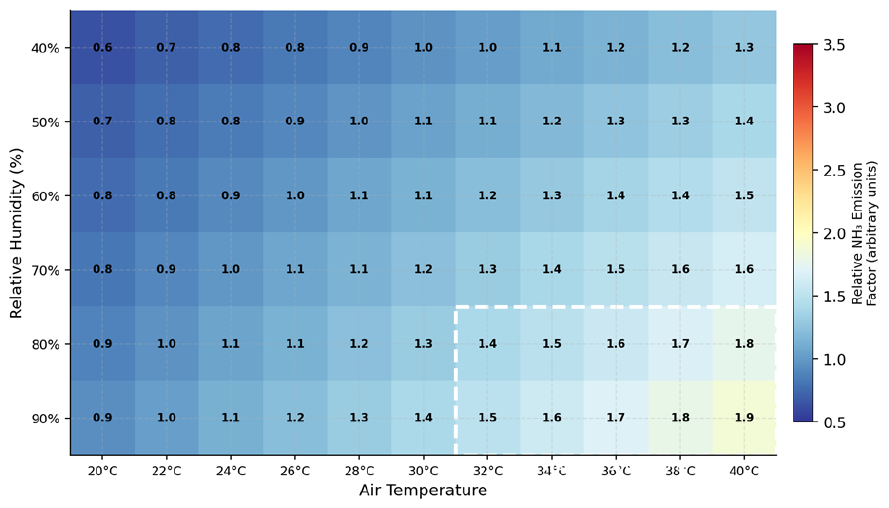
Figure 3 Estimated relative NH₃ emission factor as a function of air temperature and relative humidity in poultry litter systems. Values represent relative emission intensities normalized to baseline cool-dry conditions (20°C, 40% RH = 0.6). The dashed white rectangle demarcates the typical humid tropical operating range. Data are derived from the AMCLIM-Poultry model framework and empirical field data ; .
For manure land-spreading operations in semi-dry tropical zones, this multiplication factor extends to
Table 3: Ventilation & Environmental control strategies: NH₃ Reduction effectiveness
|
Ventilation / Control strategy |
NH₃ Reduction (%) |
Capital cost level |
Key reference |
|
Floor heating + heat exchanger |
~89% (9× baseline reduction) |
High |
Gfeller et al. 2024 |
|
Bubble column air capture reactor |
~100% (capture efficiency) |
Very High |
Lahav et al. 2008 |
|
Activated charcoal exhaust fan |
~40% |
Medium |
Imam et al. 2022 |
|
Acid-treated burlap filter |
17–42% |
Low |
Shah et al. 2022 |
|
Tunnel ventilation (optimized) |
~35% |
Medium |
Multiple tropical studies |
|
Targeted fan airflow over litter |
~28% |
Low–Medium |
Mou et al. 2024 |
|
UV-A photocatalysis |
2.6–18.7% |
Medium |
Lee et al. 2020 |
|
CFD-optimized natural ventilation |
~22% |
Low (modelling) |
Saraz et al. 2015 |
|
Curtain management only |
~15% |
Very Low |
Manno et al. 2011 |
fivefold relative to cold, wet climates. Field studies corroborate these modelling projections. Nwagwu et al. (2010) documented NH₃ concentrations exceeding safe thresholds in Nigerian tropical poultry pens during the rainy season, attributing peak concentrations to synergistic interactions between elevated ambient temperature, high relative humidity, and inadequate natural ventilation. In Brazilian broiler facilities, Sousa et al. (2023) validated predictive models demonstrating that NH₃ generation potential from wood shaving and coffee husk litter increases non-linearly with temperature between 25-40°C.
The interactive effects of temperature and relative humidity on NH₃ volatilization are illustrated in Figure 6. Under conditions typical of humid tropical poultry facilities-ambient temperatures of 28-38°C and relative humidity of 70–90%-estimated NH₃ emission factors are 1.8 to 3.5 times greater than baseline temperate conditions, underscoring the climate specificity of mitigation requirements (Figure 3, 4).
Figure 4 Climate-dependent relative NH₃ volatilization rates in poultry production systems based on the AMCLIM-Poultry model . All values are normalized to the cold dry climate baseline (1.0×). The annotation highlights the threefold amplification characteristic of humid tropical housed systems relative to baseline conditions.
Global NH₃ Emission context
Agriculture accounts for an estimated 88% of global anthropogenic NH₃ emissions (European Commission, Joint Research Centre, 2022), with agricultural emissions increasing by approximately 78% between 1980 and 2018 . Within the agricultural sector, poultry farming contributes approximately 13% of agriculture-derived NH₃ emissions globally, estimated at 5.5 ± 1.2 Tg N yr⁻¹ based on 2010 data . Both pigs and poultry systems individually account for more than 15% of estimated total livestock emissions . These figures contextualize the environmental significance of NH₃ mitigation in tropical poultry systems, where expanding production intensification is projected to increase emission burdens substantially in coming decades (Figure 5).
Figure 5 Global ammonia emission source distribution. Panel (A) presents the proportional contribution of major source categories to total global NH₃ emissions (European Commission, Joint Research Centre, 2022). Panel (B) disaggregates agricultural emissions by livestock species, highlighting the 13% contribution of poultry farming .
Litter management and amendment strategies
Aluminium sulphate (Alum) and alum mud
Aluminium sulphate (alum) is the most extensively investigated litter amendment for NH₃ mitigation. Its mechanism of action involves acidification of litter pH, which shifts the ammonium-ammonia equilibrium toward the ionized, non-volatile ammonium form (NH₄⁺), thereby suppressing gaseous NH₃ release .
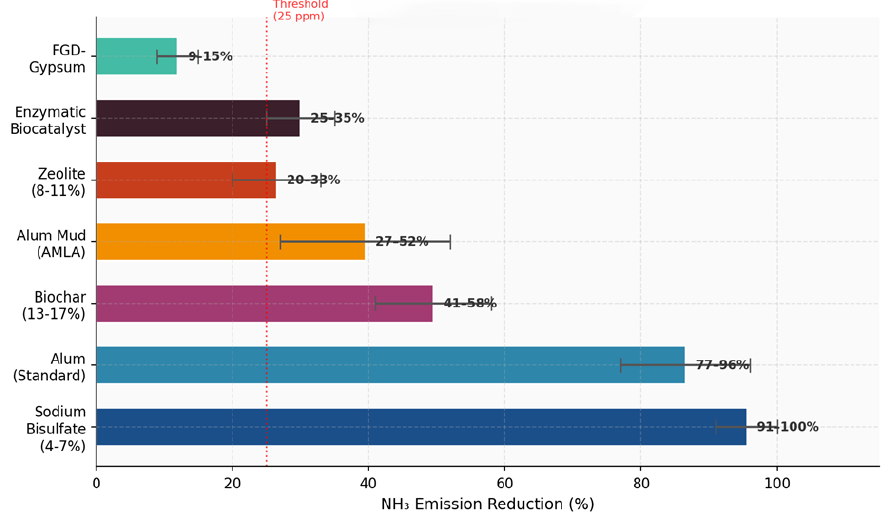
Laboratory studies report NH₃ volatilization reductions of 77–96% relative to untreated litter when alum is applied at recommended rates . Field trials corroborate substantial efficacy; Eid et al. (2022) demonstrated significant reductions
in litter NH₃ concentrations and improvements in laying hen productive performance following alum application.
The economic accessibility of alum has been constrained by rising procurement costs, motivating investigation of alternative formulations. Anderson et al. (2020, 2021) evaluated alum mud litter amendment (AMLA)-a by-product of aluminium ore processing combining alum mud, bauxite, and sulphuric acid-and reported NH₃ emission reductions of 27–52%, comparable to standard alum applied at equivalent rates. Crucially, AMLA demonstrated no adverse effects on broiler production performance and showed favorable litter chemistry outcomes, presenting a cost-competitive alternative for tropical poultry producers.
Biochar as a sustainable litter amendment
Biochar has attracted considerable research attention as a sustainable, multifunctional litter amendment. Its high surface area, cation exchange capacity, and surface acidity provide multiple mechanisms for NH₃ adsorption and retention within litter matrices . During broiler housing, Pereira et al. (2024) documented NH₃ emission reductions of 40–60% with biochar application, while simultaneously reducing global warming potential emissions by approximately 31%. Notably, biochar demonstrated comparable efficacy to alum (60% vs. 58% reduction respectively), without the environmental trade-offs associated with acid-based amendments.
Graves et al. (2024) investigated engineered Miscanthus biochar as a broiler litter amendment, reporting approximately 20% reduction in NH₃ volatilization. Production parameters including pyrolysis temperature and feedstock composition were identified as critical determinants of biochar efficacy, with higher pyrolysis temperatures generally producing biochar with superior ammonia adsorption capacity. The potential for biochar to be produced locally from agricultural residues-including rice husks and crop waste abundant in tropical regions-positions it as a particularly promising, cost-effective amendment for low-resource tropical poultry systems (Table 1).
(FCR = Feed Conversion Ratio. GHG trade-off refers to the effect of the amendment or treated litter on greenhouse gas emissions during storage and land application. Cost is indicative and regionally context-dependent.)
Zeolite and mineral-based amendments
Zeolites are microporous aluminosilicate minerals with high cation exchange capacity and surface affinity for ammonium ions, functioning as NH₃ absorbers within litter matrices. In a field trial conducted in humid tropical Nigeria, zeolite litter treatment significantly reduced NH₃ emissions and microbial loads while enhancing broiler performance indicators including body weight and feed conversion ratio . Mohammed and ElBably (2020) demonstrated that clinoptilolite zeolite at 10–20 g kg⁻¹ effectively reduced NH₃ concentrations and pathogenic microbial loads in duck litter managed under tropical conditions.
Lara (2023) documented zeolite’s ability to reduce NH₃ volatilization and alter litter pH and moisture in avian production systems, with timing and dosage identified as critical efficacy determinants. Recent comparative analyses using biochar (13–17% w/w) and zeolite (8–11% w/w) indicate NH₃ reductions of 41-46% and 20–33%, respectively, confirming biochar’s superior efficacy while acknowledging zeolite’s advantage in avoiding greenhouse gas co-benefits .
Alternative litter materials for tropical contexts
Conventional litter substrates such as wood shavings may be economically inaccessible or ecologically unsustainable in many tropical regions, motivating investigation of locally abundant alternatives. Linhares et al. (2022) monitored NH₃ concentrations from coir-husk litter in Brazilian poultry houses using diode laser photoacoustic spectroscopy, demonstrating lower NH₃ emissions relative to wood shavings while offering environmental sustainability benefits through utilization of coconut processing waste.
Thennakoon et al. (2024) evaluated Salvinia-an aquatic fern prevalent in tropical water bodies-as a broiler litter material, reporting lower NH₃ emission rates compared to paddy husk while maintaining comparable growth performance and reducing hock burn incidence. Carvalho et al. (2025) investigated quartzite tailings and kamafugite powders as litter additives under closed tropical broiler conditions, demonstrating moderate NH₃ reductions while preserving favorable litter pH and humidity profiles. Tan et al. (2019) demonstrated that mixed litter
formulations incorporating tea leaves outperformed single-substrate litters in NH₃ inhibition, particularly under varying moisture levels. These findings collectively support local waste valorization as an economically viable strategy for NH₃ reduction in tropical poultry systems (Table 2) (Figure 6).
(NH₃ performance is relative to conventional wood shavings under comparable tropical conditions. ‘Context-dependent’ indicates outcomes varied significantly by season, stocking density, or measurement method.)
Figure 6 Comparative NH₃ emission reduction efficiency of principal litter amendments tested in poultry production systems. Bars represent mean reduction percentages with error bars indicating the observed range across studies. The vertical dotted line marks the 25-ppm critical threshold above which adverse effects on bird performance and welfare are documented. Sources: Choi and Moore (2008); Pereira et al. (2024); Anderson et al. (2020, 2021); Bist et al. (2023); Eid et al. (2022); Atapattu et al. (2017); Graves et al. (2024).
Ventilation and environmental control strategies
Natural ventilation in tropical open housing
Most poultry houses across humid tropical regions employ open-sided or curtain-sided designs with natural ventilation, relying on prevailing wind patterns and stack effects for air exchange. While this approach minimizes capital costs, it introduces substantial variability in indoor airflow patterns, creating localized zones of NH₃ accumulation near litter surfaces and bird breathing zones ;. Jongbo (2020) documented inadequate air velocity for cooling in battery-caged tropical poultry pens, attributing environmental NH₃ accumulation to insufficient air exchange, and recommended computational fluid dynamics (CFD) analysis for airflow optimization.
Polat (2015) demonstrated that building design parameters-including orientation, eave height, inlet configuration, and curtain positioning-exert dominant influence over indoor air quality in humid climates. Natural ventilation efficacy was shown to vary seasonally, with NH₃ concentrations elevated during wet-season low-wind-speed periods corresponding to peak ambient humidity. These findings highlight the necessity of climate-responsive building design rather than static standardized configurations.
Mechanical ventilation and environmental control technologies
Mechanical ventilation systems offer superior control over indoor microclimatic conditions but require higher capital and operational investment. Manno et al. (2011) demonstrated that tropical broiler facilities with higher-technology ventilation systems paradoxically recorded elevated NH₃ concentrations due to higher stocking densities facilitated by environmental control capability, highlighting the interaction between ventilation technology and management decisions.
Gfeller et al. (2024) reported the most dramatic ventilation-based mitigation documented in the reviewed literature: floor heating combined with heat exchangers in tropical broiler housing reduced indoor NH₃ by a factor of approximately nine, attributing this to maintenance of drier litter conditions through reduced litter moisture accumulation.
Shah et al. (2022) evaluated citric acid-treated burlap exhaust filters applied to broiler house ventilation systems, achieving NH₃ reductions of 17–42% while simultaneously reducing thermal stratification. The study reported filter clogging as a practical limitation, partially addressed by mechanical shakers. Imam et al. (2022) designed an exhaust fan system incorporating activated charcoal adsorption in closed tropical broiler houses, maintaining NH₃ concentrations within 25-30 ppm-below the critical welfare threshold-under operational conditions.
(Estimated NH₃ reduction effectiveness for various ventilation and environmental control strategies in tropical broiler production. The floor heating + heat exchanger system represents the highest single-strategy reduction but requires significant capital investment.)
Airflow optimization and humidity management
Mou et al. (2024) conducted a field investigation in commercial broiler houses examining the effects of maintaining moderate relative humidity (50–60%) with enhanced air movement over litter surfaces. Results demonstrated that this ventilation strategy effectively controlled litter moisture content and significantly reduced NH₃-related footpad dermatitis, providing practical evidence for humidity-targeted ventilation management in tropical systems without requiring high-capital mechanical solutions.
CFD modelling has provided valuable theoretical foundations for airflow optimization in tropical poultry facilities. Saraz et al. (2015) applied CFD simulation to predict NH₃ concentration profiles and emission fluxes in naturally ventilated open houses, demonstrating the utility of these models for building design optimization and ventilation management. The model revealed that strategic inlet and baffle configuration could substantially reduce NH₃ hotspots near litter surfaces, offering practical guidance for building design in tropical contexts.
Novel ammonia capture technologies
Beyond passive litter amendments and ventilation, several active NH₃ capture systems have been investigated. Lahav et al. (2008) pioneered a dedicated air capturing system incorporating an acidic bubble column reactor positioned proximal to litter surfaces within tropical broiler houses, achieving near-100% NH₃ absorption efficiency. The system operates independently of building ventilation, capturing NH₃-laden air from the bird microenvironment and converting it to ammonium sulphate, a marketable nitrogen fertilizer. While pilot-scale results were highly promising, full economic evaluation remains pending.
Lee et al. (2020) investigated UV-A light combined with photocatalytic treatment under simulated poultry barn conditions, achieving NH₃ reductions of 2.6–18.7% depending on humidity levels and catalyst configurations. Humidity was identified as a critical modulator of photocatalytic efficacy, with higher relative humidity reducing treatment efficiency, a significant practical constraint for humid tropical applications. Scale-up and economic evaluation remain prerequisite for field implementation (Table 3).
Climate-Dependent emission modelling
Process-Based emission models
The AMCLIM-Poultry model represents the most comprehensive climate-dependent NH₃ emission model developed for global chicken farming . Applied at 0.5° global resolution using FAO livestock density data and ECMWF ERA5 meteorological inputs, the model simulates uric acid decomposition, TAN formation, and NH₃ partitioning at hourly to daily resolution. Key outputs include the demonstration that ambient temperature and relative humidity are dominant drivers of emission variability across climate zones, with humid tropical regions exhibiting emission fractions far exceeding global average values. The model’s climate sensitivity provides a mechanistic basis for designing region-specific mitigation interventions.
Sousa et al. (2023) developed and validated predictive models for NH₃ generation and emission potential in Brazilian broiler facilities, analyzing litter samples from 30 commercial aviaries across varying temperature regimes (25–40°C) and litter reuse cycles. Models demonstrated high predictive accuracy and practical utility for emission estimation in facilities where direct measurement is logistically or economically infeasible. The models accommodate two primary litter types (wood shavings and coffee husks) across up to four and six reuse cycles, respectively.
CFD and spatial emission modelling
Saraz et al. (2015) applied CFD modelling to naturally ventilated tropical poultry houses, predicting spatial NH₃ concentration profiles as functions of ventilation rate, wind velocity and direction, and litter emission fluxes. The model provides decision-support capability for optimizing building orientation, inlet positioning, and ventilation management in open tropical housing. Miles et al. (2016) characterized spatial variability in NH₃ flux within humid subtropical broiler houses, revealing significant within-house concentration gradients attributable to litter moisture heterogeneity and ventilation non-uniformity, informing targeted litter management interventions.
Limitations of current modelling approaches
Despite significant advances, current modelling approaches exhibit notable limitations for humid tropical applications. The AMCLIM-Poultry model, while globally calibrated, has not been comprehensively validated against field measurements from open-sided tropical facilities, where ventilation variability fundamentally differs from the closed-housing assumptions underlying model parameterization ; . Climate variable integration in most models is restricted to temperature and relative humidity, without explicit representation of rainfall effects on litter wetting in open facilities, or the thermal buffering effects of building design on indoor microclimate . Decision-support translation-converting model outputs into actionable management recommendations for field practitioners-remains underexplored across the reviewed model literature (Table 4).
Critical analysis and synthesis
Convergent evidence and key agreements
The reviewed literature demonstrates robust convergence across several key findings. First, humid tropical climate conditions substantially amplify NH₃ emission rates relative to temperate baselines, with temperature and relative humidity identified as dominant drivers across empirical, field, and modelling studies ; ; . Second, litter pH is a critical mediator of NH₃ volatilization, and amendments that lower litter pH below 7.0 consistently achieve significant emission reductions across diverse study designs ; ; . Third, the interactive effects of litter moisture and temperature create a compounding emission burden in tropical systems that necessitates integrated rather than single-factor mitigation approaches ; .
Divergence and inconsistencies
Divergence in the literature is most pronounced in assessments of amendment efficacy under field versus laboratory conditions. The substantial NH₃ reductions reported in controlled laboratory incubation studies (77–96% for alum; frequently exceed field-level reductions (27–52%; , reflecting the buffering effects of building aerodynamics, variable litter moisture, and management heterogeneity on apparent amendment performance.
Table 4: Summary of Climate-Dependent NH3 emission models applied to tropical poultry systems
|
Model |
Approach |
Spatial/Temporal Resolution |
Tropical Validation Status |
Key Reference |
|
AMCLIM-Poultry |
Process-based, climate-dependent |
0.5 degree global, hourly-daily |
Globally calibrated; limited open-house field validation |
Jiang et al. 2021 |
|
Brazilian predictive litter model |
Empirical/statistical |
Facility-level, 30 aviaries |
Validated for wood-shaving & coffee-husk litter (Brazil) |
Sousa et al. 2023 |
|
CFD spatial emission model |
Computational fluid dynamics |
Within-house, spatial |
Applied to naturally ventilated open houses |
Saraz et al. 2015 |
|
AMCLIM v1.0 (livestock) |
Process-based, dynamical |
Global, livestock sector |
Preprint; further validation ongoing |
Jiang et al. 2024 |
Similarly, the positive broiler performance effects associated with litter amendments (e.g., zeolite and alum) reported in several studies ; have not been universally replicated, with some investigations reporting no significant performance differences despite demonstrated NH₃ reductions ; . This variability likely reflects differences in baseline NH₃ concentrations, production density, and bird genetics across study populations.
Geographic specificity of findings also limits cross-study synthesis. The dominant representation of Brazilian and Nigerian production systems within the tropical literature means that findings may inadequately reflect the distinct challenges of South Asian (India, Bangladesh, Vietnam) and Southeast Asian (Indonesia, Philippines, Thailand) poultry systems, which differ substantially in housing design, production scale, litter material availability, and regulatory context.
Evidence gaps and priority research needs
Several critical gaps emerge from the synthesis. The absence of standardized NH₃ measurement protocols adapted for open tropical housing represents the most fundamental barrier to evidence synthesis, preventing valid cross-study comparisons and emission inventory development ; .
Long-term field validation of both advanced mitigation technologies and novel amendment strategies is lacking; the majority of promising findings derive from short-duration trials of two to eight weeks under controlled conditions, with unknown translation to commercial production across multiple seasons and flocks. Comprehensive economic analyses integrating procurement costs, labor requirements, application logistics, and performance benefits are critically underrepresented, severely limiting adoption decisions by tropical producers with constrained capital.
Finally, multi-factorial experimental designs that simultaneously vary climate conditions, litter types, amendment rates, ventilation configurations, and bird density are conspicuously absent, preventing mechanistic understanding of the interaction effects that dominate real-world production environments (Table 5).
Theoretical and practical implications
Theoretical contributions
This review reinforces and extends several theoretical frameworks relevant to NH₃ emission dynamics. The climate-biochemical coupling model-integrating ambient temperature, relative humidity, and litter physicochemistry as co-determinants of NH₃ volatilization-emerges as the most empirically supported theoretical framework for understanding tropical emission amplification ; . The paradigm shift introduced by Lahav et al. (2008)-separating NH₃ capture from building ventilation through localized active capture systems-represents a theoretically elegant solution to the fundamental tension between air exchange requirements and NH₃ containment in tropical open housing. The emerging evidence base for biochar as a sustainable, multifunctional amendment contributes to theoretical understanding of the physicochemical interactions between carbonaceous substrates and the ammonium-ammonia equilibrium in complex biological matrices ; .
Table 5: Critical Synthesis Summary: Convergence, Divergence, and Priority Gaps
|
Theme |
Convergent Evidence |
Divergence/Inconsistency |
Priority Gap |
|
Climate effect on NH3 |
Humid tropical conditions amplify NH3 emission (up to 3x) |
- |
Standardized tropical measurement protocols |
|
Litter pH management |
pH below 7.0 amendments reduce NH3 |
Laboratory (77-96%) vs field (27-52%) efficacy gap |
Long-term multi-season field trials |
|
Bird performance co-benefits |
Frequently improved with amendments |
Not universally replicated |
Multi-factorial experimental designs |
|
Geographic representativeness |
Strong evidence base from Brazil & Nigeria |
Under-representation of South/Southeast Asia |
Targeted regional field studies |
|
Economic feasibility |
- |
Rarely quantified across studies |
Comprehensive cost-benefit analyses |
Practical recommendations
For poultry producers operating in humid tropical contexts, the evidence supports a hierarchical mitigation strategy. As a primary intervention, litter pH management through acidic or adsorbent amendments (alum, biochar, zeolite) should be implemented at validated application rates, with selection informed by local cost, availability, and production context. In tropical regions with abundant agricultural biomass waste (rice husk, coconut shells, crop residues), locally produced biochar represents a particularly cost-effective and circular-economy-aligned option. As a secondary intervention, ventilation optimization-including maintenance of moderate relative humidity (50–60%), enhanced litter surface airflow, and where economically feasible, heat exchanger integration-substantially reduces litter moisture accumulation and NH₃ burden. CFD modelling provides a cost-effective tool for pre-emptive building design optimization. As a tertiary intervention in high-density closed-housing systems, active capture technologies (bubble column reactors, activated charcoal exhaust treatment) offer the highest efficacy potential but require further economic validation before widespread recommendation.
For researchers, the priority agenda is clear: standardized measurement protocol development for open tropical facilities, multi-season field trials of integrated mitigation strategies, and comprehensive socio-economic impact assessments that incorporate producer decision-making contexts. For policymakers, the evidence base supports the development of tropical-specific emission inventories and climate-responsive regulatory frameworks that incentivize adoption of proven mitigation technologies while supporting smallholder producers’ participation in sustainable intensification pathways. Given the current concentration of evidence in Brazil and Nigeria, funding bodies and regional research networks should prioritize field trials and validation studies in South and Southeast Asian poultry-producing countries (e.g., Bangladesh, India, Vietnam, Indonesia) to close this critical evidence gap.
Limitations of this review
Several limitations of this systematic review warrant acknowledgement. First, the geographic concentration of the underlying literature in Brazil and Nigeria limits the generalizability of findings to the full diversity of humid tropical poultry production contexts, particularly South and Southeast Asian systems which exhibit distinct housing designs, litter material availability, and production scales. Second, the heterogeneity of experimental designs, NH₃ measurement methodologies, and outcome metrics across included studies precluded formal meta-analysis, necessitating a narrative synthesis approach with attendant susceptibility to qualitative interpretation biases. Third, the English-language dominance of the search strategy may have excluded relevant studies published in Indonesian, Vietnamese, Thai, or other regional languages. Fourth, the rapid pace of innovation in litter amendment chemistry and ventilation engineering means that some commercially available products may not yet be represented in the peer-reviewed literature captured by this review.
Conclusions and Recommendations
This systematic review demonstrates that ammonia mitigation strategies developed for temperate poultry production cannot be directly transferred to humid tropical production systems because climatic conditions substantially alter NH₃ generation and volatilization dynamics. Elevated temperature, high relative humidity, and persistent litter moisture create conditions that intensify ammonia emissions, making climate-specific management essential for environmental sustainability, poultry welfare, and worker health.
Among the reviewed mitigation approaches, litter amendments- particularly alum, biochar, and zeolite- provide the most practical and evidence-supported interventions for reducing NH₃ emissions while often improving litter quality and production performance. Ventilation optimization, humidity control, and advanced engineering technologies further enhance mitigation effectiveness, whereas process-based and computational models offer valuable decision-support tools for predicting emissions and designing climate-adapted management strategies. The evidence consistently indicates that integrated approaches combining litter management, environmental control, and predictive modelling outperform single-intervention strategies.
Despite these advances, significant research gaps remain. The lack of standardized NH₃ measurement protocols for open tropical poultry houses, limited long-term commercial field trials, insufficient economic evaluations, and the under-representation of South and Southeast Asian production systems restrict the broader application of current findings. Future investigations should emphasize multi-season validation studies, cost–benefit analyses, and region-specific mitigation frameworks suitable for resource-constrained tropical poultry industries.
Overall, this review provides a comprehensive synthesis of current knowledge and establishes a foundation for developing evidence-based, climate-adapted ammonia mitigation strategies capable of improving environmental performance, animal welfare, and the long-term sustainability of poultry production in humid tropical regions.
Acknowledgments
The authors would like to express their sincere gratitude to the Bhuiyan Center for Interdisciplinary Research & Innovation (BCIRI) for its support and encouragement during the preparation of this manuscript.
Novelty Statement
This review is the first to comprehensively synthesize ammonia (NH₃) mitigation strategies specifically for humid tropical poultry production systems rather than extrapolating evidence from temperate regions. It integrates findings on litter amendments, ventilation engineering, ammonia capture technologies, and climate-dependent emission modelling within a single climate-focused framework. The review further identifies critical methodological gaps, including the lack of standardized measurement protocols, limited long-term field validation, and the under-representation of South and Southeast Asian poultry systems. By proposing an integrated, climate-adapted mitigation framework and highlighting regional research priorities, this review provides a practical evidence base to support sustainable poultry production, environmental protection, and future policy development in humid tropical regions.
Author’s Contribution
Md. Raufur Rahman Akanda: Conceptualization, Methodology, Writing- Original Draft, Data Curation, Statistical Analysis, Investigation, Visualization.
Md. Mahmudul Islam, Md. Mahmudur Rahman, Fahad Ahmed, Debasree Saha, and Md. Al-Amin Sarker: Writing Original Draft, Data Curation.
Md. Rimon Bhuiyan: Conceptualization, Methodology, Project Administration, Validation, Visualization, Writing Review & Editing, Supervision.
Funding
Not applicable
Consent for publication
Not applicable.
Generative AI and AI-assisted technology statement
The authors declare that no generative AI and AI assisted technology was used in the creation of this manuscript.
Competing interests
The authors declare no competing interests.
Figures
Chronological distribution of research publications on NH3 Mitigation in humid tropical poultry production (2005-2025)
Thematic distribution of literature across major research domains in humid tropical poultry NH3 mitigation
Estimated relative NH3 Emission factor as a function of temperature and relative humidity in poultry litter
Climate-dependent NH3 Volatilization rates in poultry production (Based on AMCLIM-Poultry model, Jiang et al., 2021)
Global ammonia emission source distribution
Comparative NH₃ Emission reduction efficiency of litter amendments in poultry production systems
References
- Ali, M., Z. Ahmad, and N. Ullah. 2023. ‘Evaluation of different litter management techniques on broiler performance and ammonia emissions’, Int. J. Agric. Bioscie., 2(1). https://doi.org/10.59075/ijab.v2i1.214[CrossRef]
- Anderson, K.R., P.A. Moore, J.W. Martin, and A.J. Ashworth. 2020. ‘Effect of a new manure amendment on ammonia emissions from poultry litter’, Atmosphere., 11(3): p.257. https://doi.org/10.3390/ATMOS11030257[CrossRef]
- Anderson, K.R., P.A. Moore, J.W. Martin, and A.J. Ashworth. 2021. ‘Evaluation of a novel poultry litter amendment on greenhouse gas emissions’, Atmosphere., 12(5). https://doi.org/10.3390/ATMOS12050563[CrossRef]
- Angnes, G. 2017. Gas concentrations and emissions and nutrient flow in broiler houses with litter reuse. Doctoral dissertation. Universidade de São Paulo. https://doi.org/10.11606/T.11.2017.TDE-05102017-111731[CrossRef]
- Atapattu, N.S.B.M., L.G.E. Lakmal, and P.W.A. Perera. 2017. ‘Effects of two litter amendments on air NH3 levels in broiler closed-houses’, Asian-Australasian J. Anim. Sci., 30(10): pp.1500-1506. https://doi.org/10.5713/AJAS.16.0873[CrossRef]
- Beaudor, M., D. Hauglustaine, N. Vuichard, V. Thierion, and M. Bowes. 2025. ‘Future trends of global agricultural emissions of ammonia in a changing climate’, J. Advan. Model. Earth Syst. https://doi.org/10.1029/2023MS004186[CrossRef]
- Bist, R.B., S. Subedi, L. Chai, and X. Yang. 2023. ‘Ammonia emissions, impacts, and mitigation strategies for poultry production: a critical review’, J. Environ. Manag., 328: p.116919. https://doi.org/10.1016/j.jenvman.2022.116919[CrossRef]
- Carvalho, T.V., A.A. Saczk, É.D.S. Martins, Z.M. Magriotis, and R.R.D. Lima. 2025. ‘Using quartzite (silica-SiO2) tailing and kamafugite to reduce ammonia emission in poultry litter’, Ciência e Agrotecnologia., 49. https://doi.org/10.1590/1413-7054202549006025[CrossRef]
- Choi, I. and P.A. Moore. 2008. ‘Effect of various litter amendments on ammonia volatilization and nitrogen content of poultry litter’, J. Appl. Poult. Res., 17(4): pp.454-462. https://doi.org/10.3382/JAPR.2008-00012[CrossRef]
- European Commission, Joint Research Centre (2022) EDGAR v8.1 2022: Global air pollutant emissions. European Commission, Joint Research Centre.
- Eid, Y., K. Amber, M.S. Hassan, R.M. Hassan, and A. Abo-ouf. 2022. ‘Efficacy of aluminum sulfate addition to poultry litter on productive performance of laying hens, ammonia emissions, and litter quality’, Brazil. J. Poult. Sci., 24(2). https://doi.org/10.1590/1806-9061-2021-1516[CrossRef]
- Ezenwosu, C., V. C. Udeh, and A. E. Onyimonyi. (2022). Litter treatment using zeolite as a management protocol to enhance broiler performance and control ammonia emission in broiler production in the humid tropics of Nigeria. Asian J. Res. Rev. Agric. 4:58–72. https://jagriculture.com/index.php/AJRRA/article/view/50
- Garcês, A.P.J.T., S. Afonso, A. Chilundo, and C.T.S. Jairoce. 2013. ‘Evaluation of different litter materials for broiler production in a hot and humid environment: 1. Litter characteristics and quality’, J. Appl. Poult. Res., 22(2): pp.168-176. https://doi.org/10.3382/JAPR.2012-00547[CrossRef]
- Gfeller, S., A. Valach, C. Häni, S. Bowald, and T. Küpper. 2024. ‘Floor heating and heat exchanger as an ammonia mitigation technique for broiler housing’. Presented at EGU General Assembly 2024. https://doi.org/10.5194/egusphere-egu24-19295[CrossRef]
- Graves, C., M. Sharara, S.B. Shah, P. Kolar, and J.L. Grimes. 2024. ‘Engineered Miscanthus biochar performance as a broiler litter amendment’, AgriEngineer., 6(4): pp.4911-4924. https://doi.org/10.3390/agriengineering6040280[CrossRef]
- Imam, S., R.T. Hertamawati, S. Anwar, B. Prasetyo, S.B. Kusuma, B. Hariono, S. Kautsar, and R.E. Rachmanita. 2022. ‘Design of an exhaust fan with activated charcoal in a broiler closed houses for ammonia gas mitigation’, SNRU J. Sci. Technol., 14(3). https://doi.org/10.55674/snrujst.v14i3.247352[CrossRef]
- Jiang, J., D. Stevenson, A. Uwizeye, G. Tempio, and M.A. Sutton. 2021. ‘A climate-dependent global model of ammonia emissions from chicken farming’, Biogeosci., 18(1): pp.135-158. https://doi.org/10.5194/BG-18-135-2021[CrossRef]
- Jiang, J., D.S. Stevenson, A. Uwizeye, G. Tempio, A. Falcucci, F. Casu, and M.A. Sutton. 2024. ‘A dynamical process-based model for quantifying global agricultural ammonia emissions - AMCLIM v1.0 - Part 2: Livestock farming’, EGUsphere [preprint]. https://doi.org/10.5194/egusphere-2024-3803[CrossRef]
- Jongbo, A.O. 2020. ‘The evaluation of the environmental parameters of battery-caged poultry house in the humid tropical climate’, Revista Colombiana de Ciencia Animal Recia., 12(2). https://doi.org/10.24188/RECIA.V12.N2.2020.753[CrossRef]
- Kim, C.M., J. Choi, and I. Choi. 2012. ‘Effect of alum (top-dressed and mixed) with rice hulls on pH and ammonia emissions from poultry houses’, Afric. J. Biotechnol., 11(55): pp.11838-11841. https://doi.org/10.5897/AJB11.3832[CrossRef]
- Lahav, O., T. Mor, A.J. Heber, S. Molchanov, J.C.L. Ramirez, C. Liand, D.M. Broday. 2008. ‘A new approach for minimizing ammonia emissions from poultry houses’, Water, Air, Soil Pollut., 191(1): pp.183-197. https://doi.org/10.1007/S11270-008-9616-0[CrossRef]
- Lara, N. 2023. ‘Evaluación del efecto de la aplicación de zeolita en la retención de nitrógeno y la volatilización del amoníaco en camas de granjas avícolas’. https://doi.org/10.21142/tl.2023.3403[CrossRef]
- Lee, M., J. Wi, J.A. Koziel, H. Ahn, P. Li, B. Chen, Z. Meiirkhanuly, C. Banik, and W.S. Jenks. 2020. ‘Effects of UV-A light treatment on ammonia, hydrogen sulfide, greenhouse gases, and ozone in simulated poultry barn conditions’, Atmosph., 11(3): p.283. https://doi.org/10.3390/ATMOS11030283[CrossRef]
- Linhares, F.G., K.A.A. Torres-Cordido, M.S. Sthel, M.G.D. Silva and L. Mota. 2022. ‘Monitoring of ammonia concentrations from coir-husk litter of Brazilian poultry house using diode laser photoacoustic spectroscopy’, Environ. Monitor. Assess., 194(6). https://doi.org/10.1007/s10661-022-10070-3[CrossRef]
- Liu, L., X. Zhang, W. Xu, X. Liu, Y. Li, and X. Lu. 2022. ‘Exploring global changes in agricultural ammonia emissions and their contribution to nitrogen deposition since 1980’, Proceed. Nation. Acad. Sci., 119(14): p.e2121998119. https://doi.org/10.1073/pnas.2121998119[CrossRef]
- Manno, M.C., K.R.D.S. Lima, C.A.L. Aguilar, N.S.D.S.D. Souza, Z.R.P. Barata, and M.A.O. Viana. 2011. ‘Produção de amonía no interior de galpões avícolas com modificações ambientais’, Revista de Ciências Agrárias, 54(2): pp.159-164. https://doi.org/10.4322/RCA.2012.010[CrossRef]
- Miles, D.M., J.P. Brooks, and P.A. Moore. 2016. ‘Mid-flock and post-harvest spatial characterization of broiler litter gas flux and nutrients’, Int. J. Poult. Sci., 15(5): pp.175-181. https://doi.org/10.3923/IJPS.2016.175.181[CrossRef]
- Mohammed, A.N. and M.A. ElBably. 2020. ‘Mitigation of air gas emission, and litter microbial quality in Muscovy duck pens: the effectiveness of adding clinoptilolite zeolite as a litter amendment’, J. Advan. Veterin. Res., 10(4): pp.219-225.
- Mou, C., M. Czarick, and B.D. Fairchild. 2024. ‘Evaluation of the effects of maintaining a moderate humidity (50-60%) and increased air movement on litter moisture and footpad health in a commercial broiler house’, J. Appl. Poult. Res., p.100476. https://doi.org/10.1016/j.japr.2024.100476[CrossRef]
- Nurhidayah, A.F., S. Syamsuddin, H. Hasrin, and H. Hasman. 2024. ‘Dampak perubahan iklim terhadap kualitas udara pada peternakan unggas: systematic literature review’, PETERPAN. https://doi.org/10.25181/peterpan.v6i1.3433[CrossRef]
- Nwagwu, C., P.N. Ede, I.C. Okoli, O.K. Chukwuka, and G. Okoli. 2010. ‘Study on late rainy season aerial pollutant gases concentrations in tropical poultry pen environment in Nigeria’, Int. J. Trop. Agric. Food Syst., 4(3): pp.188-194.
- Oliveira, M.D., F.C. Sousa, J.A.O. Saraz, A.A. Calderano, I.D.F.F. Tinôco, and A.P.S. Carneiro. 2021. ‘Ammonia emission in poultry facilities: a review for tropical climate areas’, Atmosphere, 12(9). https://doi.org/10.3390/ATMOS12091091[CrossRef]
- Osorio Saraz, J.A., Ferreira Tinoco, I.D.F., Gates, R.S., OLIVEIRA, D.P. and Mendes, L.B., 2013. Evaluation of different methods for determining ammonia emissions in poultry buildings and their applicability to open facilities. Dyna, 80(178), pp.51-60.
- Patterson, P.H. and Adrizal. 2005. ‘Management strategies to reduce air emissions: emphasis - dust and ammonia’, J. Appl. Poult. Res., 14(3): pp.638-650. https://doi.org/10.1093/JAPR/14.3.638[CrossRef]
- Pereira, J., F.M.S. Martins, G. Bonifácio, A.C. Garcia, J. Teixeira, and H. Trindade. 2024. ‘Biochar as an alternative litter additive to mitigate gaseous emissions from broiler housing and subsequent storage’, Agron., 14(7): p.1595. https://doi.org/10.3390/agronomy14071595[CrossRef]
- Polat, H.E. 2015. ‘Effects of poultry building design on indoor air quality in humid climates’, J. Anim. Plant Sci., 25(5), pp.1264-1272.
- Sarker, M.A.A., Saha, D., Akanda, M.R.R., Ahmed, F., Rahman, M.M., Islam, M.M. and Bhuiyan, M.R., 2026. Probiotics as a Targeted Strategy for Reducing Heat Stress-Induced Gut Dysbiosis and Improving Poultry Productivity. Journal of Advances in Food Science & Technology, 13(2), pp.154-179.
- Saraz, J.A.O., I.D.F.F. Tinôco, K.S.O. Rocha, L. Mendesand, T. Norton. 2015. ‘A CFD based approach for determination of ammonia concentration profile and flux from poultry houses with natural ventilation’, Revista Facultad Nacional de Agron., 69(1): pp.7825-7834. https://doi.org/10.15446/RFNA.V69N1.54750[CrossRef]
- Shah, S.B., K.K. Earnest, E.O. Oviedo-Rondón, P. Kolar, and I.B. Singletary. 2022. ‘Simultaneous reduction of thermal stratification and ammonia concentrations in poultry house during brooding and in cool weather’, Applied Engineer. Agric., 38(2): pp.375-386. https://doi.org/10.13031/aea.14862[CrossRef]
- Sousa, F.C., I.D.F.F. Tinôco, F. Baptista, V.F. Cruz, C.D.F. Souza, and A. Silva. 2018. ‘Quantificação de amonía em instalações de produção de frangos de corte em clima quente’, Revista em Agronegocios e Meio Ambiente., 11(3). https://doi.org/10.17765/2176-9168.2018V11N3P879-899[CrossRef]
- Sousa, F.C., I.D.F.F. Tinôco, V.F. Cruz, M. Barbari, J.A.O. Saraz, A.A.D. Silva, D.J.D.R. Coelho, and F. Baptista. 2023. ‘Potential for ammonia generation and emission in broiler production facilities in Brazil’, Anim., 13(4): p.675. https://doi.org/10.3390/ani13040675[CrossRef]
- Tan, H., M. Li, D. Jie, Y. Zhou, and X. Li. 2019. ‘Effects of different litters on ammonia emissions from chicken manure’, Int. J. Agric. Biol. Engineer., 12(4): pp.27-33. https://doi.org/10.25165/IJABE.V12I4.5011[CrossRef]
- Thennakoon, T., U. Udagedara, N.S.B.M. Atapattu, and D. Senaratna. 2024. ‘Effects of Salvinia as a broiler litter material on growth performance, behavior, welfare parameters, litter characters and ammonia emission’, Poultry Sci. https://doi.org/10.1016/j.psj.2024.103542[CrossRef]
- Toledo, T.D.S.D., A.A.P. Roll, F. Rutz, H.M. Dallmann, M.A.D. Prá, F.P.L. Leite, and V.F.B. Roll. 2020. ‘An assessment of the impacts of litter treatments on the litter quality and broiler performance: a systematic review and meta-analysis’, PLOS ONE., 15(5): pp.1-26. https://doi.org/10.1371/JOURNAL.PONE.0232853[CrossRef]
- Tugiyanti, E., I. Harisulistyawan, I. Suswoyo, and S. Heriyanto. 2023. ‘Microclimate of broiler cage with rice husk absorbent’, IOP Conference Series: Earth Environ.. Sci., 1183(1): p.012092. https://doi.org/10.1088/1755-1315/1183/1/012092[CrossRef]
- Vilela, M.O., R.S. Gates, C.D.F. Souza, C.G.D.S.T. Junior, and F.C. Sousa. 2020. ‘Nitrogen transformation stages into ammonia in broiler production: sources, deposition, transformation, and emission into the environment’, Dyna., 87(214): pp.221-228. https://doi.org/10.15446/DYNA.V87N214.83318[CrossRef]
- Yayli, B., & Kilic, I. (2025). A laboratory approach to mitigating ammonia in broiler litter material with chemical additives. International Biodeterioration and Biodegradation, 204, 106157. https://doi.org/10.1016/j.ibiod.2025.106157[CrossRef]
Services
Article usage statistics
Loading…