
The buff-throated partridge (Tetraophasis szechenyii) is an endemic species which is protected in first-grade state in China. Here, 22 polymorphic tetranucleotide microsatellite markers were isolated from T. szechenyii using a next-generation sequencing technology. The allele number of these loci ranged from two to six in genotyped 35 individuals. Polymorphism information content ranged from 0.2735 to 0.7717 with an average of 0.5149. Observed and expected heterozygosities at each locus ranged from 0 to 0.879 and 0.332 to 0.814, respectively. These markers could be used to better understand the breeding system and protection manage of this species.
Short Communication · Volume 50, Issue 2, 29 March 2018 · Open Access
Characterization of 22 New Polymorphic Microsatellite Loci from the Endangered Buff-Throated Partridge (Tetraophasis szechenyii) by using Next-Generation Sequencing
· · · ·
Affiliations & Notes ⌄
- 1Key Laboratory of Bio-resources and Eco-environment, Ministry of Education, College of Life Sciences, Sichuan University, Chengdu, 610064, P.R. China 2College of Life Sciences and Food Engineering, Yibin University, Yibin, 644007, P.R. China , * Corresponding author: rjhong-01@163.com
Article Info ⌄
- Journal:
- Pakistan Journal of Zoology
- Published:
- 29 March 2018

From the article
- Using CERVUS 3.0.3 software to analysis, the number of allele in each locus ranged from two to six.
- The observed and expected heterozygosities (Ho and He) varied from 0 to 0.879 and 0.332 to 0.814, respectively; the PIC values ranged from 0.2735 to 0.7717 with an average of 0.5149 (Table I).
Selected from the article's own text.
Abstract
Materials and methods
Blood samples of buff-throated partridge were
Abbreviations: F, forward primer; R, reverse primer; Tm, annealing temperature of primer pair; N, sample size; K, number of alleles; Ho, observed heterzygosity; He, expected heterzygosity; PIC, polymorphism information content; PHWE, probability of deviation from the Hardy-Weinberg equilibrium.
collected from 35 individuals in a wild population at Pualing Mountain, Yajiang County, Western China, and genomic DNA was extracted using E.Z.N.A. Tissue DNA Kits (Omega, USA). We constructed a shotgun genomic library using ~5µg of genomic from a single individual, which was sequenced using 454 Life Sciences Genome Sequencer FLX Titanium instrument (Roche Applied Science) at Shanghai Majorbio Biopharm Technology Co., Ltd. Over 185,734 unique reads with an average length of 447.7 bp were generated after quality filtering. We screened the high-throughput sequencing data to locate tetra-nucleotide microsatellite loci with at least seven perfect repeats by software MSDB2.4.2 and the primers were designed using the online software PRIMER. The PCR reaction mixture had a final volume of 25 µL, which contained 1 uL DNA (50ng/µL), 2.5 µL 10*PCR buffer (plus Mg2+), 1 µL dNTPs( 10 mmol/L each), 0.5 µL for each primer (10 µLmol/L), 0.5U rTaq DNA polymerase (Takara, Japan), and 18.7 µL ddH2O. The amplification profiles include an initial denaturation at 95°C for 5 min, followed by 35 cycles 30s at 94°C, 45s at 59-65.7°C, 30s at 72°C, and a final extension for 10 min at 72°C (Table I). The PCR product size were measured using the ABI PRISM 377 Genetic Analyzer (Applied Biosystems) according each forward primer labeled with fluorescent dyes (FAM, TAMRA or HEX). Polymorphism information, observed and expected heterozygosities were calculated using CERVUS 3.0.3 software .
Results and discussion
The 22 loci were subsequently used to screen all of 35 individuals. Using CERVUS 3.0.3 software to analysis, the number of allele in each locus ranged from two to six. The observed and expected heterozygosities (Ho and He) varied from 0 to 0.879 and 0.332 to 0.814, respectively; the PIC values ranged from 0.2735 to 0.7717 with an average of 0.5149 (Table I). Deviation from Hardy-Weinberg equilibrium (HWE) and linkage disequilibrium (LD) were tested using GENEPOP 3.3 and the presence of null alleles was assessed at a 95% confidence interval using MICRO-CHECKER 2.2.3 (Oosterbout et al., 2004). Three of the loci (TSZ-7, TSZ-17 and TSZ-22) showed significant deviation from HWE (P<0.001), suggesting the possibility of null alleles, non-random mating or Wahlund effect. There was no evidence of significant LD for all pairs of loci (P<0.005). The combined first-parent non-exclusion probability for the 22 markers was 0.00701993, and the second-parent non-exclusion probability was 0.00006956, as calculated by CERVUS 3.0.3 .
The microsatellite markers described here will be useful for conservation genetic studies of the buff-throat partridge, such as evaluating the genetic diversity, exploring population structure, and understanding the breeding system of the species.
Acknowledgements
This research was financially supported by the National Natural Science Foundation of China (No. 31172105), the National Sci-Tech Support Plan Project (No. 2011BAZ03186).
Statement of conflict of interest
The authors declare that there is no conflict of interests regarding the publication of this article
Figures
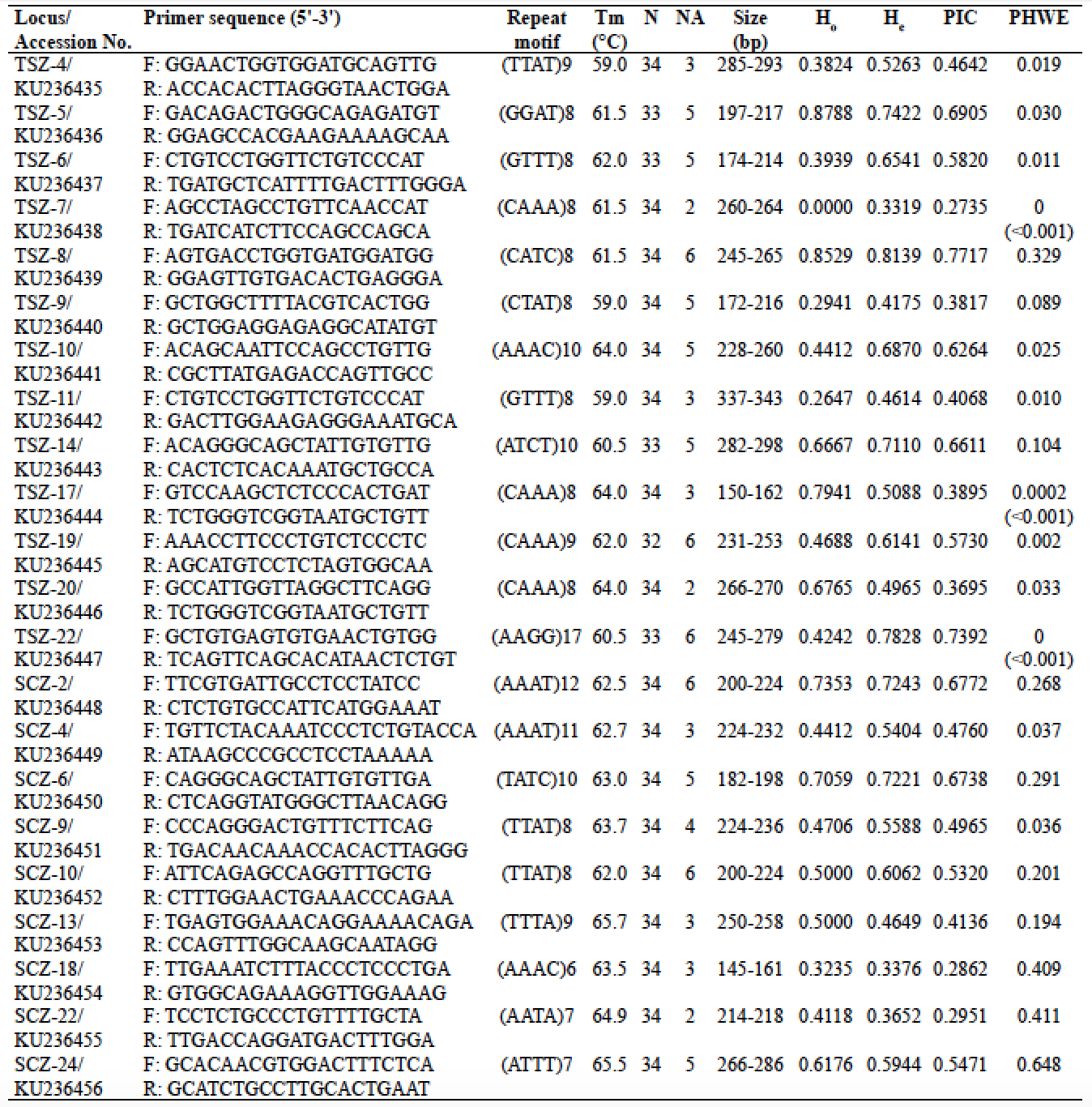
Primer sequences and characteristics of 22 tetranucleotide microsatellite loci isolated in Tetraophasis
References
- Christiakov, D.A., Hellemans, B. and Volckaert, F.A.M., 2006. Aquaculture., 255: 1-29. https://doi.org/10.1016/j.aquaculture.2005.11.031[CrossRef]
- Cockburn, A., 2006. Proc. R Soc. B-Biol., 273: 1375-1383.
- Du, L.M., Li, Y.Z., Zhang, X.Y. and Yue, B.S., 2013. J. Hered., 104: 154-157. https://doi.org/10.1093/jhered/ess082[CrossRef]
- Henry, I., Antoniazza, S., Dubey, S., Simon, C., Waldvogel, C., Burri, R. and Roulin, A., 2013. PLoS One, 8: e80112. https://doi.org/10.1371/journal.pone.0080112[CrossRef]
- Johnsgard, P.A., 1988. The quails, partridges, and francolines of the world. Oxfor University Press, New York, USA.
- Kalinowski, S.T., Taper, M.L. and Marshall, T.C., 2007. Mol. Ecol., 16: 1099-1106. https://doi.org/10.1111/j.1365-294X.2007.03089.x[CrossRef]
- Mackinnon, J.R., Phillipps, K. and He, F.Q., 2000. A field guide to the birds of China. Oxford University Press, New York, USA.
- Oosterhout, C.V., Hutchinson, W.F., Wills, D.P.M. and Shipley, P., 2004. Mol. Ecol. Notes, 4: 535-538. https://doi.org/10.1111/j.1471-8286.2004.00684.x[CrossRef]
- Perlin, M.W., Lancia, G. and Ng, S.K., 1995. Am. J. Hum. Genet., 57: 1199-1210.
- Raymond, M. and Rousset, F., 1995. J. Hered., 86: 248-249. https://doi.org/10.1093/oxfordjournals.jhered.a111573[CrossRef]
- Wang, B., Zhang, B., Yang, N., Dou, L. and Ran, J.H., 2017. Pakistan J. Zool., 49: 573-579. http://dx.doi.org/10.17582/journal.pjz/2017.49.2.573.579[CrossRef]
- Wu, A.L., Zhang, X.Y., Yang, N., Ran, J.H., Yue, B.S. and Li, J., 2010. Conserv. Genet. Resour., 2: 85-87 https://doi.org/10.1007/s12686-010-9187-4.[CrossRef]
- Xu, Y., Yang, N., Zhang, K., Yue, B.S. and Ran, J.H., 2011. J. Ornithol., 152: 695-700. https://doi.org/10.1007/s10336-011-0651-z[CrossRef]
- Yan, M., Zhang, X., Yang, N., Xu, Y., Yue, B. and Ran, J., 2011. Russ. J. Genet., 47: 201-204. https://doi.org/10.1134/S1022795410081022[CrossRef]
- Zhou, X., Xu, Y., Ran, J.H., Yue, B.S., Cao, L.S. and Li, J., 2009. Eur. J. Wildl. Res., 55: 81-83. https://doi.org/10.1007/s10344-008-0217-4[CrossRef]
Services
Article usage statistics
Loading…