
The continual depletion of fossil fuel resources has drawn attention to the value of renewable fuels, specifically bioethanol, to resolve future demands for energy. Utilizing the method of simultaneous saccharification and fermentation (SSF), the conversion of lignocellulosic biomass into bioethanol has become a remarkable industrial process that can improve bioethanol yields. This study aimed to use the thermo- and ethanol tolerant Pichia kudriavzevii and Candida tropicalis strains to study the SSF using the sugar cane bagasse as a substrate for bioethanol production. The optimization of growth and fermentation parameters was carried out to maximize the bioethanol yield. Prior to SSF, one liter of the bioethanol production was verified and confirmed through fermentation under optimized conditions, with P. kudriavzevii and C. tropicalis producing approximately 8.95 g/l and 4.97 g/l bioethanol, respectively. Afterward, SSF was conducted in 100 ml under optimized conditions using a cellulase enzyme loading of 30 Filter paper units/g biomass (FPU/g biomass), followed by the incubation. The concentration of the produced bioethanol was about 51.04 g/l by the control baker’s yeast strain (Saccharomyces cerevisiae), 68.72 g/l by P. kudriavzevii, and 55.30 g/l by C. tropicalis. These concentrations were determined utilizing the distillate through the gas chromatography headspace sampling (GCHS) method. All these results evidently proved that these two yeast strains were better than the control strain for bioethanol production. The concentration of a reducing sugar was also measured by utilizing 3,5-dinitrosalicylic acid (DNS) method. The obtained results clearly displayed the greater level a reducing sugar utilization and the prime activity of the cellulase enzyme for the bioethanol production. The new approach known as Response Surface Methodology was employed to optimize the SSF and improve the bioethanol yield by using the Design Expert 13 software.
Research Article · Volume 10, Issue 5, 7 October 2026 · Open Access
Bioprocessing of Simultaneous Saccharification and Fermentation of Bagasse for Bioethanol Production from the Stress-Tolerant Pichia kudriavzevii and Candida tropicalis Yeast Strains
· ·
Affiliations & Notes ⌄
- 1Department of Studies in Biotechnology, Davangere University, Shivagangothri, Davangere-577007, Karnataka, India
- 2Department of Biotechnology, BIET, Davangere, Karnataka, India. *Correspondence | Seema J. Patel, Department of Studies in Biotechnology, Davangere University, Shivagangothri, Davangere-577007, Karnataka, India
- 3Email: ssjp176@gmail.com
Article Info ⌄
- Journal:
- Novel Research in Microbiology Journal
- Published:
- 7 October 2026
From the article
- The optimization of yeast’s growth and the fermentation process played a major role in achieving an efficient bioethanol production.
- Response surface methodology (RSM) proved to be an effective statistical approach for optimizing the important variables impacting bioethanol production, such as temperature and incubation time.
- The results revealed that the SSF was the most promising strategy for increasing bioethanol production from sugarcane bagasse.
- This approach is useful in eco-friendly biofuel production, increases biomass usage, and improves process economics.
Selected from the article's own text.
Abstract
Introduction
Bioethanol has the potential to replace fossil fuels, as they are non-renewable and are being exhausted day by day in nature. Fermentative technologies stand out because they harness the microbial metabolism to turn simple raw materials into high-value products. The use of lignocellulosic biomass has been intimately linked to a new industrial approach known as biorefinery, which emerges as a critical strategy to substantially increasing the desired bioethanol production . The Gulf Oil Company, US, and the University of Arkansas developed the exclusively microbe-derived Simultaneous Saccharification and Fermentation (SSF) process, which overcome the limitations of the separate hydrolysis and fermentation (SHF) process. A microorganism-driven SSF approach facilitates simultaneous fermentation and saccharification at an optimal enzyme activity in a single vessel with a little sugar deposition. While bioethanol is produced in a single tank, this approach reduces the microbial contamination. SSF produces more efficient and effective bioethanol compared to the separate hydrolysis and fermentation process . Although lignocellulosic biomass is abundant, producing bioethanol from it can offer a domestic fuel supply that will minimize our dependency on these vulnerable petroleum-based fuel supplies and decrease the trade deficit . SSF combines cellulose hydrolysis by enzymes with concurrent sugar fermentation to produce bioethanol, thereby alleviating the problems caused by product inhibition . Bagasse, which is made up of three polymers, mainly cellulose, hemicellulose, and lignin is a common organic material found in nature . Bioethanol production can be facilitated by the use of cellulase enzymes, which have the ability to convert cellulose into glucose. Following that, glucose is converted into bioethanol by the activity of yeasts . In this study, a SSF was carried out for bioethanol production using bagasse as a raw material in the presence of a commercially available cellulase enzyme by the thermos- and ethanol-tolerant yeast strains isolated from local fermented foods. The objective of this study was to use SSF for bioethanol production utilizing bagasse as a raw material in the presence of a commercially available cellulase enzyme by the thermos- and ethanol-tolerant yeast strains isolated from local fermented foods.
Materials and Methods
Isolation and identification of the yeast strains
The isolation, screening of thermo and ethanol tolerance were completed, and molecular identification was carried out using the ITS gene with universal primers for PCR. The NCBI tools and MEGA software were used to construct a phylogenetic tree. Based on their similarities, the isolates’ were identified and their sequences were submitted to NCBI GenBank, recording Pichia kudriavzevii (acc. no. PV658848) and C. tropicalis (acc. no. PV621843), as mentioned in the previous study conducted by Pujar et al. (2026).
Growth optimization for fermentation
Optimization of carbon source
The yeast extract peptone (YEP) broth medium involving individual carbon sources such as D-glucose (dextrose) and sucrose was individually inoculated with a 48-h yeast culture and incubated for 48 to 72 h at 30°C. The optimum yeast’s growth and maximum biomass production were detected by measuring the optical density at 600 nm .
Optimization of pH
The YEP broth medium with a selected carbon source and different pH levels, including 3, 3.5, 4, 4.5, 5, 5.5, and 6, was individually inoculated with a 48 h yeast culture, and incubated for 48 to 72 h at 30 oC. The optimum pH for the yeast’s growth was detected by measuring the optical density at 600 nm .
Optimization of temperature
The YEP broth medium with a selected carbon source was inoculated with a 48 h yeast culture, and incubated for 48 to 72 h at different temperatures, including 30°C, 35°C, 40°C, 45°C, and 50°C. The optimum temperature for yeast’s growth was detected by measuring the optical density at 600 nm .
Optimization of fermentation conditions for bioethanol production
Optimization of fermentation conditions for bioethanol production was carried out in a 100 ml YEP broth medium with optimized carbon source, considering three parameters: Medium concentration, temperature, and incubation period. The 48 h yeast cultures with the control strain (bakery’s yeast S. cerevisiae) were inoculated individually into the single and double-strength YEP broth medium with optimized pH and carbon source, and incubated at different temperatures, such as 30 °C, 40 °C, and 50 °C, for 3-6 d of incubation.
Glucose fermentation
Using the optimized parameters, including double-strength YEP broth medium, optimized carbon source, and incubation temperature of 40°C, the 48 h yeast cultures and the control strain were employed for the 1 l fermentation broth medium with 3-6 d of incubation. The bioethanol concentration was determined according to Caputi et al. (1968). The concentration of the resulting reducing sugar was calculated using the DNS method . In this method, the sample was treated with DNS reagent, heated in a boiling water bath to produce the distinctive orange-red color, cooled, and the absorbance was determined spectrophotometrically at 540 nm using glucose as the baseline.
Bioethanol estimation
Bioethanol concentration was determined using the spectrophotometric method according to Caputi et al. (1968). The fermented sample (2 ml) was distilled at 65°C in a distillation flask containing 50 ml of distilled water. In a conical flask, 15 ml of the distillate were collected and 25 ml of chromic acid were added. The volume was increased to 50 ml by adding distilled water. In a water bath, the conical flasks were incubated at 60°C for 30 min. Afterward, the solutions were cooled to room temperature before being spectrophotometrically measured at 600 nm. The standard graph, which was created using absolute alcohol in the range of 0 to 10%, was employed to determine the alcohol percentages of the samples.
Study of the simultaneous saccharification and fermentation with bagasse
The sugar cane bagasse was collected from a locally available juice center, without adding any other ingredients, such as ice, lemon, etc. It was washed with tap water to remove the soil particles and dust and the collected bagasse was shadow dried for 2-3 d. The dried bagasse was ground using a grinder machine (miller) into a fine powder and sieve. Steam pretreatment was carried out for the bagasse powder in an autoclave at 15 psi (121 °C) for about 60 min. Afterward, it was dried, cooled at room temperature, and maintained in 5% moisture content. The soluble sugars released during pretreatment were retained by avoiding the washing procedure before fermentation. The SSF medium contained 50 g/l pretreated bagasse, 3 g/l yeast extract, 1 g/l NaCl, 2 g/l KH2PO4, 0.2 g/l CaCl2, 1.7 g/l MgSO4, where the commercially available cellulase enzyme was added at the rate of 30 FPU/g of biomass . The 1% inoculum of the 48 h yeast strain was inoculated individually onto this medium and incubated at 40 °C for 3 and 6 d. After complete distillation of the fermentation medium, the distillate was collected and the concentration of bioethanol was measured using a headspace gas chromatography (HS-GC-FID) referring to ethanol standards for calibration. A measured volume of the fermentation distillate was transferred into a sealed headspace vial, equilibrated at 105 °C for 3 min, and the vapor phase was analyzed by GC-FID. Ethanol concentration was calculated from the calibration curve . The concentration of the reducing sugars was evaluated using the DNS method. All experiments were performed in triplicate and the results are presented as mean values.
Compositional analysis of bagasse
Van Soest-type gravimetric analysis and NREL/TP guidelines were utilized for the determination of cellulose, hemicellulose, and lignin contents in the bagasse powder at two conditions, before steam treatment and after steam treatment ; .
Optimization of SSF using the response surface methodology
The central composite design response surface tool was employed to optimize the SSF with two major variables, mainly temperature and incubation time, using the Design Expert 13 software .
Statistical analysis
All experimental results were statistically analyzed using analysis of variance (ANOVA) to determine the significance of differences among the treatments. All experiments were conducted in triplicate and the results are expressed as mean values. Differences among treatments were considered statistically significant at p < 0.05.
Results and Discussion
Growth optimization for fermentation
The three tested parameters, mainly carbon source, pH, and incubation temperature were selected and checked to determine maximum growth of the yeast strains. P. kudriavzevii showed maximum growth with sucrose at pH 7.0, whereas C. tropicalis exhibited an optimum growth with glucose at pH 6.0, indicating strain-dependent differences in carbohydrate utilization and pH preference. Both strains showed good growth between 30°C and 40°C, with maximum growth observed at 40°C, suggesting their potential thermotolerant characteristics. The optimum temperature observed for P. kudriavzevii was comparable with the previous reports describing this species as a thermotolerant yeast capable of efficient growth and bioethanol production at elevated temperatures. Similarly, Yuangsaard et al. (2013) demonstrated that the thermotolerant strain P. kudriavzevii DMKU 3-ET15 efficiently fermented glucose-containing medium at pH 5.0 and 40°C, confirming the importance of carbon source and environmental conditions in determining yeast fermentation performance. The observed differences in optimum carbon source and pH between the two strains may be attributed to strain-specific metabolic characteristics and differences in nutrient assimilation. Overall, the ability of both strains to grow efficiently at 40 °C highlights their potential suitability for high-temperature fermentation processes.
Optimization of fermentation for bioethanol production
The fermentation was carried out in both single and double strength 100 ml medium with different temperatures such as 30°C, 40°C and 50°C, and for 3 d and 6 d incubation time. In the single strength medium, both yeast’s strains with the control strain (S. cerevisiae) showed nearly the same ethanol production at 30°C and 40°C for 3 and 6 d incubation time, but no bioethanol production was recorded at 50°C. In double strength medium, there was a difference in the bioethanol production with respect to the temperature and incubation time. At 30°C for 3 and 6 d of incubation, both yeast strains displayed a greater bioethanol production compared to the control strain. At 40°C, both strains expressed a little lower concentration of bioethanol production, compared to the fermentation at 30°C, but was greater than the control strain. Based on these obtained results, the 40°C incubation for 3 and 6- day was selected as the optimum fermentation condition for further work, because as mentioned earlier both yeast strains were thermotolerant. In accordance, Nadeem et al. (2015) demonstrated that optimization of the parameters, such as temperature and period of incubation are used to maximize the production of bioethanol.
Glucose fermentation
The glucose fermentation was conducted to check and verify the use of large volume fermentation medium for bioethanol production. The observed optimized conditions were employed, and after incubation, the bioethanol concentration was determined. Both yeast strains, P. kudriavzevii and C. tropicalis, produced the bioethanol of about 8.95 g/l and 4.97 g/l concentration, which was the higher concentrations of bioethanol produced compared to the control strain , recording 2.13 g/l (Table 1). P. kudriavzevii and C. tropicalis produced more bioethanol, evidenced by their effective use of glucose under ideal fermentation conditions. Compared to C. tropicalis and the control S. cerevisiae, P. kudriavzevii demonstrated a superior fermentative capability, as evidenced by the substantially higher bioethanol produced concentration. A 8.98 g/l bioethanol concentration was reported by Khonngam and Salakkam (2019) in a similar study that used sugarcane bagasse for biological conversion by S. cerevisiae TISTR 5339 strain, which was close to the concentration obtained in the present study. Before and after fermentation, the reducing sugar was also estimated by the DNS method. For bioethanol production, the two yeast strains and the control one showed a greater level of utilization of the reducing sugar, recording 0.80 g/l, 1.08 g/l, and 0.87 g/l by the S. cerevisiae, P. kudriavzevii, and C. tropicalis, respectively (Table 2). All these results were analyzed statistically by ANOVA tools.
Table 1: Bioethanol concentration obtained from glucose fermentation.
|
The concentration of bioethanol (g/l) |
||
|
Isolates |
3 d of incubation |
6 d of incubation |
|
Control |
0 |
0 |
|
S. cerevisiae (control strain) |
2.01 |
2.13 |
|
P. kudriavzevii |
6.81 |
8.95 |
|
C. tropicalis |
3.70 |
4.97 |
Table 2: The concentration of the reducing sugars utilized in glucose fermentation process.
|
Reducing sugars concentration (g/l) |
|||
|
Isolates |
Before fermentation |
After fermentation |
|
|
3 d of incubation |
6 d of incubation |
||
|
Saccharomyces cerevisiae (control strain) |
4.7 |
7.7 |
0.80 |
|
Pichia kudriavzevii |
8.1 |
7.3 |
1.08 |
|
Candida tropicalis |
4.7 |
6.75 |
0.87 |
Simultaneous saccharification and fermentation with bagasse
The SSF was carried out in both single- and double-strength 100 ml medium under optimum fermentation conditions. Initially, ethanol concentration was determined by the spectrophotometric method as mentioned above in a double-strength medium for 6 d of incubation. The yeast strains, including the control strain, showed high bioethanol concentrations of about 4.26 g/l, 11.83 g/l, and 11.36 g/l for the baker’s yeast, P. kudriavzevii, and C. tropicalis, respectively. After incubation, complete distillation was performed for the SSF medium and bioethanol concentration was estimated using the distillate by the GCHS method. The obtained results were 51.04 g/l by baker’s yeast, 68.72 g/l by P. kudriavzevii, and 55.30 g/l by C. tropicalis, as illustrated in Figure 1A, B. The higher bioethanol concentration in the double-strength SSF medium displayed that lignocellulosic sugars were converted efficiently under optimum fermentation conditions. By both spectrophotometric and GC-HS analysis, P. kudriavzevii produced the highest bioethanol concentration among the tested strains, demonstrating its superior fermentative ability and potential for bioethanol production at increasing substrate volume. In a similar study, Silva et al. (2015) demonstrated that bioethanol concentration of 29.2 g/l was obtained from the SSF using bagasse and the thermotolerant yeast Kluyveromyces marxianus IMB3 strain. Collectively, these results demonstrated that the two yeast strains exhibited a superior ethanol-producing potential compared to the control strain. The DNS method was used to evaluate the concentration of the reducing sugar, both before and after the SSF. The control, consisting of SSF medium supplemented with cellulase without yeast inoculation showed a continuous increase in reducing sugar concentration throughout the SSF process. Still, the tested yeast strains exhibited an increased reducing sugar concentration after 3 d of incubation, and then the reducing sugar concentration decreased after 6 d of incubation. These results indicated that the control was used to evaluate the contribution of enzymatic hydrolysis, while the experimental treatments containing yeast strains demonstrated the contribution of yeast-mediated sugar utilization for bioethanol production. Additionally, these results manifested that the cellulase enzyme was actively involved in SSF and successfully broke down the cellulose (Table 3). All these results were analyzed statistically by ANOVA tools.
Compositional analysis of bagasse
The concentration of major structural components such as cellulose, hemicellulose, and lignin of the bagasse used for SSF was determined at two different conditions, mainly before and after steam treatment. The BST (before steam treatment) contents of the bagasse sample involved 19.3% cellulose, 13% hemicellulose, and 2.7% lignin, and the AST (after steam treatment) contents of bagasse sample contained 30.9% cellulose, 21% hemicellulose, and 1.1% lignin. These obtained results revealed that steam pretreatment was an effective strategy for degradation of biomass components of the sugarcane bagasse. The lignocellulosic matrix was disrupted by steam treatment, which raised the relative amounts of cellulose and hemicellulose while decreasing lignin. Kasperski et al. (2026) reported similar compositional changes for steam-pretreated sugarcane bagasse, where an increased relative cellulose fraction was caused by rupture of the lignocellulosic matrix and preferential solubilization of hemicellulose.
Optimization of SSF using the response surface methodology
The response surface methodology (RSM) was used to optimize the parameters for SSF, thereby maximizing the bioethanol production. In this study, only two different variables such as temperature and incubation time, and one response, mainly bioethanol production, were employed to analyze the response
Table 3: Concentration of the reducing sugars utilized in simultaneous saccharification and fermentation process.
|
Isolates |
Single strength medium (g/l) |
Double strength medium (g/l) |
||||
|
Before inoculation |
3 d of incubation |
6 d of incubation |
Before inoculation |
3 d of incubation |
6 d of incubation |
|
|
Control |
9.3 |
10 |
12 |
11.4 |
15.8 |
17.6 |
|
Saccharomyces cerevisiae (control strain) |
9.3 |
5.3 |
4.9 |
11.4 |
12.5 |
10.7 |
|
Pichia kudriavzevii |
9.3 |
5.7 |
5 |
11.4 |
10 |
8.7 |
|
Candida tropicalis |
9.3 |
3.3 |
3 |
11.4 |
9.1 |
7.3 |
Table 4: ANOVA and fit statistics for quadratic model for Pichia kudriavzevii.
|
Source |
Sum of squares |
Degrees of freedom |
Mean square |
F value |
p value |
|
|
Quadratic model |
3547.17 |
5 |
709.43 |
9.75 |
0.0129 |
Significant |
|
A. Temperature |
442.28 |
1 |
442.28 |
6.08 |
0.0568 |
|
|
B. Incubation time |
588.78 |
1 |
588.78 |
8.09 |
0.0360 |
|
|
AB |
2.78 |
1 |
2.78 |
0.0383 |
0.8526 |
|
|
A² |
2318.84 |
1 |
2318.84 |
31.88 |
0.0024 |
|
|
B² |
39.08 |
1 |
39.08 |
0.5372 |
0.4965 |
|
|
Residual |
363.72 |
5 |
72.74 |
|||
|
Cor. total |
3910.89 |
10 |
Where; Model: refers to the overall fitted quadratic regression model, not to an individual factor, Significant: indicates that the effect or model is statistically significant or meaningful, usually when p < 0.05. Cor. Total: refers to corrected total. The p-value of the quadratic model was less than 0.05, hence, it was statistically significant.
Table 5: ANOVA and fit statistics for quadratic model for Candida tropicalis.
|
Source |
Sum of squares |
Degrees of freedom |
Mean square |
F value |
p value |
|
|
Quadratic model |
2554.68 |
5 |
510.94 |
12.76 |
0.0071 |
Significant |
|
A. Temperature |
326.83 |
1 |
326.83 |
8.16 |
0.0355 |
|
|
B. Incubation time |
415.05 |
1 |
415.05 |
10.37 |
0.0235 |
|
|
AB |
0.1623 |
1 |
0.1623 |
0.0041 |
0.9517 |
|
|
A² |
1654.51 |
1 |
1654.51 |
41.32 |
0.0014 |
|
|
B² |
23.75 |
1 |
23.75 |
0.5931 |
0.4760 |
|
|
Residual |
200.20 |
5 |
40.04 |
|||
|
Lack of fit |
187.70 |
4 |
46.93 |
3.75 |
0.3670 |
Non-significant |
|
Pure error |
12.50 |
1 |
12.50 |
|||
|
Cor. total |
2754.88 |
10 |
Where; Model: refers to the overall fitted quadratic regression model, not to an individual factor, Significant: indicates that the effect or model is statistically significant or meaningful, usually when p < 0.05. Cor. None significant means it was statistically not significant because it has a p-value greater than 0.05. Total: refers to corrected total. The p-value of the quadratic model was less than 0.05, hence, it was statistically significant.
surface of the obtained SSF results using the specific software Design Expert 13 version. The central composite design response surface tool was engaged to perform the analysis of SSF results of the two tested yeast strains individually. The RSM of the P. kudriavzevii strain was fitted by a quadratic model for ANOVA with a p-value 0.0129 (Table 4), which was less than 0.05 p-value, hence this analysis was significant. The actual value of bioethanol production (68.72 g/l ) was higher than the predicted value of 57.29 g/l, which was determined by plotting the contour and 3D surface graphs, as shown in Figure 1A, B. For the C. tropicalis, strain the quadratic model for ANOVA was fitted with the p-value 0.0071 (Table 5) and was less than the 0.05 p-value, hence it was a significant analysis. The lack of fit residual model was not significant because the obtained p-value was higher than 0.05. The actual bioethanol production concentration of 55.3 g/l was greater than the predicted value of 41.06 g/l, which was determined by plotting the contour and 3D surface graphs, as shown in Figure 2A, B. The bioethanol production during SSF was remarkably influenced by temperature and incubation time, as evidenced by the substantial quadratic models constructed for both P. kudriavzevii and C. tropicalis. Tadesse et al. (2024) reported similar findings and demonstrated that fermentation temperature and incubation time were major variables influencing bioethanol production and that a quadratic model effectively clarified the experimental data. In the present investigation, the optimized fermentation process was further substantiated by the higher experimental bioethanol concentrations compared to the predicted values.
Conclusions and Recommendations
This study showed that by employing thermo- and ethanol-tolerant yeast strains P. kudriavzevii, and C. tropicalis in the simultaneous saccharification and fermentation (SSF) process, sugarcane bagasse was efficiently utilized as a sustainable lignocellulosic feedstock for the production of bioethanol at concentrations of about 68.72 g/l by P. kudriavzevii, and 55.30 g/l by C. tropicalis. The optimization of yeast’s growth and the fermentation process played a major role in achieving an efficient bioethanol production. Response surface methodology (RSM) proved to be an effective statistical approach for optimizing the important variables impacting bioethanol production, such as temperature and incubation time. The results revealed that the SSF was the most promising strategy for increasing bioethanol production from sugarcane bagasse. This approach is useful in eco-friendly biofuel production, increases biomass usage, and improves process economics. Compared to separate hydrolysis and fermentation processes, the SSF facilitated the integration of an enzymatic hydrolysis and fermentation in a single bioreactor; thus, reducing the contamination risks and operating costs, and improving the process efficiency. Further investigations involving pilot-scale validation, strain improvement, enzyme recycling, and techno-economic analysis are highly recommended to aid in commercial adoption of this technique.
Acknowledgements
The authors acknowledge the Department of Studies in Biotechnology, Davangere University, Shivagangothri, Davangere 577007, Karnataka, India, for providing the laboratory facilities.
Novelty Statement
The novelty of this study should be considered in the context of previous reports demonstrating the use of thermotolerant yeasts for SSF of lignocellulosic biomass. The thermotolerant yeasts have previously been investigated to overcome the temperature difference between enzymatic saccharification and yeast fermentation. Moteover, P. kudriavzevii and Candida species have been previously reported for their high-temperature bioethanol production from various lignocellulosic substrates. Therefore, the present study does not claim the general use of thermotolerant yeasts for sugarcane bagasse SSF as a novel strategy. Instead, its novelty lies in the evaluation of the specific indigenous P. kudriavzevii and C. tropicalis strains obtained from traditional fermented foods, particularly their combined thermo- and ethanol-tolerance characteristics and their fermentation performance in sugarcane bagasse-based SSF. Their performance was evaluated against a control strain under comparable experimental conditions and both strains demonstrated higher bioethanol production under the optimized conditions. Thus, the contribution of this study is the identification and evaluation of these indigenous tolerant strains as promising candidates for further development and optimization of lignocellulosic bioethanol production, rather than the introduction of SSF or thermotolerant yeast technology itself.
Author’s Contribution
SJP: Conceptualization, validation, visualization, and supervision.
GP: Conceptualization, methodology, validation, investigation, resources, data curation, writing original draft, writing review and editing, software and visualization.
BH: Writing review and editing.
Funding source
This work didn’t receive any funding.
Generative AI and AI assisted technology statement
The authors declare that no generative AI and AI assisted technology was used in the creation of this manuscript.
Conflict of interests
The authors declare no conflicts of interest.
Figures
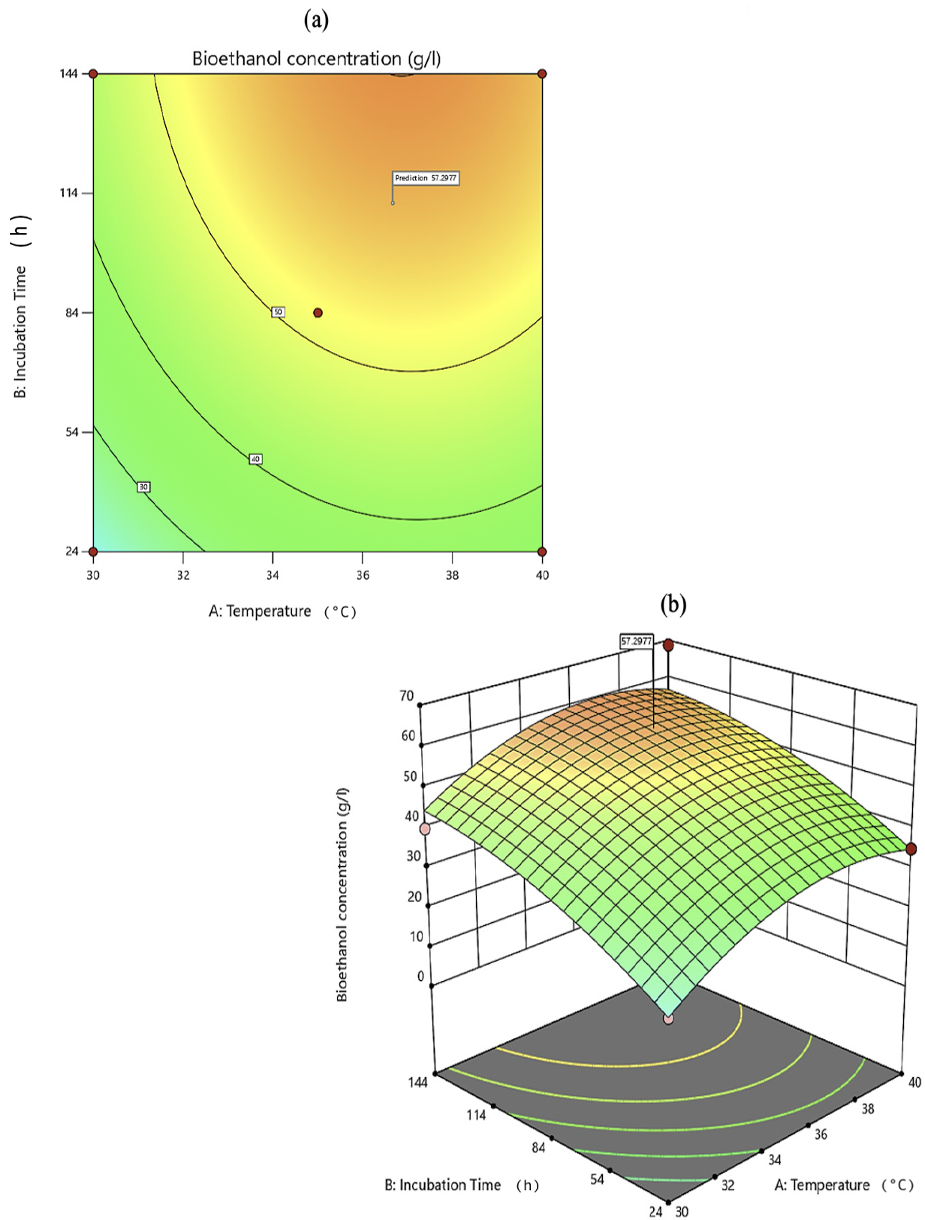
Response surface methodology of the P. kudriavzevii strain, (A) Contour plot graph and (B) 3D surface graph.
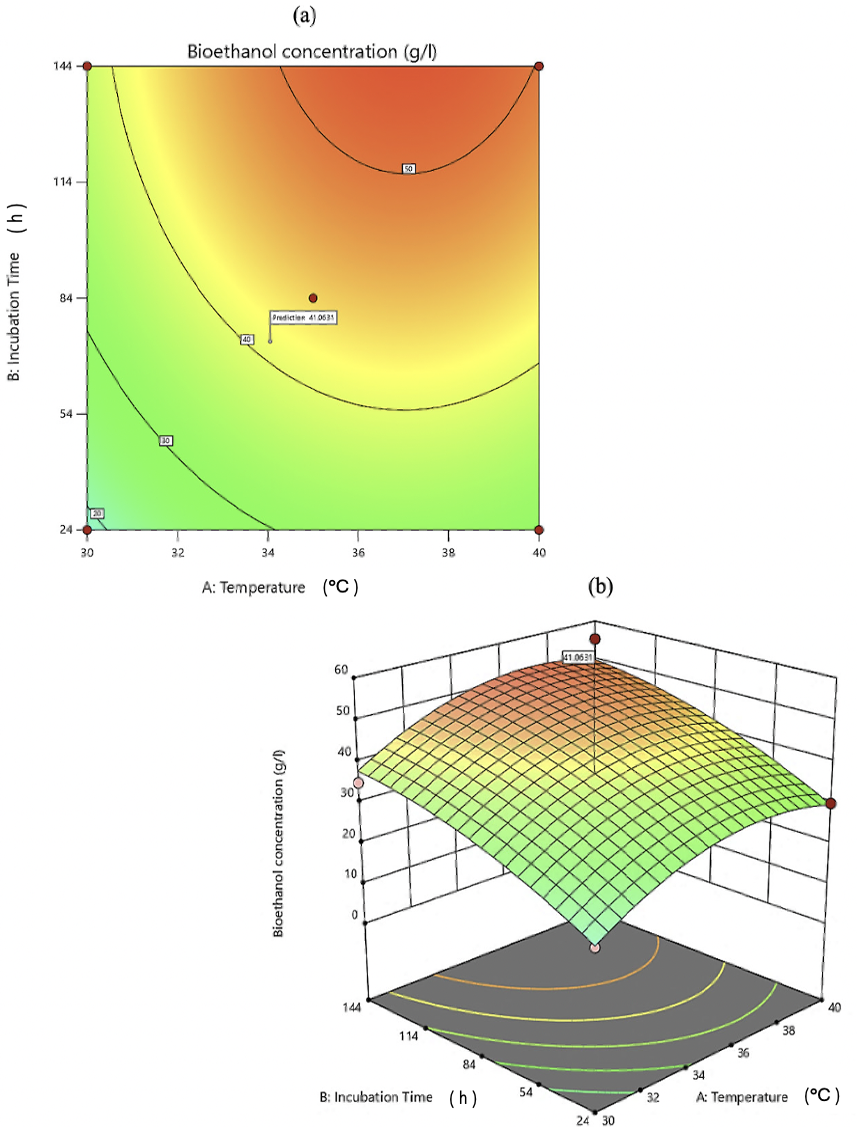
Response surface methodology of the C. tropicalis strain, (A) Contour plot graph and (B) 3D surface graph.
References
- Afedzi, A.E.K. and Parakulsuksatid, P., 2023. Recent advances in process modifications of simultaneous saccharification and fermentation (SSF) of lignocellulosic biomass for bioethanol production. Biocatal. Agric. Biotechnol., 52: 102961. https://doi.org/10.1016/j.bcab.2023.102961[CrossRef]
- Caputi, A., Ueda, M. and Brown, T.D., 1968. Spectrophotometric determination of ethanol in wine. Am. J. Enol. Vitic., 19(3): 160-165. https://doi.org/10.5344/ajev.1968.19.3.160[CrossRef]
- Cavalaglio, G., Gelosia, M., Ingles, D., Pompili, E., D’Antonio, S. and Cotana, F., 2016. Response surface methodology for the optimization of cellulosic ethanol production from Phragmites australis through pre-saccharification and simultaneous saccharification and fermentation. Ind. Crops Prod., 83: 431-437. https://doi.org/10.1016/j.indcrop.2015.12.089[CrossRef]
- Elumalai, S. and Thangavelu, V., 2010. Simultaneous saccharification and fermentation (SSF) of pretreated sugarcane bagasse using cellulase and Saccharomyces cerevisiae: Kinetics and modeling. Chem. Eng. Res. Bull., 14(1). https://doi.org/10.3329/cerb.v14i1.4156[CrossRef]
- González-Gloria, K.D., Tomás-Pejó, E., Amaya-Delgado, L., Rodríguez-Jasso, R.M., Loredo-Treviño, A., Singh, A., Hans, M., Martín, C., Kumar, S. and Ruiz, H.A., 2024. Biochemical and biorefinery platform for second-generation bioethanol: Fermentative strategies and microorganisms. Fermentation, 10(7): 361. https://doi.org/10.3390/fermentation10070361[CrossRef]
- Kareem, M.A.J., Ahmad, M., Farooq, M., Chen, Y.-F., Mustaqeem, M., Ali, A., Sk, A.A., Abbas, A. and Hakeem, A.S., 2024. Trends and advances in sustainable bioethanol production technologies from first to fourth generation: A critical review. Energy Convers. Manag., 321: 119037. https://doi.org/10.1016/j.enconman.2024.119037[CrossRef]
- Kasperski, S.D., Bosman, C.E., Petersen, A.M., Görgens, J.F. and van Rensburg, E., 2026. Bioconversion of steam-exploded sugarcane bagasse to microbial protein: An experimental investigation and techno-economic analysis. Waste Biomass Valor., 17(2): 801-815. https://doi.org/10.1007/s12649-025-03152-z[CrossRef]
- Khonngam, T. and Salakkam, A., 2019. Bioconversion of sugarcane bagasse and dry spent yeast to ethanol through a sequential process consisting of solid-state fermentation, hydrolysis, and submerged fermentation. Biochem. Eng. J., 150: 107284. https://doi.org/10.1016/j.bej.2019.107284[CrossRef]
- Li, H., Chai, X.-S., Deng, Y., Zhan, H. and Fu, S., 2009. Rapid determination of ethanol in fermentation liquor by full evaporation headspace gas chromatography. J. Chromatogr. A, 1216(1): 169-172. https://doi.org/10.1016/j.chroma.2008.11.024[CrossRef]
- Mamun-Or-Rashid, A.N.M., Lucy, T.T. and Pramanik, M.K., 2022. Isolation, identification, optimization of baker’s yeast from natural sources, scale-up production using molasses as a cheap carbohydrate source, and evaluation for bread production. Appl. Microbiol., 2(3): 516-533. https://doi.org/10.3390/applmicrobiol2030040[CrossRef]
- Miller, G.L., 1959. Use of dinitrosalicylic acid reagent for determination of reducing sugar. Anal. Chem., 31(3): 426-428. https://doi.org/10.1021/ac60147a030[CrossRef]
- Nadeem, M., Aftab, M.U., Irfan, M., Mushtaq, M., Qadir, A. and Syed, Q., 2015. Production of ethanol from alkali-pretreated sugarcane bagasse under the influence of different process parameters. Front. Life Sci., 8(4): 358-362. https://doi.org/10.1080/21553769.2015.1044620[CrossRef]
- Pujar, G., Patel, S.J., B.R, K. and Tilve, G.G., 2026. Bioprospecting of thermotolerant and ethanol tolerant fermentative potential yeasts from indigenous fermented foods. Adv. Eng. Sci., 58(1): 2800-2812.
- Rulianah, S., Gunawan, P., Hendrawati, N. and Nafisa, K.N., 2020. Production of bioethanol from bagasse with a simultaneous saccharification and fermentation (SSF) process using crude cellulase from Phanerochaete chrysosporium. AIP Conf. Proc., 2197(1): 030007. https://doi.org/10.1063/1.5140899[CrossRef]
- Rulianah, S., Prayitno and Maulidina, C.A., 2022. Utilization of bagasse for bioethanol raw materials using crude cellulase from Phanerochaete chrysosporium with SSF method. Proc. 4th Int. Conf. Life Sci. Biotechnol., 399-408. https://doi.org/10.2991/978-94-6463-062-6_40[CrossRef]
- Silva, G.M. da, Giordano, R.L.C. de, Cruz, A.J.G. da, Ramachandriya, K.D., Banat, I.M. and Wilkins, M.R., 2015. Ethanol production from sugarcane bagasse using SSF process and thermotolerant yeast. Trans. ASABE, 58(2): 193-200. https://doi.org/10.13031/trans.58.11024[CrossRef]
- Sluiter, A., Hames, B., Ruiz, R., Scarlata, C., Sluiter, J., Templeton, D. and Crocker, D., 2008. Determination of structural carbohydrates and lignin in biomass. Lab. Anal. Proced., 1617(1): 1-16.
- Tadesse, T., Dase, D., Koricha, A.D. and Bacha, K., 2024. Optimization of bioethanol production using response surface methodology for stress-tolerant wild yeasts isolated from natural forests. Int. J. Energy Res., 2024(1): 7086047. https://doi.org/10.1155/2024/7086047[CrossRef]
- Tang, C., Cavka, A., Bui, M. and Jönsson, L.J., 2024. Comparison of simultaneous saccharification and fermentation with LPMO-supported hybrid hydrolysis and fermentation. Front. Bioeng. Biotechnol., 12: 1419723. https://doi.org/10.3389/fbioe.2024.1419723[CrossRef]
- Van Soest, P.J., Robertson, J.B. and Lewis, B.A., 1991. Methods for dietary fiber, neutral detergent fiber, and nonstarch polysaccharides in relation to animal nutrition. J. Dairy Sci., 74(10): 3583-3597. https://doi.org/10.3168/jds.S0022-0302(91)78551-2[CrossRef]
- Yuangsaard, N., Yongmanitchai, W., Yamada, M. and Limtong, S., 2013. Selection and characterization of a newly isolated thermotolerant Pichia kudriavzevii strain for ethanol production at high temperature from cassava starch hydrolysate. Antonie van Leeuwenhoek, 103(3): 577-588. https://doi.org/10.1007/s10482-012-9842-8[CrossRef]
Services
Article usage statistics
Loading…