
This study was designed to compare the efficient production of ethanol in separate hydrolysis and fermentation (SHF) and simultaneous saccharification and fermentation (SSF) process. Fungal strains of Saccharomyces cervisae, Trichoderma viride, Trichoderma koninji and Trichoderma harzianum was used for subsequent process using saw dust as substrate. Three major processes convert lignocelluloses to bioethanol i.e. pretreatment of biomass, enzymatic hydrolysis of raw material and fermentation. The sawdust was pretreated with 2.5% NaOH and further processed for SHF and SSF. Maximum saccharification was observed by T. viride (10.17%) followed by T. harzianum (9.19%) and T. koninji (6.91%) at 35ËšC for 48h. Among both strategies, SSF combination of T. viride and S. cerevisiae gave maximum ethanol production (3.88%) after 12 days of fermentation at 30ËšC.
Research Article · Volume 33, Issue 2, 20 November 2018 · Open Access
Bioethanol Production from Saw Dust through Simultaneous Saccharification and Fermentation
· · · · ·
Affiliations & Notes ⌄
- 1Center for Earth and Environmental Studies, University of the Punjab New Campus, Lahore, Pakistan. 2Food and Biotechnology research center (FBRC), Pakistan Council of Scientific & Industrial Research (PCSIR) Laboratories Complex Ferozpur Road, Lahore, Pakistan. 3Department of Biotechnology, University of Sargodha, Sargodha, Pakistan. , *Corresponding author: Muhammad Nadeem mnadeempk@yahoo.com
Article Info ⌄
- Journal:
- Punjab University Journal of Zoology
- Published:
- 20 November 2018

From the article
- In this study, saw dust was treated with 2.5% NaOH and further used for saccharification process.
- Results (Figure 1) indicated that the maximum sugars was produced from saw dust by T. viride (10.17%) followed by T. harzianum (9.19%) and T. koninji (6.91%) after 48h of incubation at 35oC.
- Results (Figure 2) revealed that maximum ethanol production was obtained from T. koninji (2.44%) hydrolyzates followed by T. viride (1.80%) and T. harzianum (1.30%) after 7 days of fermentation at 30˚C. After this, ethanol percentage started to decrease due to contamination of ethanol into undesired products.
- Ethanol production was also checked in simultaneous saccharification and fermentation.
Selected from the article's own text.
Abstract
Introduction
With the industrialization revolution, petroleum demand was increases also . Petroleum and diesel are considered non-renewable resources and will be scarce in near future. In recent times, there has been great concern in the production of substitute energy sources . Bioethanol was being widely recognized as a promising renewable and environment friendly source of energy. Meeting the demands of bioethanol depends upon a regular supply of its primary raw material, i.e. biomass. Biomass has been considered as a major source of energy and it provides 10-14% of energy worldwide .
A major component of naturally-occurring biomass is cellulose. Lignocellulosic material consists of six carbon sugar that has been used for bio-ethanol production . In nature cellulose is found in relation with other components, e.g. hemicellulose, lignin and pectin in an average of 4:3:3 but the exact percentage of this component varies from source to source . Three major unit processes convert lignocelluloses to bioethanol: pretreatment of raw material, pretreated raw material into fermentable sugar by using enzymatic hydrolysis and fermentation of sugars into bioethanol .
Pretreatment can be done by various methods like physical, chemical and biological . Pretreatment is required in order to efficiently hydrolyze the fibrous cellulose into monomeric sugar because of the hard nature of lignocellulosic biomass. The pretreated material are saccharified and fermented by using separate hydrolysis and fermentation (SHF) and simultaneous saccharification and fermentation (SSF) . Saccharification is done by cellulases and hemicellulases enzymes. Trichoderma species have capability to produce cellulolytic enzymes with efficient enzymatic activity . Fermentation is done by bacteria and yeast commonly used yeast such as Saccharomyces cerevisiae. In this work research has been made to compare the efficient bioethanol production from Trichoderma viride, Trichoderma koninjii and Trichoderma harzianum.
Materials and Methods
Lignocellulosic biomass
Saw dust used in this research was purchased from local market of Lahore city. The sawdust was washed, sun-dried followed by oven drying at 70oC till constant weight and packed into zipper bags for further use.
Microorganism
Fungal strains of Trichoderma viride, Trichoderma koninji and Trichoderma harzianum were obtained from a culture bank of Institute of Agriculture Science, University of the Punjab, new campus Lahore, Pakistan. The strains were sustained on potato dextrose agar slants and preserved at 4˚C for further use. Sacchromyces cervisae was obtained from Food and Biotechnology Research Center (FBRC), PCSIR and maintained on PDA then preserved at 4˚C.
Alkaline Pretreatment of Biomass
Pretreatment of sawdust was performed as described by Irfan et al., (2011). Briefly ten grams of sawdust was soaked in 100ml of 2.5% NaOH for 2 h at room temperature. Then sample was subjected to steam in an autoclave at 121˚C for 60 minutes. The solid material was washed with distilled water to get pH 7.
Simultaneous Saccharification and Fermentation
Simultaneous saccharification and fermentation strategy was applied for ethanol production. The medium comprised of (%) 0.2 MgSO4, 0.3 K2HPO4, 0.5 (NH4)2SO4, 0.3 Peptone, 0.3 yeast extract and 3% alkali pretreated sawdust as a carbon source. The medium was sterilized at 121oC for 15min at 15psi. After sterilization, the medium was inoculated with 1ml suspension of Saccharomyces cervisiae and 1ml of T. viride, T. koninji and T. harzianum in respective flasks and incubated at 30oC for 7 days with shaking speed of 120rpm. After finishing of fermentation time, the ethanol produced was estimated. This strategy was applied in sterilized and unsterilized conditions.
Analytical method
Cellulose of treated and untreated samples was measured by the method as described by Gopal and Ranjhan (1980). The lignin content of treated and untreated biomass was measured . Ash and Moisture contents were measured by AOAC (2005) methods. Reducing sugar was determined by Miller (1959) method. The amount of ethanol was estimated calorimetrically (Captui et al., 1968). The ethanol yield was measured by using the formula as described by Yoswathana and Phuriphipat (2010).
Ethanol yield=Ethanol measured in sample/Theoretical ethanol
Statistical Analysis
All the data collected was statistically analyzed using Microsoft excel program and values presented were the mean of triplicates.
Results and Discussion
In this study, saw dust was treated with 2.5% NaOH and further used for saccharification process. Untreated saw dust contains 42% cellulose and 12% lignin while alkali treated (2.5% NaOH) saw dust 22% cellulose and 10% lignin (Table 1). One research showed that increase in alkalinity of treating saw dust resulted lignin reduction . Lignin content decreased to 27.1%, 25.5% and 24.6% in the saw dust while increase in NaOH concentration of 0.5%, 1.0% and 2.0% respectively .
Table 1: Composition of raw material.
| Components | Untreated | Treated |
| Lignin (%) | 12 ± 1.2 | 10 ± 1.01 |
| Cellulose (%) | 22 ± 1.3 | 42 ± 1.6 |
| Ash (%) | 6 ± 0.2 | 4 ± 0.12 |
| Moisture (%) | 24 ± 1.7 | 4 ± 0.02 |
After pretreatment, saw dust was saccharified using T. harzianum, T. koninji and T. viride at 35˚C for 48h. Results (Figure 1) indicated that the maximum sugars was produced from saw dust by T. viride (10.17%) followed by T. harzianum (9.19%) and T. koninji (6.91%) after 48h of incubation at 35oC. Further increase in time period resulted decline in sugar production. Previous study shows that T. viride had ability to convert cellulose into glucose . The reducing sugar was maximum (55.27 mg/g) by saccharification of rice straw after 9 days of incubation at 27˚C .
After saccharification, ethanol production was conducted through separate hydrolysis and fermentation. Results (Figure 2) revealed that maximum ethanol production was obtained from T. koninji (2.44%) hydrolyzates followed by T. viride (1.80%) and T. harzianum (1.30%) after 7 days of fermentation at 30˚C. After this, ethanol percentage started to decrease due to contamination of ethanol into undesired products. In one research shows that T. viride produce maximum ethanol (17.54mg/ml of substrate) after 4 days of fermentation . Ayeni et al., (2016) reported that alkaline peroxide oxidation pretreatment of shae tree sawdust yields 12.73g/L ethanol after 96h of fermentation by Saccharomyces cervisae. Rathna et al., (2014) reported that saw dust had potential for ethanol production in submerged fermentation by Saccharomyces cervisae under shaking conditions.
Ethanol production was also checked in simultaneous saccharification and fermentation. From the results (Figure 3), it was clearly showed that maximum ethanol production was observed by T. viride + Saccharomycese cervisae (3.88%) followed by T. harzianum+ Saccharomycese cervisae (0.75%) and T. koninji + Saccharomycese cervisae (0.53%) after 12 day of fermentation at 30˚C. Frias-Sanchez et al., (2017) reported maximum ethanol yield (17.1 g/L) in separate hydrolysis and fermentation of pine sawdust treated with nitric acid followed by sodium hydroxide pretreatment. Trevorah and Othman (2015) pretreated sawdust from Australian timber mills with 7% NaOH and reported maximum ethanol yield of 30.6% after 24h through simultaneous saccharification and fermentation with commercial enzymes and Saccharomyces cervisae. Kim et al., (2013) reported ethanol yield of 81.7% in fed-batch simultaneous saccharification and fermentation of dilute sulphuric acid treated poplar sawdust.
Conclusion
Results of this study concluded that sodium hydroxide pretreatment effectively delignify the biomass. T. viride proved to be potent fungal strain for better saccharification and in simultaneous saccharification and fermentation process for the production of bioethanol.
Figures
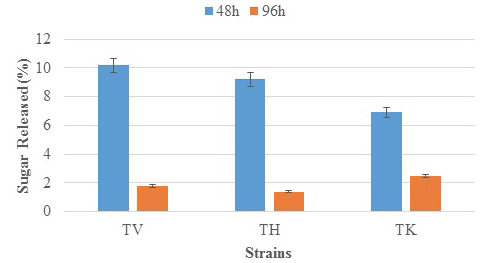
Saccharification of pretreated saw dust by T. viride (TV), T. harzianum (TH) and T. koninji (TK) at time intervals of 48h and 96h.
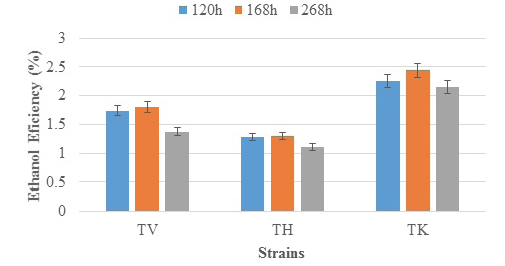
Ethanol production from saccharified biomass with Saccharomyces cerevisiae at different time intervals under sterilized conditions.
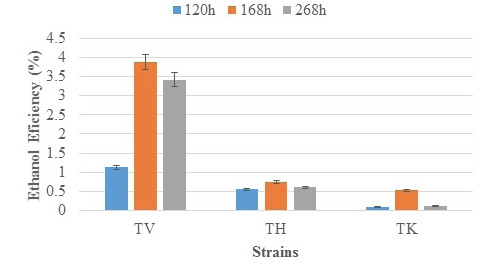
Ethanol production in simultaneous saccharification and fermentation with Saccharomyces cerevisiae in the presence of T. viride (TV), T. harzianum (TH) and T. koninji (TK).
References
- Abo-state, M., Ragab, A., El-Gendy, N., Farhat, L. and Madian, H., 2014. Bioethanol production from rice straw enzymatically saccharified by fungal isolates, Trichoderma viride F94 and Aspergillus terreus F98. Sci. Res., 3: 19-29.
- Alvira, P., Tomás-Pejó, E., Ballesteros, M. and Negro, M.J.,., 2010. Pretreatment technologies for an efficient bioethanol production process based on enzymatic hydrolysis: A review. Biores. Technol. 101: 4851-61. https://doi.org/10.1016/j.biortech.2009.11.093[CrossRef]
- Ayeni A.O., Omoleye J.A., Hymore F.K. and Pandey R.A., 2016. Effective alkaline peroxide oxidation pretreatment of shea tree sawdust for the production of biofuels: kinetics of delignification and enzymatic conversion to sugar and subsequent production of ethanol by fermentation using Saccharomyces cerevisiae. Brazil. J. Chem. Engin., 33: 33 – 45. https://doi.org/10.1590/0104-6632.20160331s20140258[CrossRef]
- Caputi, A., Ueda, M. and Brown, T., 1968. Spectrophotometric determination of ethanol in wine. Am. J. Enol. Vitic., 19: 160–165.
- Frias-Sanchez, J.C., Velazquez-Valadez, U., Pineda-Pimentel, M.G., Lopez-Miranda, J., Castro-Montoya, A.J., Carrillo-Parra, A., Vargas-Santillan, A. and Rutiaga-Quinones, J.G., 2017. Simultaneous saccharification and fermentation of pine sawdust pretreated with nitric acid and sodium hydroxide for bioethanol production. Bioresources, 12: 1052-1063.
- Gopal, K. and Ranjhan, S.K., 1980. Laboratory manual for nutrition research. Roland Press (India) Private Ltd. New Dehli, India.
- Irfan, M., Asghar, U., Nadeem, M., Nelofer, R., Syed, Q., Shakir, H. A. and Qazi, J.I., 2016. Statistical optimization of saccharification of alkali pretreated wheat straw for bioethanol production. Waste. Biomass. Valor., 7: 1389-1396.
- Irfan, M., Gulsher, M., Abbas, S., Syed, Q., Nadeem, M. and Baig, S., 2011. Effect of various pretreatment conditions on enzymatic saccharification. Songklanakarin J. Sci. Technol., 33: 397–404.
- Kim, B., Gulati, I., Park, J. and Shin, J.S., 2012. Pretreatment of cellulosic waste saw dust into reducing sugar using mercerization and etherification. Bio.Resour., 7: 5152-5166. https://doi.org/10.15376/biores.7.4.5152-5166[CrossRef]
- Kim, T.H., Choi, C.H. and Oh, K.K., 2013. Bioconversion of sawdust into ethanol using dilute sulfuric acid-assisted continuous twin screw-driven reactor pretreatment and fed-batch simultaneous saccharification and fermentation. Biores. Technol. 130: 306–313. https://doi.org/10.1016/j.biortech.2012.11.125[CrossRef]
- Li, X., Yang, H., Roy, B., Park, E.Y., Jiang, L., Wang, D. and Miao, Y., 2010. Enhanced cellulase production of the Trichoderma viride mutated by microwave and ultraviolet. Microbiol. Res., 165: 190–198. https://doi.org/10.1016/j.micres.2009.04.001[CrossRef]
- Milagres, A.M.F., 1994. Producao de xilanases por penicillium janthinellum e aplicacao das enzimas no branqueamento de polpas kraft. Campinas. Tese (Doutorado) – Universidade Estadual de Campinas. 1–137.
- Miller, G.L., 1959. Use of dinitro salicylic acid reagent for determination of reducing sugar. Anal. Chem., 31:426–428. https://doi.org/10.1021/ac60147a030[CrossRef]
- Mishra, A. and Mishra, N.C., 2013. Bioethanol production from mixed wastes using Trichoderma viride. Indian. Res. J. Genet. Biotech., 5: 111-116.
- Nadeem, M., Asghar, U., Abbas, S., SaifUllah. and Syed, Q., 2013. A potential tool to explore kallar grass (Leptochloa fusca) as a substrate for bio-fuel production. Middle-East J. Sci. Res., 18: 1133-1139.
- Nwakaire, S.L., Ezeoha, B.O. and Ugwuishiwu, S.L., 2013. Production of cellulosic ethanol from wood sawdust. Agric. Eng. Int. CIGR J., 15: 136-140.
- Oinonen, A.M. and Pirkko, S., 2002. Enhanced production of Trichoderma reesei endoglucanases and use of the new cellulase preparations in producing the stonewashed effect on denim fabric. Appl. Env. Microbiol., 68: 3956-3964. https://doi.org/10.1128/AEM.68.8.3956-3964.2002[CrossRef]
- Rathna, G. S., Saranya, R., and Kalaiselvam, M. 2014. Bioethanol from sawdust using cellulase hydrolysis of Aspergillus ochraceus and fermentation by Saccharomyces cerevisiae. Int. J. Curr. Microbiol. Appl. Sci. 3: 733-742.
- Saxena, R.C., Adhikari, D.K. and Goyal, H.B., 2009. Biomass-based energy fuel through biochemical routes: A review. Renew. Sust. Ener., 13: 167-178.
- Sun, Y. and Cheng, J., 2002. Hydrolysis of lignocellulosic materials for ethanol production: A review. Biores. Technol., 83: 1-11. https://doi.org/10.1016/S0960-8524(01)00212-7[CrossRef]
- Trevorah, R.M. and Othman, M.Z., 2015. Alkali pretreatment and enzymatic hydrolysis of Australian timber mill sawdust for biofuel production. J. Renew. Ener., Article ID 284250, 9 pages. https://doi.org/10.1155/2015/284250[CrossRef]
- Yoswathana, N. and Phuriphipat, P., 2010. Bioethanol production from rice straw. Ener. Res., 11: 26-31.
Services
Article usage statistics
Loading…