
Whitefly, Bemisia tabaci, has become a notable pest impacting cotton on a global scale. Despite the development of transgenic cotton strains that display improved resistance to numerous insect pests, they have not adequately dealt with the challenge posed by growing menace i.e B. tabaci. In the current study, we assessed nine different transgenic cotton genotypes; FH-492, FH-444, FH-152, FH-5096, FH-Lalazar, FH-326, FH-490, FH-494 and FH-142 in field to examine how the population of B. tabaci fluctuates throughout the seasons and also check the oviposition preference by genotypes in semi natural conditions. None of these varieties remained free from B. tabaci population throughout the crop duration, but they exhibited notable variations in population levels over the months. The emergence of B. tabaci populations began in the first week of June, with a substantial increase that surpassed the economic threshold level (ETL) of 5 nymphs/adults per leaf during the last week of July. A significant surge in population was observed from July to August, reaching its peak in August. Genotype FH-494 (4.1/leaf) displayed significantly lower mean populations per plant during the peak activity period of pest while FH-lalazar (10.9/leaf) presented the highest population. In case of oviposition preference FH-494 and FH-326 were the least preferred genotypes with mean egg lying (62.11, 69.66) and (86.88, 85.9) during July and August, respectively.
Research Article · Volume 58, Issue 2, 2 February 2026 · Open Access
Bemisia tabaci on Cotton: A Case Study of Seasonal Incidence with Special Emphasis on Cultivar’s Oviposition Preference
· ·
Affiliations & Notes ⌄
- 1Institute of Plant and Environmental Sciences, Faculty of Agrobiology and Food Resources, Slovak University of Agriculture in Nitra, Tr. A. Hlinku 2, 94976, Nitra, Slovakia 2Entomological Research Institute, Ayoub Agriculture Research Institute, Faisalabad 3Department of Entomology, Faculty of Agriculture, University of Agriculture Faisalabad, Pakistan * Corresponding author: xabbas@uniag.sk
Article Info ⌄
- Journal:
- Pakistan Journal of Zoology
- Published:
- 2 February 2026

From the article
- Findings exhibited that the peak period of B. tabaci activity is July and August and B. tabaci started to appear on crop after 1-2 week of crop germination.
- Pest population was present in all varieties throughout the entire crop cycle and none of the varieties appeared to exhibit resistance against B. tabaci.
- Nevertheless, the findings indicated that FH-494 and FH-326 performed relatively better in resistance to B. tabaci as both genotypes were less preferred for oviposition.
- This information can guide farmers in selecting varieties with lower pest population and understanding the infestation pattern of B. tabaci on cotton that will assist in implementing effective management strategies at the appropriate time.
Selected from the article's own text.
Abstract
Introduction
Agriculture plays a vital role in the economies of many countries, particularly in developing nations, with cotton being one of the key crops in this sector (Ahmad et al., 2017; Abbas and Ahmad, 2018). In certain countries, cotton is referred to as white gold due to the significant revenue it generates (Ali et al., 2014). Pakistan is a major producer and consumer of cotton, the indus valley civilization is where the earliest known cotton cultivation has been traced (Ahmad et al., 2018; Ali et al., 2014). Fifteen percentage of the country’s land is dedicated to cotton cultivation. The average cotton yield per hectare are remain below average due to factors; such as insect pest infestation, improper fertilizer management, water scarcity and weed encroachment (Rehman et al., 2017).
The whitefly, Bemisia tabaci (Gennadius) (Homoptera: Aleyrodidae), emerges as a significant pest responsible for crop damage through direct feeding (Nwezeobi et al., 2020). It leads to yield reductions, contaminates produce and cotton lint with honeydew, and transmits plant pathogenic viruses. It has the potential to cause losses of up to 60% in seed cotton yield (Khan and Wan, 2018).
Out of the over 1,500 identified species of B. tabaci (Martin and Mound, 2007). It is recognized as world widely one of the destructive pest to agriculture crops (Nauen et al., 2014). The pest cause direct harm to plants by feeding on them and also causes indirect damage, particularly by transmitting various viruses. In severe cases impact can lead up to 100% of crop loss (Lourenção et al., 2015). B. tabaci is notable for its extensive polyphagous behavior, as it can infest a broad spectrum of plant species, encompassing agricultural crops, ornamental plants, vegetables and even weed species (Abd-Rabou and Simmons, 2010). Due to its wide array of hosts and remarkable adaptability to diverse environments, it is considered one of the most invasive and widespread cryptic species in the world (Sani et al., 2020). It has a significant track record of displacing native cryptic species over an extended period (Wang and Yang, 2017). As a multivoltine insect that doesn’t enter inactive phases or diapause, B. tabaci population thrive year-round by continuously utilizing various hosts. Its dispersal is key to its ability to colonize diverse environments (Naranjo et al., 2010).
Especially considering that cotton is the second most extensively grown crop in the country. Therefore, understanding the interaction between the pest and its host crops is essential for grasping the population dynamics of this insect and for developing effective management strategies in agriculture.The current study was planned to evaluate cotton genotypes under field conditions to understand population dynamics in relation to native climatic conditions and oviposition preference by genotypes in semi natural conditions. The findings will provide valuable insights for growers to better comprehend the B. tabaci trend and devise effective solutions.
Materials and Methods
Crop cultivation and land preparation
Nine cotton genotypes were used in this experiment. Seeds of Bt-Cotton varieties ((FH-142, FH-444, FH-152, FH-5096, FH-Lalazar, FH-326, FH-490, FH-494, FH-492) were obtained from the Cotton Research Institute, Ayub Agriculture Research Institute, Faisalabad, Pakistan. Sowing was done by dibbling method in early May conducted at Research Area of Entomological Research Institute, AARI, Faisalabad, Pakistan (31.4140 N, 73.0487 E), employing a randomized complete Block Design with three replications. Field was distributed into 18 plots, each with size of 6m × 4m and 1m space was maintained among plots. Plant to plant and row to row distances were set at 22.5cm and 76 cm, respectively. Weeding was carried out throughout the crop season to prevent any competition between the crop and weeds for nutrients, light, water and space. Standard agronomic practices, including fertilizer and irrigation application, were adhered during the season as per the crop’s requirements and no plant protection measures were employed to manage B. tabaci infestation.
Data recording
Data was gathered on a weekly basis by randomly selected, five plants from each replicate, to count B. tabaci in lower, middle and upper sections of eachplant (Akhtar et al., 2004). The observations were made during early morning by gently tilting the cotton leaves without any disturbance to B. tabaci, as during the early morning hours B. tabaci are least active. The mean population was employed to assess the varietal response to B. tabaci populations. Meteorological data, related to humidity, rainfall and temperature were sourced from the Pakistan Meteorological Department in Islamabad.
Statistical analysis
The data of adult population and oviposition were analyzed using Statistix 8.1 software, employing analysis of variance (ANOVA) and the Tukey’s honest significant test (HSD) test at a 5% probability level. Correlations were computed to explore the potential impact of abiotic parameters on B. tabaci population.
Results and Discussion
Seasonal incidence
The findings revealed a statistically significant difference in B. tabaci populations among all cotton genotypes and none of the varieties remained free from B. tabaci population throughout the crop duration. However, the weekly data reveals that B. tabaci began to emerge during the 1st week of June and the population remained below the threshold level until the second week of July (Fig. 1A, B). There was a significant increase in B. tabaci populations during the third and fourth weeks of July (Fig. 1B), surpassing the economic threshold level (ETL) of 5 nymphs/adults or both per plant. During July the maximum B. tabaci population (5.1/leaf) was recorded on FH-lalazar during 3rd week of July while, the minimum population (1.2/leaf) was found on FH-494 during first week of July (Fig. 1B). The B. tabaci decreases from 2nd week of September to November but remains above the economic threshold level (ETL) (Fig. 1C, D, E, F). During October, a decline in B. tabaci populations occurred in all cotton varieties. The minimum population was recorded in FH-494 (0.7/leaf) and FH-326 (0.8) during the last week of October, whereas FH-lalazar (7.31) exhibited the maximum B. tabaci population during the first week of October (Fig. 1E).
The mean monthly population is illustrated in Figure 2, clearly indicating an upward trend in B. tabaci populations from July to September. The figure also highlights the substantial mean B. tabaci population across all varieties each month. Throughout June-July, the B. tabaci population remained below the economic threshold level (ETL) and showed a significant increase in August, although it stayed below the ETL (4.1/leaf) in the case of variety FH-494 while the highest population was recorded on FH-lalazar (10.9/leaf). In September, the mean lowest B. tabaci population was observed in variety FH-494 (3.4/leaf) and FH-492 (5.3/leaf), while the highest mean population (8.6/leaf) was recorded in FH-lalazar. Conversely, during October, a decline in B. tabaci populations occurred in all cotton varieties, but the overall population remained above the ETL. The average minimum population was recorded in FH-494 (1.8/leaf) and FH-326 (2.7/leaf) during the last week of October, whereas FH-lalazar (4.8) exhibited the maximum B. tabaci population during the first week of October. Similarly, in November, all varieties experienced B. tabaci attack below ETL. The average minimum population was recorded in FH-494 (0.2/leaf), while the maximum population was observed in FH-lalazar (2.12/leaf) and FH-492 (1.14/leaf).
It is evident that high B. tabaci population can lead to significant damage to cotton, potentially causing up to a 50% decrease in boll formation. Additionally, bolls from robust plants produced 33.3% more lint than those obtained from infested plants.
The selection of more suitable genotypes for oviposition experiment was done in semi-natural conditions. The high rate of eggs laying was found on genotype FH-lalazar throughout the growing season and as well as reported in the month of August. Toscano et al. (2003) also reported in their research about resistant cotton genotypes that exhibiting the antixenosis mechanism based on oviposition.
The B. tabaci begin to emerge during the 1st week of June and the population remained below the threshold level until the second week of July (Fig. 1A, B). Similarly, in India during June the onset of B. tabaci was observed in cotton fields, when crop was sown in the early May (Janu and Dahiya, 2017). There was a significant increase in B. tabaci populations during the 3rd and 4th weeks of July the B. tabaci population continued to exceed the ETL throughout August (see Fig. 1C). Roomi (2014) also reported his research results about the rising trend in B. tabaci population during August and September that is pretty similar to our findings.
The correlation matrix between B. tabaci population and other abiotic factors; relative humidity, rain fall and temperature revealed a significant (Pearson correlation r, at p≤0.05) correlation (Table II). Abiotic factors have a substantial impact on the development of insect pest populations. Our study’s results align with the findings
Table II. Correlation matrix, between seasonal Bemicia tabaci population, temperature, relative humidity and rain fall.
| Pest population | Temperature | Relative humidity % | Rain |
| 0.1480** | -0.1176 | -0.0414** |
of Ashfaq et al. (2010). He also identified a positive correlation between the B. tabaci population and mean temperature, while noting a negative correlation with mean relative humidity. The increase in B. tabaci population with rising temperatures can be attributed to their accelerated reproduction and development rates. Additionally, somewhat higher temperatures can promote rapid multiplication and activity of B. tabaci. Conversely, a negative correlation was found between the B. tabaci population and rainfall, including total rainfall and the number of rainy days, as reported by Kaur et al. (2010). This may be credited with destruction of B. tabaci eggs, nymphs and pupae during unremitting rains.
The intervals of rainfall that led to destruction in B. tabaci populations may disrupt the insect’s life cycle. With a development period of approximately three weeks (from egg to adult), the observed decrease in adult numbers in the field suggested that rainfall may inhibit egg-laying, increase mortality among nymphs, adults, and cause insects to migrate.
Conclusions
Findings exhibited that the peak period of B. tabaci activity is July and August and B. tabaci started to appear on crop after 1-2 week of crop germination. Pest population was present in all varieties throughout the entire crop cycle and none of the varieties appeared to exhibit resistance against B. tabaci. Nevertheless, the findings indicated that FH-494 and FH-326 performed relatively better in resistance to B. tabaci as both genotypes were less preferred for oviposition. This information can guide farmers in selecting varieties with lower pest population and understanding the infestation pattern of B. tabaci on cotton that will assist in implementing effective management strategies at the appropriate time.
Declarations
Acknowledgements
The authorS would like to express their sincere gratitude to Dr. Qurban Ali, Principal Scientist at the Entomological Research Institute, AARI, Faisalabad, Pakistan, for his invaluable supervision and guidance throughout this research.
Funding
This work was funded by the European Union Next Generation EU through the Recovery and Resilience Plan for Slovakia under project No. 09I03-03-V02-00043.
Stament of conflict of interest
The authors have declared no conflict of interest.
Figures
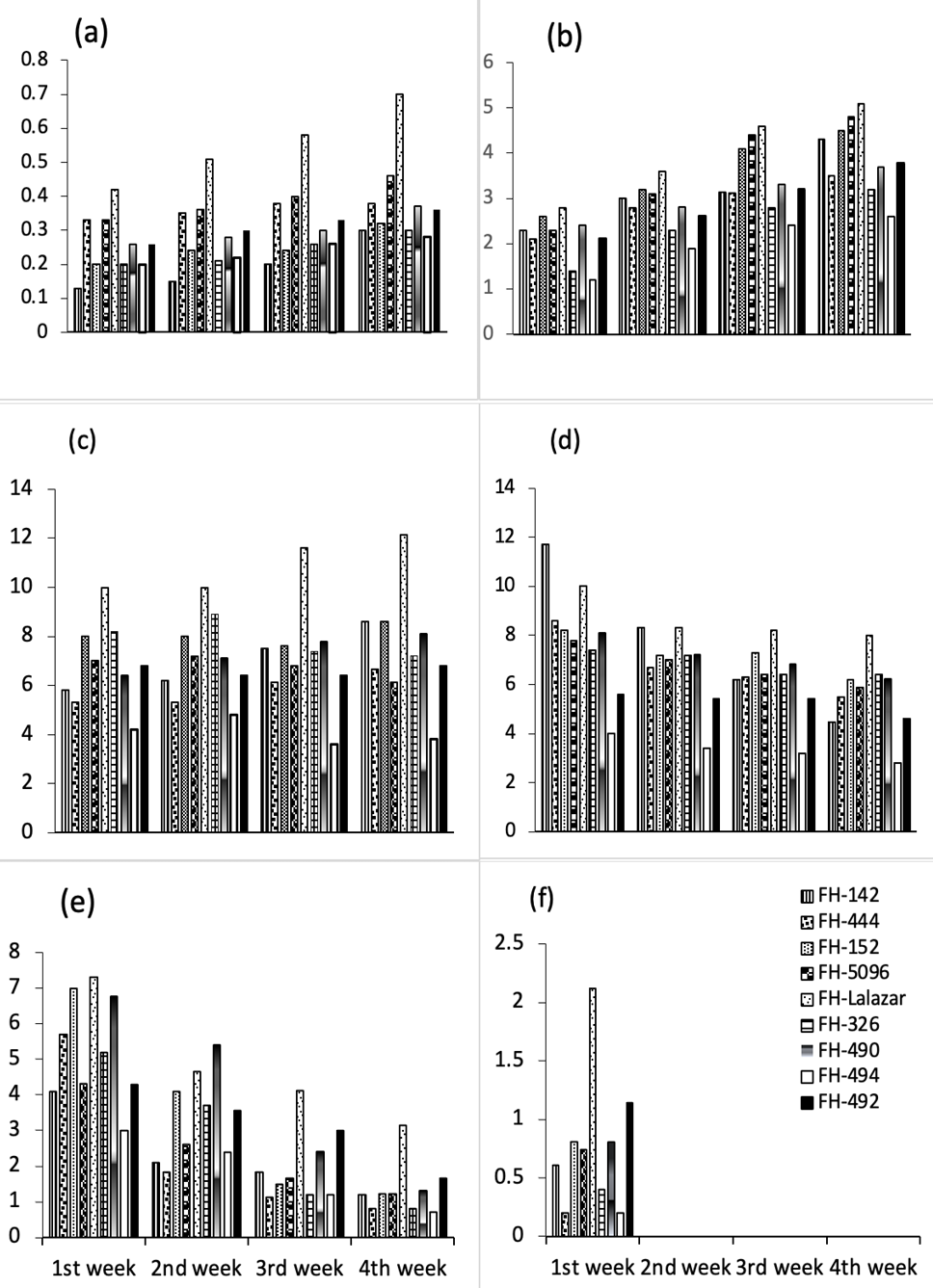
Weekly population trends of Bemicia tabaci: (A) June, (B) July, (C) August, (D) September, (E) October, (F) November, 2021.
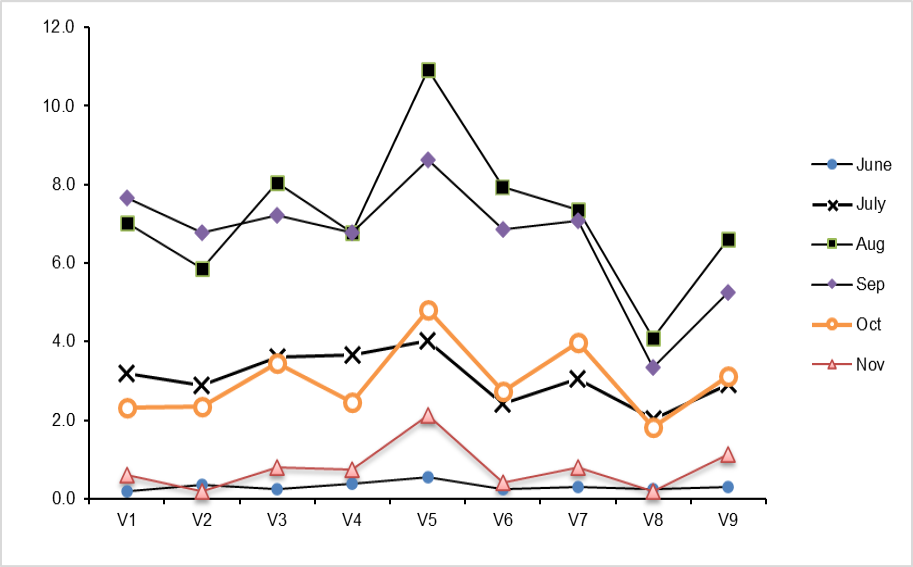
Monthly pattern of Bemicia tabaci population from June to October, 2021.
References
- The experimental genotypes were cultivated in earthen pots filled with a mixture of soil and farmyard manure in a 1:1 ratio until they reached a standardized stage with 06 leaves, following the method described by Jindal et al. (2009). To prevent any external infestation by B. tabaci, the pots were placed in a screened enclosure. The plants received daily watering. Each genotype was represented by five plants randomly positioned within the screen house, totaling five replications. Pairs of B. tabaci (males and females), sourced from B. tabaci colonies maintained on unsprayed cotton plants in a separate screened enclosure were collected. The B. tabaci were then released onto the test genotypes, ensuring equal access to all plants, with 10 pairs released per plant.
- Data for egg count was recorded on weekly basis. Five plants from each replicate were selected and two fully developed leaves from the apical part of each plant were collected. These leaves were placed in transparent bags and sent to the microscopy laboratory for B. tabaci egg count. One leaf was used to evaluate the total egg count, while the other was used for trichome counts. To standardized the observed area, two 4.9 cm² leaf disks were taken from the leaf and trichomes were counted using a stereoscopic microscope at 40x magnification.
Services
Article usage statistics
Loading…