Research Article · Volume 52, Issue 2, 16 January 2020 · Open Access
Assessment of Mitochondrial ATPase 8/6 Genes Based Genetic Diversity in Sindh Ibex (Capra aegagrus Blythi)
· · · · · · ·
Affiliations & Notes ⌄
- 1Institute of Biochemistry and Biotechnology, University of Veterinary and Animal Sciences Lahore 2Shaheed Benazir Bhutto University of Veterinary and Animal Sciences, Sakrand , JZ and AN made equal contributions to this article. , * Corresponding author: asifnadeem@uvas.edu.pk
Article Info ⌄
- Journal:
- Pakistan Journal of Zoology
- Published:
- 16 January 2020

From the article
- Genetic characterization of Sindh ibex was done on the basis of mtATPase8/6 gene.
- Results of polymorphic sites, Haplotype Diversity, G+C and Tajima’s test ATPase 8/6 gene in Sindh Ibex are shown in Tables I, II, III, IV.
- Average number of nucleotide differences was 7.408, whereas stochastic variance of k (no recombination), Vst (k) was calculated as 11.695 and G+C contents in whole population of Sindh ibex were 0.361 (519.00 sites).
- The results of the current study will help in understanding the life and evolutionary patterns of Sind Ibex.
Selected from the article's own text.
Abstract
INTRODUCTION
Wild goat species live at mountains and at higher altitudes, may face different environmental stress according to their habitat. Moreover, domestication of these species led to the decrease in genetic variety due to increase inbreeding and hence might causes the extinction of many novel and diverse breeds.
Pakistan is fairly rich in biological diversity range and has been conventionally known for its abundance in wildlife, mainly game animals such as Bradford urial (Ovisorientalis), Sindh ibex or Sara (Capra aegagrus blythi) and Chinkara (Gazella benneti) . The estimated Sindh ibex population is almost 13,155 and densely present on the Kirthar Range, with lesser concentration on Khambu and Dumber and small numbers somewhere else. Higher altitude appear critical to this species . Till now many studies have been done on goat using mitochondrial DNA (mt-DNA) and of nuclear DNA ; but no data has been published on phylogenetic diversity and genetic characterization of Sindh ibex except Heat Shock Protein 70-1 as reported by Fatima et al. (2019).
Mitochondrial ATPase-8 and ATPase-6 genes (mtATPase 8/6) are considered as one of the most potential genes for the whole mitochondrial genome due to its structure and function, and it is consisted of both conserved and rapidly evolving regions which are considered as more reliable regions for evolutionary studies (Farias et al., 2001). It is considered as one of the most valuable genetic marker to identify the relation within families and genera. . Any mutation in ATPase 6 gene causes the abrasion in single structure, tissue or organ (e.g., myopathies, encephlopathies and cardiopathies) to multisystem syndromes . So, in the present study, the sequencing of the whole mtATPase 8/6 genes of Sindh ibex has been done. The variants were identified in mtATPase 8/6 genes in Sindh ibex and phylogenetic tree was constructed to understand the genetic diversity of Sindh ibex.
MATERIALS AND METHODS
Sample collection and storage
Blood samples (n=15) of wild goat (Capra aegagrus blythi) were collected from Kirthar National Park, Sindh, Pakistan in ethylenediamine tetra acetic acid (EDTA) coated vacutainers. Samples were stored at 200C before the extraction of DNA.
Genomic DNA extraction
The blood samples were thawed and subjected to DNA extraction through organic extraction method for whole genome. Quantification of DNA was done through gel electrophoresis (0.8% agarose gel) and spectrophotometric analysis (Thermo scientific 2000 nano spectrophotometer). The gel was run at 110 volts for 30 min. BIO-RAD Gel Documentation system was used to visualize DNA bands.
PCR optimization
The PCR conditions for the amplification of mtATPase8/6 genes were optimized by using different concentration of MgCl2, dNTPs (deoxynucleotide triphosphate) and Taq polymerase to get the maximum amplification of the required product.
Touchdown PCR (Bio-Rad thermo cycler) was used to optimize the primers and PCR was performed.
Sequencing of PCR amplicon
PCR amplicons were precipitated with 100µl of 80% ethanol and then sequenced in both directions using dideoxy chain termination method by Big DyeTM Terminator on ABI 3130XL Genetic analyzer.
Bioinformatics analysis
Sequences were analyzed manually by using BioEdit software V.7.0. Sequencing homology search in public databases was carried out through Nucleotide blast program . Polymorphism was studies by the multiple sequence alignment using ClustalW2 and DnaSP, v.5 . Any change in the DNA sequence was confirmed by sequencing both sense and antisense strands. Molecular Evolutionary Genetics Analysis V.6.0 was used to construct he phylogenetic trees. Percentage similarity was calculated by using the MUSCLE tool.
RESULTS AND DISCUSSION
Wild life is a vital part of ecosystem and important assets of a country. However, very few studies have been carried out on genomic and proteomic parameters of Pakistan’s wild animals.
Genetic characterization of Sindh ibex was done on the basis of mtATPase8/6 gene. For his, the amplicon of 990bp size were amplified using the PCR. Afterwords, the products of PCR were sequenced and Chromatogram of all sequenced samples were analysed.
The results showed 20 variations at different positions. All variations were found to be homozygous Transition mutations. Results of polymorphic sites, Haplotype Diversity, G+C and Tajima’s test ATPase 8/6 gene in Sindh Ibex are shown in Tables I, II, III, IV. Twenty transitional mutations were observed, in which two were singleton variable sites with two variants positioned (Table I), while rest of eighteen variations were parsimony variable sites with two variants (Table II). Average number of nucleotide differences was 7.408, whereas stochastic variance of k (no recombination), Vst (k) was calculated as 11.695 and G+C contents in whole population of Sindh ibex were 0.361 (519.00 sites).
Table I. Polymorphic sites of ATPase 8/6 gene in Sindh ibex.
| Number of sequences | 15 |
| Number of sequences used | 15 |
| Selected region | 1-973 |
| Number of sites | 973 |
| Total number of sites (excluding sites with gaps / missing data | 519 |
| Sites with alignment gaps or missing data | 454 |
| Invariable (monomorphic) sites | 501 |
| Variable (polymorphic) sites | 20 |
| Total number of mutations | 20 |
| Singleton variable sites | 2 |
| Parsimony informative sites | 18 |
| Singleton variable sites (two variants) | 2 |
| Site positions | 193, 505 |
| Parsimony informative sites (two variants) | 18 |
| Site positions | 120, 133, 162, 183,185, 187, 201, 209, 220, 223, 291, 391, 418, 441, 448, 468, 509, 517 |
Conserved region identification showed the sequence conservation for the ibex population, 0.967 and the conservation threshold for population was 1. Conserved region for ibex specie was from 518-653 bp, comprising 135 nucleotides as shown in Table V.
Furthermpre, the results of homology analysis indicated that partial sequence of ATPase8/6 genes of Sindh ibex showed maximum similarity (99%) with that of domestic goat and sheep.
Table II. Haplotype diversity of ATPase 8/6 gene in Sindh ibex.
| Number of Haplotype, h | 5 |
| Haplotype (gene) diversity, Hd | 0.0808 |
| Variance of Haplotype diversity | 0.00277 |
| Standard Deviation of Haplotype diversity | 0.053 |
| Nucleotide diversity, Pi | 0.01427 |
| Theta (per site) from Eta | 0.01045 |
| Theta (per site) from S, Theta-W | 0.01045 |
| Variance of theta (no recombination) | 0.0000190 |
| Standard deviation of theta (no recombination) | 0.00436 |
| Variance of theta (free recombination) | 0.0000061 |
| Standard deviation of theta (free recombination) | 0.00246 |
| Average number of nucleotide differences, k | 7.408 |
| Stochastic variance of k (no recombination), Vst(k) | 11.695 |
| Sampling variance of k (no recombination), Vs(k) | 1.675 |
| Total variance of k (no recombination), V(k) | 13.369 |
| Stochastic variance of k (free recombination), Vst(k) | 2.469 |
| Sampling variance of k (free recombination), Vs(k) | 0.329 |
| Total variance of k (free recombination), V(k) | 2.799 |
| Variance of theta (no recombination) | 5.123 |
| Variance of theta (free recombination) | 1.635 |
Table III. G+C Contents of ATPase 8/6 gene in Sindh ibex.
| G+C content, | |
| G+C | 0.361 (519.00 sites) |
Table IV. Tajima’s test and Tajima’s test of ATPase 8/6 gene in Sindh ibex.
| Tajima's D | 1.45787 |
| Statistical significance | Not significant, P > 0.10 |
| Fu and Li's D* test statistic | 1.01041 |
| Statistical significance | Not significant P > 0.10 |
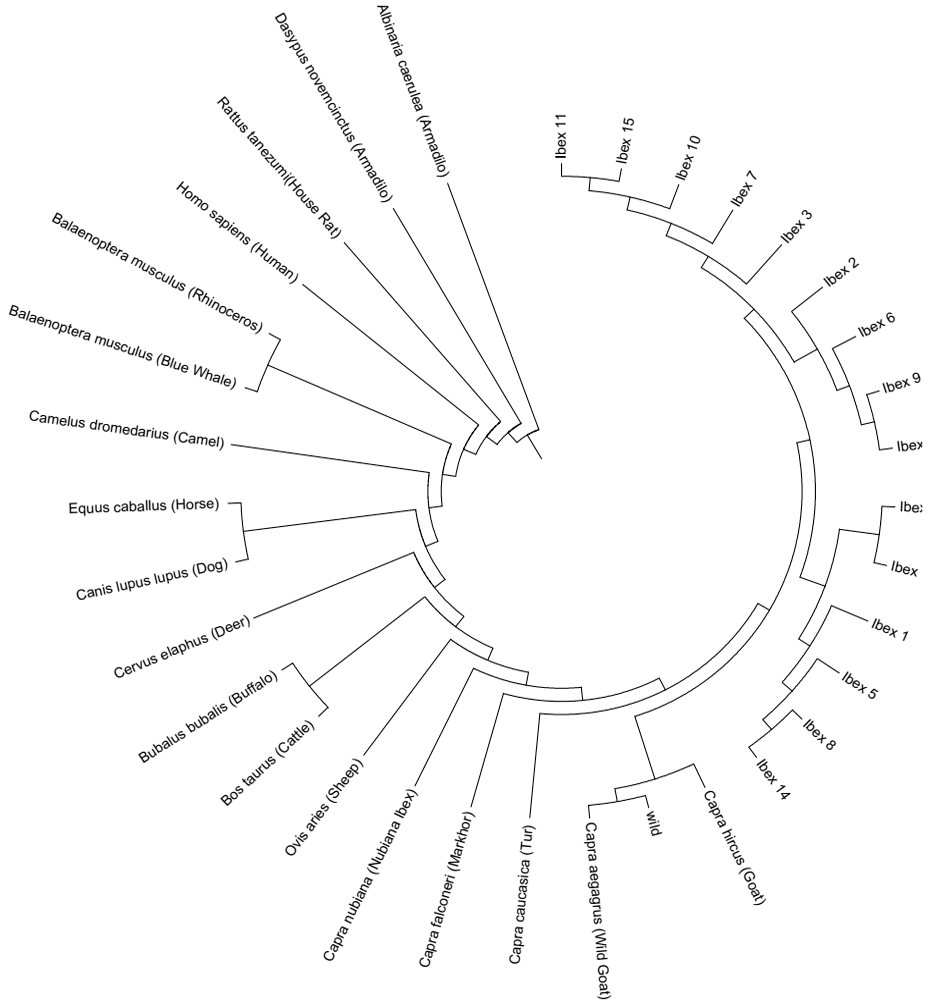
Phylogenetic analysis showed two distinct clades and ATPase8/6 gene of Sindh ibex was highly homologous to that of other animals as shown in Figues 1 and 2.
The overall results showed a close evolutionary relationship with other animals, demonstrating that they all were evolved from same ancestor. Phylogenetic analysis showed that Capra aegagrus, Capra nubiana, Capra falconeri, Capra hircus and Capra caucasica were sharing a common ancesters. Previous studies revealed that the bezoar, markhor and other wild goats are distantly related to the domestic goat, based on mtDNA analysis ; .
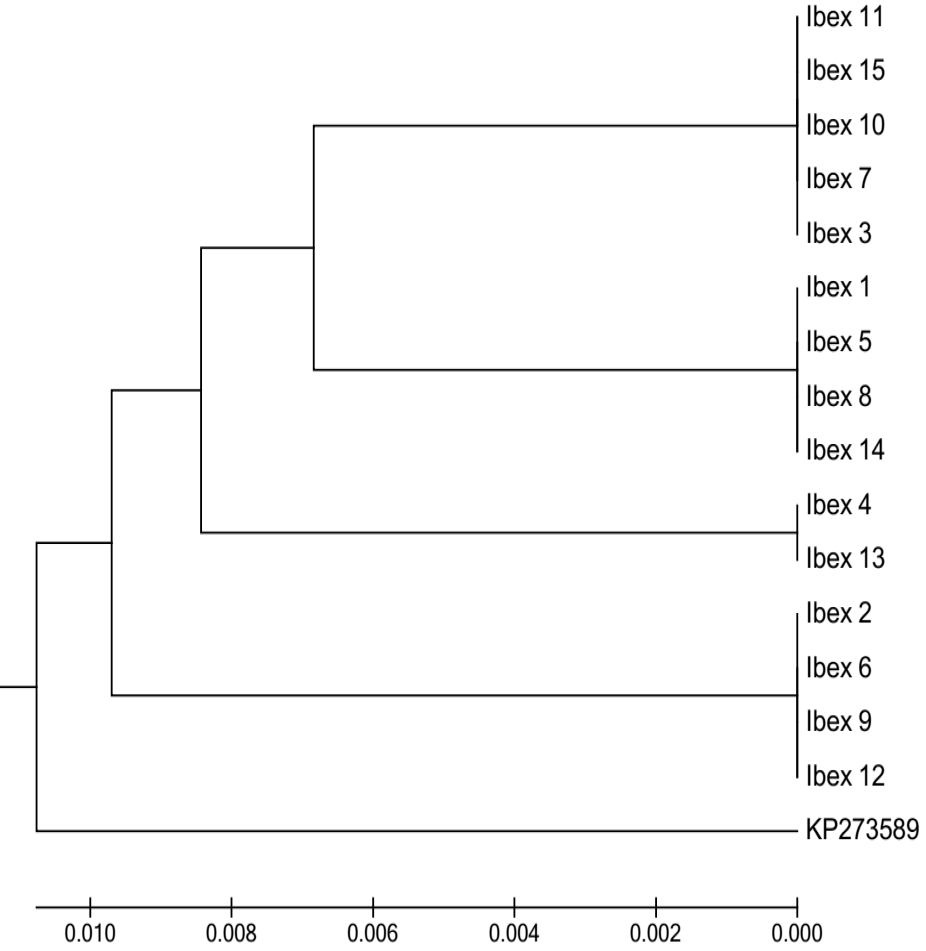
Table V. Conserved region identification of ATPase 8/6 gene in Sindh ibex.
| Net number of analyzed sites, L | 613 |
| Number of variable/polymorphic sites S | 20 |
| Sequence conservation, C | 0.967 |
| Net number of analyzed sites, L | 613 |
| Number of variable/polymorphic sites, S | 20 |
| Conserved Region | |
| Conservation threshold, CT | 1 |
| [Region Start-End Conservation Homozigosity P-value] Region_1, 518-653, 1.000, 1.000,0.0061 | |
| ATCCTATTTATTGGATCTACAAACCTATTAGGCCTTCTACCCCACTCATT TACACCAACTACACAACTATCAATAAATCTAGGCATGGCTATTCCCTTAT GAGCAGGGGCTGTAATTACAGGTTTTCGCAACAAAA | |
CONCLUSION
The results of the current study will help in understanding the life and evolutionary patterns of Sind Ibex. However, further molecular studies are needed by using the domestic goats from other countries, for better understanding and planning the conservation strategies of wildlife.
Statement of conflict of interests
The authors declare that they have no competing interests.
Figures

UPGMA tree construction within-specie by using MEGA6.

UPGMA tree construction between-species by using MEGA6.
References
- Ackerman, S.H. and Tzagoloff, A., 2005. Function, structure, and biogenesis of mitochondrial ATP synthase. Progr. Nucl. Acid Res. mol. Biol., 80: 95-133. https://doi.org/10.1016/S0079-6603(05)80003-0[CrossRef]
- Altschul, S.F., Gish, W., Miller, W., Myers, E.W. and Lipman, D.J., 1990. Basic local alignment search tool. J. mol. Biol., 215: 403-410. https://doi.org/10.1016/S0022-2836(05)80360-2[CrossRef]
- Arnot, D.E., Roper, C. and Bayoumi, R.A., 1993. Digital codes from hypervariable tandemly repeated DNA sequences in the Plasmodium falciparum circumsporozoite gene can genetically barcode isolates. Mol. Biochem. Parasitol., 61: 15-24. https://doi.org/10.1016/0166-6851(93)90154-P[CrossRef]
- Barendse, W., Armitage, S.M., Kirkpatrick, B.W., Moore, S.S., Georges, M., Womack, J.E. and Hetzel, J., 1993. A genetic map of index DNA loci on bovine chromosome 21. Genomics, 18: 598-601. https://doi.org/10.1016/S0888-7543(05)80361-1[CrossRef]
- Boyer, P.D., 1997. The ATP synthase-a splendid molecular machine. Annu. Rev. Biochem., 66: 717-749. https://doi.org/10.1146/annurev.biochem.66.1.717[CrossRef]
- Cassidy, L.M., Teasdale, M.D., Carolan, S., Enright, R., Werner, R., Bradley, D.G., Finlay, E.K. and Mattiangeli, V., 2017. Capturing goats: documenting two hundred years of mitochondrial DNA diversity among goat populations from Britain and Ireland. Biol. Lett., 13: 20160876. https://doi.org/10.1098/rsbl.2016.0876[CrossRef]
- Castresana, J., 2001. Comparative genomics and bioenergetics. Biochim. biophys. Acta (BBA-Bioenergetics), 1506: 147-162. https://doi.org/10.1016/S0005-2728(01)00227-4[CrossRef]
- Collinson, I.R., Runswick, M.J., Buchanan, S.K., Fearnley, I.M., Skehel, J.M., van Raaij, M.J. and Walker, J.E., 1994. F0 membrane domain of ATP synthase from bovine heart mitochondria: Purification, subunit composition, and reconstitution with F1-ATPase. Biochemistry, 33: 7971-7978. https://doi.org/10.1021/bi00191a026[CrossRef]
- Fatima, F., Nadeem, A. and Javed, M., 2019. Molecular characterization of heat shock protein 70-1 gene of Capra aegagrus blythi. Pakistan J. Zool., 51:195-203.
- Farias, I.P., Ortí, G., Sampaio, I., Schneider, H. and Meyer, A., 2001. The cytochrome b gene as a phylogenetic marker: the limits of resolution for analyzing relationships among cichlid fishes. J. mol. Evolut., 53: 89-103. https://doi.org/10.1007/s002390010197[CrossRef]
- Galtier, N., Nabholz, B., Glémin, S. and Hurst, G.D.D., 2009. Mitochondrial DNA as a marker of molecular diversity: a reappraisal. Mol. Ecol., 18: 4541-4550. https://doi.org/10.1111/j.1365-294X.2009.04380.x[CrossRef]
- Hajibabaei, M., Singer, G.A., Hebert, P.D. and Hickey, D.A., 2007. DNA barcoding: How it complements taxonomy, molecular phylogenetics and population genetics. Trends Genet., 23: 167-172. https://doi.org/10.1016/j.tig.2007.02.001[CrossRef]
- Herbert, R., Jamtvedt, G., Mead, J. and Hagen, K.B., 2005. Outcome measures measure outcomes, not effects of intervention. Aust. J. Physiother., 51: 3-4. https://doi.org/10.1016/S0004-9514(05)70047-7[CrossRef]
- Jacobson, M., Kim, S., Romney, J., Zhu, X. and Frisina, R.D., 2003. Contralateral suppression of distortion-product otoacoustic emissions declines with age: A comparison of findings in CBA mice with human listeners. The Laryngoscope, 113: 1707-1713. https://doi.org/10.1097/00005537-200310000-00009[CrossRef]
- Kadowaki, S., Ohnishi, K., Arai, S., Guliyev, F. and Nishiaki, Y., 2016. Mitochondrial DNA Analysis of Ancient Domestic Goats in the Southern Caucasus: A Preliminary Result from Neolithic Settlements at Göytepe and Hacı Elamxanlı Tepe. Int. J. Osteoarchaeol., 2534. https://doi.org/10.1002/oa.253[CrossRef]
- Kibegwa, F.M., Githui, K.E., Jung’a, J.O., Badamana, M.S. and Nyamu, M.N., 2016. Mitochondrial DNA variation of indigenous goats in Narok and Isiolo counties of Kenya. J. Anim. Breed. Genet., 133: 238–247. https://doi.org/10.1111/jbg.121824[CrossRef]
- Librado, P. and Rozas, J., 2009. DnaSP v5: A software for comprehensive analysis of DNA polymorphism data. Bioinformatics, 25: 1451-1452. https://doi.org/10.1093/bioinformatics/btp187[CrossRef]
- Luikart, G., Gielly, L., Excoffier, L., Vigne, J.D., Bouvet, J. and Taberlet, P., 2001. Multiple maternal origins and weak phylogeographic structure in domestic goats. Proc. natl. Acad. Sci., 98: 5927-5932. https://doi.org/10.1073/pnas.091591198[CrossRef]
- Parson, W., Pegoraro, K., Niederstätter, H., Föger, M. and Steinlechner, M., 2000. Species identification by means of the cytochrome b gene. Int. J. Legal Med., 114: 23-28. https://doi.org/10.1007/s004140000134[CrossRef]
- Petta, G., Rangabasyam, M. and Edger, R., 2004. U.S. Patent Application No. 10/829.645.
- Pidancier, N., Jordan, S., Luikart, G. and Taberlet, P., 2006. Evolutionary history of the genus Capra (Mammalia, Artiodactyla): discordance between mitochondrial DNA and Y-chromosome phylogenies. Mol. phylogeny. Evolut., 40: 739-749. https://doi.org/10.1016/j.ympev.2006.04.002[CrossRef]
- Song, H., Buhay, J.E., Whiting, M.F. and Crandall, K.A., 2008. Many species in one: DNA barcoding overestimates the number of species when nuclear mitochondrial pseudogenes are coamplified. Proc. natl. Acad. Sci., 105: 13486-13491. https://doi.org/10.1073/pnas.0803076105[CrossRef]
- Stewart, J.D., Tennant, S., Powell, H., Pyle, A., Blakely, E.L. and Mewasingh, L.D., 2009. Novel POLG1 mutations associated with neuromuscular and liver phenotypes in adults and children. J. med. Genet., 46: 209-214. https://doi.org/10.1136/jmg.2008.058180[CrossRef]
- Sultana, S., Mannen, H. and Tsuji, S., 2003. Mitochondrial DNA diversity of Pakistani goats. Anim. Genet., 34: 417-421. https://doi.org/10.1046/j.0268-9146.2003.01040.x[CrossRef]
- Tamura, K., Stecher, G., Peterson, D., Filipski, A. and Kumar, S., 2013. MEGA6: molecular evolutionary genetics analysis version 6.0. Mol. Biol. Evolut., 30: 2725-2729. https://doi.org/10.1093/molbev/mst197[CrossRef]
- Waugh, D.S., 2005. Making the most of affinity tags. Trends Biotechnol., 23: 316-320. https://doi.org/10.1016/j.tibtech.2005.03.012[CrossRef]
- Xiufeng, X. and Árnason, Ú., 1994. The complete mitochondrial DNA sequence of the horse, Equus caballus: extensive heteroplasmy of the control region. Gene, 148: 357-362. https://doi.org/10.1016/0378-1119(94)90713-7[CrossRef]
Services
Article usage statistics
Loading…