Research Article · Volume 37, Issue 2, 24 December 2022 · Open Access
A Cross-Sectional Study to Determine the Prevalence, Symptoms and Risk Factors Associated with Low Back Pain and Sciatica in District Nowshera, Pakistan
·
Affiliations & Notes ⌄
1Department of Zoology, Shaheed Benazir Bhutto Women University, Peshawar-25000, Pakistan. Corresponding author: Sheeza Iqbal sheeza894@gmail.com
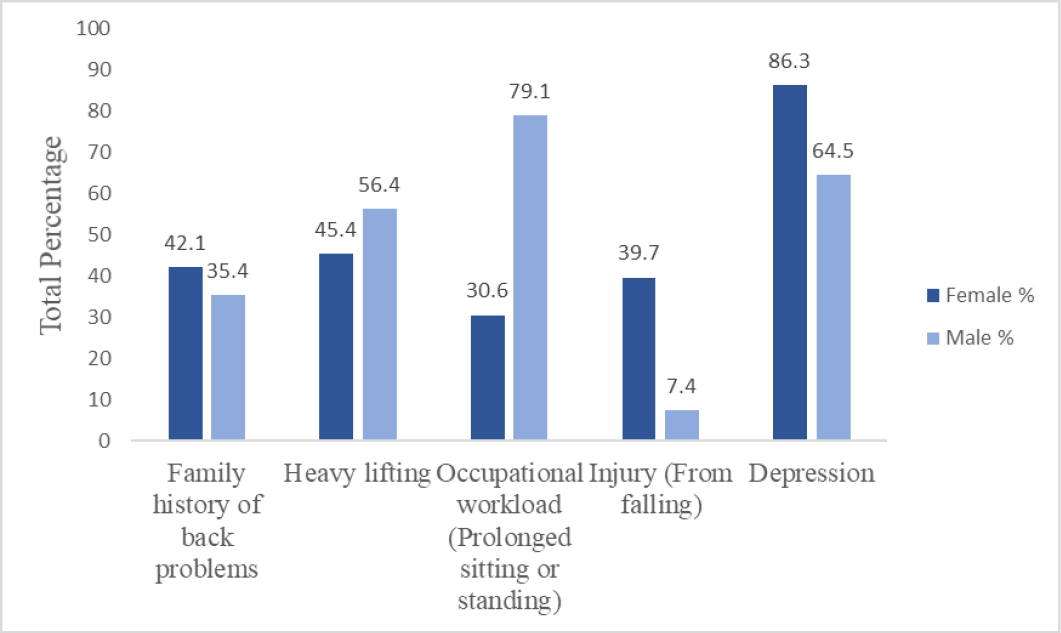
The risk factors associated with sciatica in female and male patients were family history of back problems (42.1%, 35.4%), heavy lifting (45.4%, 56.4%), occupational workload (30.6%, 79.1%), injury (39.7%, 7.4%), depression (86.3%, 64.5%), smoking (69.3%) and menopause (52.2%; Figure 1 and Table 2).
The overall prevalence of sciatica was found to be more in female patients (58.7%) compared to males (41.3%).
In conclusion, sciatica is more common among the female gender as compared to the male gender in district Nowshera.
Post-menopausal women, male smokers and patients with a sedentary lifestyle are the major risk factors for the prevalence of sciatica.
Selected from the article's own text.
Abstract
Present study was planned to determine the prevalence of sciatica with age and gender in district Nowshera and to identify symptoms and associated risk factors among male and female patients. The cross-sectional study was conducted at Qazi Hussain Ahmed Medical Complex from March to July 2020 in district Nowshera, Pakistan. A total of 150 patients with sciatica were analysed. All the patients were diagnosed with MRI, CT scan, spinal X-rays and straight leg raising (SLR) test. Of the 150 sciatica patients, 88 (58.7%) were females and 62 (41.3%) males. The prevalence of sciatica was found to increase with age, heavy lifting, occupational workload and an inactive lifestyle. Smokers were found to be more victims of sciatica (69.3%). Post-menopausal women were found to be at highest risk of sciatica (52.2%). Sciatica is more common among females as compared to males. Post-menopausal women, male smokers and patients with a sedentary lifestyle are the major risk factors for the prevalence of sciatica.
Novelty Statement | Sciatica is the pain or discomfort if the sciatic nerve gets compressed or pinched. Sciatica can potentially cause permanent nerve damage, resulting in a loss of feeling in the affected legs. The present study will make people aware of the symptoms and predictive risk factors associated with Sciatica that will help people know about preventive measures and earlier treatment of the disorder before it worsen.
Introduction
The term Sciatica (SCI) designates a syndrome in which pain is located in the lumbosacral region, spreading to the lower limb and can be felt in the buttock, thigh, calf, knee and leg or a disorder in which patient experiences pain in the distribution of sciatic nerve . Sciatica is widely known by different terms in the literature such as nerve root pain, radiculopathy, nerve root irritation or entrapment and lumbosacral radicular syndrome . Sciatic pain arises from the back spread out in the pelvic limb throughout the L5 or S1 spine segment. This pain settles down as a result of disco-radicular conflict between L4 or L5 and L5 or S1 . Cauda equina syndrome (CES) is generally described by low back pain or sciatica commonly bilaterally symmetrical however sometimes absent, particularly at L5/S1 with inferior sequestration . The condition may advance to paraplegia and permanent incontinence .
Low back pain can be classified based on the locality (LBP and sciatica) and duration of pain. Acute pain is pain that has been present for less than one month. Sub-acute pain is the pain that has been present for 1 to 6 months; moreover, pain becomes classified as chronic at 6 months . The most common cause of sciatica is a herniated lumbar disc with nerve root compression . The sacroiliac joint (SIJ) was examined to be the most important cause of sciatica in 1920. Initially, the intervertebral disc was implicated in the pathophysiology of sciatica in 1934 . By the 19th century, sciatica was studied to thought to be due to a variety of rheumatic condition which causes inflammation or swelling of the sciatic nerve. The existence of sciatic pain was originally recognized as pressure on nerve roots. Infection moreover required to be eliminated in cases of sciatica. It was discovered that sciatica can be caused by a Staphylococcus aureus epidural infection .
The risk factors of sciatica include obesity, occupational workload, carrying heavy objects and physical activities at work. Non-occupational lifting particularly with a bent back and straight knees has also been linked with an increased risk of herniated lumbar disc. Occupational exposure to the whole body vibration and work-related twisting of the trunk such as machine operators and motor vehicle drivers have also been found to increase the risk of sciatica ; . An epidemiological study has recognized that the lifetime prevalence of LBP ranges from 70 percent to 85 percent, the yearly prevalence ranges from 15 percent to 45 percent and the point prevalence is about 30 percent. According to the National Institute for Occupational Safety and Health (NIOSH), one of the most frequent occupational injuries in the United States is back injury . The prevalence of sciatica has been considered prospectively in carpenters, office workers and machine operators and among forest industry workers. The risk factors for LBP and sciatica have also been studied between middle-aged farmers of both sexes . The prevalence of sciatica in the older inhabitants varies from 9 percent to 45 percent over the age of 65 years in Sweden . A survey conducted in the United Kingdom indicates that between 3 percent to 10 percent of LBP patients will experience ‘sciatica’ with or without neurological signs among 90 percent recovering from sciatica however a further 10 percent require surgery for sciatica .
The assessment for sciatica is carried out by different parameters that are physical examinations of patients and history taking from patients. The physical examination of sciatica frequently depends on neurological testing. The diagnostic trial for sciatica is the Straight leg raising test (SLR) which is also known as Lasegue’s sign . Magnetic resonance imaging (MRI), plain radiography and computerized tomography (CT) assist to recognize sciatica aetiology . The important role of treatment for the management of sciatica patients is generally based on single ingredient medicines, for instance, nonsteroidal anti-inflammatory drugs (NSAIDs) at the lowest valuable dose with a small number of recommendations on the use of combination drug therapy. Combination drug therapy, such as a nonsteroidal anti-inflammatory drug (NSAIDs), an opioid analgesic combined with a muscle relaxant or paracetamol is often used in clinical practice to control back pain .
The study objectives were to determine the prevalence of sciatica with age and gender in district Nowshera. The present study will also make people aware of the symptoms and risk factors associated with Sciatica that will help people know about preventive measures and earlier treatment of the disorder before it leads to cauda equina syndrome.
Materials and Methods
Study area and duration
A cross-sectional survey was conducted at Qazi Hussain Ahmed Medical Complex from March to July 2020 in district Nowshera, Pakistan.
Study population
The study participants were sciatica patients who visited Qazi Hussain Ahmed Medical Complex Nowshera from whom data were collected by face to face communication. Before data collection, the objectives of the study were discussed, and written consent was taken from patients enrolled for the study.
Sample size
Data were collected from 150 patients who were diagnosed with Sciatica.
Diagnosis and sampling technique
All the patients were diagnosed with MRI, CT scan, spinal X-rays and Straight leg raising (SLR) test. The data was collected by using the Non-probability purposive sampling technique, using an adapted method from previous published study .
Study design
A quantitative research design was used in the study. A well-constructed questionnaire method was used for data collection. The questions included were closed-ended. The questionnaire was filled in according to the response of the respondents without any influence from the researcher. The questionnaire included different types of questions as symptoms, starting symptoms, previous treatment, past medical history, occupation illness, health issues, education and exercise.
Data analysis
Data were collected and entered using Microsoft excel software. The percentages were calculated where required. The results were presented in the form of tables and graphs.
Results and Discussion
Of the 150 sciatica patients, 88 (58.7%) were females and 62 (41.3%) were males. The second age group was comprised of 56 (37.3%) patients (Table 1). The percentages of all symptoms were more frequently found in females compared to male patients. Leg pain was the most common symptom for sciatica with 94.3% recorded from the female gender and 90.3% in male patients. The main risk factor for sciatica in male patients was smoking. Current smokers had an increased risk of sciatica. Out of total male subjects, 43 smokers (69.3%) suffered from sciatic pain. The main risk factor for sciatica in female patients was menopause. Out of total female patients, 46 (52.2%) suffered from sciatic pain (Table 2).
Table 1: Gender and age wise prevalence of sciatica.
Characteristics
Frequency
Percent (%)
Gender
Female
88
58.7
Male
62
41.3
Total
150
100.0
Age
14-28 years
25
16.7
29-43 years
56
37.3
44-58 years
49
32.7
59-74 years
20
13.3
Total
150
100.0
Table 2: Percentage of symptoms, smoking status and menopausal status of sciatica patients.
Characteristics
Frequency and percentage (%) of female patients
Frequency and percentage (%) of male patients
Leg pain
83 (94.3)
56 (90.3)
Hip pain
78 (88.6)
52 (83.8)
Infection (Abscess)
20 (22.7)
10 (16)
Constant pain on one side of the rear
45 (51)
28 (45)
Weakness
72 (81.8)
33 (53.2)
Numbness or tingling
64 (72.7)
45 (72.5)
Dizziness
66 (75)
24 (38.7)
Inflammation
40 (45.4)
23 (37)
Smoking status
--
43 (69.3)
Menopausal status
46 (52.2)
--
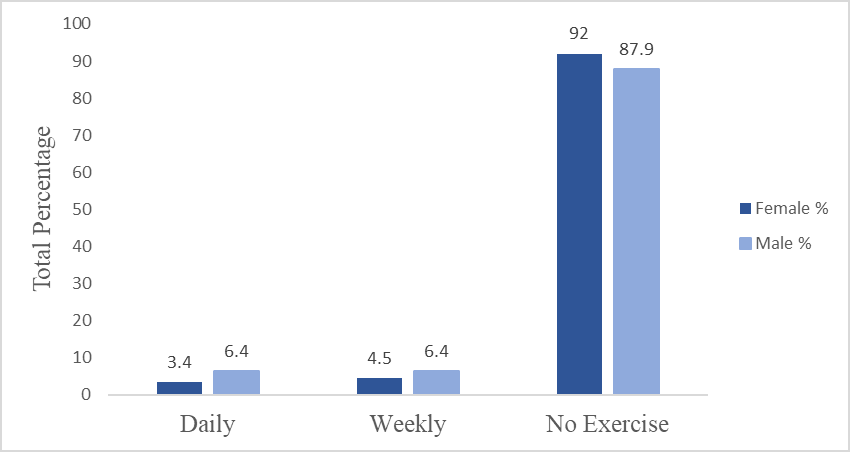
The risk factors associated with sciatica in female and male patients were family history of back problems (42.1%, 35.4%), heavy lifting (45.4%, 56.4%), occupational workload (30.6%, 79.1%), injury (39.7%, 7.4%), depression (86.3%, 64.5%), smoking (69.3%) and menopause (52.2%; Figure 1 and Table 2). Heavy lifting and depression were found to be common in both genders (Figure 1). The prevalence of sciatica was high in patients who were not doing regular exercise with 92% females and 87.9% male patients (Figure 2).
The overall prevalence of sciatica was found to be more in female patients (58.7%) compared to males (41.3%). A study conducted in Saudi Arabia shows similar results in which females were more affected (78.6%) compared to male gender (21.4%; . The present study revealed that sciatica was more common in the second age group between 29-43 years (37.3%). This finding agrees with those of Korovessis et al. (2012), who reported that the prevalence of low back pain throughout school-age increases from childhood to puberty, however, peaks among ages 35 and 55 years .
It was found that heavy lifting, occupational workload, injury and depression are the important risk factors for the prevalence of sciatica, which is similar to previously published studies ; ; Wang et al., 2016; . Smoking was an important risk factor of sciatica for male patients. Karahan et al. (2009) identified smoking as an important risk factor for sciatica. Another interesting point was noted that post-menopausal women (52.2%) showed a higher prevalence of having sciatica. One similar study was conducted by Wang et al. (2016) who observed that post-menopausal women experienced sciatica due to relative estrogen deficiency. The present study revealed that patients with an inactive lifestyle (not doing regular exercise) were found to be at higher risk of sciatica. The study conducted by Hildebrandt et al. (2000) showed that patients with a sedentary lifestyle, non-participation in sports seemed to be linked with higher prevalence rates of symptoms as compared to patients with strenuous activities.
The current study is limited by the fact that it did not give information about the preventive measures and the earlier treatment option of the disorder sciatica. Future research is needed to make people aware of the preventive measures and the earlier treatment options of the disorder before it leads to cauda equina syndrome (CES).
Conclusions and Recommendations
In conclusion, sciatica is more common among the female gender as compared to the male gender in district Nowshera. It is strongly associated with age, family history of back problems, occupational workload, heavy lifting, injury and depression. Post-menopausal women, male smokers and patients with a sedentary lifestyle are the major risk factors for the prevalence of sciatica.
Acknowledgements
We are thankful to the Qazi Hussain Ahmed Hospital for facilities for data collection from the local populations.
Conflict of interest
The authors have declared no conflict of interest.
Figures
Figure 1:.
Distribution of sciatica patients on the basis of risk factors.
Figure 2:.
Exercise status of sciatica patients.
References
Adjien, C.K., Gnonlonfoun, D., Dochamou, C., Donald, A., and Houinato, D., 2018. Epidemiological, clinical and etiological aspects of sciatica in hospital setting, CNHU-HKM Cotonou. Neurosci. Med., 9: 171-179. https://doi.org/10.4236/nm.2018.94017[CrossRef]
Euro, U., Heliövaara, M., Shiri, R., Knekt, P., Rissanen, H., Aromaa, A., and Karppinen, J., 2019. Work-related risk factors for sciatica leading to hospitalization. Sci. Rep., 9: 1-7. https://doi.org/10.1038/s41598-019-42597-w[CrossRef]
Gardner, A., Gardner, E., and Morley, T., 2011. Cauda equina syndrome: A review of the current clinical and medico-legal position. Eur. Spine J., 20: 690-697. https://doi.org/10.1007/s00586-010-1668-3[CrossRef]
Hildebrandt, V.H., Bongers, P.M., Dul, J., Van Dijk, F.J., and Kemper, H.C., 2000. The relationship between leisure time, physical activities and musculoskeletal symptoms and disability in worker populations. Int. Arch. Occupant. Environ. Hlth., 73: 507-518. https://doi.org/10.1007/s004200000167[CrossRef]
Ho, D.P., 2003. A case study of cauda equina syndrome. Permanente J., 7: 13.
Karahan, A., Kav, S., Abbasoglu, A., and Dogan, N., 2009. Low back pain: Prevalence and associated risk factors among hospital staff. J. Adv. Nurs., 65: 516-524. https://doi.org/10.1111/j.1365-2648.2008.04905.x[CrossRef]
Keriri, H., 2013. Prevalence and risk factors of low back pain among nurses in operating rooms, Taif, Saudi Arabia. Am. J. Res. Commun., 1: 25. https://doi.org/10.5958/j.2321-5798.4.1.001[CrossRef]
Kherad, M., Rosengren, B.E., Hasserius, R., Nilsson, J.Å., Redlund-Johnell, I., Ohlsson, C., Mellström, D., Lorentzon, M., Ljunggren, Ö., and Karlsson, M.K., 2017. Risk factors for low back pain and sciatica in elderly men the MrOS Sweden study. Age ageing, 46: 64-71. https://doi.org/10.1093/ageing/afw152[CrossRef]
Koes, B.W., Van Tulder, M.W., and Peul, W.C., 2007. Diagnosis and treatment of sciatica. Br. Med. J., 334: 1313-1317. https://doi.org/10.1136/bmj.39223.428495.BE[CrossRef]
Korovessis, P., Repantis, T., Zacharatos, S., and Baikousis, A., 2012. Low back pain and sciatica prevalence and intensity reported in a Mediterranean country: Ordinal logistic regression analysis. Orthopedics, 35: 1775-1784. https://doi.org/10.3928/01477447-20121120-24[CrossRef]
Kumaresan, A., Chakraborty, Arunachalam, R., Kiruthika, S., Prathap, S., and Arivoli, K., 2016. A comparative study of lumbar traction and straight leg raisingin the management of sciatica. Int. J. Pharm. Sci. Hlth. Care, 2: 2249-5738.
Leclerc, A., Tubach, F., Landre, M.F., and Ozguler, A., 2003. Personal and occupational predictors of sciatica in the GAZEL cohort. Occup. Med., 53: 384-391. https://doi.org/10.1093/occmed/kqg072[CrossRef]
Lin, P.H., Tsai, Y.A., Chen, W.C., and Huang, S.F., 2012. Prevalence, characteristics, and work-related risk factors of low back pain among hospital nurses in Taiwan: A cross-sectional survey. Int. J. Occup. Med. Environ. Hlth., 25: 41-50. https://doi.org/10.2478/s13382-012-0008-8[CrossRef]
Mathieson, S., Kasch, R., Maher, C.G., Pinto, R.Z., McLachlan, A.J., Koes, B.W., and Lin, C.W., 2019. Combination drug therapy for the management of low back pain and sciatica: Systematic review and meta-analysis. J. Pain, 20: 1-5. https://doi.org/10.1016/j.jpain.2018.06.005[CrossRef]
Peul, W.C., Brand, R., Thomeer, R.T., and Koes, B.W., 2008. Influence of gender and other prognostic factors on outcome of sciatica. Pain, 138: 180-191. https://doi.org/10.1016/j.pain.2007.12.014[CrossRef]
Rahimi-Movaghar, V., Rasouli, M.R., Sharif-Alhoseini, M., Jazayeri, S.B., and Vaccaro, A.R., 2011. Discogenic sciatica: Epidemiology, etiology, diagnosis, and management. The Sciatic Nerve: Blocks, Injuries and Regeneration. New York (NY). Nova Sci. Publ.,
Rana, J.K., and Shalya, M.S., 2017. A critical review on etiology of sciatica in ayurveda. World J. Pharam. Med. Res., 3: 161-165.
Saleem, M., Iftikhar, S., Javaid, R., Rana, T., Rana, M., and Arfat, Y., 2019. Sciatica: Medical treatment or Physiotherapy? Afr. J. Pharm. Pharmacol., 13: 203-212.
Shiri, R., Euro, U., Heliövaara, M., Hirvensalo, M., Husgafvel-Pursiainen, K., Karppinen, J., Lahti, J., Rahkonen, O., Raitakari, O.T., Solovieva, S., and Yang, X., 2017. Lifestyle risk factors increase the risk of hospitalization for sciatica: findings of four prospective cohort studies. Am. J. Med., 130: 1408-1414. https://doi.org/10.1016/j.amjmed.2017.06.027[CrossRef]
Shiri, R., Falah-Hassani, K., Viikari-Juntura, E., and Coggon, D., 2016. Leisure-time physical activity and sciatica: A systematic review and meta-analysis. Eur. J. Pain, 20: 1563-1572. https://doi.org/10.1002/ejp.885[CrossRef]
Stafford, M.A., Peng, P., and Hill, D.A., 2007. Sciatica: A review of history, epidemiology, pathogenesis, and the role of epidural steroid injection in management. Br. J. Anaesth., 99: 461-473. https://doi.org/10.1093/bja/aem238[CrossRef]
Wáng, Y.X., Wáng, J.Q., and Káplár, Z., 2016. Increased low back pain prevalence in females than in males after menopause age: Evidences based on synthetic literature review. Quant. Imag. Med. Surg., 6: 199. https://doi.org/10.21037/qims.2016.04.06[CrossRef]