
This cross-sectional study was conducted to determine the prevalence and associated risk factors of bovine tuberculosis (bTB) among large ruminants of the five districts (Peshawar, Nowshera, Charsadda, Mardan and Swabi) located in the central zone of Khyber Pakhtunkhwa (KPK), Pakistan. A total of 2400 large ruminants were sampled by convenience sampling approach and tested by comparative cervical intradermal tuberculin test (CCIT) for detection of Mycobacterium bovis infection. Data regarding socio-demographic status, risk factors and farming practices were gathered through a pre-form questionnaire. Results revealed that prevalence of bovine tuberculosis was 5.88%. Statistical analysis revealed significant association of age (OR= 3.267; CI = 1.686-6.331) and herd size (OR = 2.600; CI = 1.421-4.760) with CCIT positivity. Similarly, induction of new animals into the herd (OR= 2.661; CI = 1.758-4.028) and sheltering the animals at night (OR= 2.448; CI = 1.568-3.882) also showed association with a positive skin test. The herd owners and animal handlers had poor knowledge regarding signs, symptoms and the zoonotic nature of the infection. Three primary signs (persistent cough, weight loss and fever) were recognized by 4.7% of respondents including herd owners, herders and animal handlers. This study calls for instant measures for disease control among the animals and humans of the study area, and highlight the need for farmer education regarding bovine tuberculosis.
Research Article · Volume 51, Issue 1, 22 November 2018 · Open Access
Bovine Tuberculosis (bTB): Prevalence and Associated Risk Factors in Large Ruminants in the Central Zone of Khyber Pakhtunkhwa, Pakistan
· · · · · · · · · · ·
Affiliations & Notes ⌄
- 1College of Veterinary Sciences and Animal Husbandry, Abdul Wali Khan University, Mardan 2Department of Animal Health, The University of Agriculture, Peshawar, KPK 3Institute of Chemical Sciences, The University of Peshawar, Peshawar 4Centre of Biotechnology and Microbiology, The University of Peshawar, Peshawar 5University of Veterinary and Animal Sciences, Lahore 6University College of Veterinary and Animal Sciences, The Islamia University of Bahawalpur, Bahawalpur , * Corresponding author: vet
Article Info ⌄
- Journal:
- Pakistan Journal of Zoology
- Published:
- 22 November 2018

From the article
- Constant investigation of M. bovis infection and associated risk factors in large ruminants in the region is mandatory to design effective control measures.
- No significant difference was found in the prevalence among the different study regions because of similarity in animal husbandry and management practices.
- The animals housed indoor during the night were found at higher risk of being CCIT positive as compared to those who were housed outdoor during night.
- The conclusions of current research provide evidence about the prevalence and possible risk factors linked with positivity of M. bovis infection in large ruminants (cattle and buffalo) in Central Zone of Khyber Pakhtunkhwa, which need to include M. bovis infection in NTCP.
Selected from the article's own text.
Abstract
Introduction
Bovine tuberculosis (bTB) is an infectious zoonotic disease caused by Mycobacterium bovis (M. bovis), having a wide range of hosts ; . In an area where bTB is endemic, uncontrolled or partially controlled, aerosol is the key route of transmission for the humans along with ingestion of contaminated water, meat and milk . Workers handling carcasses of infected animals get infection through skin and mucous membranes (de la Rua-Domenech, 2006; . Bovine TB outbreaks trigger large economic losses to agricultural economies by curtailing international trade of animals and animal products, causing reduction in milk and meat production, compromising fertility, massive control and eradication strategies, and increased public health risks . Although some countries managed to eradicate bTB through regular testing and removal of infected animals, the occurrence of bTB is higher in developing countries since the control and eradication policies are not sufficiently executed ; de la Rua-Domenech, 2006). More than 125 countries reported prevalence of M. bovis infection in cattle herds to OIE, during 2005 to 2008 . Literature reported higher prevalence of disease with increasing age , while at herd level, herd size and movement of animals were associated with the bTB . New animals must be introduced from non-endemic areas to minimize the risk of new infection in the herd .
Endemicity of bovine TB among animals has been attempted to be controlled using test and slaughter strategy. For past decades, infected or carrier subjects are identified using the comparative cervical intradermal tuberculin test (CCIT), also termed as the tuberculin skin test (TST). This test is based on delayed-type hypersensitivity reaction, evoked by purified protein of Mycobacterium tuberculosis called tuberculin . Despite certain limitations, the importance of CCIT in control of TB can never be ignored. It is simple and does not demand extensive training and special laboratory aids for its procedure and interpretation of results .
Extensive struggle has been made around the globe to eradicate bTB because of its zoonotic and economic consequences. In developing countries, precise data on prevalence of infection is needed to improved surveillance programs and control of bTB . Pakistan faces a serious dearth of epidemiological data epidemiology on bTB, rendering the surveillance and eradication targets of M. bovis infection, unaccomplished. National Tuberculosis Control Program, Pakistan (NTCP) doesn’t address the transmission of bTB to humans, adding to the difficulty.
This study was designed and conducted to determine prevalence and associated risk factors of bTB caused by M. bovis in most populated and centrally located districts of Khyber Pakhtunkhwa in Pakistan.
Materials and methods
Study design and area
A cross-sectional epidemiological study was conducted to determine the prevalence of M. bovis and risk factors associated with presence of infection in large ruminants of urban and rural areas of central zone of Khyber Pakhtunkhwa, Pakistan. This study was carried out in the central zone (districts Peshawar, Nowshera, Charsadda, Mardan and Swabi) of Khyber Pakhtunkhwa, Pakistan. A total of 2400 asymptomatic large ruminants (1225 cattle and 1175 buffalo) were tested by convenience sampling approach using CCIT from January 2016 to December 2016.
Data collection
To identify the associated risk factors, semi-structured interviews were conducted after formal written consent from herd owners and livestock workers. A structured questionnaire was designed to gather animal and herd level information. Animal level data included information regarding location of the animal, species, age, gender and lactation status of the animal, while herd level data included information regarding herd size, procedure of animal procurement in the herd, breeding of animals, housing and feeding management practices and presence of various animal species in the vicinity of tested animals. Trained local government officials, conversant in local and the national language assisted with data collection. Information regarding contact of tested animals with various other species of the animals was gathered from herders. Presence of wild animal species in and around the grazing area and water source was described as contact with wild animals. The questionnaire template used, can be obtained from the corresponding author on request.
Comparative cervical intradermal tuberculin test
Comparative cervical intradermal tuberculin test was performed, briefly 0.1ml (25,000 IU) avian purified protein derivative (a-PPD) and 0.1ml (20,000 IU) bovine purified protein derivative (b-PPD) were injected at 12 cm distant points on left lateral side of neck. After 72 h of injecting a-PPD and b-PPD, the thickness of skin-fold at each injection site was measured using digital calipers. Animals were considered positive if the fold to the skin was thickened >4 mm at b-PPD injection site as compared to a-PPD injection site. While, if skin thickness at a-PPD injection site is 4mm higher than that at b-PPD injection site, the animal was considered a reactor.
Statistical analysis
The collected data was entered using the Microsoft Excel version 2013, and then exported to the Statistical Product and Service Solutions (SPSS) version 20.0 to establish associations between positive animals and the risk factors at 95% level of confidence. Summary statistics, Pearson’s chi-square test and multivariable logistic regression were done to identify associations between selected risk factors and CCIT positivity. The prevalence was calculated by dividing the number of positive animals by the total number of tested animals. Variables with a p-value of <0.05 on Pearson’s chi-square test (χ2 test) were included in multivariable models. Finally, logistic regression was used to analyze the effect of potential risk factors.
Results
In this study, 655 (27.29%) animals were from small scale farmers, reared for milk production at household level and 1745 (72.70%) animals were from commercial dairy herds. Out of 2400, 1225 (51.04%) were cattle and 1175 (48.96%) were buffaloes.
Table I.- Prevalence of bovine tuberculosis (bTB) in five districts of the Central Zone of Khyber Pakhtunkhwa, Pakistan.
| District | Animals screened (N) | Tested positive | 95% confidence level | Chi-square | ||
| n | Overall prevalence (%) = (n/N x 100) | Lower | Upper | |||
| Peshawar | 480 | 31 | 6.46 | 4.26 | 8.66 | p=0.669 |
| Nowshera | 480 | 23 | 4.79 | 2.88 | 6.70 | |
| Charsadda | 480 | 30 | 6.25 | 4.08 | 8.42 | |
| Mardan | 480 | 32 | 6.67 | 4.44 | 8.90 | |
| Swabi | 480 | 25 | 5.21 | 3.22 | 7.20 | |
| Total tested | 2400 | 141 | 5.88 | 3.78 | 7.98 | |
N, number of screened animals; n, number of infected animals for bTB.
Table II.- Bivariate frequency analysis of various parameters in positive and negative tuberculin reactors.
| Parameters | Negative | Positive | Chi-square | Parameters | Negative | Positive | Chi-square | ||||
| n | % | n | % | ||||||||
| Species | Presence of other animals with cattle and buffalo | ||||||||||
| Cattle | 1146 | 79 | 6.45% | p=0.222 | Goat | 403 | 25 | 5.84% | p=0.132 | ||
| Buffalo | 1113 | 62 | 5.28% | Donkey | 245 | 25 | 9.26% | ||||
| Age (years) | Poultry | 412 | 19 | 4.41% | |||||||
| 1-2 | 416 | 0 | 0.00% | p=0.000 | None | 349 | 20 | 5.42% | |||
| 2-3 | 504 | 18 | 3.45% | Sheep | 324 | 21 | 6.09% | ||||
| 3-4.5 | 779 | 32 | 3.95% | Horse | 279 | 12 | 4.12% | ||||
| 5->8 | 560 | 91 | 13.98% | Mule | 247 | 19 | 7.14% | ||||
| Sex | Animals kept at night | ||||||||||
| Male | 260 | 10 | 3.70% | p=0.107 | Outdoor | 188 | 4 | 2.08% | p=0.020 | ||
| Female | 1999 | 131 | 6.15% | Indoor | 2071 | 137 | 6.20% | ||||
| Lactation status | Ventilation status(if indoor at night) | ||||||||||
| Lactating | 1500 | 108 | 6.72% | p=0.072 | Ventilation | 1113 | 101 | 8.32% | p=0.355 | ||
| Non-lactating | 504 | 24 | 4.55% | No Ventilation | 478 | 36 | 7.00% | ||||
| Herd size | Pet on farm | ||||||||||
| 1 to 10 | 495 | 5 | 1.00% | p=0.000 | Dog | 563 | 36 | 6.01% | p=0.367 | ||
| 11 to 20 | 561 | 14 | 2.43% | Backyard poultry | 436 | 30 | 6.44% | ||||
| 21 to 30 | 601 | 24 | 3.84% | Other | 498 | 37 | 6.92% | ||||
| 31 to 40 | 323 | 27 | 7.71% | None | 762 | 38 | 4.75% | ||||
| 41 to 50 | 279 | 71 | 20.29% | Animals feeding through | |||||||
| Animal source | Only grazing | 1181 | 61 | 4.91% | p=0.115 | ||||||
| Raised at own farm | 1481 | 51 | 3.33% | p=0.000 | Only station feeding | 282 | 21 | 6.93% | |||
| Purchased from market | 778 | 90 | 10.37% | Grazing plus station feeding | 796 | 59 | 6.90% | ||||
| Number of old animals in the herd | |||||||||||
| 0 | 474 | 32 | 6.32% | p=0.069 | Grazing status | ||||||
| 1 | 340 | 10 | 2.86% | Communal | 636 | 44 | 6.47% | p=0.456 | |||
| 2 | 433 | 28 | 6.07% | Non-communal | 1271 | 76 | 5.64% | ||||
| 3 | 380 | 33 | 7.99% | Water trough | |||||||
| 4 | 251 | 18 | 6.69% | Combined | 1686 | 115 | 6.39% | p=0.065 | |||
| 5 and more | 381 | 20 | 4.99% | Individual | 573 | 26 | 4.34% | ||||
| Breeding of animals | Manure disposal | ||||||||||
| AI | 1284 | 72 | 5.31% | p=0.387 | Twice a day | 189 | 16 | 7.80% | p=0.459 | ||
| Natural with Own bull | 406 | 30 | 6.88% | Daily | 1927 | 117 | 5.72% | ||||
| Natural with rented bull | 569 | 39 | 6.41% | Twice a week | 143 | 8 | 5.30% | ||||
Out of 2400 CCIT tested animals, 141 were positive for bovine tuberculosis yielding prevalence of 5.88% (95% CI; 5.68 - 6.08). No statistically significant difference was found (p = 0.669) among the different study districts (Table I). Results showed non-significant association among CCIT positivity and species of animals (p = 0.222), gender (p = 0.107), lactation status (p = 0.072), number of older animals within herd (p = 0.069), breeding practices (p = 0.387), presence of various livestock species in and around large ruminants (p = 0.132), ventilation status if kept indoor at night (p = 0.355), presence of pet animals on farm (p = 0.367), feeding practices (p = 0.115), grazing practices (p = 0.456), combined drinking water source (p = 0.065) and manure disposal (p = 0.459).
Table III.- Multivariable logistic regression analysis of various parameters.
| Parameters | Odds ratio | 95% CI | P value | ||
| Lower | Upper | ||||
| Age | |||||
| 1-2 years | Reference | ||||
| 2-3 years | 1.725 | 0.638 | 4.662 | 0.283 | |
| 3-5 years | 1.078 | 0.540 | 2.154 | 0.831 | |
| 5 ->8 years | 3.267 | 1.686 | 6.331 | 0.000 | |
| Herd size | |||||
| 1 to 10 | Reference | ||||
| 11 to 20 | 1.124 | 0.665 | 1.898 | 0.663 | |
| 21 to 30 | 0.735 | 0.412 | 1.311 | 0.297 | |
| 31 to 40 | 2.594 | 1.319 | 5.102 | 0.006 | |
| 41 to 50 | 2.600 | 1.421 | 4.760 | 0.002 | |
| Animal source | |||||
| Raised at own Farm | Reference | ||||
| Purchased | 2.661 | 1.758 | 4.028 | 0.000 | |
| Animals kept at night | |||||
| Outdoor | Reference | ||||
| Indoor | 2.448 | 1.568 | 3.822 | 0.000 | |
Bivariate analysis (Table II) and multivariable logistic regression analysis (Table III) revealed the significant association between CCIT positivity and age, animal source, herd size and animal housing during the night. Bovine TB was found to be more prevalent in older animals (≥5years) as compared to younger animals (OR = 3.267; 95% CI = 1.686-6.331; p = 0.000). Statistical analysis revealed larger herd size (41-50 animals) as a potential risk factor for CCIT positivity in large ruminants (OR = 2.600; 95% CI = 1.421-4.760; p = 0.002). Similarly, the rate of CCIT test positivity was higher in farms where animals were procured from live animal markets as compared to those farms where animals were privately raised (OR = 2.661; 95% CI = 1.758-4.028; p = 0.000). Results revealed higher odds of CCIT positivity in animals kept indoor during night (OR = 2.448; 95% CI = 1.568-3.822; p = 0.000).
Respondents were also interviewed to determine their knowledge about bovine tuberculosis. Around 33.68% herd owners mentioned about persistent cough (>3 weeks) as an indication of tuberculosis. Similarly, 75.26% herd owners believed weight loss a symptom of tuberculosis while 23.68% herd owners mentioned coughing up sputum or blood as an indication of tuberculosis. On the other hand, many respondents inaccurately linked some symptoms such as vomiting (7.37%) and diarrhea (10%) with TB. Livestock owners identified chest pain, fever and chills as signs and symptoms of tuberculosis (23.16%, 80% and 47.89%, respectively). Some animal handlers identified general weakness and loss of appetite (76.32% and 80.53%, respectively) as indications of TB. All three primary signs (persistent cough, weight loss and fever) of TB were mentioned only by 7.1% of respondents showing poor awareness among farmers and animal handlers (Fig. 1).
In this study, 190 livestock farmer were interviewed about the zoonosis of bTB. Almost 97.9% herd owners had some kind of knowledge regarding tuberculosis while 2.1% had not heard of the infection. Less than one third (30.1%) of the farmers were aware of the zoonotic nature of the disease. Unpasteurized milk was thought to be the source of infection by 37.4% of the dairy farmers. Similarly, 17.4% and 11.1% knew about the air and raw meat, respectively as the source of infection (Table IV).
Table IV.- Knowledge of livestock farmers about zoonosis of bovine tuberculosis in the Central zone of Khyber Pakhtunkhwa, Pakistan.
| Parameter | No. of farmers | Farmers (%) | |
| Age (years) | |||
| <20 | 16 | 8.4 | |
| 20–30 | 25 | 13.2 | |
| 31–40 | 35 | 18.4 | |
| 41–50 | 43 | 22.6 | |
| >50 | 71 | 37.4 | |
| Education | |||
| Illiterate | 15 | 7.9 | |
| Middle | 61 | 32.1 | |
| Secondary | 85 | 44.7 | |
| Graduate | 29 | 15.3 | |
| Socio-economic status | |||
| Very Low | 13 | 6.8 | |
| Low | 54 | 28.4 | |
| Moderate | 94 | 49.5 | |
| High | 29 | 15.3 | |
| Farmers knowledge about zoonosis of Btb | |||
| Have you heard of Tuberculosis? | |||
| Yes | 186 | 97.9 | |
| No | 4 | 2.1 | |
| If yes, does TB spread from animals to human | |||
| Yes | 59 | 31.1 | |
| No | 131 | 68.9 | |
| If TB spreads from animals to human, through which way of the following: | |||
| Raw milk | 71 | 37.4 | |
| Meat | 21 | 11.1 | |
| Aerosol route | 33 | 17.4 | |
| Urine | 38 | 20.0 | |
| Feces of disease animals | 27 | 14.2 | |
Discussion
Pakistan is a sub-tropical country and Central zone of Khyber Pakhtunkhwa (KP) is located in continental grasslands and has five administrative units/districts i.e.; district Peshawar, Nowshera, Charsadda, Mardan and district Swabi lying at the porous afghan border, with frequent movement of animals and humans across the border. Dearth of data on epidemiological dynamics of bTB in region can surge serious menace of infection among subjects in the central zone of KPK. Constant investigation of M. bovis infection and associated risk factors in large ruminants in the region is mandatory to design effective control measures. During the current investigation, the overall prevalence for M. bovis infection was 5.88% in large ruminants. Within Pakistan, several studies reported variation in prevalence i.e. 3% , 2.2% , 1.7% , 9.6% , 10.6% , 11.3% and 12.72% . This variation in the prevalence of infection is attributed to differences in husbandry practices and higher numbers of crossbreds as well as exotic animals at the dairy farms . No significant difference was found in the prevalence among the different study regions because of similarity in animal husbandry and management practices.
Outcomes of multivariable statistical assessment revealed that 5 years or older animals are at higher odds of getting infection. Similar findings were reported by previous studies conducted in similar socio-economic settings , 2009, 2012; ; . Prevalence increased with the age of livestock animals because of the lengthier exposure to the etiological agent over time among older animals . In endemic scenarios, older animals were exposed to infectious agent for longer periods of time, increasing the prevalence with increasing age . Cleaveland et al. (2007) proposed reactivation of latent infection of tuberculosis in older age to be the cause of greater proportions of human tuberculosis but this is yet to be confirmed in animals. Larger herd size was found to be significant risk factor associated with bTB, which might be because of presence of higher number of animals in larger herds . Dairy farmers improve the herd size to increase farm yield which can lead to overcrowding causing increased animal-to-animal transmission (Ghebremariam et al., 2016). This study indicated that the positivity of bTB was meaningfully linked with buying and induction of new animals into the farm. These conclusions are in line with the findings of several studies as piloted in England and Uganda ; , which can be attributed due to their interaction with various animals during their stay at different dairy farms or at live animal markets. The animals housed indoor during the night were found at higher risk of being CCIT positive as compared to those who were housed outdoor during night. These outcomes may be due to the aerosol route of transmission among closely tied animals. Hence, extra risk of close contact of susceptible animals might be the main cause behind greater ratio of CCIT positive animals when housed indoor. Our results are in line with the findings of Katale et al. (2012) who reported substandard ventilation as the cause of infection transmission.
The learning rate is relatively low in emerging nations including Pakistan ; ; . Different seminars, wakefulness promotions, learning sessions and use of print and electronic media must be an important part of TB control programs.
Conclusions
The conclusions of current research provide evidence about the prevalence and possible risk factors linked with positivity of M. bovis infection in large ruminants (cattle and buffalo) in Central Zone of Khyber Pakhtunkhwa, which need to include M. bovis infection in NTCP.
Acknowledgments
Financial support to this research was provided by Higher Education Commission, Pakistan under “Startup Research Grant Program” Grant Number 1176. The authors thank the dairy farmers, Veterinary Officers (VO’s) and Veterinary Assistants (VA’s) in the research zone for their kind support in this research.
Statement of conflict of interest
The authors declare that there are no conflicts of interests regarding the publication of this article
Figures
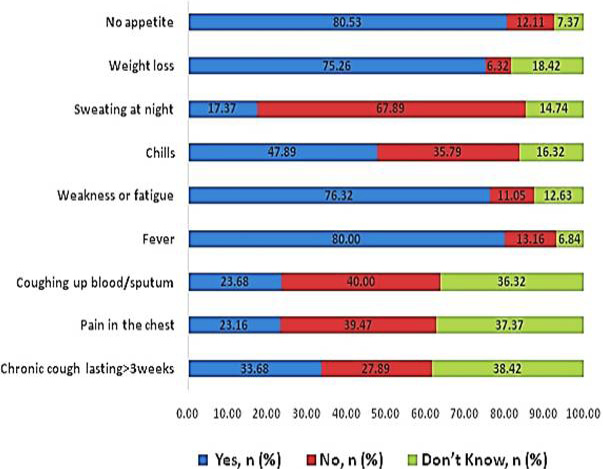
Distribution of signs and symptoms of bTB known to the livestock farmers in the Central Zone of Khyber Pakhtunkhwa, Pakistan.
References
- Amanfu, W., 2006. The situation of tuberculosis and tuberculosis control in animals of economic interest. Tuberculosis, 86: 330-335. https://doi.org/10.1016/j.tube.2006.01.007[CrossRef]
- Ameni, G., Aseffa, A., Engers, H., Young, D., Gordon, S., Hewinson, G. and Vordermeier, M., 2007. High prevalence and increased severity of pathology of bovine tuberculosis in Holsteins compared to zebu breeds under field cattle husbandry in central Ethiopia. Clin. Vacc. Immunol., 14: 1356-1361. https://doi.org/10.1128/CVI.00205-07[CrossRef]
- Awah-Ndukum, J., Temwa, J., Ngwa, V.N., Mouiche, M.M., Iyawa, D. and Zoli, P.A., 2016. Interpretation criteria for comparative intradermal tuberculin test for diagnosis of bovine tuberculosis in cattle in Maroua area of Cameroon. Vet. Med. Int., 2016: 4834851. https://doi.org/10.1155/2016/4834851[CrossRef]
- Batool, B.T., Tareen, A., Ahmed, S.S., Ejaz, H., Kakar, M.A., Rehman, S.A., Saeed, M., Ahmad, Z., Tariq, M.M., Awan, M.A. and Shahwani, M.N., 2017. Prevalence of zoonotic tuberculosis and brucellosis in animals of Quetta and Pishin Districts, Balochistan. Pakistan J. Zool., 49: 387-389. http://dx.doi.org/10.17582/journal.pjz/2017.49.1.sc4[CrossRef]
- Cleaveland, S., Shaw, D.J., Mfinanga, S.G., Shirima, G., Kazwala, R.R., Eblate, E. and Sharp, M., 2007. Mycobacterium bovis in rural Tanzania: Risk factors for infection in human and cattle populations. Tuberculosis, 87: 30-43. https://doi.org/10.1016/j.tube.2006.03.001[CrossRef]
- de la Rua-Domenech, R., 2006. Human Mycobacterium bovis infection in the United Kingdom: Incidence, risks, control measures and review of the zoonotic aspects of bovine tuberculosis. Tuberculosis, 86: 77-109. https://doi.org/10.1016/j.tube.2005.05.002[CrossRef]
- Dejene, S.W., Heitkönig, I.M., Prins, H.H., Lemma, F.A., Mekonnen, D.A., Alemu, Z.E., Kelkay, T.Z. and de Boer, W.F., 2016. Risk factors for bovine tuberculosis (bTB) in cattle in Ethiopia. PLoS One, 11: e0159083. https://doi.org/10.1371/journal.pone.0159083[CrossRef]
- Ghebremariam, M.K., Michel, A.L., Nielen, M., Vernooij, J.C. and Rutten, V.P., 2018. Farm-level risk factors associated with bovine tuberculosis in the dairy sector in Eritrea. Transb. Emerg. Dis., 65: 105-113. https://doi.org/10.1111/tbed.12622[CrossRef]
- Gopal, R., Goodchild, A., Hewinson, G., de la Rua Domenech, R. and Clifton-Hadley, R., 2006. Introduction of bovine tuberculosis to north-east England by bought-in cattle. Vet. Rec., 159: 265-271. https://doi.org/10.1136/vr.159.9.265[CrossRef]
- Ifrahim, M., 2001. Epidemiological studies on tuberculosis in cattle and buffalo population in villages around Faisalabad. Unpublished M. Sc. (Hons) thesis, University of Agriculture, Faisalabad.
- Irfan, K., Mushtaq, M.H., Ahmad, M.U.D., Khan, M.S., Chaudhry, M. and Sadique, U., 2016. Risk factors associated with Mycobacterium bovis skin positivity in cattle and buffalo in Peshawar, Pakistan. Trop. Anim. Hlth. Prod., 48: 479-485. https://doi.org/10.1007/s11250-015-0976-3[CrossRef]
- Javed, M.T., Ahmad, L., Felizianib, F., Pasqualic, P., Akhtard, M., Usman, M., Irfan, M., Severib, G. and Cagiola, M., 2012. Analysis of some of the epidemiological risk factors affecting the prevalence of tuberculosis in buffalo at seven livestock farms in Punjab Pakistan. Asian Biomed., 6: 35-42.
- Javed, M.T., Farooqi, A.F. and Ullah, H., 2009. Epidemiological basis of bovine tuberculosis in buffaloes. Pakistan J. Zool., 9: 417-420.
- Javed, M.T., Shahid, A.L., Farooqi, F.A., Akhtar, M., Cardenas, G.A., Wasiq, M. and Cagiola, M., 2010. Risk factors associated with the presence of positive reactions in the SCCIT test in water buffalo around two cities in Punjab, Pakistan. Acta Trop., 115: 242-247. https://doi.org/10.1016/j.actatropica.2010.04.004[CrossRef]
- Javed, M.T., Usman, M., Irfan, M. and Cagiola, M., 2006. A study on tuberculosis in buffaloes: some epidemiological aspects, along with haematological and serum protein changes. Vet. Arhiv., 76: 193-206.
- Katale, B.Z., Mbugi, E.V., Kendal, S., Fyumagwa, R.D., Kibik, G.S., Godfrey-Faussett, P., Keyyu, J.D., Van Helden, P. and Matee, M.I., 2012. Bovine tuberculosis at the human-livestock-wildlife interface: Is it a public health problem in Tanzania? A review. Onderstepoort J. Vet. Res., 79: a463. https://doi.org/10.4102/ojvr.v79i2.463[CrossRef]
- Kazoora, H.B., Majalija, S., Kiwanuka, N. and Kaneene, J.B., 2014. Prevalence of Mycobacterium bovis skin positivity and associated risk factors in cattle from Western Uganda. Trop. Anim. Hlth. Prod., 46: 1383-1390. https://doi.org/10.1007/s11250-014-0650-1[CrossRef]
- Kazwala, R.R., Kambarage, D.M., Daborn, C.J., Nyange, J., Jiwa, S.F. and Sharp, J.M., 2001. Risk factors associated with the occurrence of bovine tuberculosis in cattle in the Southern Highlands of Tanzania. Vet. Res. Commun., 25: 609-614. https://doi.org/10.1023/A:1012757011524[CrossRef]
- Khan, I.A., Khan, A., Mubarak, A. and Ali, S., 2008. Factors affecting prevalence of bovine tuberculosis in Nili Ravi buffaloes. Pak. Vet. J., 28: 155-158.
- Khan, I.A., Khan, A., 2007. Prevalence and risk factors of bovine tuberculosis in Nili-Ravi buffaloes in the Punjab, Pakistan. Italian J. Anim. Sci., 6: 817-820. https://doi.org/10.4081/ijas.2007.s2.817[CrossRef]
- Mahmud, M.A., Belal, S.M. and Shoshe, N.Z., 2014. Prevalence of bovine tuberculosis in cattle in the selected Upazila of Sirajganj district in Bangladesh. Bang. J. Vet. Med., 22: 141-145. https://doi.org/10.3329/bjvm.v12i2.21276[CrossRef]
- Mangesho, P.E., Shayo, E., Makunde, W.H., Keto, G.B., Mandara, C.I., Kamugisha, M.L., Kilale, A.M. and Andishengoma, D.R., 2007. Community knowledge, attitudes and practices towards tuberculosis and its treatment in Mpwapwa district, central Tanzania. Tanz. Hlth. Res. Bull., 9: 38-43.
- McGeary, A., 2008. The role of Mycobacterium bovis in tuberculosis in Africa. Med. J. Therapeu. Afr., 2: 59-62.
- Memon, M.R., Bhutto, A.L., Khatri, P., Shah, M.G. and Memon, M.I., 2017. Prevalence and risk factor analysis of bovine tuberculosis in bovine population in Karachi, Pakistan. J. Anim. Hlth. Prod., 5: 44-49.
- Michel, A.L., Muller, B. and van Helden, P.D., 2010. Mycobacterium bovis at the animal-human interface: A problem, or not? Vet. Microbiol., 140: 371-381. https://doi.org/10.1016/j.vetmic.2009.08.029[CrossRef]
- Mohamed, A.M., 2017. Tuberculin skin test for control of bovine tuberculosis: Limitation history, current challenges and future opportunities. J. Microbiol. Exp., 4: 00118. https://doi.org/10.15406/jmen.2017.04.00118[CrossRef]
- Moiane, I., Machado, A., Santos, N., Nhambir, A., Inlamea, O., Hattendorf, J., Kallenius, G., Zinsstag, J. and Correia-Neves, M., 2014. Prevalence of bovine tuberculosis and risk factor assessment in cattle in rural livestock areas of Govuro District in the Southeast of Mozambique. PLoS One, 9: e91527. https://doi.org/10.1371/journal.pone.0091527[CrossRef]
- Monaghan, M.L., Doherty, M.L., Collins, J.D., Kazda, J.F. and Quinn, P.J., 1994. The tuberculin test. Vet. Microbiol., 40: 111-124. https://doi.org/10.1016/0378-1135(94)90050-7[CrossRef]
- Mumtaz, N., Chaudhry, Z.I., Mahmood, N., Shakoori, A.R., 2008. Reliability of PCR for detection of bovine tuberculosis in Pakistan. Pakistan J. Zool., 40: 347-351
- Okeke, LA., Fawole, O., Muhammad, M., Okeke, I.O., Nguku, P., Wasswa, P., Dairo, D. and Cadmus, S., 2016. Bovine tuberculosis: A retrospective study at Jos abattoir, Plateau State, Nigeria. Pan-Afri. med. J., 25: 202.
- Oloya, J., Muma, J.B., Opuda-Asibo, J., Djønne, B., Kazwala, R. and Skjerve, E., 2007. Risk factors for herd-level bovine-tuberculosis seropositivity in transhumant cattle in Uganda. Prevent. Vet. Med., 80: 318-329. https://doi.org/10.1016/j.prevetmed.2007.03.004[CrossRef]
- Proaño-Perez, F., Benitez-Ortiz, W., Celi-Erazo, M., Ron-Garrido, L., Benitez-Capistros, R., Portaels, F. and Linden, L.R.A., 2009. Comparative intradermal tuberculin test in dairy cattle in the north of Ecuador and risk factors associated with bovine. Am. J. Trop. Med. Hyg., 81: 1103-1109. https://doi.org/10.4269/ajtmh.2009.09-0182[CrossRef]
- Reilly, L.A. and Courtenay, O., 2007. Husbandry practices, badger sett density and habitat composition as risk factors for transient and persistent bovine tuberculosis on UK cattle farms. Prevent. Vet. Med., 80: 129-142. https://doi.org/10.1016/j.prevetmed.2007.02.002[CrossRef]
- Tyrer, S. and Heyman, B., 2016. Sampling in epidemiological research: Issues, hazards and pitfalls. BJPsych. Bulletin., 40: 57-60. https://doi.org/10.1192/pb.bp.114.050203[CrossRef]
Cited by 2 articles
In journals published by ResearchersLinks.
Services
Article usage statistics
Loading…