
Sichuan sika deer Cervus nippon sichuanicus is a threatened subspecies of sika deer. Winter is the critical season affecting the survival of Sichuan sika deer. To get strategic information about the relationship between Sichuan sika deer and the environment in the winter, we conducted our study on habitat use of Sichuan sika deer in the Tiebu Nature Reserve from January to February in 2019 and 2020. The results showed that Sichuan sika deer preferred shrub vegetation and southern slope. Compared to control plots, lower elevation, longer distance to forest edge, higher herb cover and concealing condition appeared in used plots. The results of the logistic regression models showed that herb cover and elevation were the key factors. It was indicated that diet, safety and temperature were the main factors affecting the habitat use of Sichuan sika deer in winter.
Research Article · Volume 55, Issue 1, 7 November 2022 · Open Access
Winter Habitat Use of Sichuan Sika Deer Cervus nippon sichuanicus in the Tiebu Sika Deer Nature Reserve
· · · · · ·
Affiliations & Notes ⌄
- 1Yibin Key Laboratory of Zoological Diversity and Ecological Conservation, Yibin University, Yibin 644007, P. R. China. 2Faculty of Agriculture, Forestry and Food Engineering, Yibin University, Yibin 644007, P. R. China. 3Sichuan Ruoergai Forestry Bureau, Aba 624500, P. R. China. * Corresponding author: 178677471@qq.com
Article Info ⌄
- Journal:
- Pakistan Journal of Zoology
- Published:
- 7 November 2022

From the article
- For continuous variables, elevation, distance to forest edge, shrub height, shrub cover, shrub density, and herb cover showed significant differences between habitat use plots and control plots (Table III).
- The models averaged coefficients showed that, Sichuan sika deer preferred habitat with higher herb cover and lower elevation (Table V).
- Our results clearly showed that the meadow was important as a food patch for Sichuan sika deer in winter, while water was not a restricting factor.
- Our results also indirectly demonstrated the influence of temperature on habitat use of Sichuan sika deer.
Selected from the article's own text.
Abstract
INTRODUCTION
Sichuan sika deer Cervus nippon sichuanicus is a subspecies of sika deer Cervus nippon, which belongs to the Cervinae, Cervidae, Artiodactyla . Sichuan sika deer is distributed in a narrow range along the eastern edge of the Qinghai-Tibet Plateau. This deer is threatened by habitat loss and human disturbance (poaching, grazing, road building) . The wild population is about 1000 individuals . Accordingly, it is classified as a category i protected wild animal species in China, and listed as critically Endangered in the Red List of China’s Vertebrates .
Habitat is crucial for wildlife survival, and understanding the habitat use of target species is useful for designing an animal protection plan . Spatial temporal variation affects wildlife habitat use . It has been shown that the key factors for habitat use by wild animals varied over different seasons ; ; , as the environmental pressure altered seasonally. Guo (2002) pointed that due to food availability, winter was the critical season affecting survival of Sichuan sika deer. However, till now, little research was focused on the winter habitat use by Sichuan sika deer, which severely restricts the development of Sichuan sika deer conservation.
To understand the relationship between the winter environmental pressure and Sichuan sika deer habitat use and to assist managers to design more effective protection plans, we conducted the research on the winter habitat use of Sichuan sika deer in Tiebu Sika Deer Nature Reserve. Our goals were to determine which factors had a greater influence on the habitat use of Sichuan sika deer in winter, to detect the habitat characteristics which Sichuan sika deer preferred in winter, and to improve protection plans for Sichuan sika deer conservation.
MATERIALS AND METHODS
Study area
The study area is in the Tiebu Sika Deer Nature Reserve (abbreviation, TNR), China, which is located on the eastern edge of the Qinghai-Tibet Plateau. Elevation ranges from 2,450 m to 3,800 m above sea level. The annual precipitation is about 650 mm, with only ten percent of rainfall appearing from November to March. The mean annual temperature is 6.7oC and extreme low temperature recorded is -18.9oC. The TNR covers about 260 km2 , which is a mosaic of forest, bush, and meadow. Forest is distributed mainly in shady slopes, bush distributed mainly on sunny slopes, and meadow occurs mainly on gentle areas .
Sampling method and variable design
We established transects along altitudinal gradients in the TNR, ensuring the representative vegetation types could be sampled with a transect . Sampling plots were centered on signs of sika deer, were treated as used plots, with a distance not less than 100 m between them along transects. Control plots were established along transects at every 100 m change in elevation.
After each sampling point location was established, the vegetation type was determined. Then, seventeen biological and physical variables (Table I) were measured following the method of Wei et al. (2000), which was used in former sika deer research . We sampled 132 used plots and 62 control plots from January to February 2019 and 2020 (Fig. 1).
Data analyses
For categorical variables, exact goodness-of-fit tests were used to detect the difference between used and control plots, then post-hoc tests were conducted. Since we could not confirm that every variable in our research was normally distributed, both independent sample T tests and Mann–Whitney U tests were used to find the difference between used and control plots.
Table I. Description and definition of variables in the habitat sampling plots.
| Variable | Definition and description |
| Vegetation type | Five categories: coniferous forest, broad-leaved forest, bush, meadow, cultivated field |
| Slope aspect | Aspect of each 400m2 plot, defined by five categories: northern slope (315–45°), eastern slope (45–135°), southern slope (135–225°), western slope (225–315°), and no slope aspect (the plot in a flat land) |
| Slope (°) | The slope measured at the center of the 400 m2 plot |
| Elevation (m) | The elevation measured at the center of the 400 m2 plot |
| Concealing condition | Mean greatest distance looking eastward, southward, westward, and northward at a height of 1.0m at the center of the 400 m2 plot, four categories: >40 m, 20–40 m, 10–20 m, and <10 m (as the concealing condition from low to high) |
| Tree height (m) | Average height of trees in 400 m2 plot |
| Tree density (n) | Number of trees in 400 m2 plot |
| Tree size (cm) | Average diameter at breast height of the trees in 400 m2 plot |
| Shrub height (m) | Average height of shrubs in two 20 m2 rectangular subplots |
| Shrub density (n) | Average number of shrubs in two 20 m2 rectangular subplots |
| Shrub cover (%) | Average percent shrub cover in two 20 m2 rectangular subplots |
| Herb height (cm) | Average height of herbs in five 1.0 m2 subplots |
| Herb cover (%) | Average percent herbs cover in five 1.0 m2 subplots |
| Distance to forest edge (m) | Estimated straight-line distance from the sampling plot to the nearest forest edge, if the plot was in the forest, record as +x, otherwise, record as –x |
| Distance to water (m) | Straight-line distance from the sampling plot centre to the nearest water source |
| Distance to roads (m) | Straight-line distance from the sampling plot centre to the nearest road |
| Distance to habitation (m) | Straight-line distance from the sampling plot centre to the nearest residential area |
To identify the key factors affecting sika deer habitat use, information-theoretic approach was used. This investigation has conducted a correlation analysis to test independence between variables firstly. For those variables with a correlation coefficient (Pearson) above 0.5, only one variable remained in the subsequent analysis in order to reduce multicollinearity ; . Then, GLM models with binomial distribution and logit-link were built. We calculated the Akaike information criterion (corrected for sample size, AICc) to evaluate model fit, using the differences in AICc values (ΔAICc) to assess a candidate set of models of all of the possible combinations of variables. For models with ΔAICc<2, we used model averaging to obtain estimates of each regression coefficient and confidence limits to identify the key factors .
RESULTS
For categorical variables, both vegetation type and slope aspect showed significant differences between habitat use plots and control plots (Table II). The outcome of post-hoc tests indicated that sika deer preferred bush and south slope, avoiding broad-leaved forest (Table II). For continuous variables, elevation, distance to forest edge, shrub height, shrub cover, shrub density, and herb cover showed significant differences between habitat use plots and control plots (Table III).
The top ten models contained 7 variables, herb cover, shrub cover, elevation, shrub height, concealed condition, distance to forest edge, distance to water respectively, of which, herb cover and elevation appeared in all the ten models (Table IV). The models averaged coefficients showed that, Sichuan sika deer preferred habitat with higher herb cover and lower elevation (Table V).
Table II. Categorical variables in used plots and control plots of Cervus nippon sichuanicus in Tiebu Nature Reserve during winter.
| Categories | Frequency (%) | P (post-hoc tests) | |
| Control | Used | ||
| Vegetation type | |||
| Coniferous forest | 19(0.30) | 36(0.27) | 0.450 |
| Broad-leaved forest | 11(0.17) | 7(0.05) | <0.001 |
| Bush | 18(0.29) | 66(0.50) | <0.001 |
| Meadow | 12(0.19) | 22(0.16) | 0.509 |
| Cultivated field | 2(0.03) | 1(0.008) | 0.136 |
| Slope aspect | |||
| North | 17(0.27) | 26(0.19) | 0.051 |
| East | 15(0.24) | 30(0.22) | 0.761 |
| South | 11(0.17) | 41(0.31) | <0.001 |
| West | 15(0.24) | 28(0.21) | 0.477 |
| No | 4(0.06) | 7(0.05) | 0.724 |
| P<0.001 | |||
Table III. Continuous variables in used plots and control plots of Cervus nippon sichuanicus in Tiebu Nature Reserve during winter.
| Variable | Control plots | Used plots | F | U |
| Mean±SD | Mean±SD | |||
| Elevation | 2833.94±181.02 | 2758.94±161.57 | 0.004 | 0.007 |
| Slope | 28.18±16.36 | 24.25±13.61 | 0.104 | 0.198 |
| Distance to forest edge | -9.05±221.26 | -104.67±249.19 | 0.011 | 0.010 |
| Distance to water | 368.82±287.55 | 304.05±258.55 | 0.118 | 0.115 |
| Concealing condition | 2.16±1.08 | 1.77±0.93 | 0.012 | 0.021 |
| Tree height | 11.52±12.76 | 8.39±12.12 | 0.101 | 0.074 |
| Diameter at breast height | 14.90±16.90 | 10.90±16.42 | 0.119 | 0.068 |
| Tree density | 6.06±8.25 | 4.23±7.47 | 0.126 | 0.058 |
| Shrub height | 1.61±1.03 | 2.17±1.00 | 0.000 | 0.001 |
| Shrub cover | 0.10±0.29 | 0.27±0.44 | 0.002 | 0.008 |
| Shrub density | 4.98±6.04 | 6.20±5.55 | 0.167 | 0.006 |
| Herb height | 17.23±10.22 | 19.48±11.60 | 0.191 | 0.460 |
| Herb cover | 0.40±0.49 | 0.73±0.44 | 0.000 | 0.000 |
| Distance to roads | 214.19±338.44 | 188.68±245.17 | 0.552 | 0.654 |
| Distance to habitations | 929.55±736.27 | 868.94±630.25 | 0.555 | 0.928 |
Table IV. Summary of the top 10 logistic regression model sets predicting the habitat use of Cervus nippon sichuanicus.
| Model construction | K | AICc | ΔAICc | Wi |
| Herb cover + Shrub cover + Elevation + Shrub height | 5 | 208.04 | 0 | 0.10 |
| Herb cover + Shrub cover + Elevation + Concealing condition | 5 | 208.15 | 0.11 | 0.09 |
| Herb cover + Shrub cover + Elevation | 4 | 208.49 | 0.45 | 0.08 |
| Herb cover + Shrub cover + Elevation + Shrub height + Concealing condition | 6 | 208.51 | 0.47 | 0.08 |
| Herb cover + Shrub cover + Elevation + Shrub height + Distance to forest edge | 6 | 208.82 | 0.78 | 0.06 |
| Herb cover + Shrub height + Elevation + Distance to forest edge + Concealing condition | 6 | 209.08 | 1.04 | 0.06 |
| Herb cover + Shrub cover + Elevation + Distance to forest edge + Concealing condition | 6 | 209.17 | 1.13 | 0.05 |
| Herb cover + Shrub cover + Elevation + Shrub height + Distance to forest edge + Concealing condition | 7 | 209.18 | 1.14 | 0.05 |
| Herb cover + Shrub cover + Elevation + Shrub height + Distance to water | 6 | 209.26 | 1.22 | 0.05 |
| Herb cover + Shrub cover + Elevation + Distance to water | 5 | 209.34 | 1.30 | 0.05 |
Table V. Parameter estimates, standard errors, and 95% confidence limits (CL) of the model-averaged for estimating the habitat use of Cervus nippon sichuanicus.
| Variable | Estimate | SE | Lower 95% CL | Upper 95% CL | P |
| Intercept | 7.358 | 3.126 | -0.813 | 7.065 | 0.019 |
| Herb cover | 2.758 | 0.687 | -0.179 | 1.552 | 0.000 |
| Shrub cover | 2.130 | 1.279 | -0.333 | 2.891 | 0.097 |
| Shrub height | 0.189 | 0.242 | -0.063 | 0.547 | 0.436 |
| Elevation | -3.355e-3 | 1.146e-3 | -2.980e-4 | 2.590e-3 | 0.004 |
| Concealing condition | 0.146 | 0.2101 | -0.055 | 0.475 | 0.490 |
| Distance to forest edge | -3.865e-4 | 7.594e-4 | -1.974e-4 | 1.716e-3 | 0.612 |
| Distance to roads | -1.510e-4 | 4.470e-4 | -1.162e-4 | 1.010e-3 | 0.736 |
| Distance to habitations | -7.777e-6 | 6.635e-5 | -1.725e-5 | 1.500e-4 | 0.907 |
| Shrub density | -9.198e-4 | 8.924e-3 | -2.320e-3 | 0.020 | 0.918 |
| Slope | -1.659e-4 | 2.530e-3 | -6.578e-4 | 5.718e-3 | 0.948 |
| Vegetation type (Broad-leaved forest) | -0.100 | 0.390 | -0.101 | 0.882 | 0.798 |
| Vegetation type (Bush) | -0.111 | 0.422 | -0.110 | 0.955 | 0.793 |
| Vegetation type (Meadow) | -0.104 | 0.411 | -0.107 | 0.930 | 0.801 |
| Vegetation type (Cultivated field) | -0.2006 | 0.8096 | -0.210496 | 1.830 | 0.805 |
Note: regard vegetation type (coniferous forest) as a fixed reference factor.
DISCUSSION
Diet and safety are the basic needs of wild animals ; . Food availability varies over time, and winter is the diet shortage season for Sichuan sika deer . Previous research indicated that meadow was the main foraging patch of Sichuan sika deer habitat . Our research showed that herb cover was the key factor affecting the habitat use of Sichuan sika deer in winter (Table V), which indicated the importance of the diet need in winter. The safety needs caused Sichuan sika deer to utilize habitat with better concealing condition (Table III). The preference of shrub vegetation (Table II) was due to the fact that shrub could not only provide food but also acted as a shelter patch .
It has been demonstrated that human disturbance is an important factor affecting wildlife habitat use ; , while the influence of roads and habitations of Sichuan sika deer habitat use were not found in our results (Tables III and V). This may have been caused by the food availability stress, which forced the deer to utilize the habitat close to roads and habitations, and the protection of Sichuan sika deer by local Tibetans leads to the harmonious coexistence between man and deer.
Compared with summer, winter habitat use of Sichuan sika deer appeared different. In winter, Sichuan sika deer preferred habitat at lower elevation and south slope aspect, which lacked in summer . These two factors may be highly related to temperature. Previous study demonstrated that temperature could affect habitat use behaviour in many kinds of large herbivores, such as alpine ibex Capra ibex , black-tailed deer Odocoileus hemionus columbianus , mouflon Ovis gmelini musimon , and moose Alces alces . The lower elevation and south slope aspect may mainly be caused by warmer habitat selection of Sichuan sika deer. In addition, distance to water is an important factor affecting Sichuan sika deer habitat use in the summer , which had little to contribute on habitat use of Sichuan sika deer in winter (Tables III, V). The snow scattered on the mountains served as a water source.
CONCLUSIONS
Our results clearly showed that the meadow was important as a food patch for Sichuan sika deer in winter, while water was not a restricting factor. Our results also indirectly demonstrated the influence of temperature on habitat use of Sichuan sika deer. Even though road and habitations had little influence on the habitat use of Sichuan sika deer in this research, considering the huge group of free-ranging livestock and intensive firewood cutting, we suggest the higher protection of the shrub and meadow vegetation especially in winter.
ACKNOWLEDGMENTS
This study was supported by Key Fund Project of Sichuan Provincial Education Department (18ZA0543), Special Fund of Yibin University (2017RC04).
Statement of conflict of interest
The authors have declared no conflict of interest.
Figures
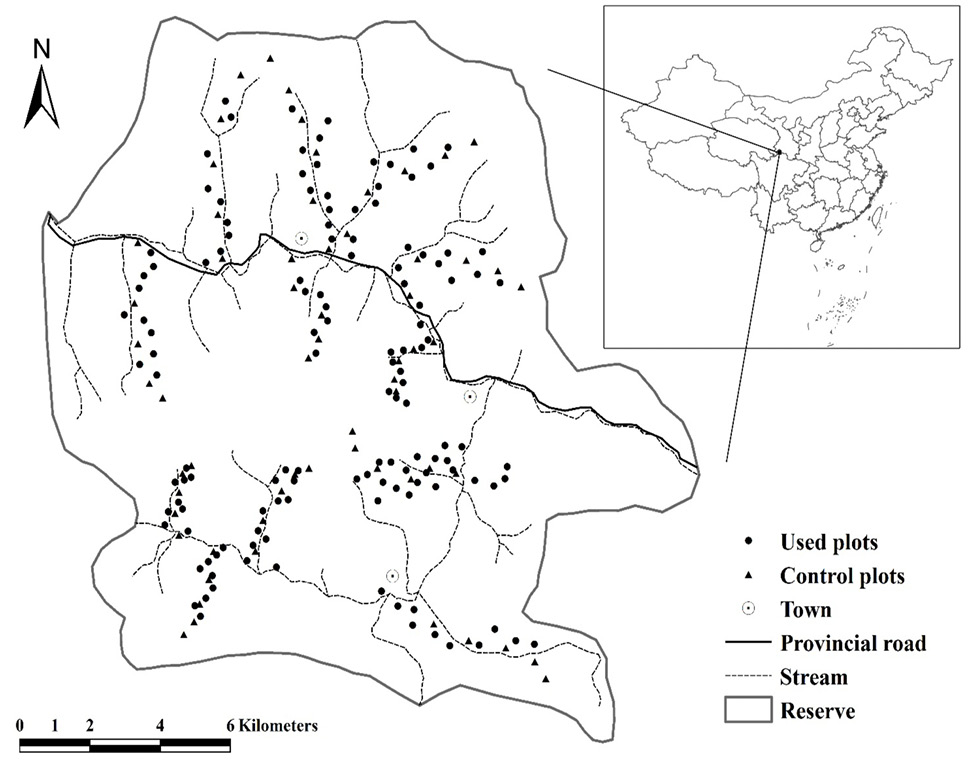
Map of the Tiebu Sika Deer Nature Reserve. The inset shows its location within Sichuan Province of China.
References
- Aublet, J.F., Festa-Bianchet, M., Bergero, D. and Bassano, B., 2009. Temperature constraints on foraging behaviour of male alpine ibex (Capra ibex) in summer, Oecologia, 159: 237-247. https://doi.org/10.1007/s00442-008-1198-4[CrossRef]
- Bourgoin, G., Garel, M., Blanchard, P., Dubray, D., Maillard, D., and Gaillard, J.M., 2011. Daily responses of mouflon (Ovis gmelini musimon x Ovis sp.) activity to summer climatic conditions. Can. J. Zool., 89: 765-773. https://doi.org/10.1139/z11-046[CrossRef]
- Bowyer, R.T. and Kie, J.G., 2009. Thermal landscapes and resource selection by blacktailed deer: implications for large herbivores. Calif. Fish Game, 95: 128-139.
- Burnham, K., and Anderson, D., 2002. Model selection and multimodel inference: A practical information-theoretic approach. Springer, New York.
- Chen, W., Wu, Q.G., Hu, J.C., Lu, X., and You, Z.Q., 2012. Seasonal habitat use of Chinese goral (Naemorhedus griseus) in a subtropical forest. Russ. J. Ecol., 43: 256-260. https://doi.org/10.1134/S106741361203006X[CrossRef]
- Corbet, G.B., and Hill, J.E., 1991. A world list of mammalian species. Oxford University, London.
- Creel, S., Schuette, P., and Christianson, D., 2014. Effects of predation risk on group size, vigilance, and foraging behavior in an African ungulate community. Behav. Ecol., 25: 773-784. https://doi.org/10.1093/beheco/aru050[CrossRef]
- Dargan, J.R., Moriyama, M., Mella, V.S.A., Lunney, D., and Crowther, M.S., 2019. The challenge for koala conservation on private land: koala habitat use varies with season on a fragmented rural landscape. Anim. Conserv., 22: 543-555. https://doi.org/10.1111/acv.12487[CrossRef]
- Dupke, C., Bonenfant, C., Reineking B., Hable R., Zeppenfeld T., Ewald M., and Heurich M., 2017. Habitat selection by a large herbivore at multiple spatial and temporal scales is primarily governed by food resources. Ecography, 40: 1014–1027. https://doi.org/10.1111/ecog.02152[CrossRef]
- Fattebert, J., Morelle, K., Jurkiewicz, J., Ukalska, J., and Borkowski, J., 2019. Safety first: Seasonal and diel habitat selection patterns by red deer in a contrasted landscape, J. Zool., 308: 111-120. https://doi.org/10.1111/jzo.12657[CrossRef]
- Filla, M., Premier, J., Magg, N., Dupke, C., Khorozyan, I., Waltert, M., Bufka, L., and Heurich, M., 2017. Habitat selection by Eurasian lynx (Lynx lynx) is primarily driven by avoidance of human activity during day and prey availability during night, Ecol. Evol., 7: 6367-6381. https://doi.org/10.1002/ece3.3204[CrossRef]
- Guo, Y.S., 2002. Determination of sika deer’s food resources and loading capacity in Tiebu Nature Reserve Sichuan, China. Acta Theriol., 22: 257-262.
- Jiang, Z.G., Jiang, J.P., Wang, Y.Z., Zhang, E., Zhang, Y.Y., Li, L.L., Xie, F., Cai, B., Cao, L., Zheng, G.M., Dong, L., Zhang, Z.W., Ding, P., Luo, Z.H., Ding, C.Q., Ma, Z.J., Tang, S.H., Cao, W.X., Li, C.W., Hu, H.J., Ma, Y., Wu, Y., Wang, Y.X., Zhou, K.Y., Liu, S.Y., Chen, Y.Y., Li, J.T., Feng, Z.J., Wang, Y., Wang, B., Li, C., Song, X.L., Cai, L., Zang, C.X., Zeng, Y., Meng, Z.B., Fang, H.X. and Ping, X.G., 2016. Red list of China’s vertebrates. Biol. Sci., 24: 500-551.
- Khadka, K.K., and James, D.A., 2016. Habitat selection by endangered Himalayan musk deer (Moschus chrysogaster) and impacts of livestock grazing in Nepal Himalaya: Implications for conservation. J. Nat. Conserv., 31: 38-42. https://doi.org/10.1016/j.jnc.2016.03.002[CrossRef]
- Morrison, M.L., Marcot, B.G., and Mannan, R.W., 1992. Wildlife habitat relationships: Concepts and applications. University of Wisconsin, Madison.
- Qi, W.H., Jiang, X.M., Yang, C.Z., and Guo, Y.S., 2014. Reproductive behavior of Sichuan sika deer, Acta Ecol. Sin., 34: 6548-6559. https://doi.org/10.5846/stxb201302210289[CrossRef]
- Rahman, D.A., Gonzalez, G., Haryono, M., Muhtarom, A., Firdaus, A.Y., and Aulagnier, S., 2017. Factors affecting seasonal habitat use, and predicted range of two tropical deer in Indonesian rainforest, Acta. Oecol., 82: 41-51. https://doi.org/10.1016/j.actao.2017.05.008[CrossRef]
- Rozhnov, V.V., Chistopolova, M.D., Lukarevskii, V.S., Hernandez-Blanco, J.A., Naidenko, S.V., and Sorokin, P.A., 2015. Home range structure and space use of a female Amur leopard, Panthera pardus orientalis (Carnivora, Felidae), Biol. Bull., 42: 821-830. https://doi.org/10.1134/S1062359015090095[CrossRef]
- Torres, R.T., Vorgós, E., Santos, J., Linnell, J.D.C., and Fonseca, C., 2012. Habitat use by sympatric red and roe deer in a Mediterranean ecosystem. Anim. Biol., 62: 351-366. https://doi.org/10.1163/157075612X631213[CrossRef]
- van Beest, F.M., van Moorter, B., and Milner, J.M., 2012. Temperature-mediated habitat use and selection by a heat-sensitive northern ungulate. Anim. Behav., 84: 723-735. https://doi.org/10.1016/j.anbehav.2012.06.032[CrossRef]
- Wei, F.W., Wang, Z.W., and Hu, J.C., 2000. Habitat use and separation between the giant panda and the red panda, J. Mammal., 80: 448–455. https://doi.org/10.1093/jmammal/81.2.448[CrossRef]
- Yang, C.Z., Xiao, Z., Guo, Y.S., Xiong, Y.Q., Zhang, X.Y., and Yue, B.S., 2012. Alarm signals of the Sichuan sika deer Cervus nippon sichuanicus, Zool. Sci., 29: 423-427. https://doi.org/10.2108/zsj.29.423[CrossRef]
- Zhang, Z.J., Swaisgood, R.R., Zhang, S.N., Nordstrom, L.A., Wang, H.J., Gu, X.D., Hu, J.C. and Wei, F.W., 2011. Old-growth forest is what giant pandas really need. Biol. Lett., 7: 403-406. https://doi.org/10.1098/rsbl.2010.1081[CrossRef]
- Zhao, C., Hu, J., Li, Y.H., Ran, J.H., Guan, J.K., Yang, C.Z., Xiong, Y.Q., Yue, B.S., 2014a. Habitat use of Sichuan Sika deer in forest, bush and meadows in the Tiebu Nature Reserve, Sichuan, China, Pakistan J. Zool., 46: 941-951.
- Zhao, C., Li, Y.H., Li, D.Y., Guan, J.K., Xiong, Y.Q., and Hu, J., 2014b. Habitat suitability assessment of Sichuan sika deer in Tiebu Nature Reserve during periods of green and dry grass, Acta Ecol. Sin., 34: 135-140. https://doi.org/10.1016/j.chnaes.2014.03.001[CrossRef]
- Zhao, C., Li, Y.H., Shi, Q., Wang, B., Xu, K.N., Zhao, S.Q., Hu, J., and Xiong, Y.Q., 2020. Summer habitat selection of Cervus nippon sichuanicus in the Sichuan Tiebu sika deer Nature Reserve. Sichuan J. Zool., 39: 56-62.
Services
Article usage statistics
Loading…