
Coronavirus consists of single-stranded, enveloped and RNA virus, largest genome among all RNA viruses and has 4 proteins i.e. envelope, spike, nucleocapsid and membrane. Coronaviruses are classified into 4 genera: Alphacoronavirus, Betacoronavirus, Gammacoronavirus and Deltacoronavirus. Betacoronavirus most probably originated from bats and the virus may have jumped to avian species and evolved as Deltacoronavirus group. The avian coronaviruses jumped among other avian species, giving rise to Gammacoronavirus from Deltacoronavirus, while Betacoronavirus may have given rise to Alphacoronavirus. It is known that SARS-CoV-2 belongs to Betacoronavirus. This most similar virus is verified in bat and Malayan Pangolin. Analysis showed that SARS-CoV-2 most probably originated by recombination of both bat and pangolin viruses. Viral protein seroconversion and viral specific nucleotide positive documented in all COVID-19 patients tested provides confirmation of a link between the presence of this virus and the disease.
Review · Volume 54, Issue 4, 24 April 2022 · Open Access
Wildlife as a Source of SARS-CoV-2 Evolution- A Review
· · ·
Affiliations & Notes ⌄
- 1Department of Zoology, Women University of Azad Jammu and Kashmir, Bagh, Pakistan 2Department of Environment Sciences, COMSATS University Islamabad, Abbottabad Campus 22060, Pakistan 3Department of Botany, Women University of Azad Jammu and Kashmir, Bagh, Pakistan 4School of Agriculture and Biology, Shanghai Jiao Tong University, Shanghai, China * Corresponding author: altaf_mughal450@yahoo.com
Article Info ⌄
- Journal:
- Pakistan Journal of Zoology
- Published:
- 24 April 2022

From the article
- It is concluded that Betacoronavirus is most probably originated first from bats species and virus may be jumped to other species and evolved as Deltacoronavirus, Gammacoronavirus and Alphacoronavirus.
- SARS-CoV-2 is belongs to genus Betacoronavirus, and has close phylogenetic relation with SARS-like coronaviruses.
- At the end of 2019, SARS-CoV-2 in China has originated, new virus has 95% similarity to SARS-CoV and spike in SARS-CoV-2 gene, the most different region among whole genome.
- SARS-CoV-2 has high transmissibility and low pathogenicity as compared to SARS-CoV.
Selected from the article's own text.
Abstract
INTRODUCTION
Coronaviruses consist of 4 proteins i.e. envelope, spike, nucleocapsid and membrane ; , single-stranded and RNA virus. Coronaviruses have the largest genome sequence among all RNA viruses. Coronaviruses infect different animal species including human (WHO, 2020).
Coronaviruses belong to order Nidovirales, family Coronaviridae, subfamily Coronavirinae. Coronaviruses have the largest RNA genome, ranging from 25-33 kilobases . On the basis of cluster analysis coronaviruses are classified into following genera: Alphacoronavirus, Betacoronavirus, Gammacoronavirus and Deltacoronavirus ; .
Alphacoronavirus belongs to subfamily Coronavirinae, and has unique characteristics as a distinctive kind of nsp1, different in sequence and size from betacoronavirus nsp1 (nonstructural RNA-binding protein 1) and not counterpart in gammacoronaviruses, and has ORF3, ORF3b and ORF3c in TGEV (transmissible gastroenteritis virus) and αmp (alphacoronavirus membrane protein). Alphacoronaviruses are monophyletic of viruses as compared with all coronaviruses group . Following species of alphacoronaviruses are recorded till now i.e. Human coronavirus 229E (HCoV-229E), Alphacoronavirus-1, Miniopterus bat coronavirus 1(Mi-BatCoV-1), Porcine epidemic diarrea virus (PEDV), Miniopterus bat coronavirus HKU8 (Mi-BatCoV-HKU8), Scotophilus bat coronavirus 512 (Sc-BatCoV-512), Rhinolophus bat coronavirus HKU2 (Rh-BatCoV-HKU2), Harbor seal coronavirus 1, Ferret coronavirus (FrCoV) and Mink coronavirus (MiCoV) ; ; .
Betacoronaviruses are monophyletic, the only well-known feature that would set them separate from other species of coronaviruses is their differnt nsp1 (i.e. nonstructural RNA-binding protein 1), different in sequence and size from alphacoronavirus nsp1 and not equal in the other groups of coronaviruses . Following species of Betacoronaviruses are recorded till now i.e. Betacoronavirus 1, Murine coronavirus, Human coronavirus HKU-1 (HCoV-HKU1), Rousettus bat coronavirus HKU9 (Ro-BatCoV-HKU9), Pipistrellus bat coronavirus HKU5 (Pi-BatCoV-HKU5), SARS coronavirus (SARS-CoV), MERS coronavirus MERS-CoV, Tylonycteris bat coronavirus HKU4 (Ty-BatCoV-HKU4) and SARS-CoV-2, .
Gammacoronavirus genome organization, morphology and gene composition, replication or biology is different from other coronaviruses. Viruses of the species Avian coronavirus not have an nsp1 (i.e. nonstructural RNA- binding protein 1) . Following species of Gammacoronaviruses are recorded till now i.e. Avian coronavirus, Asian leopard cat coronavirus (ALCCoV), Beluga Whale coronavirus SW1 (BWCoVSW1), Black-headed gull coronavirus, Chinese ferret badger coronavirus Guanxi/2006 (CFBCoVGuanxi/2006), Glaucous gull coronavirus, Glaucouswinged gull coronavirus, Pintail coronavirus PBA-124, Rock sandpiper coronavirus, Brent goose coronavirus, Snow goose coronavirus and Western sandpiper coronavirus.
Analysis of complete genome explained that the Deltacoronavirus groups have relatively smallest genomes (e.g. 25.421 to 26.674 kilobases) among all groups of coronaviruses. Delta coronaviruses have one papain-like protease domain in nsp3 (i.e. non-structural protein 3), NS6 located between M and N genes ; . Following species of Deltacoronavirus are recorded till now i.e. Bulbul coronavirus HKU11, Wigeon coronavirus HKU20, Munia coronavirus HKU13, Porcine coronavirus HKU15, Night heron coronavirus HKU19, White-eye coronavirus HKU16, Thrush coronavirus HKU12, Common moorhen coronavirus HKU21, Magpie robin coronavirus HKU18 and Sparrow coronavirus HKU17 ; .
Betacoronavirus most probably originated from bats species at nearly 3300 BC and virus may be jumped to avian species and evolved as Deltacoronavirus group at about 3000 BC. The avian coronaviruses jumped among other avian species, giving rise to Gammacoronavirus from Deltacoronavirus about 2800 BC. While Betacoronavirus may jumped among other mammals and evolved as Alphacoronavirus approximately 2400 BC. This evolution lineage shown in (Fig. 1 and Table I) and Woo et al. (2012) analysis evolutionary lineage with molecular clock analysis (MCA).
SARS CORONAVIRUSES-2
At the end of 2019, unique pneumonia was documented in Wuhan, China and might be transferred from wild animals to human and human to human. SARS-Cov-2 was observed as different and new coronavirus and has close phylogenetic relation with SARS-like coronaviruses (Fig. 2). This disease was diagnosed with novel coronavirus (SARS-Cov-2). Jiang et al. (2020) and Xu et al. (2020) also noted that the pathogen was at that time identified as a SARS-Cov-2 belonging to lineage SARS-CoV. Wu et al. (2020) analysis showed that phylogenetic comparison recognized 380 amino acid changeovers between SARS-Cov-2 and SARS, which may have caused functional and
pathogenic divergence of SARS-Cov-2. Paraskevis et al. (2020) demonstrate proof that the SARS-Cov-2 is not-mosaic consisting in approximately half of its genome of a lineage within the Betacoronavirus. These genomic characteristics showed their potential virulence in humans.
Adaptation and mutation have driven the co-evolution of coronaviruses and animals, for thousands of years . Two coronaviruses i.e. severe acute respiratory syndrome (SARS) and Middle East respiratory syndrome (MERS) were recognized to reason mild disease, like common cold, before 2003. At the end of 2019, the appearance of SARS-CoV-2 in China has originated, new virus has 95% similarity to SARS-CoV and spike in SARS-CoV-2 gene, the most different region among whole genome. SARS-CoV-2 has high transmissibility and low pathogenicity as compared to SARS-CoV. Research showed that SARS-CoV-2 may be evolved from the bat and Malayan Pangolin , but later analysis of SARS-CoV-2 showed that recombination actions were probable to happen in pangolin-bat-origin-coronaviruses either in human, bat or pangolin (Fig. 3) .
Table I. Classification of Coronaviruses, mode of transmission, hosts and diseases.
| Viruses | Hosts | Diseases | Transmission route/vector | References | |
| Alphacoronavirus | Alphacoronavirus-1 | Sus scrofa, carnivores | gastroenteritis, Feline enteritis, infectious, Swine respiratory disease, Canine enteritis | Faecal-oral, Aerosol | ; ; |
| HCoV-NL63 | Human | Respiratory disease | Aerosol | ||
| HCoV-229E | Human | Common cold | Aerosol | ||
| Mi-BatCoV-1 | Bats | Porcine epidemic diarrhea | Fecal-oral | ||
| PEDV | Sus scrofa | ||||
| Mi-BatCoV-HKU8 | Bats | ||||
| Sc-BatCoV-512 | Bat | ||||
| Rh-BatCoV-HKU2 | Bat | ||||
| FrCoV | Ferret | Ferret systemic coronavirosis, Ferret epizootic enteritis | Fecal-oral | ||
| MiCoV | Mink | Mink epizootic catarrhal gastroenteritis | Fecal-oral | ||
| Harbor seal coronavirus 1 | Pacific harbor seals | ||||
| Betacoronavirus | Murine coronavirus | Mice, rat | Puffinosis | Likely aerosol | |
| Betacoronavirus 1 | Human, horse, dog, cattle, swine, ruminant | Human common cold | Fecal-oral, aerosol | ||
| HCoV-HKU1 | Human | Human respiratory disease | Aerosol | ||
| Rousettus bat coronavirus HKU9 | Bat | ||||
| Pi-BatCoV-HKU5 | Bat | ||||
| SARS-CoV | Wild carnivores, Bat | Severe acute respiratory disease | Aerosol | ||
| SARS-CoV-2 | Bats, pangolin | COVID-19 | Aerosol | ||
| Ty-BatCoV-HKU4 | Bats (Tylonycteris spp.) | ||||
| MERS-CoV | Arabian Camel | Respiratory syndrome | Aerosol | ||
| Gammacoronavirus | Avian coronavirus | Domestic and wild bird | Bronchitis infection, respiratory and kidney disease | Aerosol, Fecal-oral | |
| BWCoVSW1 | Beluga whale | ||||
| Black-headed gull coronavirus | Black-headed gull | ||||
| ALCCoV | Asian leopard cat | ||||
| Brent goose coronavirus | Russian Brent goose | ||||
| Glaucous gull coronavirus | Glaucous gull (Larus hyperboreus) | ||||
| CFBCoVGuanxi/2006 | Chinese ferret badger | ||||
| Glaucouswinged gull coronavirus | Glaucous winged gull | ||||
| Rock sandpiper Coronavirus | Rock sandpiper | ||||
| Pintail coronavirus PBA-124 | Pintail | ||||
| Western sandpiper coronavirus | Western sandpiper | ||||
| Snow goose coronavirus | Snow goose coronavirus | ||||
| Deltacoronavirus | Common moorhen coronavirus HKU21 | Common moorhen | |||
| Wigeon coronavirus HKU20 | Wigeon | ||||
| Night heron coronavirus HKU19 | Night heron | ||||
| Magpie robin coronavirus HKU18 | Magpie robin | ||||
| Sparrow coronavirus HKU17 | Sparrow | ||||
| White-eye coronavirus HKU16 | White-eye | ||||
| Porcine coronavirus HKU15 | Porcine | ||||
| Munia coronavirus HKU13 | Munia | ||||
| Thrush coronavirus HKU12 | Thrush | ||||
| Bulbul coronavirus HKU11 | Bulbul | ||||
Zhou et al. (2020) noted Viral protein seroconversion and viral specific nucleotide positive documented in all patients tested provides confirmation of a link between the presence of this virus and the disease. Owing to shortage of specific treatment and considering the relatedness between SARS-CoV as well as SARS-CoV-2, some drugs and pre-clinical vaccine against SARS-CoV probably can be applied to this virus.
The mode is transmission is aerosol from bats to human, and human to human (Table I). Chen et al. (2020) observed that SARS-CoV-2 is more likely to impact aged males with multiple coexisting diseases, and can result in severe and fatal respiratory diseases e.g. acute respiratory distress syndrome.
CONCLUSIONS
It is concluded that Betacoronavirus is most probably originated first from bats species and virus may be jumped to other species and evolved as Deltacoronavirus, Gammacoronavirus and Alphacoronavirus. SARS-CoV-2 is belongs to genus Betacoronavirus, and has close phylogenetic relation with SARS-like coronaviruses. Adaptation and Mutation have driven the co-evolution of coronaviruses and animals. Two coronaviruses belong to genus Betacoronavirus i.e. severe acute respiratory syndrome (SARS) and Middle East respiratory syndrome (MERS) were recognized to reason mild disease, like common cold, before 2003. At the end of 2019, SARS-CoV-2 in China has originated, new virus has 95% similarity to SARS-CoV and spike in SARS-CoV-2 gene, the most different region among whole genome. SARS-CoV-2 has high transmissibility and low pathogenicity as compared to SARS-CoV. Genomic analysis showed recombination actions were probable to happen in pangolin-bat-origin-coronaviruses either in human, bat or pangolin.
Statement of conflict of interest
The authors have declared no conflict of interest.
Figures
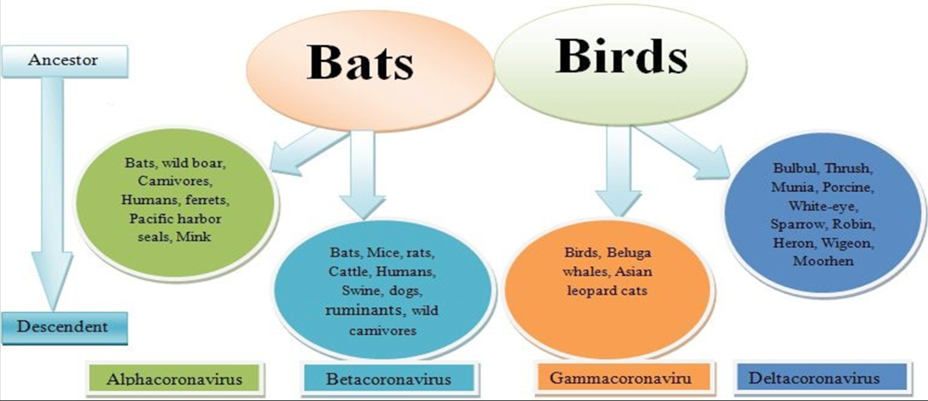
Coronaviruses are the gene source of genera i.e. Alphacoronavirus, Betacoronavirus, Gammacoronavirus and Deltacoronavirus through wild animals.
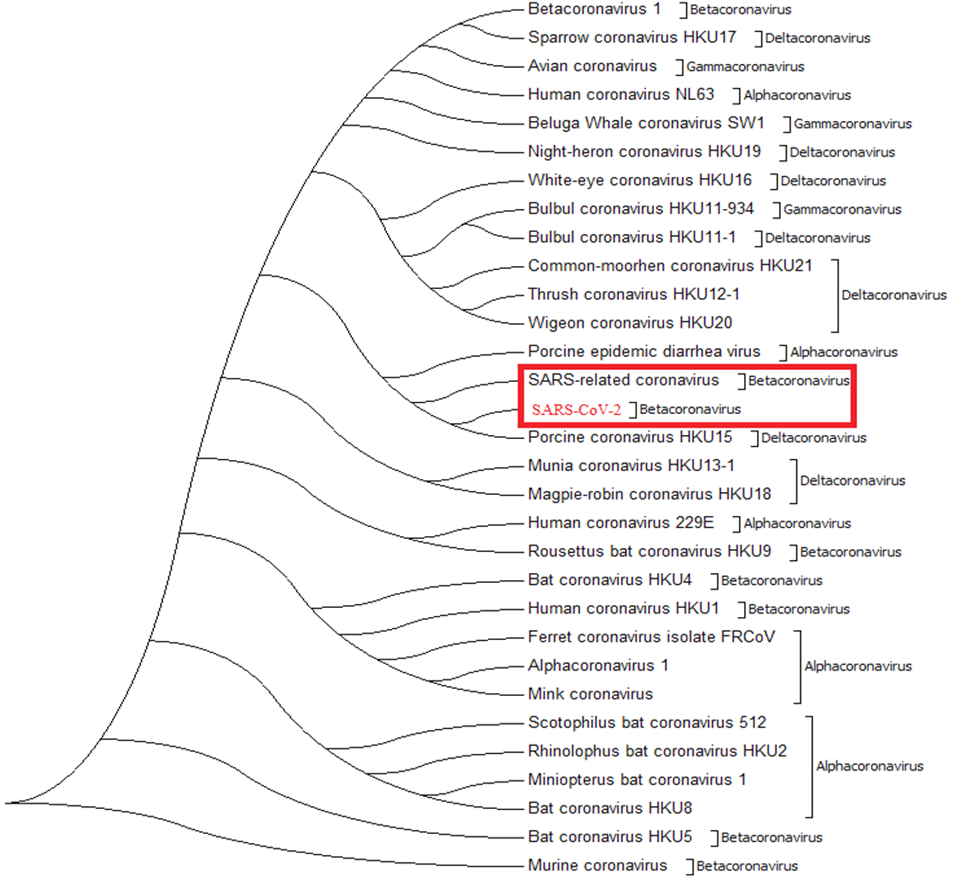
Phylogenetic analyses of whole genome through (MEGA 6.06) software. Whole genomes of all coronaviruses were collected from NCBI (National Center for Biotechnology Information).
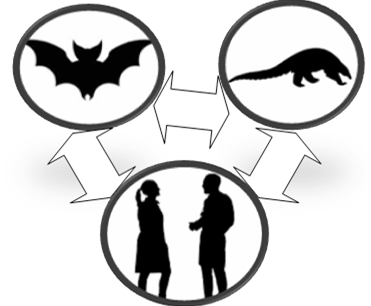
Recombination of genes actions were probable to happen in livings (human, Pangolin or bat).
References
- Chen, N., Zhou, M., Dong, X., Qu, J., Gong, F., Han, Y., Qiu, Y., Wang, J., Liu, Y. and Wei, Y., 2020. Epidemiological and clinical characteristics of 99 cases of 2019 novel coronavirus pneumonia in Wuhan, China: A descriptive study. The Lancet, 395: 507-513. https://doi.org/10.1016/S0140-6736(20)30211-7[CrossRef]
- de Barros, B.d.C.V., de Castro, C.M.O., Pereira, D., Ribeiro, L.G., Júnior, J.W.B.D., Casseb, S.M.M., Holanda, G.M., Cruz, A.C.R., Júnior, E.C.S. and Mascarenhas, J.D.A.P., 2019. First complete genome sequence of a feline alphacoronavirus 1 strain from Brazil. Microbiol. Resour. Announc., 8: e01535-01518. https://doi.org/10.1128/MRA.01535-18[CrossRef]
- Jiang, S., Du, L. and Shi, Z., 2020. An emerging coronavirus causing pneumonia outbreak in Wuhan, China: calling for developing therapeutic and prophylactic strategies. Emerg. Microb. Infect., 9: 275-277. https://doi.org/10.1080/22221751.2020.1723441[CrossRef]
- King, A.M.Q., Adams, M.J., Carstens, E.B. and Lefkowitz, E.J., 2012. Virus taxonomy: Ninth report of the international committee on taxonomy of viruses. Elsvier Academic Press. pp. 486-487.
- King, A.M., Lefkowitz, E., Adams, M.J. and Carstens, E.B., 2011. Virus taxonomy: Ninth report of the international committee on taxonomy of viruses. Elsevier.
- Lam, T.T.-Y., Shum, M.H.-H., Zhu, H.-C., Tong, Y.-G., Ni, X.-B., Liao, Y.-S., Wei, W., Cheung, W.Y.-M., Li, W.-J., Li, L.-F., Leung, G.M., Holmes, E.C. and Guan, Y.-L.H.Y., 2020. Identifying SARS-CoV-2 related coronaviruses in Malayan pangolins. Nature, 583: 282-285. https://doi.org/10.1101/2020.02.13.945485[CrossRef]
- Paraskevis, D., Kostaki, E.G., Magiorkinis, G., Panayiotakopoulos, G., Sourvinos, G. and Tsiodras, S., 2020. Full-genome evolutionary analysis of the novel corona virus (2019-nCoV) rejects the hypothesis of emergence as a result of a recent recombination event. Infect. Genet. Evol., 79: 104212. https://doi.org/10.1016/j.meegid.2020.104212[CrossRef]
- Saey, T.H., 2013. Story one: Scientists race to understand deadly new virus: SARS-like infection causes severe illness, but may not spread quickly among people. Sci. News, 183: 5-6. https://doi.org/10.1002/scin.5591830603[CrossRef]
- Scientific American. 2020. How coronaviruses cause infection from colds to deadly pneumonia. https://www.scientificamerican.com/article/how-coronaviruses-cause-infection-from-colds-to-deadly-pneumonia1/.
- Tidona, C. and Darai, G., 2011. The springer index of viruses. Springer Science and Business Media. https://doi.org/10.1007/978-0-387-95919-1[CrossRef]
- WHO. 2020. Coronavirus. https://www.who.int/health-topics/coronavirus.
- Woo, P.C., Lau, S.K., Huang, Y. and Yuen, K.-Y., 2009. Coronavirus diversity, phylogeny and interspecies jumping. Exp. Biol. Med., 234: 1117-1127. https://doi.org/10.3181/0903-MR-94[CrossRef]
- Woo, P.C., Lau, S.K., Lam, C.S., Lau, C.C., Tsang, A.K., Lau, J.H., Bai, R., Teng, J.L., Tsang, C.C. and Wang, M., 2012. Discovery of seven novel mammalian and avian coronaviruses in the genus Deltacoronavirus supports bat coronaviruses as the gene source of alphacoronavirus and betacoronavirus and avian coronaviruses as the gene source of gammacoronavirus and deltacoronavirus. J. Virol., 86: 3995-4008. https://doi.org/10.1128/JVI.06540-11[CrossRef]
- Wu, A., Peng, Y., Huang, B., Ding, X., Wang, X., Niu, P., Meng, J., Zhu, Z., Zhang, Z. and Wang, J., 2020. Genome composition and divergence of the novel coronavirus (2019-nCoV) originating in China. Cell Host and Microbe., 27: 325-328. https://doi.org/10.1016/j.chom.2020.02.001[CrossRef]
- Xu, X., Chen, P., Wang, J., Feng, J., Zhou, H., Li, X., Zhong, W. and Hao, P., 2020. Evolution of the novel coronavirus from the ongoing Wuhan outbreak and modeling of its spike protein for risk of human transmission. Sci. China Life Sci., 63: 457-460. https://doi.org/10.1007/s11427-020-1637-5[CrossRef]
- Zhang, J., Jia, W., Zhu, J., Li, B., Xing, J., Liao, M. and Qi, W., 2020. Insights into the cross-species evolution of 2019 novel coronavirus. J. Infect., 80: 671-693. https://doi.org/10.1016/j.jinf.2020.02.025[CrossRef]
- Zhou, P., Yang, X.-L., Wang, X.-G., Hu, B., Zhang, L., Zhang, W., Si, H.-R., Zhu, Y., Li, B., Huang, C.-L. and Shi, Z.-L., 2020. A pneumonia outbreak associated with a new coronavirus of probable bat origin. Nature, 579: 270-273.
Cited by 3 articles
In journals published by ResearchersLinks.
- Prevalence, Awareness, and the Response of the General Population Towards Covid-19 in 2023Pakistan Journal of Zoology · 2025
- Prevalence, Awareness, and the Response of the General Population Towards Covid-19 in 2023Pakistan Journal of Zoology · 2025
- Prevalence, Awareness, and the Response of the General Population Towards Covid-19 in 2023Pakistan Journal of Zoology · 2025
Services
Article usage statistics
Loading…