
In this study, relationship of some web parameters of the spider, Argiope trifasciata, with its body measurements was investigated. Also, role of stablimenta in efficiency of capturing prey was discussed by comparing web parameters and number of intercepted insects in decorated and non-decorated webs. For the study, 236 randomly selected webs of A. trifasciata were observed in the rice fields around the cities of Sheikhupura and Lahore, Punjab, Pakistan. In the adult spiders, mesh height, capture area and capture thread length was positively correlated with IVth leg length; mesh size also showed positive correlation with carapace width and wet weight of the spider. However, body measurements of young A. trifasciata did not show any correlation with their web characteristics. Decorated and non-decorated webs did not differ in mesh size, capture area and capture thread length. No significant difference was recorded in the number of prey items intercepted by decorated and non-decorated webs. The results of this study showed that stablimenta did not increase prey interception efficiency of the web. However, web design of A.trifasciata showed plasticity that can be explained on the basis of studied body measures.
Research Article · Volume 49, Issue 3, 28 April 2017 · Open Access
Variations in Web Architecture of Argiope trifasciata (Araneae, Araneidae) and Its Relationship with Body Parameters and Entangled Prey
· ·
Affiliations & Notes ⌄
- 1Department of Zoology, University of the Punjab, Lahore, Pakistan , * Corresponding author: abdajawed@yahoo.com
Article Info ⌄
- Journal:
- Pakistan Journal of Zoology
- Published:
- 28 April 2017

From the article
- No relationship was observed between number of insects intercepted (at least one) and capture area (decorated: r = 0.250, non-decorated: r = 0.31; P > 0.05) or mesh size (decorated: r = 0.298, non-decorated: r = 0.285; P > 0.05) of the web.
- The results of this study support the idea that adult A. trifasciata invest more resources on web compared to their young.
- Data of this study do not support the idea that larger web or decorated webs intercept more insects compared to small or non-decorated webs.
- However, further investigation is required to elucidate relationship(s) of predators and environmental conditions with web parameters and efficiency of the web in A. trifasciata spider.
Selected from the article's own text.
Abstract
INTRODUCTION
The architecture of web in spiders depicts the foraging tactics and physiological status of a spider . Different features of the web, such as size, location, orientation, quantity of the adhesive threads, etc., determine their insect interception and retention rate ; ; ; . The plasticity in the web architecture depends upon numerous biotic and abiotic factors, e.g., diversity, quality and quantity of prey, prey activity, competition and predation pressure, satiation, age, reproductive stage, temperature, humidity, wind and habitat complexity ; ; ;; ; ; ; ; . These factors influence different parameters of web, such as location, orientation, size, shape, symmetry, mesh size, capture thread length, number of radii, and decoration size ; . Spiders also exhibit considerable ontogenetic variation in the web building behavior. Adult spiders invest more material and construct larger webs compared to immature spiders . However, immature spiders construct more symmetrical and regular webs compared to adults ; .
Web design includes the size of the web and the number and arrangement of radials and spirals within the web. Size and structure of webs vary with the needs of the spider or with the quality of available silk ; . In general, a larger web is likely to encounter more prey . Similarly, variation in mesh height may also be interpreted as a specific foraging strategy. By increasing mesh height, spiders may target larger prey, whilst smaller prey may pass through in between the spirals ; ; ; . Smaller mesh size causes increase in retention rate of entangled prey but decrease size of the web . During their life span, spiders move in different habitats which vary in their characteristics; habitats may also vary due to seasonal changes. To enhance their fitness in variable habitats, spiders show plasticity in their web structure in order to capture prey of different types and sizes (Schenider and Vollrath, 1998).
Many orb-weaving spiders decorate their webs with extra, bright white, UV reflecting silk . Web decorations or stabilimenta are included in webs by a diverse range of orb-web spider species (Araneae: Araneidae, Tetragnathidae, Uloboridae). Silk decorations may act as anti-predator device in a number of ways. They may make the spider appear larger, act as a warning signal or camouflage the location of the spider . Web decoration also attracts more insects and increases the foraging success of the spider , 1998; ; . However, in some studies web decoration has been reported as a non-adaptive and non-functional behavior .
In the present study, relationship between body measures of Argiope trifasciata (Forsskål 1775) and its web characteristics in rice fields were estimated. Spiders of this species also decorate their webs. It is predicted that webs are decorated to increase their prey interception rate. Thus, this characteristic of the web will be important under conditions when prey is scarce or utilized by some other predators. It is hypothesized that high abundance of prey in the field should reduce the number of decorated webs compared to non-decorated webs; also, web parameters and their insect interception rate should be similar in decorated and non-decorated webs.
MATERIALS AND METHODS
The study was conducted during September-October, 2010 and 2012 in selected rice fields near the cities of Sheikhupura (latitude 31° 43’N and longitude 73° 59’E) and Lahore (31°33’N, 74°32’E), Punjab, Pakistan. During the study periods, daily temperature ranged from 17 ± 8°C to 30 ± 6°C, and relative humidity varied from 60–70 %. Fields were surveyed from 7.00 to 10.00 AM by walking through randomly selected transects and scanning vegetation for the webs of A. trifasciata. When an active web of female spider was found, the resident spider was removed carefully from its web, placed in a glass vial, and brought to the laboratory for body measurements viz., carapace width, IVth leg length, and wet weight. All field-collected individuals were classified into young (6-11 mm in body length) and adult (more than 11 mm in body length) spiders. Specimens smaller than 6 mm in body length were discarded and their webs were not used in the study.
The webs were sprayed with fine mist of water and corn starch using Knapsack hand sprayer (THS-119428) to clear the vision. In each web the following characteristics were recorded: horizontal and vertical diameter, number of sticky spirals in upper and lower halves, distance between the sticky spirals, upper and lower halves radius from central axis, radius of hub and free zone, number of radii, presence or absence of stablimenta and length and width of stablimenta. Web parameters, like capture area and mesh size were calculated by using the formulae designed by Herberstein and Tso (2000). Capture thread length was calculated using formula of Venner et al. (2001). Stabilimentum area was calculated as length × width of the stabilimenta . Insects entangled in the webs were removed, brought to the laboratory, weighed, measured, and identified to the order level. All the specimens of spiders and insects were preserved in a mixture of alcohol and glycerin and deposited in the Department of Zoology, University of the Punjab, Lahore, Pakistan.
Pearson’s correlation was used to assess relationship between body size measures (weight, carapace width, and IVth leg length) and the web characteristics (mesh height, capture area, capture thread length) in both adults and young A. trifasciata. The difference between web parameters of decorated and non-decorated webs were analyzed using t-test. Pearson’s correlation was used to estimate relationship of web size and stablimenta. To determine the difference in insect interception rate between decorated and non-decorated webs, Mann-Whitney U-test was applied.
Table I.- Correlation coefficient (r) values for body measurements and web parameters of adult female (n = 184) and young (n = 48) Argiope trifasciata spider(*p < 0.05; **p <0.01; ***p< 0.001).
| Mesh size | Web area | Capture thread length | |
| Adult | |||
| Carapace width | 0.532*** | 0.295** | 0.512 |
| IVth leg length | 0.578*** | 0.311** | 0.073 |
| Wet weight | 0.566*** | 0.062 | 0.017 |
| Young | |||
| Carapace width | 0.372 | 0.150 | 0.340 |
| IVth leg length | 0.425 | 0.497 | 0.644* |
| Wet weight | 0.153 | 0.094 | 0.211 |
RESULTS
In the rice fields, 232 webs of A. trifasciata were observed. Of these, 184 were constructed by adult female and 48 by young spiders. The height of these webs ranged from 23 to 92 cm above the ground. In adults, mesh size positively correlated with carapace width, IVth leg length and wet weight. Capture area showed positive relationship with carapace width and IVth leg length. Captured thread length did not show any correlation with body measures. In young, no relationship was recorded in web parameters and any of body measurements except for captured thread length and IVth leg length (Table I). The webs of adults and young significantly varied in mesh size (mean + SE; adult: 3.76 + 0.129 mm; young: 2.107 + 0.25 mm; t86 = 5.41, P < 0.001), capture area (adult: 750.9 + 43.8 cm2; young : 398.2 + 70.2 cm2; t84 = 4.86, P < 0.001), and capture thread length (adult: 1590.5 + 80.8 cm; young: 787 + 136.0 cm; t81 = 2.26, P < 0.001).
Stablimenta was recorded only in 44% of the studied webs. The proportion of adults and young that decorated their webs was very similar. Capture area and size of stablimenta showed positive relationship with each other (r = 0.363, P < 0.001). There were no differences in the web parameters of decorated and non-decorated webs: mesh size (decorated: 3.42 + 0.14 mm; non-decorated: 3.51 + 0.17 mm; t-test: t56= 1.503, P = 0.12), captured thread length (decorated: 1459.5 + 75.2 cm; non-decorated: 1324 + 58.7 cm; t-test: t56 = 1.01 ,P = 0.35 ), and capture area (decorated: 679.1 + 48.4 cm2; non-decorated: 643.1 + 32.3 cm2; t-test: t56 = 1.18, P = 0.34).
Insects trapped in the webs of A. trifasciata belonged to the orders, Diptera, Homoptera, Orthoptera, Hymenoptera, Lepidoptera and Coleoptera. Decorated and non-decorated webs did not differ from each other in their prey capture efficiency (Man-Whitney test: U = 203, n=73, P = 0.189; Fig. 1). No relationship was observed between number of insects intercepted (at least one) and capture area (decorated: r = 0.250, non-decorated: r = 0.31; P > 0.05) or mesh size (decorated: r = 0.298, non-decorated: r = 0.285; P > 0.05) of the web. However, stablimentum area was positively correlated with the number of insects intercepted by the decorated webs (r = 0.354, P = 0.001; Fig. 2).
DISCUSSION
In this study, relationship of body measurements and web parameters differed between adult and young spiders. In adults, mesh size and capture area increased with carapace width and IVth leg length. Some previous investigations had also reported positive relationship between carapace width and web size ; ; ; and between leg length and mesh size ; . However, Heiling and Herberstein (1998) had reported no relationship between mesh size and any body size measurements in adults of Nuctenea sclopetaria. In the present study, mesh height in adults also positively correlated with wet weight of the spider. However, capture thread length and capture area did not show any relationship with the wet weight of the spider. Sherman (1994) reported that spider weight is an indicator of the spider’s satiation level. Low weight spider tries to capture more prey compared to high weight spider which influences web investment and consequently web design. Sandoval (1994) argued that mesh size is independent of spider size to catch a specific sized prey. More data are needed to explain the relationship of mesh size and weight of the spider. In contrast to adult spiders, mesh height and capture area of young spiders did not show relationship to any of body measured parameters, suggesting that size and weight in young spiders did not play a major role in architecture of web. However, in the present study, IVth leg length in adult female spiders seems to be the most appropriate variable to indicate the effect of body size on web design. Nevertheless, loss or regeneration of IVth leg made it ineffective body measure to explain plasticity of the web .
Blamires (2010) reported that in Argiope keyserlingi web area was related with frequency of feeding and mesh size and with prey length and feeding frequency. The decoration of the web depends upon the biomass consumed by the spider . Production of silk is costly and only sated spider are more likely to construct decorations in their webs . During the current study period the density of flying insects was high in the field due to tillering and milking stage of the crop. This means that web decoration is not necessarily related with the increased quantity of nutrients intake . Some other workers had suggested a decrease in web decoration in sated spider ; . In the present study area, most A. trifasciata spiders did not decorate their webs. Due to high abundance of prey in the field, construction of stablimenta is unnecessary and costly for the spiders. Along with that high density of insects attract their predators which may also be the predators of the A. trifasciata. Thus, the decoration of the web is a tradeoff between risk of predation and foraging efficiency ; ; .
The present study results showed that stablimenta did not increase prey capturing efficiency of A. trifasciata in the studied rice fields. Insect interception rate was similar in decorated and undecorated webs. Tso (1996) predicted that A. trifasciata respond its low foraging efficiency by building stablimenta on their webs or by increasing the size of the web or by doing both. Previously, several studies had reported the role of other web parameters, such as mesh size, web area and capture thread length in the foraging success of the orb spiders ; . Large webs usually trap more flying insects compared to small webs ; . Visibility of the web depends on mesh size. Webs with smaller mesh have low insect interception rate due to their more visibility to flying insects. In this study, mesh size, capture area and capture thread length were similar in decorated and non-decorated webs. If the role of stablimenta is ignored as insect attraction, the results can be described more easily. Nevertheless, it also requires that stablimenta did not increase avoidance from the web. In Argiope spiders, stablimenta reflect UV light and attract UV light oriented insects . Differential response is present in the insects for UV light. Insects perceive a structure by comparing visual cues with a template . In the field, most insects were herbivores and it is likely that UV light was not important for them.
The results of this study support the idea that adult A. trifasciata invest more resources on web compared to their young. Data of this study do not support the idea that larger web or decorated webs intercept more insects compared to small or non-decorated webs. However, further investigation is required to elucidate relationship(s) of predators and environmental conditions with web parameters and efficiency of the web in A. trifasciata spider.
Conclusion
The results of this study support the idea that adult A. trifasciata invest more resources on web compared to their young. Data of this study do not support the idea that larger web or decorated webs intercept more insects compared to small or non-decorated webs. However, further investigation is required to elucidate relationship(s) of predators and environmental conditions with web parameters and efficiency of the web in A. trifasciata spider.
Statement of conflict of interest
Authors have declared no conflict of interest.
Figures
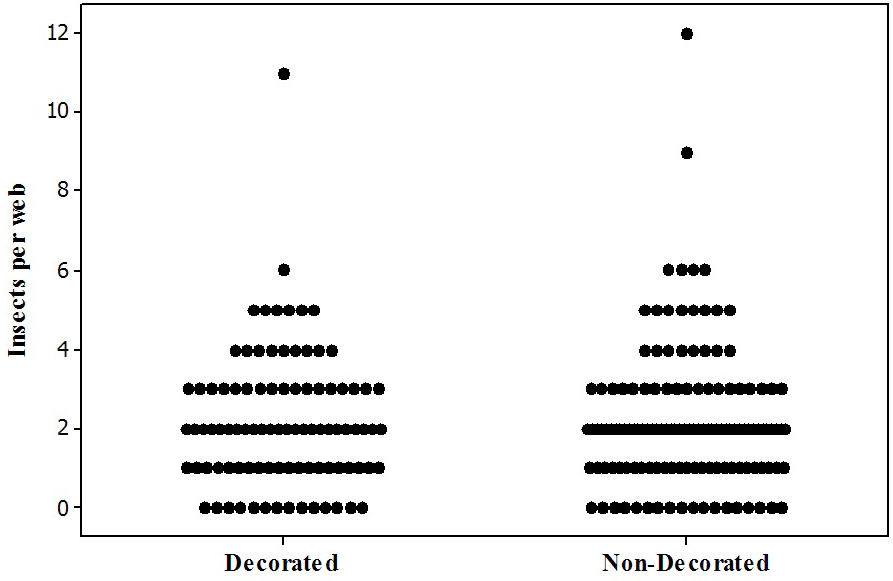
Number of insects intercepted by webs with or without decorations built by A. trifasciata in rice fields.
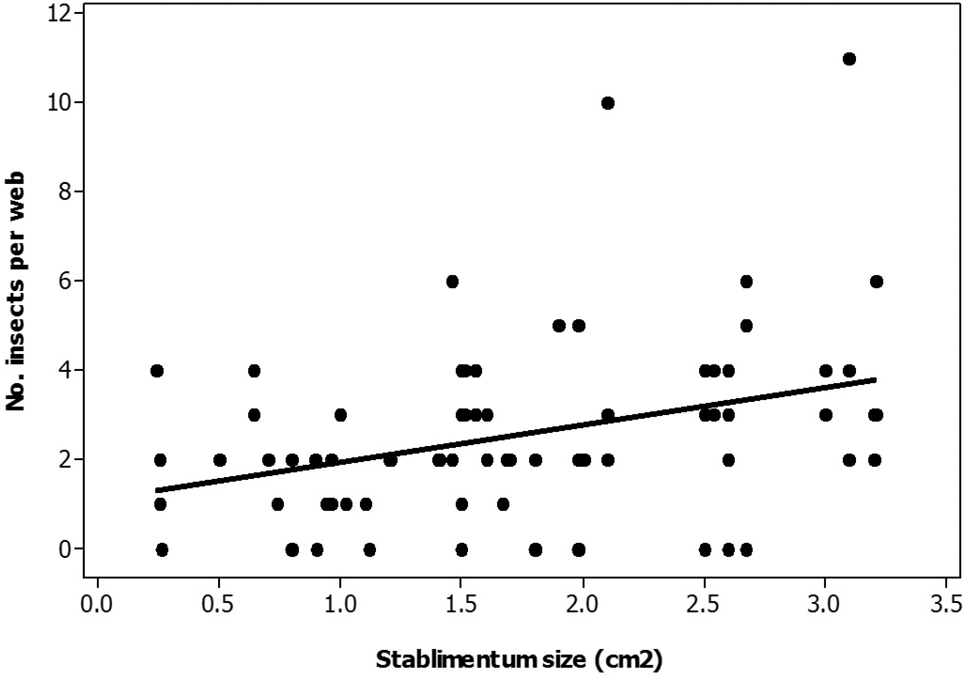
Relationship between stablimentum area and number of insects intercepted by web built by A. trifasciata in rice fields.
References
- Blackledge, T.A., 1998. Stablimentum variations and foraging success in Argiope aurantia and Argiope trifasciata (Araneae: Araneidae). J. Zool. (London), 246: 21- 27. https://doi.org/10.1111/j.1469-7998.1998.tb00128.x[CrossRef]
- Blackledge, T.A. and Eliason, C.M., 2007. Functionally independent components of prey capture are architecturally constrained in spider orb webs. Biol. Lett., 3: 456-458. https://doi.org/10.1098/rsbl.2007.0218[CrossRef]
- Blackledge, T.A. and Zevenbergen, J.M., 2006. Mesh width influences prey retention in spider orb-webs. Ethology, 112: 1194-1201. https://doi.org/10.1111/j.1439-0310.2006.01277.x[CrossRef]
- Blamires, S.J., 2010. Plasticity in extended phenotype: orb spider web architectural responses to variations in prey parameters. J. exp. Biol., 213: 3207-3212. https://doi.org/10.1242/jeb.045583[CrossRef]
- Blamires, S.J., Hochuli, D.F. and Thompson, M.B., 2009. Prey protein influences growth and decoration building in the orb spider Argiope keyserlingi. Ecol. Ent., 34: 545-550. https://doi.org/10.1111/j.1365-2311.2009.01095.x[CrossRef]
- Blamires, S.J. and Tso, I., 2013. Nutrient-mediated architectural plasticity of a predatory trap. PLoS One, 8: e54558. https://doi.org/10.1371/journal.pone.0054558[CrossRef]
- Bruce, M.J., Herberstein, M.E. and Elgar, M.A., 2001. Signal conflict between prey and predator attraction. J. Evolut. Biol., 14: 786-794. https://doi.org/10.1046/j.1420-9101.2001.00326.x[CrossRef]
- Carico, J.E., 1977. A simple dusting device for coating orb-webs for field photography. Bull. Bri. Arachnol. Soc., 4: 100.
- Chacon, P. and Eberhard, W.G., 1980. Factors affecting numbers and kinds of prey caught in artificial spider webs, with consideration of how orb webs trap prey. Bull. Br. Arachnol. Soc., 5: 29-38.
- Craig, C.L., 1986. Orb-web visibility: the influence of insect flight behaviuor and visual physiology on the evolution of web designs within the Arachneoidea. Anim. Behav., 34: 54-68. https://doi.org/10.1016/0003-3472(86)90006-0[CrossRef]
- Craig, C.L., 1989. Alternative foraging modes of orb web weaving spiders. Biotropica, 21: 257-264. https://doi.org/10.2307/2388653[CrossRef]
- Craig, C.L., 1994. Limits to learning: effects of predator pattern and colour on perception and avoidance- learning by prey. Anim. Behav., 47: 1087-1099. https://doi.org/10.1006/anbe.1994.1147[CrossRef]
- Craig, C.L. and Bernard, G.D., 1990. Insect attraction to ultraviolet-reflecting spider webs and web decorations. Ecology, 71: 616-624. https://doi.org/10.2307/1940315[CrossRef]
- Craig, C.L., Wolf, S.G., Davis, L.D., Hauber, M.E. and Maas. J.L., 2001. Signal polymorphism in the web decorating spider Argiope argentata is correlated with reduced survivorship and the presence of stingless bees, its primary prey. Evolution, 55: 986-993. https://doi.org/10.1554/0014-3820(2001)055[0986:SPITWD]2.0.CO;2[CrossRef]
- Eberhard, W.G., 1973. Stablimenta on the web of Uloborus diversus (Araneae: Uloboridae) and other species. J. Zool., 171: 367-384. https://doi.org/10.1111/j.1469-7998.1973.tb05345.x[CrossRef]
- Eberhard, W.G., 1988. Behavioral flexibility in orb web construction: Effects of supplies in different glands and spider size and weight. J. Arachnol., 16: 295-302.
- Heiling, A.M. and Herberstein, M.E., 1998. The web of Nuctenea sclopetaria (Araneae: Araneidae). Relationship between body size and web design. J. Arachnol., 26: 91-96.
- Heiling, A.M. and Herberstein, M.E., 2000. The role of experience in web-building spiders (Araneidae). Anim. Cogn., 2: 171–177. https://doi.org/10.1007/s100710050037[CrossRef]
- Herberstein, M.E., Craig, C.L. and Elgar, M.A., 2000. Foraging strategies and feeding regimes: web and decoration investment in Argiope keserlingi Karsch (Araneae: Araneidae). Evol. Ecol. Res., 2: 69-80.
- Herberstein, M.E. and Heiling, A.M., 1998. Mesh height and prey length in orb webs. Eur. J. Ent., 95: 367-371.
- Herberstein, M.E. and Tso, I.M., 2000. Evaluation of formulae to estimate the capture area and mesh height of orb webs (Araenidae, Araneae). J. Arachnol., 28: 180-184. https://doi.org/10.1636/0161-8202(2000)028[0180:EOFTET]2.0.CO;2[CrossRef]
- Higgins, L.E. and Buskirk, R.E., 1992. A trap-building predator exhibits different tactics for different aspects of foraging behavior. Anim. Behav., 44: 485-499. https://doi.org/10.1016/0003-3472(92)90058-H[CrossRef]
- Li, D., 2005. Spiders that decorate their webs at higher frequency intercept more prey and grow faster. Proc. R. Soc. B, 272: 1753-1757. https://doi.org/10.1098/rspb.2005.3160[CrossRef]
- Lin, L.H., Edmonds, D.T. and Vollrath, F., 1995. Structural engineering of an orb- spider’s web. Nature, 373: 146-148. https://doi.org/10.1038/373146a0[CrossRef]
- Murakami, Y., 1983. Factors determining the prey size of the orb-web spider Argiope amonea (L. Koch) (Argiopidae). Oecologia, 57: 72-77. https://doi.org/10.1007/BF00379564[CrossRef]
- Nentwig, W. and Rogg, H., 1988. The cross stablimentum of Argiope argentata (Araneae: Araneidae) – nonfunctional or a nonspecific stress reaction? Zool. Anz., 221: 248-266.
- Olive, C.W., 1980. Foraging specialization in orb-weaving spiders. Ecology, 61: 1133-1144. https://doi.org/10.2307/1936833[CrossRef]
- Opell, B.D., Bond, J.E. and Warner, D.A., 2006. The effects of capture spiral composition and orb-web orientation on prey interception. Zoology, 109: 339-345. https://doi.org/10.1016/j.zool.2006.04.002[CrossRef]
- Pasquet, A., Ridwan, A. and Lebrogne, R., 1994. Presence of potential prey affects web-building in an orb-weaving spider Zygiella x-notata. Anim. Behav., 47: 477-480. https://doi.org/10.1006/anbe.1994.1066[CrossRef]
- Samu, F., Mathew, G.A., Lake, D. and Vollrath, F., 1992. Spider webs are efficient collectors of agronomical spray. Pestic. Sci., 36: 47–51. https://doi.org/10.1002/ps.2780360108[CrossRef]
- Sandoval, C.P., 1994. Plasticity on web design in the spider Parawixi abistriata, a response to variable prey type. Funct. Ecol., 8: 701-707. https://doi.org/10.2307/2390229[CrossRef]
- Scharf, I., Lubin, Y.D. and Ovadia, O., 2011. Foraging decision and behavioural flexibility in trap-building predators: a review. Biol. Rev., 86: 626-639. https://doi.org/10.1111/j.1469-185X.2010.00163.x[CrossRef]
- Schneider, J.M. and Vollrath, F., 1998. The effect of prey type on the geometry of the capture web of Araneus diadematus. Naturwissenschaften, 5: 391-394. https://doi.org/10.1007/s001140050521[CrossRef]
- Seah, W.K. and Li, D., 2001. Stabilimenta attract unwelcome predators to orb-webs. Proc. R. Soc. B., 268: 1553–1558. https://doi.org/10.1098/rspb.2001.1709[CrossRef]
- Seah, W.K. and Li, D., 2002. Stablimentum variations in Argiope versicolor (Araneae: Araneidae) from Singapore. J. Zool. (London), 258: 531-540. https://doi.org/10.1017/S0952836902001693[CrossRef]
- Sherman, P.M., 1994. The orb-web: an energetic and behavioral estimator of a spider’s dynamic foraging and reproductive strategies. Anim. Behav., 48: 19-34. https://doi.org/10.1006/anbe.1994.1208[CrossRef]
- Tso, I.M., 1996. Stablimentum of the garden spider Argiope trifasciata: a possible prey attractant. Anim. Behav., 52: 183-191. https://doi.org/10.1006/anbe.1996.0163[CrossRef]
- Tso, I.M., 1998. Stablimentum decorated webs spun by Cyclosa conica (Araneae: Araneidae) trapped more insects than undecorated webs. J. Arachnol., 26: 101-105.
- Tso, I.M., Wu, H.C. and Hwang, I.R., 2005. Giant wood spider Nephila pilipes alter silk protein in response to prey variations. J. exp. Biol., 208: 1053-1061. https://doi.org/10.1242/jeb.01437[CrossRef]
- Venner, S., Thevenard, L., Pasquet, A. and Leborgne, R., 2001. Estimation of the web’s capture thread length in orb-weaving spiders: determine the most efficient formula. Ann. entomol. Soc. Am., 94: 490-496. https://doi.org/10.1603/0013-8746(2001)094[0490:EOTWSC]2.0.CO;2[CrossRef]
- Vollrath, F., 1987. Altered geometry of webs in spiders with regenerated legs. Nature, 328: 247-248. https://doi.org/10.1038/328247a0[CrossRef]
- Vollrath, F., Downes, M. and Krachkov, S., 1997. Design variability in web geometry of an orb-weaving spider. Physiol. Behav., 62: 735-743. https://doi.org/10.1016/S0031-9384(97)00186-8[CrossRef]
- Witt, P.N., Rawlngs, J.O. and Reed, C.F., 1972. Ontogeny of web-building behaviour in two orb-weaving spiders. Am. Zool., 12: 445-452. https://doi.org/10.1093/icb/12.3.445[CrossRef]
Services
Article usage statistics
Loading…