
Fecal cortisol has been suggested an indicator of preceding physiological stress, while the secretory IgA acts as the first defense against pathogens, viruses and bacteria in animals. Fresh fecal samples of adult Taihangshan macaques (Macaca mulatta tcheliensis) were collected during mating and non-mating periods, respectively, to understand the influences of mating status on physiological condition of wild macaques, through variation in fecal cortisol and IgA levels. The results showed that. (1) mean concentration of fecal cortisol in mating period (AM: 1751.12 ± 199.16 ng/g; AF: 1366.38 ± 117.85 ng/g) were significant higher than that in non-mating period (AM: 705.97 ± 82.86 ng/g; AF: 699.51 ± 56.06 ng/g). (2) there was significant difference in fecal IgA levels between mating and non-mating periods in AF, but not in AM. (3) there were obvious negative correlations between fecal cortisol and IgA levels both in AM (P = 0.04) and AF (P = 0.01) in mating period, but not in non-mating period (AM: P = 0.19; AF: P = 0.21). We concluded that mating-related stress influences not only stress hormone level but also immunological response of adult Taihangshan macaques, and that the stress-linked immunosuppression hypothesis was supported in mating period.
Research Article · Volume 55, Issue 5, 29 July 2023 · Open Access
Variations of Fecal Cortisol and IgA Levels with Reproductive Status in Wild Taihangshan Macaque (Macaca mulatta tcheliensis)
· · ·
Affiliations & Notes ⌄
- 1School of Life Sciences, Zhengzhou University, Zhengzhou, 450001 China 2Institute of Biodiversity and Ecology, Zhengzhou University, Zhengzhou, 450001 China 3Taihangshan Macaque Research Center, Jiyuan, Henan, 459000 China * Corresponding author: lujq@zzu.edu.cn
Article Info ⌄
- Journal:
- Pakistan Journal of Zoology
- Published:
- 29 July 2023

Abstract
INTRODUCTION
Stabilized internal environment, vital for survival and reproduction of wildlife, is especially important to endangered animals living in complex environment. As a responding hormone to environmental and physiological stresses, cortisol usually enhances individual’s susceptibility to infections through immunosuppression ; , while cortisol is an available indicator in body fluids for stress ; . To examine cortisol concentration, blood is believed the most reliable tested-sample, but capture-recapture method for blood collection is usually stressful and leads to increased level of plasma cortisol . Feces have been demonstrated non-invasive and efficient for measuring cortisol as well as immunoglobulin A (IgA) ; ; , and fecal cortisol concentrations were successfully used in assessing adrenocortical function of cat and dog , quantitative analysis of internal stress levels of rats ; , and evaluating reproductive states and seasonal factors on cortisol levels of non-human primates ; ; ; ; .
Acting as a first defense against pathogens, viruses and bacteria, and being presented in saliva, tears, milk, respiratory and intestinal secretions, IgA is the primary antibody responsible for mucosal defense in mammals and has been used as an indicator of individual immunocompetence ; ; . Being exposed to disease-causing agents and encounter diverse antigens from natural environment, wild animals use mucosal tissues as the primary entry point for antigens . Therefore, mucosal tissues have evolved a chronic but noninflammatory immune response without killing microorganisms, and prevent them from crossing epithelial barriers . A key component of the mucosal immune defense is the production of secretory immunoglobulin A (SIgA).
Being available signals of stress response in mammals, cortisol and IgA levels maintain balance under healthy physiological conditions in animals . However, activating immunological response to invaders and maintaining a hormonal balance are energy costed for animals, thus tradeoffs between stress hormone and immune system would be expected . Although physiological stress of animals caused by disturbance to their environment is adaptive in the short term, chronic stress inevitably impact animals health, immune system and reproductive functions ; . The immunocompetence handicap hypothesis suggests that androgenic hormone (i.e., testosterone) could stimulate the development of male secondary sexual characters but suppress their immunocompetence . The plausible explanation behind the hypothesis has relied on the costs and benefit of allocating limited energy/nutrient to various physiological traits. Given that measuring stress hormones are very common in the study of monitoring the physiological condition of wildlife ; , using stress hormones instead of testosterone could broaden the window of the immunocompetence handicap hypothesis .
Published works indicated that higher glucocorticoid concentrations can inhibit IgA production ; ; , and several studies found a negative correlation between stress level and IgA level in mammals, such as dogs ; , rats and humans ; , which all supported the immunocompetence handicap hypothesis. However, data from Sichuan snub-nosed monkey (Rhinopithecus roxellana) showed a positive correlation between fecal cortisol concentrations and fecal IgA concentrations in both sexes , while study on lachrymal IgA in chickens failed to demonstrate a correlation between the level of IgA and stress hormone .
Taihangshan macaque (Macaca mulatta tcheliensis), an endemic subspecies within rhesus macaque to China, distributed in south part of Mt. Taihangshan area, northern China , 2018). Acting as strict seasonal breeders, adult Taihangshan macaques usually mate from September to December, and the peak in October ; ; . Published works focused on behavioral laterality , geographical distribution ; , food habits , social structure and female reproductive parameters , 2013), habitat selection and macronutrients regulation , but less attention was paid on physical metabolism of cortisol and IgA. By quantitatively analyzing on variation of fecal IgA, fecal cortisol and their interaction in adult macaques, we aimed to understand the tradeoffs between fecal cortisol and IgA in different reproductive status. We predicted that: (1) concentrations of fecal cortisol and IgA in adult Taihangshan macaques vary with mating status; and (2) a negative relationship between fecal cortisol and IgA levels is expected in mating period.
MATERIALS AND METHODS
Study site
This study was conducted at Wulongkou area (35.206°N, 112.696°E), Jiyuan, Henan, China ; . Like many species of macaques, Taihangshan macaques are strictly seasonal breeders with the mating season from September to December ; .
This site exhibits a temperate continental climate with an average annual temperature of 14.3℃, average temperature 0.1℃ in January and 27.3℃ in July . The annual precipitation is 695 mm with the main characteristic of uneven spatial and temporal distribution, which made wet hot summer and dry cold winter in this area ; , 2020). The main vegetation type is shrub with only a small area of natural secondary forest in Wulongkou area, which made food resources relatively scarce in winter and the macaques experience low food availability after mating period . During the period of data collection, our study group was provisioned with a small amount of maize and peanuts .
Target group and subjects
Two free-ranging groups of Taihangshan macaques, Wulongkou-1 troop (Troop WLK-1) and Wulongkou-2 troop (Troop WLK-2), ca. 180 individuals, consisted of 19 adult males and 53 adult females, were chosen as our target groups. Individuals were identified mainly via physical characteristics (i.e., color of fur/face, presence of scar, and body size) .
Fecal samples collection
From September 2016 to March 2017, fresh fecal samples of adult male (AM) and adult female (AF) were collected and each were preserved in 50 mL EP tube. The harvested samples were immediately stored in -20℃ freezer in study site. Fecal samples were then transported to Zhengzhou University with dry ice in 5 h for further tests. Freezing samples has been reported to have minimal effects on fecal cortisol and IgA levels ; .
Totally 89 fecal samples of adult Taihangshan macaques had been collected, in which 48 and 41 samples were tested in mating and non-mating periods, respectively. When multiple samples were collected by the same individual in the same mating/ non-mating period, the average concentration was taken as the level of this individual.
Sample processing
The weighing bottle (50×30 mm) was weighted and marked, and then amount of each fecal sample (ca. 6 g) was placed into the weighing bottle and weighted. Then the samples were placed in the drawers of a SJIA-10N vacuum freeze-dryer (Ningbo SJialab Equipment Co., Ltd, Ningbo, Zhejiang, China) pumped by a 2XZ-2 direct-drive rotary vane vacuum pump (Linhai Tanshi Vacuum Equipment Co., Ltd, Linhai, Zhejiang, China). The samples were dried under -60℃ for 24 h, weighted again and grinded within clean mortar for ca. 5 min. The powdered samples were weighted for further measurements.
Fecal cortisol detection
Amount of 0.2000 (± 0.0050) g powdered feces was taken from each sample and was put into a 10 mL EP tube. Fecal cortisol was extracted following the ‘Ethanol-Methanol’ method with little adjustment ; ; . For each sample, 1 mL absolute ethanol and 1 mL double distilled water was added and was homogenized with a vortex (1000 rpm) for 10 min. The suspension was placed under 4℃ for 2 h to maximize the dissolution of cortisol. It was then homogenized again with a vortex (1000 rpm) for 3 min, and centrifuged at 4000 rpm under 4℃ for 10 min. 1 mL of the supernatant was pipetted to 5 mL EP tube. Then 2 mL absolute ethanol was added to the remaining sediment and was homogenized at 1000 rpm for 10 min. The suspension was centrifuged again at 4000 rpm under 4℃ for 10 min. 2 mL of the supernatant was added to the previous tube with 1 mL supernatant. The 3 mL supernatant was homogenized and then was centrifuged at 12000 rpm under 4℃ for 10 min, before 2 mL supernatant was harvested. This supernatant was dried with 60℃ water bath. The dried sample was stored under -20℃ freezer for later measurement of fecal cortisol.
Fecal cortisol concentration was measured with general cortisol competitive-ELISA kit (Elabscience Biotechnology Co., Ltd, Wuhan, Hubei, China). The dried fecal extract was dissolved with 500 μL 0.04 M PBS (pH= 7.2) under 4℃ for 24 h. Then the measurement was conducted following the manual provided by the manufacturer. Duplicate standard and fecal samples were measured. Based on preliminary experiment, 100 μL of fecal sample solution instead of 50 μL fecal sample solution recommended in the manual, was added to the plate cell. When stop solution was added to the plates, Bio-Tek Power Wave XS microplate spectrophotometer (Bio-Tek Instruments, Inc, Winooski, USA) was used to read the OD values at 450 nm and 570 nm. The coefficient of variation for all kits assay were less than 20%.
Fecal IgA detection
Another 0.5000 (± 0.0050) g powdered feces from the same sample was placed into a 10 mL EP tube for extracting fecal IgA following the methods of Hau et al. (2001) and Lantz et al. (2018). Briefly, 5 mL 0.04 M PBS (pH = 7.2) and 25 μL Tween-20 (Beijing Solarbio Science and Technology Co., Ltd, Beijing, China) was added to the EP tube. This mixture was homogenized with a vortex (1000 rpm) for 10 min. The suspension was placed under ambient temperature for 30 min to maximize the dissolution of IgA. It was then centrifuged at 4000 rpm under 4℃ for 10 min. 2 mL of the supernatant was pipetted to 5 mL EP tube. The supernatant was centrifuged again at 10000 rpm under 4℃ for 10 min. Then 1.5 mL of the supernatant was harvested in 2 mL EP tube and stored at -20°C freezer for further tests.
Fecal IgA level was measured with monkey IgA double antibody sandwich ELISA kit. The stored fecal IgA extracts and the ELISA kits were placed under ambient temperature for ca. 30 min. The measurement was obtained following the manual provided by the manufacturer. Duplicate standard and fecal samples were measured. Based on preliminary experiment, 150 μL of fecal IgA solution instead of 100 μL fecal IgA solution recommended in the manual, was added to the plate cell. When stop solution was added to the plates, Bio-Tek Power Wave XS microplate spectrophotometer (Bio-Tek Instruments, Inc, Winooski, USA) was used to read the OD values at 450 nm and 570 nm, respectively. The coefficient of variation for all kits assay were less than 20%.
Data analysis
The OD value for each sample, either standard or treatment, was calculated as the mean OD value of duplicated tests which subtracted the values of 570 nm from those of 450 nm. Then the standard curve for each ELISA kit was modeled using Curve Expert Professional (version 2.6.3) (Hyams Development), and the optimized model was selected for further analyses. For fecal cortisol (ng/g), the DR-Gamma model (f (x) = γ +(1- γ) * (α, β * x)) was adopted according to the score. Rational model (f (x) = γ +(a+b * x) / (1+c * x + d * x2)) was used for calculating fecal IgA concentration (ng/g).
The original data was tabulated in Microsoft Excel 2016, and then the statistics and figure plotting were conducted with IBM SPSS Statistics (version 24.0) and GraphPad Prism (version 7.0). Independent samples t-test was used to determine the differences in the concentration of fecal cortisol and IgA between mating and non-mating periods. Pearson Product-Moment correlation was used to analysis the relationship between fecal cortisol and IgA in dried feces. The values were presented as mean ± SEM. All P values are considered significant under the level of 0.05.
RESULTS
Fecal cortisol levels
Adult females
The mean concentrations of fecal cortisol in adult female Taihangshan macaques were 1366.38 ± 117.85 ng/g (median= 1485.95, n= 32) in mating period, and 699.51 ± 56.06 ng/g (median= 787.45, n= 22) in non-mating period. There was a significant difference in fecal cortisol concentration between mating and non-mating period (t= 5.11, P < 0.01) (Fig. 1A).
Adult males
The mean concentrations of fecal cortisol in adult male Taihangshan macaques were 1751.12 ± 199.15 ng/g (median = 1673.97, n = 16) in mating period, and 705.97 ± 82.86 ng/g (median = 590.53, n = 19) in non-mating period. There was a significant difference in fecal cortisol concentration between mating period and non-mating period (t = 4.85, P < 0.01) (Fig. 1A).
Statistically, there were no significant sexual differences in fecal cortisol concentration in mating period (t = -1.77, P = 0.08) and non-mating period (t = -0.07, P = 0.95) (Fig. 1A), respectively.
Fecal IgA levels
Adult females
The mean concentrations of fecal IgA of adult female Taihangshan macaques were 5089.58 ± 594.18 ng/g (median = 4854.07, n = 32) in mating period, and 999.33 ± 117.77 ng/g (median = 885.21, n = 22) in non-mating period. The IgA concentration was statistically higher in mating period than that in non-mating period (t = 6.75, P < 0.01) (Fig. 1B).
Adult males
The mean concentrations of fecal IgA of adult male Taihangshan macaques were 4391.52 ± 800.27 ng/g (median = 3960.01, n = 16) in mating period, and 2783.97 ± 579.87 ng/g (median = 1689.59, n = 19) in non-mating period. There was no significant difference between mating and non-mating periods at group level (t = 1.66, P = 0.11) (Fig. 1B).
Moreover, there was no significant sexual difference of fecal IgA concentration in mating period (t = 0.69, P = 0.49), whereas there was significant sexual difference in non-mating period (t = -3.02, P = 0.007) (Fig. 1B).
Correlation between fecal cortisol and IgA levels
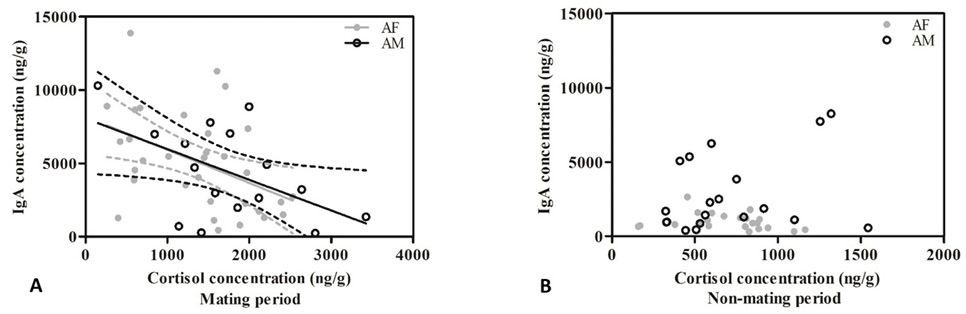
We analyzed the correlation of fecal cortisol and IgA levels in mating and non-mating periods, respectively. The results showed a trend that the fecal cortisol level was significant negatively correlated to IgA level in mating period (AM: r = -0.52, df = 16, P = 0.04; AF: r = -0.45, df = 32, P = 0.01) (Fig. 2A), whereas no significant correlation was found in non-mating period (AM: Pearson r = 0.31, df= 19, P = 0.19; AF: Pearson r = -0.28, df = 22, P = 0.21) (Fig. 2B).
Discussion
The results of this study demonstrated that, in AM Taihangshan macaques, the fecal cortisol level in mating period was significantly higher than that of non-mating period, whereas no obvious difference was found in fecal IgA levels between these two periods. However, in AF Taihangshan macaques, the fecal cortisol and IgA levels in mating period were significantly higher than those of non-mating period. Moreover, there was a significant negative correlation in adult macaques between fecal cortisol and IgA levels in mating period, but not in non-mating period. Consequently, our prediction that concentrations of fecal cortisol and IgA of adult macaques varied with reproductive status was supported, while the prediction of a negative relationship between fecal cortisol and IgA levels was supported in mating period.
Cortisol, being an important stress hormone, affects many physiological functions of animals ; ; . When subject to stress, the hypothalamic-pituitary-adrenal (HPA) axis is activated, releasing excess glucocorticoids (e.g., cortisol and corticosterone) into the bloodstream which mobilize energy reserves that are important for “fight or flight” responses . Therefore, as a responding hormone to environmental and psychological stresses in non-human primates, levels of cortisol varied with reproductive status, aggressive competition, and mating activities (M. mulatta, ; Cebus apella, ; M. fuscata, ; Propithecus verreauxi, . For adult macaques, mating season is a particularly challenging period with several conspecific spouse competition in a polygamous society. In order to cope with the increased physical and energetic demands of conspecific competition in mating period, males often increased food intake, sexual dimorphism, and a marked rise in testosterone and glucocorticoid levels ; , and females showed clear cyclic solicitation and copulation peaks . As strict seasonal breeder, adult Taihangshan macaques usually mate from September to December annually ; ; , with increased mating rates and aggressive behaviors in both sexes , which reasonably explained the higher cortisol levels during this period. The enhancement of cortisol level in adults in mating period can be attributed to physiological preparations in anticipation of aggressive behavioral and energetic demands of reproduction ; . Our findings were consistent with the results of studies on sifaka (Propithecus verreauxi) , long-tailed macaques (M. fascicularis) , chacma baboons (Papio hamadryas ursinus) , and Sichuan snub-nosed monkey . From January to May, most AF Taihangshan macaques are pregnant or postpartum, while the mating activity and conflicts among adult AMs and AFs significantly reduce during this period . As a result, cortisol level became lower in adult macaques during non-mating period than that of mating period.
Antibodies are the primary component of adaptive immune system in animals, whereas IgA is usually presented in excreted body fluids (e.g., saliva, urine, feces, milk, sweat, and tears). Studies have found that immunoglobulin levels profoundly affect wildlife health and a significant decrease in IgA can lead to increased susceptibility to infectious diseases ; ; . IgA enzyme immunoassays (ELISAs) have allowed for a direct indication of immunocompetence in mammals, such as long-tailed macaques , Sichuan snub-nosed monkeys , baboons , and reindeers (Rangifer tarandus) . Published works have shown that mean IgA concentration varied among individuals but not by sex or reproductive status in adult chimpanzees , and there were seasonal differences in mean IgA concentration among Sichuan snub-nosed monkeys but not by sex . However, in this study, we found that mean IgA concentration differed significantly between the sexes in non-mating period.
At the population level, we found that there was no significant difference of mean fecal IgA between mating and non-mating periods in adult males, whereas the mean fecal IgA level in mating period was significantly higher than that in non-mating period of adult females. After mating season, though some adult females are in the state of pregnancy or postpartum, they still have to face severe environment with cold and food shortage, which made the immune level of AF decreased than that in mating period. At different reproductive stages, the lower fecal IgA concentrations in AF may suggest a stage-dependent tradeoff between reproduction effort and immune system. Therefore, further work on AF macaques is needed to explore the relationship between reproductive status (in pregnancy, lactation, and after lactation) and immunity levels.
Under natural conditions, predation and competition may adversely affect animal physical status through neuroendocrine disruption and stress-induced immunosuppression ; . Several studies paid attention on elevated stress hormone levels regarding social aggression, reproductive status, dominance and environmental challenges of non-human primates ; ; ; , but a few involved immune system ; ; , and the tradeoffs between stress hormone and immune level in non-human primates. Our finding that the negative correlation between fecal cortisol and IgA levels of adult Taihangshan macaques in mating period supported the stress-induced immunosuppression hypothesis.
Life history theory predicts tradeoffs among costly physiological traits due to competitive allocation of limited resources ; . Previous literature showed that an acute stress response can induce an increase in immune responses ; , while chronic stress response tends to suppress immune levels ; . During mating period, the most direct and chronic stressor for adult Taihangshan macaques were competition/aggression caused by mating activities . Under this context, mating-related stress continued months, which lead to increased level of fecal cortisol and suppressed immune activity due to the tradeoffs between stress hormone and immune response. These responses can be used to monitor stress and immune system function as important indicators of health status in wild populations.
In conclusion, the concentrations of fecal cortisol and IgA of adult Taihangshan macaques differed between mating and non-mating periods. Mating-induced stress influences not only hormone level but also immunological response. The immunosuppression hypothesis was supported in mating period.
Acknowledgements
We thank the Jiyuan Administration Bureau of Taihangshan Macaque National Nature Reserve for permission to carry out this study. The authors are very grateful for the permission and logistic supports to the Administration Bureau of Jiyuan Wulongkou Scenic Spot. We are thankful to Litao Chen, Chenghe Wang, San’ao Kuang, Jianming Guo, Zhenjing Kuang for their help in the field work. We thank Dr. Weihong Ji in Massey University, New Zealand for her editing and comments on the draft manuscript.
Funding
This study was financially supported by the National Natural Science Foundation of China (No. 31472018, 31672302).
Ethics approval consent to participate
All data collection adhered to Chinese legal requirements and complied with protocols approved by the National Forestry and Grassland Administration (NFGA), China. The project was approved by all required state and local administration departments. In this study, non-invasive sampling methods were used, fecal samples were collected under natural field conditions and had no effect on the living conditions of the monkeys. This study has been approved by Ethics Committee of Life Sciences of Zhengzhou University.
Statement of conflicts of interest
The authors have declared no conflict of interests.
Figures
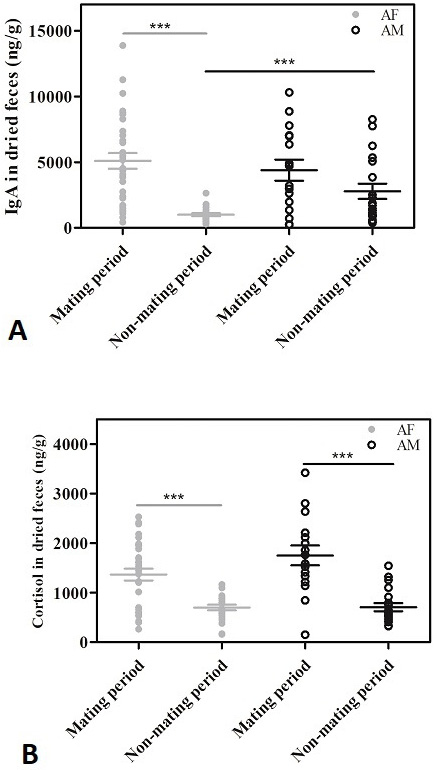
The cortisol (ng/g) (A), and IgA (ng/g) (B) concentrations in dried feces of adult Taihangshan macaques in mating period and non-mating period. The middle line represents the mean concentration and the error bars represent SEM. *** indicates P < 0.01.
References
- Barrett, G.M., Shimizu, K., Bardi, M., Asaba, S., and Mori, A., 2002. Endocrine correlates of rank, reproduction, and female-directed aggression in male Japanese Macaques (Macaca fuscata). Horm. Behav., 42: 85-96. https://doi.org/10.1006/hbeh.2002.1804[CrossRef]
- Beehner, J.C., and Bergman, T.J., 2017. The next step for stress research in primates: To identify relationships between glucocorticoid secretion and fitness. Horm. Behav., 91: 68-83. https://doi.org/10.1016/j.yhbeh.2017.03.003[CrossRef]
- Behringer, V., and Deschner, T., 2017. Non-invasive monitoring of physiological markers in primates. Horm. Behav., 91: 3-18. https://doi.org/10.1016/j.yhbeh.2017.02.001[CrossRef]
- Bercovitch, F., and Ziegler, T., 2002. Current topic in primates socioendocrinology. Annu. Rev. Anthropol., 31: 45-67. https://doi.org/10.1146/annurev.anthro.31.040202.105553[CrossRef]
- Birnie-Gauvin, K., Peiman, K.S., Larsen, M.H., Aarestrup, K., Willmore, W.G., and Cooke, S.J., 2017. Short-term and long-term effects of transient exogenous cortisol manipulation on oxidative stress in juvenile brown trout. J. exp. Biol., 220: 1693-1700. https://doi.org/10.1242/jeb.155465[CrossRef]
- Capitanio, J., Mendoza, S., and Bentson, K., 2004. Personality characteristics and basal cortisol concentrations in adult male rhesus macaques (Macaca mulatta). Psychoneuroendocrinology, 29: 1300-1308. https://doi.org/10.1016/j.psyneuen.2004.04.001[CrossRef]
- Chai, W.B., 2014. Population ecology and social ecology of rhesus macaque disturbed by ecotourism. Master thesis, Zhengzhou University, Zhengzhou.
- Creel, S., 2001. Social dominance and stress hormones. Trends Ecol. Evol., 16: 491-497. https://doi.org/10.1016/S0169-5347(01)02227-3[CrossRef]
- Cui, Z.W., Wang, Z.L., Shao, Q., Raubenheimer, D., and Lu, J.Q., 2018. Macronutrient signature of dietary generalism in an ecologically diverse primate in the wild. Behav. Ecol., 29: 804-813. https://doi.org/10.1093/beheco/ary003[CrossRef]
- Decaro, N., Pratelli, A., Tinelli, A., Martella, V., Camero, M., Domenico, B., Tempesta, M., Caroli, A.M., and Buonavoglia, C., 2004. Fecal immunoglobulin A antibodies in dogs infected or vaccinated with canine coronavirus. Clin. Diag. Lab. Immunol., 11: 102-105. https://doi.org/10.1128/CDLI.11.1.102-105.2004[CrossRef]
- Deinzer, R., 1998. Dynamics of stress-related decrease of salivary immunoglobulin a (sIgA): Relationship to symptoms of the common cold and studying behaviour. Behav. Med., 23: 161-169. https://doi.org/10.1080/08964289809596372[CrossRef]
- Fichtel, C., Kraus, C., Ganswindt, A., and Heistermann, M., 2007. Influence of reproductive season and rank on fecal glucocorticoid levels in free-ranging male Verreaux’s sifakas (Propithecus verreauxi). Horm. Behav., 51: 640-648. https://doi.org/10.1016/j.yhbeh.2007.03.005[CrossRef]
- Florence, B.D., Svendsen, L., Stodulski, G., Crowley, A., and Hau, J., 1995. Assessment of lacrimal IgA as a potential parameter for measurement of long term stress in poultry. Vivo, 9: 19-25.
- Folstad, I., and Karter, A.J., 1992. Parasites, bright males, and the immunocompetence handicap. Univ. Chicago Press Am. Soc. Natur., 3: 603-622. https://doi.org/10.1086/285346[CrossRef]
- Fürtbauer, I., Heistermann, M., Schülke, O., and Ostner, J., 2012. Brief communication: Fecal androgen excretion and fetal sex effects during gestation in wild assamese macaques (Macaca assamensis). Am. J. Physiol. Anthropol., 147: 334-339. https://doi.org/10.1002/ajpa.21646[CrossRef]
- Gesquiere, L.R., Habig, B., Hansen, C., Li, A., Freid, K., Learn, N.H., Alberts, S.C., Graham, A.L., and Archie, E.A., 2020. Noninvasive measurement of mucosal immunity in a free-ranging baboon population. Am. J. Primatol., 82: e23093. https://doi.org/10.1002/ajp.23093[CrossRef]
- Girard-Buttoz, C., Heistermann, M., Krummel, S., and Engelhardt, A., 2009. Seasonal and social influences on fecal androgen and glucocorticoid excretion in wild male long-tailed macaques (Macaca fascicularis). Physiol. Behav., 98: 168-175. https://doi.org/10.1016/j.physbeh.2009.05.005[CrossRef]
- Gordon, T., Rose, R., and Bernstein, I., 1976. Seasonal rhythm in plasma testosterone levels in the rhesus monkey (Macaca mulatta): A three-year study. Horm. Behav., 7: 229-243. https://doi.org/10.1016/0018-506X(76)90050-7[CrossRef]
- Griffin, J.F.T., and Thomson, A.J., 1998. Farmed deer: A large animal model for stress. Domest. Anim. Endocrinol., 5: 445-456. https://doi.org/10.1016/S0739-7240(98)00016-2[CrossRef]
- Guo, X.B., Wang, Z.L., Chen, J.R., Tian, J.D., Wang, B.S., and Lu, J.Q., 2010. Winter and spring food habits of Macaca mulatta tcheliensis in Taihangshan National Nature Reserve in Henan province of China. Chinese J. Ecol., 30: 483-488.
- Guo, Y.M., Garber, P.A., Tian, J.D., and Lu, J.Q., 2020. Neonatal nipple preference and maternal cradling laterality in wild Taihangshan macaques (Macaca mulatta tcheliensis). Am. J. Primatol., 82: e23197. https://doi.org/10.1002/ajp.23197[CrossRef]
- Hart, B.L., 2011. Behavioural defences in animals against pathogens and parasites: Parallels with the pillars of medicine in humans. Phil. Trans. R. Soc. B Biol. Sci., 366: 3406-3417. https://doi.org/10.1098/rstb.2011.0092[CrossRef]
- Hasselquist, D., and Nilsson, J., 2012. Physiological mechanisms mediating costs of immune responses: What can we learn from studies of birds? Anim. Behav., 83: 1303-1312. https://doi.org/10.1016/j.anbehav.2012.03.025[CrossRef]
- Hau, J., Andersson, E., and Carlsson, H.E., 2001. Development and validation of a sensitive ELISA for quantification of secretory IgA in rat saliva and faeces. Lab. Anim., 35: 301-306. https://doi.org/10.1258/0023677011911822[CrossRef]
- Hoffman, C.L., Ayala, J.E., Mas-Rivera, A., and Maestripieri, D., 2010. Effects of reproductive condition and dominance rank on cortisol responsiveness to stress in free-ranging female rhesus macaques. Am. J. Primatol., 72: 559-565. https://doi.org/10.1002/ajp.20793[CrossRef]
- Hou, J.H., and Liang, H.F., 2001. Resources and current situation of Taihangshan Macaque nature reserve. China Acad. J., 32: 40-41.
- Huang, S., Li, L., Wu, J., Li, C., Bai, J., Sun, Y., and Wang, G., 2014. Seasonal variations in immunoreactive cortisol and fecal immunoglobulin levels in Sichuan golden monkey (Rhinopithecus roxellana). Turk. J. Zool., 38: 642-650. https://doi.org/10.3906/zoo-1309-39[CrossRef]
- Kavanagh, P.S., and Kahl, B.L., 2016. Life history theory. Encycl. Evolut. Psychol. Sci., 1: 1-11. https://doi.org/10.1007/978-3-319-16999-6_1914-1[CrossRef]
- Kim, Y., Ko, E., Lappan, S., Kezele, A., Kwon, S.W., and Choe, J.C., 2013. Changes in fecal estrogen levels and sexual behavior in captive sichuan snub-nosed monkeys (Rhinopithecus roxellana) following a male replacement. Zoo Biol., 32: 342-346. https://doi.org/10.1002/zoo.21017[CrossRef]
- Lantz, E.L., Lonsdorf, E.V., Heintz, M.R., Murray, C.M., Lipende, I., Travis, D.A., and Santymire, R.M., 2018. Non-invasive quantification of Immunoglobulin a in chimpanzees (Pan troglodytes schweinfurthii) at Gombe National Park, Tanzania. Am. J. Primatol., 80: 58-66. https://doi.org/10.1002/ajp.22558[CrossRef]
- Lochmiller, R.L., and Deerenberg, C., 2000. Trade-offs in evolutionary immunology: Just what is the cost of immunity. Oikos, 1: 87-98. https://doi.org/10.1034/j.1600-0706.2000.880110.x[CrossRef]
- Lu, J.Q., Hou, J.H., Wang, H.F., and Qu, W.Y., 2007. Current status of Macaca mulatta in Taihangshan Mountains Area, Jiyuan, Henan, China. Int. J. Primatol., 28: 1085-1091. https://doi.org/10.1007/s10764-007-9197-6[CrossRef]
- Lu, J.Q., Tian, J.D., and Zhang, P., 2018. Advances in ecological research regarding rhesus macaques (Macaca mulatta). Acta Theriol. Sin., 38: 74-84.
- Lu, J.Q., Wang, H.F., and Xie, D.M., 2009. Research advances and prospects for Macaca mualatta tcheliensis in the Taihangshan Mountains Area, China. Sichuan J. Zool., 28: 952-957.
- Lynch, J.W., Ziegler, T.E., and Strier, K.B., 2002. Individual and seasonal variation in fecal testosterone and cortisol levels of wild male tufted capuchin monkeys, Cebus apella nigritus. Horm. Behav., 41: 275-287. https://doi.org/10.1006/hbeh.2002.1772[CrossRef]
- Marketon, J.I.W., and Glaser, R., 2008. Stress hormones and immune function. Cell. Immunol., 252: 16-26. https://doi.org/10.1016/j.cellimm.2007.09.006[CrossRef]
- Martin, L.B., 2009. Stress and immunity in wild vertebrates: Timing is everything. Gen. comp. Endocrinol., 163: 70-76. https://doi.org/10.1016/j.ygcen.2009.03.008[CrossRef]
- Ng, V., Koh, D., Chan, G., Ong, H.Y., Chia, S.E., and Ong, C.N., 1999. Are salivary immunoglobulin a and lysozyme biomarkers of stress among nurses? J. Occupat. environ. Med., 41: 920. https://doi.org/10.1097/00043764-199910000-00013[CrossRef]
- Paramastri, Y., Royo, F., Eberova, J., Carlsson, H., Sajuthi, D., Fernstrom, A., Pamungkas, J., and Hau, J., 2007. Urinary and fecal immunoglobulin a, cortisol and 11-17 dioxoandrostanes, and serum cortisol in metabolic cage housed female cynomolgus monkeys (Macaca fascicularis). J. med. Primatol., 36: 355-364. https://doi.org/10.1111/j.1600-0684.2007.00229.x[CrossRef]
- Patterson, S., Hahn, T., Cornelius, J., and Breuner, C., 2014. Natural selection and glucocorticoid physiology. J. Evol. Biol., 27: 259-274. https://doi.org/10.1111/jeb.12286[CrossRef]
- Pihl, L., and Hau, J., 2003. Faecal corticosterone and Immunoglobulin a in young adult rats. Lab. Anim., 37: 166-171. https://doi.org/10.1258/00236770360563822[CrossRef]
- Qu, W.Y., Zhang, Y., David, M., and Southwick, C., 1993. Rhesus monkeys (Macaca mulatta) in the Taihang Mountains, Jiyuan county, Henan, China. Int. J. Primatol., 14: 607-621. https://doi.org/10.1007/BF02215450[CrossRef]
- Rauw, W.M., 2012. Immune response from a resource allocation perspective. Front. Genet., 3: 1-14. https://doi.org/10.3389/fgene.2012.00267[CrossRef]
- Rehbinder, C., and Hau, J., 2006. Quantification of cortisol, cortisol immunoreactive metabolites, and immunoglobulin a in serum, saliva, urine, and feces for noninvasive assessment of stress in reindeer. Can. J. Vet. Res., 70: 151-154.
- Romero, 2002. Seasonal changes in plasma glucocorticoid concentrations in free-living vertebrates. Gen. comp. Endocrinol., 128: 1-24. https://doi.org/10.1016/S0016-6480(02)00064-3[CrossRef]
- Royo, F., Björk, N., Carlsson, H.E., Mayo, S., and Hau, J., 2004. Impact of chronic catheterization and automated blood sampling (Accusampler) on serum corticosterone and fecal immunoreactive corticosterone metabolites and immunoglobulin a in male rats. J. Endocrinol., 180: 145-153. https://doi.org/10.1677/joe.0.1800145[CrossRef]
- Russell, M.W., and Kilian, M., 2005. Biological activities of IgA. In: Mucosaal immunology (eds. J. Mestecky, J. Bienenstock, M.E. Lamm, L. Mayer, W. Strober and J.R. McGhee). Elsevier Academic Press Inc, San diego, CA. pp. 267-289.
- Sapolsky, R., Romero, L., and Munck, A., 2000. How do glucocorticoids influence stress responses? Integrating permissive, suppressive, stimulatory, and preparative actions. Endocr. Rev., 21: 55-89. https://doi.org/10.1210/edrv.21.1.0389[CrossRef]
- Schatz, S., and Palme, R., 2001. Measurement of fecal cortisol metabolites in cats and dogs: A non-invasive method for evaluating adrenocortical function. Vet. Res. Commun., 25: 271-287. https://doi.org/10.1023/A:1010626608498[CrossRef]
- Schwarzenberger, F., 2007. The many uses of non-invasive faecal steroid monitoring in zoo and wildlife species. Int. Zoo Yearb., 41: 52-74. https://doi.org/10.1111/j.1748-1090.2007.00017.x[CrossRef]
- Skandakumar, S., Stodulski, G., and Hau, J., 1995. Salivary IgA: A possible stress marker in dogs. Anim. Welfare, 4: 339-350.
- Stavisky, R., Watson, S., Anthony, M., Manuck, S., Adams, M., and Kaplan, J., 2003. Influence of estradiol on cortisol secretion in ovariectomized cynomolgus macaques (Macaca fascicularis). Am. J. Primatol., 60: 17-22. https://doi.org/10.1002/ajp.10076[CrossRef]
- Straling, A.K., and Wasser, S.K., 1988. Proximate and ultimate causes of reproductive suppression among female yellow baboons at Mikumi National Park, Tanzania. Am. J. Primatol., 16: 97-121. https://doi.org/10.1002/ajp.1350160202[CrossRef]
- Sun, Y.F., 2019. Preliminary study on facial expression accompanied with agonistic behavior in Taihangshan Macaques (Macaca mulatta tcheliensis). Zhengzhou, Zhengzhou University.
- Takahashi, A., Uchiyama, S., Kato, Y., Yuhi, T., Ushijima, H., Takezaki, M., Tominaga, T., Moriyama, Y., Takeda, K., Miyahara, T., and Nagatani, N., 2009. Immunochromatographic assay using gold nanoparticles for measuring salivary secretory IgA in dogs as a stress marker. Sci. Technol. Adv. Mater., 10: 1-5. https://doi.org/10.1088/1468-6996/10/3/034604[CrossRef]
- Tian, J.D., Wang, Z.L., Guo, X.B., Wang, B.S., and Lu, J.Q., 2011. Social structure of wild Macaca mulatta in the Mt. Taihangshan Area, Jiyuan, China. Acta Anthropol. Sin., 4: 425-436.
- Tian, J.D., Wang, Z.L., Lu, J.Q., Wang, B.S., and Chen, J.R., 2013. Reproductive parameters of female Macaca mulatta tcheliensis in the temperate forest of Mount Taihangshan, Jiyuan, China. Am. J. Primatol., 75: 605-612. https://doi.org/10.1002/ajp.22147[CrossRef]
- Tian, J.D., Zhang, S.Q., Guo, Y.M., Garber, P.A., Guo, W.J., Kuang, S.A., and Lu, J.Q., 2016. Evidence of placentophagia and mother-infant cannibalism in free-ranging Macaca mulatta tcheliensis in Mount Taihangshan, Jiyuan, China. Folia Primatol., 87: 381-391. https://doi.org/10.1159/000455845[CrossRef]
- Wang, D.W., Wang, Z.L., Zhang, J.X., Zhang, J.J., and Zhang, Z.B., 2009. Fecal hormone variation during prolonged social interaction in male Tscheskia triton. Physiol. Behav., 97: 347-352. https://doi.org/10.1016/j.physbeh.2009.03.002[CrossRef]
- Weingrill, T., Gray, D.A., Barrett, L., and Henzi, S.P., 2004. Fecal cortisol levels in free-ranging female chacma baboons: Relationship to dominance, reproductive state and environmental factors. Horm. Behav., 45: 259-269. https://doi.org/10.1016/j.yhbeh.2003.12.004[CrossRef]
- Xie, D.M., Lu, J.Q., Sichilima, A., and Wang, B.S., 2012. Patterns of habitat selection and use by Macaca mulatta tcheliensis in winter and early spring in temperate forest, Jiyuan, China. Biologia, 67: 234-239. https://doi.org/10.2478/s11756-011-0156-5[CrossRef]
- Zhang, S.Q., 2015. Seasonal variation in fecal cortisol levels of Taihangshan macaques under tourism disturbance. Master thesis, Zhengzhou University, Zhengzhou.
- Ziegler, T., Hodges, K., Winkler, P., and Michael, H., 2000. Hormonal correlates of reproductive seasonality in wild female hanuman langurs (Presbytis entellus). Am. J. Primatol., 51: 119-134. https://doi.org/10.1002/(SICI)1098-2345(200006)51:2<119::AID-AJP2>3.0.CO;2-O[CrossRef]
Services
Article usage statistics
Loading…