
Environmental and physiological variables (i.e., age and sex) affect the hormone levels in primates. In this study, with non-invasive methods, we measured physiological hormones including glucocorticoids (GCs), cortisol, and thyroid hormones (THs, T3 and T4) of rhesus macaques’ (Macaca mulatta) fecal pellet sampled from the Longhushan Nature Reserve, Southwest Guangxi, China. The results indicated that cortisol was negatively correlated with ambient temperature and sunlight, whereas T4 was positively correlated with sunlight. Cortisol levels sampled from spring/winter were higher than those sampled from summer/fall, while levels of GCs and T3/T4 were not significantly different among seasons, indicating adult males have more intensive mating competition during the winter, rather than to the food intake and ambient temperature. The levels of T4 in adults were significantly higher than those in immature macaques, Also, T4 in males was significantly higher than those in females, indicating different energy intake/expenditure of rhesus macaques in different age and sex classes. Our findings provide a critical base of physiological information on the rhesus macaques inhabiting the Longhushan Nature Reserve, highlighting the importance of monitoring macaques’ physiological hormones and the needs for the further knowledge on assessing the effects of tourism and provision on macaques’ management and conservation.
Research Article · Volume 55, Issue 5, 1 August 2023 · Open Access
Fecal Glucocorticoids and Thyroid Hormone Levels of Rhesus Macaques (Macaca mulatta) Inhabiting Limestone Forests of Southwest Guangxi, China
· · · · · ·
Affiliations & Notes ⌄
- 1Key Laboratory of Ecology of Rare and Endangered Species and Environmental Protection (Guangxi Normal University), Ministry of Education, Guilin 541006, China 2Guangxi Key Laboratory of Rare and Endangered Animal Ecology, Guangxi Normal University, Guilin 541006, China 3College of Life Sciences, Guangxi Normal University, Guilin 541006, China * Corresponding author: lyb_2001@126.com, hzh773@126.com
Article Info ⌄
- Journal:
- Pakistan Journal of Zoology
- Published:
- 1 August 2023

From the article
- Although age-/sex-related differences in T3 levels were not detected, significantly higher T4 levels were found in adults compared with immature macaques, as well as in males compared with females.
- Rhesus macaques inhabiting the Longhushan Nature Reserve had higher cortisol levels during the spring and winter compared with the summer and fall, whereas GCs and T3/T4 were not significantly different between seasons.
- Elevated cortisol levels occurred during the spring and winter were probably in association with intense mating competition in adult males, which was unlikely to be related to the food intake or ambient temperature.
- The stability of GCs and cortisol levels between adults and immatures, as well as between males and females, was possibly correlated with the presence of tourists and their condition of living in a large group, with more frequent fights.
Selected from the article's own text.
Abstract
INTRODUCTION
The use of non-invasive methods to measure the hormone metabolites of primate species is helpful to monitor their physical health and evaluate their physiological responses to environment challenges ; ; . Among the various hormones, glucocorticoids (GCs) and thyroid hormones (THs) have received extensive attention in the assessment of stress and energy conditions in wild primate populations ; ; . Specifically, GCs, including cortisol and corticosterone, have been used as stress hormones to evaluate the stress situation of animals when confronted with stressors . The hypothalamic pituitary adrenal (HPA) axis is activated when stressors are perceived, and GCs are rapidly secreted into the blood, which assists in mobilizing energy to coordinate a range of behaviors as a response to the stressors ; . In primates, the secretion of GCs (predominantly cortisol) is stimulated by multiple stressors caused by environmental, physiological, and/or psychological changes . Evidence from wild primates demonstrates that higher GCs levels occur when animals are faced not only with food shortage , but also with extreme ambient temperatures ; . Reduced energy intake induces a significant increase of GCs levels, such as the black howlers (Alouatta pigra) have an increase in cortisol when fruit availability is low . This is also supported by a study on the captive macaques (Macaca mulatta and M. fascicularis) that elevated cortisol levels occur during food restriction, whereas the cortisol decrease after re-feeding . Higher GCs concentrations are correlated with exposure to low ambient temperature in several primate species ; ; . Moreover, exposure to heat environment also induces an increase in GCs, as the case of marmosets (Callithrix jacchus) inhabiting in Brazil, who have higher cortisol levels in response to an extended of hot during the dry season .
Psychological stressors (e.g., social rank, male aggression, and hierarchy stability) also impact the GCs levels in primates ; . The relationship between GCs levels and social rank varies across species ; . For example, the dominant males have higher GCs levels than do low-ranking males among the bearded capuchin monkeys, Sapajus libidinosus and chimpanzees, Pan troglodytes , whereas elevated cortisol levels occur in low-ranking males compared with dominant males among rhesus macaques . Furthermore, several physiological variables, such as age class and sex, affect GCs in some primate species ; . For example, the fecal GCs levels are negatively correlated with age in Japanese macaques, M. fuscata , whereas GCs are positively associated with age in male chimpanzees . In addition, although dominant male chimpanzees show increased GCs concentrations, dominant females have lower GCs concentrations ; .
Thyroid hormones (THs, including T3 and T4), produced by the thyroid gland and are regulated by the hypothalamic pituitary thyroid (HPT) axis ; . THs play key roles in the regulation of the energy metabolism and body temperature ; ; . Generally, when food intake is below energy demands, the secretion of THs is substantially reduced to allow animals to save energy, whereas the levels of THs are increased when food intake is adequate ; ; . Previous studies have demonstrated that THs levels are also increased to stimulate thermogenesis during exposure to low ambient temperatures ; ; . Consequently, THs can serve as an important biomarker to detect the physiological responses of wild primates to variations in food availability and ambient temperature ; .
THs are linked to age and sex in humans and nonhuman primates ; ; . The concentrations of T3 are decreased with age has been found in primates, including bonobos (Pan paniscus) and chimpanzees . The immatures have higher T3 levels than adults in chimpanzees, and the decrease of T3 may coincide with the timing of somatic growth terminate . Furthermore, a study of children aged 1 to 15 have shown that the serum T3/T4 levels are negatively with age, probably due to the reduced thyroxine binding globulin (TBG) . Previous studies have also shown that THs levels vary between males and females in several species ; ; . For instance, gestating and lactating females have higher THs than cycling females and males in mantled howler monkeys (Alouatta palliata), and this change indicates that reproductive females maybe experience high energetic cost . By contrast, human studies have shown that serum THs levels decrease earlier in girls compared with boys at the end of puberty , and this difference possibly due to the sex differences in timing of growth that girls mature earlier than boys ; .
Rhesus macaques live in highly social groups with multiple males and females, and are widely distributed in south and southwest Asia ; ; . An experimental study of captive macaques showed that T3 was reduced when food intake was restricted, whereas cortisol was increased in the food restriction period and then decreased after re-feeding . Furthermore, previous studies have demonstrated that limestone living rhesus macaques are highly folivorous, preferring young leaves and mainly consuming mature leaves as a fallback food in the winter, because of the seasonal variations in rainfall ; . Consequently, limestone living rhesus macaques likely adopt physiological and behavioral responses to the seasonal change in food availability; however, limited information is available regarding the GCs and THs in the wild rhesus macaque populations.
Because physiological data on the limestone living rhesus macaques in response to the limestone habitat are lacking, we measured the GCs and THs levels in rhesus macaques living in the Longhushan Nature Reserve, Southwest Guangxi, China. The Longhushan Nature Reserve is covered by a subtropical limestone seasonal rainforest and is characterized by a northern hemisphere tropical monsoon climate ; . Previous works have shown that limestone forests have many distinctive features, such as a shortage of surface water, thinner soil layers, and poor vegetation, which render these forests unique habitats for primates . Moreover, northern hemisphere tropical monsoon climate shows significantly seasonal variability in rainfall and temperature (i.e., abundant rainfall and high temperatures during the summer and fall, and low rainfall and lower temperature during the spring and winter) . The variations in the ecological factors force the dwelling primates to face seasonal fluctuations in food resources (including fruits and young leaves) and temperature ; . Thus, we measured the GCs and THs levels of the rhesus macaques inhabiting the Longhushan Nature Reserve to explore how they respond to the seasonal variations in food availability and ambient temperature. We also explored the relationship between age/sex and the two types of hormones. We tested the following hypotheses:
1: Given that primates have higher GCs and lower THs levels when food intake declines ; , and because previous studies demonstrated that food availability is significantly reduced in the spring and winter , we predicted that the rhesus macaques in this study would show higher GCs and lower THs levels during the spring and winter.
2: Considering the facts that exposure to a low ambient temperature stimulates GCs production in primates and that THs are associated with thermoregulation ; , we predicted that higher GCs and THs levels would occur in the rhesus macaques during the spring and winter vs. the summer and fall.
3: The GCs and THs levels increase or decrease with age ; ; , and sex differences also affect these two types of hormones ; ; . Although the age-/sex-related effects on the GCs and THs levels vary across species, we predicted that age/sex differences would impact the GCs and THs in rhesus macaques.
MATERIALS AND METHODS
Study site and subjects
This study was conducted in the Longhushan Nature Reserve, Southwest Guangxi, China (22°56′–23°00′N, 107°27′–107°41′E). This reserve is covered by karst landscapes, with the hill altitude approximately ranging from 300 to 500 m above sea level and the vegetation being dominated by subtropical limestone seasonal rainforest ; . This area is also characterized by a northern hemisphere tropical monsoon climate . During the study period (from January to December 2019), we collected information on several ecological parameters (including temperature, relative humidity, sunlight, rainfall, and day length) from the meteorological department of the local protected area (Table I). The mean annual temperature was 21.9℃, the mean annual relative humidity was 80.8%, and the annual rainfall was 1,456.8 mm, mostly concentrated in the summer and fall.
Table I. Ecological factors (temperature, relative humidity, sunlight, rainfall, and day length) during the study period (between January and December 2019) in the Longhushan Nature Reserve.
| Month | Temperature/℃ | Relative humidity/% | Sunlight/h | Rainfall/mm | Day length/h |
| January | 13.0 | 86 | 23.5 | 56.3 | 11.5 |
| February | 16.3 | 85 | 31.4 | 50.1 | 12.2 |
| March | 18.6 | 86 | 65.7 | 72.9 | 12.7 |
| April | 24.4 | 83 | 103.1 | 121.9 | 13.5 |
| May | 24.8 | 82 | 98.9 | 155.5 | 14.0 |
| June | 28.0 | 84 | 135.0 | 234.1 | 14.3 |
| July | 28.2 | 84 | 148.0 | 237.7 | 14.1 |
| August | 27.9 | 81 | 194.3 | 268.7 | 13.7 |
| September | 26.0 | 76 | 232.1 | 194.8 | 13.0 |
| October | 22.8 | 78 | 122.7 | 36.5 | 12.4 |
| November | 18.9 | 73 | 123.2 | 19.4 | 11.8 |
| December | 14.4 | 71 | 131.0 | 8.9 | 11.5 |
Rhesus macaques live in a large group (approximately 400 individuals) in the Longhushan Nature Reserve. Since ecotourism started in this reserve, the rhesus macaques represent a tourist attraction. Therefore, the macaques commonly range close to humans and their diet comprises natural food resources (e.g., leaves and fruits) and an artificial food supply (e.g., corn and peanuts). Specifically, these macaques have been regularly fed corn by the reserve staff (twice daily, 10 am and 3 pm), to attract tourists, and tourists can buy peanuts from the reserve staff to feed the primates. These macaques also consume other foods (including bread, fruits, and drinks) provided by the tourists (Chen et al., 2020b). However, the amount of food supply is positively correlated with the number of tourists (which is relatively lower in the spring and winter, and higher in the summer and fall). These monkeys mainly rely on foraging in the natural environment to obtain foods when food supply is lacking and when tourists are not present.
Fecal sample collection
Total of 139 fecal samples were collected from a stationary provisioned point from January to December 2019. All samples were categorized by age (adult and immature) and sex (male and female). Among 139 samples, there were 97 samples from adults (≥ 5 years old), and 42 samples from immatures (< 5 years old). Sex was identified for 125 samples (males = 45 and females = 80) and unidentified for 14 samples. We used sterile bamboo sticks to collect the fecal interiors (free from air/soil contamination) after defecation. Feces were placed in sterile 15-mL tubes with a label and stored in a dry icebox. Subsequently, the fecal samples were transferred to ultra-low-temperature refrigerators and stored at −80℃ until further hormone analysis.
Hormone assays
Each fecal sample was lyophilized and crushed . A total of 1 g of dry feces was diluted in 9 g of phosphate buffered solution (PBS, pH = 7.3) to homogenize. The mixture was then centrifuged at 2500 rpm for 20 min. Finally, the supernatant was collected into clean centrifuge tube and stored at −20℃ before analysis.
We performed an enzyme immunoassay using a commercial ELISA kit for the quantitative analysis of hormonal concentrations in the supernatant of each sample (Genepioneer Biotechnology Co., Ltd, Nanjing, China). Briefly, we added 50 μl of the enzyme-labeled antigen to the standards and each tested sample; and added 50 μl of the standard sample to the standards and 50 μl of the diluted sample (i.e., mixing 10 μl of supernatant from each sample with 40 μl of sample diluent) to the samples. The mixture bound well in the plate during a 1-h incubation at 37℃. We used solid-phase washing to separate the substrate and free hormones, and then calculated the absorbance in each well using a spectrophotometer at 450 nm. Ultimately, we prepared a standard curve according to the concentrations and absorbances of the standard, followed by the calculation of hormone concentrations in the samples. The GCs and cortisol concentrations are reported as μg/g (dry fecal weight), and the THs (T3/T4) concentrations are expressed as ng/g (dry fecal weight).
Statistical analyses
Prior to statistical analysis, all data (including hormone levels of GCs, cortisol, T3, and T4, and ecological factors including ambient temperature, relative humidity, sunlight, rainfall, and day length) were tested for normality through the Kolmogorov Smirnov test. Because data on cortisol and T4 were not normally distributed, Spearman’s rank correlation was performed to detect the correlation between hormone levels (e.g., GCs, cortisol, T3 and T4) and ecological factors. All tests were conducted in SPSS 22.0 statistic software, and the significance level was set at 0.05, two-tailed.
Three generalized linear mixed models (GLMMs) were built to explore the variations in the levels of each hormone (i.e., GCs, cortisol, T3, and T4) during the different seasons and in the different age/sex classes. In the first model (fecal sample size, n = 139), we set season (spring and winter/summer and fall) as a fixed factor and age (adult/immature) and sex (male, female, unidentified) as a random factor, to examine the effects of seasonal changes on hormone levels. In the second model (fecal sample size, n = 139), we similarly set age (adult/immature) as a fixed factor and sex (male, female, unidentified) as a random factor, to detect the impact of age on hormone levels. Our third model tested the association between sex and hormone levels; therefore, we only used 125 fecal samples for analysis (as fecal samples from individuals whose sex was unidentifiable were removed). In this model, we set sex (male/female) as a fixed factor and included age (adult/immature) and reproductive season (mating season/non-mating season as a random factor in the models. Because male and female rhesus macaques have distinctly different energy demands and reproductive stress in the reproductive season , reproductive season was included as a random factor to control the seasonal variation in hormone levels. Furthermore, we compared these models with or without the fixed factors using ANOVA, to detect the effects of fixed factors on each dependent variable (Chen et al., 2020a). A P-value of fixed factors < 0.05 indicated them as key factors that markedly affected the response variable. The GLMMs were constructed using the lime4 package in R v.4.0.4 (R Core Team, 2021). Finally, we constructed generalized linear models (GLMs) to explore the effects of age/sex and their interactions (age*sex) on the level of each hormone (fecal sample size, n = 125). In the models, we set each hormone as the response variable, then, respectively set age, sex, and age*sex as explanatory variables, to test the effects of age/sex and their interactions on hormone levels. All variables were log10(X)-transformed, to improve normality and linearity.
RESULTS
Hormone levels in seasons with the first analysis model
During the study period, the average contents of GCs, cortisol, T3 and T4 in rhesus macaques were 66.41 ± 11.58μg/g (ranged from 45.49 to 88.21 μg/g, n = 139), 9.45 ± 1.65μg/g (ranged from 6.69 to 12.63 μg/g, n = 139), 17.35 ± 2.82 ng/g (ranged from 12.84 to 22.94 ng/g, n = 139), and 36.06 ± 6.12 ng/g (ranged from 24.26 to 47.75 ng/g, n = 139), respectively.
Under the first analysis model, we found cortisol contents were higher in the spring/winter (9.76 ± 1.54μg/g) than those in the summer/fall (9.16 ± 1.70 μg/g), indicating cortisol levels was significantly affected by season (χ2 = 5.537, df = 1, P = 0.019, Table II, Fig. 1B). Moreover, significantly negative correlations were detected between cortisol contents and temperature (rs = –0.205, n = 139, P = 0.016) and between cortisol contents and sunlight (rs = −0.252, n = 139, P = 0.003). Other ecological factors including relative humidity (rs = 0.124, P = 0.147), rainfall (rs = –0.123, P = 0.148), and day length (rs = –0.160, P = 0.059) were not significantly correlated with cortisol.
The contents of GCs (χ2 = 2.106, df = 1, P = 0.147, Fig. 1A) and T3 (χ2 = 0.447, df = 1, P = 0.504, Fig. 1C) did not significantly differ between seasons (Table II). Under the correlation analysis, no significant correlation was found between GCs contents and ecological factors (Temperature: rs = 0.080, n = 139, P = 0.346; Relative humidity: rs = –0.007, n = 139, P = 0.934; Sunlight: rs = 0.083, n = 139, P = 0.332; Rainfall: rs = 0.067, n = 139, P = 0.436; and Day length: rs = 0.043, n = 139, P = 0.614). Similarly, no significant correlation was found between T3 contents and ecological factors (Temperature: rs = –0.029, n =139, P = 0.739; Relative humidity: rs = 0.126, n =139, P = 0.139; Sunlight: rs = –0.006, n =139, P= 0.944; Rainfall: rs = 0.093, n =139, P= 0.277; and Day length: rs= 0.001, n =139, P = 0.993).
The contents of T4 were similar in summer/fall (37.01 ± 6.35 ng/g) and spring/winter (35.02 ± 5.73 ng/g) (χ2 = 3.217, df = 1, P = 0.073, Fig. 1D). T4 contents was significantly positive correlation with sunlight (rs = 0.206, n = 139, P = 0.015), whereas other ecological factors were not significantly correlation (Temperature: rs = 0.105, n =139, P = 0.218; Relative humidity: rs = –0.147, n =139, P = 0.085; Rainfall: rs = 0.045, n =139, P = 0.601; Day length: rs = 0.063, n =139, P = 0.463).
Hormone levels in age classes with the second analysis model
The levels of GCs (Adults: 67.23 ± 11.78 μg/g, n = 97; Immatures: 64.51 ± 10.99 μg/g, n = 42), cortisol (Adults: 9.57 ± 1.58 μg/g, n = 97; Immatures: 9.16 ± 1.77 μg/g, n = 42) and T3 (Adults: 17.33 ± 2.83 ng/g, n = 97; Immatures: 17.41 ± 2.82 ng/g, n = 42) between adult and immature macaques were not significantly different. However, the levels of T4 in adults (36.61 ± 6.07 ng/g, n = 97) were markedly higher than those in immature macaques (34.79 ± 6.12 ng/g , n = 42) (χ2 = 4.258, df = 1, P = 0.039; Table III).
Hormone levels in sex classes with the third analysis model
The average contents of GCs, cortisol, T3, and T4 in males were 65.98 ± 12.29 μg/g (n = 45), 9.19 ± 1.66 μg/g, 17.22 ± 2.78 ng/g, and 37.27 ± 5.77 ng/g, respectively. Similarly, the average contents of GCs, cortisol, T3, and T4 in females were 66.87 ± 11.80 μg/g (n = 80), 9.48 ± 1.59 μg/g, 17.36 ± 2.88 ng/g, and 35.62 ± 6.44 ng/g. We found only T4 in males (37.27 ± 5.77 ng/g, n = 45) had significantly higher levels than those in females (35.62 ± 6.44 ng/g, n = 80) (χ2 = 4. 589, df = 1, P = 0.032, Tables IV, V), whereas GCs, cortisol and T3 were not significantly different between males and females (Table IV).
Table II. Differences in the glucocorticoids (GCs), cortisol and thyroid hormones (T3/T4) in rhesus macaques between seasons: based on GLMMs.
| Sample | Response variable | Explanatory variable | Estimate | SE | t | χ2 (df=1) | p |
| N = 139 | GCs | Intercept | 1.824 | 0.009 | 202.240 | 2.106 | 0.147 |
| Spring and winter | -0.019 | 0.013 | -1.442 | ||||
| Cortisol | Intercept | 0.949 | 0.015 | 62.263 | 5.537 | 0.019* | |
| Spring and winter | 0.032 | 0.013 | 2.518 | ||||
| T3 | Intercept | 1.230 | 0.008 | 148.200 | 0.447 | 0.504 | |
| Spring and winter | 0.008 | 0.012 | 0.664 | ||||
| T4 | Intercept | 1.560 | 0.020 | 76.131 | 3.217 | 0.073 | |
| Spring and winter | -0.022 | 0.013 | -1.764 |
*: p<0.05
Table III. Differences in the glucocorticoids (GCs), cortisol, and thyroid hormones (T3/T4) between adults and immatures of the rhesus macaques: based on GLMMs.
| Sample | Response variable | Explanatory variable | Estimate | SE | t | χ2 (df=1) | p |
| N = 139 | GCs | Intercept | 1.821 | 0.008 | 234.566 | 1.518 | 0.218 |
| Immature | -0.017 | 0.014 | -1.227 | ||||
| Cortisol | Intercept | 0.976 | 0.009 | 103.795 | 2.124 | 0.145 | |
| Immature | -0.021 | 0.015 | -1.431 | ||||
| T3 | Intercept | 1.233 | 0.007 | 171.011 | 0.028 | 0.867 | |
| Immature | 0.002 | 0.013 | 0.167 | ||||
| T4 | Intercept | 1.565 | 0.014 | 108.590 | 4.258 | 0.039* | |
| Immature | -0.036 | 0.015 | -2.401 |
*, p<0.05
Table IV. Differences in the glucocorticoids (GCs), cortisol, and thyroid hormones (T3/T4) between males and females of the rhesus macaques: based on GLMMs.
| Sample | Response variable | Explanatory variable | Estimate | SE | t | χ2 (df=1) | p |
| N = 125 | GCs | Intercept | 1.818 | 0.009 | 205.271 | 0.198 | 0.657 |
| Male | -0.007 | 0.015 | -0.441 | ||||
| Cortisol | Intercept | 0.965 | 0.014 | 69.017 | 0.873 | 0.350 | |
| Male | -0.007 | 0.015 | -0.479 | ||||
| T3 | Intercept | 1.234 | 0.008 | 155.137 | 0.062 | 0.803 | |
| Male | -0.003 | 0.013 | -0.248 | ||||
| T4 | Intercept | 1.528 | 0.025 | 62.134 | 4.589 | 0.032* | |
| Male | 0.041 | 0.016 | 2.602 |
*, p<0.05
Table V. Effects of age and sex on the glucocorticoids (GCs), cortisol, and thyroid hormones (T3/T4) in rhesus macaques.
| Term | Explanatory variable | Estimate | SE | t | p |
| GCs model | Intercept | 1.816 | 0.009 | 195.122 | <0.001*** |
| Age | 0.027 | 0.029 | 0.906 | 0.367 | |
| Sex | 0.015 | 0.020 | 0.746 | 0.457 | |
| Age*sex | -0.060 | 0.038 | 0.746 | 0.457 | |
| Cortisol model | Intercept | 0.972 | 0.009 | 108.986 | <0.001*** |
| Age | -0.019 | 0.028 | -0.669 | 0.505 | |
| Sex | 0.002 | 0.019 | 0.079 | 0.937 | |
| Age*sex | -0.012 | 0.036 | -0.343 | 0.732 | |
| T3 model | Intercept | 1.231 | 0.008 | 146.291 | <0.001*** |
| Age | 0.026 | 0.027 | 0.965 | 0.336 | |
| Sex | 0.003 | 0.018 | 0.169 | 0.866 | |
| Age*sex | -0.032 | 0.034 | -0.950 | 0.344 | |
| T4 model | Intercept | 1.548 | 0.009 | 177.385 | <0.001*** |
| Age | -0.039 | 0.028 | -1.417 | 0.159 | |
| Sex | 0.047 | 0.019 | 2.529 | 0.013* | |
| Age * sex | -0.014 | 0.035 | -0.400 | 0.690 |
*, p<0.05; ***, p<0.001
DISCUSSION
Among wild primates, GCs and THs are associated with food availability and extreme temperatures (i.e., cold temperature and high temperature) ; ; . In the present study, the rhesus macaques exhibited higher concentrations of cortisol during the spring and winter than they did during the summer and fall, whereas GCs and T3/T4 levels did not differ significantly. These results are not completely consistent with our prediction #1, i.e., that the rhesus macaques in Longhushan Nature Reserve would have higher GCs and lower THs levels during the spring and winter; moreover, they were not consistent with our prediction #2, i.e., that higher GCs and THs levels would occur in the rhesus macaques during the spring and winter vs. the summer and fall. Generally, GCs are negatively correlated with food intake, and THs are positively correlated with energy intake ; ; . The rhesus macaques inhabiting the Longhushan Nature Reserve probably do not face a marked seasonal food scarcity, although the food availability is low in the winter and spring . Previous studies have shown that limestone-living rhesus macaques have a folivorous diet (i.e., young leaves accounting for 48.9%–56.9% and fruits accounting for 27.3%–28.7% of their food intake) compared with the frugivorous subpopulations inhabiting tropical forests ; . Similarly, sympatric limestone-living primates adopt a similar strategy in diet, and they consume more leaves in response to seasonal shortages of their preferred food items, such as fruits, as reported for Assamese macaques, M. assamensis ; and white-headed langurs, Trachypithecus leucocephalus . Thus, limestone-living rhesus macaques consume a substantially lower amount of quality leaves in response to fruit scarcity, likely assisting in their adaptation to the limestone forest . Compared with fruits, leaves are richer in fiber and contain lower nutrient levels . Previous studies have also shown that an increase in cortisol is associated with a lower fruit intake, and that the concentrations of THs are positively related with fruit intake and negatively correlated with young-leaf intake ; . However, the diet of rhesus macaques inhabiting the Longhushan Nature Reserve is unlike that of other limestone-living rhesus macaques, among whom the diet completely relies on the natural food resources, such as fruits and leaves. The macaques inhabiting the Longhushan Nature Reserve not only forage in the environment, but also obtain foods (e.g., corn and peanuts) from the reserve staff and tourists. Corn and peanuts contain adequate nutrients as they are rich in starch and lipid, respectively . Consequently, the consumption of the provisioned foods (corn and peanuts) by the rhesus macaques inhabiting the Longhushan Nature Reserve likely compensates for the energy deficit of leaves, as the GCs and THs levels did not significant drop during spring and winter vs. summer and fall.
Furthermore, temperature may be not responsible for the higher cortisol levels detected during the spring and winter. Although studies of several nonhuman primates indicated that excess GCs are released during exposure to a cold temperature ; ; , the concentrations of T3/T4 were surprisingly similar between the spring/winter and summer/fall in the present study. There is no doubt that THs play a key role in thermoregulation in vertebrates ; ; ; . For instance, mantled howlers living in the tropical habitat and Japanese macaques living in the cold habitat both display higher T3 levels during the cooler season . Consequently, regardless of the negative correlation detected between temperature and cortisol, the results are still likely insufficient to explain the elevated cortisol levels observed in the spring and winter. Similarly, because psychological stressors (including social rank, male aggression, and hierarchy stability) are related to the GCs, but not to THs levels in primates, collectively, we consider that the higher cortisol levels detected during the spring and winter are mostly likely attributable to psychological stress.
Studies of several seasonally breeding nonhuman primate species demonstrated that the males have an increase in GCs levels during the mating season, which reflects the high physiological stress associated with intense reproductive competition ; , b). Rhesus macaques are seasonal breeders, and higher GCs levels in males are positively associated with their mating efforts (i.e., mate guarding and mating competition) during the mating season ; . Among the rhesus macaques inhabiting the Longhushan Nature Reserve, mating predominantly occurs in November, December, and January, with the peak occurring in December, and the birth season taking place from April to August . Moreover, these macaques live in an unusually large group (approximately 400 individuals), likely making competitions for mating opportunity intensive among adult males. Therefore, intense mating competition among the male rhesus macaques inhabiting the Longhushan Nature Reserve probably led to the elevated cortisol levels detected during the spring and winter.
In our study, significant differences in the T4 levels were observed between adult and immature individuals, as well as between males and females, whereas the GCs, cortisol, and T3 levels did not exhibit significant variations between adults and immatures or between males and females. This result is not completely consistent with the prediction that age/sex differences would impact the GCs and THs in rhesus macaques. The GCs and cortisol levels were not affected by age in our study objects, which was in contrast with previous findings for other primates, i.e., that the GCs or cortisol levels were positively or negatively correlated with age ; . A previous study reported an age-related increase in GCs in male chimpanzees, probably because of impaired hypothalamic pituitary adrenal regulation during the aging process ; however, given the lack of significant changes in GCs and cortisol levels between males and females in this study, we reasonably speculate that the macaques inhabiting the Longhushan Nature Reserve possibly live in a constant high-stress environment, which would explain the physiological effects on hormones. As mentioned previously, the rhesus macaques inhabiting the Longhushan Nature Reserve are visited and accept provisions from the reserve staff and tourists, which means that they range closely to humans. There is evidence that higher cortisol levels occur in some primates exposed to an increase in the number of tourists, such as spider monkeys (Ateles geoffroyii rufiventris) and black howlers ; . Similarly, provisioned primates have a more intense within-group competition for human foods, which contain more nutrients (El-Alami et al., 2012; . A study of rhesus macaques also demonstrated that elevated cortisol levels are positively associated with an increase in population density, and that the macaques in the high-density group received more-severe fight wounds than did those in the low-density group . Because our study objects are not only disturbed by tourists, but also live in a large group of approximately 400 individuals, the stability of GCs and cortisol levels in the rhesus macaques inhabiting the Longhushan Nature Reserve may be explained by the fact that they live under consistently high-stress conditions.
Although age-/sex-related differences in T3 levels were not detected, significantly higher T4 levels were found in adults compared with immature macaques, as well as in males compared with females. In this study, adult macaques had higher T4 concentrations than did the immature individuals, which was in contrast with previous findings that higher THs occur early in life and decrease later, as observed in humans, rhesus macaques, bonobos, and chimpanzees ; ; . Studies of primates showed that immature individuals need more nutrition for growth, because they spend less time resting than adults, and they spend more time feeding and playing ; ; . However, considering that the rhesus macaques inhabiting the Longhushan Nature Reserve are provisioned with high-starch and high-fat foods, the adult macaques are expected to eat more provisioned foods, similar to that observed for provisioned Barbary macaques (M. sylvanus), i.e., that adult males and adult females eat more high-quality foods than do immature individuals . Therefore, adult macaques possibly have a higher energy intake than do immature individuals in this study.
In addition, the males had higher T4 levels than the females, which was likely related to the energy intake and expenditure. THs are involved in the regulation of the basal metabolism, which is associated with body size ; . Studies have demonstrated that an increase in body size is accompanied by a need to increase metabolism . Consequently, higher THs levels are expected to occur in males vs. females when sexual dimorphism in body size occurs . Because rhesus macaques have distinct sexual dimorphism, in that the males have a larger body size than the females , the males are therefore more likely to have a higher metabolism. Moreover, male macaques generally outrank female individuals because the males have an advantage in body size and canine size . Furthermore, several studies of food-provisioned macaques have shown that males have priority access to high-quality foods compared with females ; . Similarly, we observed that the males commonly occupied more foods compared with the females when they were provisioned foods (corn and peanuts) in this study. Collectively, the males have a higher metabolism and consume more high-quality foods, possibly explaining their higher T4 levels compared with females.
CONCLUSION
Rhesus macaques inhabiting the Longhushan Nature Reserve had higher cortisol levels during the spring and winter compared with the summer and fall, whereas GCs and T3/T4 were not significantly different between seasons. Elevated cortisol levels occurred during the spring and winter were probably in association with intense mating competition in adult males, which was unlikely to be related to the food intake or ambient temperature. In addition, age and sex were associated with differences in the concentrations of T4, whereas GCs, cortisol, and T3 were not affected by age and sex. The stability of GCs and cortisol levels between adults and immatures, as well as between males and females, was possibly correlated with the presence of tourists and their condition of living in a large group, with more frequent fights. Moreover, the adult individuals had higher T4 levels than did immature individuals, and higher T4 concentrations occurred in males compared with females. These differences may be attributed to the fact that the age/sex classes have a different energy intake and expenditure, thus highlighting the effects of age and sex on T4 levels in rhesus macaques. Our findings provide a critical base of physiological information on the rhesus macaques inhabiting the Longhushan Nature Reserve, highlighting the importance of monitoring macaques’ physiological hormones and the needs for the further knowledge on assessing the effects of tourism and provision on macaques’ management and conservation.
ACKNOWLEDGMENTS
This study was supported by the National Natural Science Foundation of China (No 32170488, 31960106, 31960104). We are very grateful to the Guangxi Longhushan Nature Reserve for permitting us to collect fecal samples in the study site.
Statement of conflict of interest
The authors have declared no conflict of interest.
Figures
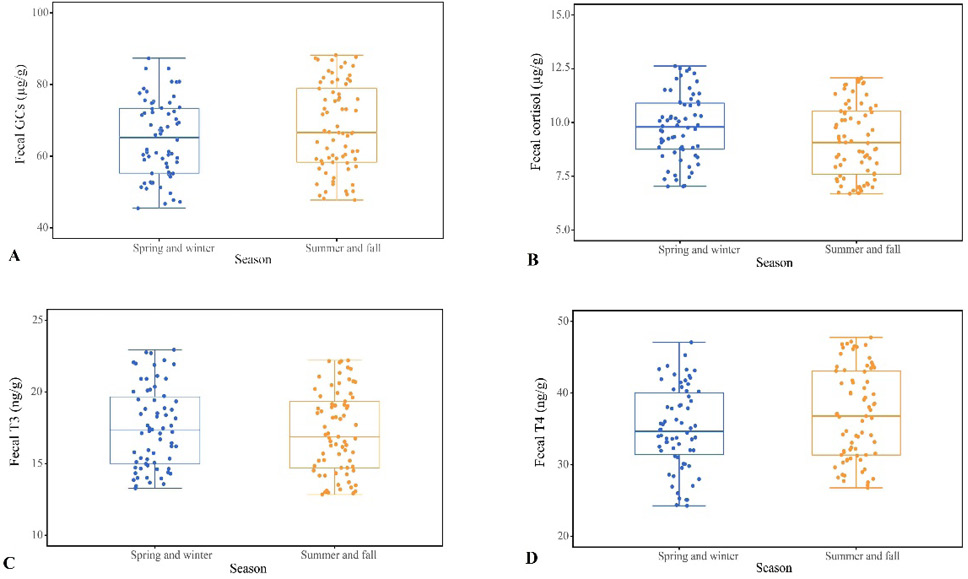
Variations in the glucocorticoids (GCs), cortisol, and thyroid hormones (T3/T4) in rhesus macaques between seasons (spring and winter VS summer and fall).
References
- Beehner, J.C., and Bergman, T.J., 2017. The next step for stress research in primates: To identify relationships between glucocorticoid secretion and fitness. Horm. Behav., 91: 68-83. https://doi.org/10.1016/j.yhbeh.2017.03.003[CrossRef]
- Beehner, J.C., and McCann, C., 2008. Seasonal and altitudinal effects on glucocorticoid metabolites in a wild primate (Theropithecus gelada). Physiol. Behav., 95: 508-514. https://doi.org/10.1016/j.physbeh.2008.07.022[CrossRef]
- Behie, A.M., Pavelka, M.S., and Chapman, C.A., 2010. Sources of variation in fecal cortisol levels in howler monkeys in Belize. Am. J. Primatol., 72: 600-606. https://doi.org/10.1002/ajp.20813[CrossRef]
- Behringer, V., Deschner, T., Murtagh, R., Stevens, J.M.G., and Hohmann, G., 2014. Age-related changes in thyroid hormone levels of bonobos and chimpanzees indicate heterochrony in development. J. Hum. Evol., 66: 83-88. https://doi.org/10.1016/j.jhevol.2013.09.008[CrossRef]
- Boucai, L., Hollowell, J.G., and Surks, M.I., 2011. An approach for development of age, gender, and ethnicity-specific thyrotropin reference limits. Thyroid, 21: 5-11. https://doi.org/10.1089/thy.2010.0092[CrossRef]
- Carnegie, S.D., Fedigan, L.M., and Ziegler, T.E., 2011. Social and environmental factors affecting fecal glucocorticoids in wild, female white faced capuchins (Cebus capucinus). Am. J. Primatol., 73: 861-869. https://doi.org/10.1002/ajp.20954[CrossRef]
- Charpentier, M.J.E., Givalois, L., Faurie, C., Soghessa, O., Simon, F., and Kappeler, P.M., 2018. Seasonal glucocorticoid production correlates with a suite of small-magnitude environmental, demographic, and physiological effects in mandrills. Am. J. Phys. Anthropol., 165: 20-33. https://doi.org/10.1002/ajpa.23329[CrossRef]
- Chen, T., Huang, Z., Huang, C., Wei, H., and Zhou, Q., 2020a. Positional behaviours of François’ langur (Trachypithecus francoisi) in the limestone forest of Nonggang, Guangxi, South-West China. Folia Primatol., 91: 170-187. https://doi.org/10.1159/000502503[CrossRef]
- Chen, T., Li, Y., Liang, J., Li, Y., and Huang, Z., 2020b. Gut microbiota of provisioned and wild rhesus macaques (Macaca mulatta) living in a limestone forest in southwest Guangxi, China. MicrobiologyOpen, 9: e981. https://doi.org/10.1002/mbo3.981[CrossRef]
- Cristobal-Azkarate, J., Marechal, L., Semple, S., Majolo, B., and MacLarnon, A., 2016. Metabolic strategies in wild male Barbary macaques: Evidence from faecal measurement of thyroid hormone. Biol. Lett., 12: 20160168. https://doi.org/10.1098/rsbl.2016.0168[CrossRef]
- Davis, N., Schaffner, C.M., and Smith, T.E., 2005. Evidence that zoo visitors influence HPA activity in spider monkeys (Ateles geoffroyii rufiventris). Appl. Anim. Behav. Sci., 90: 131-141. https://doi.org/10.1016/j.applanim.2004.08.020[CrossRef]
- Dettmer, A.M., Novak, M.A., Meyer, J.S., and Suomi, S.J., 2014. Population density-dependent hair cortisol concentrations in rhesus monkeys (Macaca mulatta). Psychoneuroendocrinology, 42: 59-67. https://doi.org/10.1016/j.psyneuen.2014.01.002[CrossRef]
- Dias, P.A.D., Coyohua-Fuentes, A., Canales-Espinosa, D., Chavira-Ramirez, R., and Rangel-Negrin, A., 2017. Hormonal correlates of energetic condition in mantled howler monkeys. Horm. Behav., 94: 13-20. https://doi.org/10.1016/j.yhbeh.2017.06.003[CrossRef]
- Dunger, D.B., Perkins, J.A., Jowett, T.P., Edwards, P.R., Cox, L.A., Preece, M.A., and Ekins, R.P., 1990. A longitudinal study of total and free thyroid hormones and thyroxinebinding globulin during normal puberty. Eur. J. Endocrinol., 123: 305-310. https://doi.org/10.1530/acta.0.1230305[CrossRef]
- El Alami, A., Van Lavieren, E., Rachida, A., and Chait, A., 2012. Differences in activity budgets and diet between semiprovisioned and wild-feeding groups of the endangered Barbary macaque (Macaca sylvanus) in the central High Atlas Mountains, Morocco. Am. J. Primatol., 74: 210-216. https://doi.org/10.1002/ajp.21989[CrossRef]
- Fichtel, C., Kraus, C., Ganswindt, A., and Heistermann, M., 2007. Influence of reproductive season and rank on fecal glucocorticoid levels in free-ranging male Verreaux’s sifakas (Propithecus verreauxi). Horm. Behav., 51: 640-648. https://doi.org/10.1016/j.yhbeh.2007.03.005[CrossRef]
- Fisher, D.A., Sack, J., Oddie, T.H., Pekary, A.E., Hershman, J.M., Lam, R.W., and Parslow, M.E., 1977. Serum T4, TBG, T3 uptake, T3, reverse T3, and TSH concentrations in children 1 to 15 years of age. J. clin. Endocr. Metab., 45: 191-198. https://doi.org/10.1210/jcem-45-2-191[CrossRef]
- Garber, P.A., McKenney, A., Bartling-John, E., Bicca-Marques, J.C., De la Fuente, M.F., Abreu, F., Schiel, N., Souto, A., and Phillips, K.A., 2020. Life in a harsh environment: the effects of age, sex, reproductive condition, and season on hair cortisol concentration in a wild non-human primate. PeerJ, 8: e9365. https://doi.org/10.7717/peerj.9365[CrossRef]
- Gesquiere, L.R., Pugh, M., Alberts, S.C., and Markham, A.C., 2018. Estimation of energetic condition in wild baboons using fecal thyroid hormone determination. Gen. comp. Endocrinol., 260: 9-17. https://doi.org/10.1016/j.ygcen.2018.02.004[CrossRef]
- Gordon, A.D., 2006. Scaling of size and dimorphism in primates II: Macroevolution. Int. J. Primatol., 27: 63-105. https://doi.org/10.1007/s10764-005-9004-1[CrossRef]
- Harrison, M.J.S., 1983. Age and sex differences in the diet and feeding strategies of the green monkey, Cercopithecus sabaeus. Anim. Behav., 31: 969-977. https://doi.org/10.1016/S0003-3472(83)80001-3[CrossRef]
- Hernandez-Pacheco, R., Rawlins, R.G., Kessler, M.J., Delgado, D.L., Ruiz-Lambides, A.V., and Sabat, A.M., 2016. Discovery of a secular trend in Cayo Santiago macaque reproduction. Am. J. Primatol., 78: 227-237. https://doi.org/10.1002/ajp.22502[CrossRef]
- Hoffman, C.L., Ruiz-Lambides, A.V., Davila, E., Maldonado, E., Gerald, M.S., and Maestripieri, D., 2008. Sex differences in survival costs of reproduction in a promiscuous primate. Behav. Ecol. Sociobiol., 62: 1711-1718. https://doi.org/10.1007/s00265-008-0599-z[CrossRef]
- Huang, Z., Huang, C., Tang, C., Huang, L., Tang, H., Ma, G., and Zhou, Q., 2015. Dietary adaptations of Assamese macaques (Macaca assamensis)in limestone forests in Southwest China. Am. J. Primatol., 77: 171-185. https://doi.org/10.1002/ajp.22320[CrossRef]
- Iwaku, K., Noh, J.Y., Minagawa, A., Kosuga, Y., Suzuki, M., Sekiya, K., Matsumoto, M., Ohye, H., Kunii, Y., Yoshihara, A., Watanabe, N., Mukasa, K., Ito, K., and Ito, K., 2013. Determination of pediatric reference levels of FT3, FT4 and TSH measured with EC Lusys kits. Endocr. J., 60: 799-804. https://doi.org/10.1507/endocrj.EJ12-0390[CrossRef]
- Kaack, B., Walker, L., Brizzee, K.R., and Wolf, R.H., 1979. Comparative normal levels of serum triiodothyronine and thyroxine in nonhuman primates. Lab. Anim. Sci., 29: 191-194.
- Li, Y., Ma, G., Liu, S., Zhou, Q., Li, Y., and Huang, Z., 2021. Habitat use by Assamese macaques (Macaca assamensis) in the limestone forests, Southwestern Guangxi, China. Chinese J. Zool., 56: 16-27. https://doi.org/10.13859/j.cjz.202101003[CrossRef]
- Lindburg, D.G., 1976. Dietary habits of rhesus monkeys Macaca mulatta in Indian forests. J. Bombay nat. Hist. Soc., 73: 261–269.
- Liu, C., Ding, J., Gao, X., Du, C., Hou, C., Wu, X., Shen, W., and Zhu, J., 2021. Effects of acute low temperature stress on the hormones and gene expression of glucocorticoid receptor of large yellow croaker Larimichthys crocea. J. Therm. Biol., 99: 103018. https://doi.org/10.1016/j.jtherbio.2021.103018[CrossRef]
- Lu, J., Tian, J., and Zhang, P., 2018. Advances in ecological research regarding rhesus macaques (Macaca mulatta) in China. Acta Theriol. Sin., 38: 74-84. https://doi.org/10.16829/j.slxb.150128[CrossRef]
- Lu, S., Chen, T., Huang, Z., Li, Y., and Lu, C., 2021. Interannual variation in food choice of white-headed langur inhabiting limestone forests in Fusui, southwest Guangxi, China. Ecol. Evol., 11: 9349-9360. https://doi.org/10.1002/ece3.7726[CrossRef]
- Maestripieri, D., and Georgiev, A.V., 2016. What cortisol can tell us about the costs of sociality and reproduction among free-ranging rhesus macaque females on Cayo Santiago. Am. J. Primatol., 78: 92-105. https://doi.org/10.1002/ajp.22368[CrossRef]
- Maibeche, Y., Moali, A., Yahi, N., and Menard, N., 2015. Is diet flexibility an adaptive life trait for relictual and peri-urban populations of the endangered primate Macaca sylvanus? PLoS One, 10: e0118596. https://doi.org/10.1371/journal.pone.0118596[CrossRef]
- Marty, P.R., Balasubramaniam, K.N., Kaburu, S.S.K., Hubbard, J., Beisner, B., Bliss-Moreau, E., Ruppert, N., Arlet, M.E., Mohd Sah, S.A., Ismail, A., Mohan, L., Rattan, S.K., Kodandaramaiah, U., and McCowan, B., 2020. Individuals in urban dwelling primate species face unequal benefits associated with living in an anthropogenic environment. Primates, 61: 249-255. https://doi.org/10.1007/s10329-019-00775-4[CrossRef]
- McLennan, M.R., and Ganzhorn, J.U., 2017. Nutritional characteristics of wild and cultivated foods for chimpanzees (Pan troglodytes) in agricultural landscapes. Int. J. Primatol., 38: 122-150. https://doi.org/10.1007/s10764-016-9940-y[CrossRef]
- Mendonca-Furtado, O., Edaes, M., Palme, R., Rodrigues, A., Siqueira, J., and Izar, P., 2014. Does hierarchy stability influence testosterone and cortisol levels of bearded capuchin monkeys (Sapajus libidinosus) adult males? A comparison between two wild groups. Behav. Process., 109: 79-88. https://doi.org/10.1016/j.beproc.2014.09.010[CrossRef]
- Milich, K.M., Georgiev, A.V., Petersen, R.M., Emery Thompson, M., and Maestripieri, D., 2018. Alpha male status and availability of conceptive females are associated with high glucocorticoid concentrations in high-ranking male rhesus macaques (Macaca mulatta) during the mating season. Horm. Behav., 97: 5-13. https://doi.org/10.1016/j.yhbeh.2017.09.014[CrossRef]
- Muller, M.N., Enigk, D.K., Fox, S.A., Lucore, J., Machanda, Z.P., Wrangham, R.W., and Emery Thompson, M., 2021. Aggression, glucocorticoids, and the chronic costs of status competition for wild male chimpanzees. Horm. Behav., 130: 104965. https://doi.org/10.1016/j.yhbeh.2021.104965[CrossRef]
- Mullur, R., Liu, Y.Y., and Brent, G.A., 2014. Thyroid hormone regulation of metabolism. Physiol. Rev., 94: 355-382. https://doi.org/10.1152/physrev.00030.2013[CrossRef]
- Nabi, G., Robeck, T.R., Yujiang, H., Tang, B., Zheng, J., Wang, K., and Wang, D., 2021. Circulating concentrations of thyroid hormones and cortisol in wild and semi-natural Yangtze finless porpoise (Neophocaena asiaeorientalis). Conserv. Physiol., 9: coab034. https://doi.org/10.1093/conphys/coab034[CrossRef]
- Ortiga-Carvalho, T.M., Chiamolera, M.I., Pazos-Moura, C.C., and Wondisford, F.E., 2016. Hypothalamus pituitary thyroid axis. Comp. Physiol., 6: 1387-1428. https://doi.org/10.1002/cphy.c150027[CrossRef]
- Ostner, J., Heistermann, M., and Schulke, O., 2008a. Dominance, aggression and physiological stress in wild male Assamese macaques (Macaca assamensis). Horm. Behav., 54: 613-619. https://doi.org/10.1016/j.yhbeh.2008.05.020[CrossRef]
- Ostner, J., Kappeler, P., and Heistermann, M., 2008b. Androgen and glucocorticoid levels reflect seasonally occurring social challenges in male redfronted lemurs (Eulemur fulvus rufus). Behav. Ecol. Sociobiol., 62: 627-638. https://doi.org/10.1007/s00265-007-0487-y[CrossRef]
- Parra, A., Villalpando, S., Junco, E., Urquieta, B., Alatorre, S., and García-Bulnes, G., 1980. Thyroid gland function during childhood and adolescences. Eur. J. Endocrinol., 93: 306-314. https://doi.org/10.1530/acta.0.0930306[CrossRef]
- R Core Team, 2021. R: A language and environment for statistical computing. R Foundation for Statistical Computing, Vienna, Austria. https://www.R-project.org/
- Plavcan, J.M., 2001. Sexual dimorphism in primate evolution. Am. J. Phys. Anthropol., 166: 25-53. https://doi.org/10.1002/ajpa.10011[CrossRef]
- Rimbach, R., Pillay, N., and Schradin, C., 2017. Both thyroid hormone levels and resting metabolic rate decrease in African striped mice when food availability decreases. J. exp. Biol., 220: 837-843. https://doi.org/10.1242/jeb.151449[CrossRef]
- Sadoughi, B., Girard-Buttoz, C., Engelhardt, A., Heistermann, M., and Ostner, J., 2021. Non-invasive assessment of metabolic responses to food restriction using urinary triiodothyronine and cortisol measurement in macaques. Gen. comp. Endocrinol., 306: 113736. https://doi.org/10.1016/j.ygcen.2021.113736[CrossRef]
- Sapolsky, R.M., Romero, L.M., and Munck, A.U., 2000. How do glucocorticoids influence stress responses? Integrating permissive, suppressive, stimulatory, and preparative actions. Endocr. Rev., 21: 55-89. https://doi.org/10.1210/edrv.21.1.0389[CrossRef]
- Schaebs, F.S., Wolf, T.E., Behringer, V., and Deschner, T., 2016. Fecal thyroid hormones allow for the non-invasive monitoring of energy intake in capuchin monkeys. J. Endocrinol., 231: 1-10. https://doi.org/10.1530/JOE-16-0152[CrossRef]
- Sciurba, J.D., Hayes, J.M., Nouraie, S.M., Wilson, H.M., Fortman, J.D., and Halliday, L.C., 2021. Reference intervals for total T4 and free T4 in cynomolgus macaques (Macaca fascicularis) and rhesus macaques (Macaca mulatta). J. Am. Assoc. Lab. Anim. Sci., 60: 380-387. https://doi.org/10.30802/AALAS-JAALAS-20-000126[CrossRef]
- Takeshita, R.S.C., Bercovitch, F.B., Huffman, M.A., Mouri, K., Garcia, C., Rigaill, L., and Shimizu, K., 2014. Environmental, biological, and social factors influencing fecal adrenal steroid concentrations in female Japanese macaques (Macaca fuscata). Am. J. Primatol., 76: 1084-1093. https://doi.org/10.1002/ajp.22295[CrossRef]
- Takeshita, R.S.C., Bercovitch, F.B., Kinoshita, K., and Huffman, M.A., 2018. Beneficial effect of hot spring bathing on stress levels in Japanese macaques. Primates, 59: 215-225. https://doi.org/10.1007/s10329-018-0655-x[CrossRef]
- Tang, C., Huang, L., Huang, Z., Krzton, A., Lu, C., and Zhou, Q., 2016. Forest seasonality shapes diet of limestone living rhesus macaques at Nonggang, China. Primates, 57: 83-92. https://doi.org/10.1007/s10329-015-0498-7[CrossRef]
- Tang, C., Jiang, J., Huang, C., Lu, C., and Zhou, Q., 2017. Influence of environmental and social factors on activity rhythm and time budget of rhesus macaques (Macaca mulatta) in Karst habitat. Acta Theriol. Sin., 37: 131-138. https://doi.org/10.16829/j.slxb.201702003[CrossRef]
- Tecot, S.R., Irwin, M.T., and Raharison, J.L., 2019. Faecal glucocorticoid metabolite profiles in diademed sifakas increase during seasonal fruit scarcity with interactive effects of age/sex class and habitat degradation. Conserv. Physiol., 7: coz001. https://doi.org/10.1093/conphys/coz001[CrossRef]
- Thompson, C.L., Powell, B.L., Williams, S.H., Hanya, G., Glander, K.E., and Vinyard, C.J., 2017. Thyroid hormone fluctuations indicate a thermoregulatory function in both a tropical (Alouatta palliata) and seasonally cold-habitat (Macaca fuscata) primate. Am. J. Primatol., 79: e22714. https://doi.org/10.1002/ajp.22714[CrossRef]
- Thompson, M.E., Muller, M.N., Kahlenberg, S.M., and Wrangham, R.W., 2010. Dynamics of social and energetic stress in wild female chimpanzees. Horm. Behav., 58: 440-449. https://doi.org/10.1016/j.yhbeh.2010.05.009[CrossRef]
- Touitou, S., Heistermann, M., Schulke, O., and Ostner, J., 2021. Triiodothyronine and cortisol levels in the face of energetic challenges from reproduction, thermoregulation and food intake in female macaques. Horm. Behav., 131: 104968. https://doi.org/10.1016/j.yhbeh.2021.104968[CrossRef]
- Touma, C., and Palme, R., 2005. Measuring fecal glucocorticoid metabolites in mammals and birds: the importance of validation. Annls N.Y. Acad. Sci., 1046: 54-74. https://doi.org/10.1196/annals.1343.006[CrossRef]
- Turcotte, C.M., Mann, E.H.J., Stock, M.K., Villamil, C.I., Montague, M.J., Dickinson, E., Surratt, S.B., Martinez, M., Williams, S.A., Antón, S.C., and Higham, J.P., 2022. The ontogeny of sexual dimorphism in free-ranging rhesus macaques. Am. J. Biol. Anthropol., 177: 314-327. https://doi.org/10.1002/ajpa.24442[CrossRef]
- Vaglio, S., Kaburu, S.S.K., Pearce, R., Bryant, L., McAuley, A., Lott, A., Sheppard, D.J., Smith, S., Tompkins, B., Elwell, E., Fontani, S., Young, C., Marliani, G., and Accorsi, P.A., 2021. Effects of scent enrichment on behavioral and physiological indicators of stress in zoo primates. Am. J. Primatol., 83: e23247. https://doi.org/10.1002/ajp.23247[CrossRef]
- Vandeleest, J.J., Winkler, S.L., Beisner, B.A., Hannibal, D.L., Atwill, E.R., and McCowan, B., 2020. Sex differences in the impact of social status on hair cortisol concentrations in rhesus monkeys (Macaca mulatta). Am. J. Primatol., 82: e23086. https://doi.org/10.1002/ajp.23086[CrossRef]
- Wang, J., Feng, M., and Li, Y., 1996. The study on population ecology of Macaca mulatta at Longhushan Nature Reserve, Guangxi. Acta Theriol. Sin., 16: 264-271. https://doi.org/10.16829/j.slxb.1996.04.005[CrossRef]
- Watanuki, Y., and Nakayama, Y., 1993. Age difference in activity pattern of Japanese monkeys: Effects of temperature, snow, and diet. Primates, 34: 419-430. https://doi.org/10.1007/BF02382651[CrossRef]
- Waterman, P.G., and Kool, K.M., 1994. Colobine food selection and plant chemistry. In: Colobine monkeys: Their ecology, behaviour and evolution (eds. A.G. Davies and J.F. Oates). Cambridge University Press, Cambridge, UK. pp. 251-284.
- Wen, J., Qiao, Q.G., Zhao, Z.J., Wang, D.H., Zheng, W.H., Wang, Z.X., and Liu, J.S., 2019. Effects of thyroid hormones and cold acclimation on the energy metabolism of the striped hamster (Cricetulus barabensis). J. comp. Physiol. B, 189: 153-165. https://doi.org/10.1007/s00360-018-1197-7[CrossRef]
- Yuan, D., 1994. Karstology in China. Geology Press, Beijing.
- Zhang, L., Huang, J.H., and Huang, Q.G., 2007. Biodiversity status quo and protection countermeasures for Guangxi Longhushan Nature Reserve. Central South For. Invent. Plann., 26: 65-67.
- Zhang, S., Cui, Z., Zhang, Y., Wang, B., Zhu, M., Lu, J., and Wang, Z., 2018. Low ranking individuals present high and unstable fecal cortisol levels in provisioned free ranging adult male rhesus macaques (Macaca mulatta) during the birth season in a mountain area of northern China. Primates, 59: 517-522. https://doi.org/10.1007/s10329-018-0692-5[CrossRef]
- Zhou, Q.H., Huang, Z.H., Wei, H., Huang, C.M., 2018. Variations in diet composition of sympatric Trachypithecus francoisi and Macaca assamensis in the limestone habitats of Nonggang, China. Zool. Res., 39: 284-290. https://doi.org/10.24272/j.issn.2095-8137.2018.046[CrossRef]
- Zhou, Q., Tang, H., Wei, C., and Huang, C., 2009. Diet and seasonal changes in rhesus macaques (Macaca mulata) at Seven-star Park, Guilin. Acta Theriol. Sin., 29: 419-426. https://doi.org/10.16829/j.slxb.2009.04.012[CrossRef]
Services
Article usage statistics
Loading…