
Makoto Kondo1*, Anuraga Jayanegara2, Yutaka Uyeno3, Hiroki Matsui1
1Graduate school of Bioresources, Mie University, Kurimamachiya, Tsu city, Mie, Japan, 514-8507; 2Faculty of Animal Science, Bogor Agricultural University, Bogor 16680, Indonesia; 3Faculty of Agriculture, Shinshu University, Minamiminowa, Nagano, Japan.
*Correspondence | Makoto Kondo, Mie University, Kurimamachiya, Tsu city, Mie, Japan; Email: makok@bio.mie-u.ac.jp
Abstract
Agro-industrial by-products containing tannins have potential to be used as alternative ruminant feed sources. To explore the functional effects of agro-industrial by-products on livestock production, the contents of tannins such as total extractable phenolics (TEPH) and condensed tannins (CT), in 15 kinds of by-products were determined and their protein-precipitating capacity (PPC) was also measured. TEPH content was the highest in chestnut husk, followed by tea grounds. Grape skin, winery residue and chestnut husk showed high CT content. Furthermore, TEPH, but not CT, content was positively correlated with PPC (p<0.001). The PPC on a TEPH basis was the highest in black tea grounds, followed by cedar bark and cypress bark. Green tea grounds, banana peel, grape skin, and winery residue showed moderate PPC, whereas citrus peels and coffee grounds did not show any PPC. Among these by-products, four by-products showing moderate PPC might have potentiality to be considered as feedstuffs that protect protein degradation in the rumen; particularly green tea grounds would be preferred as protein supplements due to high CP content and moderate PPC.
Keywords | Agro-industrial by-products, Phenolics, Protein precipitating capacity, Tannins
Editor | Kuldeep Dhama, Indian Veterinary Research Institute, Uttar Pradesh, India.
Received | October 24, 2015; Revised | November 12, 2015; Accepted | November 15, 2015; Published | December 23, 2015
Citation | Kondo M, Jayanegara A, Uyeno Y, Matsui H (2016). Variation of tannin contents in selected agro-industrial by-products and their biological activity in precipitating protein. Adv. Anim. Vet. Sci. 4(2): 66-70.
ISSN (Online) | 2307-8316; ISSN (Print) | 2309-3331
Copyright © 2016 Kondo et al. This is an open access article distributed under the Creative Commons Attribution License, which permits unrestricted use, distribution, and reproduction in any medium, provided the original work is properly cited.
Short Communication · Volume 4, Issue 2, Pages 66–70, 23 December 2015 · Open Access
Variation of Tannin Contents in Selected Agro-Industrial By-products and their Biological Activity in Precipitating Protein
· · ·
Article Info ⌄
- Journal:
- Advances in Animal and Veterinary Sciences
- Published:
- 23 December 2015

From the article
- To explore the functional effects of agro-industrial by-products on livestock production, the contents of tannins such as total extractable phenolics (TEPH) and condensed tannins (CT), in 15 kinds of by-products were determined and their protein-precipitating capacity (PPC) was also measured.
- The PPC on a DM basis indicates how many proteins can be bound by the by-products and PPC on a TEPH basis indicates the activity of phenolic compounds themselves.
- These results indicated that the barks contained low amounts of extractable phenolics, but these compounds could bind more protein than phenolics found in other by-products.
- Furthermore, banana peel, grape skin, winery residue, and green tea grounds showed low or moderate PPC on a TEPH basis.
Selected from the article's own text.
Abstract
Each bar indicates mean ±SEM (n = 3).
that feeding of black tea grounds at a 5% DM of the total diet to goats showed lower CP digestibility and higher excretion of acid-detergent insoluble proteins; these could be interpreted as tannin-protein complexes . In contrast with PPC on a DM basis, two types of barks also showed higher levels of PPC on a TEPH basis among the by-products in the present study. These results indicated that the barks contained low amounts of extractable phenolics, but these compounds could bind more protein than phenolics found in other by-products. According to comparable PPC on a TEPH basis between barks and black tea grounds, pheolics in barks possibly make complexes with proteins and the complexes would be too tight to break in digestive tract in ruminant, similar to those found in black tea grounds. The phenolics in black tea grounds and two kinds of bark could be useful for anthelmintic effect, which requires a strong protein binding capacity in the intestine . Similar to the barks, phenolics in the husks from chestnut, peanut, and cacao also showed relatively higher PPC on a TEPH basis as compared with other by-products. Particularly, peanut husk and cacao husk showed higher levels of PPC when it was expressed on a TEPH basis. This result also indicates that the phenolics in these husks can bind so much protein that even the TEPH contents were low. Furthermore, banana peel, grape skin, winery residue, and green tea grounds showed low or moderate PPC on a TEPH basis. Our previous data showed that phenolics in green tea grounds protect proteins from degradation in the rumen, but do not strongly inhibit protein digestion in the post-rumen . According to the present data, phenolics in banana peel, grape skin and winery residue may also bind proteins moderately in the rumen, but they may exhibit lower binding activity in post-rumen, as similar to green tea ground. Min et al. (2003) reported that moderate levels of tannins protect protein degradation in the rumen and increase amino acid absorption in the small intestine, thereby improving the growth rate in lambs. Further research is needed to determine whether the by-products with moderate PPC increase the efficiency of protein digestion in ruminants.
Figure 2 shows simple correlations between PPC on a DM basis and TEPH content (left) or with CT content (right). The correlation coefficients of PPC with TEPH and CT were 0.851 (p<0.001) and 0.468 (p=0.078), respectively. These results are similar to those observed for some agro-industrial by-products in India . Significant correlation between PPC and TEPH suggests that the PPC is influenced by TEPH and not by CT. Not only content but also structures of tannins vary widely among different plant materials . In addition to CT in plants, hydrolysable tannins and simple phenolic compounds such as gallates and flavonoid monomers that can be detected by TEPH assay, may bind to proteins. Parameters such as TEPH would be acceptable in understanding the general characteristics of tannins in agro-industrial by-products.
In conclusion, based on the information of the chemical compositions and PPC (Table 1), the by-products examined in the present study can be classified into 5 groups; group 1 showed high PPC both on DM and TEPH basis (black tea grounds, oolong tea grounds and chestnut husk), group 2 showed low TEPH content, but high PPC (peanut husk, cacao husk, ceder bark and cypress bark), group 3 showed high CP and moderate PPC (green tea grounds), group 4 showed low CP and moderate PPC (banana peel, grape skin and winery residue) and group 5 showed no PPC (orange peel, grape fruit peel, lemon peel and coffee grounds). For livestock production, group 1 by-products may have the potential for use as anthelmintic agents without any
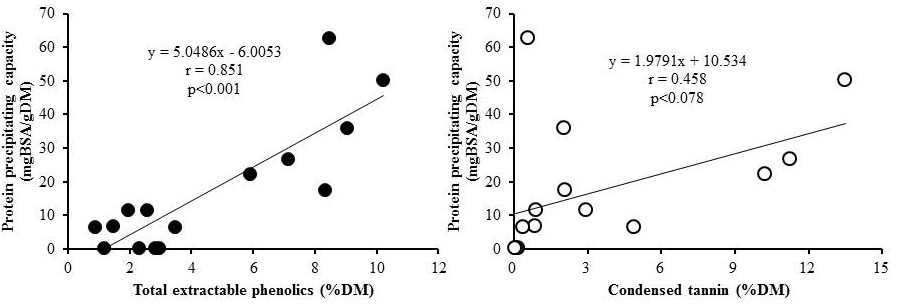
Figure 2: Correlation between protein precipitating capacity with the contents of total extractable phenolics (left) and condensed tannins (right)
BSA: bovine serum albumin
Table 1: Chemical compositions of agro-industrial by-products
| CP (%DM) | ADF (%DM) | ADL (%DM) | TEPH (%DM) | CT (%DM) | |
| Orange peel | 5.7 | 16.6 | 1.6 | 2.3 | 0.1 |
| Grape fruit peel | 7.2 | 17.6 | 1.6 | 3.0 | 0.2 |
| Lemon peel | 9.3 | 21.5 | 5.3 | 2.8 | 0.1 |
| Banana peel | 8.4 | 16.7 | 2.6 | 3.5 | 4.9 |
| Grape skin | 8.7 | 45.0 | 25.0 | 7.1 | 11.3 |
| Winery residue | 7.6 | 27.9 | 17.9 | 5.9 | 10.3 |
| Chestnut husk | 4.0 | 51.6 | 25.4 | 10.2 | 13.5 |
| Peanut husk | 4.4 | 77.9 | 35.9 | 2.6 | 2.9 |
| Coffee ground | 13.6 | 42.2 | 13.7 | 1.2 | 0.0 |
| Cacao husk | 15.6 | 38.8 | 17.6 | 1.5 | 0.9 |
| Cedar bark | 2.7 | 88.4 | 45.8 | 0.9 | 0.4 |
| Cypress bark | 2.5 | 90.1 | 55.3 | 2.0 | 0.9 |
| Green tea ground | 29.2 | 24.3 | 8.7 | 8.3 | 2.1 |
| Oolong tea ground | 22.6 | 33.6 | 16.3 | 9.0 | 2.1 |
| Black tea ground | 25.5 | 27.1 | 9.5 | 8.5 | 0.6 |
CP: crude protein; ADF: acid detergent fiber; ADL: acid detergent lignin; TEPH: total extractable phenolics; CT: condensed tannin
pretreatment, whereas group 2 by-products may have the same potential after extraction and condensation of effective fractions. Among these by-products, four by-products in group 3 and 4 showing moderate PPC can be considered as feedstuffs that protect protein degradation in the rumen; particularly green tea grounds would be potentially preferred as protein supplements due to high CP content and moderate PPC. For the future implications of these by-products, inhibitory interactions between tannins and rumen microorganisms should also be investigated since tannins may inhibit the growth of microoganisms due to their PPC . Further researches using animal experiments are necessary to understand both positive and negative the biological activities of tannins not only on protein utilization but also on microbiome in ruminant with related to tannin contents and PPC.
ACKNOWLEDGEMENTS
This work was supported by JSPS KAKENHI Grant Number 15K07272.
Authors contribution
Makoto Kondo carried out the experiment, and wrote the draft of manuscript. Anuraga Jayanegara performed the statistics and provided technical support. Yutaka Uyeno and Hiroki Matsui checked the experimental design and supported in writing the manuscript. All authors revised the manuscript.
Conflict of Interest
The authors have no conflict of interests.
References
- Bagheripour E, Rouzbehan Y, Alipour Y (2008). Effects of ensiling, air-drying and addition of polyethylene glycol on in vitro gas production of pistachio by-products. Anim. Fees Sci. Technol. 146: 327-336. http://dx.doi.org/10.1016/j.anifeedsci.2008.01.002[CrossRef]
- Hoste H, Jackson F, Athanasiadou S, Thamsborg SM, Hoskin SO (2006). The effects of tannin-rich plants on parasitic nematodes in ruminants. Trends Parasitol. 22(6): 253-261. http://dx.doi.org/10.1016/j.pt.2006.04.004[CrossRef]
- Jayanegara A, Goel G, Makkar HPS, Becker K (2015). Divergence between purified hydrolysable and condensed tannin effects on methane emission, rumen fermentation and microbial population in vitro. Anim. Feed Sci. Technol. 209: 60-68. http://dx.doi.org/10.1016/j.anifeedsci.2015.08.002[CrossRef]
- Kondo M, Hidaka M, Kita K, Yokota H (2007). Feeding value of supplemented diet with black tea by-product silage: Effect of polyethylene glycol addition to the diet on digestibility of protein fractions in goats. Grassl. Sci. 53: 131-137. http://dx.doi.org/10.1111/j.1744-697X.2007.00083.x[CrossRef]
- Kondo M, Hirano Y, Jayanegara A, Kita K, Yokota H (2014). Fermentation characteristics, tannin contents and in vitro ruminal degradation of green tea and black tea by-products ensiled at different temperatures. Asian-Austral. J. Anim. Sci. 27(7): 937-945.
- Makkar HPS, Singh B, Negi SS (1990). Tannin levels and their degree of polymerization and specific activity in some agricultural by products. Biological Wastes. 31: 137-144. http://dx.doi.org/10.1016/0269-7483(90)90167-Q[CrossRef]
- Makkar HPS (1996). Quantification of tannins in tree and shrub foliage: A laboratory manual. Springer-Science+Business Media, B.V.
- McSweeney CS, Palmer B, McNeill DM, Krause DO (2001). Microbial interactions with tannins: nutritional consequences for ruminants. Anim. Feed Sci. Technol. 91(1-2):83-93. http://dx.doi.org/10.1016/S0377-8401(01)00232-2[CrossRef]
- Min BR, Barry TN, Attwood GT, McNabb WC (2003). The effect of condensed tannins on the nutrition and health of ruminants fed fresh temperate forages: a review. Anim. Feed Sci. Technol. 106 (1-4): 3-19. http://dx.doi.org/10.1016/S0377-8401(03)00041-5[CrossRef]
- Miyake Y, Yamamoto K, Morimitsu Y, Osawa T (1998). Characteristics of antioxidative flavonoids glysocides. Food Sci. Int. Tokyo. 4(1): 48-53. http://dx.doi.org/10.3136/fsti9596t9798.4.48[CrossRef]
- Mueller-Harvey I (2006). Unravelling the conundrum of tannins in animal nutrition and health. J. Sci. Food Agri. 86(13): 2010-2037. http://dx.doi.org/10.1002/jsfa.2577[CrossRef]
- Naumann HD, Hagerman AE, Lambert BD, Muir JP, Tedeschi LO, Kothmann MM (2014). Molecular weight and protein-precipitating ability of condensed tannins from warm-season perennial legumes. J. Plant Interact. 9(1): 212-219. http://dx.doi.org/10.1080/17429145.2013.811547[CrossRef]
- Nonhebel S, Kastner T (2011). Changing demand for food, livestock feed and biofuels in the past and in the near future. Livestock. Sci. 139: 3-10. http://dx.doi.org/10.1016/j.livsci.2011.03.021[CrossRef]
- Ozdal T, Capanoglu E, Altay F (2013). A review on protein–phenolic interactions and associated changes. Food Res. Int. 51(2): 954-970. http://dx.doi.org/10.1016/j.foodres.2013.02.009[CrossRef]
- Van Soest PJ, Robertson JD, Lewis BA (1991). Methods for dietary fiber, neutral detergent fiber, and nonstarch polysaccharides in relation to animal nutrition. J. Dairy Sci. 74(10): 3583-3597. http://dx.doi.org/10.3168/jds.S0022-0302(91)78551-2[CrossRef]
- Yamamoto T, Juneja LR, Chu DC, Kim M (1997). Chemistry and applications of green tea, CRC press. Florida, USA.
Services
Article usage statistics
Loading…