
Use of larvicidal proteins based on bacteria is regarded as an effective and environment friendly method of insect control. In this regard, surface layer (S-layer) protein in various strains of Lysinibacillus sphaericus is reported to exhibit bioinsecticidal property. Here, we aimed to search for local strain of L. sphaericus and test its S-layer protein for toxicity against Culex quinquefasciatus and Anopheles stephensi larvae. For this purpose, we isolated various bacterial strains from our local environment using standard microbiological techniques. Among those isolates, we found novel strain of L. sphaericus Q001, identified by ribotyping and MALDI-biotyping. The 16S ribosomal RNA gene of this strain is 96% similar to that of highly entomotoxic WHO reference strain 2362. The gene sequence was submitted to Genbank (OQ701385). We isolated the S-layer protein of this strain by treating it with lithium chloride (LiCl). After SDS-PAGE analysis, the protein was subjected to in-gel digestion and peptide mass fingerprinting for identification. Following the successful identification of this protein, we used it to test its toxicity against mosquito larvae by following WHO guidelines with slight modification. The bioassays were performed in triplicate and LC50 was calculated by applying log probit analysis. In conclusion, we found that S-layer protein of L. sphaericus Q001 was effective against the tested larvae with LC50 values of 8.5 µg/ml and 16.1 µg/ml against Cx. quinquefasciatus and An. stephensi larvae respectively. Furthermore, field trials can reveal the true potential of this protein as bioinsecticide.
Research Article · Volume 56, Issue 6, 25 October 2024 · Open Access
Toxicity of Lysinibacillus sphaericus Q001 S-Layer Protein Against Culex quinquefasciatus and Anopheles stephensi Larvae
· ·
Affiliations & Notes ⌄
- 1School of Biological Sciences, University of the Punjab, Quaid-e-Azam Campus, Lahore 54590, Pakistan 2Department of Wildlife and Ecology, University of Veterinary and Animal Sciences, Lahore, Pakistan 3Primary and Secondary Healthcare Department, Kasur, Pakistan * Corresponding author: annegardner80@yahoo.co.uk, qagardner.sbs@pu.edu.pk
Article Info ⌄
- Journal:
- Pakistan Journal of Zoology
- Published:
- 25 October 2024

From the article
- While the presence of S-layer protein is reported in different Bacillus species but not all such proteins are entomotoxic.
- In this study, we found that S-layer protein from L. sphaericus Q001 is toxic against mosquito larvae especially against Cx.
- We also isolated and identified S-layer protein of this bacterium.
- The protein toxicity against mosquito larvae was tested according to WHO guidelines.
Selected from the article's own text.
Abstract
Introduction
Mosquitos are one of the leading vectors to transmit arboviruses and associated diseases especially in tropical region. Despite the efforts to control and eliminate the mosquito-borne diseases through vaccination and chemotherapeutic agents, mosquito control is still the primary method to overcome these diseases . The use of chemical insecticides to control mosquitos poses many environmental hazards. Moreover, continuous use of insecticides also leads to the development of resistance in the insects. Khan and Akram (2019) reported that mosquitoes developed an increased resistance against commonly used insecticides such as deltamethrin, permethrin and temephos.
The use of insecticidal protein based on bacteria is a safe and economical alternative to chemical insecticides. In this regard, Lysinibacillus sphaericus and Bacillus thuringiensis are considered the most potent bacteria producing different insecticidal toxins . L. sphaericus is a gram positive, endospore forming, rod shaped bacterium. Based on DNA sequence analysis, various strains of L. sphaericus are classified into five homology groups. The strains belonging to group IIA are reported to be most toxic against insect larvae including the reference strain 2362 .
Entomopathogenic strains of L. sphaericus possess crystalline binary (Bin) protoxin which are produced during spore forming stage. Bin toxin consists of BinA and BinB which are non-toxic individually but their equimolar mixture results in dimer formation which is active against mosquito larvae . This bacterium also produces mtx1, 2 and 3 toxins during vegetative growth but their practical application is limited due to high susceptibility to protease enzymes . Other insecticidal proteins include sphaericolysin and Cry48Aa/Cry49a ; . Different strains of L. sphaericus are reported to have larvicidal S-layer protein . This protein makes it persistent even in the presence of toxic heavy metal contaminants such as lead, chromium, cadmium and arsenic . Besides, S-layer protein in some strains were found to be active against insect larvae . These studies led us to search for local isolate of L. sphaericus and investigate the toxicity of its S-layer protein against different mosquito larvae as a measure to control the spread of mosquito borne diseases.
Materials and Methods
Chemicals
Isolation of bacteria and growth conditions
Since the S-layer protein of bacteria is reported to bind with heavy metals, soil and water samples were collected randomly from different sites contaminated with heavy metal containing industrial effluents . The samples were collected in sterile, screw-capped Falcon® tubes and stored at 4 ℃ till further use. Different bacterial isolates were purified by preparing serial dilution of samples and spreading on LB agar plates followed by incubation at 37 ℃ . Purified bacterial strains were cultured in LB broth (tryptone 1%, NaCl 0.5% and yeast extract 0.5%) at 37 ℃ and 120 rpm till the desired optical density (OD600) was obtained (approximately 1.0 – 2.0 OD600).
Identification of bacteria
Isolated bacteria were subjected to biochemical characterization according to Bergey’s Manual of Systematic Bacteriology . For 16S rRNA sequencing, genomic DNA of the bacteria was isolated using DNA purification kit according to manufacturer’s instructions. 16S rRNA gene was amplified using universal primers pair (27 F and 1542 R) . The amplicon was analyzed by agarose gel electrophoresis and purified using GeneJet purification kit. The gene was sequenced using dideoxy Sanger sequencing method and analyzed using Applied Biosystem 3500 Hitachi Genetic Analyzer (Hitachi high technologies corporation, Tokyo, Japan).
Further identification was confirmed through MALDI-biotyping (MBT). 1 ml overnight grown bacterial culture was centrifuged and washed with distilled water. 300 μl of distilled water and 900 μl of absolute ethanol were added to the sample followed by vortexing and centrifugation in a benchtop centrifugation machine at 12000 rpm for 1 min, at room temperature (25 ℃). The supernatant was discarded and the cell pellet was resuspended in minimum volume of 70% formic acid and 100% acetonitrile in equal ratio. The sample was vortexed and 1 μl supernatant was spotted on MALDI target plate. The sample was air dried and then 1.5 µl of HCCA matrix solution (12 to 14 mg of α-cyano-4-hydroxycinnamic acid in 1:2 ratio of 100% acetonitrile to 0.1% trifluroacetic acid) was applied on the sample. The MBT samples were analyzed on autoflex (III) smartbeam matrix-assisted laser desorption/ionization time of flight/ time of flight (MALDI TOF/TOF) spectrometer (Bruker Daltonics GmbH) equipped with MBT compass using Flex Control (version 3.4.135.0) and MBT compass explorer (v 4.1) programs . The automated run programme was created in MBT Compass by entering the plate identity code and samples names. In acquisition window, following conditions were used in MBT_FC.par programme; mass range of 2 to 20 kDa, positive polarity in a linear detector mode at 1.867 kV, 1200 shots (obtained from 6 buffered spectra; 200 shots in one acquired spectrum) at 100 Hz laser repetition rate, using 30-32% laser slider value, 68–70 laser beam attenuation, laser beam focus at 65, PIE (pulsed ion extraction delay time) 120 ns, lens voltage at 6.05 kV, ion source voltages 1 and 2 were 20 and 19.05 kV, respectively. Since data were acquired in linear detector mode therefore reflector voltages were zero. Following run completion, identification of a microorganism was recorded in the terms of log score. The threshold score value for identification by manufacturers was set at 1.7. Above this score, identification was considered reliable.
Isolation of S-layer protein
Overnight grown culture of L. sphaericus was subcultured in 100 LB medium at 37 ℃ and 120 rpm till OD600 1.0. The cells were harvested by centrifugation at 6000 g for 15 min and washed with distilled water. The harvested cells were resuspended in 10 ml of 6 M LiCl solution, containing 0.1 mM phenylmethylsulfonyl fluoride (PMSF) as a serine protease inhibitor and incubated at room temperature for 30 min with slight agitation. The cells were harvested at 15000 g for 15 min at 4 ℃. The supernatant containing S-layer protein was passed through 0.45 μm filter and concentrated on 5 kDa Pellicon® XL ultrafiltration cassette. The solution was desalted using PD10 column (GE Healthcare). The solution was further concentrated by using Amicon® ultracentrifugal filter (Millipore) and analyzed on SDS-PAGE. The sample was stored at -20 ℃ till further use .
Identification of S-layer protein
S-layer protein was extracted from polyacrylamide gel and subjected to in-gel digestion using trypsin (sequencing grade from Promega®). 2 µl of peptide mixture was mixed with 4 µl of HCCA matrix (12 to 14 mg of α-cyano-4-hydroxycinnamic acid in 1:2 ratio of 100% acetonitrile to 0.1%trifluroacetic acid) and spotted on MALDI ground steel plate. The samples were analyzed on MALDI-TOF in positive ion reflectron mode using flex control method (version 3.4) and 45 % laser intensity.
The m/z list obtained from the analysis was then processed for protein identification with Bruker Daltonics Biotools version 3.2, using Mascot search engine with following parameters: Database: NCBIprot, taxonomy: firmicutes (gram-positive bacteria), fixed modification: carbamidomethylation of cysteine, variable modification: methionine oxidation, mass values: monoisotopic, peptide mass tolerance: ±370 ppm, peptide charge state: [M + 1H]+1 .
Bioassays against mosquito larvae
Bioassays were performed according to WHO guidelines with slight modifications. Cx. quinquefasciatus and An. stephensi larvae were collected from natural breeding sites. These mosquito species were identified according to the standard identification keys and diagnostics , already implemented in Primary and Secondary Healthcare Department of Kasur. Ten larvae in late 3rd or initial 4th instar stage were placed in 20 ml tap water containing 10 μg/ml of yeast extract (Merck CAS No. 8013-01-2) and different concentrations of S-layer protein. The larvae were incubated in petri plates (covered with cheesecloth) at 25-30 ℃ for 48 h with 12 h light and 12 h dark cycles. The experiments were performed in triplicate (WHO, 2005).
Data analyses
The experiment was invalidated if more than 10% larvae pupated in control group. The mortalities in experiment group were corrected according to Abbot’s formula, if 5% to 20% mortalities were recorded in control group . The dose-response curve and LC50 were calculated by applying log-probit analysis using SPSS (version 29.0).
Results
Strain and S-layer protein identification
The isolate under study was found to be L. sphaericus using 16S rRNA gene sequencing as well as MALDI-biotyping with 98% sequence identity and 2.18 ±0.059 score, respectively. According to Bruker Daltonics, a log score value of 2 or higher means identification with high confidence. S-layer protein was successfully identified through Mascot peptide mass fingerprinting with a score value of 102 (data unpublished).
Larvicidal activity
The effects of different doses of S-layer protein on the mortality of Cx. quinquefasciatus and An. stephensi larvae are given in Tables I and II. The corresponding dose-response curves of S-layer against these mosquitos are shown in Figure 1. A comparison of normalized mortalities of Culex and Anopheles larvae at given concentrations of S-layer protein is presented in Figure 2. The protein was found to be toxic against both types of larvae. LC50 calculated by log probit analysis was found to be 8.5 and 16.1 μg/ ml against Cx. quinquefasciatus and An. stephensi larvae respectively (Table III). It is obvious from these results that S-layer protein is significantly more toxic against Cx. quinquefasciatus.
Table I. The lethal effect of different concentrations of L. sphaericus Q001 surface layer on Cx. quinquefasciatus larvae.
Table II. The lethal effect of different concentrations of L. sphaericus Q001 surface layer on An. stephensi larvae.
| Dose | No. of dead larvae in replicate | |||
| 1 (n=10) | 2 (n=10) | 3 (n=10) | Total (n=30) | |
| 0 | 0 | 0 | 0 | 0 |
| 12 | 1 | 1 | 0 | 2 |
| 13 | 1 | 1 | 1 | 3 |
| 14 | 2 | 2 | 1 | 5 |
| 15 | 3 | 2 | 2 | 7 |
| 16 | 5 | 4 | 4 | 13 |
| 17 | 6 | 6 | 7 | 19 |
| 18 | 8 | 7 | 7 | 22 |
| 19 | 9 | 8 | 8 | 25 |
| 20 | 10 | 10 | 10 | 30 |
Table III. LC50 of L. sphaericus Q001 S-layer against Cx. quinquefasciatus and An. stephensi calculated by log-probit analysis.
| Mosquito | LC50 (μg/ml) | 95% confidence limit | R2 |
| Cx. quinquefasciatus | 8.5 | 7.79-9.13 | 0.960 |
| An. stephensi | 16.1 | 15.39-16.81 | 0.971 |
Discussion
Surface layer protein is typically the component of cell envelope of archaea but is also found in some rare bacteria. While its role in archaea is mostly limited to the maintenance of the shape of cell and its division, bacterial surface layer is natively involved in different functions such as surface adhesion, recognition of cell, molecular sieve, and as protective covering against harsh environmental conditions . Moreover, it is also reported to be involved in pathogenesis in some bacteria such as Clostridium difficile .
The S-layer protein in the present study was successfully identified by peptide mass fingerprinting but a central chunk of protein remained unmatched. We reasoned that this section is probably glycosylated and hence it did not match the naked peptides (data unpublished). In fact, S-layer proteins in bacteria are one of the unique examples to exhibit post-translational glycosylation in prokaryotes . In contrast to eukaryotic proteins, glycosylation in prokaryotes is not linked to protein folding and cell signaling but provides significant insight to the evolution and selection pressure of the microbe as well as the functions of protein .
While the presence of S-layer protein is reported in different Bacillus species but not all such proteins are entomotoxic. For example, the S-layer protein of L. sphaericus reference strain 2362 was reported to be nontoxic against Aedes aegypti larvae . Binary (Bin) protoxin is the most entomotoxic agent reported in L. sphaericus yet. This toxin is similar to other toxic Cry proteins present in Bacillus thuringiensis. It has been recently renamed as toxin pesticidal protein “Tpp” and references therein). Once swollen by the mosquito larvae, this protein is broken down into its subunit BinA and BinB. BinB binds to its receptors in the midgut while BinA has cytotoxic activity . The difference in the cytotoxicity of binary toxins against different larvae is found to be correlated with the ability of BinB to bind with the receptor in the midgut of larvae. If the entry of BinA is facilitated by an alternative pathway, its toxicity is increased .
The mode of action of S-layer proteins against mosquito larvae is still unknown . In this study, we found that S-layer protein from L. sphaericus Q001 is toxic against mosquito larvae especially against Cx. quinquefasciatus. This result is consistent with previous findings that reported high toxicity of S-layer against Cx. quinquefasciatus ; . However, LC50 of S-layer against An. stephensi is almost double to that against Cx. quinquefasciatus. This lesser susceptibility of An. stephensi to S-layer protein is previously reported . At this stage it can be assumed that S-layer protein has cytotoxic mode of action similar to that of Bin toxin. The difference in susceptibility of various mosquito larvae could be the result of different nature or expression level of binding receptors present in these larvae. These speculations need experimental verification..
Conclusion
In conclusion, we successfully confirmed the microbial strain under discussion to be L. sphaericus by using both 16S rRNA sequencing and MLADI biotyping with high confidence. The sequence of 16S rRNA gene was submitted to GenBank with accession no. OQ701385. We also isolated and identified S-layer protein of this bacterium. The protein toxicity against mosquito larvae was tested according to WHO guidelines. LC50 against Cx. quinquefasciatus and An. stephensi larvae was found to be 8.5 µg/ml and 16.1 µg/ml. Further investigation and in field bioassay of this protein can potentially lead to the development of commercial larvicidal product and help reduce the spread of mosquito borne diseases.
Acknowledgement
Authors greatly acknowledge Prof. M. Akhtar (FRS) for his epitomic insight towards research and knowledge.
Funding
The present research work was supported by recurrent grant of School of Biological Sciences. MALDI mass spectrometer was funded by Higher Education Commission, Islamabad, Pakistan.
IRB approval
The present work was waived off from institutional review board as it does not involve any bioethical issues.
Ethics statement
Not applicable.
Data availability
16S rRNA gene sequence of L. sphaericus Q001 from this study was submitted to Genbank under accession number OQ701385.
Statement of conflict of interest
The authors have declared no conflict of interest.
Figures
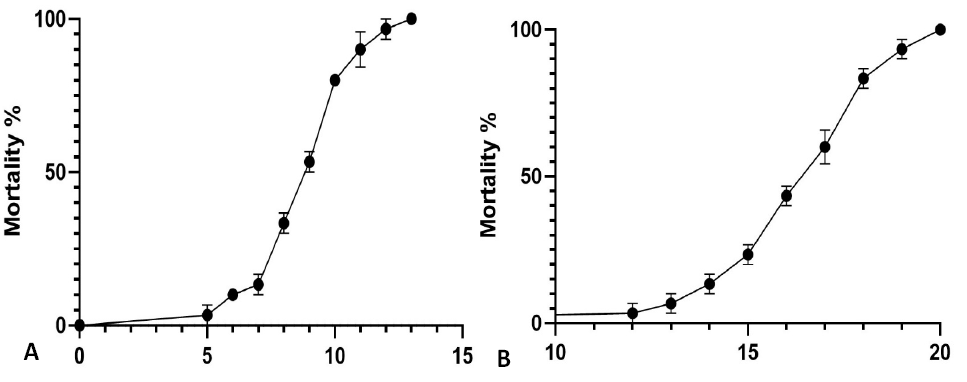
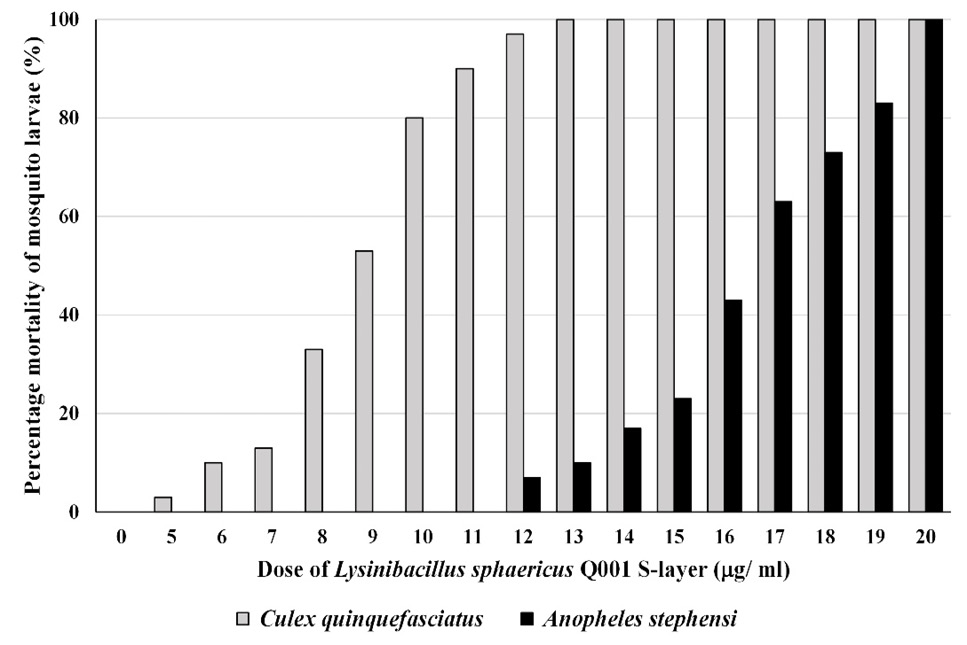
Mortality of Cx. quinquefasciatus and An. stephensi larvae against L. sphaericus Q001 S-layer protein.
References
- Abbott, W.S., 1987. A method of computing the effectiveness of an insecticide. J. Am. Mosq. Contr. Assoc., 3: 302–303.
- Allievi, M.C., Palomino, M.M., Acosta, M.P., Lanati, L., Ruzal, S.M. and Sánchez-Rivas, C., 2014. Contribution of S-layer proteins to the mosquitocidal activity of Lysinibacillus sphaericus. PLoS One, 9: 10. https://doi.org/10.1371/journal.pone.0111114[CrossRef]
- Azim, N., Gardner, Q.A., Rashid, N. and Akhtar, M., 2019. Mechanistic studies on Pyrobaculum calidifontis porphobilinogen synthase (5-aminolevulinic acid dehydratase). Bioorg. Chem., 91: 103117. https://doi.org/10.1016/j.bioorg.2019.103117[CrossRef]
- Berry, C., 2012. The bacterium, Lysinibacillus sphaericus, as an insect pathogen. J. Invertebr. Pathol., 109: 1–10. https://doi.org/10.1016/j.jip.2011.11.008[CrossRef]
- Bukhari, S., 2018. First studies on the identification of microorganisms in Pakistan by Maldi biotyping. University of the Punjab, Lahore.
- Cappuccino, J. and Welsh, C., 2020. Microbiology: A laboratory manual, 12th ed. Pearson.
- Edo, J. and Dussán, V.A.J., 2016. Adsorption of toxic metals and control of mosquitos-borne disease by Lysinibacillus sphaericus: Dual benefits for health and environment. Biomed. environ. Sci., 29: 187–196.
- Fagan, R.P. and Fairweather, N.F., 2014. Biogenesis and functions of bacterial S-layers. Nat. Rev. Microbiol., 12: 211–222. https://doi.org/10.1038/nrmicro3213[CrossRef]
- Ferguson, N.M., 2018. Challenges and opportunities in controlling mosquito-borne infections. Nature, 559: 490–497. https://doi.org/10.1038/s41586-018-0318-5[CrossRef]
- Hire, R.S., Hadapad, A.B., Dongre, T.K. and Kumar, V., 2009. Purification and characterization of mosquitocidal Bacillus sphaericus BinA protein. J. Invertebr. Pathol., 101. https://doi.org/10.1016/j.jip.2009.03.005[CrossRef]
- Khan, H.A.A. and Akram, W., 2019. Resistance status to deltamethrin, permethrin, and temephos along with preliminary resistance mechanism in Aedes aegypti (Diptera: Culicidae) from Punjab, Pakistan. J. med. Ent., 56: 1304–1311. https://doi.org/10.1093/jme/tjz057[CrossRef]
- Lacey, L.A., Grzywacz, D., Shapiro-Ilan, D.I., Frutos, R., Brownbridge, M., and Goettel, M.S., 2015. Insect pathogens as biological control agents: Back to the future. J. Invertebr. Pathol., 132: 1–41. https://doi.org/10.1016/j.jip.2015.07.009[CrossRef]
- Lane, D.J., 1991. 16S/23S rRNA sequencing. In: Nucleic acid techniques in bacterial systematics (eds. E. Stackebrandt and M. Goodfellow). John Wiley & Sons, New York. pp. 115-175.
- Logan, N.A., Vos, P. De, Garrity, G.M., Jones, D., Krieg, N.R., Ludwig, W., Rainey, F.A., Schleifer, K.-H., and Whitman, W.B., 2009. Bergey’s manual of systematic bacteriology. Volume three, The Firmicutes, 2nd ed. Springer, New York.
- Lozano, L.C., Ayala, J.A. and Dussán, J., 2011. Lysinibacillus sphaericus S-layer protein toxicity against Culex quinquefasciatus. Biotechnol. Lett., 33: 2037–2041. https://doi.org/10.1007/s10529-011-0666-9[CrossRef]
- Nishiwaki, H., Nakashima, K., Ishida, C., Kawamura, T. and Matsuda, K., 2007. Cloning, functional characterization, and mode of action of a novel insecticidal pore-forming toxin, sphaericolysin, produced by Bacillus sphaericus. Appl. environ. Microbiol., 73: 3404–3411. https://doi.org/10.1128/AEM.00021-07[CrossRef]
- Pabst, M., Grouzdev, D.S., Lawson, C.E., Kleikamp, H.B.C., de Ram, C., Louwen, R., Lin, Y.M., Lücker, S., van Loosdrecht, M.C.M. and Laureni, M., 2021. A general approach to explore prokaryotic protein glycosylation reveals the unique surface layer modulation of an anammox bacterium. ISME J., 16: 346–357. https://doi.org/10.1038/s41396-021-01073-y[CrossRef]
- Rippere, K.E., Johnson, J.L. and Yousten, A.A., 1997. DNA similarities among mosquito-pathogenic and nonpathogenic strains of Bacillus sphaericus. Int. J. Syst. Bact., 47: 214–216. https://doi.org/10.1099/00207713-47-1-214[CrossRef]
- Rubio, V.P., Bravo, A. and Olmos, J., 2017. Identification of a Bacillus thuringiensis surface layer protein with cytotoxic activity against MDA-MB-231 breast cancer cells. J. Microbiol. Biotechnol., 27: 36–42. https://doi.org/10.4014/jmb.1607.07020[CrossRef]
- Sanger, F., Nicklen, S. and Coulson, A.R., 1977. DNA sequencing with chain-terminating inhibitors. Proc. natl. Acad. Sci. U.S.A., 74: 5463–5467. https://doi.org/10.1073/pnas.74.12.5463[CrossRef]
- Santana-Martinez, J.C., Silva, J.J. and Dussan, J., 2019. Efficacy of Lysinibacillus sphaericus against mixed-cultures of field-collected and laboratory larvae of Aedes aegypti and Culex quinquefasciatus. Bull. entomol. Res., 109: 111–118. https://doi.org/10.1017/S0007485318000342[CrossRef]
- Schäffer, C. and Messner, P., 2001. Glycobiology of surface layer proteins. Biochimie, 83: 591–599. https://doi.org/10.1016/S0300-9084(01)01299-8[CrossRef]
- Sharma, M., Hire, R.S., Hadapad, A.B., Gupta, G.D. and Kumar, V., 2017. PEGylation enhances mosquito-larvicidal activity of Lysinibacillus sphaericus binary toxin. Bioconjug. Chem., 28: 410–418. https://doi.org/10.1021/acs.bioconjchem.6b00565[CrossRef]
- Silva-Filha, M.H.N.L., Romão, T.P., Rezende, T.M.T., Carvalho, K.S., de Menezes, H.S.G., Do Nascimento, N.A., Soberón, M. and Bravo, A., 2021. Bacterial toxins active against mosquitoes: Mode of action and resistance. Toxins (Basel), 13: 523. https://doi.org/10.3390/toxins13080523[CrossRef]
- Sleytr, U.B., Schuster, B., Egelseer, E.M. and Pum, D., 2014. S-layers: Principles and applications. FEMS Microbiol. Rev., 38: 823–864. https://doi.org/10.1111/1574-6976.12063[CrossRef]
- WHO, 2005. Guidelines for laboratory and field testing of mosquito larvicides. World Health Organization. https://apps.who.int/iris/handle/10665/69101
- Wilkerson, R.C., Linton, Y.M. and Strickman, D., 2021. Mosquitoes of the World, 1st ed. Johns Hopkins University Press.
Services
Article usage statistics
Loading…