Short Communication · Volume 38, Issue 1, 3 April 2023 · Open Access
The Assessment of Morphometric Variation of Aedes aegypti Larvae with the Seasonal Environment Temperature Inversion in Selected Areas of Lahore, Pakistan
· · · · · ·
Affiliations & Notes ⌄
- 1Department of Environmental Sciences and Engineering, Government College University Faisalabad, Pakistan. 2Department of Zoology, Government College Women University Faisalabad, Pakistan. 3Department of Medical Entomology and Parasitology, Institute of Public Health, Lahore, Pakistan. 4Sustainable Development Study Centre, Government College University Lahore, Pakistan. 5Department of Environment Sciences, National College of Business Administration and Economics, Lahore, Pakistan. Corresponding
Article Info ⌄
- Journal:
- Punjab University Journal of Zoology
- Published:
- 3 April 2023

From the article
- The results showed that seasonal thermal fluctuations affected the total body size, head length and width, abdominal length and width, and thoracic length and width of Ae.
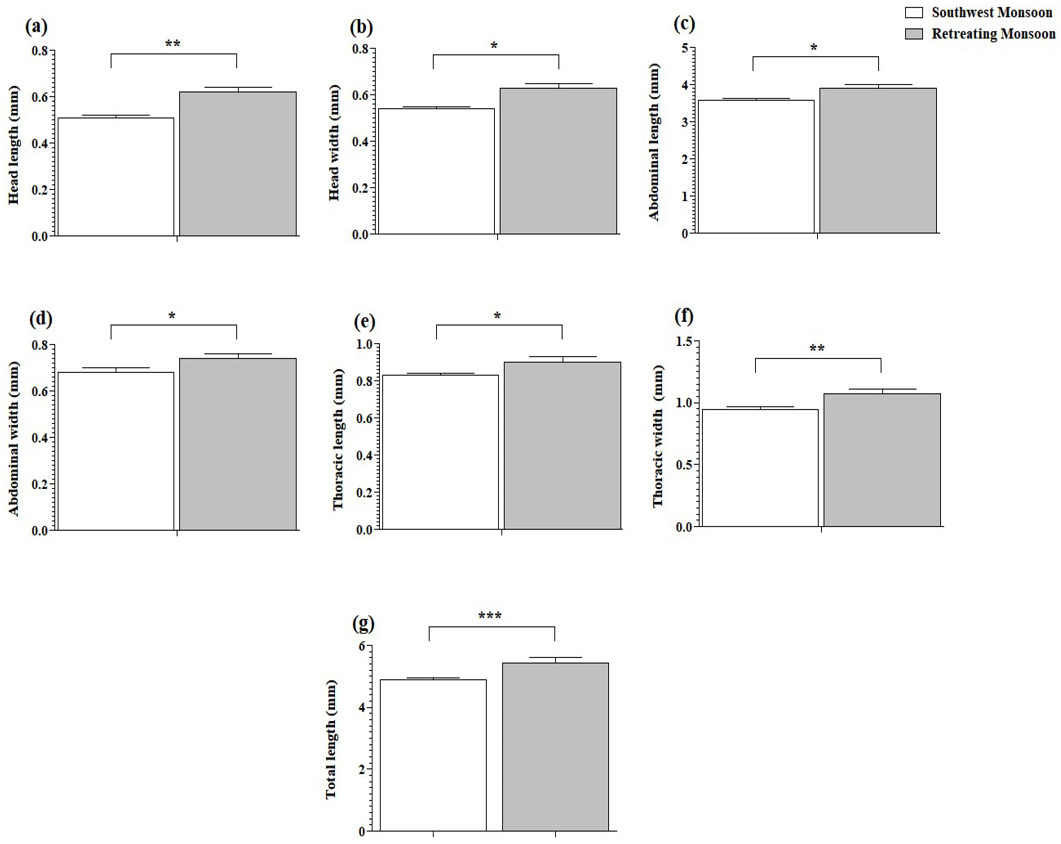
- It was found that the average head length (0.51±0.01mm) during southwest monsoon significantly increased (P ≤ 0.01) (0.62 ±0.02mm) during the retreating monsoon season (Figure 1a).
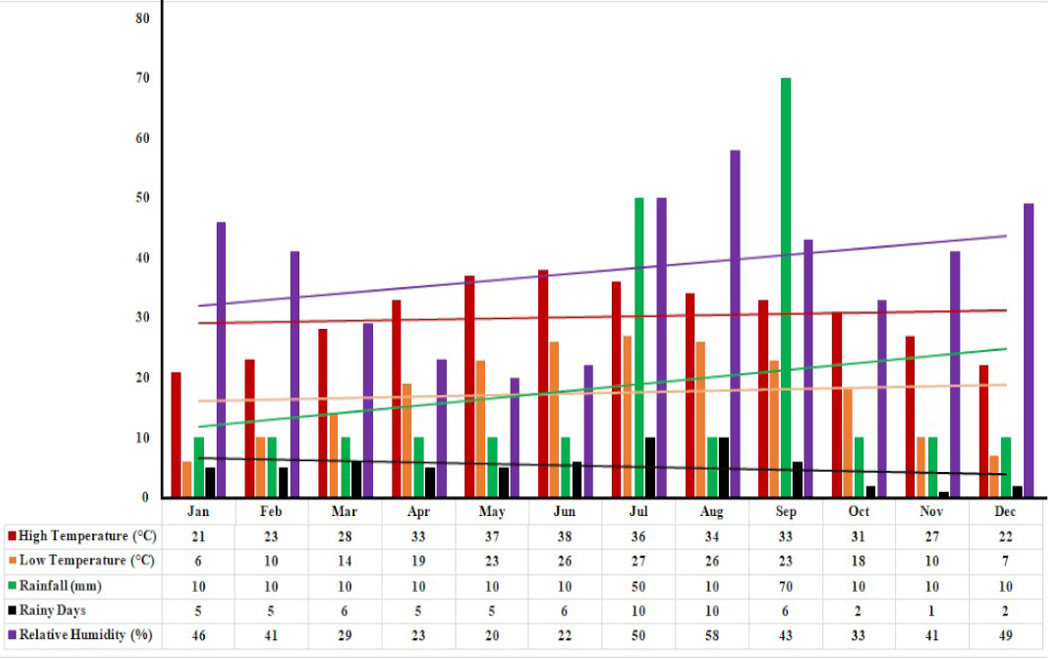
- While the average overall size of the larvae under laboratory temperature were recorded as 4.343±0.40 mm. The temperature variation during Southwest Monsoon and Retreating Monsoon are shown in (Figure 2).
- The study concluded that changes in meteorological conditions during the development of Aedes aegypti have a significant effect on the larval size and low temperatures of breeding water significantly increase (P≤0.05) the body size, head, thorax and abdomen of larvae.
Selected from the article's own text.
Abstract
Introduction
Mosquitoes are an important group of insects because they spread pathogens that cause disease in human and animal . The primary vector of various human arboviral diseases, including dengue, Zika, and chikungunya fever, is a mosquito of the genus Aedes, namely Aedes aegypti .
As a poikilotherm, the internal temperature of insects, including mosquitoes, fluctuates and rely on the temperature of the nearby environment . Temperature changes affect physiology, behaviour, ecology, and insect survival . Because of seasonal thermal fluctuations, insect development faces the risks, such as desiccation, metabolic changes, and loss of mobility .
The development of insects primarily depends on temperature and can be delayed or accelerated by altering the temperature . The Aedes mosquitoes have 4 life stages: egg, larva, pupa and adult. The entire life cycle, from an egg to an adult, takes approximately 8-10 days. In Ae. aegypti, there is a direct association between the mosquito’s immature development stage and the temperature . The development rate improved linearly with temperatures (22°C to 28°C) ; ; . It is critical to follow on for about ten days the advancement from the egg to the adult stages and Christiansen (2015) described that no adults appeared at temperatures below 18°C or above 34°C after pupation, but at 35°C, all larvae died before emergence .
Since mosquitoes are also poikilotherms, almost all biological activity is affected by ambient environmental conditions, such as humidity and temperature . Given the increasing phenomenon of climate change, it is important to understand how mosquitoes respond to changes in body characteristics and critical environmental parameters needed to predict survival rates. The present study assessed the changes in body sizes of Ae. aegypti larvae in two different seasons of the year, i.e., Southwest Monsoon (June through September) and Retreating Monsoon (October and November), to better understand the fluctuation in the development rate of Ae. Aegypti larvae in different environmental temperatures.
Materials and Methods
Larval collection, selection and identification
A total of 216 (n= 36/month) Ae. aegypti larvae were collected during the southwest monsoon (June through September) and retreating monsoon (October and November). The larvae were collected from selected areas of Wahga town and Allama Iqbal town of the district Lahore. The collected samples were then transported to the Department of Environmental Science and Engineering at the Government College University Faisalabad for further investigations. The larval samples were preserved in 70% formalin according to method. The collected larvae were identified to species level with the aid of a microscope by identification key. For the control, larvae were reared at laboratory maintained optimum temperature and relative humidity i.e., 28±1°C and 80%±5, respectively.
Morphometric characterization of larvae
After mounting with Hoyer’s medium for morphometric parameters assessment, the dead larvae were scrutinized. The head length, head width, thoracic length, thoracic width, abdominal length, abdominal width, and total length of larvae were determined with the aid of a stereomicroscope (BOECO BST-606, Germany) and method described by ; .
Statistical analysis
The statistical determination of the length and width of variations in body segments of the larva was analyzed with Student’s t-test using Prism v.7 (GraphPad Software, San Diego, CA, USA). The P-value (p<0.05) was considered significant.
Results
The results showed that seasonal thermal fluctuations affected the total body size, head length and width, abdominal length and width, and thoracic length and width of Ae. aegypti larvae (Figure 1). It was found that the average head length (0.51±0.01mm) during southwest monsoon significantly increased (P ≤ 0.01) (0.62 ±0.02mm) during the retreating monsoon season (Figure 1a). Similarly, the average head width in southwest monsoon was 0.54±0.01mm, which significantly increased (P ≤ 0.05) in retreating monsoon (0.63±0.02mm) (Figure 1b). The abdominal length in southwest monsoon (3.57 ±0.07mm) got significantly increased (P ≤ 0.05) in retreating monsoon (3.91±0.09mm) (Figure 1c). At the same time the abdominal width in southwest monsoon (0.68±0.02mm) was also significantly increased (P ≤ 0.05) in retreating monsoon (0.74 ±0.02mm) (Figure 1d). Furthermore, the thoracic length significantly increased (P ≤ 0.05) during retreating monsoon from 0.83±0.01mm in southwest monsoon to 0.90±0.03mm (Figure 1e). The average thoracic width during southwest monsoon was recorded at 0.95±0.02mm which also significantly increased (P ≤ 0.05) in retreating monsoon (1.07±0.04mm) (Figure 1f). The overall size of Ae. aegypti larvae in Southwest Monsoon was recorded at 4.91±0.05mm that increased highly significantly (P≤0.001) in retreating monsoon (5.43±0.20mm) (Figure 1g). While the average overall size of the larvae under laboratory temperature were recorded as 4.343±0.40 mm. The temperature variation during Southwest Monsoon and Retreating Monsoon are shown in (Figure 2).
Discussion
Changing environmental temperatures affect the development stages of mosquitoes and have a significant impact on their population dynamics . The temperatures between 16°C-34°C are suitable for Aedes aegypti development, and at water temperatures below 8°C, the larvae become immobile and die within a few weeks . In Pakistan, dengue control field staff identify Aedes mosquitoes, on the bases of larval and siphon tube size. So, the information about the size is important to minimize the chances of wrong identification of the dengue vectors at the initial stage. Therefore, we conducted this study to observe the difference in body size and different body structures of Ae. aegypti larvae in two seasons, i.e., southwest monsoon (June through September) and retreating monsoon (October and November). To our knowledge, this is the first study to assess the morphometric variation of Aedes aegypti larvae with the seasonal environment temperature inversion in selected areas of Lahore, Pakistan.
Recent studies also showed that at lower temperatures, the survival of larvae is correlated with food availability in water and intraspecific density ; . Aedes aegypti larvae with sufficient nutrient supply at cool ambient temperatures (15°C) can remain at a particular age for several months ; ; .
It has been established that a temperature between 31°C-32°C is optimal for larvae to complete their development, and mortality threshold temperature ranges between 14°C and 38°C , 1958). The survival of mosquitoes during the development stages depends on the regional temperature and their tolerance to cold and heat .
Previously the pattern of the development time and size of the A. aegypti and A. albopictus mosquito is affected by changes in the temperature of the surrounding environment when it exceeds the lower critical development threshold . The findings of showed that changes in the temperature could alter the stage and size of development starting from the larval stage. In a study conducted by the rate of development slowed and size increased as temperature decreased.
Conclusion
The study concluded that changes in meteorological conditions during the development of Aedes aegypti have a significant effect on the larval size and low temperatures of breeding water significantly increase (P≤0.05) the body size, head, thorax and abdomen of larvae. Climate change affects the immature stages of larval development. The findings might help in improving Aedes aegypti control measures and monitoring strategies by better understanding variation in larval development rates under different environmental temperatures. However, the study is limited in scope due to the smaller sample sizes and was carried out in two towns of one district only i.e., district Lahore. We suggest further studies with larger sample size and different settings across the dengue-endemic areas of the country.
Acknowledgments
The authors thank the Department of Health, Government of Punjab for the permission for and support for this worthy study.
Conflict of interest
The authors have declared no conflict of interest.
Figures

Body features of Ae. aegypti larvae (a) head length, (b) head width (c) abdominal length (d) abdominal width (e) thoracic length (f) thoracic width (g) total length. All data are expressed as means ± standard deviation (SD). The significance represented as ns P > 0.05, *P ≤ 0.05, **P ≤ 0.01, ***P ≤ 0.001 in Southwest Monsoon and Retreating Monsoon.

Variation in different climatic factors (minimum and maximum monthly temperatures, average rainfall and days per month, and average relative humidity) in Lahore.
References
- Andrew, J., and Bar, A., 2013. Morphology and morphometry of Aedes aegypti adult mosquito. Annu. Res. Rev. Biol., 3: 52-69.
- Barreaux, A.M., Stone, C.M., Barreaux, P., and Koella, J.C., 2018. The relationship between size and longevity of the malaria vector Anopheles gambiae (ss) depends on the larval environment. Parasit. Vectors, 11: 1-9. https://doi.org/10.1186/s13071-018-3058-3[CrossRef]
- Bar-Zeev, M., 1957. The effect of extreme temperatures on different stages of Aedes aegypti (L.). Bull. Entomol. Res., 48: 593-599. https://doi.org/10.1017/S0007485300002765[CrossRef]
- Bar-Zeev, M., 1958. The effect of temperature on the growth rate and survival of the immature stages of Aedes aegypti (L.). Bull. Entomol. Res., 49: 157-163. https://doi.org/10.1017/S0007485300053499[CrossRef]
- Bayoh, M.N., and Lindsay, S.W., 2003. Effect of temperature on the development of the aquatic stages of Anopheles gambiae sensu stricto (Diptera: Culicidae). Bull. Entomol. Res., 93: 375-381. https://doi.org/10.1079/BER2003259[CrossRef]
- Beck-Johnson, L.M., Nelson, W.A., Paaijmans, K.P., Read, A.F., Thomas, M.B., and Bjornstad, O.N., 2013. The effect of temperature on Anopheles mosquito population dynamics and the potential for malaria transmission. PLoS One, 8: e79276. https://doi.org/10.1371/journal.pone.0079276[CrossRef]
- Brady, O.J., Golding, N., Pigott, D.M., Kraemer, M.U., Messina, J.P., Reiner, R.C., Jr., Scott, T.W., Smith, D.L., Gething, P.W., and Hay, S.I., 2014. Global temperature constraints on Aedes aegypti and Ae. albopictus persistence and competence for dengue virus transmission. Parasit. Vectors, 7: 338. https://doi.org/10.1186/1756-3305-7-338[CrossRef]
- Caminade, C., Mcintyre, K.M., and Jones, A.E., 2019. Impact of recent and future climate change on vector-borne diseases. Ann. N. Y. Acad. Sci., 1436: 157-173. https://doi.org/10.1111/nyas.13950[CrossRef]
- Christiansen-Jucht, C.D., Parham, P.E., Saddler, A., Koella, J.C., and Basanez, M.G., 2015. Larval and adult environmental temperatures influence the adult reproductive traits of Anopheles gambiae s.s. Parasit. Vectors, 8: 456. https://doi.org/10.1186/s13071-015-1053-5[CrossRef]
- Couret, J., and Benedict, M.Q., 2014. A meta-analysis of the factors influencing development rate variation in Aedes aegypti (Diptera: Culicidae). BMC Ecol., 14: 3. https://doi.org/10.1186/1472-6785-14-3[CrossRef]
- Couret, J., Dotson, E., and Benedict, M.Q., 2014. Temperature, larval diet, and density effects on development rate and survival of Aedes aegypti (Diptera: Culicidae). PLoS One, 9: e87468. https://doi.org/10.1371/journal.pone.0087468[CrossRef]
- Cristophers, S., 1960. Aedes aegypti (L). The yellow fever mosquito. Its life history, bionomics and structure, Cambridge university press.
- Farjana, T., Tuno, N., and Higa, Y., 2012. Effects of temperature and diet on development and interspecies competition in Aedes aegypti and Aedes albopictus. Med. Vet. Entomol., 26: 210-217. https://doi.org/10.1111/j.1365-2915.2011.00971.x[CrossRef]
- Foster, W.A., and Walker, E.D., 2019. Mosquitoes (Culicidae), Medical and veterinary entomology. Elsevier. https://doi.org/10.1016/B978-0-12-814043-7.00015-7[CrossRef]
- Giesen, C., J. Roche, L. Redondo-Bravo, C. Ruiz-Huerta, D. Gomez-Barroso, A. Benito, And Z. Herrador., 2020. The impact of climate change on mosquito-borne diseases in Africa. Pathog. Glob. Hlth., 114: 287-301. https://doi.org/10.1080/20477724.2020.1783865[CrossRef]
- Gunathilaka, N., Upulika, H., Udayanga, L., and Amarasinghe, D., 2019. Effect of larval nutritional regimes on morphometry and vectorial capacity of Aedes aegypti for dengue transmission. Biomed. Res. Int., 3607342. https://doi.org/10.1155/2019/3607342[CrossRef]
- Khan, J., Ghaffar, A., and Khan, S.A., 2018. The changing epidemiological pattern of Dengue in Swat, Khyber Pakhtunkhwa. PLoS One, 13: e0195706. https://doi.org/10.1371/journal.pone.0195706[CrossRef]
- Reinhold, J.M., Lazzari, C.R., and Lahondere, C., 2018. Effects of the Environmental Temperature on Aedes aegypti and Aedes albopictus Mosquitoes: A review. Insects, 9: 158. https://doi.org/10.3390/insects9040158[CrossRef]
- Rocklov, J., and Dubrow, R., 2020. Climate change: An enduring challenge for vector-borne disease prevention and control. Nat. Immunol., 21: 479-483. https://doi.org/10.1038/s41590-020-0648-y[CrossRef]
- Rueda, L.M., 2004. Pictorial keys for the identification of mosquitoes (Diptera: Culicidae) associated with dengue virus transmission. Walter reed army inst of research Washington Dc Department Of Entomology. https://doi.org/10.11646/zootaxa.589.1.1[CrossRef]
- Sasmita, H.I., Tu, W.C., Bong, L.J., and Neoh, K.B., 2019. Effects of larval diets and temperature regimes on life history traits, energy reserves and temperature tolerance of male Aedes aegypti (Diptera: Culicidae): optimizing rearing techniques for the sterile insect programmes. Parasit. Vectors, 12: 578. https://doi.org/10.1186/s13071-019-3830-z[CrossRef]
- Sutiningsih, D., Nurjazuli, N., Nugroho, D., and Satoto, T.B.T., 2019. Larvicidal activity of brusatol isolated from Brucea javanica (L) Merr on Culex quinquefasciatus. Iran. J. Publ. Hlth., 48: 688-696. https://doi.org/10.18502/ijph.v48i4.1002[CrossRef]
- Teng, H.J., and Apperson, C.S., 2000. Development and survival of immature Aedes albopictus and Aedes triseriatus (Diptera: Culicidae) in the laboratory: effects of density, food, and competition on response to temperature. J. Med. Entomol., 37: 40-52. https://doi.org/10.1603/0022-2585-37.1.40[CrossRef]
- Wimalasiri-Yapa, B., Barrero, R.A., Stassen, L., Hafner, L.M., Mcgraw, E.A., Pyke, A.T., Jansen, C.C., Suhrbier, A., Yakob, L., Hu, W., Devine, G.J., and Frentiu, F.D., 2021. Temperature modulates immune gene expression in mosquitoes during arbovirus infection. Open Biol., 11: 200246. https://doi.org/10.1098/rsob.200246[CrossRef]
- Yang, H.M., Macoris, M.L., Galvani, K.C., Andrighetti, M.T., and Wanderley, D.M., 2009. Assessing the effects of temperature on the population of Aedes aegypti, the vector of dengue. Epidemiol. Infect., 137: 1188-1202. https://doi.org/10.1017/S0950268809002040[CrossRef]
Services
Article usage statistics
Loading…