Research Article · Volume 14, Issue 3, 31 August 2026 · Open Access
Thymus vulgaris and Mentha piperita Essential Oil Film-Forming Suspensions and Their Therapeutic Effects on Experimentally Induced Mastitis in Ewes
·
Affiliations & Notes ⌄
1Department of Physiology, Biochemistry and Pharmacology, College of Veterinary Medicine, University of Baghdad, Baghdad, Iraq. *Correspondence | Hammad Mohammad Allawi, Department of Physiology, Biochemistry and Pharmacology, College of Veterinary Medicine, University of Baghdad, Baghdad, Iraq
Post-treatment SCC significantly declined in both T. vulgaris gel and M. piperita suspension groups, with the greatest reduction in M. piperita (63.11 ± 2.79), followed by T. vulgaris (67.43 ± 2.66), compared to amoxicillin (91.13 ± 4.52).
Following 72 hours of treatment, milk fat percentage increased markedly, reaching 6.47 ± 0.79% in the M. piperita group, compared with 6.31 ± 0.51% in T. vulgaris and 6.01 ± 0.37% in amoxicillin-treated ewes.
The essential oils demonstrated positive antimicrobial activity against pathogens responsible for subclinical mastitis in sheep.
This study highlighted the antibacterial and anti-inflammatory activities of T. vulgaris and M. piperita suspensions and their potential use in treating animal infectious diseases caused by S. aureus, including drug-resistant and biofilm-forming strains.
Selected from the article's own text.
Abstract
Mastitis caused by intramammary infections is a major constraint in dairy sheep production, resulting in reduced milk yield and quality. This study investigated the preparation of Thymus vulgaris and Mentha piperita essential oil (EO) film-forming suspensions and their therapeutic effects on experimentally induced mastitis in ewes. Suspensions (2% and 4%) were formulated using ethyl cellulose, xanthan gum, and Tween 80. Experimental mastitis was induced in twenty-five ewes by intramammary infusion of Staphylococcus aureus, and animals were randomly assigned to five groups: negative control, positive control, T. vulgaris suspension-treated, M. piperita suspension-treated, and amoxicillin-treated groups. The M. piperita suspension showed the greatest therapeutic effect, achieving the lowest somatic cell count (63.11 ± 2.79 cells/ml) and the highest milk yield (453 ± 21.6 ml/animal/day) and fat content (6.47 ± 0.79%) (p < 0.05). The IL-8 level (131.65 ± 4.93 pg/ml) and IL-12 level (211.13 ± 9.13 pg/ml) were significantly lower in the T. vulgaris suspension group compared with the amoxicillin-treated group (p < 0.05). The essential oils exhibited significant antimicrobial activity against the pathogens responsible for clinical mastitis in sheep. Moreover, the application of a film-forming suspension containing these essential oils effectively reduced the risk of antimicrobial resistance development and minimized the formation of chemical residues
Antimicrobial resistance is a critical factor that complicates mastitis treatment and often leads to therapeutic failure. Research indicates that microorganisms exhibit varying levels of resistance to antibiotics. Even with the introduction of advanced generations of antibiotics, the incidence of drug-resistant bacteria continues to grow . Moreover, recent studies stress the significance of antibiotic resistance, highlighting the urgent need for further research in this area . Staphylococcus aureus is a widespread commensal bacterium found in many mammalian species. Under certain conditions, however, it can act as an opportunistic pathogen, leading to infections that range from mild to severe, including mastitis. Consequently, S. aureus is considered one of the primary pathogens associated with both clinical and subclinical ovine mastitis worldwide ; .
Mastitis is significant for three main reasons: its impact on sheep health, the economic losses it causes, and its implications for human health. Sheep milk is primarily used for traditional cheese production, making the control of mastitis and the maintenance of milk hygiene key objectives in sheep farming, alongside milk and lamb production. Although antimicrobials play an essential role in mastitis control programs, their use must be carefully managed ; ; .
Essential oils consist of a complex blend of volatile compounds unique to each plant, which contribute to their diverse bioactivities, these compounds include alkaloids, carotenoids, flavonoids, isoflavones, phenolic acids, terpene hydrocarbons (oxygenated and non-oxygenated), and aldehydes ; . Their antimicrobial action involves several mechanisms, such as disrupting the cell wall and cytoplasmic membrane, causing cytoplasmic coagulation, inhibiting toxic bacterial metabolites, and blocking bacterial efflux systems. Nevertheless, the effectiveness of this activity depends on both the pathogen involved and the specific composition of the essential oil ; .
The aim of this study was to assess the therapeutic efficacy of ethyl cellulose–based film-forming suspensions formulated with Thymus vulgaris and Mentha piperita essential oils (2% and 4%) against Staphylococcus aureus–induced mastitis in Awassi ewes.
Materials and Methods
Preparation of film-forming suspensions
The film-forming suspensions were prepared by simple dispersion. Ethyl cellulose (Sigma®, USA), xanthan gum (Kelco®, USA), and Tween 80 (Croda®, Singapore) were mixed with distilled water at 500 rpm at room temperature for 30 min using a mechanical stirrer. Then, the essential oil (EO) was dispersed at concentrations of 2% and 4% by adding it to the solution, which was subsequently stirred under the same conditions for 60 min. The formulation details are shown in Table 1 .
Evaluation of average droplet size and stability
The droplet size distribution of film-forming suspensions (2%, 4% of T. vulgaris and M. piperita suspensions) was analyzed via optical microscopy using Sudan IV dye (Merck@, Germany) and an Olympus BX41 microscope (1000×). Three images per sample were processed digitally to calculate mean droplet diameter and distribution. Stability was assessed after 30 days at room temperature by comparing droplet diameters on days 1 and 30 .
Table 1: Composition of T. vulgaris and M. piperita film-forming suspensions.
Concentrations/ Ingredients
T (2%)
T (4%)
M (2%)
M (4%)
Ethyl cellulose
2.5
2.5
2.5
2.5
Xanthan Gum
0.5
0.5
0.5
0.5
Tween 80
0.2
0.2
0.2
0.2
T. vulgaris
2.0
4.0
-
-
M. piperita
-
-
2.0
4.0
Distilled water
Up to the total volume of 100 ml
T: T. vulgaris; M: M. piperita
Experimental animal
The study was conducted at the University of Baghdad, College of Veterinary Medicine sheep sheds. Twenty-five healthy adult Awassi ewes (>2 years, 35–45 kg) were used. All underwent physical exams, milk analysis. Animals were acclimatized for one month with balanced feed and free access to water.
Induction of experimental mastitis
An overnight inoculated trypticase soy agar with S. aureus was utilized to prepare 7 x 10² CFU/ml bacterial suspension in phosphate buffer saline; twenty ewes were served as a model for experimental mastitis. The previously milked-out of the udder was infused with 1 ml of bacterial suspension (each 12 hr. per day) by sterilized stainless blunt end needle .
Experimental design
Twenty-five ewes were used in this experiment. The animals were randomly allocated into five experimental groups (n = 5 per group), viz.:
Group A: Healthy ewes that received no treatment and served as the negative control.
Group B: Infected ewes treated with 10 ml of suspension free essential oil, serving as the positive control.
Group C: Infected ewes treated with 10 ml of 2% T. vulgaris suspension.
Group D: Infected ewes treated with 10 ml of 2% M. piperita suspension.
Group E: Infected ewes treated with amoxicillin (10 ml; 31.25 mg/kg) according to Machado and Bicalho (2018).
All treatments were administered via intramammary injection once daily for three consecutive days.
Somatic cell count
Milk samples were taken before infection, after infection, and after treatment. The first three streams of milk were discarded, and approximately five ml of milk were collected from each quarter into sterile test tubes before being delivered to the laboratory. For the direct examination of the somatic cell count, the freshly collected milk samples were thoroughly mixed. Then, 0.01 ml (10 μl) of milk was spread evenly over a 1 cm2 area on a clean slide. The slides were dried on a flat horizontal surface without the application of heat. Finally, they were stained with Newman-Lambert stain .
Figure 1.
Milk yield
Milk yield per ewe was evaluated before infection, after infection, and following treatment. For quality, the first three milk jets were discarded, after which milk samples were manually collected into individual sterile bottles for total bacterial count (TC) analysis .
Milk fat content (%)
Ten ml of sulphuric acid were transferred into the butyrometer, and 10 ml of milk sample were added at 24 °C. One ml of isoamyl alcohol was added, and the lock stopper was inserted securely. The butyrometer was shaken until the curd was completely digested. It was then placed in a water bath at 60-63°C for 5 minutes, centrifuged for 4 minutes, and the fat percentage was recorded .
Measurements of interleukin 8 and 12
The concentrations of cytokines in quarter milk samples were determined by ELISA using kits (Cloud-clone®, Houston, USA) specific for IL-8 and IL-12. All procedures were performed in accordance with the manufacturer’s instructions. Absorbance readings were recorded using an ELx800 automatic microplate reader at 450 nm, with 630 nm serving as the reference wavelength. The inter- and intra-assay coefficients of variation for all examined cytokines were found to be less than 10%, indicating high procedural precision and reproducibility ; ; .
Statistical analysis
The Statistical Package for the Social Sciences was used to detect the effects of different groups and periods on the study parameters. A two-way Analysis of Variance (ANOVA) followed by the Least Significant Difference (LSD) test was employed to compare the means across the different experimental groups.
Results
Droplet size and stability of film-forming suspensions
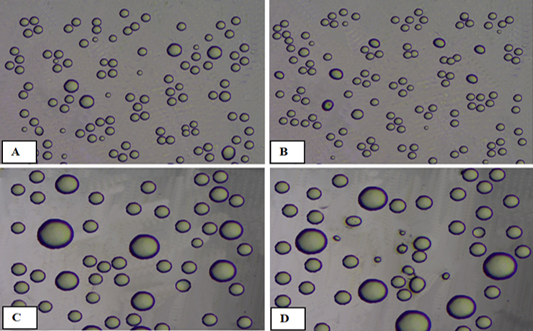
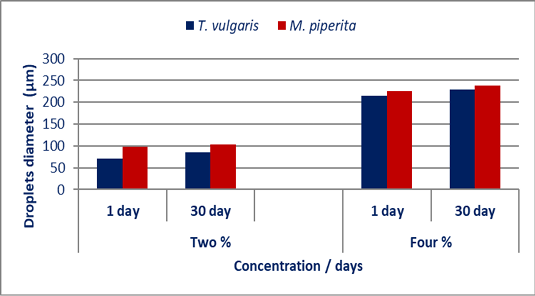
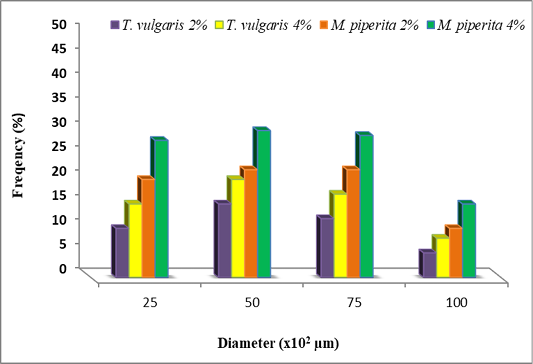
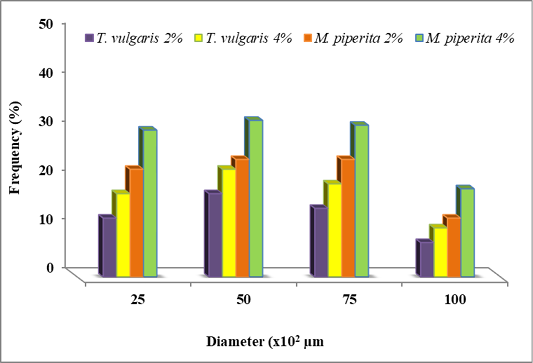
As shown in Figure 1-4, increasing the concentration of T. vulgaris and M. piperita suspensions from 2% to 4% resulted in a significant increase in average droplet diameter. After 30 days, droplet sizes further increased for both suspensions at both concentrations, indicating reduced stability. The M. piperita suspension consistently exhibited larger average droplet diameters compared to the T. vulgaris suspension.
Somatic cell count
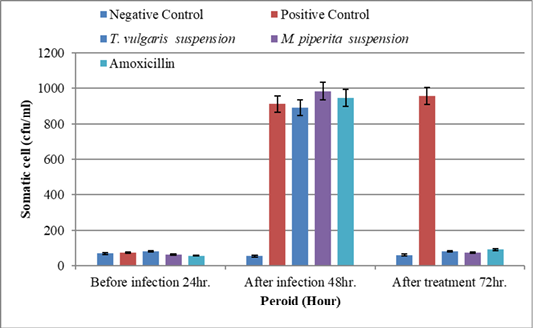
Somatic cell count (SCC) increased significantly (p ≤ 0.05) 48 h after infection compared with the pre-infection values (Figure 5). After 72 h of treatment, SCC decreased significantly (p ≤ 0.05) in the treated groups compared with the positive control. The lowest SCC was recorded in the M. piperita-treated group (63.11 ± 2.79 ×10³ cells/ml), followed by the T. vulgaris group (78.43 ± 3.08 ×10³ cells/ml) and the amoxicillin-treated group (91.13 ± 4.52 ×10³ cells/ml).
Milk yields
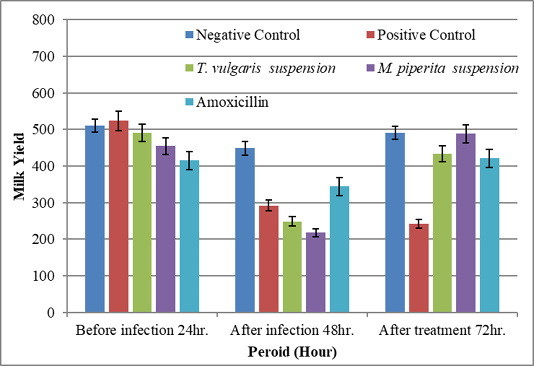
As shown in Figure 6, milk yield decreased significantly (p ≤ 0.05) 48 h after infection compared with the pre-infection values. After 72 h of treatment, milk yield increased significantly (p ≤ 0.05) in the treated groups compared with the positive control. The highest milk yield was observed in the M. piperita-treated group (453 ± 21.6 ml), followed by the T. vulgaris group (433 ± 17.3 ml) and the amoxicillin-treated group (406 ± 15.2 ml).
Milk fat percentage
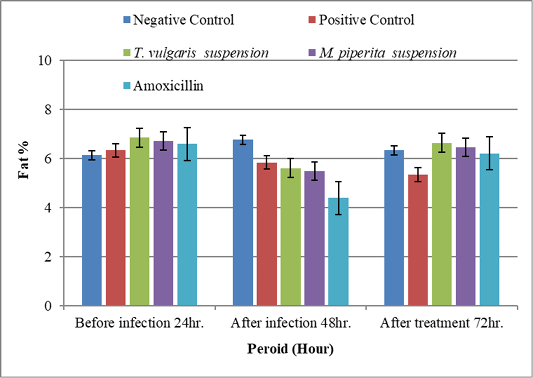
Milk fat percentage decreased significantly (p ≤ 0.05) 48 h after infection compared with the pre-infection values (Figure 7). After 72 h of treatment, milk fat percentage increased significantly (p ≤ 0.05) in the treated groups compared with the positive control. The highest milk fat percentage was recorded in the M. piperita-treated group (6.47 ± 0.79%), followed by the T. vulgaris group (6.31 ± 0.51%) and the amoxicillin-treated group (6.01 ± 0.37%).
IL-8 concentration in milk
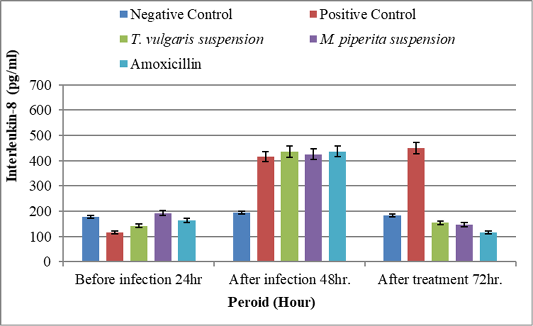
As presented in Figure 8, milk IL-8 concentration increased significantly (p ≤ 0.05) after 48 h of infection in all infected groups compared with the pre-infection values. After 72 h of treatment, IL-8 levels decreased significantly (p ≤ 0.05) in the treated groups compared with the positive control. The lowest IL-8 concentration was observed in the M. piperita-treated group (131.65 ± 4.93 pg/mL), followed by the T. vulgaris group (179.77 ± 8.77 pg/mL) and the amoxicillin-treated group (193.88 ± 8.35 pg/mL).
IL-12 concentration in milk
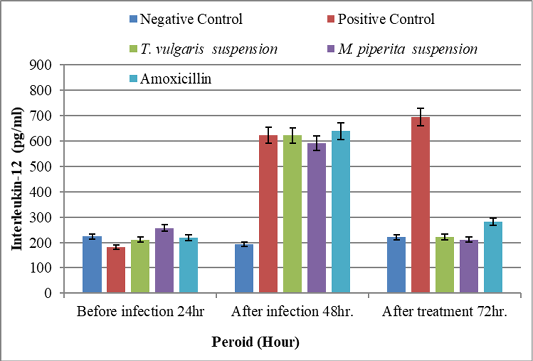
Milk IL-12 concentration increased significantly (p ≤ 0.05) after 48 h of infection in all infected groups compared with the pre-infection values (Figure 9). After 72 h of treatment, IL-12 levels decreased significantly (p ≤ 0.05) in the treated groups compared with the positive control. The lowest IL-12 concentration was recorded in the T. vulgaris-treated group (211.13 ± 9.13 pg/mL), followed by the M. piperita group (248.19 ± 10.86 pg/mL) and the amoxicillin-treated group (282.58 ± 26.05 pg/mL).
Discussion
Droplet size and stability are key determinants of film-forming suspension performance. In this study, both T. vulgaris and M. piperita suspensions showed droplet size depended on EO concentration and storage time. At 2% EO, droplet sizes were smaller than at 4%. M. piperita consistently produced larger droplets, likely due to its higher viscosity and interfacial tension. These results align with previous findings that higher EO content increases droplet size and reduces dispersion efficiency ; ; .
After 30 days of storage, all formulations exhibited increased droplet size, indicating instability from coalescence or phase separation. The effect was more pronounced in 4% EO formulations, confirming that higher oil content yields larger, less stable droplets ; .
Somatic cell count (SCC) is a primary indicator of udder health and mastitis in small ruminants. In healthy sheep milk, SCC is usually below 500,000 cells/ml but rises sharply during infection due to immune cell infiltration ; ; .
Infection caused a marked rise in SCC (892.22 ± 26.52 and 984.66 ± 29.86 after 48 h), confirming acute mastitis, consistent with previous reports of pathogen-induced leukocyte infiltration . Post-treatment SCC significantly declined in both T. vulgaris gel and M. piperita suspension groups, with the greatest reduction in M. piperita (63.11 ± 2.79), followed by T. vulgaris (67.43 ± 2.66), compared to amoxicillin (91.13 ± 4.52). These results indicate that essential oils effectively suppress inflammation and bacterial growth, enhancing udder recovery beyond antibiotic therapy .
Recent studies support these findings; Omid et al. (2023) reported that phytogenic extracts in ewes significantly reduced SCC and improved milk quality, surpassing some antibiotics. The antimicrobial and anti-inflammatory effects of thymol and carvacrol (in T. vulgaris) and menthol (in M. piperita) are well established, as they disrupt bacterial membranes, inhibit biofilms, and modulate immune responses ; .
Milk yield decreased significantly (P ≤ 0.05) 48 hours after infection, indicating the detrimental effect of mastitis on milk production. This decline can be attributed to inflammatory damage in mammary tissue, impaired alveolar secretion, and reduced glandular activity, consistent with previous findings ; .
After 72 hours of treatment, milk yield improved significantly in all groups. The M. piperita suspension group showed the highest recovery (453 ± 21.6 ml), followed by T. vulgaris suspension (433 ± 17.3 ml) and amoxicillin (406 ± 15.2 ml). The superior effect of M. piperita may be linked to menthol’s antimicrobial and anti-inflammatory properties, which promote mammary tissue repair and restore normal milk secretion ; . These findings highlight the potential of essential oil-based formulations as effective natural alternatives for improving milk yield during mastitis recovery.
Milk fat content significantly decreased (P ≤ 0.05) 48 hours after infection, likely due to impaired lipid synthesis and secretion resulting from mammary inflammation ; .
Following 72 hours of treatment, milk fat percentage increased markedly, reaching 6.47 ± 0.79% in the M. piperita group, compared with 6.31 ± 0.51% in T. vulgaris and 6.01 ± 0.37% in amoxicillin-treated ewes. The improvement may result from the antioxidant and anti-inflammatory actions of menthol and thymol, which enhance mammary gland recovery and lipid metabolism ; .
The significant elevation of milk IL-8 and IL-12 concentrations within 48 h post-infection confirms activation of the innate immune response following S. aureus challenge. Bacterial components such as lipoteichoic acid and peptidoglycan are recognized primarily by Toll-like receptor 2 (TLR2) expressed on mammary epithelial cells and macrophages, triggering MyD88-dependent signaling and activation of NF-κB, which induces transcription of pro-inflammatory cytokines (Bannerman, 2009).
IL-8 upregulation reflects enhanced neutrophil chemotaxis toward the mammary gland. As a potent chemokine, IL-8 mediates rapid recruitment of polymorphonuclear leukocytes during mastitis; however, excessive neutrophil infiltration may contribute to tissue injury via reactive oxygen species and proteolytic enzyme release ; . Therefore, the markedly elevated IL-8 concentrations observed during early infection are consistent with acute inflammatory activation.
Similarly, the sharp increase in IL-12 levels suggests activation of antigen-presenting cells and polarization toward a Th1-type immune response. IL-12 promotes IFN-γ production and enhances macrophage bactericidal activity, facilitating intracellular pathogen clearance . However, sustained IL-12 expression has been associated with exacerbated inflammatory responses and tissue damage in bovine mastitis .
Following treatment, the significant reduction in IL-8 and IL-12 concentrations in the plant extract–treated groups indicates modulation of inflammatory signaling pathways in addition to antibacterial activity. The superior immunomodulatory effect observed in the T. vulgaris group may be attributed to thymol and carvacrol, which inhibit NF-κB activation and suppress pro-inflammatory cytokine expression . These compounds have been shown to interfere with TLR-mediated signaling cascades, thereby attenuating cytokine overproduction.
M. piperita exhibited moderate immunoregulatory activity, likely mediated by menthol, which has demonstrated inhibitory effects on inflammatory mediator synthesis and oxidative stress pathways . In contrast, although amoxicillin reduces bacterial load, it does not directly suppress host inflammatory signaling, which may explain the comparatively higher residual cytokine levels. Moreover, S. aureus persistence through biofilm formation and intracellular survival mechanisms can limit antibiotic efficacy .
Collectively, these findings support a dual mechanism of action for the tested essential oils: Direct antimicrobial disruption of bacterial cell membranes combined with immunomodulatory suppression of NF-κB–dependent cytokine production. This integrated mechanism may explain the more pronounced reduction in inflammatory markers compared with antibiotic treatment alone.
Limitations
Despite the promising findings of the present study, several limitations should be acknowledged:
First, GC–MS characterization of the tested oil was not performed within this study. However, the extraction procedure, chemical profiling by GC–MS, and antimicrobial susceptibility testing were comprehensively described in our previously published study in the same journal. As the present investigation represents a direct continuation of that work and utilized the same oil preparation protocol, repetition of the chemical characterization was intentionally avoided to prevent methodological redundancy. Nevertheless, future studies may re-confirm chemical composition when using newly extracted batches to ensure consistency and reproducibility.
Second, post-treatment bacterial assessment following oil removal was not conducted. Therefore, the persistence of the antibacterial effect and the potential for bacterial regrowth after discontinuation of exposure were not evaluated. Future research should incorporate post-treatment monitoring to determine the duration and sustainability of the antimicrobial effect.
Third, histological integrity testing was not included in the current experimental design. Although the study focused primarily on evaluating antibacterial efficacy, the absence of histopathological or cytotoxicity assessment limits conclusions regarding tissue compatibility and structural safety. Further investigations involving histological analysis are recommended to confirm the safety profile and potential translational applicability of the tested oil.
Collectively, addressing these limitations in future studies will strengthen the mechanistic understanding, safety validation, and clinical relevance of the findings.
Conclusions
The essential oils demonstrated positive antimicrobial activity against pathogens responsible for subclinical mastitis in sheep. This study highlighted the antibacterial and anti-inflammatory activities of T. vulgaris and M. piperita suspensions and their potential use in treating animal infectious diseases caused by S. aureus, including drug-resistant and biofilm-forming strains. These results indicate that essential oils may serve as a promising natural alternative for controlling veterinary pathogens. The findings highlight the potential of essential oil particularly in the context of the growing problem of antibiotic resistance
Acknowledgements
The authors would like to thank members of the Department of Physiology, Biochemistry and Pharmacology, College of Veterinary Medicine, University of Baghdad, Baghdad, Iraq, Veterinary medicine, Baghdad university, Iraq for their collaboration.
Novelty Statement
This study introduces ethyl cellulose-based film-forming suspensions containing Thymus vulgaris and Mentha piperita essential oils as a novel intramammary treatment for experimental ovine mastitis. The formulations demonstrated superior therapeutic efficacy by reducing inflammation and somatic cell count while improving milk production and quality, highlighting their potential as natural alternatives to conventional antibiotic therapy
Authors’ Contribution
HMA and OMS designed the study. HMA conducted the experimental work and collected the samples. NAR performed the statistical analysis and interpretation of data. HMA wrote the manuscript. All authors read and approved the final version of the manuscript. The final manuscript draft was reviewed by all authors.
Ethical approval
This study received ethical approval in accordance with the Animal Utilization Protocol Certification (No. 924/PG), issued by the Research Ethics Committee of the College of Veterinary Medicine, University of Baghdad.
Funding
The authors received no specific funding for this work.
Generative AI and AI assisted technology statement
The authors declare that no generative AI and AI assisted technology was used in the creation of this manuscript.
Conflict of interest
The authors have declared no conflict of interest.
Figures
Figure 1:.
Droplet size distribution of T. vulgaris oil suspensions observed under a microscope (×1000). Samples at concentrations of 2% and 4% are shown at 1 day (A, B) and after 30 days (C, D), respectively.
Figure 2:.
Average droplet diameter (Dp) of oil droplets in suspension at 1 and 30 days for T. vulgaris and M. piperita oils at 2% and 4% concentrations.
Figure 3:.
Frequency-averaged droplet diameter (Dp) of T. vulgaris and M. piperita oil suspensions at 1 day
Figure 4:.
Frequency-averaged droplet diameter (Dp) of T. vulgaris and M. piperita oil suspensions at 30 days.
Figure 5:.
Somatic cell count (×10³ cells/mL) in milk of ewes infected with S. aureus and treated with T. vulgaris suspension, M. piperita suspension, and amoxicillin at different time points. Data are expressed as mean ± SEM (n = 5).
Figure 6:.
Milk yield (ml) of ewes infected with S. aureus and treated with T. vulgaris suspension, M. piperita suspension, and amoxicillin at different time points. Data are expressed as mean ± SEM (n = 5).
Figure 7:.
Milk fat percentage (%) in milk of different experimental groups at different time points. Data are expressed as mean ± SEM (n = 5).
Figure 8:.
IL-8 concentration (pg/mL) in milk of different experimental groups at different time points. Data are expressed as mean ± SEM (n = 5).
Figure 9:.
IL-12 concentration (pg/mL) in milk of different experimental groups at different time points. Data are expressed as mean ± SEM (n = 5).
References
Abd AH (2012). Immunological response of bovine mammary cell lines in mastitis and milk hygiene. Iraqi J. Vet. Med., 36(1): 1-13. https://doi.org/10.30539/iraqijvm.v36i1.515[CrossRef]
Abood AS (2010). Comparative study of milk somatic cells count (SCC) in cows, sheep and goats in summer and winter in Baghdad. Iraqi J. Vet. Med., 34(2): 126-130. https://doi.org/10.30539/iraqijvm.v34i2.641[CrossRef]
Ahmed ZA, Yousif AA (2021). Molecular and phylogenetic analysis of methicillin resistant Staphylococcus aureus isolated from subclinical mastitis in lactating ewes. Iraqi J. Vet. Sci., 35(Suppl. III): 121-126. https://doi.org/10.33899/ijvs.2021.131854.2013[CrossRef]
Albenzio M, Ciliberti MG (2018). Somatic cells and health status of the mammary gland in dairy sheep and goats. In: (Capuco MR, Dahl GE, Van Amburgh ML (Eds.), Lactation, Milk, and the Mammary Gland (pp. 513–536).
Anton N, Vandamme TF (2011). Nano-emulsions and micro-emulsions: clarifications of the critical differences. Pharma. Res., 28(5): 978-985. https://doi.org/10.1007/s11095-010-0309-1[CrossRef]
Asaad AY (2023). In vitro antimicrobial activity of essential oil derived from Callistemon viminalis aerial part. Al-Kindy Coll. Med. J., 19(1): 69-74. https://doi.org/10.47723/kcmj.v19i1.892[CrossRef]
Atalla H, Gyles C, Jacob CL, Moisan H, Malouin F, Mallard BA (2008). Characterization of immune response to Staphylococcus aureus in experimentally infected sheep. Vet. Immunol. Immunopathol., 123(2–4): 192–204.
Auldist MJ, Hubble IB (1998). Effects of mastitis on raw milk and dairy products. Austral. J. Dairy Technol., 53(1): 28.
Bannerman DD (2019). Pathogen-dependent induction of cytokines during intramammary infection. Vet. Immunol. Immunopathol., 217: 90–96.
Barreiros Y, de Meneses AC, Alves JLF, Mumbach GD, Ferreira FA, Machado RAF, de Araujo PHH (2022). Xanthan gum-based film-forming suspension containing essential oils: Production and in vitro antimicrobial activity evaluation against mastitis-causing microorganisms. Lwt, 153: 112470. https://doi.org/10.1016/j.lwt.2021.112470.[CrossRef]
Bassolé IHN, Juliani HR (2012). Essential oils in combination and their antimicrobial properties. Molecules, 17(4): 3989-4006. https://doi.org/10.3390/molecules17043989[CrossRef]
Buswell J (1995). Simple mastitis bacteriology for the practice. In Practice, 17(9): 426-432. https://doi.org/10.1136/inpract.17.9.426[CrossRef]
Caroprese M, Albenzio M, Annicchiarico G, Sevi A (2006). Changes occurring in immune responsiveness of single-and twin-bearing Comisana ewes during the transition period. J. Dairy Sci., 89(2): 562-568. https://doi.org/10.3168/jds.S0022-0302(06)72119-1[CrossRef]
Caroprese M, Catalano M, Laudadio V, Tufarelli V (2006). Interleukin-8 expression in bovine mammary epithelial cells after Staphylococcus aureus infection. Vet. Res. Commun., 30(7): 681–688.
El-Sayed A, Kamel M (2020). Climatic changes and their role in emergence and re-emergence of diseases. Environ. Sci. Pollut. Res. Int., 27(18): 22336–22352. https://doi.org/10.1007/s11356-020-08896-w[CrossRef]
Ergene O, Baloglu H, Haciogullari V, Çolakoğlu HE (2025). Prevalence of subclinical mastitis in sheep, etiological agents, and antimicrobial susceptibility in Northern Cyprus. Polish J. Vet. Sci., 28(2): 203-211. https://doi.org/10.24425/pjvs.2025.154939[CrossRef]
Fathi M, Ebrahimi M, Momeni M, Fakharian F (2022). Thymol and carvacrol suppress NF-κB signaling and cytokine expression in mastitis models. Molecules, 27(18): 6032.
Gharaibeh MH, Mahafzah TA, Abu-Qatouseh LF, Khanfar M, Abdulmawjood A (2025). Molecular characterization and antimicrobial-resistance gene profile of Staphylococcus aureus strains isolated from ovine mastitis in Jordan. Vet. World, 18(2): 270. https://doi.org/10.14202/vetworld.2025.270-279[CrossRef]
Islam MA, Takagi M, Peng DQ, Ueda S, Ito H (2020). Milk cytokine profiles during mastitis and their role as diagnostic biomarkers. J. Dairy Sci., 103(2): 1805–1815.
Jaguezeski AM, Perin G, Crecencio RB, Baldissera MD, Stefanil LM, Da Silva AS (2018). Addition of curcumin in dairy sheep diet in the control of subclinical mastitis. Acta Sci. Vet., 46: 7-7. https://doi.org/10.22456/1679-9216.86851[CrossRef]
Kerro Dego O, Pacha PA, Gillespie BE, Pighetti GM (2020). Experimental Staphylococcus aureus mastitis infection model by teat dipping in bacterial culture suspension in dairy cows. Animals, 10(5): 751. https://doi.org/10.3390/ani10050751[CrossRef]
Kumar R, Singh S, Sharma R (2019). Safety and efficacy of essential oil gels for topical delivery: A review. Curr. Drug Delivery, 16(2): 173–183.
Machado VS, Bicalho RC (2018). Prepartum application of internal teat sealant or intramammary amoxicillin on dairy heifers: Effect on udder health, survival, and performance. J. Dairy Sci., 101(2): 1388-1402. https://doi.org/10.3168/jds.2017-13415[CrossRef]
Mahmoud SH, Yassein SN (2024). The effectiveness of β-glucan in the treatment of caprine mastitis induced by Candida albicans. Iraqi J. Vet. Med., 48(2): 81-87. https://doi.org/10.30539/zkxy6e07[CrossRef]
Man A, Gordienko R, Viljoen AM (2019). The in vitro antimicrobial activity of Melaleuca alternifolia (tea tree oil) in an era of increasing antimicrobial resistance: A review. S. Afr. J. Bot., 122: 16-22.
McClements DJ (2012). Nanoemulsions versus microemulsions: terminology, differences, and similarities. Soft Matter., 8(6): 1719-1729. https://doi.org/10.1039/C2SM06903B[CrossRef]
Mohsin SI, Allawe AB (2025). Immunological evaluation of methicillin resistant Staphylococcus aureus (MRSA) of SpA vaccine from cases of mastitis in cows. Adv. Anim. Vet. Sci., 13(7): 1435-1444. https://doi.org/10.17582/journal.aavs/2025/13.7.1435.1444[Full text][CrossRef]
Naich MA, Altaf M, Iqbal N, Luqman Z, Javed Z (2025). Emergence of methicillin-resistant Staphylococcus aureus from subclinical mastitis of Cholistani sheep posing a great threat to the development of antibiotic resistance. Int. J. Agric. Innov. Cutt. Edge Res. (HEC Recognised), 3(2): 36-45.
Omid M, Sabet S, Torki M, Khadem AA (2023). Effects of phytogenic extracts on mastitis indicators and milk quality in ewes. J. Dairy Sci., 106(11): 7875-7888.
Paape MJ, Wiggans GR, Bannerman DD, Thomas DL, Sanders AH, Contreras A, Miller RH (2007). Monitoring goat and sheep milk somatic cell counts. Small Rumin. Res., 68(1-2): 114-125. https://doi.org/10.1016/j.smallrumres.2006.09.014[CrossRef]
Saleem HD, Razooqi MA, Gharban HAJ (2021). Cumulative effect of subclinical mastitis on immunological and biochemical parameters in cow milk. Arch. Razi Inst., 76(6): 1629.
Salehi B, Vazirian M, Moghaddasi M, Ghasemi A, Vazirian N, Khosroshahi NA, Sharifi-Rad J (2021). Therapeutic potential of Mentha species from various countries: A comprehensive review. J. Sci. Food Agric., 101(1): 23-33.
Salman ZO, Al-Juboori SI, Alwash BM (2024). Antioxidant and cytotoxic effects of essential oils extracted from Viola odorata L. cultivated in Iraq. Iraqi J. Agric. Sci., 55(5): 1734-1742. https://doi.org/10.36103/tx316514[CrossRef]
Shah MA, Rashid M, Zeshan B, Khan AT, Shah SA (2015). Comparison of fat percentage in milk of various dairy animals by using Gerber and Lactoscan methods. Sarhad J. Agric., 31(3): 195-201.
Shakeel F, Alam P, Anwer MK, Alanazi SA, Alsarra IA, Alqarni MH (2019). Wound healing evaluation of self-nanoemulsifying drug delivery system containing Piper cubeba essential oil. 3 Biotech, 9(3): 82. https://doi.org/10.1007/s13205-019-1630-y[CrossRef]
Silanikove N, Leitner G, Merin U, Prosser CG (2014). Recent advances in exploiting goat’s milk: Quality, safety and production aspects. Small Rumin. Res., 123(1): 5–12.
SPSS (2019). Statistical packages of social sciences-SPSS/ IBM statistics 26 step by step. 16th Edition.
Tavares VB, Naves P, de Carvalho SML, de Sá PR, Soares AMS, Furtado RA, da Cunha LCS (2022). Essential oils as natural antimicrobial agents in food preservation: A review. Food Sci. Technol., 42.
Touma MM, Jassim HS, Hyyawi SM, Nayyef HJ, Abbas AH (2021). The role of IFN-γ and TNF-α in experimental mastitis. Iraqi J. Agric. Sci., 52(1). https://doi.org/10.36103/ijas.v52i1.1242[CrossRef]
Wang J, Li J, Ji X, Zhang L, Wang R, Wang H, He T (2025). Antimicrobial resistance and molecular epidemiology of Klebsiella pneumoniae isolated from bovine mastitis in seven provinces in China. BMC Microbiol., 25(1): 407. https://doi.org/10.1186/s12866-025-04147-5[CrossRef]
Weiss J, Gaysinsky S, Davidson M, McClements J (2009). Nanostructured encapsulation systems: Food antimicrobials. In: Global issues in food science and technology. Academic Press. pp. 425-479. https://doi.org/10.1016/B978-0-12-374124-0.00024-7[CrossRef]
Zhang X, Hu Z, Zhang J, Guo J, He J, Guo X (2021). Alterations in the composition of milk and in the health status of the mammary gland of dairy goats after experimental intramammary infection with Staphylococcus aureus. Front. Vet. Sci., 8: Article 734969.
Thymus vulgaris and Mentha piperita Essential Oil Film-Forming Suspensions and Their Therapeutic Effects on Experimentally Induced Mastitis in Ewes · ResearchersLinks