Research Article · Volume 13, Issue 5, 13 April 2025 · Open Access
The Impact of Organic Substrate Fatty Acids on the Fatty Acid Composition of Hermetia Illucens Larvae: A Meta-Analysis
· · · · · · ·
Affiliations & Notes ⌄
1Graduate School of Nutrition and Feed Science, IPB University, Bogor, Indonesia
2Department of Nutrition and Feed Technology, Faculty of Animal Science, IPB University, Bogor, Indonesia
3Study Program of Animal Science, Faculty of Agriculture, Tanjungpura University, Jl. Prof. Hadari Nawawi, Pontianak, Kalimantan Barat, Indonesia. *Correspondence | Rakhmad Perkasa Harahap, Study Program of Animal Science, Faculty of Agriculture, Tanjungpura University, Jl. Prof. Hadari Nawawi, Pontianak, Kalimantan Barat, Indonesia
This underscores the larvae’s capacity to adjust their lipid profile in response to metabolic requirements, rather than depending exclusively on the fatty acid composition of their substrate.
It can be concluded that although substrate composition affects the fatty acid profile of larvae, it does not directly effect the concentrations of specific fatty acids, including C10:0, C12:0, C14:0, and C14:1, in the larvae.
This indicates that the larvae have inherent metabolic mechanisms that govern fatty acid production and storage, irrespective of the fatty acid composition of the substrate.
In any case, substrate composition can substantially increase the concentrations of C16:0, C16:1, C18:0, C18:1, and polyunsaturated fatty acids (PUFAs) in the larvae, especially when the substrates are abundant in these fatty acids.
Selected from the article's own text.
Abstract
This study aimed to exploring the dynamic changes fatty acid composition of organic waste through Hermetia illucens larvae using a meta-analysis method. A database was created using studies that have documented different compositions of fatty acid profile substrates in Hermetia illucens. Data tabulation only involved credible international journals as indicated by Scopus indexed. A total of 11 articles were integrated into the database. The statistical analysis used the mixed model methodology. Random effects were considered in the studies, and the fatty acid substrate dose was treated as a fixed effect. The results showed that the increase C16:0, C18:0, C16:1, C18:1, C18:2, omega-3, omega-6, omega-3: omega-6 SFA, MUFA, and PUFA in substrate increased C16:0, C18:0, C16:1, C18:1, C18:2, omega-3, omega-6, omega-3:omega-6, SFA, MUFA and PUFA content on Hermetia illucens larvae (P<0.05). This study concludes that there are several fatty acids of Hermetia illucens larvae influenced by fatty acids in the substrate.
Black Soldier Fly Larvae (BSFL), or Hermetia illucens, have substantial weight increase during their developmental phases, particularly during the larval phase. Beginning at around 200-300 mg in the first week , the quantity taken could rise to 500-600 mg by the second week and 1-1.5 grams by the third week . The maximum weight, around 2 grams or greater, is generally reached by the end of of the fourth week prior to the prepupal stage. The nutritional profile of BSFL is important, with elevated protein levels (40-44%) and fat content (30-35%), which fluctuate according to their age and diet ; . The quick growth and substantial nutritional value of BSFL make it a valuable resource for animal feed, especially in poultry and aquaculture, in addition to its use in waste management applications ; .
Organic waste is a significant environmental problem in various sectors, including the agricultural, livestock and food industries. Organic waste contains various types of organic compounds, including fatty acids, which can have a negative impact on the environment if not managed properly. Hermetia illucens larvae are bioconversion commonly used to accelerate composting organic matter. Hermetia illucens larvae can efficiently utilize organic resources, such as fruit, vegetable, food waste, and manure . Hermetia illucens larvae can reduce organic waste by as much as 84.5% under managed environments, including temperatures hitting 34°C and a pH of 8, with a larval density of 200 larvae per reactor . In another research, BSFL reported a 64.3% efficiency in organic waste degradation, followed by a notable rise in larval biomass, showing effective waste conversion .
The fatty acid component of Hermetia illucens larvae is influenced by the substrate and larval weight . The fatty acid synthase (FAS) is responsible for producing essential saturated fatty acids, including lauric acid, which is comparable to coconut oil in content. This synthesis is crucial for cellular processes and is influenced by genetic factors . The moisture content of the substrate is a critical factor affecting larval growth and survival, which in turn influences lipid accumulation. Optimal moisture levels enhance larval performance, thereby potentially affecting the fatty acid profile .
Research has shown that Black Soldier Fly Larvae (BSFL) can assimilate and modify dietary fatty acids, leading to variations in their own fatty acid content. BSFL are capable of converting organic waste into nutrient-rich biomass, which includes the assimilation and modification of dietary fatty acids ; . Quantitative fatty acid signature analysis (QFASA) faces challenges in accurately determining diet composition due to variations in fatty acid assimilation and metabolism, which can affect the calibration coefficients used in these analyses . Modification of fatty acids can be done by knowing which fatty acids are sensitive to changes in fatty acids in the substrate. Lauric fatty acid (C12:0) as the highest medium chain fatty acid (MCFA) in the larvae had varied in several studies, about 43.0-60.5% and 17.0-44.0% . The variation also was shown in the omega 3 fatty acids in Hermetia illucens larvae is about 2.3% with food residue as a substrate . However, the enrichment of omega-3 fatty acids in the substrate can increase the amount omega-3 fatty acids in the larvae. The enrichment of omega 3 fatty acids increases it to 11.8% with 50% substrate of Schizochytrium micro algae industrial waste .
The novelty of this research lies in its use of a meta-analysis approach to synthesize data from multiple studies and explore the overall trends and variations in fatty acid composition across a wider range of organic waste substrates. This comprehensive analysis will provide valuable insights into the factors influencing fatty acid modification in BSFL and contribute to optimizing their use in various applications, including animal feed and biodiesel production. According to the variation results in several studies, the study aimed to exploring the dynamic changes fatty acid composition of organic waste through Hermetia illucens larvae using a meta-analysis method.
MATERIALS AND METHODS
Data Development and Inclusion Criteria
A database was developed based on scientific publications available online at the Scopus database, accessed through the institutional IPB University network (https://www.scopus.com/search/, accessed on 27 February 2023). The articles used in the database had several criteria, including that the articles must be published in English, the studies must involve treatment of Hermetia illucens larvae with measured fatty acid content in organic subtrate and Hermetia illucens larvae, and the experiments must be conducted in vivo on Hermetia illucens larvae. All relevant titles of publication from the respective websites were further imported into the reference manager for selection purposes. Using the Preferred Reporting Items for Systematic Reviews and Meta-Analysis (PRISMA) protocol , a database was created.
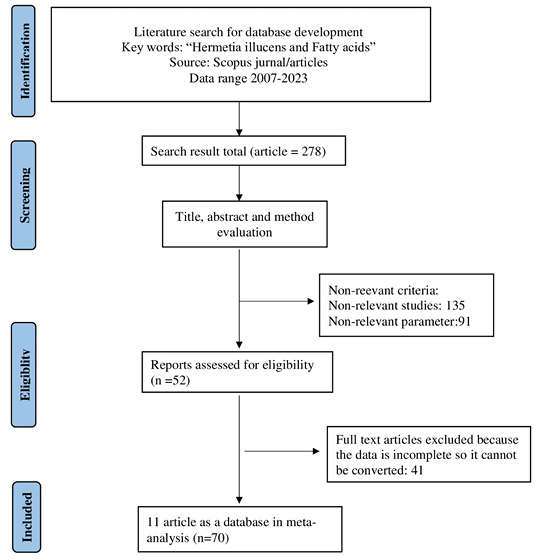
A total of 278 articles were initially identified through the keyword search. The process of literature search and selection is illustrated in Figure 1. These articles were then assessed based on their abstracts and full texts, resulting in the inclusion of 70 studies (comparisons) in this study, as listed in Table 1. If an article reported on multiple experiments, each experiment was coded separately.
The database encompassed the fatty acid composition of Hermetia illucens, including C10:0,C12:0, C14:0, C14:1, C16:0, C16:1, C18:0, C18:1, C18:2, total omega-6, total omega-3, omega-3:6, saturated fatty acids (SFA), monounsaturated fatty acid (MUFA), polyunsaturated fatty acid (PUFA). The fatty acid proportions used in this research were based on dry matter (DM) g/kg substrate. To facilitate further data analysis, the data for the same parameters were converted into the same units of measurement before being tabulated into the database. Table 2 presents the descriptive statistics of the compiled database.
Modelling and Analysis of Data
The database was statistically analyzed using a mixed model methodology where the model has been widely used in meta-analyses related to animal nutrition . The different studies considered a random effect, and the fatty acid level was treated as a fixed effect. The following statistical models were used:
Yij=B0+BXij+B2Xij2+si+biXij+eij
Where;
Yj = dependent variable.
B0 = overall intercept across all studies (fixed effect).
B1 = linear regression coefficient Y on X (fixed effect).
B2 = Y squared regression coefficient on X (fixed effect).
Xij = predictor value of continuous variable (nutrition level).
si = random effect of study i.
bi = random effect of study i on the regression coefficient Y on X in study i.
eij = unexplained residual error.
When the respective quadratic regression models were not significant at P<0.05, an appropriate mixed linear regression model was applied. Research variables are stated in class statements because they do not contain quantitative information . The statistical model used is p-values. The significance of an effect is stated when the P-value < 0.05 and tends when the P-value between 0.1 and 0.05. All statistical analyzes were performed using SAS software, version (9.4).
Table 1: Studies included in the meta-analysis.
No
Reference
Country
Year
Substrate
Fase
1
Oonincx et al., 2015
Netherlands
2015
High protein high fat, high protein low fat, low protein high fat, low protein low fat
Table 3 indicated that the levels of C10:0, C12:0, C14:0, and C14:1 (DM g/kg) in the substrate (independent variable) did not influence the fatty acid profile content of Hermetia illucens (dependent variable) for the same fatty acids (P>0.05). This fits with the results reported of Spranghers et al. (2017), indicating that although substrate composition affects the fatty acid profile, it is not the exclusive factor. This suggests that Hermetia illucens larvae may have intrinsic metabolic processes that regulate the production and storage of fatty acids, irrespective of the fatty acid level in the substrate. The research conducted by Boukid et al. (2021) support this perspective, demonstrating that the fatty acid profiles of Hermetia illucens remain stable across diverse meals, suggesting a degree of metabolic independence from the substrate’s composition. This metabolic independence may elucidate why fluctuations in the concentrations of C10:0, C12:0, C14:0, and C14:1 in the substrate do not lead to comparable modifications in the fatty acid profile of the larvae.
Table 2: Descriptive statistics of the database used in the meta-analysis.
Li et al. (2021) performed a comprehensive analysis of the lipid profile in Hermetia illucens larvae, identifying 19 enriched metabolic pathways, of which nine are directly related to lipid metabolism, including pathways involved in glycerolipid (GL) and glycerophospholipid (GP) metabolism. These pathways are essential for regulating triglycerides (TG) and phospholipids, which are fundamental components of the larvae’s lipid composition. The findings indicate that the metabolic pathways involved in lipid synthesis and storage are significantly active during the growth and development of Hermetia illucens. This underscores the larvae’s capacity to adjust their lipid profile in response to metabolic requirements, rather than depending exclusively on the fatty acid composition of their substrate. The study indicated that these fatty acids may be partially synthesized from carbohydrates, with concentrations potentially increasing after the decomposition of organic substrates ; ; ; ; ; ; .
The meta-analysis revealed that the levels of C16:0, C16:1, C18:0, C18:1, C18:2, total omega-6, total omega-3, omega-3:6 ratio, saturated fatty acids (SFA), monounsaturated fatty acids (MUFA), and polyunsaturated fatty acids (PUFA) in the substrate significantly increased the fatty acid profile content of Hermetia illucens (P<0.05). These findings suggest that Hermetia illucens possesses the capacity to accumulate both C16:0 and C18:0 fatty acids, with a notably higher ability to synthesize C16:0 compared to C18:0.
The conversion of C16:0 to C16:1 is facilitated by the presence of isomerases, specifically the 9-desaturase, which catalyzes this isomerization process. The variation in C16:1 levels observed in Hermetia illucens larvae is likely due to several factors, including the C16:1 content in the substrate, the non-fiber carbohydrate (NFC) content in the substrate, and the presence of key enzymes involved in fatty acid synthesis, such as thioesterase II, -9-desaturase, 12 fat2 desaturase, and 6 fat3 desaturase . These enzymatic processes collectively contribute to the modulation of the larvae’s fatty acid profile. In addition, Boukid et al. (2021) demonstrated that the fatty acid profiles of Hermetia illucens larvae are significantly influenced by their dietary composition, particularly the abundance of C16:0 and C18:2.
Carbohydrates, fats, and proteins undergo glycolysis, producing pyruvic acid, which is subsequently converted into acetyl-CoA. Acetyl-CoA serves as the precursor for fatty acid synthesis in Hermetia illucens . This metabolic pathway enables the larvae to accumulate and synthesize C18:1 fatty acids, which are essential for regulating membrane integrity. C18:1 fatty acids, particularly oleic acid, play a vital role in maintaining optimal membrane function, especially for critical membrane proteins like ATPases, which require oleic acid for optimal function .
Table 3: Regression equations of the content level fatty acid profile substrate (independent variable) on content fatty acid profile Hermatia illucens larvae (response variable) from the mixed model analysis.
The enzymes present in Hermetia illucens, such as 9-desaturase, 9 and 12 fat2 desaturase, and 6 fat3 desaturase (Δ12, 9 and 12 isomerases), facilitate the conversion of C18:0 to C18:1 cis-9 and subsequently to C18:2n6 and C18:3n3 . These findings highlight the significant influence of the substrate’s C18:0 content on the larvae’s C18:0 and C18:1 levels. This relationship mirrors observations in feed formulation studies, where the omega-3 content in the larvae correlates with the omega-3 content of the feed ingredients ; ; ; ; .
Furthermore, the study by Schiavone et al. (2017) demonstrated that when Hermetia illucens larvae were fed substrates rich in polyunsaturated fatty acids (PUFAs), particularly linoleic acid (C18:2 n-6), there was a corresponding increase in the PUFA content of the larvae. This direct relationship between substrate composition and the fatty acid profile of the larvae underscores the larvae’s ability to effectively utilize dietary fatty acids to enhance their own lipid profiles. Additionally, the findings of Anankware et al. (2021) emphasized the importance of the omega-3 to omega-6 ratio in the dietary fatty acid profile of Hermetia illucens, suggesting that a balanced intake of these fatty acids could improve the health outcomes of animals consuming these larvae. This further highlights the significance of substrate composition, not only in enhancing the fatty acid profile of Hermetia illucens but also in promoting better nutritional outcomes for the animals that consume them.
Moreover, Hermetia illucens larvae are unable to synthesize polyunsaturated fatty acids (PUFAs) de novo, suggesting that PUFA levels in the larvae are strongly determined by the PUFA content of the substrate ; ; . The positive correlations observed between substrate and larvae fatty acid profiles indicate that higher fatty acid concentrations in the substrate are mirrored by higher fatty acid levels in the larvae. However, it is important to consider that factors such as oxidation, microbial activity (both external and gut microbiota), digestive enzymes, and the age of the larvae can also influence fatty acid absorption and metabolism, potentially modifying the overall fatty acid profile in the larvae.
CONCLUSIONS AND RECOMMENDATIONS
It can be concluded that although substrate composition affects the fatty acid profile of larvae, it does not directly effect the concentrations of specific fatty acids, including C10:0, C12:0, C14:0, and C14:1, in the larvae. This indicates that the larvae have inherent metabolic mechanisms that govern fatty acid production and storage, irrespective of the fatty acid composition of the substrate. In any case, substrate composition can substantially increase the concentrations of C16:0, C16:1, C18:0, C18:1, and polyunsaturated fatty acids (PUFAs) in the larvae, especially when the substrates are abundant in these fatty acids.
ACKNOWLEDGEMENTS
I would like to express my sincere gratitude to IPB University for providing the research facilities and support. I also wish to thank my research colleagues for their valuable collaboration and contributions throughout this study.
NOVELTY STATEMENTS
This research is novel due to its application of a meta-analysis method to integrate data from several studies and examine the general trends and variations in fatty acid content over a broader spectrum of organic waste substrates. This extensive research will yield significant insights into the determinants affecting fatty acid alteration in BSFL and contribute in maximizing their application in diverse fields, such as animal feed.
AUTHOR’S CONTRIBUTIONS
Mochamad Dzaky Alifian as the main author. Nahrowi, Anuraga Jayanegara and Sumiati as mentors. Eko Lela Fitriana, Irwan Susanto, and Rakhmad Perkasa Harahap as the authors of the method and database selection, Qorry Nurul Hasanah as the journal format adjustment.
Conflict of Interest
We confirm that there are no conflicts of interest related to the discussed material, including financial, personal, or other relationships with individuals or organizations.
Figures
Figure 1:.
A PRISMA flow diagram of the literature search strategy and selection for meta-analysis.
References
Abd El-Hack ME, Shafi ME, Alghamdi WY (2020). Black soldier fly (Hermetia illucens) meal as a promising feed ingredient for poultry: A comprehensive review. Agriculture, 10(8): 339. https://doi.org/10.3390/agriculture10080339[CrossRef]
Anankware JP, Roberts BJ, Cheseto X (2021). The nutritional profiles of five important edible insect species from West Africa—An analytical and literature synthesis. Front. Nutr., 8: 792941. https://doi.org/10.3389/fnut.2021.792941[CrossRef]
Barroso FG, Sánchez-Muros MJ, Rincón MÁ (2019). Production of n-3-rich insects by bioaccumulation of fishery waste. J. Food Compos. Anal., 82: 103237. https://doi.org/10.1016/j.jfca.2019.103237[CrossRef]
Boukid F, Riudavets J, Del Arco L, Castellari M (2021). Impact of diets including agro-industrial by-products on the fatty acid and sterol profiles of larvae biomass from Ephestia kuehniella, Tenebrio molitor and Hermetia illucens. Insects, 12(8): 672. https://doi.org/10.3390/insects12080672[CrossRef]
Čičková H, Newton GL, Lacy RC, Kozánek M (2015). The use of fly larvae for organic waste treatment. Waste Manage., 35: 68–80. https://doi.org/10.1016/j.wasman.2014.09.026[CrossRef]
Danieli PP, Lussiana C, Gasco L (2019). The effects of diet formulation on the yield, proximate composition, and fatty acid profile of the black soldier fly (Hermetia illucens L.) prepupae intended for animal feed. Animals, 9(4): 178. https://doi.org/10.3390/ani9040178[CrossRef]
Downer RGH, Matthews JR (1976). Patterns of lipid distribution and utilisation in insects. Am. Zool., 16(4): 733–745. https://doi.org/10.1093/icb/16.4.733[CrossRef]
El-Dakar MA, Ramzy RR, Ji H, Plath M (2020). Bioaccumulation of residual omega-3 fatty acids from industrial Schizochytrium microalgal waste using black soldier fly (Hermetia illucens) larvae. J. Clean Prod., 268: 122288. https://doi.org/10.1016/j.jclepro.2020.122288[CrossRef]
El-Kaiaty AM, Dawa DT, El-Sayed TR (2022). The impact of black soldier fly (Hermetia illucens) as feed supplementation on productive and physiological performance of broiler chickens. World’s Vet. J., 133–140. https://doi.org/10.54203/scil.2022.wvj17[CrossRef]
Ewald N, Vidakovic A, Langeland M (2020). Fatty acid composition of black soldier fly larvae (Hermetia illucens)–Possibilities and limitations for modification through diet. Waste Manag., 102: 40–47. https://doi.org/10.1016/j.wasman.2019.10.014[CrossRef]
Finke MD (2013). Complete nutrient content of four species of feeder insects. Zoo. Biol., 32(1): 27–36. https://doi.org/10.1002/zoo.21012[CrossRef]
Fitriana EL, Jayanegara A, Astuti DA, Laconi EB (2022a). Growth performance and nutrient composition of black soldier fly larvae reared on solid-state fermentation substrates with various white rot fungi. Biodiversitas J. Biol. Divers., 23(9). https://doi.org/10.13057/biodiv/d230959[CrossRef]
Fitriana EL, Laconi EB, Astuti DA, Jayanegara A (2022b). Effects of various organic substrates on growth performance and nutrient composition of black soldier fly larvae: A meta-analysis. Bioresour. Technol. Reports, 18: 101061. https://doi.org/10.1016/j.biteb.2022.101061[CrossRef]
Frooninckx L, Broeckx L, Goossens S (2024). Optimizing substrate moisture content for enhanced larval survival and growth performance in Hermetia illucens: exploring novel approaches. Discovery Anim., 1: 7. https://doi.org/10.21203/rs.3.rs-3986375/v1[CrossRef]
Gao Z, Wang W, Lu X (2019). Bioconversion performance and life table of black soldier fly (Hermetia illucens) on fermented maize straw. J. Clean Prod. 230: 974–980. https://doi.org/10.1016/j.jclepro.2019.05.074[CrossRef]
Giannetto A, Oliva S, Lanes CFC (2020). Hermetia illucens (Diptera: Stratiomydae) larvae and prepupae: Biomass production, fatty acid profile and expression of key genes involved in lipid metabolism. J. Biotechnol., 307: 44–54. https://doi.org/10.1016/j.jbiotec.2019.10.015[CrossRef]
Hoc B, Francis F, Carpentier J (2021). ω3-enrichment of Hermetia illucens (L. 1758) prepupae from oilseed byproducts. J. Saudi Soc. Agric. Sci., 20(3): 155–163
Huaripata J, Carrasco A, Farfán Chilicaus GC (2023). Culture of black soldier fly larvae (Hermetia illucens) as a strategy for use of organic waste, Cajamarca. Laccei, 1:. https://doi.org/10.18687/laccei2023.1.1.163[CrossRef]
Jiang Y, Xue W, Peng Z (2024). Functional characterization of fatty acid synthase in Hermetia illucens. bioRxiv 2003–2024. https://doi.org/10.1101/2024.03.22.586266[CrossRef]
Kinasih I, Putra RE, Permana AD (2018). Growth performance of black soldier fly larvae (Hermetia illucens) fed on some plant based organic wastes. HAYATI J. Biosci., 25(2): 79. https://doi.org/10.4308/hjb.25.2.79[CrossRef]
Li M, Wang G, Shang R (2021). Comparative lipid profile analysis of Hermetia illucens larvae fed food waste at different days of age using an LC-MS-based lipidomics approach. J. Insect Sci. 21(5): 17. https://doi.org/10.1093/jisesa/ieab081[CrossRef]
Li Q, Zheng L, Qiu N (2011). Bioconversion of dairy manure by black soldier fly (Diptera: Stratiomyidae) for biodiesel and sugar production. Waste Manag., 31(6): 1316–1320. https://doi.org/10.1016/j.wasman.2011.01.005[CrossRef]
Li X, Dong Y, Sun Q (2022). Growth and fatty acid composition of black soldier fly Hermetia illucens (Diptera: Stratiomyidae) larvae are influenced by dietary fat sources and levels. Animals, 12(4): 486. https://doi.org/10.3390/ani12040486[CrossRef]
Liberati A, Altman DG, Tetzlaff J (2009). The PRISMA statement for reporting systematic reviews and meta-analyses of studies that evaluate health care interventions: explanation and elaboration. Ann. Intern. Med., 151: W-65.
Liland NS, Biancarosa I, Araujo P (2017). Modulation of nutrient composition of black soldier fly (Hermetia illucens) larvae by feeding seaweed-enriched media. PLoS One, 12(8): e0183188. https://doi.org/10.1371/journal.pone.0183188[CrossRef]
Marco A, Ramzy RR, Ji H (2021). Influence of substrate inclusion of quail manure on the growth performance, body composition, fatty acid and amino acid profiles of black soldier fly larvae (Hermetia illucens). Sci. Total. Environ., 772: 145528. https://doi.org/10.1016/j.scitotenv.2021.145528[CrossRef]
Meneguz M, Schiavone A, Gai F (2018). Effect of rearing substrate on growth performance, waste reduction efficiency and chemical composition of black soldier fly (Hermetia illucens) larvae. J. Sci. Food Agric., 98(15): 5776–5784. https://doi.org/10.1002/jsfa.9127[CrossRef]
Moula N, Scippo M-L, Douny C (2018). Performances of local poultry breed fed black soldier fly larvae reared on horse manure. Anim. Nutr., 4(1): 73–78. https://doi.org/10.1016/j.aninu.2017.10.002[CrossRef]
Oonincx DGAB, Van Broekhoven S, Van Huis A, Van Loon JJA (2015). Feed conversion, survival and development, and composition of four insect species on diets composed of food by-products. PLoS One, 10(12): e0144601. https://doi.org/10.1371/journal.pone.0144601[CrossRef]
Putri DA, Chadirin Y, Yuwono AS (2024). Food Waste Management Utilizing Black Soldier Fly Larvae. EMSI, 2: 26–35.
Rabani V, Cheatsazan H, Davani S (2019). Proteomics and lipidomics of black soldier fly (Diptera: Stratiomyidae) and blow fly (Diptera: Calliphoridae) larvae. J. Insect Sci., 19(3): 29. https://doi.org/10.1093/jisesa/iez050[CrossRef]
Sauvant D, Schmidely P, Daudin J-J, St-Pierre NR (2008). Meta-analyses of experimental data in animal nutrition. Animal, 2(8): 1203–1214. https://doi.org/10.1017/S1751731108002280[CrossRef]
Schiavone A, Cullere M, De Marco M (2017). Partial or total replacement of soybean oil by black soldier fly larvae (Hermetia illucens L.) fat in broiler diets: effect on growth performances, feed-choice, blood traits, carcass characteristics and meat quality. Ital. J. Anim. Sci., 16(1): 93–100. https://doi.org/10.1080/1828051x.2016.1249968[CrossRef]
Spranghers T, Ottoboni M, Klootwijk C (2017). Nutritional composition of black soldier fly (Hermetia illucens) prepupae reared on different organic waste substrates. J. Sci. Food Agric. 97(8): 2594–2600. https://doi.org/10.1002/jsfa.8081[CrossRef]
St-Pierre NR (2001). Invited review: Integrating quantitative findings from multiple studies using mixed model methodology. J. Dairy Sci., 84(4): 741–755. https://doi.org/10.3168/jds.S0022-0302(01)74530-4[CrossRef]
Starling AP, East JM, Lee AG (1993). Effects of phosphatidylcholine fatty acyl chain length on calcium binding and other functions of the calcium-magnesium-ATPase. Biochemistry, 32(6): 1593–1600. https://doi.org/10.1021/bi00057a025[CrossRef]
Ushakova NA, Brodskii ES, Kovalenko AA (2016). Characteristics of lipid fractions of larvae of the black soldier fly Hermetia illucens. In: Doklady biochemistry and biophysics. Springer, 468(1): 209–212
Uswatun KA, Asiyanthi TL, Ibrahim D (2024). Potential of Black Soldier Fly Larvae in Reduction Various Types Organic Waste. Ecol. Eng. Environ. Technol., 25:. https://doi.org/10.12912/27197050/190639[CrossRef]
Xiao X, Jin P, Zheng L (2018). Effects of black soldier fly (Hermetia illucens) larvae meal protein as a fishmeal replacement on the growth and immune index of yellow catfish (Pelteobagrus fulvidraco). Aquac. Res., 49(4): 1569–1577. https://doi.org/doi.org/10.1111/are.13611[CrossRef]
Zulkifli S, Jayanegara A, Pramudya B (2023). Alleviation of Selected Environmental Waste through Biodegradation by Black Soldier Fly (Hermetia illucens) Larvae: A Meta-Analysis. Recycling, 8(6): 83. https://doi.org/10.3390/recycling8060083[CrossRef]