Research Article · Volume 14, Issue 11, 19 October 2026 · Open Access
The Effect of Integrated Controlled Exercise and Heat Load on Thermal Homeostasis and Metabolic Profile in Jawarandu Goats
· · · ·
Affiliations & Notes ⌄
1Animal Physiology and Biochemistry Laboratory, Department of Animal Nutrition and Feed Technology, Faculty of Animal Husbandry, University of Padjadjaran, Jatinangor Campus, Jl. Ir. Soekarno KM.21, Jatinangor-Sumedang 45363, Indonesia
2Department of Animal Bioscience, Faculty of Food Security, Surabaya State University. Campus 3, Jl. Prof. Dr. Moestopo No. 4, Pacar Keling, Tambaksari District, Surabaya, East Java 60131, Indonesia
3Department of biochemistry, microbiology and biotechnology, School of Pure and Applied Sciences, Kenyatta University, Kenya. *Correspondence | Ronnie Permana, Animal Physiology and Biochemistry Laboratory, Department of Animal Nutrition and Feed Technology, Faculty of Animal Husbandry, University of Padjadjaran, Jatinangor Campus, Jl. Ir. Soekarno KM.21, Jatinangor-Sumedang 45363, Indonesia
4Email: permana@unpad.ac.id
5Magister Program in Educational Technology, University of Muhammadiyah, Jakarta, Indonesia
High THI combined with exercise boosts the thermoregulatory response and affects goat metabolic adaptation by elevating energy mobilisation to maintain homeostasis.
The Environmental Resilience Index (ERI) integrates various physiological and metabolic indicators into a single comprehensive measure that differentiates goat resilience to heat stress and physical activity.
This approach could be a valuable tool for evaluating physiological resilience in goat production systems in tropical areas.
Incorporating 2 hours of exercise at a THI of 72-77 appears feasible and advantageous for animal welfare.
Selected from the article's own text.
Abstract
This study investigated how the Temperature–Humidity Index (THI) combined with controlled exercise influences thermoregulatory responses, metabolic changes, and resilience in Jawarandu goats under tropical conditions. A 2 × 3 factorial design was employed, with two THI levels (72–77 and 78–83) and three exercise durations (0, 2, and 4 hours). Measured thermoregulatory parameters included rectal temperature, respiratory rate, heart rate, and body surface temperature, while metabolic parameters encompassed glucose, NEFA, β-HBA, triglycerides, cholesterol, total protein, albumin, urea, creatinine, and lactate. We analysed data using a two-way ANOVA with Tukey’s test at a 5% significance level. We integrated all parameters into an Environmental Resilience Index (ERI) via data normalisation, and depicted adaptation patterns using radar plots. The interaction between THI and exercise significantly influenced (P<0.01) most thermoregulatory and metabolic variables. High THI combined with 4 hours of exercise increased respiratory rate, heart rate, body surface temperature, glucose, NEFA, urea, and lactate, while decreasing triglycerides, cholesterol, total protein, and albumin, reflecting enhanced energy mobilisation due to heat stress and activity. Radar plots showed narrower adaptation profiles with higher THI and longer exercise durations. The highest ERI scores appeared in goats maintained at THI 72–77 without exercise or with 2 hours of exercise, whereas the lowest scores appeared under THI 78–83 with 4 hours of exercise. These findings suggest that heat load intensifies exercise’s metabolic effects and confirm that the ERI is a valuable combined indicator for assessing goats’ resilience to heat stress and physical activity in tropical environments.
Global climate change has increased the frequency, duration, and intensity of heat stress, significantly affecting livestock productivity, health, and welfare, particularly in tropical regions. In goats, higher ambient temperatures and humidity raise the Temperature–Humidity Index (THI), increasing the heat load that must be dissipated to maintain homeostasis. When the THI exceeds the thermoneutral range, heat-loss mechanisms become less effective, triggering compensatory responses such as increased respiration and heart rate, elevated body temperature, and shifts in energy metabolism. These responses aim to maintain physiological functions, but if prolonged, they can reduce production efficiency, worsen health, and diminish livestock’s ability to adapt to tropical environments ; .
The Jawarandu goat is an indigenous Indonesian breed, commonly found on Java Island, especially in West Java. It is valued for its ability to thrive in tropical climates, efficiently utilise local forage, and its economic importance as a meat and, in some areas, milk source. Smallholder farmers manage most Jawarandu goats through a semi-intensive system that combines penned housing with grazing. During grazing, these goats face daily variations in temperature, humidity, and sunlight, leading to environmental heat stress and increased heat from physical activity ; . Despite their noted adaptability to tropical conditions, the physiological and metabolic processes enabling this resilience, especially under the combined stress of heat and grazing, remain insufficiently understood ; ; .
In addition to environmental factors, physical activity during grazing increases metabolic heat production because of higher muscle energy demands. Exercise stimulates the mobilisation of glucose, free fatty acids (non-esterified fatty acids; NEFA), and other energy substrates to sustain muscle activity and metabolic balance ; . Under high THI conditions, increased heat production from physical activity can amplify the thermal load on livestock, triggering physiological responses that reflect the interaction between external heat stress and elevated internal metabolism ; . This interaction affects not only physiological parameters but also energy metabolite profiles, hormonal balance, stress biomarkers, and the efficiency of environmental adaptation. Therefore, evaluating the combination of THI and grazing activity is crucial for understanding the biological adaptation mechanisms of local goats in tropical production systems ; .
Most previous studies have evaluated heat stress or exercise separately, using one or more physiological or metabolic indicators. While this approach has provided valuable information, it has not fully captured the animal’s adaptive capacity, as responses to environmental stress involve complex interactions among physiological systems ; , energy metabolism ; , and stress mechanisms ; . In tropical grazing systems, these two factors coexist; relying on a single biomarker is often insufficient to represent livestock biological condition fully. To date, studies that integrate Jawarandu goats’ physiological and metabolic responses into a composite index describing adaptive capacity to the combined effects of THI and grazing activity remain scarce ; .
Composite index-based approaches are increasingly used in physiology and livestock production because they integrate multiple biological indicators into a single, easily interpretable value. Building on this concept, the study developed the Environmental Resilience Index (ERI). This integrative indicator combines physiological and metabolic response parameters to assess the adaptive resilience of Jawa goats to the combined effects of environmental heat load and grazing activity. In addition to statistical analysis using Two-way ANOVA, the study utilised radar plot visualisation to illustrate multidimensional patterns of change across treatments, enabling more comprehensive observation of relationships among parameters.
This study aims to evaluate how the interaction between the Temperature–Humidity Index (THI) and grazing duration affects the physiological and metabolic responses of Jawarandu goats, and to develop the Environmental Resilience Index (ERI) as a quantitative indicator of adaptive resilience in tropical environments.
MATERIALS AND METHODS
Animal and experimental design
One hundred and eighty male Jawarandu goats, aged 15-17 months, were used in this study. The study lasted three months. The experimental goats were divided into six treatment groups, with three replicates of 10 goats each. Goats were randomly assigned to treatment groups. Treatments comprised factors A1 (THI = 72-77), A2 (78-83), and B1 (no grazing), B2 (2 hours of grazing), and B3 (4 hours of grazing). Each experimental unit used a goat pen measuring 8 x 3 metres. The grazing area measured 50 x 30 metres.
The study monitored the environmental microclimate within the cages. Throughout the period, the average temperature ranged from 23 to 30°C, and humidity from 55 to 90%. We calculated the Temperature-Humidity Index (THI) using the formula provided by Mushawwir and Hernawan (2025), as shown below.
Where Tdb = dry-bulb temperature; RH= relative humidity obtained based on the difference between dry (Tdb) and wet bulb temperatures (Twb)
Blood sampling and recording
Blood samples were collected from each animal once a month for three months using standard procedures and a sampling kit that complied with health and safety protocols. We immediately tested the collected blood to determine haematological parameters, and prepared some formarker analysis in accordance with predetermined protocols.
We recorded physiological responses weekly for three months. For animals receiving grazing, measurements were taken immediately before the end of the grazing period.
Sample Analysis
A Mindray BC-6200/BC-5150 haematology analyser was employed to evaluate haematological parameters in accordance with standard protocols. Metabolic markers were quantified using a spectrophotometric method with the Biolabo KIT , while muscle markers were measured via ELISA following the MYBiosource KIT protocol .
Data Analysis
All data were analysed using IBM SPSS Statistics version 27.0 (IBM Corp., Armonk, NY, USA). The effects of the Temperature–Humidity Index (THI) levels (72–77 and 78–83), exercise durations (0, 2, and 4 hours), and their interaction on various parameters were evaluated using a two-way ANOVA in a 2 × 3 factorial design. Before analysis, we tested data for normality using the Shapiro–Wilk test and for homogeneity of variance using Levene’s test. Significant effects (P < 0.05) were followed by pairwise comparisons using Tukey’s Honest Significant Difference (HSD).
To provide a comprehensive understanding of physiological adaptation, we normalised all thermoregulatory, metabolic, and stress biomarker parameters to a 0–100 scale using min–max normalisation. For parameters that increased with stress—such as rectal temperature, respiratory rate, heart rate, and lactate—we reversed the scoring so higher scores consistently reflected better physiological states. These scores were then aggregated to create the Environmental Resilience Index (ERI), which indicates goats’ physiological resilience to the combined impacts of heat load and exercise . We visualised adaptation patterns with a radar plot based on these normalised values.
RESULTS AND DISCUSSION
Thermoregulatory responses of goats under different thi and exercise
The thermoregulatory responses of Jawarandu goats at different THI levels and grazing durations are shown in Table 1.
Most thermoregulatory parameters showed a significant interaction between THI and exercise duration (P<0.001), except rectal temperature, which was influenced only by THI (P<0.001). Neither exercise nor the interaction significantly affected rectal temperature (P>0.05) (Table 1). Overall, higher THI levels amplified the physiological response to exercise, as shown by greater increases in respiratory rate, heart rate, and body surface temperature in the 78–83 THI group than in the 72–77 THI group. At lower THI, increasing exercise duration caused modest physiological changes, whereas at higher THI, the thermoregulatory response intensified progressively with longer exercise. This trend was especially clear in respiratory and heart rates, which rose gradually from the no-exercise group to the 4-hour exercise group and peaked at 78–83 THI with 4 hours of exercise. Similarly, body surface temperature followed this pattern, suggesting increased heat dissipation at higher heat loads. Conversely, rectal temperature stayed relatively stable as exercise duration increased but remained elevated at high THI, indicating that peripheral thermoregulatory mechanisms—such as increased respiration, heart rate, and heat redistribution—help maintain core temperature within physiological limits.
The notable interaction between THI and exercise duration on respiration rate, heart rate, and body surface temperature shows that as environmental heat load increases, the thermoregulatory response to physical activity becomes more pronounced. Under high THI conditions, exercise increases metabolic heat production, causing goats to engage heat-loss mechanisms such as heightened pulmonary ventilation, faster peripheral blood flow, and heat redistribution to the surface. This physiological reaction explains the gradual rise in respiration rate, heart rate, and surface temperature with high THI combined with 4 hours of exercise. Conversely, the changes at low THI were less significant. THI solely influenced rectal temperature and showed no interaction with exercise, suggesting that thermoregulatory mechanisms effectively
Tabel 1: Effects of temperature–humidity index (thi) and exercise on thermoregulatory responses of jawarandu goats.
THI
Exercise
Rectal Temperature (°C)
Respiration Rate (breaths min⁻¹)
Heart Rate
(beats min⁻¹)
Body Surface Temperature (°C)
72–77
0 h
38.68 ± 0.78Bb,f
27.04 ± 0.65Cc,f
76.99 ± 0.77Dc,f
31.54 ± 0.75Cb,f
2 h
38.72 ± 0.65Bb,ef
31.06 ± 0.82Bc,e
82.11 ± 0.71Cc,e
32.17 ± 0.73Bb,e
4 h
39.12 ± 0.70Ab,d
32.06 ± 0.72Bc,de
83.10 ± 0.68Cc,de
32.18 ± 0.75Bb,de
78–83
0 h
39.27 ± 0.71Aa,c
43.07 ± 0.76Ca,c
87.11 ± 0.74Ca,c
32.96 ± 0.79Ba,c
2 h
39.92 ± 0.73Aa,b
49.03 ± 0.71Ba,b
94.06 ± 0.77Ba,b
33.80 ± 0.68Ba,b
4 h
39.80 ± 0.74Aa,a
53.05 ± 0.63Aa,a
113.97 ± 0.71Aa,a
35.80 ± 0.81Aa,a
P-value
THI
<0.001
<0.001
<0.001
<0.001
Exercise
0.105
<0.001
<0.001
<0.001
THI × Exercise
0.375
<0.001
<0.001
<0.001
A–C: Means within the same THI level followed by different uppercase letters differ significantly among exercise treatments (P < 0.05); a–b: Means within the same exercise level followed by different lowercase letters differ significantly between THI levels (P < 0.05); a–f (second superscript, after the comma): Means with different letters indicate significant differences among all six THI × Exercise treatment combinations according to Tukey’s HSD test (P < 0.05).
kept core body temperature within normal limits despite higher external and internal heat loads ; .
Current research indicates that the peripheral response is the first line of defence in maintaining homeothermia. Core temperature rises only when heat dissipation capacity is exceeded. Thus, the combination of high THI and exercise produces a synergistic effect on thermoregulatory activation without causing an excessive increase in core body temperature, reflecting goats’ physiological adaptation to heat stress and physical activity ; ; .
Blood metabolic adaptations to combined thi and exercise
Overall, the interaction between THI and exercise duration significantly affected most blood metabolic parameters (P<0.05), including glucose, NEFA, lactate, triglycerides, total protein, albumin, and urea (Table 2).
The results showed a consistent metabolic response pattern: the combination of high THI (78–83) and 4 hours of exercise produced the most significant metabolic changes compared with other treatments. This condition was characterised by increased concentrations of glucose, NEFA, urea, and lactate, indicating greater mobilisation of energy reserves and metabolic activity under simultaneous heat load and physical activity. Conversely, triglycerides, cholesterol, total protein, and albumin tended to decrease with increasing THI and exercise duration, indicating increased utilisation of energy substrates and shifts in metabolic balance.
In contrast, β-hydroxybutyrate (β-HBA), cholesterol, and creatinine did not show a consistent interaction pattern, so their responses were relatively stable across treatment combinations. Overall, these results indicate that heat load strengthens the effect of exercise on metabolic adaptation, so the resulting physiological responses arise not only from each factor separately but also from their interaction in meeting energy needs and maintaining homeostasis during heat stress.
The significant interaction between THI and exercise across most metabolic parameters indicates that higher environmental heat stress amplifies exercise-induced metabolic shifts. When high THI coincides with exercise, glucose, NEFA, urea, and lactate rise, signalling activation of energy-mobilisation mechanisms to meet increased energy needs during heat stress and muscle work. The glucose increase likely results from stress hormone-driven stimulation of glycogenolysis and gluconeogenesis. Conversely, elevated NEFA suggests enhanced lipolysis, providing an alternative energy source when energy demands are heightened. Elevated lactate levels reflect increased anaerobic glycolysis driven by greater muscle energy requirements and less efficient heat dissipation during exercise under high THI conditions ; ; ; .
Conversely, decreases in triglycerides and cholesterol indicate increased lipid utilisation as an energy substrate, while decreases in total protein and albumin indicate a redistribution of protein metabolism to maintain energy and osmotic balance . Interestingly, β-hydroxybutyrate and creatinine were relatively stable, indicating that fat-oxidation capacity and kidney function could still maintain metabolic homeostasis under the conditions of this study. Overall, these results indicate that heat load and exercise work synergistically in
Table 2: Effects of thi and exercise on blood metabolic adaptations of goats.
Parameter
THI 72–77
THI 78–83
P (THI)
P (Exercise)
P (THI × Exercise)
0 h
2 h
4 h
0 h
2 h
4 h
Glucose (mg/dL)
56.03 ± 1.01Aa,c
55.72 ± 1.00Ab,c
56.20 ± 1.08Ab,c
55.89 ± 0.99Ca,c
57.56 ± 0.75Ba,b
59.53 ± 0.82Aa,a
<0.001
<0.001
<0.001
NEFA (mmol/L)
0.08 ± 0.008Ab,c
0.16 ± 0.224Ab,c
0.13 ± 0.013Ab,c
0.12 ± 0.018Ca,c
0.36 ± 0.013Ba,b
0.74 ± 0.096Aa,a
<0.001
<0.001
<0.001
β-HBA (mmol/L)
0.60 ± 0.531Aa,a
0.85 ± 0.285Aa,a
0.85 ± 0.275Aa,a
0.85 ± 0.283Aa,a
0.89 ± 0.244Aa,a
0.52 ± 0.034Bb,a
0.869
0.155
0.015
TAG (mg/dL)
28.69 ± 0.78Aa,a
26.06 ± 0.73Ba,b
24.66 ± 0.79Ca,c
25.68 ± 0.77Ab,b
23.72 ± 0.81Bb,c
19.47 ± 0.53Cb,d
<0.001
<0.001
<0.001
Cholesterol (mg/dL)
83.74 ± 0.76Aa,a
94.95 ± 0.82Aa,a
91.67 ± 0.79Aa,a
95.70 ± 0.76Aa,a
87.65 ± 0.75Bb,a
82.68 ± 1.28Cb,a
0.237
0.269
0.438
Total Protein (mg/dL)
86.01 ± 0.77Aa,a
85.37 ± 0.72ABa,a
85.11 ± 0.75Ba,a
83.64 ± 0.82Ab,b
81.17 ± 0.78Bb,c
78.61 ± 0.71Cb,d
<0.001
<0.001
<0.001
Albumin (mg/dL)
23.56 ± 0.78Ba,b
24.70 ± 0.70Aa,a
25.14 ± 0.74Aa,a
22.75 ± 0.77Ab,b
22.89 ± 0.80Ab,b
20.30 ± 0.76Bb,c
<0.001
<0.001
<0.001
Urea (mg/dL)
17.59 ± 0.72Ab,c
17.88 ± 0.76Ab,c
17.97 ± 0.75Ab,c
18.38 ± 0.79Ca,c
19.42 ± 0.79Ba,b
21.46 ± 0.73Aa,a
<0.001
<0.001
<0.001
Creatinine (mg/dL)
0.92 ± 0.650Aa,a
0.78 ± 0.602Ab,a
0.83 ± 0.688Ab,a
1.27 ± 0.722Aa,a
1.47 ± 0.692Aa,a
1.54 ± 0.723Aa,a
0.002
0.922
0.647
Lactate (mmol/L)
1.50 ± 0.74Ab,d
1.49 ± 0.75Ab,d
1.62 ± 0.74Ab,d
2.75 ± 0.74Ca,c
3.84 ± 0.75Ba,b
5.68 ± 0.68Aa,a
<0.001
<0.001
<0.001
A–C: Means within the same THI level followed by different uppercase letters differ significantly among exercise treatments (P < 0.05); a–b: Means within the same exercise level followed by different lowercase letters differ significantly between THI levels (P < 0.05); a–c :(second superscript, after the comma): Means with different letters indicate significant differences among all six THI × Exercise treatment combinations according to Tukey’s HSD test (P < 0.05).
directing changes in energy metabolism through increased utilisation of carbohydrates, lipids, and some proteins as a physiological adaptation strategy to maintain energy balance during heat stress ; ; ; .
Environmental resilience index (ERI)
We calculated an integrated assessment of thermoregulatory and metabolic responses by assigning an index to the THI condition and to controlled exercise duration through grazing, as shown in Table 3.
Based on the integration of thermoregulatory, metabolic, and stress biomarker indicators, the Environmental Resilience Index (ERI) differed significantly among treatment combinations (P<0.001). The highest ERI values were observed in goats maintained at a THI of 72–77 without exercise, whereas the lowest values were observed in goats maintained at a THI of 78–83 with 4 hours of exercise. This indicates that an increased heat load, followed by prolonged physical activity, significantly reduces physiological adaptive capacity. The ERI decline occurred gradually as THI and exercise duration increased, indicating a synergistic effect of both factors on the animals’ physiological resilience.
The increased environmental heat load, exacerbated by exercise, further limits the capacity for physiological homeostasis. Under these conditions, thermoregulatory activity increases alongside the mobilisation of energy substrates, changes in protein and lipid metabolism, and activation of the stress response to maintain internal balance. This demonstrates that physiological resilience results from interactions among multiple biological systems, rather than being determined by a single biomarker. Therefore, an index-based approach enables a more comprehensive evaluation of animal adaptation than conventional analyses that focus on a single group of parameters. Integrative index approaches such as the ERI are increasingly important in supporting the concept of precision livestock farming because they can summarise thermoregulatory responses ; , metabolism , and stress into a single, easily interpretable measure, while providing a scientific basis for decision-making in heat stress mitigation strategies and exercise management in goats ; ; ; Polsky and von Keyserlingk, 2017).
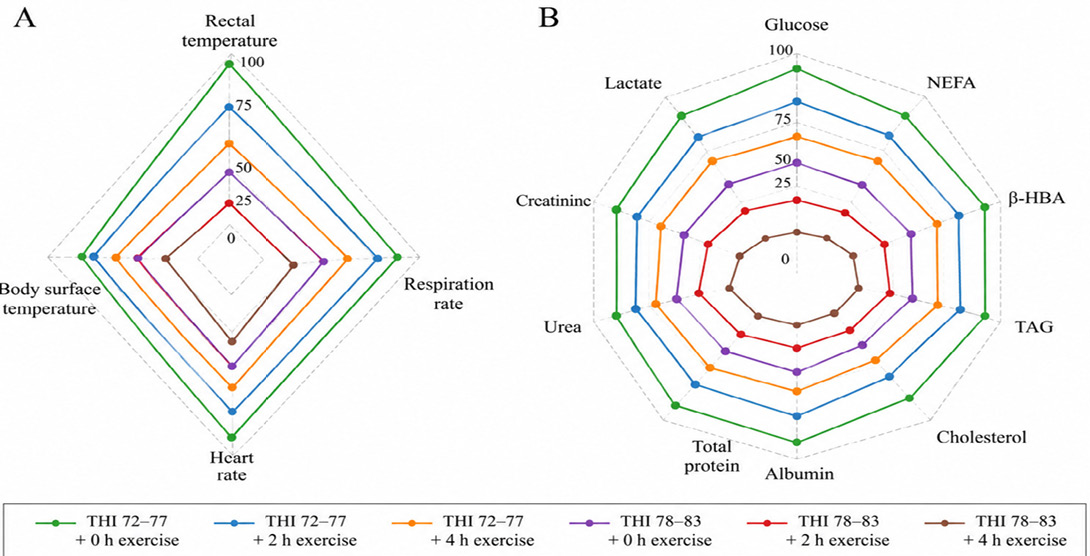
The radar plot (Figure 1) shows that the high-ERI group was characterised by a stable thermoregulatory response, a more balanced metabolic profile, and lower stress biomarkers. Conversely, the low-ERI group showed a stronger thermoregulatory response, increased energy mobilisation, and activation of stress mechanisms.
Table 3: Environmental resilience index (eri) of goats under different thi and exercise.
THI
Exercise
Thermoregulatory Index
Metabolic Adaptation Index
Environmental Resilience Index (ERI)
Resilience Category
72–77
0 h
93.4 ± 1.6Aa,a
91.8 ± 1.4Aa,a
92.6 ± 1.2Aa,a
Excellent
72–77
2 h
89.6 ± 1.5Ba,b
88.5 ± 1.3Ba,b
89.1 ± 1.0Ba,b
Excellent
72–77
4 h
84.9 ± 1.7Ca,c
84.1 ± 1.5Ca,c
84.6 ± 1.3Ca,c
Good
78–83
0 h
78.8 ± 1.8Ab,d
79.2 ± 1.7Ab,d
78.8 ± 1.4Ab,d
Moderate
78–83
2 h
70.7 ± 1.5Bb,e
69.5 ± 1.6Bb,e
70.2 ± 1.2Bb,e
Moderate
78–83
4 h
58.9 ± 1.8Cb,f
56.8 ± 1.7Cb,f
57.7 ± 1.5Cb,f
Low
A–C: Means within the same THI level followed by different uppercase letters differ significantly among exercise treatments (P < 0.05); a–b: Means within the same exercise level followed by different lowercase letters differ significantly between THI levels (P < 0.05); a–c (second superscript, after the comma): Means with different letters indicate significant differences among all six THI × Exercise treatment combinations according to Tukey’s HSD test (P < 0.05). Compiled and categorized based on OECD (2008).
Figure 1 presents the physiological and metabolic adaptation profiles of goats to the combination of THI and exercise duration, based on snormalised parameters. In general, both radar plots show a consistent pattern: the polygon area decreases as THI and exercise duration increase. In Figure 1A, the 72–77 THI group without exercise exhibited the largest polygon area, reflecting the most stable thermoregulatory conditions. Conversely, the combination of 78–83 THI with 4 hours of exercise produced the smallest polygon area, indicating an increased thermal load and a reduced capacity for physiological adaptation. A similar pattern is observed in Figure 1B, where the metabolic profile gradually shifted as heat stress and physical activity increased.
The low THI group preserved a better metabolic balance. Conversely, the high THI group subjected to extended exercise exhibited a reduced radar area, suggesting higher energy mobilisation and changes in metabolic homeostasis. The similar patterns between thermoregulatory and metabolic radar suggest that physiological and metabolic responses are coordinated in response to heat load and exercise.
The radar plot (Figure 1) shows that simultaneous increases in THI and exercise duration limit goats’ physiological and metabolic adaptation, indicating a reduced capacity to maintain homeostasis. This pattern demonstrates that thermoregulatory and metabolic responses work in concert to handle increased heat production and energy demands during heat stress. Consequently, the radar visualisation effectively captures multidimensional changes that are difficult to identify through individual parameters. These findings support using the Environmental Resilience Index (ERI) as a comprehensive measure for evaluating livestock’s physiological resilience under the combined pressures of heat load and exercise ; ; .
CONCLUSIONS
High THI combined with exercise boosts the thermoregulatory response and affects goat metabolic adaptation by elevating energy mobilisation to maintain homeostasis. The Environmental Resilience Index (ERI) integrates various physiological and metabolic indicators into a single comprehensive measure that differentiates goat resilience to heat stress and physical activity. This approach could be a valuable tool for evaluating physiological resilience in goat production systems in tropical areas. Incorporating 2 hours of exercise at a THI of 72-77 appears feasible and advantageous for animal welfare.
ACKNOWLEDGEMENTS
The authors thank the Al Musthofa Foundation and Muhammadiyah University of Jakarta for their support with facilities and funding during this research. They also thank all laboratory technicians and field staff who assisted during data collection and sample analysis.
NOVELTY STATEMENT
This research introduces the Environmental Resilience Index (ERI), a comprehensive measure for assessing goats’ physiological resilience to the combined impacts of the Temperature–Humidity Index (THI) and exercise. The ERI consolidates various thermoregulatory and metabolic responses into one metric, offering a more complete picture of adaptive capacity than a single biomarker. This method provides a more objective assessment and is applicable in environmental physiology research and livestock management in tropical areas.
AUTHOR’S CONTRIBUTION
All authors in this article have contributed equally, from the design and implementation of field tests and analysis, data tabulation, and contributions to data presentation and analysis, to writing/revising the draft of this article.
Ethical approval
The Animal Ethics Committee of the Directorate of Research Permit Management, Indonesia, has evaluated and approved the feasibility of this research with a certificate number 5023/KEP.11/SK/12/2025.
Generate AI and AI-assisted technology statement
The author declares that this article was written without the use of AI or similar technologies.
Conflict of interest
The authors declare no conflicts of interest related to this work.
Figures
Figure 1:.
Radar plot of the physiological and metabolic adaptation profile of goats to the combination of THI and exercise duration.
References
Al-Ramamneh D (2023). Thermoregulation in sheep and Goats: A Review. Asian J. Biol., 17(1): 34–42. https://doi.org/10.9734/ajob/2023/v17i1315[CrossRef]
Baird MF, Graham SM, Baker JS, Bickerstaff GF (2022). Creatine kinase- and exercise-related muscle damage implications for muscle performance and recovery. J. Nutr. Metab., 12(22): 960363.
Bernabucci U, Lacetera N, Baumgard LH, Rhoads RP, Ronchi B, Nardone A (2021). Metabolic and hormonal acclimation to heat stress in domesticated ruminants. Animal, 15(Suppl 1): 100299.
Brancaccio P, Maffulli N, Limongelli FM (2023). Creatine kinase monitoring in sports medicine. Br. Med. Bull., 81–82(1): 209–230. https://doi.org/10.1093/bmb/ldm014[CrossRef]
Chaves LMF, Freitas AP, Silva MJS, Santos FC (2022). Haematological indicators of physiological adaptation in sheep under tropical environments. Trop. Anim. Health Prod., 54(6): 352.
Cray C, Zaias J, Altman NH (2022). Acute phase response in animals: A review. Comp. Med., 59(6): 517–526.
Danso F, Lungu SE, Zhou G, Ju X (2024). Effects of heat stress on goat production and mitigating strategies: A Review. Animals, 14(12): 1793. https://doi.org/10.3390/ani14121793[CrossRef]
El-Magd MA, El-Shetry ES, Saleh AA, Alagawany M (2024). Metabolic and haematological biomarker alterations during physiological adaptation in farm animals: A review. Vet. Sci., 11(2): 76.
Fanta Y, Duguma G, Alemayehu K, Memey K (2024). Hematological parameters of and goats fed diets containing water hyacinth-based concentrate mixtures. Front. Vet. Sci., 11:1286563. https://doi.org/10.3389/fvets.2024.1286563[CrossRef]
Korelidou V, Panousis N, Kritsepi-Konstantinou M (2026). Haematological parameters in goats: variability, physiological influences, and diagnostic value. Animals, 16(9):1295. https://doi.org/10.3390/ani16091295[CrossRef]
Kumar D, Sejian V, Bhatta R (2024). Physiological and hematological responses of ruminants exposed to environmental and metabolic stress. Front. Vet. Sci., 11: 1404041.
Lees AM, Sejian V, Wallage AL, Steel CC, Mader TL, Lees JC, Gaughan JB (2023). The impact of environmental stressors on livestock physiology and welfare. Animals, 13(7): 1205.
Lisuzzo A, Rizzo M, Giannetto C, Arfuso F (2024). Metabolic adaptation and energy balance indicators in ruminants: The role of NEFA and BHBA. Front. Vet. Sci., 11: 1404041.
Luke TDW, McFadden JW, de Veth MJ, Bradford BJ (2020). A tale of two biomarkers: Understanding NEFA and BHBA as indicators of energy metabolism in ruminants. J. Dairy Sci., 103(8): 7426–7440.
Marcato F, Brand H van den, Kemp B, Reenen K van (2018). Evaluating Potential biomarkers of health and performance in veal calves [review of evaluating potential biomarkers of health and performance in veal calves]. Front. Vet. Sci., 5. https://doi.org/10.3389/fvets.2018.00133[CrossRef]
Mota-Rojas D, Napolitano F, Strappini A, Orihuela A, Ghezzi M, Hernández-Ávalos I, Whittaker AL (2022). Animal welfare in extensive systems and the physiological consequences of environmental stressors. Animals, 12(18): 2397.
Mushawwir A, Hernawan E (2025). Panduan Praktikum fisiologi produksi. Fakultas Peternakan, Universitas Padjadjaran, Bandung, pp. 23-27.
OECD (2008). Handbook on constructing composite indicators: methodology and user guide. OECD Publishing, Paris. https://doi.org/10.1787/9789264043466-en[CrossRef]
Permana R, Syamsu JA, Aritonang HN, Nugraha AA, Mushawwir A (2026). Accelerated road transport duration affects physiological condition, muscle physiology, and body weight in Leumosin breed bulls (LBB). Adv. Anim. Vet. Sci., 14(2):285-292. https://doi.org/10.17582/journal.aavs/2026/14.2.285.292[Full text][CrossRef]
Polsky L, von Keyserlingk MAG (2017). Invited review: Effects of heat stress on dairy cattle welfare. J. Dairy Sci., 100(11): 8645–8657. https://doi.org/10.3168/jds.2017-12651[CrossRef]
Rodrigues RCM, Furtado DA, Ribeiro LN, Silva RDS, Olivera AGD, Silva JPDC, Silva MRD, Mascarenhas NMH, Cavalcanti CR (2024). Thermoneutral temperature and thermal stress of sheep and goats: A review. Anim. Prod. Sci.
Salama AAK, Caja G, Hamzaoui S, Badaoui B, Castro-Costa A, Facanha DAE, Guilhermino MM, Bozzi R (2024). Varied responses to heat stress in dairy goats. Small Ruminant Res., 121(1): 73–79. https://doi.org/10.1016/j.smallrumres.2013.11.021[CrossRef]
Santinello M, Lora I, Villot C, Cozzi G, Penasa M, Chevaux E, Martin B, Guerra A, Righi F, Marchi MD (2024). Metabolic profile of Charolais young bulls transported over long distances. Res. Padua Arch. (University of Padua). 231: 106296–106296. https://doi.org/10.1016/j.prevetmed.2024.106296[CrossRef]
Sejian V, Bhatta R, Gaughan JB, Dunshea FR, Lacetera N (2018). Adaptation of animals to heat stress. Animal, 12(s2): s431–s444. https://doi.org/10.1017/S1751731118001945[CrossRef]
Simões J, Almeida AM, Silva S (2024). Metabolic periparturient diseases in small ruminants: Biomarkers and physiological implications. Applied Sciences, 14(21): 10073. https://doi.org/10.3390/app142110073[CrossRef]
Simões J, Almeida AM, Silva S (2024). Metabolic periparturient diseases in small ruminants: Biomarkers and physiological implications. Appl. Sci., 14(21): 10073. https://doi.org/10.3390/app142110073[CrossRef]
Tanuwiria UH, Susilawati I, Tasripin D, Salman LB, Mushawwir A (2022). Evaluation of cardiovascular biomarkers and lipid regulation in lactation friesian holstein at different altitudes in west java, Indonesia. HAYATI J. Biosci. 29: 428-434. https://doi.org/10.4308/hjb.29.4.428-434[CrossRef]
Tölü C, Daş G, Yıldız N, Rian D G, Sia G (2025). Effect of pasture and feeding systems on haematological traits and physiological responses of goat. Animals, 15. https://pmc.ncbi.nlm.nih.gov/articles/PMC12399073 https://doi.org/10.7717/peerj.19846[CrossRef]