Special Issue: Emerging and Re-Emerging Animal Health Challenges in Low and Middle-Income Countries · Volume 12, Issue 1, 5 December 2024 · Open Access
Study Different Protocols for Estrus Synchronization in Sheep Using the Vaginal Sponge and CIDR
· ·
Affiliations & Notes ⌄
1Surgery and Obstetrics Department, College of Veterinary Medicine, Al-Qasim Green University, Babylon 51013, Iraq
2Department of Surgery and Obstetrics, College of Veterinary Medicine, University of Baghdad, Baghdad, Iraq
3Al-Amal University College for Medical Sciences, Karbala, Iraq. *Correspondence | Sulake Fadhil Al-Zubaidi, Surgery and Obstetrics Department, College of Veterinary Medicine, Al-Qasim Green University, Babylon 51013, Iraq
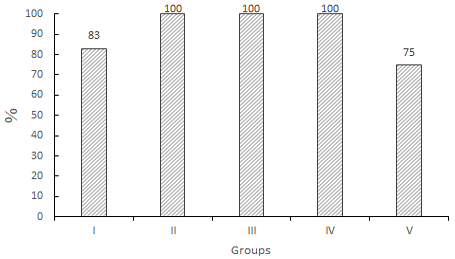
Estrus synchronization is one of the programs to increase the productivity of sheep in the world. The aim for this study was to compare between different protocols for estrus synchronization in sheep. A total of twenty-two Awasi ewes of 2-3 years of age were divided into 5 groups: Group I consisted of six ewes and were treated with Flurogestone Acetate Vaginal Sponge (40 mg) for 14 days. Group II was treated with sponge was soaked with 60 mg of Medroxyprogesterone acetate/sponge for 10 days. Group III was treated with sponge was soaked with 60 mg of Medroxyprogesterone acetate/sponge for 14 days. Group IV was treated with CIDR containing progesterone (0.3 g) for 10 days. Group V was treated with CIDR containing progesterone (0.3 g) for 14 days. After the removal of the sponges or CIDR, all animals in each group were injected with eCG 500 I.U. The incidence of estrus was 83%, 100%, 100%, 100%, and 75 % for the I, II, III, IV and V groups, respectively. The onset of estrus after removing vaginal sponges and CIDR were 44±4.51 hr. in group I, 52.25±0.50 hr. in group II, and 57.5±5.96 hr. in group III, 53.25±4.99 hr. in group IV and 43 ±6.40 hr. in group V. There were significant (p>0.05) differences between groups II, III, and IV when compared to control group I. According to the conception rate, ewes synchronized in group I showed 80% in group II 75%, in group III 25%, in group IV 100%, and finally, in group V 75% conception rate. It was concluded that using CIDR for 10 days with 500 IU of eCG is the best method for estrus synchronization with a high conception rate.
The control of sheep reproduction involves synchronizing the estrous cycle and lambing either in the reproductive season or non-reproductive season ; . For this purpose, many different protocols have been done to reach the best results, such as male effect and hormonal treatment ; ; . Progesterone is the most commercial hormone used for estrous synchronization in sheep which can be given by different methods such as orally, injectable, vaginal sponges and control internal drug-releasing device (CIDR) ; Martinez-Ros and Gonzalez-Bulnes, 2019; . The principle for using progesterone in different forms was to mimic the corpus luteum function . Vaginal sponges and CIDR are the most widely used in sheep in the world, while in Iraq, the CIDR is not widely used like sponges ; . Equine chorionic gonadotrophin (eCG) has the activity of follicle-stimulating hormones (FSH) and little effect of luteinizing hormone (LH), therefore, it can be used before or during the removal of sponges or CIDR ; . Many studies have reported the efficacy of a combination of sponges and eCG for estrus synchronization and conception rate ; ; . While other studies used CIDR with eCG conveyed different results, Martinez-Ros and Gonzalez-Bulnes (2019) studied in Segureña ewes and found that the fertility rate was 68.4%, also Alhimaidi et al. (2023) documented that the fertility rate was 92.59% in Naimi ewes. This study compared different estrus synchronization protocols and conception rates in local ewes.
Materials and Methods
The study was conducted in Babylon- Iraq during December 2023 where twenty-two Awassi ewes (of ages 2-3) years were used. All ewes were fertile with the previous one lambing at least. Ewes underwent a vaginal examination before the insertion of sponges and CIDR. Ewes allocated into 5 groups: Group I: six ewes treated with Flurogestone Acetate Vaginal Sponge 40 mg (Chifeng Boen, China) for 14 days. Group II: four ewes treated with (Esponjavet, Spain) in which its polyurethane sponge was soaked with 60 mg of Medroxyprogesterone acetate/sponge for 10 days. Group III: four ewes treated with (Esponjavet, Spain) in which its polyurethane sponge was soaked with 60 mg of Medroxyprogesterone acetate/sponge for 14 days. Group IV: four ewes treated with Eazi-breed™ CIDR®, Pfizer Animal Health, USA) containing progesterone 0.3 g for 10 days. Group V: four ewes treated with Eazi-breed™ CIDR®, Pfizer Animal Health, USA) containing progesterone 0.3 g for 14 days. After the removal of the sponges or CIDR: Group I was injected with eCG (500 I.U.) (Chifeng Boen, China). For groups, II and III ewes were injected with 500 IU of eCG (Oviser® Hipra, Spain. For groups, IV and V ewes were injected with 500 IU of eCG (Ecegon® Biogenesis Bago, Argentina). All ewes in different groups were exposed to rams after 36 hours after removing sponges or CIDR. After three months from removing sponges and CIDR, the pregnancy diagnosis was done by using an Ultrasound device (Chison Ecovet 3, China) with a convex probe (3.5-5) MHz. The Incidence of estrus rate and conception rate for the two protocols with consideration of the following formula:
Equation 1.Equation 2.
The statistical significance of the differences among various groups was determined by two tailed t-test.
Results and Discussion
Table 1 illustrates that the incidence of estrus was 83%, 100%, 100%, 100%, and 75 % for the I, II, III, IV and V groups, respectively (Figure 1).
Table 1: Incidence of estrus, onset of estrus, and conception rate of ewes synchronized for five groups.
Group
No. of ewes
Incidence of estrus (%)
Time (hr.) of estrus onset after removing the sponge
Conception rate (%)
I
6
83
44±4.51
80
II
4
100
52.25±0.50*
75
III
4
100
57.5±5.96*
25
IV
4
100
53.25±4.99*
100
V
4
75
43 ±6.40
75
*: significant (p>0.05) differences compared to group I.
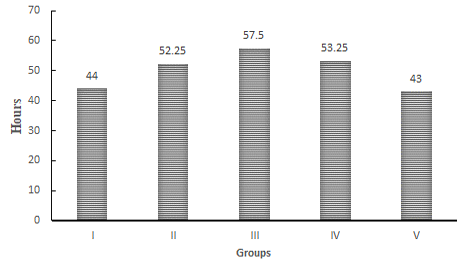
The onset of estrus after removing vaginal sponges and CIDR were 44±4.51 h in group I, 52.25±0.50 h in group II, and 57.5±5.96 h in group III, 53.25±4.99 h in group IV and 43±6.40 h in group V. There were significant (p>0.05) differences between groups II, III, and IV when compared to group I (Figure 2).
The signs of estrus, such as searching of the male, contraction of the vulva, frequent urination, vaginal mucus discharge, bleating, and mounting, were detected after removing sponges and CIDR for each group.
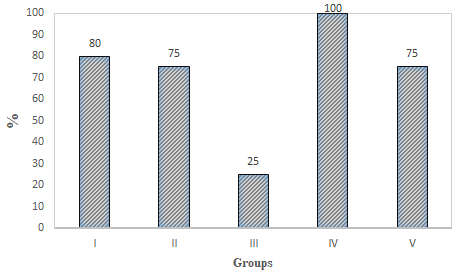
According to the conception rate, ewes synchronized in group I showed 80% in group II 75%, in group III 25%, in group IV 100%, and finally, in group V 75% conception rate Figure 3.
The incidence of estrus ranges between 75 and 100 % in different groups of treatment; this result is higher than those recorded by Gimenez et al. (2005) in which they found it 70.5% in Awasi ewes by Melengestrol Acetate. Gonzalez-Bulnes (2020) documented that 89.5% of synchronized Segureña ewes treated with CIDR-eCG protocols showed estrus signs. Our results were lower than those reported by Yu et al. (2022), in which they proved that the percentage ranged from 70% to 86.67% in five groups of treated Hu sheep. Altincekic (2022) have recorded 77.8% and 62.2% for fluorogestone acetate and CIDR groups, respectively. Taçyildiz et al. (2023) have demonstrated in Tuj ewes that the percentages were 73.33% and 70.59% in the short and long term of P4 plus eCG, which were lower than reported in this study.
In accordance with the onset of estrus in this study, it ranged between 43 to 57 hours. These results align with Martinez-Ros and Gonzalez-Bulnes (2019) in which they observed that the range of onset of estrus was 24 to 52 hours. The same results were reported by Biehl et al. (2019) and Yu et al. (2022), who documented the onset of estrus about 48 hr. after removing sponges or CIDR. In contrast to our results, Altincekic (2022) and Taçyıldız et al. (2023) demonstrated 35.2, 37.6, 36.5, and 32.9 h, with different protocols, respectively.
Estrus and conception are crucial indicators for assessing the reproductive efficacy of sheep. The highest percentage of conception rate was recorded in group IV (100%), 80 % in group I, 75 % in groups II and V. Moreover, the conception rate was the lowest in group III (25) %. The result in group III may be attributed to bad management and vaginitis that occurred after long-term (14) days of administration sponges ; ; . Quintero-Elisea et al. (2012) determined that the conception rate of ewes had no statistically significant difference (P >0.05) when using various protocols of estrous synchronization with FGA-based combined with eCG. For pregnancy rate, Martinez-Ros and Gonzalez-Bulnes (2019) documented that the percentage was 68.4% in the CIDRI-eCG group, while Taçyildiz et al. (2023) demonstrated that the percentage was 46.67 and 58.82% in short term and long-term treatment with sponges, respectively, which lower than our results. Yu et al. (2022) noted the average pregnancy rate was 71.43 to 80.77%, which is in accordance with our study. Furthermore, our findings align closely with the results presented by Alhimaidi et al. (2023) in the CIDR-eCG group, which revealed a rate of 92.95%.
Conclusion
It was concluded that using CIDR for 10 days with 500 IU of eCG is the best method for estrus synchronization with a high conception rate.
Acknowledgments
The authors would like to thank veterinarians in the education veterinary hospital in Babylon for their cooperation.
Novelty Statement
The study used different protocols of estrus synchronization in ewes in Iraq.
Authors’ contribution
All authors equally contributed.
Conflict of interest
The authors have declared no conflict of interest.
Figures
Figure 1:.
The incidence of estrus in the treated groups.
Figure 2:.
The onset of estrus after removing the sponge and CIDR in the treated groups.
Figure 3:.
The conception rate in the treated groups.
References
Abecia JA, Forcada F, Gonzalez-Bulnes A (2012). Hormonal control of reproduction in small ruminants. Anim. Reprod. Sci., 130: 173–179. https://doi.org/10.1016/j.anireprosci.2012.01.011[CrossRef]
Al-Hamedawi TM, Khammas DJ, Al-Ubaidi AS (2003). Effect of estrus synchronization on vaginal flora and subsequent fertility in ewes. Iraqi J. Vet. Sci., 16: 73–79.
Alhimaidi AR, Ammari AA, Alghadi MQ, Amran RA, Rady AM (2023). Comparison between the CIDR or sponge with hormone injection to induce estrus synchronization for twining and sex preselection in Naimi sheep. Open Chem., 21(1): 20220296. https://doi.org/10.1515/chem-2022-0296[CrossRef]
Al-Marzani EAH, Barwary MS (2022). Effect of different estrus synchronization on serum E2, P4, FSH and LH during different estrus periods and pregnancy in ewes. Iraqi J. Agric. Sci., 53(4): 743-751. https://doi.org/10.36103/ijas.v53i4.1584[CrossRef]
Altincekic SO (2022). Effects of different protocols for estrus synchronization in ewes on vaginal pH, estrus time and reproductive performance and change in vaginal electrical resistance values. Anim. Sci. Pap. Rep., 40(1): 75-88.
Al-Zubaidi SFA (2017). Vaginal microflora in ewes after estrus synchronization with intravaginal sponges. Iraqi J. Vet. Med., 41(2): 67-71. https://doi.org/10.30539/iraqijvm.v41i2.50[CrossRef]
Biehl MV, de Ferraz Junior MVC, Barroso JPR, Susin I, Ferreira EM, Polizel DM, Pires AZ (2019). The reused progesterone device has the same effect on short or long estrus synchronization protocols in tropical sheep. Trop. Anim. Health Prod., 51: 1545–1549. https://doi.org/10.1007/s11250-019-01841-1[CrossRef]
Dias J, Miranda V, Oliveira F, Junior SV, Haas C, Costa V, Lucia JrT, Vieira A, Corcini C, Gasperin B (2020). Treatment with eCG and hCG to induce onset of estrous cycles in ewes during the non-breeding season: Effects on follicular development and fertility. Anim. Reprod. Sci., 212: 106-232. https://doi.org/10.1016/j.anireprosci.2019.106232[CrossRef]
Evans A, Dufy P, Crosby T, Hawken P, Boland M, Beard A (2004). Effect of ram exposure at the end of progestogen treatment on estrous synchronization and fertility during the breeding season in ewes. Anim. Reprod. Sci., 84: 349-358. https://doi.org/10.1016/j.anireprosci.2003.12.013[CrossRef]
Gatti M, Ungerfeld R (2012). Intravaginal sponges to synchronize estrus decrease sexual attractiveness in ewes. Theriogenology, 78: 1796–1799. https://doi.org/10.1016/j.theriogenology.2012.07.001[CrossRef]
Gimenez Diaz CA, Emsen E, Koycegiz F, Emsen B, Yaprak M, Kutluca M (2005). Synchronization of estrus in fat tailed sheep using melengestrol acetate (MGA) in the breeding season. J. Appl. Anim. Res., 28(1): 25-27. https://doi.org/10.1080/09712119.2005.9706782[CrossRef]
Gonzalez-Bulnes A, Menchaca A, Martin GB, Martinez-Ros P (2020). Seventy years of progestagen treatments for management of the sheep oestrous cycle: where we are and where we should go. Reprod. Fertil. Dev., 32: 441–452. https://doi.org/10.1071/RD18477[CrossRef]
Manes J, Campero C, Hozbor F, Alberio R, Ungerfeld R (2015). Vaginal histological changes after using intravaginal sponges for oestrous synchronization in anoestrous ewes. Reprod. Domest. Anim., 50: 270–274. https://doi.org/10.1111/rda.12482[CrossRef]
Martinez-Ros P, Gonzalez-Bulnes A (2019). Efficiency of CIDR-based protocols including GnRH instead of eCG for estrus synchronization in sheep. Animals, 9(4): 146. https://doi.org/10.3390/ani9040146[CrossRef]
Martinez-Ros P, Lozano M, Hernandez F, Tirado A, Rios-Abellan A, López-Mendoza MC, Gonzalez-Bulnes A (2018). Intravaginal device-type and treatment-length for ovine estrus synchronization modify vaginal mucus and microbiota and affect fertility. Animals, 8(12): 226. https://doi.org/10.3390/ani8120226[CrossRef]
Mura M, Luridiana S, Pulinas L, Bizzarri D, Cosso G, Carcangiu V (2019). Melatonin treatment and male replacement every week on the reproductive performance in Sarda sheep breed. Theriogenology, 135: 80-84. https://doi.org/10.1016/j.theriogenology.2019.06.008[CrossRef]
Quintero-Elisea JA, Macías-Cruz U, Álvarez-Valenzuela FD, Correa-Calderón A, González-Reyna A, Lucero-Magaña FA, Soto-Navarro SA, Reyes LA (2011). The effects of time and dose of pregnant mare serum gonadotropin (PMSG) on reproductive efficiency in hair sheep ewes. Trop. Anim. Health Prod., 43: 1567–1573. https://doi.org/10.1007/s11250-011-9843-z[CrossRef]
Taçyıldız E, Kuru BB, Kuru M (2023). The effect of short-term or long-term progesterone-based estrus synchronization on fertility parameters in tuj ewes outside the breeding season. Van Vet. J., 34(3): 237-243. https://doi.org/10.36483/vanvetj.1296531[CrossRef]
Talebkhan GM, Farzaneh N, Gallehdar E, Mohri M (2012). Reproductive performance in out of breeding season of fatty ewes using implant norgestomet with or without PMSG. Trop. Anim. Health Prod., 44: 965–968. https://doi.org/10.1007/s11250-011-9993-z[CrossRef]
Wildeus S (2000). Current concepts in synchronization of estrus: Sheep and goats. J. Anim. Sci., 77: 1-14. https://doi.org/10.2527/jas2000.00218812007700ES0040x[CrossRef]
Willard ST, Dickerson T, Dodson R, Weis A, Godfrey RW (2006). Administration of 6-methoxybenzoxazolinone (MBOA) does not augment ovulatory responses in St. Croix White ewes super ovulated with PMSG. Anim. Reprod. Sci., 93: 280–291. https://doi.org/10.1016/j.anireprosci.2005.08.002[CrossRef]
Yu X, Bai Y, Yang J, Zhao X, Zhang L, Wang J (2022). Comparison of five protocols of estrous synchronization on reproductive performance of Hu sheep. Front. Vet. Sci., 9: 843514. https://doi.org/10.3389/fvets.2022.843514[CrossRef]