
Zika virus (ZIKV) has gained research interests after its recent outbreak in Brazil and America in 2015, where it affected millions of people. Studies have shown its role in developing microcephaly and GBS Syndrome. There is a need to develop drugs against ZIKV. Here we uses pharmacoinformatics techniques to identify potential inhibitors against ZIKV protease NS2B-NS3, which has a well-known role in the viral replication. By using three dimensional structure of the NS2B-NS3, an allosteric site has been identified in the protein. Moreover, the identified site is used for structure-based virtual screening. After screening 100,000 compounds, 14 compounds are selected, which fulfilled different already established drug likeliness parameters such as rule of five and nontoxic nature. These 14 compounds are used for pharmacophore modeling, and Zinc natural compounds database (ZND) is screened against the developed pharmacophore. The compounds with the highest pharmacophore fit scores are screened and docked on the identified allosteric site of NS2B-NS3. Analysis of the data showed two compounds (ZINC00845171, ZINC08782519)as potential inhibitors for NS2B-NS3 of ZIKV.
Research Article · Volume 50, Issue 5, 3 August 2018 · Open Access
Structure Based Virtual Screening and Molecular Docking Studies for Identification of Allosteric Inhibitors against Zika Virus Protease NS2B-NS3
· · · · · ·
Affiliations & Notes ⌄
- 1Department of Biosciences, COMSATS University Islamabad, Sahiwal Campus, Punjab , * Corresponding author: farrukhccb@gmail.com
- 2farrukh@ciitsahiwal.edu.pk
Article Info ⌄
- Journal:
- Pakistan Journal of Zoology
- Published:
- 3 August 2018

From the article
- Physical features of these three compounds showed their potential to be a valuable inhibitor for the allosteric site of NS2B-NS3.
- In silico screening against the allosteric pocket of ZIKV protease NS2B/NS3 protease led us to identify new inhibitors for the protease.
- Fourteen compounds have been selected after a structure-based virtual screening of 100,000 compounds, and a pharmacophore is developed.
- Analysis showed two (ZINC00845171 and ZINC08782519) compounds as potential inhibitors for ZIKV NS2B/NS3 protease and lead compounds against ZIKV.
Selected from the article's own text.
Abstract
Introduction
Zika virus (ZIKV) belongs to flavivirus genus. The other renowned members of the genus are: Dengue virus (DENV), West Nile virus, Japanese encephalitis virus and Yellow fever virus. ZIKV was isolated in 1947 from the serum of a monkey in Zika Forest . However, it emerged as a disease-causing agent in 2015. ZIKV was spread in Brazil in May 2015, and then it was rapidly spread throughout America . In 2016, 531,000 suspected cases of this virus were reported in different American territories. Moreover, a congenital syndrome has been associated with Zika virus (Ikejezie et al., 2017). The main vectors of this virus are Aedes aegypti mosquitoes, though other mosquito species can also contribute in its transmission . Additionally, several cases have been reported for sexual transfer of the virus (Ikejezie et al., 2017).
ZIKV genome is composed of, positive-sense, single-stranded RNA molecule of approximately 11 kb . Studies have shown that the viral genome is translated into a single polyprotein, which is cleaved into 10 mature proteins by cellular and viral proteases. Studies have shown that 7, out of these 10, proteins are non-structural and designated NS1, NS2A, NS2B, NS3, NS4A, NS4B, and NS5. Remaining three are structural proteins including Capsid (C), Pre-membrane/membrane (prM), and Envelope (E) proteins ; ; .
ZIKV causes mild illness with symptoms fever, arthralgia, rash, conjunctivitis, muscle and joint pain . The current outbreak of ZIKV in Brazil and Latin America showed a positive correlation between viral infection and rise of microcephaly . Moreover, studies have shown that ZIKV is also associated with neurological disorders such as Guillain-Barre syndrome .
Studies have highlighted NS2B-NS3, a serine protease, as a key player in ZIKV replication ; . The crystal structure of NS2B-NS3 and substrate specificity profile has already been determined ; . Analysis showed that the binding pocket of NS2B-NS3 protease is highly hydrophobic like the other similar proteases in other flavivirus . A recent study has targeted an allosteric site of NS2B-NS3 complex and they have identified certain compounds for the inhibition (hfNPS) of the protease . However, the identified compounds are highly water soluble and host unfavorable pharmacokinetic parameters. The authors have suggested further study to identify inhibitors with favorable pharmacokinetic parameters . In this study, we have screened 100,000 compounds for the inhibitors of NS2B-NS3, perform virtual screening against the allosteric site and determine naturally occurring compounds as inhibitor of the protease. It is a step toward developing a potential drug against ZIKV.
Methodology
Allosteric site identification
The allosteric site of DENV NS2B-NS3 protease (PDB: 2FOM) has already been reported . By superposing ZIKV NS2B-NS3 (5GXJ) on the DENV NS2B-NS3 protease (PDB: 2FOM), we determined the allosteric site in ZIKV NS2B-NS3. Both protein structures are superimposed by using PyMol software .
Protein preparation for docking
The NS2B-NS3 protein structure (PDB: 5GXJ) was retrieved from Protein Data Bank (https://www.rcsb.org). The chain B and water molecules were deleted using Chimera software for docking analysis. By using AutoDock Vina polar hydrogen and Kollman charges added in the structure . A grid with dimensions 100×100×100 Ǻ with center x = -0.254, y = 11.832 and z = -24.015 was used for targeted docking in the allosteric site of NS2B-NS3.
Virtual screening
Mcule was used to perform the structure-based virtual screening (SBVS) . It uses a built-in AutoDock Vina tool to perform docking of small ligands against target site. Each ligand of the selected database is docked against the selected allosteric pocket. Ligands were scored according to the minimum binding energy.
Drug-like properties determination of the selected compounds
The best compounds were checked by OSIRIS property explorer (Actelion Pharmaceuticals Ltd., Allschwil, Switzerland) for drug-like properties. Molecular weight, LogP, hydrogen bond donor, hydrogen bond acceptor and polar surface area were determined. Those compounds that fulfill rule of five (Ro5) criteria were further filtered by checking the compound toxicity using Mcule lead optimization tool toxicity checker . AdmetSar was used to check the ADMET (Absorption, Distribution, Metabolism, Excretion, Toxicity) properties , such as blood brain barrier, human intestinal absorption, caco-2 permeability, honey bee toxicity, fish toxicity etc.
Pharmacophore modeling
Ligands based pharmacophore modeling performed by Ligand scout . Ligand scout is a tool that generates three dimensional pharmacophore models from structural data of macromolecules ligands complexes. Zinc Natural Derivatives (ZND) database downloaded from Zinc specialized databases. Each compound of the database is screened against the generated pharmacophore and scored according to matching features.
Compound interactions and toxicity
The compounds with highest pharmacophore fit score were further screened through their different physical properties such as Ro5, toxicity and ADMET parameters. The filtered compounds were docked to the allosteric sites of NS2B-NS3, and their interactions with the allosteric sites residues were checked by using LIGPLOT .
Results and Discussion
In the post genome era, bioinformatics has emerged a valuable tool for large data analysis. Several applications of different bioinformatics tools have been reported ranging from gene prediction to drug identification ; ; ; . In this study we focus to identify drug against Zika virus which is highly linked with several neurological disorders.
Allosteric site analysis
The allosteric sites of ZIKV NS2B-NS3 comprise 15 residues: Asp71, Lys73, Gln74, Trp83, Leu85, Ala87, Ala88, Trp89, Gly91, Thr118, Asp120, Ile147, Leu149, Asn152 and Val155. These residues are located at topological positions to the residues of allosteric site in DENV NS2B-NS3 . This site comprises 3 polar (Gln74, Thr118, Asn152), 9 nonpolar (Trp83, Leu85, Ala87, Ala88, Trp89, Gly91, Ile147, Leu149, Val155), 1 basic (Lys73) and 2 acidic residues (Asp71, Asp120) residues (Fig. 1). Analysis of the site suggested that it will hinder the interactions of NS3 with its cofactor NS2B, leading the inhibition of protease as reported by Shiryaev et al. (2017). Therefore, the site is used as a drug target site in this study.
Structure-based virtual screening
100,000 compounds from Mcule were docked on the allosteric site of the NS2B-NS3. Top 100 compounds were selected based on their lowest binding energy (< -9 kcal/mol) (Table I). We analyzed different features of these selected 100 compounds, such as toxicity and Ro5 as explained by Lipinski et al. (2001). According to Lipinski et al. (2001), a good permeable drug must have these five features. First, the molecular weight of drug preferably be less than 500 g/mol; second, hydrogen bond donor (HBD) moieties in the drug be less than 5; third, hydrogen bond acceptor (HBA) be less than 10; fourth, its polar surface area (PSA) be less than 140 Ǻ and last is logarithm of partition coefficient between n-octanol and water, log(coctanol/cwater) (cLogP ) must be less than five. In addition to Ro5, we determined toxicity and interactions of these compounds with NS2B-NS3. Only 14 compounds, out of the 100 selected compounds, passed Ro5 and toxicity test so they were taken for further analysis. Table I summarizes the feature of these compounds and their structures are shown in Figure 2.
Analysis of the data showed that M1 has lowest binding energy (-9 kcal/mol), suggesting its strongest interactions with the allosteric site as compared to the other 13 molecules (Table I). Such interactions are facilitated by its 6 HBA and 1 HBD. Additionally, the cLogP and relative PSA of M1 falls in the allowed reign. On the other hand, M14 pose the maximum binding energy in these 14 molecules (-7.8 kcal/mol). It host 8 HBA whereas HBA are absent in the structure.
Table I.- Features of the 14 inhibitors of the NS2B-NS3.
| No | Molecules | Binding energy (kcal/mol) | Molecular weight (g/mol) | cLogP | HBA | HBD | Relative PSA |
| 1 | M1 | -9 | 427.55 | 3 | 6 | 1 | 0.17071 |
| 2 | M2 | -8.6 | 404.322 | 4.3022 | 6 | 0 | 0.24966 |
| 3 | M3 | -8.5 | 446.958 | 2.7846 | 7 | 1 | 0.22571 |
| 4 | M4 | -8.4 | 375.349 | 2.1211 | 5 | 0 | 0.15715 |
| 5 | M5 | -8.2 | 326.423 | 1.5393 | 5 | 0 | 0.29039 |
| 6 | M6 | -8.1 | 396.493 | 1.7641 | 8 | 1 | 0.23992 |
| 7 | M7 | -8.1 | 310.4 | 2.1138 | 5 | 2 | 0.23924 |
| 8 | M8 | -8.1 | 441.811 | 3.8176 | 5 | 1 | 0.17553 |
| 9 | M9 | -8 | 449.477 | 3.0763 | 7 | 0 | 0.21256 |
| 10 | M10 | -7.9 | 333.346 | 3.0529 | 6 | 1 | 0.27512 |
| 11 | M11 | -7.9 | 410.476 | 1.5397 | 9 | 0 | 0.26448 |
| 12 | M12 | -7.9 | 384.459 | 3.2613 | 7 | 2 | 0.32795 |
| 13 | M13 | -7.9 | 390.502 | 1.5855 | 6 | 2 | 0.25924 |
| 14 | M14 | -7.8 | 355.328 | 1.6942 | 8 | 0 | 0.32856 |
The compounds respective molecule ID’s are: M1, MCULE-6483787945-0-3; M2, MCULE-2598332550-0-1; M3, MCULE-6717908673-0-1; M4, MCULE-4017669026-0-1; M-5, MCULE-4088032230-0-2; M-6, MCULE-8969381945-0-1; M7, MCULE-8631834817-0-1; M8, MCULE-3248415882-0-2; M9, MCULE-3498445429-0-1; M10, MCULE-3686500192-0-1; M11, MCULE-1165852831-0-1; M12, MCULE-7095580128-0-1; M13, MCULE-7204888140-0-1; M14, MCULE-2760593673-0-1.
Table II.- Features of 3 pharmacophores.
| Drug ID | Fit score | Acceptors | Binding energy (kcal/mol) | Donor | Weight | Log P | TPSA | Toxicity |
| ZINC00845171 | 53.33 | 7 | -8.9 | 0 | 452.44 | 3.29 | 59.73 | Nontoxic |
| ZINC08782519 | 52.88 | 6 | -8 | 2 | 413.4 | 2.93 | 75.08 | Nontoxic |
| ZINC15674546 | 52.65 | 7 | -8.3 | 2 | 432.49 | 1.61 | 96.53 | Nontoxic |
Pharmacophore
A pharmacophore is generated by merging the chemical features of the above 14 compounds (Table I; Fig. 2). This pharmacophore host five hydrogen bond acceptors and two hydrophobic rings (Supplementary Fig. S1).
Pharmacophore screening results
The pharmacophore is used to screen 30,793 natural compounds from ZND, and 10 compounds with the maximum pharmacophore fit score (lowest 52.65) has been selected (Table II). A fit score shows the extent of similarity of one compound with the given pharmacophore. Only 3 compounds, out of these 10 compounds, passed the toxicity test. Physical features of these three compounds showed their potential to be a valuable inhibitor for the allosteric site of NS2B-NS3. For example, their HBA, HBD, logP and the topological polar surface area are within the allowed reign. These values are summarized in Table II. Moreover we determine the total no of hydrogen bond between these three ligands and the allosteric site (NS2B-NS3) residues (Fig. 3). Analysis of the structures showed that ZINC08782519, ZINC00845171 and ZINC15674546 forms 3, 1 and 1 hydrogen bonds, respectively, with different residues of allosteric site (Fig. 3). These interactions play a vital role in binding affinity of a ligand.
ADMET properties of the novel compounds
For an orally administrated drug, it should fulfill the ADMET parameters. If the properties are weak, the candidate will have a high risk of failure. One of the compound, ZINC15674546, is eliminated from the study because it does not follow the ADMET parameters. The ADMET properties of the two novel compounds are in Table III.
Table III.- ADMET properties of two novel compounds.
| Properties | ZINC00845171 | ZINC08782519 |
| Blood-brain barrior (BBB+) | 0.9834 | 0.9376 |
| Human intestinal absorption (HIA-) | 1 | 1 |
| Caco2 permeability | 0.5 | 0.6856 |
| CYP450 2D6 inhibitor (non-substrate) | 0.571 | 0.7596 |
| AMES toxicity | NT | NT |
| Carcinogens | NC | NC |
| Acute oral toxicity (III) | 0.5863 | 0.5475 |
| Aquous solubility (LogS) | ||
| Rat acute toxicity (LD50, mol/kg) |
Analysis of their ADMET properties showed that both the compounds are nontoxic and noncarcinogenic as established from AEMS and carcinogenicity test (Table III). Moreover, we determined Rat Acute Toxicity LD50 for both the compounds. Another interesting feature of these compounds is optimal putative blood brain barrier value (BBB: >0.93), which is essential for penetration through the CNS. On the other hand, analysis of these structures showed these compounds are non-substrate for CYP450 2D6, suggesting a moderate metabolism rate of these compounds. Most importantly, both the compounds are water soluble as evident from their logS and both compounds have logS value (>-3.40).
Conclusion
In silico screening against the allosteric pocket of ZIKV protease NS2B/NS3 protease led us to identify new inhibitors for the protease. Fourteen compounds have been selected after a structure-based virtual screening of 100,000 compounds, and a pharmacophore is developed. By screening available natural compounds in the ZND database against pharmcophore, top 10 compounds were selected based on their fit scores and drug properties determined. Analysis showed two (ZINC00845171 and ZINC08782519) compounds as potential inhibitors for ZIKV NS2B/NS3 protease and lead compounds against ZIKV.
Acknowledgement
We gratefully acknowledge Higher Education Commission (HEC) of Pakistan for grants to this study.
Supplementary material
There is supplementary material associated with this article. Access the material online at: http://dx.doi.org/10.17582/journal.pjz/2018.50.5.1709.1715
Statement of conflict of interest
Authors have declared no conflict of interest.
Figures
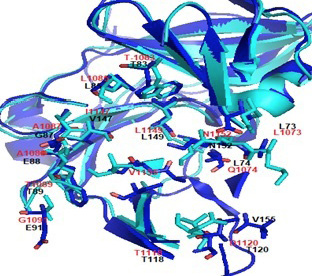
Superimpose NS2B-NS3 of DENV (blue) on NS2B-NS3 of ZIKV (cyan). It also shows allosteric site residues of DENV (red) and ZIKV (black).
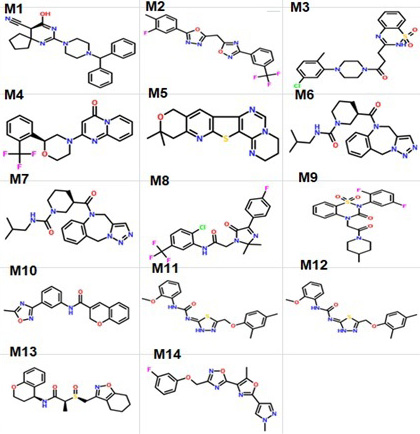
Structure of selected 14 compounds.
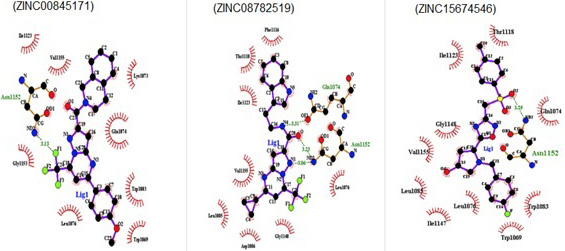
Hydrogen bonding between ligands and NS2B-NS3 allosteric site residues.
References
- Baronti, C., Piorkowski, G., Charrel, R.N., Boubis, L., Leparc-Goffart, I. and de-Lamballerie, X., 2014. Complete coding sequence of zika virus from a French polynesia outbreak in 2013. Genome Announc., 2: e00500. https://doi.org/10.1128/genomeA.00500-14[CrossRef]
- Campos, G.S., Bandeira, A.C. and Sardi, S.I., 2015. Zika virus outbreak, Bahia, Brazil. Emerg. Infect. Dis., 21: 1885-1886. https://doi.org/10.3201/eid2110.150847[CrossRef]
- Cheng, F., Li, W., Zhou, Y., Shen, J., Wu, Z., Liu, G., Lee, P.W. and Tang, Y., 2012. admetSAR: A comprehensive source and free tool for assessment of chemical ADMET Properties. J. Chem. Infect. Model., 52: 3099-3105. https://doi.org/10.1021/ci300367a[CrossRef]
- Colman, E., Golden, J., Roberts, M., Egan, A., Weaver, J. and Rosebraugh, C., 2012. The FDA’s assessment of two drugs for chronic weight management. N. Engl. J. Med., 367: 1577-1579. https://doi.org/10.1056/NEJMp1211277[CrossRef]
- Dick, G.W.A., Kitchen, S.F. and Haddow, A.J., 1952. Zika virus (I). Isolations and serological specificity. Trans. R. Soc. trop. Med. Hyg., 46: 509-520. https://doi.org/10.1016/0035-9203(52)90042-4[CrossRef]
- Driggers, R.W., Ho, C.Y., Korhonen, E.M., Kuivanen, S., Jääskeläinen, A.J., Smura, T., Rosenberg, A., Hill, D.A., de Biasi, R.L., Vezina, G., Timofeev, J., Rodriguez, F.J., Levanov, L., Razak, J., Iyengar, P., Hennenfent, A., Kennedy, R., Lanciotti, R., du Plessis, A. and Vapalahti, O., 2016. Zika virus infection with prolonged maternal viremia and fetal brain abnormalities. N. Engl. J. Med., 374: 2142-2151. https://doi.org/10.1056/NEJMoa1601824[CrossRef]
- Gruba, N., Rodriguez-Martinez, J.I., Grzywa, R., Wysocka, M., Skoreński, M., Burmistrz, M., Lecka, M., Lesner, A., Sienczyk, M. and Pyrć, K., 2016. Substrate profiling of Zika virus NS2B-NS3 protease. FEBS Lett., 590: 3459-3468. https://doi.org/10.1002/1873-3468.12443[CrossRef]
- Ikejezie, J., Shapiro, C.N., Kim, J., Chiu, M., Almiron, M., Ugarte, C., Espinal, M.A. and Aldighieri, S., 2016. Zika virus transmission-Region of the Americas. MMWR Morb. Mort., 66: 329-334. https://doi.org/10.15585/mmwr.mm6612a4[CrossRef]
- Jamil, F., Raheel, S. and Rasheed, H., 2018. Docking of smaller ligands in the heme pocket of Hell’s Gate Globin IV. Pakistan J. Zool., 4: 1199-1600 http://dx.doi.org/10.17582/journal.pjz/2018.50.4.sc9[Full text][CrossRef]
- Kiss, R., Sandor, M. and Szalai, F.A., 2012. A public web service for drug discovery. J. Cheminform., 4: 17. http://mcule.com
- Kuno, G. and Chang, G.J., 2007. Full-length sequencing and genomic characterization of Bagaza Kedougou and Zika viruses. Arch. Virol., 152: 687-696. https://doi.org/10.1007/s00705-006-0903-z[CrossRef]
- Lei, J., Hansen, G., Nitsche, C., Klein, C.D., Zhang, L. and Hilgenfeld, R., 2016. Crystal structure of Zika virus NS2B-NS3 protease in complex with a boronate inhibitor. Science, 353: 503-505. https://doi.org/10.1126/science.aag2419[CrossRef]
- Li, Y., Zhang, Z., Phoo, W.W., Loh, Y.R., Wang, W., Liu, S., Chen, M.W., Hung, A.W., Keller, T.H., Luo, D. and Kang, C., 2017. Structural dynamics of Zika virus NS2B-NS3 protease binding to dipeptide inhibitors. Structure, 25: 1242-1250. https://doi.org/10.1016/j.str.2017.06.006[CrossRef]
- Lill, M.A. and Danielson, M.L., 2011. Computer-aided drug design platform using PyMOL. J. Comput. Aided Mol. Des., 25: 13-19. https://doi.org/10.1007/s10822-010-9395-8[CrossRef]
- Lipinski, C.A., Lombardo, F., Dominy, B.W. and Feeney, P.J., 2001. Experimental and computational approaches to estimate solubility and permeability in drug discovery and development settings. Adv. Drug Deliv. Rev., 46: 3-26. https://doi.org/10.1016/S0169-409X(00)00129-0[CrossRef]
- Mackenzie, J., 2005. Wrapping things up about virus RNA replication. Traffic, 6: 967-977. https://doi.org/10.1111/j.1600-0854.2005.00339.x[CrossRef]
- Moghadam, S.R.J., Bayrami, S., Moghadam, S.J., Golrokhi, R., Pahlaviani, F.G. and Seyedalinaghi, S.A.S., 2016. Zika virus: A review of literature. Asian Pac. J. trop. Med., 6: 989-994. https://doi.org/10.1016/j.apjtb.2016.09.007[CrossRef]
- Mukhametov, A., Newhouse, E.I., Aziz, N.A., Saito, J.A. and Alam, M., 2014. Allosteric pocket of the dengue virus (serotype 2) NS2B/NS3 protease: In silico ligand screening and molecular dynamics studies of inhibition. J. Mol. Graph. Model., 52: 103-113. https://doi.org/10.1016/j.jmgm.2014.06.008[CrossRef]
- Nowakowski, T.J., Pollen, A.A., di Lullo, E., Sandoval-Espinosa, C., Bershteyn, M. and Kriegstein, A.R., 2016. Expression analysis highlights AXL as a candidate zika virus entry receptor in neural stem cells. Cell Stem Cell, 18: 591-596. https://doi.org/10.1016/j.stem.2016.03.012[CrossRef]
- Rana, N., Ehsan, N., Ihsan, A. and Jamil, F., 2017. Analyses of the pseudogenes of Helicobacter pylori. Pakistan J. Zool., 49: 1261-1265. https://doi.org/10.17582/journal.pjz/2017.49.4.1261.1265[CrossRef]
- Shiryaev, S.A., Farhy, C., Pinto, A., Huang, C.T., Simonetti, N., Elong-Ngono, A., Dewing, A., Shresta, S., Pinkerton, A.B., Cieplak, P., Strongin, A.Y. and Terskikh, A.V., 2017. Characterization of the Zika virus two-component NS2B-NS3 protease and structure-assisted identification of allosteric small-molecule antagonists. Antivir. Res., 143: 218-229. https://doi.org/10.1016/j.antiviral.2017.04.015[CrossRef]
- Sironi, M., Forni, D., Clerici, M. and Cagliani, R., 2016. Nonstructural proteins are preferential positive selection targets in Zika virus and related Flaviviruses. PLoS Negl. Trop. Dis., 10: e0004978. https://doi.org/10.1371/journal.pntd.0004978[CrossRef]
- Tan, C.W., Sam, I.C., Chong, W.L., Lee, V.S. and Chan, Y.F., 2017. Polysulfonate suramin inhibits Zika virus infection. Antivir. Res., 143: 186-194. https://doi.org/10.1016/j.antiviral.2017.04.017[CrossRef]
- Tariq, F., Khalid, Q., Sehgal, S.A., Mannan, S. and Jamil, F., 2016. Possible roles of the pseudogenes of Salmonella typhimurium. Pakistan J. Zool., 48: 1805-1810.
- Trott, O. and Olson, A.J., 2010. AutoDock vina: improving the speed and accuracy of docking with a new scoring function, efficient optimization, and multithreading. J. Comput. Chem., 31: 455-461.
- Wallace, A.C., Laskowski, R.A. and Thornton, J.M., 1995. LIGPLOT: A program to generate schematic diagrams of protein-ligand interactions. Protein Eng., 8: 127-134. https://doi.org/10.1093/protein/8.2.127[CrossRef]
- Wolber, G. and Langer, T., 2005. LigandScout: 3-D pharmacophores derived from protein-bound ligands and their use as virtual screening filters. J. Chem. Infect. Model., 45: 160-169. https://doi.org/10.1021/ci049885e[CrossRef]
- Yildiz, M., Ghosh, S., Bell, J.A., Sherman, W. and Hardy, J.A., 2013. Allosteric inhibition of the NS2B-NS3 protease from dengue virus. ACS Chem. Biol., 8: 2744-2752. https://doi.org/10.1021/cb400612h[CrossRef]
Supplementary material
Cited by 3 articles
In journals published by ResearchersLinks.
- In-Silico Identification of Potential NS2B-NS3 Protease Inhibitors against Zika VirusHosts and Viruses · 2025
- Let’s Dock: A Smart Platform for Molecular DockingPakistan Journal of Zoology · 2022
- Computational Pharmacophore Modelling of 5-HT2a and D2 Receptor Inhibitors of SchizophreniaPakistan Journal of Zoology · 2018
Services
Article usage statistics
Loading…