Tarun Kumar1, Ran Vir Singh1, Deepak Sharma1, Saurabh Gupta2, Kundan Kumar Chaubey2, Krishan Dutta Rawat2, Naveen Kumar2, Kuldeep Dhama3, Ruchi Tiwari4, Shoor Vir Singh2*
1Division of Genetics and Breeding, Indian Veterinary Research Institute (IVRI), Izatnagar, Bareilly–243122, Uttar Pradesh, India; 2Microbiology Laboratory, Animal Health Division, Central Institute for Research on Goats (CIRG), Makhdoom, PO–Farah, Mathura– 281122, Uttar Pradesh, India; 3Division of Pathology, Indian Veterinary Research Institute (IVRI), Izatnagar, Bareilly–243122, Uttar Pradesh, India; 4Department of Veterinary Microbiology and Immunology, College of Veterinary Science and Animal Husbandry, DUVASU, Mathura –281001, Uttar Pradesh, India
*Corresponding author: shoorvir.singh@gmail.com; shoorvir_singh@rediffmail.com
ABSTRACT
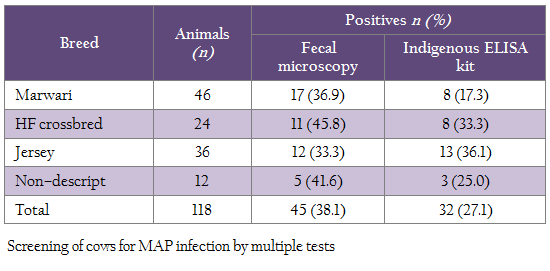
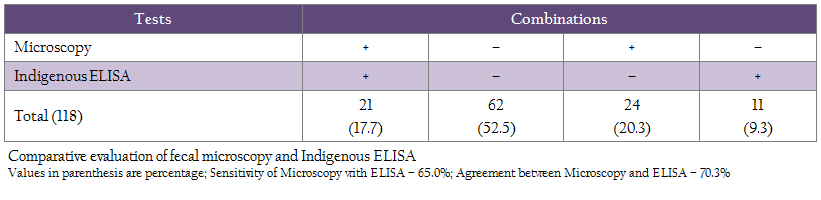
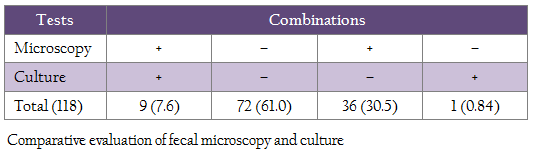
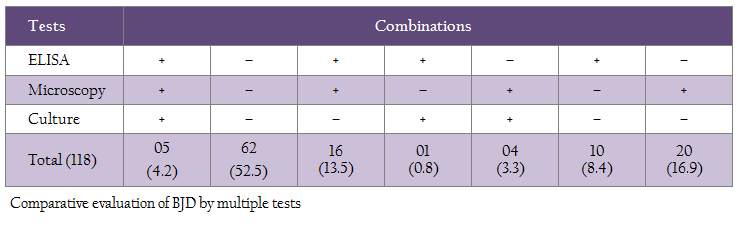
In the present study status of Mycobacterium avium (MAP) subspecies paratuberculosis (MAP) was estimated in cows belonging to a Goshala located at the Holy town of Barsana in Mathura district, wherein cows were suffering with clinical Bovine Johne’s Disease (BJD). Randomly 118 cows were sampled and screened for MAP. Of 118 fecal samples screened by microscopy and culture, 45 (38.1%) and 10 (8.4%) were positive for MAP infection, respectively. While screening of 118 serum samples by ‘Indigenous ELISA kit’, 32 (27.1%) were positive. Sensitivity of ‘fecal microscopy’ with respect to culture and Indigenous ELISA kit was 90.0 and 65.0%, respectively. Comparison of culture and Indigenous ELISA with ‘fecal microscopy’ revealed substantial agreement between two tests. Study showed that in the absence of sensitive and specific field based screening tests, microscopy would be a cost effective and useful test for the large scale screening of the domestic ruminants against BJD.
Key Words: Bovine Johne’s disease, Microscopy, ELISA, Culture