
This study aimed to determine the kinship and genetic diversity between Limousin and Madrasin cattle based on the sex determining region-Y (SRY) gene. SRY gene is used in the analysis of genetic diversity for sex determination based on the paternal pathway (Y chromosome). The DNA samples used for this study were 10 frozen straw of Limousin cattle and 10 samples of Madrasin cattle. The method used in this research was a descriptive analysis by duplex polymerase chain reaction and analyzing the results of the SRY gene sequencing of limousine cattle and Madrasin cattle. In the present study, we showed that the SRY gene of Madrasin cattle and Limousine cattle could be amplified with SRY F and SRY R primers with a PCR product length of 318 bp. Based on these results, Madura, Limousin, and Madrasin cattle had similarities based on the SRY gene (paternal pathway).
Short Communication · Volume 56, Issue 1, 23 December 2023 · Open Access
SRY Gene Based Kinship Relationship of Limousin and Madrasin Cattle
· · · · · · ·
Affiliations & Notes ⌄
- 1Department of Veterinary Reproduction, Faculty of Veterinary Medicine, Universitas Airlangga, Surabaya, East Java, Indonesia 2Research Centre for Applied Zoology, National Research and Innovation Agency (BRIN), Bogor, West Java, Indonesia 3Division of Pharmacology and Toxicology, School of Veterinary Medicine and Biomedical Sciences, IPB University, Bogor, West Java, Indonesia * Corresponding author: budi-u-2@fkh.unair.ac.id
Article Info ⌄
- Journal:
- Pakistan Journal of Zoology
- Published:
- 23 December 2023

Abstract
Materials and methods
The study was approved by Animal Care and Use Committee of Veterinary of Medicine Faculty, Universitas Airlangga (reference number: 1.KE.200.03.2021). This study was conducted from December 2021 to June 2022 at Faculty of Veterinary Medicine, Universitas Airlangga, Surabaya, Indonesia and National Research and Innovation Agency (BRIN), Bogor, Indonesia.
The DNA sampel used for this study were 10 frozen straw of Limousin cattle and 10 samples of Madrasin cattle. Two pairs of primers, forward and reverse were used for gene amplification, F 5-AAG GGG AGA ACA GTT AGG GAG A-3’ and R 5-ATC GGG TTG CAT AGT ATT GAA G-3’. For duplex polymerase chain reaction, 25 µl of PCR amplification reaction mixture contained 12.5 µl GoTag Green Master Mix (Promega), 2 µl DNA samples, 1 µl primer F (10 pmol), 1 µl primer R (10 pmol), and 8.5 µl nuclease-free water (Promega). The Duplex PCR program consisted of pre denaturation at 94º C for 5 min, denaturation at 94ºC for 30 sec, annealing at 60ºC for 30 sec, and extension at 72ºC for 30 sec with 45 repetitions of the cycle. After that, the cycle ends with the final extension of 72ºC for 10 min, followed by a hold time at a temperature of 4ºC.
The analyzed PCR products were conducted by electrophoresis on 1.5% agarose gel using SYBr dye (Invitrogen S7563, North America). Molecular markers (Ladder, Invitrogen) measuring 100 bp were electrophoresed together to determine the size of the PCR product. Furthermore, the gel electrophoresis results were observed using the gel documentation system and the size of the amplicon was determined using the software provided in the gel doc. Results can be seen at 318 bp. Determination of nucleotide sequences is carried out using DNA sequencing, which is the final step to obtain nucleotide sequence data from fragments resulting from the multiplication of DNA fragments. Single bands on an agarose gel as a PCR product were used as templates in the sequencing reaction using forward and reverse primers during amplification.
Analysis of the results of this sequencing was carried out by comparing the nucleotide base sequence of the sample with the nucleotide sequence of Madura cattle as the main reference using the Molecular Evolutionary Genetics Analysis (MEGA) 7 program.
Results and discussion
Figure 1 shows the genetic variation found among Madrasin cattle, Limousin cattle, and Madura cattle.
The nucleotide frequency of SRY gene sequences for Madrasin, Limousin, and Madura cattle is shown in Table I.
The construction of the phylogeny tree was used to see the kinship between Madrasin cattle, Limousin cattle, and Madura cattle. The results of the phylogenetic tree are presented in Figure 2 and the genetic distance matrix is shown in Table II.
Table I. Nucleotide frequency SRY genes in Madrasin, Limousin, and Madura cattle.
| Sample | Nucleotide frequency (%) | Total | |||
| T | C | A | G | ||
| MD1S SRY | 18.5 | 24.6 | 33.0 | 23.9 | 276 |
| MD2S SRY | 18.5 | 24.6 | 33.0 | 23.9 | 276 |
| MD3S SRY | 18.5 | 24.6 | 33.0 | 23.9 | 276 |
| L2S SRY | 18.5 | 24.6 | 33.0 | 23.9 | 276 |
| L1S SRY | 18.5 | 24.6 | 33.0 | 23.9 | 276 |
| M2S SRY | 18.5 | 24.6 | 33.3 | 23.6 | 276 |
| Avg. | 18.5 | 24.6 | 33.0 | 23.9 | 276 |
The results of this study have been conducted against the gene of sex determining region Y (SRY) Madura cattle, and Limousin cattle and obtained their Madrasin genetic variation. The sex determining Region Y gene variation was obtained from the similarity of the nucleotide sequences among the 5 cattle samples used in this study. The difference in the nucleotide sequence was only found in one base location of the Madura cattle sequence. The difference in base sequences between Madura and Madrasin cattle was obtained at location 225 where the base sequence A was only found in Madura cattle and G in Madrasin and Limousin cattle. The existence of Y chromosomes determines typically the sex in mammals. Male sex would be determined by the normal function of the Y chromosome gene or Sex-detremining region Y . Sex chromosomes (X and Y on mammals) are widely discussed as proof of genetic evolution. It could be seen from the similarity of the promoter of the SRY gene from different animal species . SRY gene polymorphism also been identified on Madura cattle, Friesian Holstein cattle, Sahiwal cattle, Bali cattle and Buffalo . The polymorphism showed specific alleles type which can be used as an effective genetic marker to detect crossbreeding between livestock based on the inherited mutation (polymorphism) similarity .
The SRY gene is a marker gene inherited from the male side (bull) and it is expected to be used as a marker to monitor the crossbreeding. The monitoring of those cattle is an initial effort to increase the genetic variation and enhance the genetic qualities without threatening the germplasm purity ; . The results of the phylogenetic tree of Madrasin, Limousin and Madura cattle based on SRY gene showed that it can be seen that Madrasin cattle have the same or almost the same genetics as Limousin cattle based on the SRY gene (the genetic distance between Madrasin and Limousin cattle is 0.000 while the genetic distance between Madrasin and Madura cattle is 0.003) but very far from Bos taurus (genetic distance 0.052) and Bos indicus. The genetic distance between the 5 research samples for Madrasin cattle codes 1 and 3 compared to Madura cattle is 0.003, while for Madrasin and Limousin cattle, the distance is very close or the same based on the SRY gene. The study of genetic variation in an organism, especially in livestock between types of organisms is very important because it relates to variations in phenotype. The phenotypic variation can be due to genetic variation or environmental variation or environmental and genetic variations. Knowledge of genetic variation has many
Table II. Genetic distance matrix of Madrasin, Limousin and Madura cattle based on SRY gene.
| MD1S_SRY | MD3S_SRY | L2S_SRY | L1S_SRY | |
| MD1S_SRY | ||||
| MD3S_SRY | 0.0000000000 | |||
| L2S_SRY | 0.0000000000 | 0.0000000000 | ||
| L1S_SRY | 0.0000000000 | 0.0000000000 | 0.0000000000 | |
| M2S_SRY | 0.0036335924 | 0.0036335924 | 0.0036335924 | 0.0036335924 |
useful applications. The application of this genetic variation, for example, to identify animals and find their origin, determine kinship and gene mapping ; .
To our knowledge, the current study genetic of variation can also be used as a basis for species conservation. Conservation of animal species is very important because many types of animals are currently threatened with extinction and the genes they carry may be useful in the future . Based on these study, it is assumed that there are the SRY genes of Madrasin cattle and Limousine cattle could be amplified with SRY F and SRY R primers with a PCR product length of 318 bp. Madura, Limousin, and Madrasin cattle have similarities based on the SRY gene (paternal pathway). The limitation of this study was taken during pandemic time. Thus, further detailed investigations of are necessary to research on associated genes that more comprehensive results can be collated in local Indonesian cattle.
Acknowledgments
This study was supported by Internal research grant of Faculty of Veterinary Medicine, Universitas Airlangga (602/PUF-UA/PT03/09/2019) and collaboration with Postdoctoral Program of National Research and Innovation Agency (BRIN) of Indonesia.
Statement of conflict of interest
The authors have declared no conflict of interest.
Figures
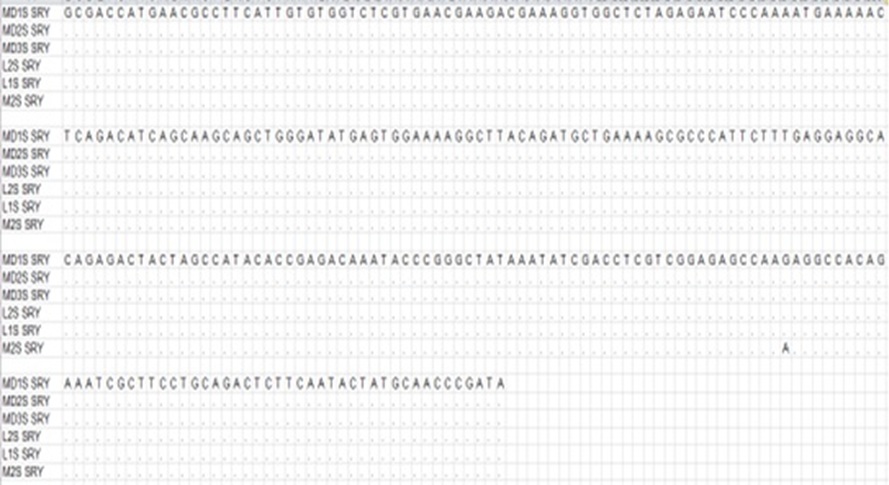
Alignment results in the nucleotide bases of Madrasin Cattle, Limousin Cattle, and Madura Cattle (MD1S SRY= Madrasin Cattle SRY Gene 1; MD2S SRY = Madrasin Cattle SRY Gene 2; MD3S SRY= Madrasin Cattle SRY Gene 3; L2S SRY= Limousin Cattle SRY Gene 2; L1S SRY= Limousin Cattle SRY Gene 1; M2S SRY= Madura cattle SRY gene).
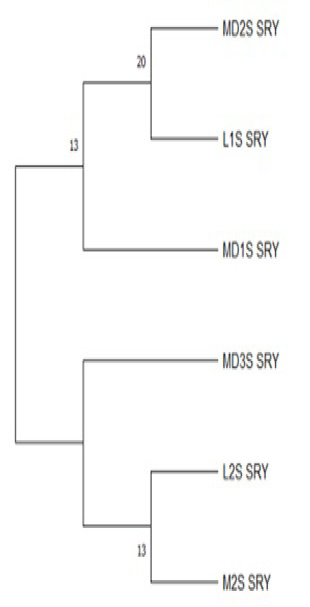
Phylogenetic tree of Madrasin, Limousin and Madura cattle based on SRY gene.
References
- Ahmad, H.I., Ahmad, M.J., Jabbir, F., Ahmar, S., Ahmad, N., Elokil, A.A., and Chen, J., 2020. Front. Ecol. Evol., 8: 130. https://doi.org/10.3389/fevo.2020.00103[CrossRef]
- Amin, M., 2021. AIP Conf. Proc., 2353: 030039.
- Arslan, K., Akyuz, B., Akcay, A., Ilgar, E.G., Macun, H.C., and Cinar, M.U., 2017. Slov Vet. Res., 54: 91-98.
- Bai, W.I., Yin, R.H., Zhao, S.J., Li, C., Ma, Z.J., Yin, R.L., and Zhao, Z.H., 2010. Fd. Contr., 21: 726-731. https://doi.org/10.1016/j.foodcont.2009.10.016[CrossRef]
- Casarini, L., and Crepieux, P., 2019. Front. Endocrinol. (Lausanne), 10: 305-315. https://doi.org/10.3389/fendo.2019.00305[CrossRef]
- Chang T.Y., Yanga, Y., Retzelc, E.F., and Liu, W.S., 2013. Proc. natl. Acad. Sci., 110: 12373-12378. https://doi.org/10.1073/pnas.1221104110[CrossRef]
- Cheng, Y., Huang, C., and Tsai, H., 2016. J. Vet. Med. Sci., 78: 281-286. https://doi.org/10.1292/jvms.15-0295[CrossRef]
- Ciptadi, G., Nasich, M., Budiarto, A., Nuryadi., and Nurgiatiningsih, V.M.A., 2021. Pak. Vet. J., 32: 624-626.
- Ellergen, H., 2011. Genetics, 12: 157-166. https://doi.org/10.1038/nrg2948[CrossRef]
- Hartatik, T., Priyadi, D.A., Agus, A., Bintara, S., Budisatria, I.G.S., Panjono, Ismaya, Widyobroto, B.P., and Adinata, Y., 2018. Bull. Anim. Sci., 42: 179-183. https://doi.org/10.21059/buletinpeternak.v42i3.29940[CrossRef]
- Kurtz, S., Lucas-Hahn, A., Schlegelberger, B., Gohring, G., Nietmann, H., Mettenleiter, T.C., and Petersen, B., 2021. Proc. natl. Acad. Sci. USA, 118: e2008743118. https://doi.org/10.1073/pnas.2008743118[CrossRef]
- Law, N.C., Donaubauer, E.M., Zeleznik, A.J., and Hunzicker-Dunn, M., 2017. Endocrinology, 1: 2043-2051. https://doi.org/10.1210/en.2017-00163[CrossRef]
- Leroy, G., Bumung, R., Boettcher, P., Besbes, B., From, T., and Hoffmann, I., 2018. Glob. Fd. Secur., 17: 84-91. https://doi.org/10.1016/j.gfs.2018.04.003[CrossRef]
- Leven, J.S.E., 2019. Front. Endrocinol., 10: 23-32.
- Mohammad, K., Olsson, M., Andersson, G., Purwantara, B., Van-Tol, H.T.A., Rodriquez-Martinez, H., Colenbrabder, B. and Lenstra, J.A., 2009. Reprod. Domest. Anim., 47: 2-6. https://doi.org/10.1371/annotation/e674f274-4378-47f1-97e1-f95a2d3bb59b[CrossRef]
- Raschia, M.A., Nani, J.P., Maizon, D.O., Beribe, M.J., Amadio, A.F., and Poli, M.A., 2018. J. Anim. Sci. Technol., 60: 31-41. https://doi.org/10.1186/s40781-018-0189-1[CrossRef]
- Siswijono, S.B., Nurgiartiningsih, V.M.A., Nugroho, B.A., Fanani, Z., and Winarno, P.S., 2017. Res. J. Pharm. biol. Chem., 8: 866-870.
- Utomo, B., Putranto, E.D., and Fadholly, A., 2020. Vet. World, 13: 879–883. https://doi.org/10.14202/vetworld.2020.879-883[CrossRef]
- Utomo, B., Rimayanti, R., Triana, I.N., and Fadholly, A., 2021. Vet. World, 14: 3224-3228. https://doi.org/10.14202/vetworld.2021.3224-3228[CrossRef]
- Weller, M.M.D.C.A., Fortes, M.R.S., Porto-Neto, L.R., Kelly, M., Venus, B., Kidd, L., Rego, J.P.A., Edwards, S., Boe-Hensen, G.B., Piper, E., Lehnert, S.A., Guiaraes, S.E.F., Moore, S.S., 2016. Front. Vet. Sci., 3: 94. https://doi.org/10.3389/fvets.2016.00094[CrossRef]
Services
Article usage statistics
Loading…