Research Article · Volume 11, Issue 4, 21 March 2023 · Open Access
Spirulina platensis Algae Enhances Endogenous Antioxidant Status, Modulates Hemato-Biochemical Parameters, and Improves Semen Quality of Growing Ram Lambs
· · · · · ·
Affiliations & Notes ⌄
1Department of Clinical Pathology, Faculty of Veterinary Medicine, Kafrelsheikh University, Kafrelsheikh, Egypt
2Department of Physiology, Faculty of Veterinary Medicine, Kafrelsheikh University, Kafrelsheikh, Egypt
3Department of Fish Processing and Biotechnology, Faculty of Aquatic and Fisheries Sciences, Kafrelsheikh University, Kafrelsheikh, 33516, Egypt
4Animal Production Research Institute, Agricultural Research Center, Egypt
5High Institute for Agricultural Co-Operation, Shoubra, Egypt
6Department of Animal Production, Faculty of Agriculture, Mansoura University, Mansoura, Egypt. *Correspondence | Abdel-Khalek E. Abdel-Khalek, Department of Animal Production, Faculty of Agriculture, Mansoura University, Mansoura, Egypt
The reports on the effects of dietary SPL on small ruminant performance are rare, so the goal of this study was to detect the impact of dietary incorporation of SPL alga on growth, hemato-biochemical parameters, antioxidant status, and semen quality of crossbred rams.
The obtained results indicated that final body weight gain significantly increased only for animals fed a diet supplemented with 5 g SPL/kg (G3) for 5 months, as a feeding period (10-15 month of age), in comparison with the controls.
We can conclude that the Spirulina platensis algae can be used safely as a potentially healthy feed for growing ram lambs as dietary incorporation at a level of 5 g/kg diet.
It can improve weight gain, hematology, liver and kidney function, lipid profile, semen characteristics, and lipid peroxidation in blood serum and seminal plasma of growing ram lambs from 10 up to 15 months of age.
Selected from the article's own text.
Abstract
Spirulina is generally used as a nutraceutical feed supplement due to its nutrient profile, lack of toxicity, and therapeutic effects. This study aimed to explore the effect of dietary inclusion of Spirulina platensis (SPL) algae on growth, hemato-biochemical parameters, antioxidant status, and semen quality of cross-bred lambs (½ Finnish × ½ Ossime). Twenty-four lambs aged 10 months with 32.93±0.48 kg LBW were distributed into three groups (8/group). Lambs in G1 (controls) were fed a basal diet without treatment. In G2 and G3, the daily diet was supplied with 1 and 5 g SPL /kg from 10 to 15 months of age. Dietary SPL supplementation significantly increased body weight, count of red and white blood cells, packed cell volume, and serum total protein, high-density lipoproteins, testosterone, and thyroid hormones (T3 and T4), and significantly decreased activity of aspartate and alanine transaminases (AST and ALT), triglycerides, cholesterol, low-density lipoproteins (LDL), very-LDL, and urea. Semen variables including semen volume, and percentages of sperm motility, livability, and abnormality as well as concentration and output of sperm cells were significantly by SPL. In serum and seminal plasma, glutathione, superoxide dismutase, catalase, and glutathione peroxidase significantly increased, while malondialdehyde significantly decreased in SPL groups. Based on our results, spirulina as a dietary feed additive (5 g/kg diet) could be used safely for improving growth, health, antioxidant defense system, and semen quality of growing cross-bred ram lambs from 10 to 15 months of age.
Animal reproduction is a crucial issue because of its impact on the overall benefits of the herd. Management of animal reproduction is the base of the achievement of good economic and productive performances for maximizing animal longevity (Maquivar et al., 2021). Fertility is one of the most crucial concerns in the flock for its impact on the productivity and economic aspects of the animal industry . Selection and acquisition of males, and well-managed tools of males at mating and pre- and post-breeding season, are representing challenges for using males either in natural or artificial insemination . In sheep flock, healthy status, and the nutritional and environmental factors affect the productivity of ram lambs or rams .
Male infertility is caused by the harmful effects of oxidative stress which causes damage to the germ cells and sperm function development . The antioxidant defense system can protect the body cells against the deleterious effects of reactive oxygen species (ROS) produced by exogenous agents, so increasing ROS generation over the ability of the intracellular antioxidant defense system causes the oxidative stress .
Spirulina platensis (Arthrospira platensis), a blue-green microalga, family Oscillatoriaceae, is considered a source of proteins and vitamins , and has properties as antioxidant, anticancer, anti-apoptotic, anti-inflammatory, antiviral, immunomodulatory , anti-apoptotic, antiviral, and immunomodulatory . Also, it contains 50–70% proteins, all essential amino acids, vitamins, minerals (Zn, Mg, and Se), phycocyanin, tocopherols, phenolics, carotenoids, and fatty acids, especially γ-linolenic acid , and carotenoids which have impacts on fertility in many species . In diet of different species of fishes, SPL was added as an alternative natural carotenoid source .
To our knowledge, there are few research reports on the effects of dietary Spirulina on small ruminant productivity. Therefore, the current research aimed to detect the impact of dietary incorporation of Spirulina platensis alga on growth, hemato-biochemical parameters, antioxidant status, and semen quality of crossbred growing rams.
MATERIALS AND METHODS
This current study was conducted within the framework of scientific and research cooperation between Animal Production Research Institute (APRI), Agricultural Research Center, Egypt and Faculty of Veterinary Medicine Kafrelsheikh University, Egypt.
Animals
Clinically normal twenty-four growing rams taken from the flock of Sakha Animal Production Research Station, Egypt were served as experimental animals, At the beginning of the experiment, animals have 32.93±0.48 kg body weight and aged 10 months. The experimental animals were in good health status, clinically free of external and internal parasites, and normal external genitalia. Animals were housed in a hygienic pen. Animal management and handling during the whole experiment and blood samples were collected by an expert veterinarian.
Experimental groups
The experimental animals (n=24) were randomly distributed to 3 groups, 8/group. Animals in the 1st group were fed on corn silage and concentrate without any additives (G1, control), while G2 and G3 were fed the same diet with SPL at levels of 1 and 5 g/kg concentrate feed mixture CFM), respectively, from 10 to 15 months of age. The CFM was a mixture of wheat bran (40%), ground yellow corn (35%) undecorticated cottonseed meal (19%), molasses (3%), limestone (2%) and common salt (1%). The feeds were offered to animals to cover their requirements according to NRC (2007). The amounts of feeds were adjusted based on body weight changes and the physiological state while water was provided ad libitum.
Experimental procedures
Live body weight and scrotal measurements
Throughout the experimental period from 10 to 15 months of age, animals were individually weighed (bi-weekly) electronically by digital balance, then the scrotal circumference of each animal was measured at the median region of both testes using a tape.
Semen collection and evaluation
At the beginning of the experimental period (10 months of age), semen ejaculates were collected once/week from all animals in each group up to 15 months of age, then the averages of semen characteristics were monthly calculated. Semen was collected by an artificial vagina of rams. Evaluation of semen included ejaculate volume, and sperm initial motility , live sperm (Eosin and Nigrosin stain), and abnormal sperm percentages. Neubeuer hemocytoometer was used for determining sperm count microscopically, while total sperm count was computed by multiplying sperm concentration by ejaculate volume. Seminal plasma was obtained by centrifugation of semen samples at 700 g for 20 min, then stored at -20 oC until analysis.
Blood sampling
At the terminal of the experimental period (15 months of age), blood samples were taken from the jugular vein of all animals in each group into two types of test tubs. The 1st type, blood samples were collected into test tubs containing EDTA, as an anticoagulant, for hematological parameters. The 2nd samples were taken in plain centrifuge tubes without anticoagulants. Blood serum was obtained after clotting (2-3 h) and centrifugation (3000 g for 15 min) and stored (-20 °C) for further analysis of biochemicals, hormones, lipid peroxidation, and antioxidant markers.
Analytical procedures
Hematological parameters
In the 1st blood samples (the whole blood), blood samples expose to determining the count of red (RCBs) and white (WBCs) blood cells, packed cell volume (PCV), and hemoglobin concentration (Hb). Also, erythrocytic indices including means of corpuscular volume (MCV), corpuscular hemoglobin (MCH), and corpuscular hemoglobin concentration (MCHC) as well as differential counts of WBCs (lymphocytes, monocytes, neutrophils, eosinophils, and basophils) were measured by using automated blood cells counter with an Auto Hematology Analyzer (Sysmex F-800, Japan) according to .
Serum biochemical parameters and enzyme activity
In the serum of the 2nd blood samples, total protein and albumin concentrations were estimated, while globulin was calculated. Serum triglycerides and total cholesterol was determined according to Richmond (1973), high density lipoproteins (HDL) according to , while low density lipoproteins (LDL), and very LDL (VLDL) concentrations were calculated according to an equation . Serum urea and creatinine were assayed according Henry et al. (1974) and Fabiny and Einghausen (1971), respectively. The activity of aspartate aminotransferase (AST) and alanine aminotransferase (ALT) was measured as described by Reitman and Frankel (1957). Serum biochemical determinations were performed by spectrophotometer and chemical kits (Bio diagnostics, Cairo, Egypt).
Lipid peroxidation and antioxidant enzymes
Lipid peroxidation in terms of malondialdehyde level and activity of antioxidant enzymes such as superoxide dismutase , catalase , and glutathione peroxidase were determined in blood serum and the seminal plasma using chemical kits (Biodiagnostics, Cairo, Egypt).
Hormonal profiles
The enzyme-linked immunosorbent assay (ELISA) was used to determine serum and seminal plasma testosterone and serum thyroid hormones (triiodothyronine, T3, and tetraiodothyronine, T4) by using commercial kits (DRG Diagnostics GmbH, Marburg, Germany following the manufacturer’s instructions (DRG Diagnostics).
Statistical analysis
The results were tabulated as the means±standard error. One-way ANOVA was used to study the effect of treatment on all parameters studied, except for semen variables. Factorial design (3 treatments x 6 ages) was used to study the effect of three treatments, 6 ages, and their interaction on all semen variables. A computer program (SAS, 2009) was used for the statistical analysis. The significant differences in means of treatment or age were tested using Multiple Range test of Duncan (1955). All means were set at a level of P < 0.05.
RESULTS
Live body weight
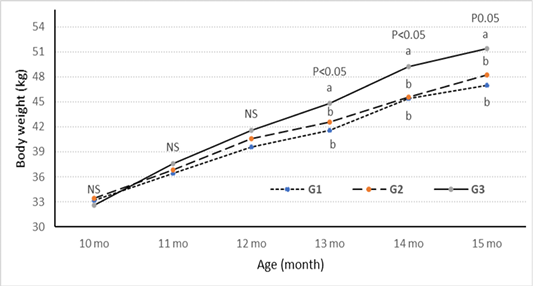
Results of growth changes (Figure 1) revealed a significant improving effect of Spirulina (SPL) supplementation in a dose-response manner on the live body weight of animals starting at 13 months of age, reflecting higher total weight gains in G3 than in G1 and G2 at 13, 14, and 15 months of age.
Scrotal circumference
The differences in the scrotal circumference of animals in the experimental groups were not significant at all ages (Table 1).
Table 1: Average scrotal circumferences (cm) of animals fed the experimental diets.
Age (month)
Scrotal circumferences (cm)
G1 (Control)
G2 (1 g/kg)
G3 (5 g/kg)
10
21.42±0.67
21.61±0.77
22.32±0.44
11
23.40±0.66
23.20±0.86
24.00±0.31
12
25.60±0.86
25.40±0.97
25.60±0.64
13
27.20±1.35
27.80±1.15
28.20±1.02
14
28.80±1.64
29.20±0.37
31.20±0.80
15
30.00±1.50
31.40±0.50
31.80±0.66
Table 2: Hematological findings of animals in the experimental groups at the end of the experimental period.
Parameter
Experimental group
G1 (Control)
G2 (1 g/kg)
G3 (5 g/kg)
P value
RBCs (x106/μl)
10.57± 0.315b
11.75± 0.348a
11.92± 0.359a
0.044
Hb (gm/dl)
11.13± 0.335b
12.13±0.237a
12.26±0.323a
0.010
PCV (%)
29.33±0.881b
32.00±1.73a
32.667±1.20a
0.046
MCV (fl)
27.755±0.287
27.366±2.29
27.59±1.963
0.988
MCH (pg)
10.539±0.468
10.307±0.264
10.32±0.350
0.886
MCHC (%)
37.947±1.307
38.288±3.755
37.688±2.162
0.987
WBC (x103/μl)
7.66±0.463b
8.22±0.483a
8.59±0.379a
0.034
Neutrophils (x103/μl)
1.54±0.102
1.66±0.283
1.68±0.073
0. 056
Lymphocytes (x103/μl)
5.14±0.652
5.45±0.319
5.80±0.409
0.053
Monocytes (x103/μl)
0.75±0.137
0.83±0.102
0.86±0.088
0.054
Eosinophils (x103/μl)
0.155±0.053
0.172±0.061
0.17±0.007
0.854
Basophils (x103/μl)
0.080±0.056
0.11±0.037
0.08±0.022
0. 640
a and b: Means within the same row with different superscripts are significantly different (P<0.05). RBCs: Red blood cells count. Hb: Hemoglobin. PCV: Packed cell volume. MCV: Mean corpuscular volume. MCH: Mean corpuscular hemoglobin. MCHC: Mean corpuscular hemoglobin concentration. WBCs: White blood cells count.
Table 3: Serum biochemical analysis of animals in different experimental groups at the end of the experimental period.
Item
Experimental group
p value
G1(Control)
G2 (1 g/kg)
G3 (5 g/kg)
Total protein (g/dl)
5.167±0.231c
5.715±0.238b
6.093±0.563a
0.050
Albumin (g/dl)
1.457±0.124
1.450±0.032
1.460±0.084
0.997
Globulin (g/dl)
3.71±0.353
4.27±0.250
4.63±0.600
0.059
ALT (U/mL)
31.00±2.516a
27.66±2.403b
26.00±2.041b
0.040
AST (U/mL)
47.33±2.044a
42.33±2.173b
40.33±1.856b
0.037
Urea (mg/dl)
51.29±3.61a
49.30±0.683b
47.93±0.645c
0.050
Creatinine
0.776±0.061
0.673±0.056
0.770±0.072
0.058
TG (mg/dl)
130.74±2.994a
124.45±3.083ab
116.59±5.245b
0.014
TC (mg/dl)
98.71±3.44a
91.69±2.532b
87.017±3.389b
0.048
HDL (mg/dl)
42.73±9.758c
46.96±0.232b
57.07±2.285a
0.027
LDL (mg/dl)
29.83±3.073a
19.83±5.544b
6.62±4.221c
0.040
v-LDL(mg/dl)
26.14±0.998a
24.89±0.816b
23.31±1.049b
0.041
a, b, and c: Means within the same row with different superscripts are significantly different (P<0.05). A/G ratio: Albumin/globulin ratio. TG: Triglycerides. TC: Total cholesterol. HDL: High-density lipoprotein. Low-density lipoprotein. V-LDL: Very low-density lipoprotein. AST: Aspartate aminotransferase. ALT: Alanine aminotransferase.
Hematological findings
The count of RBCs and WBCs, Hb concentration, and PCV% were significantly enhanced in G2 and G3 compared with G1. However, RBCs indices including MCV, MCH, and MCHC in addition to the count of neutrophils, lymphocytes, monocytes, eosinophils, and basophils were not affected significantly by treatments (Table 2).
Serum constituents
Results in Table 3 declared that SPL administration significantly increased the concentration of serum total protein and HDL-cholesterol, and significantly decreased the concentration of total cholesterol, LDL, v-LDL, and urea as well as the activity of AST and ALT in blood serum of animals as compared to control. However, triglyceride concentration significantly increased only in G3 as compared to other groups. The differences in albumin, globulin, and creatinine concentrations were not significant. Despite these results, SPL exhibited the best effect on serum biochemical and enzyme activity in G3 as compared to G2.
Semen production
Dietary inclusion of both levels of SPL revealed a significant increase in the overall mean of ejaculate volume (EV),
Table 4: Semen variables of ram lambs as affected by SPL treatment.
Group
Semen characteristics
EV (ml)
SM (%)
SL (%)
AS (%)
SCC (×109/ml)
TSO (×109/ejac.)
G1
0.72±0.03c
74.00±0.87c
72.83±0.91b
12.1±0.40a
2.37±0.07c
1.78±0.12b
G2
0.78±0.04b
76.00±1.02b
74.53±0.93a
11.36±0.39ab
2.51±0.08b
2.04±0.14ab
G3
0.84±0.04a
77.66±1.00a
75.6±0.90a
10.68±0.53b
2.65±0.10a
2.37±0.19a
a, b, and c: Means within the same column with different superscripts are significantly different at (P<0.05). EV: Ejaculate volume. SM: Sperm motility. SL: Sperm livability. SCC: Sperm cell count. TSO: Total sperm output.
Table 5: Semen variables of ram lambs as affected by animal age.
Semen characteristics
Age (month)
10
11
12
13
14
15
EV (ml)
0.48±0.00f
0.63±0.02e
0.77±0.01d
0.85±0.01c
0.92±0.02b
1.04±0.03a
SM (%)
68.00±0.65e
72.33±0.66d
75.00±0.84c
78.33±0.79b
80.33±0.82b
81.33±0.72a
SL (%)
66.46±0.68e
70.86±0.59d
74.20±0.50c
76.53±0.80b
78.60±0.56a
79.26±0.58a
AS (%)
14.93±0.47a
12.86±0.42b
11.53±0.40c
10.33±0.41d
9.86±0.30ed
9.13±0.36e
SCC (×109/ml)
1.82±0.03f
2.08 ±0.05e
2.45±0.06d
2.72±0.18c
2.91±0.70b
3.09±0.77a
TSO (×109/ejac.)
0.90±0.02f
1.31±0.06e
1.90±0.08d
2.32±0.09c
2.70±0.11b
3.26±0.16a
a, b, f: Means within the same row with different superscripts are significantly different (P<0.05). EV: Ejaculate volume. SM: Sperm motility. SL: Sperm livability. SCC: Sperm cell count. TSO: Total sperm output
Table 6: Lipid peroxidation biomarker (MDA) and antioxidant enzyme activity in blood serum and seminal plasma of animals in different experimental groups at the end of the experimental period.
Item
Experimental groups
P value
G1(Control)
G2 (1 g/kg)
G3 (5 g/kg)
Blood serum
MDA (nmol/ml)
20.90±0.668a
16.63±0.493b
15.20±0.553b
0.001
GSH (nmol/ml)
7.12±0.36b
8.82±0.410a
9.610±0.370a
0.048
SOD (U/ml)
8.63±0.181b
10.11±0.569a
10.57±0.436a
0.042
CAT (U/ml)
10.21±0.423b
11.02±0.756a
12.15±0.866a
0.040
GPX (pg/ml)
53.67±2.727b
62.44±4.241a
66.90±3.391a
0.017
Seminal plasma
MDA (nmol/mL)
2.99±0.091a
2.44±0.201b
2.06±0.107c
0.050
GSH (nmol/mL)
9.61±0.239c
10.447±0.430b
11.67±0.369a
0.041
SOD (U/mL)
6.343±0.381c
8.207±0.814b
9.833±0.723a
0.056
CAT (U/mL)
33.91±2.05c
39.77±0.179b
46.44±3.567a
0.017
GPX (Pg/mL)
61.96±2.276c
71.91±1.974b
79.57±2.632a
0.050
, ba and c: Means within the same row with different superscripts are significantly different (P<0.05). MDA: Malonaldehyde. GSH: Reduced glutathione. SOD: Superoxide dismutase. CAT: Catalase. GPx: Glutathione peroxidase.
sperm motility (SM), sperm livability (SL), and sperm cell concentration (SCC). However, the overall mean of all semen characteristics was significantly improved in G3 as compared to G2 and G1, in terms of increasing EV, SM, SL, SCC, and total sperm output (TSO), and decreasing abnormal sperm (AS, Table 4).
As affected by age, the overall mean of EV, SM, SL, SCC, and TSOD significantly increased, while AS significantly decreased by age advancing from 10 up to 15 months of age (Table 5).
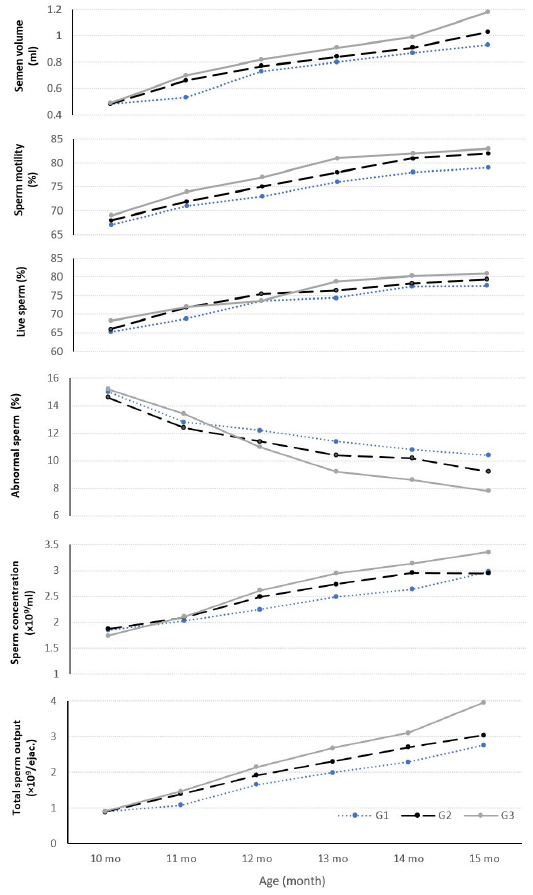
Analysis of variance revealed that the effect of interaction between group x age was not significant on all semen characteristics, indicating the superiority of animals in G3, followed by those in G2 in comparison with controls at all ages studied (G1, Figure 2).
Testosterone profile in serum and semen plasma
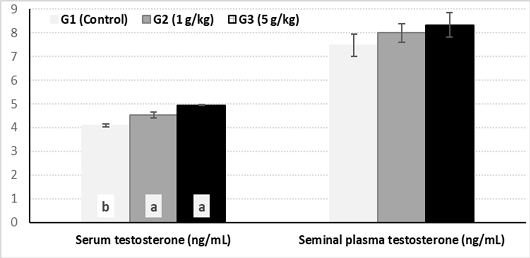
Results illustrated in Figure 3 showed that SPL treatment significantly affected testosterone concentration in blood serum, while testosterone concentration in the seminal plasma was not affected by SPL treatment. SPL at both levels (G2 and G3) significantly increased serum testosterone as compared to the control.
Antioxidant status of serum and semen
Dietary SPL supplementation showed significant enhancement in lipid peroxidation and antioxidant enzymatic activities in blood serum and seminal plasma of animals. The level of malondialdehyde (MDA) was significantly reduced, while the activity of GSH, SOD, CAT, and Gpx significantly increased in the serum and seminal plasma of animals in G2 and G3 compared with G1. The highest level of SPL in G3 (1 g/kg) showed significantly more benefits on MDA level and antioxidant enzyme activity in the seminal plasma (Table 6).
Thyroid hormone profile in blood serum
Dietary incorporation of SPL (1 and 5 g/kg) revealed a remarkable and significant enhancement in serum concentrations of triiodothyronine (T3) and thyroxine (T4) compared with the control (Table 7).
DISCUSSION
SPL was incorporated in the diets of fish, shrimp, and poultry as a protein and vitamin complement to aqua feeds . The reports on the effects of dietary SPL on small ruminant performance are rare, so the goal of this study was to detect the impact of dietary incorporation of SPL alga on growth, hemato-biochemical parameters, antioxidant status, and semen quality of crossbred rams. In the current study, we hypothesized that dietary inclusion of SPL, with its potent antioxidative properties, could have beneficial effects on the semen quality of animals. The obtained results indicated that final body weight gain significantly increased only for animals fed a diet supplemented with 5 g SPL/kg (G3) for 5 months, as a feeding period (10-15 month of age), in comparison with the controls. The positive impacts of SPL administration on weight gain were reported in Santa Inês ram lambs , growing rabbits , and even in the broilers . Also, SPL supplementation improved weight gains in both dams and offspring . Moreover, SPL exhibited an important role in boosting body weight and carcass yield in lambs , rabbits , and poultry . The positive effect of SPL on health and production may be attributed to the high nutritional value of SPL. Also, SPL may stimulate extracellular enzymes the release of via the microbiota in the gut to improve weight gain in growing lambs . In ruminants, SPL could reduce degradation of protein resulting in alterations in diversity of bacteria and elevating the synthesis of microbial protein synthesis in the rumen . Also, SPL reduced the retention time of microbial crude
Table 7: Thyroid hormones in blood serum of animals in different experimental groups at the end of the experimental period.
Item
Experimental group
P value
G1 (Control)
G2 (1 g/kg)
G3 (5 g/kg)
T3 (ng/dL)
112.67±3.283b
121.00±3.163a
125.00±2.309a
0.042
T4 (pmol/L)
8.753±0.372b
9.780±0.031a
10.487±0.535a
0.050
a and b Means within the same row with different superscripts are significantly different (P<0.05). T3: Triiodothyronine. T4: Tetraiodothyronine (thyroxin).
protein in the rumen . About 20% of dietary SPL escape from the degradation in the rumen being available within the abomasum for the direct absorption ; ; . SPL is a rich source of calcium, iron, beta carotene, and protein with abundant in micro- and macro-nutrients, as well as having strong nutritional properties . SPL reacts as a usable food sustaining favorable intestinal microflora. It is well known that the testicular size is concerning animal live body weight. In our study, there is an association of increased live body weight of animals in SPL-groups (not significant in G2 and significant in G3), with a tendency of increase in scrotal circumference (testicular size) as compared to controls, but these increases were not significant.
Concerning the hematological findings, we detected that erythrogram and leukogram variables significantly increased in animals fed both SPL levels compared with the controls. The improving the hematological variables in our study may be due to the rich content of SPL from crude protein, vitamin B12, Fe, and essential macro- and micro-elements (El-Deeb et al., 2023). Our results are in accordance with the results of El-Sabagh et al. (2014), who indicated that SPL supplementation increased the total leukocytic count of fattening lambs. SPL increased leucocytes chickens and fish (Watanuki et al., 2006). Increased WBCs production might be related to phycocyanin and polysaccharides contents in SPL supplemented to animals . These findings may be in parallel with improving the immune response through measuring WBCs. Watanuki et al. (2006) found that SPL enhanced animal immunity and antibody production in mice. Also, SPL was found to strengthen the immune response by stimulating function of macrophages (monocytes), phagocytes (monocytes and neutrophils), and immunoglobins . Therefore, SPL is considered as a natural antioxidant and immune stimulant for human and animal without adverse effects in comparison with the synthetic antioxidant ; .
In our study, serum biochemical observations revealed normal hepatic synthetic function through enhanced serum total protein, with normal albumin concentration, and non-significant changes in serum hepatic injury biomarkers (AST and ALT) in both SPL groups. Also, SPL had a significant impact on kidney function via a reduction in urea and creatinine concentrations in blood serum, but SPL at a level of 5 g/kg showed the best results. SPL protects rats against nephrotoxicity by reducing concentration of urea and creatinine. Dietary SPL administration has the ability to decrease cytokine tumor necrosis factor-alpha (TNF-α) and cyclooxygenase-2 to protect liver and kidney functions . SPL contains phenolic antioxidants and C-phycocyanin targeting Nrf2 and NF-κB pathways and heptadecanewhich decrease activity of NF-κB ; . These findings proved the ability of SPL to protect hepatic-renal sfunction. Moreover, containing SPL blue pigment phycocyanin reduces the hepatic toxicity induced by paracetamol-free radicals . Presence of SOD, β-carotene, Se, or vitamins in SPL have immune-stimulant properties ; . Improving kidney function by SPL in the current paper may be attributed to triterpenes and flavonoids in SPL as an antioxidant . In addition, positive effects of SPL on lipid profile were in dose-response pattern. Similar results were reported in sheep and cows , whereas SPL decreased concentration of total lipid, total cholesterol, and triglycerides and raised HDL. SPL has anti-lipidemic and anti-hyperglycemia actions by decreasing glucose, cholesterol, and triglycerides, and increasing insulin resistance . The hypolipidaemic activity of SPL may be due to β-carotene and linolenic acid in SPL; both affect synthesis of the cholesterol. In this context, SPL reduced cholesterol in rabbits fed a diet containing high cholesterol level . Phycocyanin in SPL likes to bile acids in the jejunum, and reduced absorption of cholesterol .
According to the obtained results, dietary administration of SPL significantly improved semen quality in terms of increasing EV, SM, SL, SCC, and TSO, and decreasing AS, particularly, in ejaculates of animals in fed 5 g SPL/kg diet as compared to those fed 1 g/kg or the controls. Oral SPL administration improved the mercury-induced toxicity in the reproductive system of male rats . In accordance with our results, a significant increase in sperm motility and the count was found after treatment with SPL in rats ; . It is of interest to note that improving ejaculate volume and semen quality by SPL is associated with increased weight gain testosterone level significantly in blood serum and a tendency of increase in the seminal plasma. The impact of SPL on the reproduction may be due by regulating the reproductive hormones or/and by inhibiting the oxidative stress via decreasing ROS, and raising antioxidant enzyme capacity . Concerning the antioxidant status of dietary SPL administration, our results showed that SPL incorporation enhanced the endogenous antioxidant status through a remarkable enhancement in enzyme activities of GSH, SOD, CAT, and GPx, and decreased lipid peroxidation by reducing MDA levels in a dose-manure pattern in both blood serum and the seminal plasma compared with the unsupplied control group. As such, we detected an improvement in lipid peroxidation marker by decreasing the MDA level and increasing the activity of antioxidant enzymes (GSH, SOD, CAT, and GPx) in blood serum and seminal plasma in SPL treatment groups, but the highest level of SPL showed more impact on the seminal plasma than in blood serum. In accordance with the obtained results, SPL has antioxidants contents such as phycocyanin, polysaccharides, α-tocopherol and ß-carotene with potent antioxidant capacities , and SOD which reduce ROS . As proven in our study, Wu et al. (2016) mentioned that SPL treatment increased GSH, CAT, and SOD activities and decreased level of MDA which indicate the antioxidant, immunological, and anti-inflammatory activities of SPL . Generally, Ibrahim and Abdel-Daim (2015) reported non-toxic, bio-available, and potent antioxidant capacity of SPL. In chemoprevention, phycocyanin and Se derived from SPL can exert potent antioxidant capacity to reduce the lipid peroxidation . Also, C-phycocyanin and carotenoids in may help in improving animal reproduction .
Moreover, we observed additional benefits of SPL on serum concentration of T3 and T4. In association with the amelioration in the level of thyroid hormones by SPL treatment, there was an in attenuation of oxidative stress in the thyroid tissues by decreasing caspase-3 activity and DNA damage . The contents in SPL may also eliminate inflammatory gene expression in splenocytes by inhibition of the Toll-like receptor 4 signaling pathways. Moreover, increasing γ-linolenic acid in SPL can decrease LPS-induced inflammatory gene expression in monocytes and macrophages . Organic extract of SP represses TNF-α expression and secretion in macrophages . Spirulina displays high antioxidant and anti-inflammatory activities with numerous neutralizing and oxidative effects on free radicals and heavy metals .
CONCLUSIONS AND RECOMMENDATIONS
We can conclude that the Spirulina platensis algae can be used safely as a potentially healthy feed for growing ram lambs as dietary incorporation at a level of 5 g/kg diet. It can improve weight gain, hematology, liver and kidney function, lipid profile, semen characteristics, and lipid peroxidation in blood serum and seminal plasma of growing ram lambs from 10 up to 15 months of age.
Novelty Statement
The effect of dietary incorporation of Spirulina platensis (SPL) alga during the pre-pubertal stage (15-16 month of age) on improving the growth, health, antioxidant status, and semen quality of ram lambs raised for natural mating or artificial insemination.
AUTHOR’S CONTRIBUTION
Substantial contributions to conception and design DHA, MME-M, AEA, and RAA-W. Acquisition of data ZIE, HKZ, and AEA. Analysis and interpretation of data DHA, MME-M, AAE-B, RAAW and AEA. Statistical analyses RAAW, AAE-B, HKZ and AEA. Drafting of the manuscript DHA, AEA, MME-M and ZIE. Critically revising the manuscript for important intellectual content, AEA, DHA, MME-M and AAE-B. Final approval of the manuscript for publication (all authors).
Animal welfares statement
The experimental procedures were carried out in accordance with Directive 2010/63/EU of the European Parliament and of the Council of 22 September 2010 on the protection of animals used for scientific purposes.
Conflict of interest
The authors have declared no conflicts of interest.
Figures
Figure 1:.
Change in live body weight of animals in the experimental groups at different ages. (a and b: Means at each age with different superscripts are significantly different at P<0.05; NS: non-significant differences).
Figure 2:.
Change in semen characteristics of ram lambs in the experimental groups at different ages.
Figure 3:.
Testosterone profile in blood serum and seminal plasma of animals in different experimental groups at the end of the experimental period. (Means with different superscripts are significantly different at P<0.05).
References
Abdel-Daim M, El-Bialy BE, Rahman HGA Haidy, Radi AM, Hefny HA, Hassan AM (2016). Antagonistic effects of Spirulina platensis against sub-acute deltamethrin toxicity in mice: biochemical and histopathological studies. Biomed. Pharmacother, 77: 79–85. https://doi.org/10.1016/j.biopha.2015.12.003[CrossRef]
Abell LL, Levy BB, Brodie BB, Kendall FE (1952). A simplified method for the estimation of total cholesterol in serum. J. Biol. Chem., 195: 357-366. https://doi.org/10.1016/S0021-9258(19)50907-3[CrossRef]
Afkhami-Ardakani M, Hasanzadeh S, Shahrooz R, Delirezh N, Malekinejad H (2018). Antioxidant effects of Spirulina platensis (Arthrospira platensis) on cyclophosphamide-induced testicular injury in rats. Vet. Res. Forum, 9(1): 35–41.
Anvara AA, Nowruzib B (2021). Bioactive properties of spirulina: A review. E134–E142 Microbial Bioactives. https://doi.org/10.25163/microbbioacts.412117B0719110521[CrossRef]
Belay A (2002). The potential application of Spirulina (Arthrospira) as a nutritional and therapeutic supplement in health management, Review. J. Am. Nutr. Assoc., 5(1): 27-48.
Beltman M (2013). Ovine reproductive management: More than just counting sheep. Vet. Rec., 173: 604–605. https://doi.org/10.1136/vr.f7533[CrossRef]
Bezerra LR, Silva AMA, Azevedo SA, Mendes RS, Mangueira JM, Gomes AKA (2010). Performance of Santa Inês lambs submitted to the use of artificial milk enriched with Spirulina platensis. Ciência Anim. Bras., 11(2): 258-263. https://doi.org/10.5216/cab.v11i2.1198[CrossRef]
Bhat VB, Madyastha KM (2001). Scavenging of peroxynitrite by phycocyanin and phycocyanobilin from Spirulina platensis: Protection against oxidative damage to DNA. Biochem. Biophys. Res. Commun., 285: 262–266. https://doi.org/10.1006/bbrc.2001.5195[CrossRef]
Buttarello M (2004). Quality specification in haematology: The automated blood cell count. Clin. Chim. Acta, 346(1): 45-54. https://doi.org/10.1016/j.cccn.2004.02.038[CrossRef]
Chang CS, Sun HL, Lii CK, Chen HW, Chen PY, Liu KL (2010). Gamma-linolenic acid inhibits inflammatory responses by regulating NF-kappaB and AP-1 activation in lipopolysaccharide-induced RAW 264.7 macrophages. Inflammation, 33: 46–57. https://doi.org/10.1007/s10753-009-9157-8[CrossRef]
Chen T, Wong YS (2008). In vitro antioxidant and antiproliferative activities of selenium-containing phycocyanin from seleniumenriched Spirulina platensis. J. Agric. Food Chem., 56(12): 4352–4358. https://doi.org/10.1021/jf073399k[CrossRef]
Cocuzza M, Athayde KS, Agarwal A, Pagani R, Sikka SC, Lucon AM, Srougi M, Hallak J (2008). Impact of clinical varicocele and testis size on seminal reactive oxygen species levels in a fertile population: A prospective controlled study. Fertil. Steril., 90: 1103–1108. https://doi.org/10.1016/j.fertnstert.2007.07.1377[CrossRef]
Colla LM, Muccillo-Baisch AL, Costa JAV (2008). Spirulina platensis effects on the levels of total cholesterol, HDL and triacylglycerols in rabbits fed with a hypercholesterolemic diet. Braz. Arch. Biol. Technol., 51(2): 405-411. https://doi.org/10.1590/S1516-89132008000200022[CrossRef]
Correia S, Vaz CV, Silva AM, Cavaco JE, Socorro S (2017). Regucalcin counteracts tert-butyl hydroperoxide and cadmium-induced oxidative stress in rat testis. J. Appl. Toxicol., 37: 159–166. https://doi.org/10.1002/jat.3333[CrossRef]
Dalle Zotte A, Cullere M, Sartori A, Szendrő Z, Kovàcs M, Giaccone V, Dal Bosco A (2014). Dietary spirulina (Arthrospira platensis) and thyme (Thymus vulgaris) supplementation to growing rabbits: Effects on raw and cooked meat quality, nutrient true retention and oxidative stability. Meat Sci., 98(2): 94-103. https://doi.org/10.1016/j.meatsci.2014.05.005[CrossRef]
Duncan DB (1955). Multiple range and multiple F–test biometrics, Biometrics,. 11: 10. https://doi.org/10.2307/3001478[CrossRef]
Ebrahim RM (2020). Prophylactic effect of Spirulina platensis on radiation-induced thyroid disorders and alteration of reproductive hormones in female albino rats. Int. J. Radiat. Res., 18(1): 83-90.
El-Deeb MM, Megahed A, Abdel-Hafez MAM, Fatma ES, Ibrahim EMM (2023). Effect of adding Spirulina platensis algae to small ruminant rations on productive, reproductive traits and some blood components. Acta Sci. Anim. Sci., 45: e57546. https://doi.org/10.4025/actascianimsci.v44i1.57546[CrossRef]
El-Desoky GE, Bashandy SA, Alhazza IM, Al-Othman ZA, AboulSoud MA, Yusuf K (2013). Improvement of mercuric chlorideinduced testis injuries and sperm quality deteriorations by Spirulina platensis in rats. PLoS One, 8(3): e59177. https://doi.org/10.1371/journal.pone.0059177[CrossRef]
El-Sabagh MR, Abd Eldaim MA, Mahboub DH, AbdelDaim M (2014). Effects of Spirulina platensis algae on growth performance, antioxidative status and blood metabolites in fattening lambs. J. Agric. Sci., 6(3): 92. https://doi.org/10.5539/jas.v6n3p92[CrossRef]
El-Sayed ES, Hikal M, Abo El-Khair B, El-Ghobashy R, El-Assar A (2018). Hypoglycemic and hypolipidemic effects of Spirulina platensis, phycocyanin, phycocyanopeptide and phycocyanobilin on male diabetic rats. Arab Univ. J. Agric. Sci., 26(3): 1121–1134. https://doi.org/10.21608/ajs.2018.28365[CrossRef]
Evans AM, Smith DL, Moritz JS (2015). Effects of algae incorporation into broiler starter diet formulations on nutrient digestibility and 3 to 21 d bird performance. J. Appl. Poult. Res., 24(2): 206-214. https://doi.org/10.3382/japr/pfv027[CrossRef]
Fabiny DL, Eriinghausen G (1971). Automated Reaction-Rate Method for Determination of Serum Creatinine with the CentrifiChem. Clin. Chem., 17: 696. https://doi.org/10.1093/clinchem/17.8.696[CrossRef]
Finamore A, Palmery M, Bensehaila S, Peluso I (2017). Review Article: Antioxidant, immunomodulating, and microbialmodulating activities of the sustainable and ecofriendly spirulina. Oxidative Med. Cell Longevity: D 3247528, 14 pages. https://doi.org/10.1155/2017/3247528[CrossRef]
Friedwald WT, Levy RI, Fredriekson DS (1972). Estimation of concentration of low-density lipoprotein cholesterol in plasma without use of preparative ultracentrifuge. Clin. Chem., 18: 499–502. https://doi.org/10.1093/clinchem/18.6.499[CrossRef]
Gargouri M, Soussi A, Akrouti A, Magné C, El-Feki A (2019). Potential protective effects of the edible alga arthrospira platensis against lead-induced oxidative stress, anemia, kidney injury, and histopathological changes in adult rats. Appl. Physiol. Nutr. Metab., 44: 271–281. https://doi.org/10.1139/apnm-2018-0428[CrossRef]
Grzanna R, Polotsky A, Phan PV, Frondoza CG (2006). Immolina, a high-molecular-weight polysaccharide fraction of spirulina, enhances chemokine expression in human monocytic THP-1 cells. J. Altern. Complement. Med., 12(5): 429–435. https://doi.org/10.1089/acm.2006.12.429[CrossRef]
Hassanein HAM, Arafa MM, Warda MAA (2014). Effect of using Spirulina platensis and chlorella vulgaris as feed additives on growing rabbit performance. Egypt. J. Rabbit Sci., 24: 413–431. https://doi.org/10.21608/ejrs.2014.47489[CrossRef]
Henry RJ, Canmon DC, Winkelman JW (1974). Principles and techniques, Harper and Row. Clin. Chem. 415.
Ibrahim AE, Abdel-Daim MM (2015). Modulating effects of Spirulina platensis against Tilmicosin Induced Cardiotoxicity in mice. Cell J., 17(1): 137-144.
Kaoud HA (2012). Effect of Spirulina platensis as a dietary supplement on broiler performance in comparison with prebiotics. Sci. J. Appl. Res., 2: 46–51.
Khalifa EI, Hassanien HAM, Mohamed AH, Hussein AM, Azza AM (2016). Influence of addition Spirulina platensis algae powder on reproductive and productive performance of dairy Zaraibi goats. Egypt. J. Nutr. Feed., 19: 211–225. https://doi.org/10.21608/ejnf.2016.74901[CrossRef]
Kim DH, Park MH, Choi YJ Chung KW, Park CH, Jang EJ, An HJ, Yu BP, Chung HY. (2013). Molecular study of dietary heptadecane for the antiinflammatory modulation of NF-κB in the aged kidney. PLoS One, 8(3). https://doi.org/10.1371/journal.pone.0059316[CrossRef]
Lamminen M, Halmemies-Beauchet-Filleau A, Kokkonen T, Jaakkola S, Vanhatalo A (2019). Different microalgae species as a substitutive protein feed for soya bean meal in grass silage based dairy cow diets. Anim. Feed Sci. Technol., 247: 112-126. https://doi.org/10.1016/j.anifeedsci.2018.11.005[CrossRef]
Latif AAE, Assar DH, Elkaw EM, Hamza HA, Alkhalifah DHM, Hozzein WN, Hamouda RA (2021). Protective role of Chlorella vulgaris with Thiamine against Paracetamol induced toxic effects on haematological, biochemical, oxidative stress parameters and histopathological changes in Wistar rats. Sci. Rep., 11(1): 3911. https://doi.org/10.1038/s41598-021-83316-8[CrossRef]
Liang Y, Bao Y, Gao X, Deng K, An S, Wang Z, Huang X, Liu D, Liu Z, Wang F, Fan Y (2020). Effects of spirulina supplementation on lipid metabolism disorder, oxidative stress caused by high-energy dietary in Hu sheep. Meat Sci., 164: 108094. https://doi.org/10.1016/j.meatsci.2020.108094[CrossRef]
Mantog S (2012). Spirulina as a natural carotenoid source on growth, pigmentation and reproductive performance of yellow tail cichlid Pseudotropheus acei. Aquac. Int., 20: 869–878. https://doi.org/10.1007/s10499-012-9512-x[CrossRef]
Maquivar MG, Smith SM, Busboom JR (2021). Reproductive management of rams and ram lambs during the pre-breeding season in US sheep farms. Animals, 11: 2503. https://doi.org/10.3390/ani11092503[CrossRef]
Melrose DR, Laing JA (1970). The characteristics of normal semen. Chap. 4, Fertility in the domestic animals. Ed. by J.A. Laing Bailliere Tindalland Gassell, London.
Mokhbatly AA, Assar DH, Ghazy EW, Elbialy Z, Rizk SA, Omar AA, Gaafar AY, Dawood MAO (2020). The protective role of spirulina and β-glucan in African catfish (Clarias gariepinus) against chronic toxicity of chlorpyrifos: Hemato-biochemistry, histopathology, and oxidative stress traits. Environ. Sci. Poll. Res. Int., 27(25): 31636–31651. https://doi.org/10.1007/s11356-020-09333-8[CrossRef]
Morise A, Serougne C, Gripois D, Blouquit MF, Lutton C, Hermier D (2004). Effects of dietary alpha linolenic acid on cholesterol metabolism in male and female hamsters on the LPN strain. J. Nutr. Biochem., 15(1): 51-61. https://doi.org/10.1016/j.jnutbio.2003.10.002[CrossRef]
Nagaoka S, Shimizu K, Kaneko H, Shibayama F, Morikawa K, Kanamaru Y, Otsuka A, Hirahashi T, Kato T (2005). A novel protein C-phycocyanin plays a crucial role in the hypocholesterolemic action of Spirulina platensis concentrates in rats. J. Nutr., 135(10): 2425-2430. https://doi.org/10.1093/jn/135.10.2425[CrossRef]
Niu YJ, Zhou W, Guo J, Nie ZW, Shin KT, Kim NH, Lv WF, Cui XS (2017). C-Phycocyanin protects against mitochondrial dysfunction and oxidative stress in parthenogenetic porcine embryos. Sci. Rep., 7: 1–10. https://doi.org/10.1038/s41598-017-17287-0[CrossRef]
NRC (2007). Nutrient requirements of small ruminants: Sheep, goats, cervids, and new world camelids. Washington DC: National Academy Press.
Ohkawa H, Ohishi N, Yagi K (1979). Assay tor lipid peroxides in animal tissues by thiobarbituric acid reaction. Anal. Biochem., 95: 351-358. https://doi.org/10.1016/0003-2697(79)90738-3[CrossRef]
Owens C, Belcher R (1965). A colorimetric micro-method for the determination of glutathione. Biochem. J., 94: 705. https://doi.org/10.1042/bj0940705[CrossRef]
Paglia DE, Valentine WN (1967). Studies on the quantitative and qualitative characterization of erythrocyte glutathione peroxidase. J Lab Clin. Med., 70(1):158-69.
Panjaitan T, Quigley SP, McLennan SR, Swain AJ, Poppi DP (2014). Spirulina (Spirulina platensis) algae supplementation increases microbial protein production and feed intake and decreases retention time of digesta in the rumen of cattle. Anim. Prod. Sci., 55(4): 535-543. https://doi.org/10.1071/AN13146[CrossRef]
Panjaitan T, Quigley S, McLennan S, Poppi D (2010). Effect of the concentration of Spirulina (Spirulina platensis) algae in the drinking water on water intake by cattle and the proportion of algae bypassing the rumen. Anim. Prod. Sci., 50(6): 405-409. https://doi.org/10.1071/AN09194[CrossRef]
Pham TX, Park YK, Lee JY (2016). Anti-inflammatory effects of Spirulina platensis extract via the modulation of histone deacetylases. Nutrients, 8: 6. https://doi.org/10.3390/nu8060381[CrossRef]
Quigley SP, Poppi DP (2009). Strategies to increase growth of weaned Bali calves. Canberra, AU: ACIAR. Retrieved from http://era.daf.qld.gov.au/id/eprint/2391/1/LPS%202004%20023.pdf
Reitman S, Frankel S (1957). A colorimetric method for the determination of serum glutamic oxalacetic and glutamic pyruvic transaminases. Am. J. Clin. Pathol., 28: 56–63. https://doi.org/10.1093/ajcp/28.1.56[CrossRef]
Richmond W (1973). Enzymatic determination of cholesterol. Clin. Chem., 19: 1350. https://doi.org/10.1093/clinchem/19.12.1350[CrossRef]
Riss J, Decordé K, Sutra T, Baccou JC, Jouy N, Brune JP, Rouanet JM (2007). Phycobiliprotein C-phycocyanin from Spirulina platensis is powerfully responsible for reducing oxidative stress and NADPH oxidase expression induced by an atherogenic diet in hamsters. J. Agric. Food Chem., 55(19): 7962-7967. https://doi.org/10.1021/jf070529g[CrossRef]
Ronda SR, Lele SS (2008). Culture conditions stimulating high gamma-linolenic acid accumulation by Spirulina platensis. Braz. J. Microbiol., 39: 693–697. https://doi.org/10.1590/S1517-83822008000400018[CrossRef]
SAS (2009). Statistical analysis system. SAS Institute, version 9.2. Cary, NC, USA.
Seo JS, Lee KS, Jang JH, Quan Z, Yang KM, Burri BJ (2004). The effect of dietary supplementation of β-carotene on lipid metabolism in streptozotocin-induced diabetic rats. Nutr. Res., 24(12): 1011-1021. https://doi.org/10.1016/j.nutres.2004.09.001[CrossRef]
Sharoud MN (2015). Protective effect of Spirulina against paracetamol induced hepatic injury in rats. J. Exp. Biol. Agric. Sci., 3: 44–53.
Sinha AK (1972). Colorimetric assay of catalase. Anal. Biochem., 47: 389-394. https://doi.org/10.1016/0003-2697(72)90132-7[CrossRef]
Somchit MN, Mohamed NA, Ahmad Z, Zakaria ZA, Shamsuddin L, Omar-Fauzee MS, Kadir AA (2014). Anti-inflammatory and anti-pyretic properties of Spirulina platensis and Spirulina lonar: A comparative study. Pak. J. Pharm. Sci., 27(5): 1277–1280.
Soni RA, Sudhakar K, Rana RS (2019). Comparative study on the growth performance of Spirulina platensis on modifying culture media. Energy Rep., 5: 327-336. https://doi.org/10.1016/j.egyr.2019.02.009[CrossRef]
Van Metre DC, Rao S, Kimberling CV, Morley PS (2012). Factors associated with failure in breeding soundness examination of Western USA rams. Prev. Vet. Med., 105: 118–126. https://doi.org/10.1016/j.prevetmed.2012.02.002[CrossRef]
Watanuki H, Ota K, Tassakka ACMAR, Kato T, Sakai M (2006). Immunostimulant effects of dietary Spirulina platensis on carp, Cyprinus carpio. Aquaculture, 258: 157–163. https://doi.org/10.1016/j.aquaculture.2006.05.003[CrossRef]
Wu Q, Liu L, Miron A, Klímová B, Wan D, Kuča K (2016). The antioxidant, immunomodulatory, and anti-inflammatory activities of Spirulina: An overview. Arch. Toxicol., 90(8): 1817-1840. https://doi.org/10.1007/s00204-016-1744-5[CrossRef]
Zhang HQ, Lin AP, Sun Y, Deng YM (2001). Chemo and radio-protective effects of polysaccharide of Spirulina platensis on hemopoietic system of mice and dogs. Acta Pharmacol. Sin., 22: 1121–1124.
Zhang J, Miao S, Huang S, Li S, Zhang JZ, Miao S Huang S, Li S.L. (2010). Effect on ruminal internal environment and degradation of dairy cow by different level of spirilina. China Cattle Sci., 36(6): 32-36.
Zhang T, Liu K, Zhong W, Li G, Liu H (2020). Effects of dietary vitamin E supplementation on the reproductive performance of yearling female mink (Neovison vison) fed wet fish-based feed. Anim. Reprod. Sci., 213: 106270. https://doi.org/10.1016/j.anireprosci.2019.106270[CrossRef]