
Mutualistic interaction between invasive ants and honeydew-producing hemipterans has been extensively examined in many studies. Laboratory experiments showed that invasive ant Solenopsis invicta (Hymenoptera: Formicidae) suppress ghost ants Tapinoma melanocephalum (Hymenoptera: Formicidae) through interference competition. However, relatively less testing have been done to evaluate the competition for mutual exploitation between the two ant species in the field. Here, we investigated the interference of the fire ant S. invicta on the interactions between the ghost ant T. melanocephalum and the invasive mealybug Phenacoccus solenopsis (Hemiptera: Pseudococcidae) in the field. The results showed that fire ant invasion significantly suppressed honeydew exploitation by ghost ant. Fire ant suppression markedly increased the ghost ant foraging activity both on plants and the ground. Ant diversity in fire ant-infested plots was significantly reduced compared with in fire ant-free plots. Compared with in the no-ant plots, the colony growth rate of mealybug significantly increased, and the parasitism of mealybug was obviously decreased, both in fire ant-infested plots and in fire ant-free plots. Colony growth rate of mealybug in fire ant-infested plots was greater than fire ant-free plots. These results suggest that S. invicta suppresses the exploitation of honeydew-producing hemipterans by ghost ant and occupies most of the honeydew resource.
Research Article · Volume 49, Issue 1, 11 November 2016 · Open Access
Solenopsis invicta Suppress Native Ant by Excluding Mutual Exploitation from the Invasive Mealybug, Phenacoccus solenopsis
· · · · ·
Affiliations & Notes ⌄
- 1Hubei Insect Resources Utilization and Sustainable Pest Management, Key Laboratory, College of Plant Science and Technology, Huazhong Agricultural University, Wuhan 430070, China p.p1 {margin: 0.0px 0.0px 0.0px 0.0px
- 2font: 10.0px 'Times New Roman'} 2Red Imported Fire Ant Research Center, South China Agricultural University, Guangzhou 510642, China * Corresponding author: xuyijuan@yahoo.com
Article Info ⌄
- Journal:
- Pakistan Journal of Zoology
- Published:
- 11 November 2016

From the article
- Our results demonstrate that both fire ant S. invicta and ghost ant T. melanocephalum can facilitate colony growth of mealybug by repulse parasitoids.
- However, honeydew exploitation by ghost ant significantly declined when fire ant were introduced, ghost ant foraging was increased when fire ants were excluded.
- Ant diversity was significantly reduced when fire ants were included.
- These results suggest that S. invicta suppresses the exploitation of honeydew producing hemipterans by ghost ant and occupies most of the honeydew resource.
Selected from the article's own text.
Abstract
INTRODUCTION
Beneficial interactions between ants and hemipterans occur extensively in many ecosystems ; ; ; . In such a relationship, ants frequently protect hemipterans against their predators and parasitoids ; ; ; . Ants also stimulate the feeding potential of hemipterans and help them reach favorable parts of host plants ; . In return, ants obtain large amounts of honeydew produced by hemipterans ; ; . Previous studies indicated that mutualisms between ants and hemipterans have a profound effect on the composition and function of ecological systems ; . For example, mutualistic interaction between invasive ant and aphid plays a fundamental role in the establishment and spread of ant invasion (Wilder et al., 2011a). However, how such interaction system facilitated invasion success received relatively little attention.
The monopoly of resources by invasive species is one of the most critical threat to ecosystem because it can significantly influence native communities ; . Resource competition and mutualism exploited by invasive species can play a role in the disintegration of original ecosystems . The availability of important nutrients can also profoundly affect the structure and function of ecological communities ; . For example, high-carbohydrate honeydew produced by hemipterans is a valuable food resource for invasive ants and native species. As a product of mutualistic relationships, essential resources enhance the ecological success or spread of invasive ants. As an important food resource, honeydew can also facilitate the invasion of Solenopsis invicta (Wilder et al., 2011a). Honeydew produced by aphids is important in the diet of the invasive ant species S. invicta . The colony growth and worker survival of S. invicta are significantly enhanced when these ants provided honeydew produced by hemipterans (Zhou et al., 2012a). Furthermore, the colonies of the native ant Dorymyrmex bureni (Hymenoptera: Formicidae) with access to honeydew and insect prey support twice as many workers and twice as much brood under laboratory conditions compared with ants feeding on insect prey only . Therefore, honeydew produced by hemipterans plays a critical role in these mutualistic interactions ; .
Previous studies showed that fire ants invasion has negative effects on native communities ; ; ; Wilder et al., 2011a, b; . The extraordinary densities and increased feeding efficiency of invasive ants at introduced locations are important for their success. Invasive ants compete with and prey on different vertebrates; mutual interactions with numerous plants and other insects are also disrupted ; . Predation is an important mechanism by which fire ants negatively affect native species communities. Numerous invertebrates and vertebrates are negatively affected and killed by fire ants ; . Monopolization and competition for important resources by fire ants are other reasons for colony disintegration and declines in native species populations in fire ant-infested areas. For instance, native ant populations are significantly suppressed, and mutualism with aphids is almost monopolized by S. invicta . A similar study reported that Argentine ants interfered with the foraging of native ant species and prevented the establishment of new colonies of native ant species . Although many studies have determined the effects of invasive ants on native communities, the effects of invasive ants on subdominant and subordinate ant species in the recipient biota may be mediated through a diversity of competitive mechanisms .
Red imported fire ant, S. invicta, and mealybug, P. solenopsis, are two important invasive species in South China. Abundant populations of these two invasive species are present in ecosystems. Both have caused serious damage to agriculture and forestry production ; . Furthermore, S. invicta and Phenacoccus solenopsis frequently form mutual relationships. Both species substantially benefit from this relationship, which is mainly reflected in the improvement of population growth and fitness (Zhou et al., 2012a, b, 2013). Mutualism between S. invicta and P. solenopsis is extensively present. In addition to S. invicta, ghost ant, Tapinoma melanocephalum (Hymenoptera: Formicidae), have also established interactions with P. solenopsis (Zhou et al., 2012a, 2014a). T. melanocephalum is an invader whose native range remains unknown. Nevertheless, studies have suggested that this species originates from Africa or Asia . Ghost ant workers frequently tend honeydew-producing insects and scavenge for dead insects in the fields . T. melanocephalum has thrived for a long time in southern China, where it is fully established as a resident species. We focused on the T. melanocephalum because this species is abundant in south China and requires omnivorous diets that frequently include mutualist-provided honeydew. Previous results suggested that T. melanocephalum was one of the dominant species in the areas infected by S. invicta (Lu et al., 2014). Numerous studies have examined competition between fire ants and native ants ; ; ; ; ; Zhou et al., 2014b). However, relatively little research has tested if invasive ants compete with or exclude native ants from mutualist-provided resources. Studies demonstrating the mechanism by which invasive ant influence the mutual exploitation of another ant is also insufficient. Direct studies on the competition between ant species could provide more accurate information for better understanding the mechanism of interspecific competition. Here, we conducted a series of field experiments to test whether S. invicta suppress native ant by excluding mutual exploitation from the invasive mealybug P. solenopsis.
MATERIALS AND METHODS
Plants and insects
Hibiscus rosa-sinensis (Malvales: Malvaceae) plants were cultivated in plastic flowerpots (18 cm × 14 cm × 17 cm) in the greenhouse. Each plant was approximately 25 cm in height and had 20 true leaves. The ovisacs of P. solenopsis were collected from the campus of South China Agricultural University and placed on the H. rosa-sinensis plants. The 1st instar mealybug nymphs were inoculated on the H. rosa-sinensis plants and raised for several generations. The mealybug colonies was reared in the laboratory at maintained temperature 27±2 oC with relative humidity 60–70%.
Field investigation
Our investigation was conducted in an experimental field of South China Agricultural University (23° 09′ 40.44″ N, 113° 21′ 41.09″ E), in the suburbs of Guangzhou, China. The experimental fields are located in a fireweed ecosystem and uniformly covered with scrub plants and grass (mainly Zoysia tenuifolia) (Poales : Poaceae). According to our continuous investigation, S. invicta colonies are polygynic and have been established for 3 years. H. rosa-sinensis was grown naturally and present as major vegetation. All the H. rosa-sinensis plant were 100-150 cm in height (stems and leaves were completely developed, flowers not opened during the whole experimental stage). We established plots measuring 5 × 5 m. Adjacent plots were separated by a minimum of 150 m. The experimental plots included three treatments: (1) Plots with an infestation of S. invicta colonies (n=12). (2) Plots remaining free of S. invicta colonies (n=10). S. invicta colonies were suppressed by treating with boiling water . Fire ant workers were not completely excluded from the plots, while the number was quite small (no more than four workers in pitfall trap). The S. invicta colonies were eliminated within the 5 × 5 m plots and also from within a 35-m wide buffer zone around each plot. (3) Plots with S. invicta infestations in which the bases of the main stems of the plants were covered with paraffin. Paraffin was used as barrier to keep plants ants-free in the plots (n=15). H. rosa-sinensis plants in each plot was evenly distributed. One H. rosa-sinensis plant was haphazardly selected in each plot. We conducted our experiment at the end of February 2012. The average temperature was approximately 26 °C during the day. On sunny days, the first instar of mealybug transferred to each selected plant separately by using small plastic tubes with cotton plugs before this mealybug was introduced to the study site. During this transfer, four tubes, each containing 100 individuals, were placed on the top branches of each H. rosa-sinensis plant. After the plug was removed, the nymphs crawled out from the tubes and started move to the tender plant leaves. We started investigation for foraging activity of S. invicta and T. melanocephalum, and other native ants on each H. rosa-sinensis plant and the surrounding ground on March 2, 2012. The investigation was conducted fortnightly. Ants foraging activity on the plants was determined by counting the number of foraging ants moving up and down the plant trunk for 3 min. Pitfall traps were used to determine the foraging activity on the ground surface. A circle with its center point located at the selected H. rosa-sinensis plant, with a radius of approximately 40 cm was drawn. Four pitfall traps (i.e., a 50 ml centrifuge tube with 25 ml of 75% alcohol) were placed inside the circle at an angle of 90° from each other. Each centrifuge tube was embedded in the ground. The mouth of the centrifuge tube was placed parallel to the ground surface. We collected pitfall traps after 24 h and then combined the contents of the four tubes at each plot into one sample. All ant species occurring on plants and captured in pitfall traps were recorded. At the end of our investigations, the surviving mealybug and mummified mealybug was counted. We defined the colony growth rate of mealybug as the final population divided by the initial population density.
Statistical analysis
All data were tested for a normal distribution with the Shapiro-Wilk test. A one-way analysis of variance (ANOVA), using Type III sum of squares or independent sample t-test, was performed to compare the means among all measured variables when the data were normally distributed and had similar variances. For the data that were not normally distributed, the nonparametric Kruskal-Wallis test was applied for comparing the median. The Mann-Whitney test for multiple comparisons among the different groups was used if the results of the Kruskal-Wallis test showed significant differences at the 0.05 level. We used the general linear model (GLM) to analyze the mixed effects of fire ant invasion and location (on ground/on plant) on ant diversity. All statistical analyses were conducted with SPSS version 14.0 (SPSS Inc., Chicago, IL).
RESULTS
Effects of S. invicta invasion on foraging activity of T. melanocephalum
The results showed that S. invicta was not present on plant in the fire ant-free plots. The suppression of S. invicta significantly decreased the foraging activity of S. invicta on plants with time sequence (Fig. 1A, Table I, Fire ants: Time × Fire ants). S. invicta suppression markedly increased the ghost ant foraging activity on plants (Fig. 1B, Table I, Ghost ants: Fire ants). This effect on ghost ants increased with time sequence (Table I, Ghost ants: Time × Fire ants).
Table I.- Analysis of variance of ants foraging activity on plants in fire ants-infested plots.
Table II.- Analysis of variance of ants foraging activity on ground in fire ants-infested plots.
| Source of variation | Fire ants | Ghost ants | ||||||
| SS | df | F | P | SS | df | F | P | |
| Time | 1,009.972 | 5 | 0.389 | 0.855 | 734.075 | 5 | 0.465 | 0.802 |
| Fire ants | 46,289.020 | 1 | 89.224 | 0.000 | 12,801.616 | 1 | 40.535 | 0.000 |
| Time × Fire ants | 455.245 | 5 | 0.176 | 0.971 | 1,082.196 | 5 | 0.685 | 0.635 |
| Error | 62,255.417 | 120 | 37,897.733 | 120 | ||||
In fire ant-free plots, foraging worker numbers of S. invicta on the ground significantly decreased (Fig. 2A, Table II, Fire ants: Fire ants). S. invicta suppression positively affected the foraging activity of ghost ants on the ground (Fig. 2B, Table II, Ghost ants: Fire ants). However, this positive effect on ghost ant declined with our investigative time sequence (Table II, Ghost: Time × Fire ants).
Effects of S. invicta invasion on ant diversity
The results showed that the number of ant species both on the plants and the ground in fire ant-infested plots were less as compared to fire ant-free plots (Table III). Ant diversity in fire ant-infested plots was significantly reduced compared with in ant-free plots (Table IV, Ants). Ant diversity on ground was significantly more than on plants
Table III.- Ant species on ground surface and on plant in fire ant-infested plots and fire ant-free plots.
| Ant species | Surface | Plant | ||
| Fire ant- infested plots | Fire ant-free plots | Fire ant- infested plots | Fire ant-free plots | |
| Ponerinae | ||||
| Odontoponera Mayr | ||||
| Odontoponera transversa (Smith) | × | √ | × | × |
| Leptogenys Roger | ||||
| Leptogenys chinensis (Mayr) | × | √ | × | × |
| Pachycondyla Smith | ||||
| Pachycondyla luteipes (Mayr) | × | √ | × | × |
| Diacamma Mayr | ||||
| Diacamma rugosum (Le Guillou) | √ | √ | × | √ |
| Myrmicinae | ||||
| Solenopsis Westwood | ||||
| Solenopsis invicta Buren | √ | √ | √ | √ |
| Pheidole Westwood | ||||
| Pheidole pieli Santschi | × | √ | × | × |
| Pheidole yeensis Forel | × | √ | × | × |
| Pheidologeton Mayr | ||||
| Pheidologeton diversus (Jerdon) | √ | √ | × | × |
| Monomorium Mayr | ||||
| Monomorium pharaonis (L.) | × | √ | × | × |
| Monomorium orientale (Mayr) | × | √ | × | × |
| Dolichoderinae | ||||
| Tapinoma Foerster | ||||
| Tapinoma melanocephalum (Fabricius) | √ | √ | √ | √ |
| Formicinae | ||||
| Plagiolepis Mayr | ||||
| Plagiolepis rothneyi (Forel) | × | √ | × | × |
| Total species number | 4 | 12 | 2 | 3 |
√, the ant species is present; ×, the ant species is absent.
(Table IV, Locations). In addition, significant effects on the ant diversity were found for the interactions between ant and location treatments (Table IV, Locations × Ants). We found that the native ant Diacamma rugosum (Hymenoptera: Formicidae) occasionally appeared on the plants in fire ant-free plots, but the numbers were quite small. All of the collected ant species belonged to four subfamilies with ten genera and twelve species (Table III).
Effects of ant tending on mealybug colony growth
The results showed that ant tending significantly affected the colony growth rate of mealybugs (Fig. 3A, χ2=16.693, df=2, P<0.001, Kruskal-Wallis test). The mean colony growth rate in fire ant-infested plots was significantly greater than that in fire ant-free plots (Fig. 3A, U=27.000, P=0.03, Mann-Whitney U test). The mealybug colony growth rate in fire ant-free plots was significantly greater as compared to plots with no ants (Fig. 3A, U=29.500, P=0.01, Mann-Whitney U test). Parasitism was significantly different across the three types of plots (F=9.409, df=2, P=0.001, One-way ANOVA). The number of mummified mealybugs in no-ant plots was greater than that in fire ant-infested and fire ant-free plots (P<0.001, P=0.011, respectively, LSD test).
Table IV.- Analysis of variance of ant diversity in plots.
| Source of variation | SS | df | F | P |
| Location | 77.042 | 1 | 99.409 | 0.000 |
| Ants | 63.375 | 1 | 81.774 | 0.000 |
| Location × Ants | 57.042 | 1 | 73.602 | 0.000 |
| Error | 15.500 | 20 |
Location, the position of ant appeared (on ground surface or on plant); Ants, the different treatments of the experiments (fire ant- infested plots or fire ant-free plots).
DISCUSSION
Invasive ants are generally recognized by their extreme aggression and broad omnivory. For instance, S. invicta invasion has negatively affected the structure and function of ecosystems ; ; ; ; . Native communities can be displaced by invasive species in the invaded areas . The native species S. geminata (Hymenoptera: Formicidae) and S. xyloni (Hymenoptera: Formicidae) have been extensively displaced since S. invicta invaded the area ; . S. invicta also compete with native dolichoderine ants D. bureni for access to mutualistic relationships with aphids . The results showed that foraging activity of ghost ant species T. melanocephalum was significantly suppressed by fire ant invasion. This is consistent with previous studies that the abundance of dolichoderine ants was lower in areas with fire ants and that these ants increased in abundance when fire ants were removed , b).
As a competitor, S. invicta gained access to food resources and reached high population densities by reducing the populations of native species . S. invicta eventually dominated in most of the foraging arenas against S. geminata and S. xyloni . S. invicta is a greedy predator, its invasion of cotton fields results in 38% and 50% decreases in the survival of Chrysopa perla (Neuroptera: Chrysopidae) larvae and lady beetles, respectively . In an S. invicta-invaded area, species richness and populations of the native ant community decrease by 70% and 90%, respectively . S. invicta monopolizes the mutualistic relationships with hemipterans on plants. The ant D. bureni found tending aphids only when S. invicta was removed . S. invicta is the dominant ant species found tending aphids on shrubs and trees in the southeastern parts of the United States (Wilder et al., 2011b). To dominate access to mutualisms, S. invicta even transferred their nests to places near plants where hemipterans were located . In this study, S. invicta invasion disturbed the interaction between P. solenopsis and the ghost ant T. melanocephalum. Foraging activity of ghost ants was significantly decreased and the abundance of ant diversity was largely restrained in fire ant-infested plots. Zhou et al. (2012a) also showed that the foraging frequency of T. melanocephalum is restrained by interference from S. invicta when the two ant species are foraging on the same plant under laboratory condition. Only one native ant species was observed foraging on plants in fire ant-infested plots. This result is consistent with findings that S. invicta adversely affects the relationship between native ants and bean aphids by reducing the population density of native ants . T. melanocephalum appeared more frequently on H. rosa-sinensis plants than D. rugosum in this study. This result may suggest that T. melanocephalum could resist the attack of other native species. T. melanocephalum workers effectively utilize their pygidial gland secretions as an alarm-defense system during aggressive encounters with other invaders . Previous studies have also shown that some ant species can withstand interspecific competition by invasive ants. For example, Monomorium minimum (Hymenoptera: Formicidae) can coexist with S. invicta in the southeastern United States . Monomorium ergatogyna (Hymenoptera: Formicidae) was the only native ant that resisted the displacement caused by Argentine ants by releasing potent chemical defensive compounds ; . Dorymyrmex spp. and Forelius spp., were often located adjacent to S. invicta colonies and rarely attacked by S. invicta , b). The results also showed that ant diversity on plants were significantly higher than that on ground. This may suggest that honeydew produced by P. solenopsis has exacerbated the competition between S. invicta and native ants. Wilder et al. (2011) also reported that honeydew produced by aphids elevate colony growth of S. invicta and aid the competitive ability of this invasive species.
Tending by ants can facilitate the colony growth of hemipterans ; . Aphid populations and predation affecting sentinel bollworm eggs were greater in the presence of S. invicta than in its absence ; ; . The colony growth of mealybug was facilitated by Argentine ants ; , 2007). P. solenopsis population was greater in fire ant-infested plots than in fire ant-free plots (Zhou et al., 2012a). This study confirmed that the colony growth rate of mealybugs was greater in fire ant-infested plots than in fire ant-free plots. We also found that the mealybug growth rate exhibited a greater increase in fire ant-free plots as compared with the no-ant plots. This result was consistent with our previous study, which showed that T. melanocephalum protects mealybugs from natural enemies and contributes to mealybug colony growth, both ladybeetles and parasitoids showed a strong avoidance response to T. melanocephalum (Zhou et al., 2014a). Although the native ant D. rugosum was also observed on plants in fire ant-free plants, it was less frequent compared with the occurrence of T. melanocephalum, which suggest that most honeydew produced by mealybug was occupied by T. melanocephalum on fire ant-free plots. The result was that mummified mealybug numbers in fire ant-free plots were significantly lower than those in no-ant plots, which confirmed our hypothesis. The result also enhances the evidence that S. invicta suppresses the exploitation of honeydew-producing hemipterans by ghost ants in the field.
Conclusion
Our results demonstrate that both fire ant S. invicta and ghost ant T. melanocephalum can facilitate colony growth of mealybug by repulse parasitoids. However, honeydew exploitation by ghost ant significantly declined when fire ant were introduced, ghost ant foraging was increased when fire ants were excluded. Ant diversity was significantly reduced when fire ants were included. These results suggest that S. invicta suppresses the exploitation of honeydew producing hemipterans by ghost ant and occupies most of the honeydew resource.
ACKNOWLEDGMENTS
We are grateful to the anonymous reviewers for their valuable comments on an earlier version of this manuscript. This study was supported by the National Natural Science Foundation of China (Grant No. 31101498 and 31401808).
Conflict of interest statement
We declare that we have no conflict of interest.
Figures
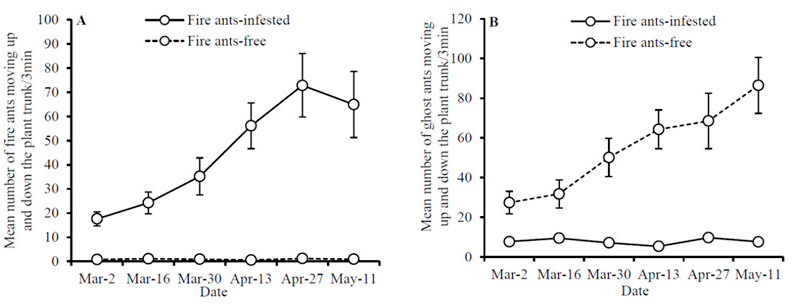
Dynamics of ant foraging activity on plants in fire ant-infested plots and fire ant-free plots. A, Fire ants; B, Ghost ants.
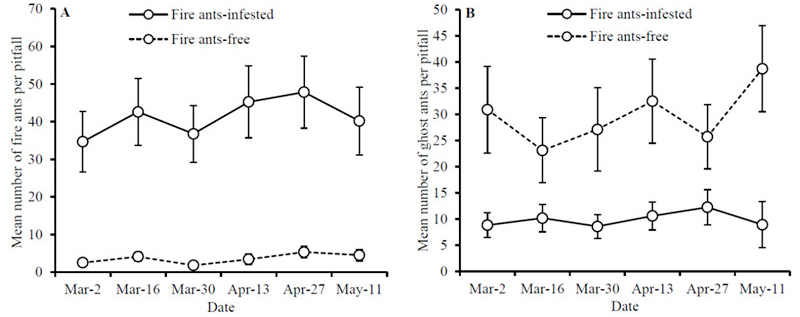
Dynamics of ant foraging activity on ground in fire ant-infested plots and fire ant-free plots. A, Fire ants; B, Ghost ants.
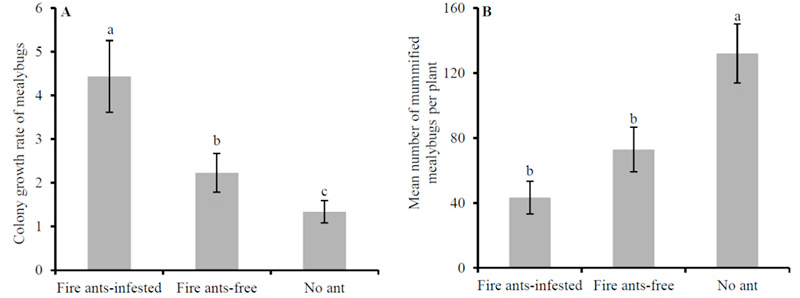
Effects of ants’ tending on mealybug colony growth (A, mean growth rate; B, mean number of mummified mealybugs). Different letters above bars indicate statistically significant differences between the treatment and the control. A, Mann-Whitney test, P = 0.05; B, LSD test, P = 0.05.
References
- Adams, E.S. and Traniello, J.F., 1981. Chemical interference competition by Monomorium minimum (Hymenoptera: Formicidae). Oecologia, 51: 265-270. http://dx.doi.org/10.1007/BF00540612[CrossRef]
- Baylis, M. and Pierce, N.E., 1992. Lack of compensation by final instar larvae of the myrmecophilous lycaenid butterfly, Jalmenus evagoras, for the loss of nutrients to ants. Physiol. Ent., 17: 107-114. http://dx.doi.org/10.1111/j.1365-3032.1992.tb01186.x[CrossRef]
- Bishop, D. and Bristow, C., 2001. Effect of Allegheny mound ant (Hymenoptera: Formicidae) presence on homopteran and predator populations in Michigan jack pine forests. Annls. entomol. Soc. Am., 94: 33-40. http://dx.doi.org/10.1603/0013-8746(2001)094[0033:eoamah]2.0.co;2[CrossRef]
- Brightwell, R.J. and Silverman, J., 2010. Invasive Argentine ants reduce fitness of red maple via a mutualism with an endemic coccid. Biol. Invasions, 12: 2051-2057. http://dx.doi.org/10.1007/s10530-009-9607-0[CrossRef]
- Bruno, J.F., Stachowicz, J.J. and Bertness, M.D., 2003. Inclusion of facilitation into ecological theory. Trends Ecol. Evolut., 18: 119-125. http://dx.doi.org/10.1016/S0169-5347(02)00045-9[CrossRef]
- Buckley, R., 1987. Interactions involving plants, homoptera, and ants. Annu. Rev. Ecol. System., 18: 111-135. http://dx.doi.org/10.1146/annurev.es.18.110187.000551[CrossRef]
- Calixto, A.A., Harris, M.K. and Barr, C.L., 2007a. Resurgence and persistence of Dorymyrmex flavus after reduction of Solenopsis invicta Buren with a broadcast bait. Environ. Ent., 36: 549-554. http://dx.doi.org/10.1603/0046-225X(2007)36[1112:NARTSI]2.0.CO;2[CrossRef]
- Calixto, A.A., Harris, M.K., Knutson, A. and Barr, C.L., 2007b. Native ant responses to Solenopsis invicta Buren reduction using broadcast baits. Environ. Ent., 36: 1112-1123. http://dx.doi.org/10.1603/0046-225X(2007)36[1112:NARTSI]2.0.CO;2[CrossRef]
- Cook, J.L., 2003. Conservation of biodiversity in an area impacted by the red imported fire ant, Solenopsis invicta (Hymenoptera: Formicidae). Biodiv. Conserv., 12: 187-195. http://dx.doi.org/10.1023/A:1021986927560[CrossRef]
- Coppler, L.B., Murphy, J.F. and Eubanks, M.D., 2007. Red imported fire ants (Hymenoptera: Formicidae) increase the abundance of aphids in tomato. Fl. Entomol., 90: 419-425. http://dx.doi.org/10.1653/0015-4040(2007)90[419:RIFAHF]2.0.CO;2[CrossRef]
- Daane, K.M., Sime, K.R., Fallon, J. and Cooper, M.L., 2007. Impacts of Argentine ants on mealybugs and their natural enemies in California’s coastal vineyards. Ecol. Ent., 32: 583-596. http://dx.doi.org/10.1111/j.1365-2311.2007.00910.x[CrossRef]
- Daane, K.M., Sime, K.R., Hogg, B.N., Bianchi, M.L., Cooper, M.L., Rust, M.K. and Klotz, J.H., 2006. Effects of liquid insecticide baits on Argentine ants in California’s coastal vineyards. Crop Protec., 25: 592-603. http://dx.doi.org/10.1016/j.cropro.2005.08.015[CrossRef]
- Davidson, D.W., Cook, S.C. and Snelling, R.R., 2004. Liquid-feeding performances of ants (Formicidae): ecological and evolutionary implications. Oecologia, 139: 255-266. http://dx.doi.org/10.1007/s00442-004-1508-4[CrossRef]
- Diaz, R., Knutson, A. and Bernal, J.S., 2004. Effect of the red imported fire ant on cotton aphid population density and predation of bollworm and beet armyworm eggs. J. econ. Ent., 97: 222-229.
- Epperson, D. and Allen, C., 2010. Red imported fire ant impacts on upland arthropods in Southern Mississippi. Am. Midl. Natural., 163: 54-63. http://dx.doi.org/10.1674/0003-0031-163.1.54[CrossRef]
- Eubanks, M.D., 2001. Estimates of the direct and indirect effects of red imported fire ants on biological control in field crops. Biol. Contr., 21: 35-43. http://dx.doi.org/10.1006/bcon.2001.0923[CrossRef]
- Eubanks, M.D., Blackwell, S.A., Parrish, C.J., Delamar, Z.D. and Hull-Sanders, H., 2002. Intraguild predation of beneficial arthropods by red imported fire ants in cotton. Environ. Ent., 31: 1168-1174. http://dx.doi.org/10.1603/0046-225X-31.6.1168[CrossRef]
- Hawlena, D. and Schmitz, O.J., 2010. Herbivore physiological response to predation risk and implications for ecosystem nutrient dynamics. Proc. natl. Acad. Sci. USA, 107: 15503-15507. http://dx.doi.org/10.1073/pnas.1009300107[CrossRef]
- Helms, K.R. and Vinson, S.B., 2002. Widespread association of the invasive ant Solenopsis invicta with an invasive mealybug. Ecology, 83: 2425-2438. http://dx.doi.org/10.1890/0012-9658(2002)083[2425:WAOTIA]2.0.CO;2[CrossRef]
- Helms, K.R. and Vinson, S.B., 2008. Plant resources and colony growth in an invasive ant: the importance of honeydew-producing hemiptera in carbohydrate transfer across trophic levels. Environ. Ent., 37: 487-493. http://dx.doi.org/10.1093/ee/37.2.487[CrossRef]
- Holway, D.A., 1998. Effect of Argentine ant invasions on ground-dwelling arthropods in northern California riparian woodlands. Oecologia, 116: 252-258. http://dx.doi.org/10.1007/s004420050586[CrossRef]
- Holway, D.A., 1999. Competitive mechanisms underlying the displacement of native ants by the invasive Argentine ant. Ecology, 80: 238-251. http://dx.doi.org/10.1890/0012-9658(1999)080[0238:CMUTDO]2.0.CO;2[CrossRef]
- Holway, D.A., Lach, L., Suarez, A.V., Tsutsui, N.D. and Case, T.J., 2002. The causes and consequences of ant invasions. Annu. Rev. Ecol. System., 33: 181-233. http://dx.doi.org/10.1146/annurev.ecolsys.33.010802.150444[CrossRef]
- Huang, J., Xu, Y.J., Lu, Y.Y., Zeng, L. and liang, G.W., 2010. Effects of red imported fire ants (Hymenoptera: Formicidae) on the relationship between native ants and aphids in mung bean fields in China. Sociobiology, 55: 415-425.
- Human, K.G. and Gordon, D.M., 1996. Exploitation and interference competition between the invasive Argentine ant, Linepithema humile, and native ant species. Oecologia, 105: 405-412. http://dx.doi.org/10.1007/BF00328744[CrossRef]
- Kaplan, I. and Eubanks, M.D., 2002. Disruption of cotton aphid (Homoptera: Aphididae)-natural enemy dynamics by red imported fire ants (Hymenoptera: Formicidae). Environ. Ent., 31: 1175-1183. http://dx.doi.org/10.1603/0046-225X-31.6.1175[CrossRef]
- King, J.R. and Tschinkel, W.R., 2006. Experimental evidence that the introduced fire ant, Solenopsis invicta, does not competitively suppress co-occurring ants in a disturbed habitat. J. Anim. Ecol., 75: 1370-1378. http://dx.doi.org/10.1111/j.1365-2656.2006.01161.x[CrossRef]
- King, J.R. and Porter, S.D., 2007. Body size, colony size, abundance, and ecological impact of exotic ants in Florida’s upland ecosystems. Evol. Ecol. Res., 9:757-774.
- Lebrun, E.G., Tillberg, C.V., Suarez, A.V., Folgarait, P.J., Smith, C.R. and Holway, D.A., 2007. An experimental study of competition between fire ants and Argentine ants in their native range. Ecology, 88: 63-75. http://dx.doi.org/10.1890/0012-9658(2007)88[63:AESOCB]2.0.CO;2[CrossRef]
- Lu, Y.Y., Wu, B.Q., Zeng, L. and Xu, Y.J., 2014. Comparison of foraging ability between Solenopsis invicta and Tapinoma melanocephalum (Hymenoptera: Formicidae). Sociobiology, 59: 1015-1024.
- Lu, Y.Y., Zeng, L., Wang, L., Xu, Y.J. and Chen, K.W., 2008. Precaution of solenopsis mealybug Phenacoccus solenopsis Tinsley. J. environ. Ent., 30: 386-387
- Moller, H., 1996. Lessons for invasion theory from social insects. Biol. Conserv., 78: 125-142. http://dx.doi.org/10.1016/0006-3207(96)00022-5[CrossRef]
- Morrison, L.W., 2000. Mechanisms of interspecific competition among an invasive and two native fire ants. Oikos, 90: 238-252. http://dx.doi.org/10.1034/j.1600-0706.2000.900204.x[CrossRef]
- Nattrass, R. and Vanderwoude, C., 2001. A preliminary investigation of the ecological effects of red imported fire ants (Solenopsis invicta) in Brisbane. Ecol. Manage. Restor., 2: 220-223.
- Phillips, P. and Sherk, C., 1991. To control mealybugs, stop honeydew-seeking ants. Calif. Agric., 45: 26-28.
- Porter, S.D. and Savignano, D.A., 1990. Invasion of polygyne fire ants decimates native ants and disrupts arthropod community. Ecology, 71: 2095-2106. http://dx.doi.org/10.2307/1938623[CrossRef]
- Powell, B.E. and Silverman, J., 2010. Impact of Linepithema humile and Tapinoma sessile (Hymenoptera: Formicidae) on three natural enemies of Aphis gossypii (Hemiptera: Aphididae). Biol. Contr., 54: 285-291. http://dx.doi.org/10.1016/j.biocontrol.2010.05.013[CrossRef]
- Renault, C., Buffa, L. and Delfino, M., 2005. An aphid-ant interaction: effects on different trophic levels. Ecol. Res., 20: 71-74. http://dx.doi.org/10.1007/s11284-004-0015-8[CrossRef]
- Savage, A.M., Johnson, S.D., Whitney, K.D. and Rudgers, J.A., 2011. Do invasive ants respond more strongly to carbohydrate availability than co-occurring non-invasive ants? A test along an active Anoplolepis gracilipes invasion front. Austral. Ecol., 36: 310-319. http://dx.doi.org/10.1111/j.1442-9993.2010.02152.x[CrossRef]
- Schmitt, R.J. and Holbrook, S.J., 2003. Mutualism can mediate competition and promote coexistence. Ecol. Lett., 6: 898-902. http://dx.doi.org/10.1046/j.1461-0248.2003.00514.x[CrossRef]
- Simberloff, D., 2006. Invasional meltdown 6 years later: important phenomenon, unfortunate metaphor, or both? Ecol. Lett., 9: 912-919. http://dx.doi.org/10.1111/j.1461-0248.2006.00939.x[CrossRef]
- Simpson, S.J. and Raubenheimer, D., 2012. The nature of nutrition: a unifying framework from animal adaptation to human obesity. Princeton University Press.
- Smith, M.R., 1965. House-infesting ants of The Eastern United States: their recognition, biology and economic importance. US Dept. of Agriculture.
- Stachowicz, J.J., 2001. Mutualism, facilitation, and the structure of ecological communities. BioScience, 51: 235-246. http://dx.doi.org/10.1641/0006-3568(2001)051[0235:MFATSO]2.0.CO;2[CrossRef]
- Stadler, B. and Dixon, A.F.G., 2005. Ecology and evolution of aphid-ant interactions. Annu. Rev. Ecol. Evolut. System., 36:345-372. http://dx.doi.org/10.1146/annurev.ecolsys.36.091704.175531[CrossRef]
- Tomalski, M., Blum, M., Jones, T., Fales, H., Howard, D. and Passera, L., 1987. Chemistry and functions of exocrine secretions of the ants Tapinoma melanocephalum and T. erraticum. J. Chem. Ecol., 13: 253-263. http://dx.doi.org/10.1007/BF01025886[CrossRef]
- Trager, J.C., 1991. A revision of the fire ants, Solenopsis geminata group (Hymenoptera: Formicidae: Myrmicinae). J. N.Y. entomol. Soc., 99: 141-198.
- Traveset, A. and Richardson, D.M., 2006. Biological invasions as disruptors of plant reproductive mutualisms. Trends Ecol. Evolut., 21: 208-216. http://dx.doi.org/10.1016/j.tree.2006.01.006[CrossRef]
- Tschinkel, W.R., 1988. Distribution of the fire ants Solenopsis invicta and S. geminata (Hymenoptera: Formicidae) in northern Florida in relation to habitat and disturbance. Annls. entomol. Soc. Am., 81:76-81. http://dx.doi.org/10.1093/aesa/81.1.76[CrossRef]
- Tschinkel, W.R., 2006. The fire ants. Harvard University Press.
- Vinson, S.B., 1994. Impact of the invasion of Solenopsis invicta Buren on native food webs. Exotic ants: biology, impact and control of introduced species. Westview Press, Boulder, CO. pp. 241-258.
- Wang, L., Lu, Y.Y., Xu, Y.J. and Zeng, L., 2013. The current status of research on Solenopsis invicta Buren (Hymenoptera: Formicidae) in Mainland China. Asian Myrmecol., 5: 125-138.
- Way, M.J., 1963. Mutualism between ants and honeydew-producing homoptera. Annu. Rev. Ent., 8: 307-344. http://dx.doi.org/10.1146/annurev.en.08.010163.001515[CrossRef]
- Wheeler, W.M., 1910. Ants: their structure, development and behavior. Columbia University Press.
- Wilder, S.M., Barnum, T.R., Holway, D.A., Suarez, A.V. and Eubanks, M.D., 2013. Introduced fire ants can exclude native ants from critical mutualist-provided resources. Oecologia, 172: 197-205. http://dx.doi.org/10.1007/s00442-012-2477-7[CrossRef]
- Wilder, S.M., Holway, D.A., Suarez, A.V. and Eubanks, M.D., 2011b. Macronutrient content of plant-based food affects growth of a carnivorous arthropod. Ecology, 92: 325-332. http://dx.doi.org/10.1890/10-0623.1[CrossRef]
- Wilder, S.M., Holway, D.A., Suarez, A.V., Lebrun, E.G. and Eubanks, M.D., 2011a. Intercontinental differences in resource use reveal the importance of mutualisms in fire ant invasions. Proc. natl. Acad. Sci. USA, 108: 20639-20644. http://dx.doi.org/10.1073/pnas.1115263108[CrossRef]
- Wojcik, D.P., Allen, C.R., Brenner, R.J., Forys, E.A., Jouvenaz, D.P. And Lutz, R.S., 2001. Red imported fire ants: impact on biodiversity. Am. Entomol., 47: 16-23. http://dx.doi.org/10.1093/ae/47.1.16[CrossRef]
- Wu, D., Zeng, L., Zhou, A.M. and Xu, Y.J., 2013. Effects of Solenopsis invicta (Hymenoptera: Formicidae) tending on the probing behavior of Phenacoccus solenopsis (Hemiptera: Pseudococcidae). Fl. Entomol., 96: 1343-1349. http://dx.doi.org/10.1653/024.096.0413[CrossRef]
- Yao, I. and Akimoto, S.I., 2002. Flexibility in the composition and concentration of amino acids in honeydew of the drepanosiphid aphid Tuberculatus quercicola. Ecol. Ent., 27: 745-752. http://dx.doi.org/10.1046/j.1365-2311.2002.00455.x[CrossRef]
- Zeng, L., Lu, Y.Y., He, X.F., Zhang, W.Q. and Liang, G.W., 2005. Identification of red imported fire ant Solenopsis invicta to invade mainland China and infestation in Wuchuan, Guangdong. Chinese Bull. Ent., 42:144-148.
- Zhou, A.M., Lu, Y.Y., Zeng, L., Xu, Y.J. and Liang, G.W., 2012a. Does mutualism drive the invasion of two alien species? The case of Solenopsis invicta and Phenacoccus solenopsis. PLoS One, 7: e41856. http://dx.doi.org/10.1371/journal.pone.0041856[CrossRef]
- Zhou, A.M., Zeng, L., Lu, Y.Y., Xu, Y.J., Liang, G.W., 2012b. Fire ants protect mealybugs against their natural enemies by utilizing the leaf shelters constructed by the leaf roller Sylepta derogata. PLoS One, 7: e49982. http://dx.doi.org/10.1371/journal.pone.0049982[CrossRef]
- Zhou, A.M., Lu, Y.Y., Zeng, L., Xu, Y.J. and Liang, G.W., 2013. Solenopsis invicta (Hymenoptera: Formicidae), defend Phenacoccus solenopsis (Hemiptera: Pseudococcidae) against its natural enemies. Environ. Ent., 42: 247-252. http://dx.doi.org/10.1603/EN12168[CrossRef]
- Zhou, A.M., Liang, G.W., Zeng, L., Lu, Y.Y. and Xu, Y.J., 2014a. Interactions between ghost ants and invasive mealybugs: the case of Tapinoma Melanocephalum (Hymenoptera: Formicidae) and Phenacoccus Solenopsis (Hemiptera: Pseudococcidae). Fl. Entomol., 97: 1474-1480. http://dx.doi.org/10.1653/024.097.0423[CrossRef]
- Zhou, A.M., Liang, G.W., Lu, Y.Y., Zeng, L. and Xu, Y.J., 2014b. Interspecific competition between the red imported fire ant, Solenopsis invicta buren and ghost ant, Tapinoma melanocephalum fabricius for honeydew resources produced by an invasive mealybug, Phenacoccus solenopsis Tinsiley. Arthropod-Pl. Interac., 8: 469-474.
Services
Article usage statistics
Loading…