
PCR protocol was developed to detect hyperparasitism in cotton mealybug. Cotton mealybug, Phenacoccus solenopsis (Hemiptera: Pseudococcidae) is an invasive and major pest on cotton. Aenasius bambawalei (Hymenoptera: Encyrtidae) is an effective parasitoid of mealybug and has been the backbone of the biological control program of cotton mealybug in Pakistan, but its multiplication for inundative releases has been impacted by a hyperparasitoid, Promuscidea unfasciativentris Girault (Hymenoptera: Aphelinidae: Eriaporinae). Traditionally the detection of hyperparasitoid is done by host-rearing, but that is time-consuming when working with field populations at larger scale. The current study used morphology and DNA sequences from mitochondrial (cytochrome oxidase I) and nuclear (internal transcribed spacer I) genes to identify the hyperparasitoid Promuscidea unfasciativentris. The successful PCR-based detection of hyperparasitism is promising for designing strategies for the biological control program of cotton mealybug.
Short Communication · Volume 49, Issue 4, 29 July 2017 · Open Access
PCR-Based Detection of a Hyperparasitoid in Cotton Mealybug, Phenacoccus solenopsis Tinsley (Hemiptera: Pseudococcidae)
· · ·
Affiliations & Notes ⌄
- 1Centre for Biodiversity Genomics, Biodiversity Institute of Ontario, University of Guelph, Guelph, ON, Canada 2National Institute for Biotechnology and Genetic Engineering, Jhang Road, Faisalabad 38000, Pakistan , * Corresponding author: entomologist.nibge@gmail.com
Article Info ⌄
- Journal:
- Pakistan Journal of Zoology
- Published:
- 29 July 2017

From the article
- Diagnostic PCR based on P. unfasciativentris-specific primers from ITS1 to detect hyperparasitism in mealybug specimens was successful, as it amplified a 755 bp PCR product exclusively from P. unfasciativentris (Fig. 1A).
- PCR using DNA from field collected mealybug (host) also amplified the anticipated 755 bp fragment of ITS1 from the hyperparasitized mealybug individuals (Fig. 1B).
- This study provides basic information on the identity and status of P. unfasciativentris as a hyperparasitoid and develops PCR primers to detect hyperparasitism in the mealybug host.
- An expanded use of PCR for hyperparasitoid detection in its primary host may provide additional help in managing mealybug population through biological control.
Selected from the article's own text.
Abstract
Materials and methods
Aenasius bambawalei is being multiplied on mealybug host for field releases in the mass-rearing laboratory of the Directorate of Entomology, AARI, Faisalabad, at controlled temperature (28±2°C) and humidity (70±5% RH) . Presence of the hyperparasitoid was noticed in early summer of 2010 in the rearing cages when instead of A. bambawalei another wasp was found emerging from the mealybug mummies. The emerging wasps were collected and identified using taxonomic literature and keys developed by Hayat and Verma (1980) and Hayat (1998). Based on the key characters including number of antennal segments, head structure and setae, presence of white band across T1 of gaster, wing venations, and tibial segments, the wasp was identified to the species, Promuscidea unfasciativentris Girault (Hymenoptera: Aphelinidae: Eriaporinae).
For identification and detection of hyperparasitoid, DNA extractions were performed using Fast Tissue-to-PCR kit (K1091, Fermentas). A partial fragment of the 3′-end of COI was amplified and sequenced using primers and PCR conditions described earlier . The COI 5’-end (DNA barcode) was amplified with primer pair LCO/HCO . ITS1 from A. bambawalei and P. unfasciativentris were amplified and sequenced using universal primer pair ITS1-18sF1 TACACACCGCCCGTCGCTACTA and ITS1-5.8sR1 ACACAACGTTTTTATGTTTTC . PCR products were cloned (InsTAclone PCR Cloning Kit, Fermentas) and subsequently sequenced commercially (Macrogen Inc. South Korea). The obtained sequences were edited using EditSeq (DNASTAR, Inc. USA) to remove the primer bases, aligned in MEGA5 to check for stop codons, and analyzed using Basic Local Alignment Search Tool (BLAST) function “blastn” on NCBI (www.ncbi.nlm.nih.gov) for the validity and match searches. The sequences generated in this study are available in the DDBJ/EMBL/GenBank (COI: AB667989, AB667990; ITS1: AB667991, AB667992, AB667993). The obtained ITS1 sequences of P. unfasciativentris, A. bambawalei, and P. solenopsis were aligned in MegAlign (DNASTAR, Inc. USA) to identify the nucleotide sequence variability suitable for designing P. unfasciativentris-specific primers. The ITS1 from P. solenopsis has been sequenced by our laboratory and is available under accession AB439213. One new P. unfasciativentris-specific forward primer from ITS1 sequence of P. unfasciativentris, Hyp-ITS1F1 (TCTCGAACACTTAAATCTCGACG) was designed and used with the reverse primer ITS1-5.8sR1 to amplify a 755 bp fragment of ITS1 for the diagnostic PCR.
For detection of hyperparasitism mealybug nymphs, adults and mummies were either picked randomly from the A. bambawalei rearing facility or collected from different localities around Faisalabad to perform diagnostic PCR for hyperparasitoid detection. In total, 100 mealybug individuals were used in the diagnostic PCR for hyperparasitoid detection. PCR was performed in a 25-µL reaction with primer pair Hyp-ITS1F1 and ITS1-5.8sR1 using 1 µL of DNA and following the profile: 94°C, 3 min; 94°C 30s, 55°C 1 min, 72°C 1 min (35 cycles); and 72°C 7 min. PCR products were separated on 1% agarose gels, stained with ethidium bromide and DNA bands were visualized under UV illumination. A single PCR band of 755 bp on the gel was counted as a hyperparasitized mealybug.
Results and discussion
A 650-bp PCR fragment of the COI-gene from 5’-end and an 816-bp fragment from 3’-end of P. unfasciativentris were amplified and sequenced. NCBI blast searches for both the COI fragments showed similar level of identities (87%) with the wasp species from the families Trichogrammatidae, Aphelinidae, and Pteromalidae but the similarity was not conclusive with any particular species. A 755 bp fragment of ITS1 was obtained from P. unfasciativentris and 685 bp from A. bambawalei. BLAST search of ITS1 from P. unfasciativentris or A. bambawalei did not find exact matches on GenBank, however, the nearest sequence matches for both the species belonged to Chalcidoidea, an indication the sequences are valid. Non-availability of DNA sequence data from the same or similar species in the databases limits the utility of DNA for sequence-match-based specimen identifications.
Diagnostic PCR based on P. unfasciativentris-specific primers from ITS1 to detect hyperparasitism in mealybug specimens was successful, as it amplified a 755 bp PCR product exclusively from P. unfasciativentris (Fig. 1A). PCR using DNA from field collected mealybug (host) also amplified the anticipated 755 bp fragment of ITS1 from the hyperparasitized mealybug individuals (Fig. 1B). Among 100 field-collected mealybugs analyzed with P. unfasciativentris -specific primers, 69 were positive for hyperparasitism. Parasitism/ hyperparasitism detection by PCR using marker genes has been accomplished previously in various insect hosts ; ; . In fact, PCR method has proved superior to the conventional methods, such as host-dissection or host-rearing, for making parasitism estimates . This superiority is mainly due to the ability of PCR to amplify DNA from small tissues and detect parasitoid across all developmental stages including eggs .
Aphelinids are generally known to parasitize insects belonging to the Sternorrhynchous Homoptera, and species of a few genera almost always act as hyperparasitoids. Members of the genus Promuscidea are regarded as hyperparasitoids of other hymenopteran primary parasitoids and the coccids are thus their secondary hosts . It has been documented that cotton mealybug is the primary host for A. bambawalei ; . Hyperparasitism can impact primary parasitoid populations and cause biological control failure . This study provides basic information on the identity and status of P. unfasciativentris as a hyperparasitoid and develops PCR primers to detect hyperparasitism in the mealybug host. Considering the importance of A. bambawalei as the primary mealybug control agent in Pakistan, in-depth research on various biological parameters of P. unfasciativentris is required to devise a better strategy for mealybug control. An expanded use of PCR for hyperparasitoid detection in its primary host may provide additional help in managing mealybug population through biological control.
Acknowledgements
Research support grants from the Ministry of Food and Agriculture and Higher Education Commission (HEC) Pakistan are acknowledged.
Statement of conflict of interest
The authors declare no conflict of interest for this study.
Figures
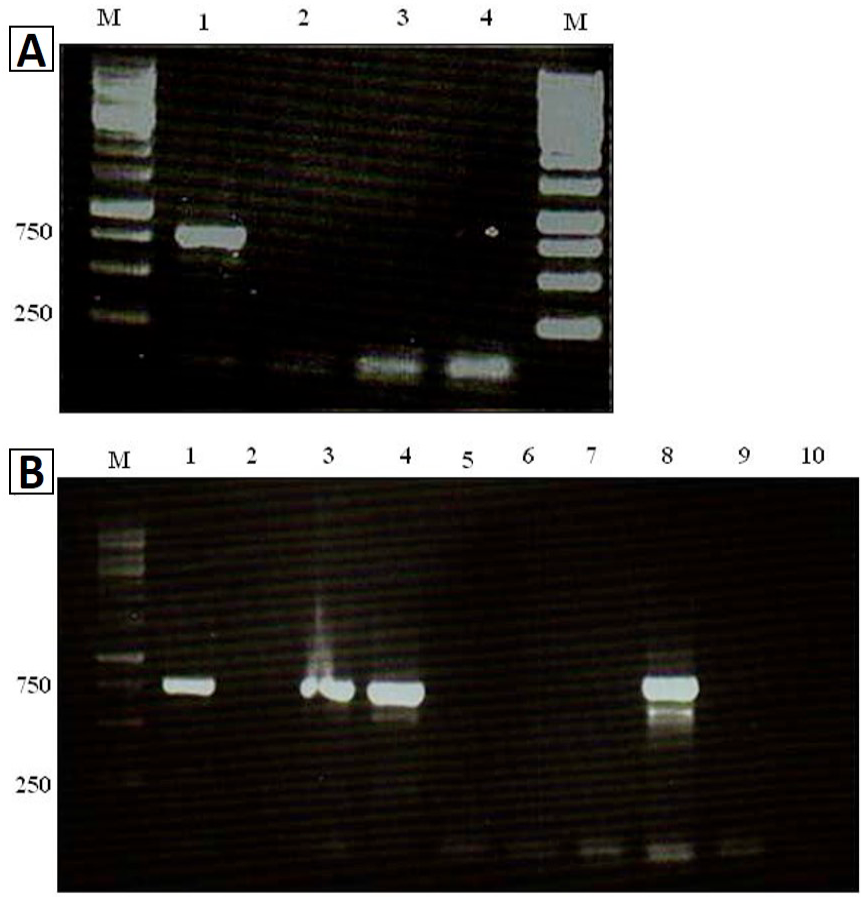
Diagnostic PCR for detection of hyperparasitism in cotton mealybug. PCR was performed with P. unfasciativentris-specific PCR primers, Hyp-ITS1F1 and ITS1-5.8sR1 to amplify a 755 bp ITS1 fragment. A, M, DNA marker, lane 1, DNA from identified Promuscidea unfasciativentris, lane 2, Aenasius bambawalei, lane 3, Phenacoccus solenopsis (3), lane 4, negative control; B, lanes 1-10, DNA from P. solenopsis adults collected from cotton fields and used in the diagnostic PCR. PCR bands (755 bp) in lanes 1, 3, 4, and 8 indicate the mealybugs were hyperparasitized by P. unfasciativentris while the empty lanes (2, 5, 6, 7, 9 and 10) indicate the mealybugs were free from the hyperparasitoid.
References
- Ahmed, M.Z., Ma, J., Qiu, B.-L., He, R.-R., Wu, M.-T., Liang, F., Zhao, J.-P., Lin, L., Hu, X.-N., Lv, L.-H., Breinholt, J.W. and Lu, Y.-Y., 2015. Environ. Ent., 44: 907-918. https://doi.org/10.1093/ee/nvv034[CrossRef]
- Arif, M.I., Rafiq, M., Wazir, S., Mehmood, N. and Ghaffar, A., 2012. Int. J. Agric. Biol., 14: 557–562.
- Ashfaq, M., Braun, L., Hegedus, D. and Erlandson, M., 2004. Biocont. Sci. Technol., 14: 731-735. https://doi.org/10.1080/09583150410001683592[CrossRef]
- Ashfaq, M., Erlandson, M. and Braun, L., 2005. Biol. Contr., 32: 371-377. https://doi.org/10.1016/j.biocontrol.2004.11.007[CrossRef]
- Ashfaq, M., Shah, G.S., Noor, A.R., Ansari, S.P. and Mansoor, S., 2010. Biocont. Sci. Technol., 20: 625-630. https://doi.org/10.1080/09583151003693535[CrossRef]
- Erlandson, M., Braun, L., Baldwin, D., Soroka, J., Ashfaq, M. and Hegedus, D., 2003. Can. Entomol., 135 : 71-83. https://doi.org/10.4039/n02-017[CrossRef]
- Folmer, O., Black, M., Hoeh, W., Lutz, R. and Vrijenhoek, R., 1994. Mol. Mar. Biol. Biotechnol., 3: 294-299.
- Gariepy, T.D., Kuhlmann, U., Gillott, C. and Erlandson, M., 2007. J. appl. Ent., 131: 225-240.
- Hameed, A., Aziz, M.A., Aheer, G.M., 2012. Pakistan J. Zool., 44: 685-690.
- Hayat, M., 1998. Aphelinidae of India (Hymenoptera: Chalcidoidea): a taxonomic revision. In: Memoirs on Entomology, International. 13, Associated Publishers Florida, USA, pp. 416.
- Hayat, M., 2009. Biosystematica, 3: 21-26.
- Hayat, M. and Verma, M., 1980. Orient. Insects, 14: 29-40. https://doi.org/10.1080/00305316.1980.10434832[CrossRef]
- Hebert, P.D.N., Cywinska, A., Ball, S.L. and deWaard, J.R., 2003. Proc. R. Soc. B, 270: 313-321. https://doi.org/10.1098/rsbl.2003.0025[CrossRef]
- Heckel, D.G., 2003. Annu. Rev. Ent., 48: 235-260. https://doi.org/10.1146/annurev.ento.48.091801.112624[CrossRef]
- Hoelmer, K.A. and Kirk, A.A., 2005. Biol. Contr., 34: 255-264. https://doi.org/10.1016/j.biocontrol.2005.05.001[CrossRef]
- Hodgson, C., Abbas, G., Arif, M.J. and Saeed, S., 2008. Zootaxa, 1913: 1-35.
- Ji, Y-J., Zhang, D-X. and He, L-J., 2003. Mol. Ecol. Notes, 3: 581-585. https://doi.org/10.1046/j.1471-8286.2003.00366.x[CrossRef]
- Liang, G.H., Jang, E.B., Heller, W.P., Chang, C.L., Chen, J.H., Zhang, F.P. and Geib, S.M., 2015. Pest Manage. Sci., 71: 1666-1674. https://doi.org/10.1002/ps.3976[CrossRef]
- Nofemela, R.S., 2013. Biol. Contr., 65: 218–224. https://doi.org/10.1016/j.biocontrol.2013.02.003[CrossRef]
- Ram, P. and Saini, R.K., 2010. J. biol. Contr., 24: 104-109.
- Schooler, S.S., Barro, P.J.D. and Ives, A.R., 2011. Biol. Contr., 58: 167-173. https://doi.org/10.1016/j.biocontrol.2011.05.018[CrossRef]
- Shafee, S.A., 1974. Entomophaga, 19: 33-39. https://doi.org/10.1007/BF02371506[CrossRef]
- Tamura, K., Peterson, D., Peterson, N., Stecher, G., Nei, M. and Kumar, S., 2011. Mol. Biol. Evol., 28: 2731-2739. https://doi.org/10.1093/molbev/msr121[CrossRef]
- Tanwar, R.K., Jeyakumar, P., Singh, A., Jafri, A.A. and Bambawale, O.M., 2011. J. environ. Biol., 32: 381-384.
- Tilmon, K.J., Danforth, B.N., Day, W.H. and Hoffmann, M.P., 2000. Ann. Entomol. Soc. Am., 93: 640-647. https://doi.org/10.1603/0013-8746(2000)093[0640:DPSCIA]2.0.CO;2[CrossRef]
Services
Article usage statistics
Loading…