
Avocado is a cash crop for orchard growers and fruit producers. It is famous for its dietary and economic benefits all over the world. Field experiences and literature reveals that avocado varieties behave differently in different locations. These studies were conducted for standardization of promising commercial variety of avocado for cultivation in Punjab. Avocado varieties Murree Gola and Ceylon blue were tested in different locations for their performance. Data was collected for both varieties which shown that Murree Gola flowering is 8-10 days earlier than that of Ceylon blue, while ripening is 6-12 days later in Murree Gola as compared with Ceylon blue. Flowering duration remained 15 days in Murree Gola and 13 days in Ceylon blue. Murree Gola produced heavier fruits (484g) compared to Ceylon Blue (370 g) while Murree Gola produced 150 kg fruit per tree and Ceylon blue produced 120 kg fruit per tree. Murree Gola gave 25% more fruit yield as compared with Ceylon blue which makes it suitable for competing with the climatic conditions of the target areas. Performance comparison of both varieties in same agro-climatic conditions reflects that Murree Gola variety of avocado may give better economical returns to the growers.
Research Article · Volume 39, Issue 4, 12 December 2023 · Open Access
Smart Avocado (Persea americana Mill) Production in Sub Mountainous Agro Climatic Conditions of Punjab, Pakistan
· · · · ·
Affiliations & Notes ⌄
- 1Hill Fruit Research Institute (HFRI) Murree, Pakistan
- 2Barani Agricultural Research Institute (BARI) Chakwal, Pakistan
- 3Department of Horticulture, Ghazi University, Dera Ghazi Khan, Pakistan. *Correspondence | Muhammad Ashraf Sumrah, Barani Agricultural Research Institute (BARI) Chakwal, Pakistan
- 4Emai: ashrafsumrah@gmail.com
Article Info ⌄
- Journal:
- Sarhad Journal of Agriculture
- Published:
- 12 December 2023
Abstract
Introduction
Avocado plantation in Pakistan was started during the year 1955 at Hill Fruit Research Station (HFRS) Murree, Punjab Pakistan. A hectic research was conducted for standardization of production technology and varietal performance comparisons among changing agro climatic conditions. Avocado has wide adaptability range (Gill et al., 2018) for different varieties in temperate and semi temperate areas. Small land holding and limited water resources are the major hurdles for fruit production in targeted areas. It is need of the day to produce the precious fruit ‘avocado’ for judicial use of land and water resources in combination with agro climatic conditions of sub-mountainous areas. These studies were initiated for identification of most successful and high yielding variety of avocado during 2018 and carried on for 3 years for data recording. The experiment was concluded in 2021 for final recommendation.
Avocado is a crop with enormous economic significance among farming communities (Cáceres-Zambrano et al. 2022; Gómez et al., 2023). The gaps in cultivars improvement, agronomic management and postharvest handling also need due attention to improve the productivity of avocado in target areas . The locality and environment has deep impact on production and adaptability of avocado cultivation along with credit facility and strong infrastructure. Supply chain also helps for enhancing production level of avocado variety ‘Hass .
Avocado varieties ‘Pinkerton’ and ‘Bacon’ are recommended for Raya valley and other areas having similar agro-ecologies. Jalata (2021) stated that crop diversification can be useful strategy Avocado can be considered as important alternative crop for the farmers as its suitability to the agro ecologies, high domestic and export potential avocado can provide multiple benefits to the farmers to improve their livelihood .
Avocado can provide multiple benefits to the farmers especially to improve farmers’ income, increase land productivity, sustainability and food security ; . Furthermore, it has complementary advantages for business and economic activities of growing towns in nearby areas. Avocado is a high yielder, the nutritional value of avocado is recommendable for nutritional deficient people in developing countries.
There is relationship between quality of fruit and production locality, which allowed discriminating fruits by their region of origin. New technologies increase avocado productions in target areas and may positively contribute to improve livelihood through nutrition and income generation of stakeholders (Henao et al. 2019; .
There are even important factors for the growth of avocado trees were determined: Forest border, slope, permeability, soil depth, land use capability, protected areas/forbidden zones, average and minimum temperature stated that suitability values of growing models were compared to Hass avocado production; models were able to identify both novel areas with potential for cultivation, and sites where this crop has been planted in relatively unsuitable areas. Avocado cultivation is identifying areas with environmental potential in Colombia and currently not planted with Hass avocado ; .
These studies were arranged for standardization of promising verities for cultivation in Pothwar region and Upper Punjab areas after a complete adoptability study. Production and yield performance was compared in three ecologies. Yield and sporting aspects of fruit production stages were studied and analyzed for decision.
Materials and Methods
The study was conducted in three different locations and districts (Hill Fruit Research Station Murree, Horticultural Research Station Nowshehra, and Rehan Farm, Sargodha) Twenty-five years old trees of avocado variety Murree Gola and Ceylon Blue were selected for collection and comparison of production data. Final recommendations of variety were given on the basis of performance in selected agro climatic conditions.
Experimental units (avocado trees) were approximately of same age and canopy size. All the treatments were maintained according to standard agricultural practices i.e irrigation, fertilization, pruning and health management. Data was recorded when fruit showed colour change indicating fruit maturity. Fruit maturity stage was considered a standard when fruit was ready for wholesale marketing. Harvesting of fruit was made manually and weighed on Electronic balance.
The experiment was laid out according to Factorial Design of layout with two factors i.e Avocado varieties (Murree Gola and Ceylon Blue) and three experimental locations with 4 replications of each treatment. Data was statistically analyzed for final design of the results.
Flowering time (week): Flowering time was recorded (week) on opening of first flower cluster.
Anthesis period (days): Anthesis period was recorded by counting the No. of days from opening of first flower cluster to opening of last flower cluster.
Table 1: Flowering time (week) of avocado verities at different locations.
| Location of trial | 2018 | 2019 | 2020 | |||
| Murree Gola | Ceylon Blue | Murree Gola | Ceylon Blue | Murree Gola | Ceylon Blue | |
| Tret Murree | April, 2nd week | April 3rd week | April 1st week | April 3rd week | April 3rd week | April 4th week |
| HRS Nowshera | April. 1st week | April 2nd week | March 4th week | April 1st week | April. 2nd week | April 2nd week |
| Rehan Farm Sargodha | March 2nd week | March 3rd week | March 3rd week | March 4th week | March 3rd week | March 4th week |
Fruit maturity (days): Fruit maturity was calculated by counting the No. of days from fruit setting to horticultural maturity of the fruit i.e., color change stage of fruit.
Fruit weight (g): Average fruit weight was calculated by weighing 20 randomly selected fruits of each variety after attaining the horticultural maturity.
Yield per tree (Kg): Yield per tree was calculated by weighing fruit collected after complete harvesting operation.
Results and Discussion
Production data was collected and manipulated for conclusion of final recommendations. Production parameters considered in these studies are as following.
Flowering time (week)
Data regarding flowering time (Table 1) of both avocado verities collected from different experimental sites depicted that Murree Gola variety is about one week earlier in flowering than Ceylon Blue which reveals difference in varietal behavior of avocado. Varieties showed variable behavior in different locations which may be due to agro climatic conditions and genetic makeup of the variety. Flowering behavior of Murree Gola in various ecologies showed that this variety is suitable for sub mountainous and plane areas having early spring. While data collected from Ceylon Blue shows its better suitability in lower and foot hills. Our studies are in conformity with Camilo et al. (2019).
Anthesis period (days)
Data regarding anthesis period (Figure 1) reveals that anthesis period of Murree Gola is longer than Ceylon Blue. This might be due to genetic difference of both varieties of avocado which may be helpful for successful pollination and minimize the climatic risk. Our results are in conformation with the data recorded by Selim et al. (2018).
Fruit maturity (days)
Data regarding fruit ripening period depicted that Murree Gola variety is later in ripening as compared to Ceylon Blue. This fruit ripening behavior of both varieties may be due to difference in genetic makeup and climatic conditions of study area. This differential behavior in different localities has also been reported by Guillermo et al. (2018).
Fruit weight (g)
Data regarding average fruit weight revealed that Murree Gola produced heavier than Cylon Blue in all localities of the study area. Fruit weight was improved in slightly warm areas as compare to colder areas which might be due to climatic conditions of the site. Our conclusions is in line with studies of Sora (2023) and Juma et al. (2019).
Fruit yield/ Tree (kg)
Data regarding yield/tree reflects that fruit yield differs in different localities under the study area. Yield increases in slightly warm areas as compared with cool climatic conditions. It might be due to genetic makeup of the variety and better photosynthesis activities of leaves. Similar results had been reported by Abebe et al. (2022) and Nkansah et al. (2016).
Conclusion and Recommendations
Murree Gola variety of avocado is suitable for lower Hills and foot mountains where northern areas cool winds are blocked by highlands and wind breaks. Ceylon Blue is most suitable for plane areas having cool, humid environmental conditions.
Acknowledgements
We are thankful for Director Barani Agricultural Research Institute (BARI) Chakwal and Horticulturist of Hill Fruit Research Institute (HFRI) Murree for their kind supervision and management of activities during research.
Novelty Statement
In Pakistan, Avocado is a new fruit crop which is being cultivated only on small scale on the area of Murre. This experiment was conducted for the standardization of different promising avocado varieties in Pothwar area.
Author’s Contribution
Muhammad Afzal: Conceived and designed the experiments.
Muhammad Ashraf Sumrah: Analyzed the data.
Azhar Hussain: Contributed materials/analysis/tools.
Zoma Saleem and Syed Hamza Mehfooz: Wrote the paper.
Javeria Sherani: Read and approved the final manuscript.
Conflict of interest
The authors have declared no conflict of interest.
Figures
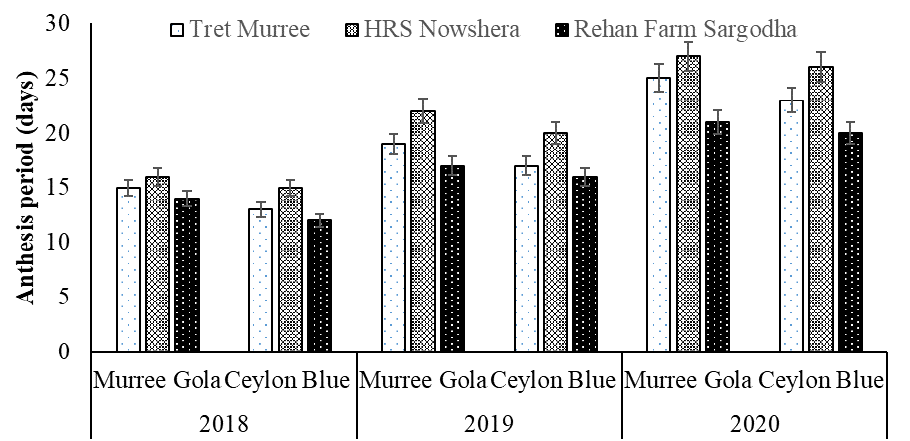
Anthesis period (days) of avocado verities at different locations.
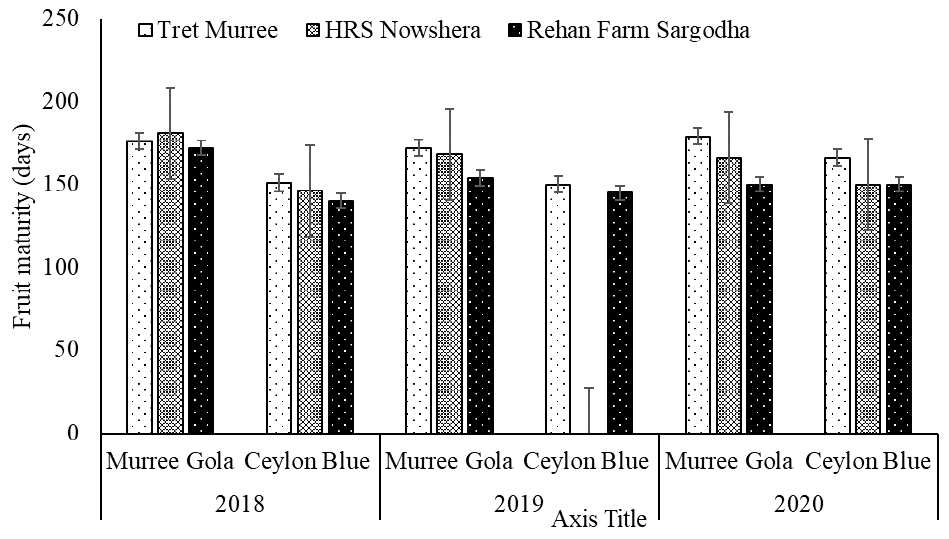
Fruit maturity (days) of avocado verities at different locations.
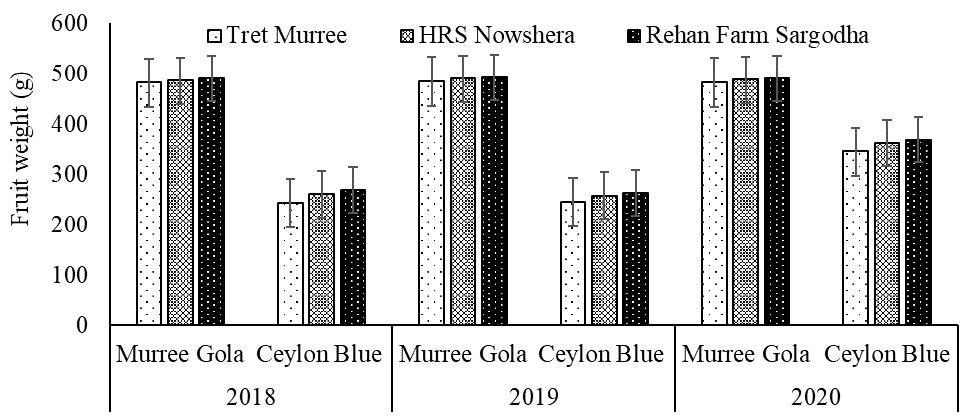
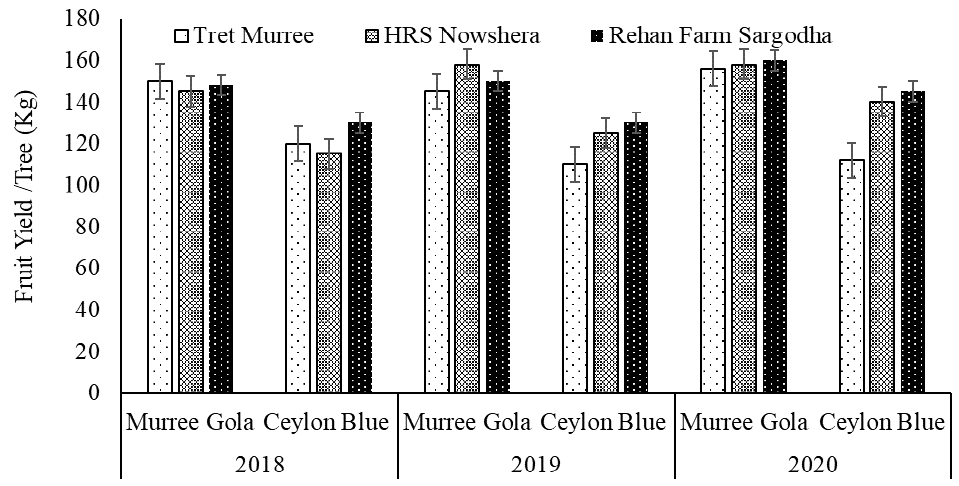
Multi location fruit yield /tree (kg) of avocado verities.
References
- Abebe, H., W. Biratu, K. Tesfay, M. Berhe and H. Gebremeskel. 2022. Growth and yield evaluation of avocado (Persea americana) varieties sin lowland agro ecology of Raya Azebo, Southern Zone of Tigray Region, Northern Ethiopia. Agro Bali: Agric. J., 5(2): 263-273. https://doi.org/10.37637/ab.v5i2.919[CrossRef]
- Box, G.E.P., J.S. Hunter and W.G. Hunter. 2005. Statistics for experimenters: Design, discovery and innovation. Wiley-Inters Science.
- Caceres-Zambrano, J., J.G. Ramírez-Gil and D. Barrios. 2022. Validating technologies and evaluating the technological level in avocado production systems: A value chain approach. Agronomy, 12(12): 3130. https://doi.org/10.3390/agronomy12123130[CrossRef]
- Camilo, J.C., M. Ortiz-Sanchez, D.L. Restrepo-Serna, P.P. Pineres, A.P. and C.A.C. Alzate. 2019. Influence of products portfolio and process contextualization on the economic performance of small-and large-scale avocado biorefineries. Biores. Technol., 342: 126060.
- George, O., G.D. Odhiambo, S. Wagai and J. Kwach. 2019. An analysis of socioeconomic factors affecting avocado production in saline and flooded areas around Lake Victoria Basin of Western Kenya. Afr. J. Agric. Res., 14(35): 2048-2061. https://doi.org/10.5897/AJAR2019.14153[CrossRef]
- Gil, J.G.R., M.O.J. Gonzalo and A.T. Peterson. 2018. Potential geography and productivity of “Hass” avocado crops in Colombia estimated by ecological niche modeling. Sci. Hortic., 237. https://doi.org/10.1016/j.scienta.2018.04.021[CrossRef]
- Gomez, C.J.R., H.R. Espinosa and F.R. Betancur. 2023. Farmer, learning and teaching: A cluster analysis of technology adopters in avocado farming in Colombia. Trop. Subtrop. Agroecosyst., 26(1). https://doi.org/10.56369/tsaes.4434[CrossRef]
- Guillermo, J.G., J.G. Morales and A.T. Peterson. 2018. Potential geography and productivity of “Hass” avocado crops in Colombia estimated by ecological niche modeling. Sci. Horticult., 237: 287-295.
- Henao-Rojas, J.C., J.H. Lopez, N.W. Osorio and J.G. Ramírez-Gil. 2019. Fruit quality in Hass avocado and its relationships with different growing areas under tropical zones. Rev. Ceres. Viçosa, 66(5): 341-350. https://doi.org/10.1590/0034-737x201966050003[CrossRef]
- Jalata, Z., 2021. Current status, potentials and opportunities of avocado production as an alternative crop: The case of Ethiopia. Agric. Rev., 42(3): 336-341. https://doi.org/10.18805/ag.R-179[CrossRef]
- Juma, I., H. Fors, H.P. Hovmalm, A.N.M. Fatih, M. Geleta, A.S. Carlsson and R.O. Ortiz, 2019. Avocado production and local trade in the southern highlands of Tanzania: A case of an emerging trade commodity from horticulture. Agronomy, 9(11): 749. https://doi.org/10.3390/agronomy9110749[CrossRef]
- Knight, R.J. and C.W. Campbell. 1999. Ecological adaptation and the evolution of modern avocado cultivars. Rev. Chapingo Ser. Hortic., 5: 49-54. https://doi.org/10.5154/r.rchsh.1999.04.034[CrossRef]
- Lara-Pulido, J.A., A.G. Sanginés, J.M. Torres-Rojo, J.M. Núñez-Hernández, J. Riojas, V. Pérez-Cirera, K. Breceda, M.J. Barragán, D.E. Blas and C.J. Quiroga. 2022. Honey-guacamole: Assessment of pollination environmental service in avocado production in Michoacan, Mexico. Acta Univ., 31 México. https://doi.org/10.15174/au.2021.3083[CrossRef]
- Legesse, T., A. Ashebir and K. Kebede. 2023. Farmers’ participation decision in high value market and its effect on food security of smallholder avocado producers in Sidama region, Ethiopia. https://doi.org/10.21203/rs.3.rs-3124184/v1[CrossRef]
- Malekela, A., 2022. Avocado production and farmers strategy for earning livelihoods in Njombe, Tanzania.
- Montgomery, D.C., 2019. Design and analysis of experiments (10th ed.). John Wiley and Sons.
- Mopan, Y.E.A., O. Rubiano-Ovalle, H. Paz, A.F. Solis Pino, M. Chong and A. Luna. 2019. Fresh product supply chain analysis in cauca, Colombia- A hass avocado system dynamics approach. Rev. Ceres, Viçosa, 66(5): 341-350.
- Mopan, A.Y., E., Solis Pino, A.F., Rubiano-Ovalle, O., Paz and I.M. Ramirez. 2023. Spatial analysis of the suitability of hass avocado cultivation in the Cauca Department, Colombia, using multi-criteria decision analysis and geographic information systems. ISPRS Int. J. Geo-Info., 12(4): 136.
- Nkansah, G.O, K.G. Ofosu-Budu and A.W. Ayarna. 2016. Genetic diversity among local and introduced avocado germplasm based on morpho-agronomic traits. Int. J. Plant Breed. Genet., 7(2): 76-91. https://doi.org/10.3923/ijpbg.2013.76.91[CrossRef]
- Ogunwusi, A.A. and H.D. Ibrahim. 2016. Economic significance of avocado pear in Nigeria. Developing Country Studies, www.iiste.org ISSN 2224-607X (Paper) ISSN 2225-0565 6(3).
- Selim, S., D.K. San, C. Selim and B.T. San. 2018. Site selection for avocado cultivation using GIS and multi-criteria decision analyses: Case study of Antalya, Turkey. https://doi.org/10.1016/j.compag.2018.09.038[CrossRef]
- Sora, S.A., 2023. Evaluation of avocado (Persea americana) for growth and yield at Teppi, Southwestern Ethiopia, pp. 46-50. https://doi.org/10.1080/15538362.2023.2178595[CrossRef]
Services
Article usage statistics
Loading…