
Severe Fever with Thrombocytopenia Syndrome (SFTS) is an emerging tick-borne zoonotic disease caused by the SFTS virus (SFTSV), a member of the genus Bandavirus. Since its identification in China in 2009, the disease has spread across East and Southeast Asia and has become a major public health concern because of its high morbidity, substantial case fatality rate, and expanding geographic distribution. This narrative review synthesizes current evidence on the epidemiology, virology, transmission, pathogenesis, clinical manifestations, diagnosis, prognostic factors, treatment, and public health implications of SFTS. Relevant peer-reviewed literature, systematic reviews, meta-analyses, surveillance reports, and clinical studies were critically reviewed to provide an updated overview of the disease. SFTSV is primarily transmitted by Haemaphysalis longicornis ticks, although person-to-person transmission through infected blood and body fluids has been documented. The disease is characterized by high fever, thrombocytopenia, leukopenia, gastrointestinal symptoms, and progressive multi-organ dysfunction. Severe disease is associated with excessive cytokine production, immune dysregulation, high viral load, advanced age, neurological involvement, and elevated liver enzymes. Diagnosis relies mainly on RT-PCR during the acute phase and serological testing during convalescence. No universally approved antiviral therapy is currently available; management remains largely supportive, while favipiravir and ribavirin continue to be investigated. SFTS remains an important emerging infectious disease with significant clinical and public health implications. Early diagnosis, prompt supportive care, strengthened surveillance, effective infection prevention, and continued research into antiviral agents and vaccines are essential to reduce disease burden and improve patient outcomes.
Mini-Review · 26 August 2026 · Open Access
Severe Fever with Thrombocytopenia Syndrome (SFTS): A Comprehensive Review of Epidemiology, Pathogenesis, Clinical Features, and Management
Affiliations & Notes ⌄
- 1Department of Veterinary & Animal Sciences, University of Rajshahi, Rajshahi-6205, Bangladesh
- 2Faculty of Veterinary & Animal Sciences, University of Rajshahi, Rajshahi-6205, Bangladesh. *Correspondence | Md. Rimon Bhuiyan, Department of Veterinary & Animal Sciences, University of Rajshahi, Rajshahi-6205, Bangladesh
- 3Email: s1911168127@ru.ac.bd
Article Info ⌄
- Journal:
- Hosts and Viruses
- Published:
- 26 August 2026
From the article
- Severe Fever with Thrombocytopenia Syndrome is an emerging tick-borne viral disease with significant morbidity and mortality across East and Southeast Asia.
- The disease is characterised by high fever, thrombocytopenia, leucopenia, and systemic inflammation driven by a dysregulated host cytokine response.
- The expanding geographic distribution of SFTS, combined with its capacity for human-to-human transmission, underscores the urgent need for heightened clinical awareness, robust surveillance, effective infection control, and continued investment in the development of targeted antiviral therapies and vaccines.
Selected from the article's own text.
Abstract
Introduction
Severe Fever with Thrombocytopenia Syndrome (SFTS) is an emerging tick-borne viral haemorrhagic fever first reported in China in 2009 and caused by the SFTS phlebovirus (SFTSV), a novel member of the Phenuiviridae family within the genus Bandavirus b; . The disease was initially identified in rural areas of central and eastern China, particularly in Hubei, Henan, Shandong, Liaoning, and Jiangsu provinces . Since that initial discovery, SFTS has been confirmed in South Korea, Japan, Vietnam, Thailand, and Taiwan, raising alarms about its potential for broader geographic spread ; ; ; ; .
The causative agent, SFTSV, is primarily transmitted through the bite of the Haemaphysalis longicornis tick, though person-to-person transmission via contact with infected blood or secretions has been documented in nosocomial and household settings ; ; Gai et al., 2012a; . The virus is classified as a trisegmented, negative-sense single-stranded RNA virus, and its emergence has been linked to ecological factors including deforestation, changing land use patterns, and expanding tick habitats ; .
SFTS carries a substantial case fatality rate (CFR), ranging from approximately 6% to over 30% across different studies, making it one of the most lethal tick-borne diseases known ; Gai et al., 2012b). The mortality risk is especially elevated in elderly patients, immunocompromised individuals, and those with delayed presentation ; . The disease course is characterised by progressive thrombocytopenia, leucopenia, elevated liver enzymes, and a hyperinflammatory state driven by dysregulated cytokine production ; .
Despite more than a decade of research, no specific antiviral therapy has received regulatory approval for SFTS, and management remains largely supportive. This review aims to provide a comprehensive, up-to-date synthesis of available evidence regarding the epidemiology, virology, clinical features, pathogenesis, risk factors, and treatment strategies of SFTS, to guide clinicians, public health practitioners, and researchers in their response to this continuing threat.
Virology and taxonomy
SFTSV is a negative-sense, single-stranded RNA virus with a trisegmented genome comprising large (L), medium (M), and small (S) segments. The L segment encodes the RNA-dependent RNA polymerase, the M segment encodes the surface glycoproteins (Gn and Gc) responsible for host cell attachment and entry, and the S segment encodes the nucleoprotein (NP) and a nonstructural protein (NSs) ; Lei, Liu and Yu, 2015). The NSs protein plays a significant role in viral immune evasion by antagonising the type I interferon response, thereby facilitating early viral replication and contributing to the immunopathology of disease (Figure 1).
Phylogenetic analysis has identified multiple genotypic lineages of SFTSV across its geographic range, with distinct clades circulating in China, South
Korea, and Japan . These differences in viral genetics may partially account for observed variations in clinical severity and CFR across countries. The evolutionary analysis indicates that SFTSV likely emerged in China and subsequently spread across East Asia, facilitated by migratory birds and movement of tick-infested animals ; .
SFTSV has a broad host range among domestic and wild animals. Serological studies from China have detected SFTSV antibodies in cattle, sheep, dogs, and pigs, with high seroprevalence in areas where human cases cluster . These animals serve as amplifying hosts, increasing tick infection rates and, consequently, human exposure risk. Remarkably, direct cat-to-human transmission has also been reported, further expanding the recognised modes of zoonotic spillover .
Epidemiology
Global distribution and burden
Since the first confirmed human cases in China in 2009, SFTS has emerged as the dominant tick-borne viral disease in East Asia . A comprehensive analysis of data from 2011 to 2018 identified over 60,000 reported cases in mainland China, predominantly concentrated in Henan, Shandong, Hubei, Anhui, Liaoning, and Zhejiang provinces . National surveillance data from China demonstrate a consistent seasonal pattern, with peak incidence between April and October, corresponding to the activity cycle of H. longicornis ticks ; .
South Korea identified its first cases in 2012 and has since reported a steadily increasing annual incidence ;. In Japan, SFTS was confirmed retrospectively with cases dating to 2005, and prospective surveillance from 2013 onwards has documented hundreds of confirmed cases with one of the highest CFRs globally ; ; . Vietnam reported its first endemic cases in 2019, and Thailand documented confirmed infections between 2019 and 2020 ; . Taiwan recorded its first case in 2020 . A recent global systematic review and meta-analysis estimated that the pooled seroprevalence of SFTSV in humans ranges considerably across regions, with higher rates in endemic rural communities .
Transmission routes
The primary route of SFTSV transmission to humans is through the bite of infected H. longicornis ticks. Occupational and recreational exposure in tick-endemic rural and forested areas constitutes the main risk context, with farmers, foresters, and outdoor workers disproportionately affected a; . However, the disease is not exclusively tick-borne; multiple documented clusters have confirmed human-to-human transmission.
Person-to-person transmission has been described through direct contact with the blood, secretions, or excreta of infected patients ; Gai et al., 2012b; . Nosocomial transmission has been documented in South Korea, where healthcare workers became infected after unprotected contact with acutely ill patients . Household transmission clusters have also been reported in China, including a well-characterised cluster involving blood exposure . These findings underscore the importance of rigorous infection control measures when managing confirmed or suspected SFTS cases.
Risk factors for infection
Epidemiological studies consistently identify residence in or frequent visits to rural or mountainous areas with tick activity as the predominant environmental risk factor for SFTS acquisition a; . Agricultural activity, particularly during spring and summer months, significantly elevates exposure probability. Age is a notable demographic risk factor; most cases occur in adults over 50 years, and seroprevalence studies suggest that exposure and susceptibility both increase with age . Gender-specific differences in incidence have been reported, with some studies showing higher rates in men, though this likely reflects occupational exposure disparities .
Pathogenesis
Viral entry and early replication
Following tick inoculation, SFTSV enters cells via receptor-mediated endocytosis, with the glycoproteins Gn and Gc mediating attachment to host cell receptors ; . The virus primarily targets monocytes and macrophages, dendritic cells, and endothelial cells. Early viral replication in these cell types is facilitated by the NSs protein’s capacity to suppress type I interferon production, allowing the virus to evade innate immune responses during the initial incubation period of five to fourteen days ; .
Immune dysregulation and cytokine storm
The hallmark of SFTS pathogenesis is a profound dysregulation of the immune response, characterised by excessive cytokine and chemokine release. Studies have documented markedly elevated serum levels of interleukin (IL)-6, IL-10, interferon-gamma (IFN-γ), tumour necrosis factor-alpha (TNF-α), and multiple chemokines in SFTS patients, with levels correlating directly with disease severity ; ; . This cytokine storm, driven by hyperactivated monocytes and macrophages, leads to vascular leakage, organ dysfunction, and haematological abnormalities.
Thrombocytopenia, the defining laboratory feature of SFTS, arises from a combination of direct viral suppression of megakaryocyte function in bone marrow, peripheral platelet destruction by virus-infected macrophages, and consumption coagulopathy . Leucopenia, particularly lymphopenia, results from both direct viral cytopathic effects and activation-induced lymphocyte apoptosis. Impaired T-cell and natural killer (NK) cell function further compromises the adaptive immune response, allowing viral amplification .
Multi-organ involvement
The systemic inflammatory response in SFTS leads to widespread organ involvement. Hepatocellular damage is almost universally observed, manifesting as elevated transaminases and is associated with poorer outcomes . Renal impairment and cardiac involvement are recognised in severe cases. Neurological complications, including encephalitis, have been reported, with evidence linking SFTSV directly to central nervous system pathology . The combination of coagulopathy, thrombocytopenia, and vascular inflammation may lead to haemorrhagic manifestations in critically ill patients .
Host signalling pathways targeted by sftsv for innate immune evasion
Beyond broadly suppressing type I interferon (IFN) induction, SFTSV interferes with several discrete steps of the host pattern-recognition and interferon-signalling cascade. Viral RNA is sensed by retinoic acid-inducible gene I (RIG-I) and Toll-like receptor 3 (TLR3), which normally signal through the mitochondrial antiviral-signalling protein (MAVS) and the TIR-domain-containing adaptor-inducing interferon-β (TRIF) to activate TANK-binding kinase 1 (TBK1) and inhibitor of κB kinase ε (IKKε), driving phosphorylation of interferon regulatory factor 3 (IRF3) and nuclear factor-κB (NF-κB) ; . The viral nonstructural protein (NSs) subverts this cascade at its earliest steps: NSs forms cytoplasmic inclusion bodies that physically sequester TBK1, IKKε, IRF3, RIG-I, and the E3 ubiquitin ligase TRIM25 away from the mitochondrial signalling platform, preventing IRF3 phosphorylation and nuclear translocation without requiring direct degradation of these factors ; . Downstream of IFN secretion, NSs additionally hijacks signal transducer and activator of transcription 1 and 2 (STAT1/STAT2) into the same inclusion bodies, blocking Janus kinase–STAT (JAK–STAT) signalling and abrogating interferon-stimulated gene expression; this effect is largely restricted to the human orthologue of STAT2 and may partly explain the limited pathogenicity of SFTSV in wild-type rodents . NSs further sequesters the tumour progression locus 2 (TPL2)/ABIN2/p105 signalling complex, biasing the inflammatory response towards interleukin-10 secretion and dampening antiviral defences while contributing to the dysregulated cytokine milieu described above . Collectively, these findings show that SFTSV evades innate immunity not through a single blockade but through coordinated, multi-tiered interference with RIG-I/TLR3–MAVS/TRIF–TBK1/IKKε–IRF3 signalling, JAK–STAT signalling, and NF-κB-dependent inflammatory pathways, several of which represent candidate targets for host-directed antiviral therapy.
Clinical features
Clinical presentation
SFTS typically presents with an acute febrile illness following an incubation period of five to fourteen days after tick exposure. The cardinal manifestations include high fever (often exceeding 38.5°C), thrombocytopenia, leucopenia, and gastrointestinal symptoms such as nausea, vomiting, and diarrhoea ; ; . Fatigue and myalgia are nearly universal, and lymphadenopathy has been reported in a significant proportion of patients.
The disease course can be divided into three phases: a febrile phase (days 1–7), a multi-organ dysfunction phase (days 7–14), and a convalescent phase. During the febrile phase, patients present with high fever, gastrointestinal symptoms, and progressive haematological abnormalities. In severe cases, the second phase is marked by haemorrhagic manifestations, neurological symptoms, respiratory failure, and circulatory collapse (Gai et al., 2012a; . Patients who survive this phase generally recover over subsequent weeks, though fatigue may persist.
Laboratory findings
Laboratory investigations consistently reveal thrombocytopenia (platelet count <100 × 10⁹/L in most cases) and leucopenia. Elevated serum alanine aminotransferase (ALT), aspartate aminotransferase (AST), and lactate dehydrogenase (LDH) reflect hepatic involvement. Elevated creatine kinase (CK) indicates myositis. Proteinuria and elevated blood urea nitrogen may signal renal involvement ; . Coagulation abnormalities, including prolonged prothrombin time and elevated D-dimer, occur in severe cases. Viral load, measurable by RT-PCR, correlates with clinical severity and is a useful prognostic marker .
Neurological and other complications
Neurological complications including altered consciousness, convulsions, and encephalopathy occur in a subset of severe cases and are associated with high mortality . SFTSV has been directly detected in cerebrospinal fluid, confirming neuroinvasion. Yokomizo et al. (2022), in a systematic review of Japanese case reports, documented the diverse clinical presentations of SFTS in Japan, highlighting that neurological features disproportionately characterised fatal cases.
Risk factors for mortality
SFTS carries a significant case fatality rate, and identifying risk factors for severe outcome is of paramount clinical importance. Age is the most consistently reported predictor of mortality; patients aged over 60 years have substantially higher CFRs compared to younger individuals, likely reflecting senescence-associated immune dysfunction and greater comorbidity burden ; ; .
Laboratory parameters at admission are powerful prognostic markers. High viral load, markedly elevated AST and ALT, severe thrombocytopenia, elevated creatinine, and elevated CK have all been independently associated with fatal outcomes in multivariate analyses (Gai et al., 2012a; ; ; . Neurological manifestations at presentation, including impaired consciousness, are strongly predictive of death ; . A meta-analysis by He et al. (2020) pooling data from multiple cohorts confirmed that older age, neurological involvement, elevated liver enzymes, and high viral load were the most robust independent predictors of fatal outcome.
Impaired immune function, including lymphocytopenia and low NK cell counts, has been associated with disease severity, consistent with the central role of innate and adaptive immunity in containing SFTSV replication ; . Delayed diagnosis and presentation to healthcare facilities also worsen prognosis, reinforcing the need for clinical awareness in endemic areas.
Diagnosis
Definitive diagnosis of SFTS requires laboratory confirmation. Reverse transcription polymerase chain reaction (RT-PCR) targeting SFTSV genomic RNA in blood is the gold standard for early-phase diagnosis, with high sensitivity during the febrile phase when viraemia is greatest . Enzyme-linked immunosorbent assay (ELISA) for SFTSV-specific IgM and IgG antibodies is useful for serological confirmation in the convalescent phase, though antibody responses may be delayed or absent in fatal cases due to severe immunosuppression .
Clinically, SFTS should be suspected in any febrile patient from an endemic area presenting with thrombocytopenia, leucopenia, and gastrointestinal symptoms, particularly during the spring-to-autumn tick season. The differential diagnosis includes other tick-borne illnesses (Anaplasma phagocytophilum, Ehrlichia species), viral haemorrhagic fevers, scrub typhus, and haematological disorders. The epidemiological history of tick exposure or contact with confirmed cases is critical to prompt diagnostic consideration ; .
Treatment and management
No specific antiviral therapy has been approved for SFTS, and management remains primarily supportive. Ribavirin, a broad-spectrum nucleoside analogue, has been evaluated in several clinical studies with inconsistent results; some retrospective analyses suggest potential benefit when initiated early, but robust randomised controlled trial evidence is lacking ; . Favipiravir, an RNA polymerase inhibitor, has shown in vitro activity against SFTSV and has been used clinically in Japan, where it is conditionally approved; preliminary data are encouraging, but definitive evidence from prospective trials is still awaited .
Supportive care forms the cornerstone of SFTS management and includes platelet transfusions for haemorrhagically significant thrombocytopenia, red cell transfusions for anaemia, fluid resuscitation guided by haemodynamic parameters, and organ support including renal replacement therapy and ventilatory support for critically ill patients ; . The use of intravenous immunoglobulin and corticosteroids to attenuate the cytokine storm has been reported in case series, though evidence remains anecdotal. High-quality intensive care with vigilant monitoring of haematological and biochemical parameters is associated with improved survival .
Infection prevention and control is essential. Healthcare workers caring for SFTS patients should employ contact and droplet precautions, including gloves, gowns, and eye protection, given the documented risk of nosocomial transmission ; . In the community, personal protective measures against tick bites- including use of repellents, appropriate clothing, and prompt tick removal- remain the primary prevention strategy in the absence of a licensed vaccine .
Public health implications
SFTS represents a significant and evolving public health challenge across East and Southeast Asia. The expanding geographic range of the disease, driven by tick habitat expansion associated with climate change and land use change, suggests that the burden of SFTS will continue to grow ; . The clustering of cases in elderly rural populations with limited access to specialist healthcare creates particular vulnerability.
Strengthening surveillance systems to capture both human cases and animal reservoirs is critical for early detection of outbreaks and monitoring trends in viral evolution ; . The development of a safe and effective SFTSV vaccine remains a priority research goal. Candidate vaccines targeting the glycoproteins Gn and Gc have shown promise in animal models, but none have yet reached clinical evaluation . International collaboration in surveillance, research, and preparedness planning is essential given the potential for SFTS to emerge in new regions (Figure 2).
Progress in vaccine development and application prospects
No SFTSV vaccine has yet received regulatory approval, but preclinical development has accelerated markedly across several platforms. DNA vaccines encoding the glycoproteins Gn and Gc have induced robust humoral and cellular immunity in aged ferrets and conferred complete protection against lethal challenge, whereas constructs targeting the nucleoprotein, nonstructural protein, or RNA-dependent RNA polymerase alone have generally failed to protect, underscoring Gn/Gc as the principal protective antigen . Viral-vector platforms have shown similar promise: a recombinant vesicular stomatitis virus expressing SFTSV Gn/Gc protected interferon-α/β receptor-knockout mice from lethal infection and additionally conferred cross-protection against the related Heartland bandavirus , while a recombinant adenovirus type 5 expressing Gn induced stronger protective immunity than an equivalent Gc-expressing construct . Whole inactivated-virus preparations adjuvanted with aluminium hydroxide have also demonstrated immunogenicity and accelerated viral clearance in mouse models, offering a comparatively simple manufacturing route .
The most rapidly advancing platform is the messenger RNA (mRNA) vaccine, mirroring the success of mRNA technology against SARS-CoV-2. Lipid nanoparticle-encapsulated mRNA encoding the Gn head domain, alone or fused to a self-assembling ferritin nanoparticle scaffold, has elicited potent neutralising-antibody and T-cell responses and provided complete protection against lethal SFTSV challenge in wild-type and interferon-α/β receptor-knockout mouse models, with the ferritin-fused construct further shown to fully protect aged ferrets when delivered as a protein-subunit nanoparticle ; . Because elderly patients bear the greatest burden of fatal SFTS, vaccine platforms that are both immunogenic and well tolerated in older or immunosenescent hosts, such as adjuvanted protein-subunit and mRNA formulations, are considered the most clinically translatable candidates. Nevertheless, no SFTSV vaccine candidate has yet entered human clinical trials, and important challenges remain, including the absence of an immunocompetent animal model that fully reproduces severe human disease, uncertainty over the durability of vaccine-induced protection, and the need to achieve broad cross-genotype protection given the marked genetic diversity of circulating SFTSV strains. Continued investment in comparative platform evaluation, standardised correlates of protection, and eventual first-in-human trials will be essential to translate these preclinical advances into a licensed vaccine .
Conclusions and Recommendations
Severe Fever with Thrombocytopenia Syndrome is an emerging tick-borne viral disease with significant morbidity and mortality across East and Southeast Asia. The disease is characterised by high fever, thrombocytopenia, leucopenia, and systemic inflammation driven by a dysregulated host cytokine response. Elderly patients and those with high viral loads or neurological involvement at presentation face the greatest mortality risk. The expanding geographic distribution of SFTS, combined with its capacity for human-to-human transmission, underscores the urgent need for heightened clinical awareness, robust surveillance, effective infection control, and continued investment in the development of targeted antiviral therapies and vaccines. Supportive care remains the mainstay of management, and early, intensive clinical monitoring is critical to improving outcomes. Future research should prioritise prospective trials of candidate therapeutics, vaccine development, and ecological studies to delineate the changing transmission landscape of this important emerging infection.
Acknowledgements
The author would like to express his sincere gratitude to the Bhuiyan Center for Interdisciplinary Research & Innovation (BCIRI) for its support and encouragement during the preparation of this manuscript.
Novelty Statement
This review integrates the latest evidence on the epidemiology, pathogenesis, diagnosis, treatment, immune evasion mechanisms, and vaccine development of SFTS, providing a comprehensive and up-to-date resource while highlighting key research gaps and future priorities.
Author Contributions
Md. Rimon Bhuiyan: Conceptualisation, literature search, writing- original draft, Data curation, writing- review and editing, Supervision, critical revision. The author approved the final manuscript.
Generative AI and AI-assisted technology statement
The author declares that no generative AI and AI assisted technology was used in the creation of this manuscript.
Conflict of interest
The author declares no conflicts of interest.
Figures
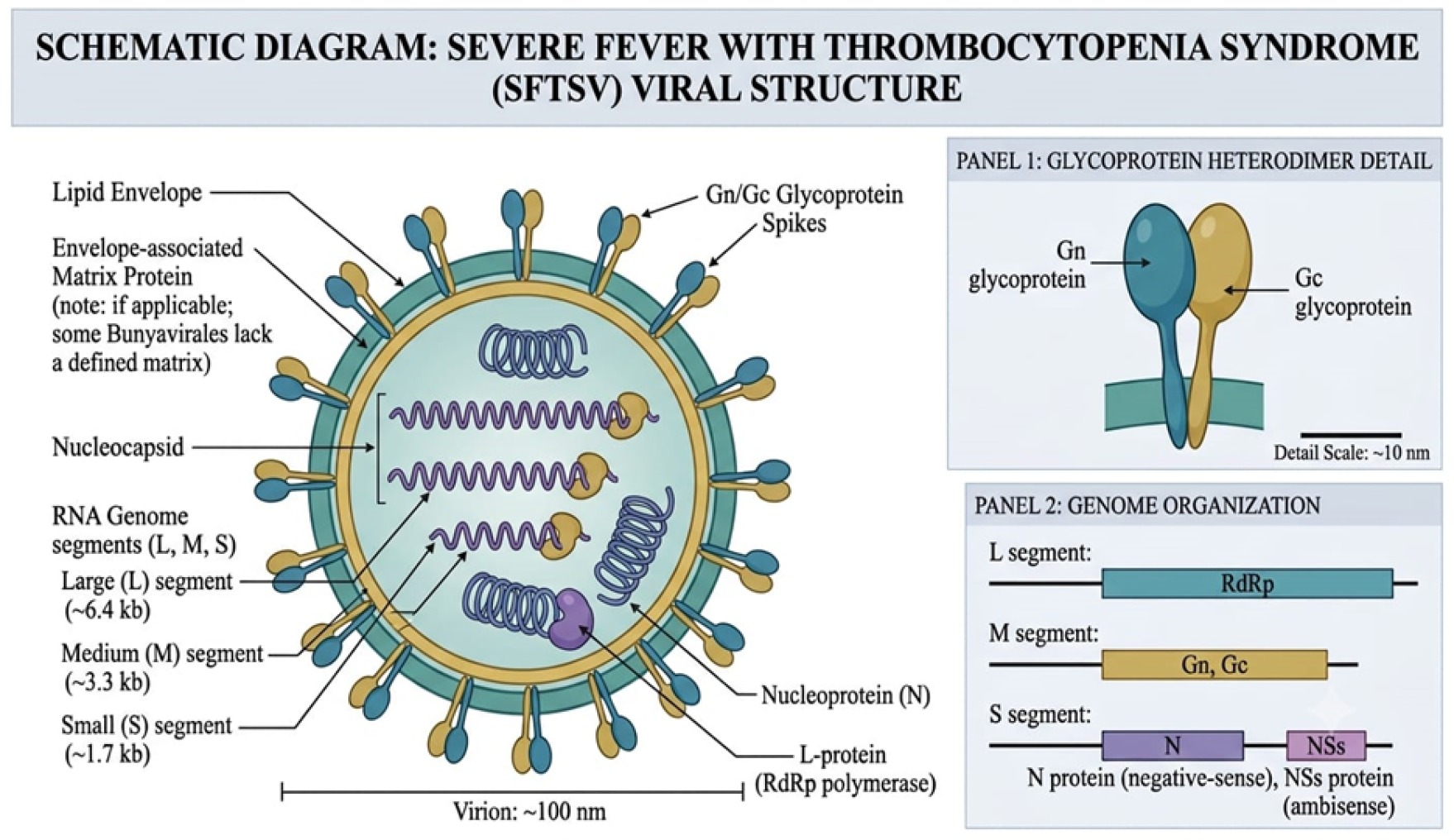
Schematic structure of Severe Fever with Thrombocytopenia Syndrome Virus (SFTSV).
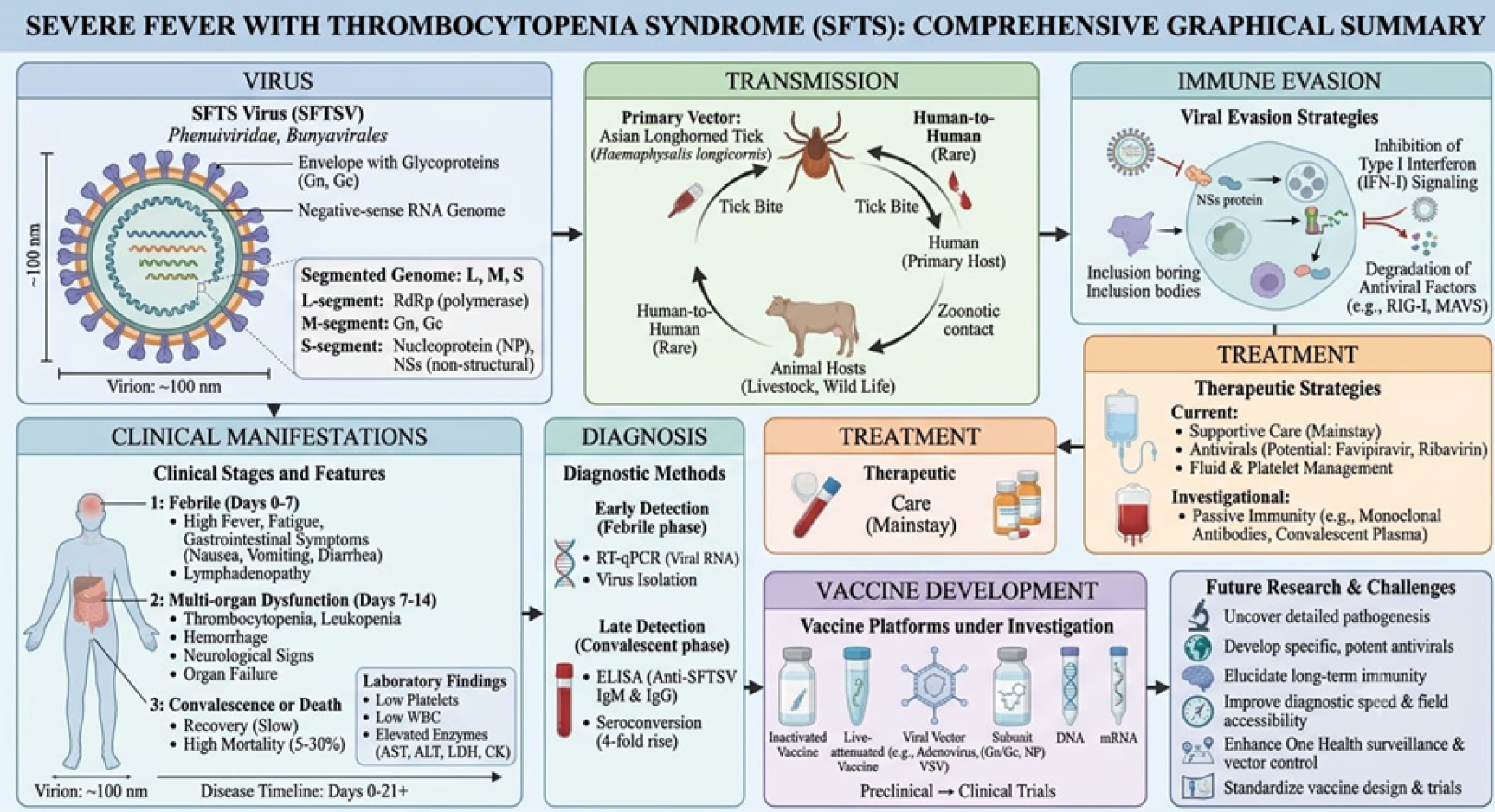
Graphical summary of SFTSV transmission, host immune evasion, clinical manifestations, diagnosis, treatment, vaccine development, and future research directions.
References
- Casel, M.A., S.J. Park, and Y.K. Choi. 2021. Severe fever with thrombocytopenia syndrome virus: emerging novel phlebovirus and their control strategy. Experimen. Molecul. Med., 53(5): pp.713–722. https://doi.org/10.1038/s12276-021-00610-1[CrossRef]
- Charoensakulchai, S., K. Matsuno, T. Nakayama, E.E. Shioda, and H.A. Imad. 2025. Epidemiological characteristics of severe fever with thrombocytopenia syndrome. Americ. J. Trop. Med. Hygiene., 112(5): p.956. https://doi.org/10.4269/ajtmh.24-0616[CrossRef]
- Chen, H., K. Hu, J. Zou, and J. Xiao. 2013. A cluster of cases of human-to-human transmission caused by severe fever with thrombocytopenia syndrome bunyavirus. Int. J. Infec. Diseas., 17(3): pp.e206–e208. https://doi.org/10.1016/j.ijid.2012.11.006[CrossRef]
- Choi, S.J., S.W. Park, I.G. Bae, S.H. Kim, S.Y. Ryu, H.A. Kim, H.C. Jang, J. Hur, J.B. Jun, Y. Jung, and H.H. Chang. 2016. Severe fever with thrombocytopenia syndrome in South Korea, 2013–2015. PLoS Neglec. Trop. Diseas., 10(12): p.e0005264. https://doi.org/10.1371/journal.pntd.0005264[CrossRef]
- Cui, H., S. Shen, L. Chen, Z. Fan, Q. Wen, Y. Xing, Z. Wang, J. Zhang, J. Chen, B. La, and Y. Fang. 2024. Global epidemiology of severe fever with thrombocytopenia syndrome virus in human and animals: a systematic review and meta-analysis. Lancet Region. Health – Western Pacif., 48. https://doi.org/10.1016/j.lanwpc.2024.101133[CrossRef]
- Cui, N., R. Liu, Q.B. Lu, L.Y. Wang, S.L. Qin, Z.D. Yang, L. Zhuang, K. Liu, H. Li, X.A. Zhang, and J.G. Hu. 2015. Severe fever with thrombocytopenia syndrome bunyavirus-related human encephalitis. J. Infect., 70(1): pp.52–59. https://doi.org/10.1016/j.jinf.2014.08.001[CrossRef]
- Deng, B., S. Zhang, Y. Geng, Y. Zhang, Y. Wang, W. Yao, Y. Wen, W. Cui, Y. Zhou, Q. Gu, and W. Wang. 2012. Cytokine and chemokine levels in patients with severe fever with thrombocytopenia syndrome virus. PLoS ONE., 7(7): p.e41365. https://doi.org/10.1371/journal.pone.0041365[CrossRef]
- Deng, B., B. Zhou, S. Zhang, Y. Zhu, L. Han, Y. Geng, Z. Jin, H. Liu, D. Wang, Y. Zhao, and Y. Wen. 2013. Clinical features and factors associated with severity and fatality among patients with severe fever with thrombocytopenia syndrome bunyavirus infection in Northeast China. PLoS ONE., 8(11): p.e80802. https://doi.org/10.1371/journal.pone.0080802[CrossRef]
- Ding, F., W. Zhang, L. Wang, W. Hu, R.J. Soares Magalhaes, H. Sun, H. Zhou, S. Sha, S. Li, Q. Liu, and Q. Li. 2013. Epidemiologic features of severe fever with thrombocytopenia syndrome in China, 2011–2012. Clin. Infect. Diseas., 56(11): pp.1682–1683. https://doi.org/10.1093/cid/cit100[CrossRef]
- Ding, S., G. Niu, X. Xu, J. Li, X. Zhang, H. Yin, N. Zhang, S. Jiang, S. Wang, M. Liang, and X. Wang. 2014. Age is a critical risk factor for severe fever with thrombocytopenia syndrome. PLoS ONE., 9(11): p.e111736. https://doi.org/10.1371/journal.pone.0111736[CrossRef]
- Dualis, H., A.C. Zefong, L.K. Joo, N.K.D. Singh, S.S.S.A. Rahim, R. Avoi, M.S. Jeffree, M.R. Hassan, M.Y. Ibrahim, and A. Omar. 2021. Factors and outcomes in severe fever with thrombocytopenia syndrome (SFTS): a systematic review. Annal. Med. Surg., 67: p.102501. https://doi.org/10.1016/j.amsu.2021.102501[CrossRef]
- Gai, Z., M. Liang, Y. Zhang, S. Zhang, C. Jin, S.W. Wang, L. Sun, N. Zhou, Q. Zhang, Y. Sun, and S.J. Ding. 2012a. Person-to-person transmission of severe fever with thrombocytopenia syndrome bunyavirus through blood contact. Clin. Infect. Diseas., 54(2): pp.249–252. https://doi.org/10.1093/cid/cir776[CrossRef]
- Gai, Z.T., Y. Zhang, M.F. Liang, C. Jin, S. Zhang, C.B. Zhu, C. Li, X.Y. Li, Q.F. Zhang, P.F. Bian, and L.H. Zhang. 2012b. Clinical progress and risk factors for death in severe fever with thrombocytopenia syndrome patients. The Journal of Infectious Diseas., 206(7): pp.1095–1102. https://doi.org/10.1093/infdis/jis472[CrossRef]
- Guo, C.T., Q.B. Lu, S.J. Ding, C.Y. Hu, J.G. Hu, Y. Wo, X.J. Fan, S.L. Wang, N. Qin, Cui, and Z.D. Yang. 2016. Epidemiological and clinical characteristics of severe fever with thrombocytopenia syndrome (SFTS) in China: an integrated data analysis. Epidemiology and Infection, 144(6), pp.1345–1354. https://doi.org/10.1017/S0950268815002678[CrossRef]
- He, F., X. Zheng, and Z. Zhang. 2021. Clinical features of severe fever with thrombocytopenia syndrome and analysis of risk factors for mortality. BMC Infectious Diseases, 21(1), p.1253. https://doi.org/10.1186/s12879-021-06946-3[CrossRef]
- He, Z., B. Wang, Y. Li, Y. Du, H. Ma, X. Li, W. Guo, B. Xu, and X. Huang. 2020. Severe fever with thrombocytopenia syndrome: a systematic review and meta-analysis of epidemiology, clinical signs, routine laboratory diagnosis, risk factors, and outcomes. BMC Infectious Diseases, 20(1), p.575. https://doi.org/10.1186/s12879-020-05303-0[CrossRef]
- Hicks, P., T.B. Manzoni, J.B. Westover, R.J. Petch, B. Roper, B.B. Gowen, and P. Bates. 2024. Safety, immunogenicity, and efficacy of a recombinant vesicular stomatitis virus vectored vaccine against severe fever with thrombocytopenia syndrome virus and heartland bandavirus. Vaccines, 12(12), p.1403. https://doi.org/10.3390/vaccines12121403[CrossRef]
- Huang, X., J. Li, A. Li, S. Wang, and D. Li. 2021. Epidemiological characteristics of severe fever with thrombocytopenia syndrome from 2010 to 2019 in mainland China. International Journal of Environmental Research and Public Health, 18(6), p.3092. https://doi.org/10.3390/ijerph18063092[CrossRef]
- Jeong, D.E., J. Yoon, B. Kim, and J.G. Kang. 2025. The immunogenicity and protection efficacy evaluation of mRNA vaccine candidate for severe fever with thrombocytopenia syndrome in mice. PLOS Neglected Tropical Diseases, 19(4), p.e0012999. https://doi.org/10.1371/journal.pntd.0012999[CrossRef]
- Jin, C., M. Liang, J. Ning, W. Gu, H. Jiang, W. Wu, F. Zhang, C. Li, Q. Zhang, H. Zhu, and T. Chen. 2012. Pathogenesis of emerging severe fever with thrombocytopenia syndrome virus in C57/BL6 mouse model. Proceedings of the National Academy of Sciences, 109(25), pp.10053–10058. https://doi.org/10.1073/pnas.1120246109[CrossRef]
- Kato, H., T. Yamagishi, T. Shimada, T. Matsui, M. Shimojima, M. Saijo, K. Oishi, and SFTS Epidemiological Research Group-Japan. 2016. Epidemiological and clinical features of severe fever with thrombocytopenia syndrome in Japan, 2013–2014. PLoS ONE, 11(10), p.e0165207. https://doi.org/10.1371/journal.pone.0165207[CrossRef]
- Kida, K., Y. Matsuoka, T. Shimoda, H. Matsuoka, H. Yamada, T. Saito, O. Imataki, N. Kadowaki, K. Noguchi, K. Maeda, and Y. Mochizuki. 2019. A case of cat-to-human transmission of severe fever with thrombocytopenia syndrome virus. Japanese Journal of Infectious Diseases, 72(5), pp.356–358. https://doi.org/10.7883/yoken.JJID.2018.526[CrossRef]
- Kim, D., E. Kim, S. Kim, Y. Chung, C.J. Lai, I. Cha, S.D. Cho, Y. Choi, X. Dai, S. Kim, and S. Kang. 2023. Self-assembling Gn head ferritin nanoparticle vaccine provides full protection from lethal challenge of Dabie bandavirus in aged ferrets. MBio, 14(5), pp.e01868-23. https://doi.org/10.1128/mbio.01868-23[CrossRef]
- Kim, D., C.J. Lai, I. Cha, and J.U. Jung. 2024. Current progress of severe fever with thrombocytopenia syndrome virus (SFTSV) vaccine development. Viruses, 16(1), p.128. https://doi.org/10.3390/v16010128[CrossRef]
- Kim, K.H., J. Yi, G. Kim, S.J. Choi, K.I. Jun, N H. Kim, P.G. Choe, N.J. Kim, J.K. Lee, and M.D. Oh. 2013. Severe fever with thrombocytopenia syndrome, South Korea, 2012. Emerging Infectious Diseases, 19(11), p.1892. https://doi.org/10.3201/eid1911.130792[CrossRef]
- Kim, W.Y., W. Choi, S.W. Park, E.B. Wang, W.J. Lee, Y. Jee, K.S. Lim, H.J. Lee, S.M. Kim, S.O. Lee, and S.H. Choi. 2015. Nosocomial transmission of severe fever with thrombocytopenia syndrome in Korea. Clinical Infectious Diseases, 60(11), pp.1681–1683. https://doi.org/10.1093/cid/civ128[CrossRef]
- Kobayashi, Y., H. Kato, T. Yamagishi, T. Shimada, T. Matsui, T. Yoshikawa, T. Kurosu, M. Shimojima, S. Morikawa, H. Hasegawa, and M. Saijo. 2020. Severe fever with thrombocytopenia syndrome, Japan, 2013–2017. Emerging Infectious Diseases, 26(4), p.692. https://doi.org/10.3201/eid2604.191011[CrossRef]
- Lam, T.T.Y., W. Liu, T.A. Bowden, N. Cui, L. Zhuang, K. Liu, Y.Y. Zhang, W.C. Cao, and O.G. Pybus. 2013. Evolutionary and molecular analysis of the emergent severe fever with thrombocytopenia syndrome virus. Epidemics, 5(1), pp.1–10. https://doi.org/10.1016/j.epidem.2012.09.002[CrossRef]
- Lei, X.Y., M.M. Liu, and X.J. Yu. 2015. Severe fever with thrombocytopenia syndrome and its pathogen SFTSV. Microbes and Infection, 17(2), pp.149–154. https://doi.org/10.1016/j.micinf.2014.12.002[CrossRef]
- Li, D.X. 2015. Severe fever with thrombocytopenia syndrome: a newly discovered emerging infectious disease. Clinical Microbiology and Infection, 21(7), pp.614–620. https://doi.org/10.1016/j.cmi.2015.03.001[CrossRef]
- Li, H., Q.B. Lu, B. Xing, S.F. Zhang, K. Liu, J. Du, X.K. Li, N. Cui, Z.D. Yang, L.Y. Wang, and J.G. Hu. 2018. Epidemiological and clinical features of laboratory-diagnosed severe fever with thrombocytopenia syndrome in China, 2011–17: a prospective observational study. The Lancet Infectious Diseases, 18(10), pp.1127–1137. https://doi.org/10.1016/S1473-3099(18)30293-7[CrossRef]
- Li, J., S. Li, L. Yang, P. Cao, and J. Lu. 2021. Severe fever with thrombocytopenia syndrome virus: a highly lethal bunyavirus. Critical Reviews in Microbiology, 47(1), pp.112–125. https://doi.org/10.1080/1040841X.2020.1847037[CrossRef]
- Li, J.C., J. Zhao, H. Li, L.Q. Fang, and W. Liu. 2022. Epidemiology, clinical characteristics, and treatment of severe fever with thrombocytopenia syndrome. Infectious Medicine, 1(1), pp.40–49. https://doi.org/10.1016/j.imj.2021.10.001[CrossRef]
- Lin, T.L., S.C. Ou, K. Maeda, H. Shimoda, J.P.W. Chan, W.C. Tu, W.L. Hsu, and C.C. Chou. 2020. The first discovery of severe fever with thrombocytopenia syndrome virus in Taiwan. Emerging Microbes and Infections, 9(1), pp.148–151. https://doi.org/10.1080/22221751.2019.1710436[CrossRef]
- Liu, K., N. Cui, L.Q. Fang, B.J. Wang, Q.B. Lu, W. Peng, H. Li, L.Y. Wang, S. Liang, H.Y. Wang, and Y.Y. Zhang. 2014. Epidemiologic features and environmental risk factors of severe fever with thrombocytopenia syndrome, Xinyang, China. PLoS Neglected Tropical Diseases, 8(5), p.e2820. https://doi.org/10.1371/journal.pntd.0002820[CrossRef]
- Liu, K., H. Zhou, R.X. Sun, H.W. Yao, Y. Li, L.P. Wang, D. Mu, X.L. Li, Y. Yang, G.C. Gray, and N. Cui. 2015. A national assessment of the epidemiology of severe fever with thrombocytopenia syndrome, China. Scientific Reports, 5(1), p.9679. https://doi.org/10.1038/srep09679[CrossRef]
- Liu, M.M., X.Y. Lei, H. Yu, J.Z. Zhang, and X.J. Yu. 2017. Correlation of cytokine level with the severity of severe fever with thrombocytopenia syndrome. Virology Journal, 14(1), p.6. https://doi.org/10.1186/s12985-016-0677-1[CrossRef]
- Liu, Q., B. He, S.Y. Huang, F. Wei, and X.Q. Zhu. 2014b. Severe fever with thrombocytopenia syndrome, an emerging tick-borne zoonosis. The Lancet Infectious Diseases, 14(8), pp.763–772. https://doi.org/10.1016/S1473-3099(14)70718-2[CrossRef]
- Liu, Y., Q. Li, W. Hu, J. Wu, Y. Wang, L. Mei, D.H. Walker, J. Ren, Y. Wang, and X.J. Yu. 2012. Person-to-person transmission of severe fever with thrombocytopenia syndrome virus. Vector-Borne and Zoonotic Diseases, 12(2), pp.156–160. https://doi.org/10.1089/vbz.2011.0758[CrossRef]
- Miao, D., M.J. Liu, Y.X. Wang, X. Ren, Q.B. Lu, G.P. Zhao, K. Dai, X.L. Li, H. Li, X.A. Zhang, and W.Q. Shi. 2021. Epidemiology and ecology of severe fever with thrombocytopenia syndrome in China, 2010–2018. Clinical Infectious Diseases, 73(11), pp.e3851–e3858. https://doi.org/10.1093/cid/ciaa1561[CrossRef]
- Ning, Y.J., M. Wang, M. Deng, S. Shen, W. Liu, W.C. Cao, F. Deng, Y.Y. Wang, Z. Hu, and H. Wang. 2014. Viral suppression of innate immunity via spatial isolation of TBK1/IKKε from mitochondrial antiviral platform. Journal of molecular cell biology, 6(4), pp.324-337. https://doi.org/10.1093/jmcb/mju015[CrossRef]
- Ning, Y.J., K. Feng, Y.Q. Min, W.C. Cao, M. Wang, F. Deng, Z. Hu, and H. Wang. 2015. Disruption of type I interferon signaling by the nonstructural protein of severe fever with thrombocytopenia syndrome virus via the hijacking of STAT2 and STAT1 into inclusion bodies. Journal of virology, 89(8), pp.4227-4236. https://doi.org/10.1128/JVI.00154-15[CrossRef]
- Niu, G., J. Li, M. Liang, X. Jiang, M. Jiang, H. Yin, Z. Wang, C. Li, Q. Zhang, C. Jin, and X. Wang. 2013. Severe fever with thrombocytopenia syndrome virus among domesticated animals, China. Emerging Infectious Diseases, 19(5), p.756. https://doi.org/10.3201/eid1905.120245[CrossRef]
- Qian, H., L. Tian, W. Liu, L. Liu, M. Li, Z. Zhao, X. Lei, W. Zheng, Z. Zhao, and X. Zheng. 2024. Adenovirus type 5-expressing Gn induces better protective immunity than Gc against SFTSV infection in mice. npj Vaccines, 9(1), p.194. https://doi.org/10.1038/s41541-024-00993-y[CrossRef]
- Qu, B., X. Qi, X. Wu, M. Liang, C. Li, C.J. Cardona, W. Xu, F. Tang, Z. Li, B. Wu, and K. Powell. 2012. Suppression of the interferon and NF-κB responses by severe fever with thrombocytopenia syndrome virus. Journal of virology, 86(16), pp.8388-8401. https://doi.org/10.1128/JVI.00612-12[CrossRef]
- Rattanakomol, P., S. Khongwichit, P. Linsuwanon, K.H. Lee, S. Vongpunsawad, and Y. Poovorawan. 2022. Severe fever with thrombocytopenia syndrome virus infection, Thailand, 2019–2020. Emerging Infectious Diseases, 28(12), p.2572. https://doi.org/10.3201/eid2812.221183[CrossRef]
- Saijo, M. 2018. Pathophysiology of severe fever with thrombocytopenia syndrome and development of specific antiviral therapy. Journal of Infection and Chemotherapy, 24(10), pp.773–781. https://doi.org/10.1016/j.jiac.2018.07.009[CrossRef]
- Seo, J.W., D. Kim, N. Yun, and D.M. Kim. 2021. Clinical update of severe fever with thrombocytopenia syndrome. Viruses, 13(7), p.1213. https://doi.org/10.3390/v13071213[CrossRef]
- Shin, J., D. Kwon, S.K. Youn, and J.H. Park. 2015. Characteristics and factors associated with death among patients hospitalized for severe fever with thrombocytopenia syndrome, South Korea, 2013. Emerging Infectious Diseases, 21(10), p.1704. https://doi.org/10.3201/eid2110.141928[CrossRef]
- Silvas, J.A., and P.V. Aguilar. 2017. The emergence of severe fever with thrombocytopenia syndrome virus. The American Journal of Tropical Medicine and Hygiene, 97(4), p.992. https://doi.org/10.4269/ajtmh.16-0967[CrossRef]
- Sun, J., L. Lu, H. Wu, J. Yang, J. Ren, and Q. Liu. 2017. The changing epidemiological characteristics of severe fever with thrombocytopenia syndrome in China, 2011–2016. Scientific Reports, 7(1), p.9236. https://doi.org/10.1038/s41598-017-08042-6[CrossRef]
- Sun, L., Y. Hu, A. Niyonsaba, Q. Tong, L. Lu, H. Li, and S. Jie. 2014. Detection and evaluation of immunofunction of patients with severe fever with thrombocytopenia syndrome. Clinical and Experimental Medicine, 14(4), pp.389–395. https://doi.org/10.1007/s10238-013-0259-0[CrossRef]
- Sun, Y., C. Jin, F. Zhan, X. Wang, M. Liang, Q. Zhang, S. Ding, X. Guan, X. Huo, C. Li, and J. Qu. 2012. Host cytokine storm is associated with disease severity of severe fever with thrombocytopenia syndrome. The Journal of Infectious Diseases, 206(7), pp.1085–1094. https://doi.org/10.1093/infdis/jis452[CrossRef]
- Takahashi, T., K. Maeda, T. Suzuki, A. Ishido, T. Shigeoka, T. Tominaga, T. Kamei, M. Honda, D. Ninomiya, T. Sakai, and T. Senba. 2014. The first identification and retrospective study of severe fever with thrombocytopenia syndrome in Japan. The Journal of Infectious Diseases, 209(6), pp.816–827. https://doi.org/10.1093/infdis/jit603[CrossRef]
- Tang, X., W. Wu, H. Wang, Y. Du, L. Liu, K. Kang, X. Huang, H. Ma, F. Mu, S. Zhang, and G. Zhao. 2013. Human-to-human transmission of severe fever with thrombocytopenia syndrome bunyavirus through contact with infectious blood. The Journal of Infectious Diseases, 207(5), pp.736–739. https://doi.org/10.1093/infdis/jis748[CrossRef]
- Tran, X.C., Y. Yun, S.H. Kim, N.T.P. Thao, P.K.C. Man, J.R. Yoo, S.T. Heo, N.H. Cho, and K.H. Lee. 2019. Endemic severe fever with thrombocytopenia syndrome, Vietnam. Emerging Infectious Diseases, 25(5), p.1029. https://doi.org/10.3201/eid2505.181463[CrossRef]
- Wang, F., Y. Wu, J. Jiao, J. Wang, and Z. Ge. 2020. Risk factors and clinical characteristics of severe fever with thrombocytopenia syndrome. International Journal of General Medicine, pp.1661–1667. https://doi.org/10.2147/IJGM.S292735[CrossRef]
- Wang, Y., Z. Song, X. Wei, H. Yuan, X. Xu, H. Liang, and H. Wen. 2022. Clinical laboratory parameters and fatality of severe fever with thrombocytopenia syndrome patients: a systematic review and meta-analysis. PLoS Neglected Tropical Diseases, 16(6), p.e0010489. https://doi.org/10.1371/journal.pntd.0010489[CrossRef]
- Wu, X., X. Qi, B. Qu, Z. Zhang, M. Liang, C. Li, C.J. Cardona, D. Li, and , Z. Xing. 2014. Evasion of antiviral immunity through sequestering of TBK1/IKKε/IRF3 into viral inclusion bodies. Journal of virology, 88(6), pp.3067-3076. https://doi.org/10.1128/JVI.03510-13[CrossRef]
- Xu, X., Z. Sun, J. Liu, J. Zhang, T. Liu, X. Mu, and M. Jiang. 2018. Analysis of clinical features and early warning indicators of death from severe fever with thrombocytopenia syndrome. International Journal of Infectious Diseases, 73, pp.43–48. https://doi.org/10.1016/j.ijid.2018.05.013[CrossRef]
- Yang, K., J. Chen, Z. Chen, and Y. Zheng. 2023. Risk factors for death in patients with severe fever with thrombocytopenia syndrome. The American Journal of Tropical Medicine and Hygiene, 109(1), p.94. https://doi.org/10.4269/ajtmh.22-0667[CrossRef]
- Yang, T., H. Huang, L. Jiang, and J. Li. 2022. Overview of the immunological mechanism underlying severe fever with thrombocytopenia syndrome. International Journal of Molecular Medicine, 50(3), pp.1–12. https://doi.org/10.3892/ijmm.2022.5174[CrossRef]
- Yokomizo, K., M. Tomozane, C. Sano, and R. Ohta. 2022. Clinical presentation and mortality of severe fever with thrombocytopenia syndrome in Japan: a systematic review of case reports. International Journal of Environmental Research and Public Health, 19(4), p.2271. https://doi.org/10.3390/ijerph19042271[CrossRef]
- Yu, X.J. 2018. Risk factors for death in severe fever with thrombocytopenia syndrome. The Lancet Infectious Diseases, 18(10), pp.1056–1057. https://doi.org/10.1016/S1473-3099(18)30312-8[CrossRef]
- Zhan, J., Q. Wang, J. Cheng, B. Hu, J. Li, F. Zhan, Y. Song, and D. Guo. 2017. Current status of severe fever with thrombocytopenia syndrome in China. Virologica Sinica, 32(1), pp.51–62 https://doi.org/10.1007/s12250-016-3931-1.[CrossRef]
- Zhang, S., J. Wang, Q. Zhang, Y. Pan, Z. Zhang, Y. Geng, B. Jia, Y. Li, Y. Xiong, X. Yan, and J. Li. 2024. Association of liver function and prognosis in patients with severe fever with thrombocytopenia syndrome. PLoS Neglected Tropical Diseases, 18(4), p.e0012068. https://doi.org/10.1371/journal.pntd.0012068[CrossRef]
Services
Article usage statistics
Loading…