Peste des petits ruminants (PPR) is a contagious, economically important, World Organization for Animal Health (OIE) notifiable, morbillivirus (small ruminant morbillivirus-SRMV) infecting disease of sheep and goats and other related wildlife small ruminants species. The disease causes the highest death among various infectious diseases that limit the optimum productivity of sheep and goats in the world. Most of the sheep and goats are reared by poor sections of rural communities for nutrition, livelihood, and financial needs (Balamurugan et al., 2021). The disease poses a serious threat to small ruminant production in Africa, Asia, and the Middle East, where the disease is widespread and endemic; hence the disease outbreak on small ruminants has a huge socio-economic impact on all the developing countries (Balamurugan et al., 2014, 2021; OIE and FAO, 2015; Yirga et al., 2020). Because of its increasing spread, it becomes a main constraint in augmenting the productivity of small ruminants in endemic countries. OIE has considered PPR as an economically important ruminants’ disease and taken action to eradicate PPRV by 2030, as part of the OIE/FAO Global Strategic Plan (OIE and FAO, 2015). Vaccination is an important tool for the control of PPR in endemic developing countries like India because of the availability of effective and safe vaccines which provide long-lasting protection (OIE and FAO, 2015).
India is a vast country with a population of 148.88 million goats and 74.26 million sheep against a world population of ~2 billion small ruminants (Balamurugan et al., 2020b, 2021). Sheep and goats are the ‘‘Any Time Money’’ of the poor landless, marginal, and small farmers and they generate income and employment for their livelihood. The disease reporting, understanding of the disease epidemiology, strong support of diagnostics and surveillance, and vaccination of the animals are highly imperative for the effective control of disease, besides strategic plan and infrastructure facilities. India practiced focused vaccination in PPR outbreak places since 2002 and program mode since 2011 even before the global strategy was scheduled (Singh et al., 2009; Balamurugan et al., 2016). During 2011, the Government of India (https://www.dahd.nic.in) implemented a national control program on PPR (PPR-CP), in which the vaccination was covered in South peninsular India in the first phase, and the remaining states and union territories were included in the second phase from 2014 (Balamurugan et al., 2016, 2021). Since then, various programs have been taken care including mass vaccination, restricted nomadic movements, surveillance, focus vaccination, and quarantine of animals to control the spread of the disease. Despite vaccination, several outbreaks of PPR in sheep and goats are occurring and have not been recorded properly, owing to inadequate reporting of animal diseases in India. Moreover, neither systematic surveillance nor sero-monitoring was undertaken to assess the effectiveness of the vaccination in a particular region except for a few studies (Balamurugan et al., 2018, 2020b). The disease has been brought under control in some of the states and PPR outbreaks threat reported declined progressively and substantially in the continuous vaccination practiced states like Chhattisgarh (Balamurugan et al., 2018) and Southern peninsular region (Balamurugan et al., 2020b) and benefits outweigh the cost of a vaccination program (Govindaraj et al., 2019).
Flock or herd immunity, although may be used in a slightly different sense, basically refers to the proportion of immune individuals in a population that reduces the risk of infection to the susceptible individuals by the presence and proximity of immune individuals (Fine et al., 2011). This threshold flock /herd immunity of PPR is set to be about 70- 80% in the global eradication of the strategy of PPR (OIE and FAO, 2015; Hammami et al., 2016). The proportion of immune animals which confer protection due to population immunity may vary depending on the contact structure of the population and transmissibility of the agent. The prevalence studies after PPR vaccination in small ruminants has been reported from different endemic countries in the world including India (Balamurugan et al., 2018, 2020b; Yirga et al., 2020).
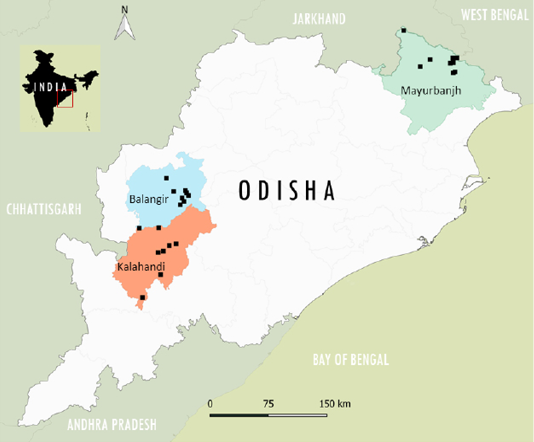
The Odisha state implemented a mass vaccination, during the year 2015 in the second phase of the PPR-CP implementation (Balamurugan et al., 2016, 2020a). However, despite the implementation of PPR-CP in Odisha, systematic epidemiological surveys for PPR for the state have not been conducted except for serosurvey during 2017-2018 (Balamurugan et al., 2020a), which showed 54.2% prevalence of the PPRV antibodies in small ruminants population. Despite mass vaccination is being adopted, disease outbreaks with associated epidemiological factors are being reported sporadically in some places of Odisha state (Kumar et al., 2017; Mishra et al., 2020; Rath et al., 2020). Therefore, after regular implementing the vaccination program, the present serosurvey is being undertaken here along with the collection of host factors to establish the population immunity of PPR in sheep and goats at a given period to determine PPRV antibodies status towards the eradication of PPR in Odisha state.