Mazhar Hussain Mangi1, Asghar Ali Kamboh1*, Rahmatullah Rind1, Parkash Dewani2, Zaheer Ahmed Nizamani4, Ali Raza Mangi3, Ali Raza Nizamani4, Waseem Ali Vistro3
1Department of Veterinary Microbiology, Faculty of Animal Husbandry and Veterinary Sciences, Sindh Agriculture University, Tandojam; 2Directorate of Veterinary Research & Diagnosis, Central Veterinary Diagnosis Laboratory (CVDL) Tandojam, Sindh; 3Department of Veterinary Anatomy and histology, Faculty of Animal Husbandry and Veterinary Sciences, Sindh Agriculture University, Tandojam; 4Department of Veterinary Pathology, Faculty of Animal Husbandry and Veterinary Sciences, Sindh Agriculture University, Tandojam, Pakistan.
*Correspondence | Asghar Ali Kamboh, Sindh Agriculture University, Tandojam, Pakistan; Email: drasgharkamboh@yahoo.com
Abstract
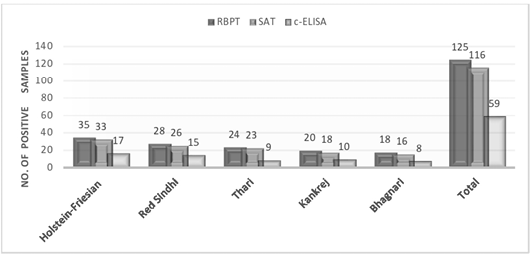
Brucellosis is considered to be one of the most widespread zoonosis in the world. A comparative study on the seroprevalence of brucellosis in indigenous cattle breeds and exotic cattle (Holstein-Friesian) was carried out in district Hyderabad, Sindh, Pakistan. A total of 500 serum samples, 100 each from Red Sindhi, Thari, Kankrej, Bhagnari and Holstein-Friesian breeds were collected from both male and female animals and examined by Rose Bengal plate test (RBPT), serum agglutination test (SAT) and Competitive Enzyme Linked Immunosorbent Assay (c-ELISA). The overall prevalence of brucellosis in cattle was determined as 25, 23.2 and 11.8% by RBPT, SAT and c-ELISA respectively. However, highest prevalence of brucellosis was recorded in Holstein-Friesian (RBPT: 35%; SAT: 33%; c-ELISA: 17%), followed by Red Sindhi (RBPT: 28%; SAT: 26%; c-ELISA: 15%), Thari (RBPT: 24%; SAT: 23%; c-ELISA: 9%), Kankrej (RBPT: 20%; SAT: 18%; c-ELISA: 10%) and Bhagnari (RBPT: 18%; SAT: 16%; c-ELISA: 8%). The sex-wise comparison of seropositive animals indicated that the prevalence of brucellosis was 26.88% in females and 8% in males by both, RBPT and SAT. Furthermore somewhat lower prevalence (12.22%) of brucellosis was demonstrated in female cattle by c-ELISA. The effect of age on the seroprevalence of brucellosis in cattle of Sindh province was also studied. Of the 250 sera examined from cattle ≤ 4 years of age, 51(20.4%), 49(19.6%) and 26 (10.4%) were found positive by RBPT, SAT and c-ELISA respectively. While, of the 250 sera of ˃ 4 years of age 74 (29.6%), 66 (26.4%) and 33 (13.2%) were found positive by RBPT, SAT and c-ELISA, respectively. It was concluded from the present study that exotic cattle (Holstein-Friesian) have higher seroprevalence of brucellosis compared to local cattle breeds amongst which highest prevalence was recorded in Red Sindhi and lowest in Bhagnari breed. Further, among the sero-diagnostic techniques applied during present investigation, the c-ELISA was found as superior technique to determine brucellosis in cattle.
Keywords | Seroprevalence, Brucellosis, Holstein-Friesian, Cattle breeds, Sindh
Editor | Sanjay Kumar Singh, In-Charge Animal Gynecology Lab, Animal Reproduction Division, Indian Veterinary Research Institute, Izatnagar 243122, Bareilly (UP), India.
Received | July 13, 2015; Revised | August 30, 2015; Accepted | September 02, 2015; Published | September 29, 2015
Citation | Mangi MH, Kamboh AA, Rind R, Dewani P, Nizamani ZA, Mangi AR, Nizamani AR, Vistro WA (2015). Seroprevalence of brucellosis in Holstein-Friesian and indigenous cattle breeds of Sindh Province, Pakistan. J. Anim. Health Prod. 3(4): 82-87.
ISSN | 2308–2801
Copyright © 2015 Mangi et al. This is an open access article distributed under the Creative Commons Attribution License, which permits unrestricted use, distribution, and reproduction in any medium, provided the original work is properly cited.