

ResearchersLinks

Research Article · Volume 3, Issue 2, Pages 35–38, 30 April 2015 · Open Access

Prevalence Survey of Bovine Brucellosis in Apparently Healthy Dairy Animals in Karachi, Pakistan

· · · · · · ·

Article Info ⌄
Journal:
Journal of Animal Health and Production
Published:
30 April 2015

From the article

  • For milk samples a total of 100 farms were visited and 200 milk samples were collected from cattle and buffalos of different towns of Karachi.
  • An overall, prevalence of Brucella abortus in milk samples was recorded as 14% (28/200).
  • Highest prevalence of bovine brucellosis was recorded in dairy farms of Landhi Cattle Colony (25%), followed by Hospital Chorangi (22.2%), Filter Plant (20.0%) and Karadar (16.67%), while lowest one was found at farms of Nagori dairies (5.88%).
  • From these results it could be concluded that brucellosis is present in the apparently healthy dairy cattle and buffaloes of Karachi, however, its prevalence is low comparing with other small cities of Pakistan.

Selected from the article's own text.

Abstract

NaeemUllah Durrani1*, RahmatUllah Rind1, Asghar Ali Kamboh1, Faiza Habib1, Saba Parveen Samo2, Shujat Ali khan3, ZiaUllah4, Muhammad Shahid5

1Department of Veterinary Microbiology; 2Department of Animal Nutrition; 3Department of Veterinary Anatomy and Histology; 4Department of Animal Reproduction, Faculty of Animal Husbandry and Veterinary Sciences, Sindh Agriculture University, Tandojam, Pakistan; 5Veterinary Research Institute, Bacha Khan Chowk, Peshawar, KPK, Pakistan.

*Correspondence | NaeemUllah Durrani, Sindh Agriculture University, Tandojam, Pakistan; Email: drnaeemdurrani12@gmail.com

Abstract
Brucellosis is one of the major zoonosis diseases that are still prevalent throughout the world. The present modified cross-sectional study aims to determine the prevalence of brucellosis in apparently healthy dairy cattle/buffaloes in Karachi, Pakistan. A total of 100 farms at different localities of Karachi were visited and milk and blood samples (n=200 each) were collected. These were analysed by Rose Bengal Plate Test (RBPT), complement fixation test (CFT) and milk ring test (MRT). Results indicated a 17.5%, 12.5% seropositive samples by RBPT and CFT, respectively. While, 14% were recorded in the milk samples analysed by MRT. In different areas (towns) prevalence percentage varied highly, ranging from 5.88% to 25%. From these results it could be concluded that brucellosis is present in the apparently healthy dairy cattle and buffaloes of Karachi, however, its prevalence is low comparing with small cities of Pakistan. Furthermore, disease prevalence is diverse in different areas of Karachi. These results emphasize the need for a better monitoring of the disease by government policies or local veterinarians to overcome the disease prevalence.

Keywords | Brucellosis, Cattle, Buffalo, Prevalence, Karachi
INTRODUCTION

The economic importance of livestock goes beyond direct food production. Skins, fibers, manure (fertilizer or fuel), draught power, and capital are also livestock benefits. Livestock provides a lifeline for a large proportion of 95% of the world’s rural population that lives in the developing world and cultivates 64% of the world’s arable land. The major products of livestock are draught power, meat, milk, eggs, manure, feathers, fiber, hides, and horn .

Livestock is facing several health issues, however, the most important livestock diseases endemic in rural areas include brucellosis and calf scour . Brucellosis is one of the major zoonotic diseases. It is still prevalent throughout the world. Although many developed countries have eradicated Brucella abortus from cattle, but it continues to pose a major public and animal health problem. Even though, Brucella has definite host preferences, bovine brucellosis caused mainly by B. abortus. The main factors of concern for the farmers to brucellosis are the low fertility and the high mortality in young animals .

Brucellosis is a major reproduction problem, and unfortunately in developing countries farmers not taken keen interest to regularly tests their animals for brucellosis. Some small scale farms cannot afford to practice the system of culling for positive animals. These animals become carriers of the Brucella organism and thus a potential source of infection. Even though many countries have extensive eradication programs, some even having eradicated the disease, brucellosis is still a serious disease challenging the veterinary and medical professions. The reported incidences and the prevalence of the disease vary from country to country and region to region .

The present study was therefore, carried out to record the prevalence of brucellosis in apparently healthy dairy cattle and buffaloes of Karachi, Pakistan.

MATERIALS AND METHODS

Study Design

A modified cross-sectional study design was used to find out the prevalence of brucellosis in cattle and buffaloes in Karachi. A total of 100 farms at different localities of Karachi were visited during February-August 2011 and samples were collected from lactating animals. Visits were made to all 4 districts of Karachi and a total of 200 dairy buffaloes and cattle were examined and samples including blood and milk samples were collected. A total of 5 ml milk or blood sample were collected ascetically in sterilized sample bottles and transported to laboratory under refrigerated conditions for analysis . Upon coagulation, serum were separated from blood samples and it was further centrifuged at 3000 rpm for 10 min to remove any cellular material.

Laboratory Procedures

Milk Ring Test (MRT)

Milk Ring Test (MRT) was performed according to the standard procedure (OIE, 2008). Hematoxylin stained Brucella abortus (Strain-99) antigen was purchased from Veterinary Research Institute (VRI, Lahore, Pakistan) and used for MRT as recommended by manufacturer.

Rose Bengal Plate Test (RBPT)

Rose Bengal Plate Test (RBPT) was performed according to the method as described by Khalil and Gabbar (1992). The Rose Bengal stained antigen containing Brucella abortus cells (strain-99) suspended in buffer at pH 3.6 were used, as per the recommendation of supplier (VRI, Lahore, Pakistan).

Complement Fixation Test (CFT)

Serum samples which were reacted positive to RBPT were reanalysed by CFT to confirm and to eliminate any cross reaction. All test protocols and interpretations of fixation ratios were followed as per standard procedure (OIE, 2008).

RESULTS

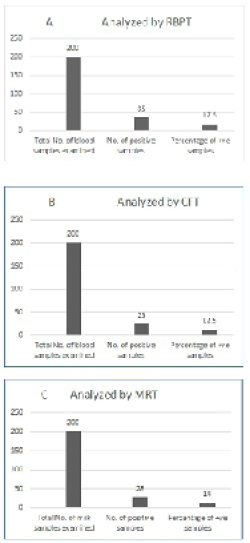
During present survey, a total of 200 blood and milk samples were collected and examined for bovine brucellosis and results have been summarized in Figure 1. During sera analysis through RBPT, 35 (17.5%) were found sero-positive for bovine brucellosis (Figure 1A). However, when same sera were analyzed by CFT only 25 (12.5%) were shown reactivity (Figure 1B).

Figure 1: Prevalence of bovine brucellosis in Karachi: A. Analysed by RBPT; B. Analysed by CFT; C. Analysed by MRT

For milk samples a total of 100 farms were visited and 200 milk samples were collected from cattle and buffalos of different towns of Karachi. These were analyzed by MRT and results have been summarized in Table 1 and Figure 1C. An overall, prevalence of Brucella abortus in milk samples was recorded as 14% (28/200). Highest prevalence of bovine brucellosis was recorded in dairy farms of Landhi Cattle Colony (25%), followed by Hospital Chorangi (22.2%), Filter Plant (20.0%) and Karadar (16.67%), while lowest one was found at farms of Nagori dairies (5.88%).

Table 1: Prevalence of bovine brucellosis in milk samples in different towns of Karachi

Town name

No. of individual farm’s milk examined

No. of positive

farms

Sample prevalence

(%)

Landhi Cattle Colony

4

1

25.00

Nagori dairies

34

2

5.88

Hospital Chorangi

9

2

22.22

Karadar

48

8

16.67

Filter Plant

5

1

20.00

Total

100

14

14.00

DISCUSSION

The prevention of human brucellosis depends on the control of the disease in animals. The successful eradication of the bovine disease has been achieved mainly in industrialized countries (Europe and Americas). However, most countries in Asia do have control programs as well, but they do not exist in Pakistan . The people of this country are frequently infected with B. abortus, but it generally produces a less serious disease than virulent strains of B. melitensis or B. suis . The findings of this study clearly underline the necessity to improve the legislation on animal disease controls. As in present investigation, among 200 blood samples examined, a proportion of 17.5% to 12.5% were found sero-positive by RBPT and CFT respectively. These values were quite higher (i.e., 1.84% and 1.38% by RBPT and CFT respectively) than recorded in a recent study in eastern Ethiopia . However, in an Irish study, 51% prevalence of bovine brucellosis was recorded in CFT . These differences might be due to different geographical locations as prevalence of bacterial diseases having been found varied from region to region ; . Similar type of findings has been observed in our results of samplings from different farms/towns. However, difference of testing techniques could also be factor for variation of prevalence recorded, because it is well known that different techniques have numerous level of sensitivity . In general, the ELISA is preferable to the complement fixation test (CFT) because it is more sensitive and it is not affected by pro- or anti-complementary factors. If ELISA reagents are not available, or if subtyping is pursued, then CFT could be performed as a most sensitive test .

Milk ring test (MRT) is known to be an essential screening test for brucellosis in milk. We have used this test in our study and found 14% cases as positive. This prevalence is quite low as compared to our study in Hyderabad that showed 31-47% prevalence in cattle and buffaloes respectively. Likewise, in another study in Faisalabad, 20.1% was recorded in horses . These results clearly indicated that Karachi has a low prevalence of brucellosis as compared to other small cities of Pakistan i.e., Hyderabad and Faisalabad. This reflects the better managemental and sanitary conditions in dairy farms of Karachi as compared to other small cities of Pakistan. Because, it is well recognized that sanitary conditions like disposal of aborted material, contact with stray dogs and other wild animals etc., are the major risk factors for brucellosis .

From these results it could be concluded that brucellosis is present in the apparently healthy dairy cattle and buffaloes of Karachi, however, its prevalence is low comparing with other small cities of Pakistan. These results emphasize the need for a better monitoring of the disease by government policies or local veterinarians. Above all, it is essential to raise the awareness of the disease among all the dairy cattle/buffalo farmers.

References

  1. Alton GG, Nielsen K, Duncan JR (1990). Brucella melitensis, in Animal Brucellosis. CRC Press, Boca Raton. FL, 383-422.
  2. Corbel MJ (1997). Brucellosis an Overview. Emerg. Infect. Dis. 3(2): 213-21. http://dx.doi.org/10.3201/eid0302.970219[CrossRef]
  3. Ansari ARMIH, Rahman MM, Islam MZ, Das BC, Habib A, Belal SMSH, Islam K (2014). Prevalence and antimicrobial resistance profile of Escherichia coli and salmonella isolated from diarrheic calves. J. Anim. Health Prod. 2(1): 12 – 15. http://dx.doi.org/10.14737/journal.jahp/2014/2.1.12.15[Full text][CrossRef]
  4. Degefu H, Mohamud M, Hailemelekot M, Yohannes M (2011). Seroprevalence of bovine brucellosis in agro pastoral areas of Jijjiga zone of Somali National Regional State, Eastern Ethiopia. Ethiop. Vet. J. 15(1): 37-47. http://dx.doi.org/10.4314/evj.v15i1.67683[CrossRef]
  5. Ferris NP, Dawson M (1988). Routine application of enzyme-linked immunosorbent assay in comparison with complement fixation for the diagnosis of foot-and-mouth and swine vesicular disease. Vet. Microbiol. 16: 201–209. http://dx.doi.org/10.1016/0378-1135(88)90024-7[CrossRef]
  6. Gall D, Nielsen K (2004). Serological diagnosis of bovine brucellosis: a review of test performance and cost comparison. Rev. Sci. Tech. 23(3): 989-1002.
  7. Gul ST, Khan A, Ahmad M, Hussain I (2013). Seroprevalence of brucellosis and associated hemato-Biochemical changes in Pakistani horses. Pak. J. Agri. Sci. 50(4): 745-750.
  8. Hayes M, Ashe S, Collins DM, Power S, Kenny K, Sheahan M, O’Hagan G, More SJ (2009). An evaluation of Irish cattle herds with inconclusive serological evidence of bovine brucellosis. Irish Vet. J. 62(3): 182-190. http://dx.doi.org/10.1186/2046-0481-62-3-182[CrossRef]
  9. Hoffmann D (1999). Asian Livestock to the Year 2000 and beyond. Working Paper series 1/2: 1-44.
  10. Khalil MA, Gabbar A (1992). Procedure in Veterinary Microbiology. Field Documents No. 6.2nd Ed. C.V.D.L. Tandojam, Sindh, Pakistan. 6-93.
  11. OIE (2008). Bovine brucellosis. In: Manual of diagnostic tests and vaccines for terrestrial animal. 6 th Ed, Pp. 409-438.12, rue de Prony, Paris, France.
  12. Radostits OM, Gay CC, Blood DC, Hinchcliff KW (2000). Veterinary Medicine, A textbook of the Diseases of Cattle, Sheep, Pigs, Goats and Horses. Harcourt Publishers Limited, London. Pp. 867-882.
  13. Mailk S, Kumar A, Verma AK, Gupta MK, Sharma SD, Sharma AK, Rahal A (2013). Incidence and drug resistance pattern of collibacillosis in cattle and buffalo calves in Western Utter Pradesh in India. J Anim. Health Prod. 1(2): 15-19
  14. Sachan N, Nautiyal B, Agarwal RK, Singh VP, Verma AK (2013). Sero-epidemiological Pattern of Salmonellosis in Animals of Rohilkhand Region, Uttar Pradesh, India. J. Anim. Health Prod. 1(1): 6-9.
  15. Soomro AH, Kamboh AA, Rind R, Dawani P, Sarwar M, Abro SH, Awais M (2014). A study on prevalence and risk factors of brucellosis in cattle and buffaloes in district Hyderabad, Pakistan. J. Anim. Health Prod. 2 (3): 33 – 37. http://dx.doi.org/10.14737/journal.jahp/2014/2.3.33.37[Full text][CrossRef]

Cited by 4 articles

In journals published by ResearchersLinks.

  1. Sero-Epidemiological Investigation of Abortifacient Bacteria in Goats and Sheep in Three Districts of Sindh Province of PakistanPakistan Journal of Zoology · 2023
  2. Isolation of Mycobacterium bovis from Milk and Nasal Discharge Samples of Cattle from Hyderabad and Tando Allahyar DistrictsJournal of Animal Health and Production · 2016
  3. The Prevalence of Brucellosis in Kundhi Buffaloes in District Hyderabad, PakistanJournal of Animal Health and Production · 2015
  4. Seroprevalence of Brucellosis in Holstein-Friesian and Indigenous Cattle Breeds of Sindh Province, PakistanJournal of Animal Health and Production · 2015

Services

Article usage statistics

Loading…

Prevalence Survey of Bovine Brucellosis in Apparently Healthy Dairy Animals in Karachi, Pakistan · ResearchersLinks