Research Article · Volume 14, Issue 2, 6 February 2026 · Open Access
Rumen Fermentability, Volatile Fatty Acid Profiles, and Predicted Microbiome Function in Response to Graded Indigofera zollingeriana Pellet Inclusion
· · ·
Affiliations & Notes ⌄
- 1Doctoral Program in Animal Science, Faculty of Animal Science, Universitas Brawijaya, Ketawanggede, 65145, Malang, Indonesia
- 2Faculty of Animal Science, Universitas Hasanuddin, Tamalanrea, 90245, Makassar, Indonesia. *Correspondence | Suyadi Suyadi, Faculty of Animal Science, Universitas Brawijaya, Ketawanggede, 65145, Malang, Indonesia
- 3Email: suyadi@ub.ac.id
- 4Faculty of Animal Science, Universitas Brawijaya, Ketawanggede, 65145, Malang, Indonesia
Article Info ⌄
- Journal:
- Advances in Animal and Veterinary Sciences
- Published:
- 6 February 2026

Abstract
INTRODUCTION
Rumen fermentation is the main biochemical process that determines the efficiency of nutrient utilization in ruminant livestock, where the rumen microbial community converts feed carbohydrates into volatile fatty acids (VFAs), which are the main source of energy for the host. The proportion of VFA, specifically the ratio of acetate to propionate, is often used as an indicator of fermentability and fermentation energy efficiency, as propionate is a major precursor of gluconeogenesis ; ; . Therefore, a nutritional strategy that can direct fermentation towards a more efficient formation of VFA is an important focus in the development of ruminant feed.
Indigofera zollingeriana is a tropical legume with a high protein content and great potential as a substitute for conventional protein sources in animal feed . However, the presence of bioactive compounds, such as tannins, in Indigofera can modulate rumen fermentation in a complex manner. At low to moderate levels, tannins can increase nitrogen utilization efficiency and regulate nutrient degradation; however, at higher levels, they can suppress the activity of fermentative microbes and decrease fermentability ; . Thus, the rumen fermentation response to Indigofera is highly dependent on its level of inclusion in the diet. The inclusion levels of Indigofera zollingeriana used in this study, low (13.5%) and moderate (27.1%), were selected based on previous findings suggesting that low-to-moderate levels of tannin-rich legumes can improve rumen fermentation by modulating protein degradation and microbial activity, whereas higher levels may impose antinutritional effects that alter microbial function and fermentability ; .
In addition to affecting fermentation output, changes in feed composition can shift the metabolic function of the rumen microbiome. Although 16S rRNA gene sequencing-based approaches have been widely used to describe the structure of microbial communities, the information obtained has not fully explained how community changes translate into changes in metabolic function. The development of function prediction methods, such as PICRUSt2, allows the inference of the metabolic pathways of the microbiome based on taxonomic profiles, thus providing a framework for attributing fermentation changes to potential underlying metabolic functions .
Although several studies have evaluated the influence of Indigofera on the degradation and composition of rumen microbes, studies that specifically integrate rumen fermentability, rumen modifiers, VFA profiles, and prediction of microbiome metabolic function are still limited ; . Understanding how Indigofera levels modulate the metabolic functions of the microbiome, specifically carbohydrate degradation pathways, pyruvate fermentation, and microbial adaptive mechanisms, is critical for interpreting diet-driven shifts in rumen fermentation patterns and end-product partitioning (e.g., VFA ratios), complementing conventional degradability outcomes. Therefore, this study aimed to evaluate rumen fermentability and VFA profiles in response to graded inclusion levels of Indigofera zollingeriana pellets, interpreted from the perspective of predicted rumen microbial metabolic function, addressing the limited integrated evidence currently available under controlled in vitro conditions. However, limited information is available regarding the integrated evaluation of rumen fermentability, volatile fatty acid profiles, and predicted microbiome functional potential in response to graded inclusion levels of Indigofera zollingeriana, particularly under controlled in vitro conditions.
MATERIALS AND METHODS
Experimental design and feed preparation
The experiment was conducted in vitro using a completely randomized design with three dietary treatments: T0 (control diet without Indigofera pellets), T1 (low inclusion level of Indigofera zollingeriana pellets), and T2 (moderate inclusion level of Indigofera zollingeriana pellets). The arginine–tannin complex (0.25%) was applied uniformly across all treatments, including the control, and therefore was not considered a differentiating experimental factor. Each biological replicate represented an independent batch incubation derived from separate rumen fluid collections.
Indigofera zollingeriana leaves were processed into pellets to ensure homogeneity and reduce selective feeding effects. Pelleting is known to influence the physical availability of nutrients and may affect the temporal exposure of rumen microbes to tannins compared with fresh or meal forms of feed. The feed composition and nutritional content are presented in Table 1.
The in vitro degradation of dry matter (IVDMD) and organic matter (IVOMD) was determined using the in vitro post-fermentation residue method ; . The degradation of dry ingredients was calculated from the oven residue at 105°C for 12 h, while OM degradation was determined by ashing the residue at 600 °C for 2 h. The concentration of ammonia nitrogen (NH₃-N) was analyzed using the indophenol method. Microbial protein synthesis was estimated indirectly based on nitrogen incorporation into the microbial biomass, with the protein concentration determined using the Lowry method and bovine serum albumin as a standard. Rumen fluid was collected from fistulated cattle fed a standard forage-concentrate diet and was mixed with a buffer solution under anaerobic conditions. Each substrate was incubated in duplicate (technical duplicates) within each biological replicate for 48 h at 39 °C.
Table 1: Ingredient composition and proximate nutrient content of experimental diets.
| Feed ingredient | T0 (%) | T1 (%) | T2 (%) |
| Sorghum silage | 50.00 | 50.00 | 50.00 |
| Indigofera zollingeriana | 0.00 | 13.57 | 27.13 |
| DDGS | 10.85 | 5.40 | 1.80 |
| Copra Meal | 9.04 | 4.53 | 1.81 |
| Fat powder | 2.72 | 2.72 | 2.72 |
| Cassava meal | 1.81 | 2.72 | 1.81 |
| Molasses | 1.81 | 1.81 | 0.91 |
| Corn gluten feed | 3.62 | 3.62 | 3.62 |
| Coffee hull | 7.69 | 4.07 | 1.35 |
| Soybean meal | 7.23 | 6.33 | 3.62 |
| Rice bran | 4.53 | 4.53 | 4.53 |
| Premix | 0.45 | 0.45 | 0.45 |
| Arginine–tannin | 0.25 | 0.25 | 0.25 |
| Chemical composition (% dry matter) | |||
| Dry matter (DM, %) | 89.99 | 89.95 | 90.15 |
| Organic matter (OM, %) | 89.62 | 89.10 | 89.71 |
| Crude protein (CP, %) | 14.49 | 13.31 | 13.27 |
| Crude fiber (CF, %) | 22.10 | 27.74 | 28.96 |
| Ether extract (EE, %) | 4.82 | 3.80 | 4.40 |
| Ash (%) | 10.38 | 10.90 | 10.29 |
| Nitrogen-free extract (%) | 48.23 | 44.26 | 43.09 |
Volatile fatty acid (VFA) profile analysis
The analysis of volatile fatty acids included acetate, propionate, and butyrate. Samples of the fermented liquids were analyzed using gas chromatography (GC-8A, Shimadzu) equipped with CP-FDAP columns. The total VFA and the ratio between VFA fractions (C2:C3, C3:C4, C2+C4:C3, and the proportion of each VFA to the total VFA) were calculated to evaluate ruminal fermentation.
DNA extraction and 16S rRNA gene sequencing
Rumen microbial DNA was extracted using the PureLink™ Genomic DNA Kit, according to the manufacturer’s protocol. The V3–V4 region of the 16S rRNA gene was amplified using universal primers, and the resulting amplicons were sequenced using the Illumina MiSeq platform. Raw sequencing data were processed using the DADA2 pipeline to infer amplicon sequence variants (ASVs) for downstream microbial community analysis .
Microbiome functional prediction and multivariate analysis
Given the limited number of sequenced samples per treatment, microbiome functional predictions and multivariate analyses were interpreted descriptively to explore trends, not for formal statistical inference . Functional prediction of the rumen microbiome was performed using PICRUSt2 based on the ASV data derived from 16S rRNA gene sequencing. Predicted microbial metabolic functions were annotated in terms of KEGG Orthology (KO) and MetaCyc metabolic pathways using reference genomic databases. Multivariate analyses, including principal component analysis (PCA) and heatmap visualization, were applied to evaluate shifts in microbial metabolic function patterns among dietary treatments ; . Because functional predictions were generated from a limited number of sequenced samples without inferential statistical testing, PICRUSt2 results were interpreted descriptively and exploratorily.
Statistical analysis
Data on degradation, pH, NH₃-N, microbial protein synthesis, and VFA profiles were analyzed using one-way analysis of variance (ANOVA). Differences between treatments were tested using Duncan’s test at a significance level of P < 0.05. PCA and clustering of metabolic functions were performed to identify shifts in the metabolic potential of the rumen microbiome between treatments. Therefore, functional differences are presented as supportive patterns aligned with the fermentation outcomes rather than definitive treatment effects.
RESULTS
Rumen fermentation characteristics and volatile fatty acid (VFA)
The effects of dietary treatments on rumen fermentation characteristics and volatile fatty acid (VFA) profiles are shown in Table 2.
The effects of dietary treatments on rumen fermentation characteristics and volatile fatty acid (VFA) profiles are presented in Table 2. In vitro dry matter degradation (IVDMD) and in vitro organic matter degradation (IVOMD) did not differ significantly among the treatments (p > 0.05), although numerically higher values were observed in T0 and lower values in T2. The individual VFA concentrations (C2, C3, and C4), total VFA production, microbial protein synthesis, ammonia nitrogen (NH₃–N) concentration, and rumen pH were not significantly affected by the dietary treatments (p > 0.05). In contrast, the dietary treatments significantly affected the VFA ratios. The acetate-to-propionate ratio (C2:C3) and the combined ratio of acetate plus butyrate to
Table 2: Effects of dietary treatments on in vitro rumen fermentation characteristics and volatile fatty acid (VFA) profiles.
| Parameter | T0 | T1 | T2 |
| IVDMD (%) | 62.99 ± 2.32 | 61.70 ± 6.51 | 57.19 ± 6.48 |
| IVOMD (%) | 66.71 ± 7.58 | 61.95 ± 5.95 | 57.29 ± 7.03 |
| C2 (mM) | 50.57 ± 14.05 | 46.55 ± 17.56 | 40.27 ± 9.41 |
| C3 (mM) | 9.75 ± 2.40 | 14.97 ± 6.07 | 13.96 ± 3.05 |
| C4 (mM) | 15.17 ± 3.09 | 13.82 ± 4.10 | 10.50 ± 1.59 |
| VFA Total (mM) | 75.49 ± 16.24 | 75.34 ± 27.03 | 64.73 ± 13.34 |
| C2:C3 | 5.48 ± 1.98a | 3.16 ± 0.75b | 2.88 ± 0.06b |
| C3:C4 | 0.68 ± 0.29b | 1.08 ± 0.21ab | 1.33 ± 0.27a |
| C2+C4:C3 | 7.12 ± 2.48b | 4.12 ± 0.93a | 3.65 ± 0.08a |
| C2: VFA total | 0.66 ± 0.05 | 0.61 ± 0.03 | 0.62 ± 0.02 |
| C3: VFA total | 0.14 ± 0.05b | 0.20 ± 0.03a | 0.22 ± 0.00a |
| C4: VFA total | 0.20 ± 0.01a | 0.19 ± 0.02b | 0.17 ± 0.03b |
| MPS concentration (mg/100ml) | 90.03 ± 6.58 | 85.70 ± 8.39 | 94.17 ± 14.06 |
| NH₃-N (mg/100 ml) | 25.88 ± 8.71 | 25.20 ± 7.95 | 14.01 ± 3.97 |
| pH | 6.85 ± 0.03 | 6.84 ± 0.02 | 6.87 ± 0.08 |
Note: Values within a row with different superscripts (a, b) differ significantly at p < 0.05, based on Duncan’s multiple range test. Values with the same superscript are not significantly different.
propionate (C2+C4:C3) were significantly lower in T1 and T2 than in T0 (p < 0.05). The C3:C4 ratio and the proportion of propionate relative to total VFA (C3/VFA) were significantly higher in T1 and T2, whereas the proportion of butyrate relative to total VFA (C4/VFA) was significantly lower compared with T0 (p < 0.05).
Microbial taxonomic overview of the rumen microbiome
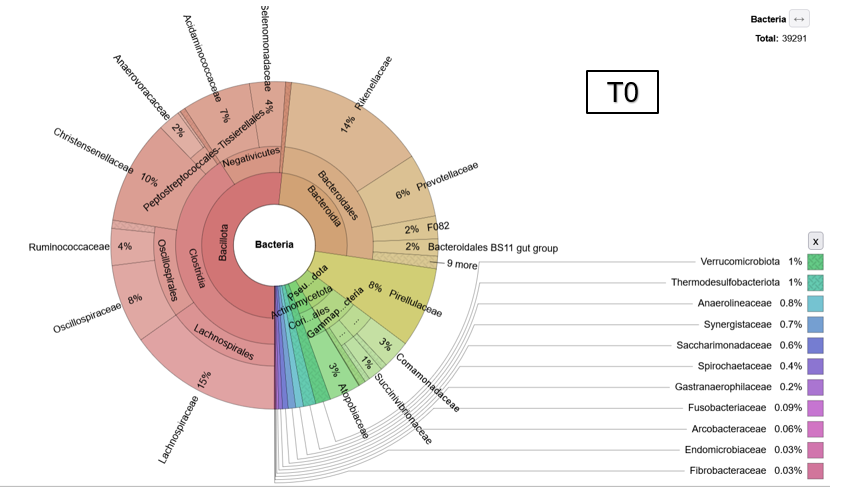
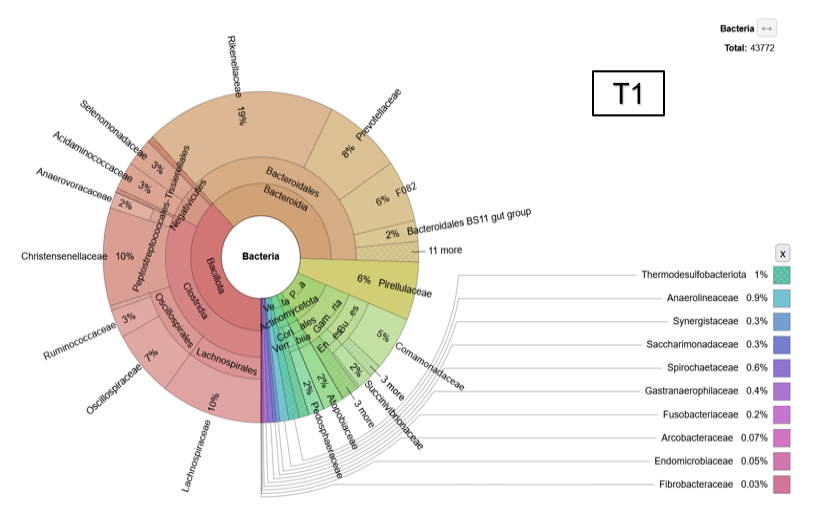
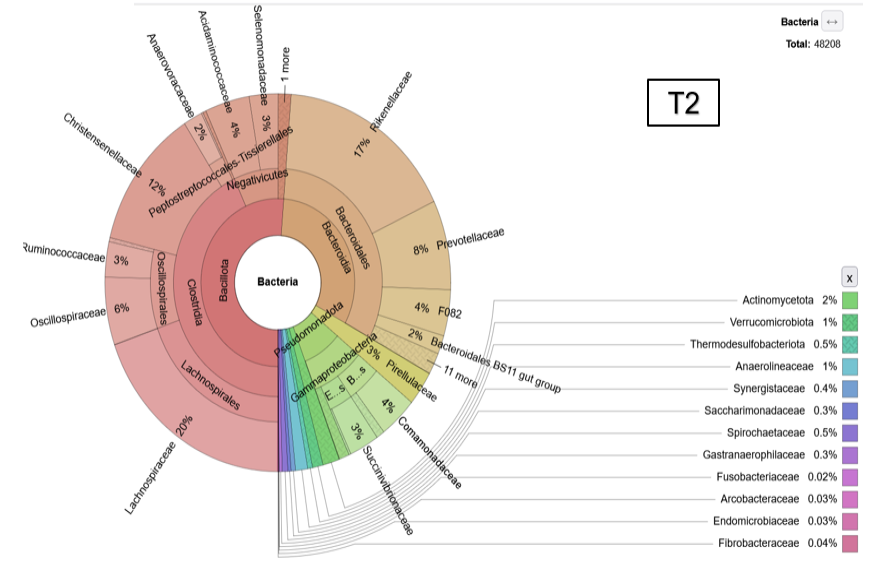
Figures 1–3 present the Krona visualization of the rumen bacterial community composition under control conditions (T0) and Indigofera zollingeriana inclusion treatments (T1 and T2). Across all treatments, the rumen microbiome was consistently dominated by bacteria belonging to the phyla Firmicutes and Bacteroidetes. In the control treatment (Figure 1), Firmicutes constituted the largest proportion of the microbial community, with prominent representation of taxa affiliated with the orders Lachnospirales and Oscillospirales, whereas Bacteroidota were mainly represented by members of the family Prevotellaceae. Minor proportions of other bacterial groups were also detected, indicating a diverse microbial community under the controlled dietary conditions. In the T1 and T2 treatments, the overall taxonomic structure remained broadly similar to that of the control, with Firmicutes and Bacteroidetes continuing to dominate the microbial community. Differences among treatments were primarily observed in the relative abundance patterns of the dominant taxa, with no major loss of key bacterial groups. Minor taxa remained present at low abundance in all treatments, suggesting that the overall microbial diversity was maintained despite changes in dietary Indigofera inclusion. Krona plots illustrated the overall taxonomic stability of the rumen microbiome across treatments, supporting the observation that functional shifts occurred without major changes in the dominant taxa.
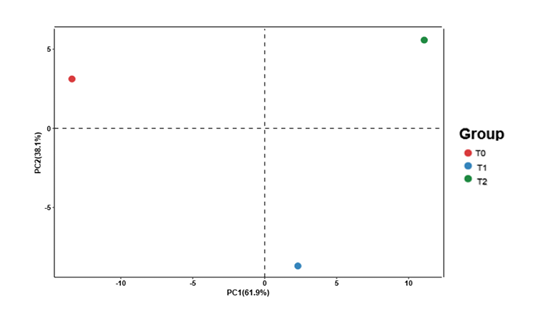
Principal component analysis (Figure 4) showed a clear separation among dietary treatments based on the combined rumen fermentation parameters and predicted microbial functional profiles of the rumen fluid. The first principal component (PC1), accounting for 61.9% of the total variance, separated the control treatment (T0) from the Indigofera zollingeriana–supplemented treatments (T1 and T2). The second principal component (PC2), which explained 38.1% of the variance, further differentiated T1 and T2, indicating distinct multivariate profiles between the two inclusion levels.
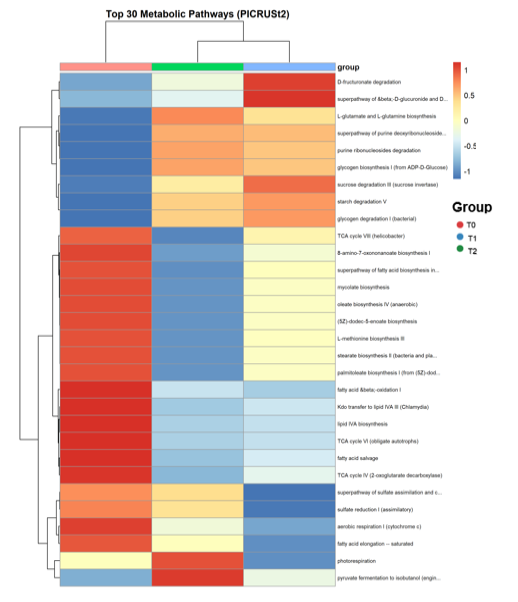
In the heatmap (Figure 5), each treatment exhibited distinct pathways with strong enrichment (indicated by the red intensity). The control treatment (T0) showed high enrichment of pathways related to fatty acid biosynthesis, lipid A biosynthesis, mycolate and stearate biosynthesis, and basal TCA cycle–related pathways, indicating the dominance of core biosynthetic and maintenance metabolism.
T1 treatment was characterized by strong enrichment of carbohydrate degradation pathways, including starch degradation, sucrose degradation, glycogen biosynthesis and degradation, and pyruvate fermentation–related pathways, reflecting a distinct clustering pattern compared with T0 and T2. In contrast, the T2 treatment showed pronounced enrichment of pathways associated with respiration and stress-related metabolism, particularly aerobic respiration (cytochrome c), sulfur reduction and sulfate assimilation, purine degradation, and TCA cycle variants, which differentiated T2 these results indicate from the other treatments in the heatmap. Despite the relatively stable phylum-level composition across treatments, the functional profiles exhibited marked divergence, indicating functional plasticity within the taxonomically robust rumen microbiome. This suggests that dominant microbial taxa adjust their metabolic strategies in response to dietary pressure rather than being replaced by entirely different ones.
DISCUSSION
Rumen fermentation to Indigofera inclusion
The present study demonstrated that the inclusion of Indigofera zollingeriana pellets induced dose-dependent changes in rumen fermentation outcomes. The control treatment (T0) maintained the highest IVDMD/IVOMD and total VFA concentrations, reflecting a robust baseline fermentability under conventional substrate conditions. At low inclusion (T1), degradation was numerically lower than that at T0, whereas the total VFA remained at comparable levels, indicating that the overall fermentation intensity was not substantially reduced. This pattern suggests that T1 primarily altered fermentation routing (i.e., VFA distribution) rather than markedly reducing fermentation extent. In contrast, the higher inclusion level (T2) resulted in the lowest degradation and total VFA, indicating a reduction in the overall fermentative output. This pattern is consistent with a shift from “productive fermentation” towards a more constrained metabolic state when legume-derived bioactive compounds and lignocellulosic complexity increase beyond an optimal threshold ; ; . Because the arginine–tannin supplement was uniformly applied, the observed treatment effects were attributed to the graded inclusion of Indigofera zollingeriana pellets rather than the supplement itself.
VFA ratios identify a functionally efficient fermentation state
Among the evaluated fermentation indicators, the VFA ratios (C2:C3 and C2+C4:C3) emerged as the most sensitive markers for distinguishing between the dietary treatments. The pronounced reduction in C2:C3 observed in T1 reflected a directional shift in fermentation end-product distribution toward a more propionate-oriented profile, despite the absence of statistically significant changes in individual VFA concentrations or total VFA production. From a rumen bioenergetics perspective, a lower acetate-to-propionate ratio is widely interpreted as a redirection of reducing equivalents toward propionate formation, which enhances the glucogenic potential of the host ; ; . Importantly, because total VFA production and substrate degradation in T1 were statistically comparable to those in T0, the observed ratio shifts indicate an improvement in fermentation quality rather than quantity. In contrast, although T2 exhibited VFA ratios similar to those of T1, the consistent numerical decline in total VFA production and digestibility suggests a metabolically constrained fermentative state. This pattern implies that higher Indigofera inclusion may impose adaptive metabolic demands on the rumen microbiome, favoring maintenance over the maximal fermentative output. Collectively, these findings support a dose-dependent response in which moderate Indigofera inclusion optimizes fermentation patterns, whereas higher inclusion approaches a biological constraint, consistent with hormetic responses reported for plant secondary compounds in ruminant diets ; .
NH₃–N decline reflects enhanced nitrogen protection under higher indigofera
Although NH₃–N concentrations did not differ among treatments (p > 0.05)), a consistent numerical decline was observed with increasing Indigofera inclusion, particularly at T2., indicates reduced ruminal proteolysis and deamination or increased nitrogen protection, mechanisms commonly associated with tannin-containing forages and legume bioactives. Tannins can bind to dietary proteins and reduce their ruminal degradation, thereby lowering NH₃-N concentration while preserving the availability of amino acids post-ruminally, depending on the dose and tannin type ; ; ; . Importantly, the NH₃-N values remained within the functional range for microbial growth, which is consistent with the absence of significant differences in microbial protein synthesis (MPS). The stable MPS suggests that, despite shifts in VFA profiles and NH₃-N concentration, microbial growth capacity was not impaired within the incubation conditions, an outcome that strengthens the inference that treatment effects were primarily expressed through changes in metabolic routing and substrate utilization rather than overt microbial inhibition ; ; ; .
Additionally, the rumen pH remained stable across the treatments, with no evidence of acidotic conditions. This stability indicates that fermentation shifts were not driven by extreme environmental stress in the rumen but rather reflected controlled metabolic adjustments to changes in substrate composition and bioactive exposure. In other words, the system appears to remain homeostatic even when the fermentation output declines at higher inclusion levels.
Taxonomic profiles
Krona-based taxonomic overviews (Figures 1–3) indicated that Firmicutes and Bacteroidota remained dominant across treatments, representing a conserved core rumen microbiota. The persistence of taxa affiliated with Lachnospirales/ Oscillospirales and Prevotellaceae suggests that fundamental fibrolytic and saccharolytic capacities were retained under Indigofera inclusion. Such taxonomic continuity is important because it implies that the observed fermentation changes were less likely due to a collapse of key fermenters and more likely due to functional modulation either changes in relative abundance of functionally distinct subgroups or shifts in gene expression/metabolic potential within the same broad community structure ; .
The subtle community shifts observed at T1 were consistent with a controlled rebalancing of carbohydrate utilization, aligning with the propionate-enriched profile. Under T2, the continued presence of core phyla alongside constrained fermentative output suggests a state in which microbial metabolism may become more constrained by substrate accessibility (e.g., higher lignocellulosic complexity).
PICRUSt2-based functional predictions of metabolic reorientation
The PCA and heatmap derived from PICRUSt2 (MetaCyc/KO annotations) provided an integrative perspective on the potential functional shifts underlying the fermentation patterns. PCA showed a clear separation between T0 and Indigofera-supplemented treatments along PC1, indicating that Indigofera inclusion systematically shifted the predicted metabolic capacity. Importantly, T1 and T2 were separated along PC2, demonstrating that functional profiles diverged between low and high inclusion levels rather than shifting uniformly. This mirrors the fermentation data: T1 maintained total VFA while shifting ratios, whereas T2 had numerically lower total VFA and degradation rates. Heatmap analysis (Figure 5) further supports this functional stratification of the genes. T1 exhibited strong enrichment of carbohydrate degradation and central fermentative routes (e.g., starch/sucrose/glycogen utilization and pyruvate-related fermentation pathways), consistent with the elevated propionate proportion and a numerically lower C2:C3 ratio observed in vitro. Functionally, this implies that the microbial community under T1 was equipped to intensify the utilization of readily fermentable substrates and channel carbon flow towards propionate-linked end products ; . The apparent taxonomic stability alongside shifts in predicted functions can be interpreted in the context of functional redundancy and subtle compositional differences at lower taxonomic ranks that may influence PICRUSt2 inference. It is important to note that PICRUSt2 predictions reflect inferred genomic potential, not direct measurements of gene expression or metabolic flux. Therefore, the observed pathway enrichment should be interpreted as a shift in functional capacity, not confirmed microbial activity.
Integrated interpretation and practical implications
The integration of fermentation parameters, taxonomic profiles, and predicted functional pathways supports a coherent, dose-dependent model. Moderate inclusion of Indigofera zollingeriana pellets (T1) promoted a more efficient fermentation pattern, as reflected by favorable VFA partitioning (lower C2:C3 ratio and higher propionate proportion), while maintaining statistically comparable total VFA production and substrate degradation relative to that of the control. This response suggests a functionally favorable inclusion range in which fermentation quality is improved without compromising overall fermentative capacity. In contrast, higher inclusion levels (T2) were associated with similar shifts in VFA ratios but were accompanied by consistent numerical reductions in total VFA production and digestibility, indicating a transition toward a more constrained and adaptive fermentative state This suggests a predicted reorientation of microbial metabolic potential, which should be interpreted as supportive rather than mechanistic evidence. From a practical standpoint, these findings highlight that moderate Indigofera inclusion offers functional benefits for rumen fermentation, whereas higher inclusion levels should be applied cautiously due to potential metabolic constraints on the rumen microbiome . Thus, Indigofera inclusion exerts a graded effect: Modest levels reorient fermentation patterns, whereas excessive levels constrain fermentation output. The intermediate inclusion level of Indigofera zollingeriana (approximately 13.5%) represents the most functionally favorable level within the tested range, where beneficial modulation of fermentation and predicted microbial function occurs without measurable inhibitory effects. This pattern aligns with the concept of hormesis, where low doses of bioactive compounds can exert stimulatory effects, while higher doses may induce inhibitory or adaptive constraints. Future studies employing replicated metagenomic or, preferably, metatranscriptomic approaches are needed to validate the functional trends predicted here. This study was conducted using a 48-h in vitro batch culture system, which is suitable for initial feed evaluation but does not account for rumen adaptation, feed intake regulation, or host-mediated responses. Therefore, the findings should be interpreted within the context of in vitro conditions and not extrapolated directly to in vivo animal performance. This approach provides a basis for further investigation of other tropical forage legumes, including Gliricidia, Calliandra, Leucaena, and Stylosanthes spp., under similar experimental frameworks , 2020).
CONCLUSION
An intermediate inclusion level of Indigofera zollingeriana pellets (T1) promoted a more favorable rumen fermentation pattern, as reflected by a higher propionate proportion and improved VFA partitioning, without significantly affecting substrate digestibility, total VFA production, microbial protein synthesis, or the rumen pH. In contrast, higher inclusion levels (T2) were associated with similar directional shifts in VFA ratios, accompanied by numerically constrained fermentative outputs and predicted microbial functional reorientation, indicating an adaptive rather than an efficiency-enhancing response. Collectively, these findings indicate that moderate inclusion of Indigofera pellets represents the most favorable inclusion level within the tested range modulating rumen fermentation quality, whereas higher inclusion levels should be applied cautiously because of the potential metabolic constraints on rumen microbiome composition. Predicted microbial functional shifts provided complementary context to fermentation patterns rather than direct evidence of metabolic activity.
ACKNOWLEDGMENTS
The authors gratefully acknowledge the financial and institutional support provided by the Indonesian Education Scholarship (BPI), LPDP – Ministry of Finance of the Republic of Indonesia, Center for Higher Education Funding and Assessment, Ministry of Higher Education, Science, and Technology, and Universitas Brawijaya.
NOVELTY STATEMENT
This study demonstrates that the graded inclusion of Indigofera zollingeriana pellets modulates rumen fermentation primarily through shifts in VFA partitioning rather than changes in absolute fermentative output. An intermediate inclusion level (T1) favored a propionate-oriented fermentation profile while maintaining stable total VFA production, microbial protein synthesis, and rumen pH, indicating improved fermentation quality. In contrast, higher inclusion (T2) was associated with similar ratio shifts accompanied by numerically constrained fermentative outputs and a predicted functional reorientation of the rumen microbiome toward adaptive metabolic pathways.
Author’s Contribution
MFL: Conceptualization, experimental design, data collection, laboratory analysis, data interpretation, manuscript drafting, and revision. SS: Supervision, study design refinement, critical review, and manuscript editing.
OS: Methodological guidance, data interpretation, and manuscript review.
JAS: Scientific input, interpretation of results, and final manuscript approval.
Generative AI and AI-assisted technology statement
The authors declare that generative AI or AI-assisted tools were not used to generate scientific content, analyze data, or draw conclusions in this study.
Conflict of interest
The authors have declared no conflict of interest regarding the publication of this manuscript.
Figures

Microbial taxonomic overview of the rumen microbiome (T0).

Microbial taxonomic overview of the rumen microbiome (T1).

Microbial taxonomic overview of the rumen microbiome (T2).

PICRUSt2 analysis based on MetaCyc pathways - (PCA) predicted microbial functional.

The heatmap of the top 30 predicted metabolic pathways.
References
- Adejoro FA, Hassen A, Akanmu AM (2019). Effect of lipid-encapsulated acacia tannin extract on feed intake, nutrient digestibility and methane emission in sheep. Animals, 9(11): 863. https://doi.org/10.3390/ani9110863[CrossRef]
- Besharati M, Maggiolino A, Palangi V, Kaya A, Jabbar M, Eseceli H, De Palo P, Lorenzo JM (2022). Tannin in ruminant nutrition: Review. Molecules, 27(23): 8273. https://doi.org/10.3390/molecules27238273[CrossRef]
- Briones JM, Ball BK, Jena S, Lescun TB, Chan DD, Brubaker DK (2025). Rumenomics: Evaluation of rumen metabolites from healthy sheep identifies differentially produced metabolites across sex, age, and weight.
- Callahan BJ, McMurdie PJ, Rosen MJ, Han AW, Johnson AJA, Holmes SP (2016). DADA2: High-resolution sample inference from Illumina amplicon data. Nat. Methods, 13(7): 581–583. https://doi.org/10.1038/nmeth.3869[CrossRef]
- Caspi R (2006). MetaCyc: A multiorganism database of metabolic pathways and enzymes. Nucl. Acids Res., 34(90001): D511–D516. https://doi.org/10.1093/nar/gkj128[CrossRef]
- Caspi R, Billington R, Fulcher CA, Keseler IM, Kothari A, Krummenacker M, Latendresse M, Midford PE, Ong Q, Ong WK (2018). The MetaCyc database of metabolic pathways and enzymes. Nucleic Acids Res, 46(D1): D633-D639. https://doi.org/10.1093/nar/gkv1164[CrossRef]
- Czerkawski JW (2013). An introduction to rumen studies. Elsevier.
- Daning DAR, Yusiati LM, Hanim C, Widyobroto BP (2020). The use of essential oils as rumen modifier in dairy cows. Indones. Bull. Anim. Vet. Sci., 30(4): 189. https://doi.org/10.14334/wartazoa.v30i4.2524[CrossRef]
- Douglas GM, Maffei VJ, Zaneveld JR, Yurgel SN, Brown JR, Taylor CM, Huttenhower C, Langille MGI (2020). PICRUSt2 for prediction of metagenome functions. Nat. Biotechnol., 38(6): 685–688. https://doi.org/10.1038/s41587-020-0548-6[CrossRef]
- Elihasridas, Pazla R, Ikhlas Z, Yanti G, Martaguri I, Fitri Y, Sari RWW (2025). Improving feed quality through the addition of mangrove fruit (Sonneratia alba) on Indigofera (Indigofera zollingeriana). Andalas. Livest., 2(1): 71–85. https://doi.org/10.25077/alive.v2.n1.p71-85.2025[CrossRef]
- Flint HJ, Thomson AM (1990). Deoxyribonuclease activity in rumen bacteria. Lett. Appl. Microbiol., 11(1): 18–21. https://doi.org/10.1111/j.1472-765X.1990.tb00126.x[CrossRef]
- France J, Kebreab E (2008). Mathematical modelling in animal nutrition introduction. Mathematical Modelling in Animal Nutrition, pp. 1–11. https://doi.org/10.1079/9781845933548.0001[CrossRef]
- Ginting, PSA, Pazla R, Ikhlas Z (2025). Effectiveness of adding molasses and gambier leaf extract on the quality of Indigofera zollingeriana silage. IOP Conf. Ser. Earth Environ. Sci., 1497(1): 012049. https://doi.org/10.1088/1755-1315/1497/1/012049[CrossRef]
- Henderson G, Cox F, Ganesh S, Jonker A, Young W, Janssen PH (2015). Rumen microbial community composition varies with diet and host, but a core microbiome is found across a wide geographical range. Sci. Rep., 5(1): 14567.
- Ku MJ, Miguel MA, Kim SH, Jeong CD, Ramos SC, Son AR, Cho YI, Lee SS, Lee SS (2023). Effects of Italian ryegrass silage-based total mixed ration on rumen fermentation, growth performance, blood metabolites, and bacterial communities of growing Hanwoo heifers. J. Anim. Sci. Technol., 65(5): 951–970. https://doi.org/10.5187/jast.2023.e16[CrossRef]
- Latief MF, Karti PDMH, Prihantoro I (2018). Adaptation of acid-tolerant Leucaena leucocephala cv Tarramba Calluses after gamma irradiation on regenerative media. IOP Conf. Ser. Mater. Sci. Engin., 434: 012120. https://doi.org/10.1088/1757-899X/434/1/012120[CrossRef]
- Latief MF, Nohong B, Nompo S (2020). The effect of phosphorus fertilizer on growth characteristics and dry matter production of Styloshantes guianensis. IOP Conf. Ser. Earth Environ. Sci., 492(1): 012012. https://doi.org/10.1088/1755-1315/492/1/012012[CrossRef]
- Makkar HPS (2003). Effects and fate of tannins in ruminant animals, adaptation to tannins, and strategies to overcome detrimental effects of feeding tannin-rich feeds. Small Rumin. Res., 49(3): 241–256. https://doi.org/10.1016/S0921-4488(03)00142-1[CrossRef]
- Makmur M, Zain M, Marlida Y, Khasrad K, Jayanegara A, Arida E (2025). Dietary Indigofera zollingeriana improves the nutritional quality of kacang goat muscle by enhancing polyunsaturated fatty acid composition. Curr. Res. Nutr. Food Sci. J., 13(1): 185–199. (Portico). https://doi.org/10.12944/CRNFSJ.13.1.12[CrossRef]
- Mccann JC, Wickersham TA, Loor JJ (2014). High-throughput methods redefine the rumen microbiome and its relationship with nutrition and metabolism. Bioinf. Biol. Insights, 8: BBI.S15389. https://doi.org/10.4137/BBI.S15389[CrossRef]
- Mueller-Harvey I (2006). Unravelling the conundrum of tannins in animal nutrition and health. J. Sci. Food Agric., 86(13): 2010–2037. (Portico). https://doi.org/10.1002/jsfa.2577[CrossRef]
- Nueraihemaiti G, Huo X, Zhang H, Shi H, Gao Y, Zeng J, Lin Q, Lou K (2025). Effect of diet supplementation with two yeast cultures on rumen fermentation parameters and microbiota of fattening sheep in vitro. Microorganisms, 13(3): 550. https://doi.org/10.3390/microorganisms13030550[CrossRef]
- Oliveira RM, Pereira Filho JM, Inô C, Andrade É, Lucena KH, Oliveira JP, Pereira E, Oliveira R, Edvan R, Bezerra L (2025). Microencapsulated escape lysine with tannin as an adjuvant in sheep diets. Vet. Sci., 12(1): 14. https://doi.org/10.3390/vetsci12010014[CrossRef]
- Patra AK, Saxena J (2010). A new perspective on the use of plant secondary metabolites to inhibit methanogenesis in the rumen. Phytochemistry, 71(11–12): 1198–1222. https://doi.org/10.1016/j.phytochem.2010.05.010[CrossRef]
- Patra AK, Saxena J (2010). Exploitation of dietary tannins to improve rumen metabolism and ruminant nutrition. J. Sci. Food Agric., 91(1): 24–37. (Portico). https://doi.org/10.1002/jsfa.4152[CrossRef]
- Patra AK, Saxena J (2011). Exploitation of dietary tannins to improve rumen metabolism and ruminant nutrition. J. Sci. Food Agric., 91(1): 24–37. (Portico). https://doi.org/10.1002/jsfa.4152[CrossRef]
- Prodanović R, Bošnjaković D, Djordjevic A, Simeunović P, Arsić S, Mitrović A, Jovanović L, Vujanac I, Kirovski D, Nedić S (2025). Effects of chestnut tannin extract on enteric methane emissions, blood metabolites and lactation performance in mid-lactation cows. Animals, 15(15): 2238. https://doi.org/10.3390/ani15152238[CrossRef]
- Rabee AE, Abou-souliman I, Yousif AI, Lamara M, El-Sherbieny MA, Elwakeel EA, Sallam AM (2025). Variations in rumen microbiota and host genome impacted feed efficiency in goat breeds. Front. Microbiol., 16. https://doi.org/10.3389/fmicb.2025.1492742[CrossRef]
- Rakhmani SIW, Puastuti W, Yulistiani D, Jayanegara A (2025). Growth performance of pre-weaning lambs given starter feed containing Indigofera zollingeriana leaf meal. IOP Conf. Ser. Earth Environ. Sci., 1484(1): 012012. https://doi.org/10.1088/1755-1315/1484/1/012012[CrossRef]
- Rifa’i R, Radiati LE, Hawa LC, Hawa LC, Susilorini TE, Surjowardojo P (2025). Microbial shifts in subclinical mastitis milk of tropical dairy cows revealed by nanopore 16S sequencing. Adv. Anim. Vet. Sci., 13(11). https://doi.org/10.17582/journal.aavs/2025/13.11.2489.2497[Full text][CrossRef]
- Shinkai T, Takizawa S, Fujimori M, Mitsumori M (2024). Invited review the role of rumen microbiota in enteric methane mitigation for sustainable ruminant production. Anim. Biosci., 37(2): 360–369. https://doi.org/10.5713/ab.23.0301[CrossRef]
- Susanto I, Jayanegara A, Ridwan R, Wiryawan IKG, Laconi EB (2025). Metagenomic insights into microbial community dynamics of fermented Indigofera zollingeriana supplemented with probiotics and phytobiotics. Biodiv. J. Biol. Diver., 26(6). https://doi.org/10.13057/biodiv/d260613[CrossRef]
- Thompson JP, Cristobal-Carballo O, Yan T, Lawther K, Dimonaco NJ, Zeller WE, Zhang Z, Huws S, Safo L, Southam AD, Ludwig C, Lloyd GR, Stergiadis S, Theodoridou K (2025). Unlocking the potential of willow condensed tannins: Effects on rumen fermentation, microbiome, and metabolome for sustainable ruminant nutrition. Anim. Microb., 7(1). https://doi.org/10.1186/s42523-025-00444-6[CrossRef]
- Tilley J, Terry R (1963). A two-stage technique for the in vitro digestion of forage crops. Grass Forage Sci., 18(2): 104-111. https://doi.org/10.1111/j.1365-2494.1963.tb00335.x[CrossRef]
- Valenti B, Scicutella F, Viti C, Daghio M, Mannelli F, Gigante D, Buccioni A, Bolletta V, Morbidini L, Turini L, Natalello A, Servili M, Selvaggini R, Pauselli M (2025). Olive tree leaves in dairy sheep diet: Effects on rumen metabolism, microbiota composition and milk quality. Animal, 19(3): 101435. https://doi.org/10.1016/j.animal.2025.101435[CrossRef]
- Van Soest PJ (1994). Nutritional ecology of the ruminant. https://doi.org/10.7591/9781501732355[CrossRef]
- Vastolo A, Mora B., Kiatti DD, Nocerino M, Haroutounian S, Baka RD, Ligda P, Cutrignelli MI, Niderkorn V, Calabrò S (2025). Assessment of the effect of agro-industrial by-products rich in polyphenols on in vitro fermentation and methane reduction in sheep. Front. Vet. Sci., 12. https://doi.org/10.3389/fvets.2025.1530419[CrossRef]
- Wang J, Zhang EG, Zhang M, Zhang Y., Bai T, Pu X, Liu J, Guo X, Sarker S, Cheng, L (2025). No rumen fermentation profiles and associated microbial diversities difference were found between Hu sheep and Karakul sheep fed a cottonseed hull diet. Microbiome, 13(1). https://doi.org/10.1186/s40168-024-02020-7[CrossRef]
- Wang W, Wu Q, Li W, Wang Y, Zhang F, Lv L, Li S, Yang H (2022). High-gossypol whole cottonseed exhibited mediocre rumen degradability and less microbial fermentation efficiency than cottonseed hull and cottonseed meal with an in vitro gas production technique. Fermentation, 8(3): 103. https://doi.org/10.3390/fermentation8030103[CrossRef]
- Yang F, Henniger MT, Izzo AS, Melchior EA, Clemmons BA, Oliver MA, Gaffney JR., Martino C, Ault-Seay TB, Striluk ML, Embree JJ, Cordero-Llarena JF, Mulon PY, Anderson DE, Embree MM, Myer PR (2025). Performance improvements and increased ruminal microbial interactions in Angus heifers via supplementation with native rumen bacteria during high-grain challenge. Sci. Rep., 15(1). https://doi.org/10.1038/s41598-025-86331-1[CrossRef]
- Zhu W, Guo J, Li X, Li Y, Song L, Li Y, Feng B, Bao X, Li J, Gao Y, Xu H (2025). Effects of gallic acid on in vitro ruminal fermentation, methane emission, microbial composition, and metabolic functions. Animals, 15(13): 1959. https://doi.org/10.3390/ani15131959[CrossRef]
Services
Article usage statistics
Loading…