
Zoos are established to engage the general public in informal education, research and conservation, as well as maintaining their role as attractive places for entertainment and recreation. Zoos provide home for different animals that are of common occurrence, geographically rare species, attractive species, trafficked animals seized by the authorities, and injured and orphaned animals. The presence of visitors and their activities affect the behavior of animals in the zoo due to the structural design and the attractiveness of animals. The more attractive bird, ostrich Struthio camelus in Central Zoo of Nepal is suffering from visitors’ activities. Both male and female ostrich turn their heads many times towards visitors while they are resting and moving. The female ostrich was less affected by visitors’ presence while resting due to the structural design of the cage/enclosure than the male ostrich. Visitors influenced both male and female ostrich activities while moving. As the visitors’ presence affects the behavioral activities of ostrich, we recommend to extend the cage/enclosure to give space to the birds to avoid closer contact with the visitors OR raise a tinted glass partition between the Ostrich (both female and male) and the visitors through which only visitors could see the ostrich.
Short Communication · Volume 52, Issue 6, 9 October 2020 · Open Access
Responses of Captive Ostrich Struthio camelus to Zoo Visitors at Central Zoo, Lalitpur, Nepal
· · · · · · · · · · · · · ·
Affiliations & Notes ⌄
- 1Central Department of Zoology, Institute of Science and Technology, Tribhuvan University, Kirtipur, Kathmandu, Nepal 2National Trust for Nature Conservation-Central Zoo, Lalitpur, Nepal , * Corresponding author: hpsharma@cdztu.edu.np
Article Info ⌄
- Journal:
- Pakistan Journal of Zoology
- Published:
- 9 October 2020

From the article
- Altogether 2378 visitors observed the sample ostriches (male and female).
- From these observations, we found that visitors’ presence and activities affected the behavioral activities of ostrich.
Selected from the article's own text.
Abstract
Materials and methods
We studied the response of two captive ostriches (one male, one female) towards visitors in Nepal’s Central Zoo from 24 June to 7 August 2018, during the rainy, summer season in Nepal. The average daytime temperature was 27.5 oC during this time of the year. Observations on ostrich behavior were recorded for three hours twice a week between 2:10 pm and 5:10 pm continuously on Sundays and Tuesdays for six weeks. In our preliminary study between 20th and 26th May 2018, we noticed that the fear was found to be one of the causes to turn ostrich’s head towards visitors. We noted how often the ostriches turned their heads towards visitors while resting and moving (natural phenomenon) due to disturbances from visitors during a total of 2160 minutes of observation in the six-week study period. Head turns were recorded every time they occurred (all occurrences). We ignored the head turn of ostrich while they looked around more when locomoting, whether or not visitors were present. In addition, we recorded the duration of time that the ostrich watched visitors after being disturbed by them, and the length of time each ostrich spent looking towards visitors. We recorded the number of visitors at every 10 minutes interval of the observation bout because in our preliminary study we noticed that ostrich remained disturbed until 10 minutes of the presence of visitors.
We compared the effect of visitors on male and female ostriches while at rest and moving. Our data were not normally distributed, therefore we performed Mann-Whitney U test to determine the differences in number of visitors observing male and female ostrich. We compared the time spent by male and female ostrich while turning their head towards visitors. In addition, we performed Chi-square test to understand the effects of visitors’ presence and absence on head turning behavior in both male and female ostrich. We compared the number of head turns with or without visitors’ presence. The response variable for this study was the number of times head was turned towards visitors while resting and moving (walking or running), and the explanatory variable was the presence of visitors. We performed analysis in R Program (R Core team, 2017).
Results
We observed the number of visitors and ostrich behavior at both male and female ostrich enclosures for a total of 2160 minutes (three hours of observation twice a week for six weeks). Altogether 2378 visitors observed the sample ostriches (male and female). Among them 1439 visitors observed the male and 939 observed the female during the study period. The maximum number of visitors observing ostriches at one time was 25 (range: 0-25 for male; 0-10 for female) in 10 minutes of observation (Fig. 1). Fewer visitors were observed at the female ostrich enclosure (female: median = 1.00; male: medium= 3.00; W= 32802; p = <0.001).
Both male and female ostriches turned their heads many times towards visitors while resting (male: median = 2.00; female: W= 22273.5, p = 0.410; Fig. 1). The female ostrich looked towards visitors less minutes than the male while resting (male: median = 0.6 minutes; female: medium= 1.00 minute; W= 22734, p = 0.643). The male ostrich turned its head towards visitors more often than the female while moving/running (male: median = 2.00; female: median = 1.00; W=27205, p = 0.002; Fig. 1). The male ostrich also spent more time looking at visitors while moving, compared to the female (male: median = 1.00; female: median = 0.02; W = 28628.5, p = 0.001).
The presence of visitors was found to affect the male ostrich activities while resting (x2 = 69.211, df= 1, p = <0.001) but not the female ostrich activities (x2 = 1.0775, df= 1, p = 0.299), Visitors’ presence significantly influenced the activities of both the male and female (male: x2 = 5.4162, df= 1, p = 0.02; female: x2 = 6.4856, df= 1, p = 0.011; Fig. 1) while moving.
Discussion
The Central Zoo of Nepal is one of the most popular recreational destinations for people who visit the Kathmandu valley. In our visual observations among the birds in zoo, the ostrich is one of the most attractive exhibits due to its unusually large size, and the recent initiation of ostrich farming in Nepal. In addition, more visitors are enjoying through observing the activities of another attractive mammal species Siamang (Symphalangus syndactylus) which was exotic to Nepal.
The enclosure size of the male ostrich at the Central Zoo is larger and compared to that of the female, gives visitors a clearer view of the occupant. Both the male and the female ostrich turned their heads in response to visitors’ presence while they were resting. Generally, the ostrich responds to the activities near to it probably due to stressor . Other animals such as primates show agnostic behavior due to visitors’ presence ; .
The female ostrich gets less disturbed while resting, probably being more familiar with visitors than the male due to the location and design of the enclosure. However, she spent less time observing visitors than the male. It is probably due to the expectation of male to get food from visitors (even though it is prohibited). Feeding of ostrich in captivity in the designed area is more frequent than from the floor , therefore they would expect food from the visitors. Visitors presence also influenced female ostrich activities while moving due to their expectation of food from visitors. From these observations, we found that visitors’ presence and activities affected the behavioral activities of ostrich. Male ostrich became aggressive towards the female when they were kept in the same enclosure probably due to more stress on the male from visitors. This behavior might prevent the breeding of this pair in the zoo. Therefore, more improvements are needed in the existing conditions of Nepalese Zoo captive environment. We recommend some structural design improvements in the zoo. The Enclosure may be extended to give space to the birds to avoid closer contact with the visitors OR raise a tinted glass partition between the Ostrich (both female and male) and the visitors through which only visitors could see the ostrich.
Acknowledgements
We thank Central Department of Zoology, Tribhuvan University and NTNC-Central Zoo, Lalitpur for providing research opportunities and research permission. Authors thank Dr. Wendy Wright, Federation University, Australia for her constructive comments to shape the manuscript. Further, we thank staffs of central zoo and Master’s degree students of Central Department of Zoology of the batch 2018 for their support and active participation on data collection.
Statement of conflicts of interest
The authors have no conflict of interest to declare in relation to this work.
Figures
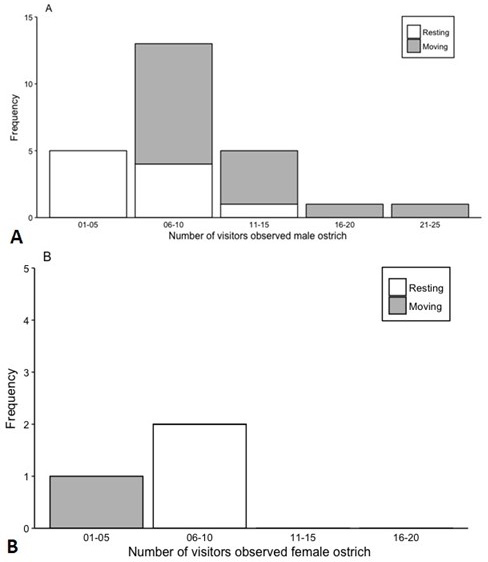
Number of zoo visitors watching male (A) and female (B) ostrich and head turned towards visitors by the ostrich during the study period.
References
- Aarts, G., MacKenzie, M., McConnell, B., Fedak, M. and Matthiopoulos, J., 2008. Ecography, 31: 140–160. https://doi.org/10.1111/j.2007.0906-7590.05236.x[CrossRef]
- Bertram, B.C.R., 1992. The ostrich communal nesting system. Princeton University Press., Princeton, New Jersey, USA. pp. 193. https://doi.org/10.1515/9781400863143[CrossRef]
- Brown, L.H., Urban, E.K. and Newman, K., 1982. The birds of Africa. Academic Press, London, UK. Vol. I., pp. 32-37.
- Burger, J. and Gochfeld, M., 1988. Ostrich, 59: 14–20. https://doi.org/10.1080/00306525.1988.9633919[CrossRef]
- Chamove, A.S., Hosey, G.R. and Schaetzel, P., 1988. Zoo Biol., 7: 359-369. https://doi.org/10.1002/zoo.1430070407[CrossRef]
- Cooper, R.G., Horbańczuk, J.O., Villegas-Vizcaíno, R., Sebei, S.K., Mohammed, A.E.F. and Mahrose, K.M., 2010. Trop. Anim. Hlth. Prod., 42: 363-373. https://doi.org/10.1007/s11250-009-9428-2[CrossRef]
- Davies, S.J.J.F. and Bertram, B.C.R., 2003. Ostrich, Firefly Encycl. Birds, pp. 34-37.
- del Hoyo, J., Elliot, A. and Sargatal, J., 1992. Handbook of the birds of the world: Ostrich to ducks. Lynx Edicions, Barcelona, Spain. Vol. 1
- Ferrer, N. and McDuffie, L., 2019. Zoo Biol., 38: 133-135. https://doi.org/10.1002/zoo.21461[CrossRef]
- Gill, J.A. and Sutherland, W.J., 2000. Predicting the consequences of human disturbancefrom behavioural decisions. In: Behaviour and Conservation (eds. L.M. Gosling and W.J. Sutherland). Cambridge University Press, Cambridge, UK. pp. 51-64.
- Glatston, A.R., Geilvoet-Soeteman, E., Hora-Pecek, E. and Van Hooff, J.A.R.A.M., 1984. Zoo Biol., 3: 241-253. https://doi.org/10.1002/zoo.1430030307[CrossRef]
- Hall, B.A., Melfi, V., Burns, A., McGill, D.M. and Doyle, R.E., 2018. Peer J., 6: e4454. https://doi.org/10.7717/peerj.4454[CrossRef]
- IUCN., 2018. The IUCN Red List of Threatened Species. Version 2018-2. Available at: www.iucnredlist.org. (Accessed: September 2019).
- Lacy, R.C., 2019. Zoo Biol., 38: 67-77. https://doi.org/10.1002/zoo.21468[CrossRef]
- Margulis, S.W., Hoyos, C. and Anderson, M., 2003. Zoo Biol., 22: 587-599. https://doi.org/10.1002/zoo.10115[CrossRef]
- Mearns, K.F. and Liebenberg, J., 2018. Athens J. Tourim. http://www.athensjournals.gr/tourism/2018-1-X-Y-Mearns2.pdf
- Mellish, S., Ryan, J.C., Pearson, E.L. and Tuckey, M.R., 2019. Conserv. Biol., 33: 40-52. https://doi.org/10.1111/cobi.13177[CrossRef]
- Menon, D.G., Bennett, D.C. and Cheng, K.M., 2014. J. Anim., 8: 1-8.
- Musi, E.Z., Binta, M.G. and Lumba, N.J., 2008. Res. J. Poult. Sci., 2: 1-4.
- Paxton, C.G.M., Bubier, N.E. and Deeming, D.C., 1997. Br. Poult. Sci., 38: 151-155. https://doi.org/10.1080/00071669708417960[CrossRef]
- R Core Team., 2017. R. Found. Stat. Comp., Vienna, Austria. https://www.R-project.org.
- Ripple, W.J., Wolf, C., Newsome, T.M., Betts, M.G., Ceballos, G., Courchamp, F., Hayward, M.W., Van Valkenburgh, B., Wallach, A.D. and Worm, B., 2019. Conserv. Lett., e12627. https://doi.org/10.1111/conl.12627[CrossRef]
- Sauer, E.F. and Sauer, E.M., 1966. Living Bird, 5: 45–75.
- Sauer, E.F. and Sauer, E.M., 1967. The Auk, pp. 571-587.
- Stevens, J., Thyssen, A., Laevens, H. and Vervaecke, H., 2013. J. Zoo Aquar. Res., 1: 31-34.
- Tribe, A. and Booth, R., 2003. Hum. Dimen. Wildl., 8: 65-74. https://doi.org/10.1080/10871200390180163[CrossRef]
- Wells, D.L., 2005. Appl. Anim. Behav. Sci., 93: 13-17. https://doi.org/10.1016/j.applanim.2005.06.019[CrossRef]
Services
Article usage statistics
Loading…