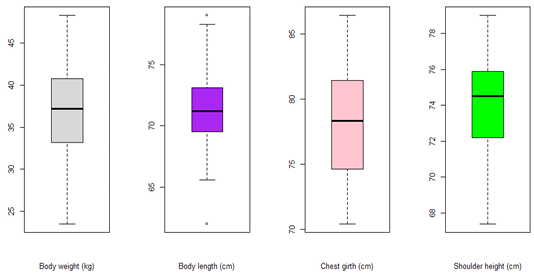
The result of current study was in accordance with the result of Subagyo et al. (2017) reported that body weight of EG goats in three villages ranged from 34,50 ± 2,67 to 37,60 ± 4,00 kg. The EG goat in this study had a lower body size than that reported by Subagyo et al. (2017) that female EG goats had body measurements of BL, CG and SH of 74.93 ± 3.75 cm, 82.80 ± 4.86 cm, and 77.30 ± 3.47 cm, respectively, with average body weight was relatively the same, namely 35.77 ± 3.14 kg.
The difference in body weight and body measurements of the present study with the results of previous study are thought to be influenced by differences in the maintenance environment, such as different feedstuff, feeding management and also different temperature where in the Pesawaran regency (the location of this study) reached 29˚C, whereas the average temperature in location of the study of Subagyo et al. (2017) was 25˚C. This statement is supported by Devendra and Burn (1994) who stated that environmental factors greatly influence the weight and body measurements of goats, that different maintenance environments resulted in varying body sizes, even for the same breed.
The result of pearson correlation between body weight and body measurements corroborate to the result reported by
Table 3: Regression equation of body measurements with body weight of female EG goat.
Note: BW: body weight; BL: body length; CG: chest girth; SH: shoulder height; r: pearson correlation; R2: determination coefficient; Adj.R2: adjusted R2; RSE: residual standard error; **: significant at level 0.01.
Victori et al. (2016) in EG goats, Nurhayati et al. (2014) in Jawarandu goats, Afolayan et al. (2006) in Yankasa sheep, and by Sabbioni et al. (2019) in Cornigliese sheep reporting that CG had the highest correlation with BW compared to BL and SH. This might be due to the growth of CG was in line with the growth of ribs, muscles and fat of the animals. Oliveira et al. (2018) reported that there was relationship between high rib yield and the increase of carcass fat proportion, and the increase of rib weight was also related to rapid growth and fat accumulation.
The finding of regression models of current study confirmed with the result reported by Chitra et al. (2012), Adeyinka and Mohammed (2006), and Sabbioni et al. (2019) that combination of CG and BL was the best predictor for BW of goat or sheep. The best predictor of CG and BL for BW might be related to the form of goat body that resemble to a tube shape of which CG as base area and BL as the height of the tube resulted in volume which is body weight, so that the larger CG and BL the hevier the goat body weight (Isroli, 2001). However, Iqbal et al. (2013) reported that combination of three body measurements (body length, withers height and heart girth) was the best predictors for BW with R2 of 0.69 in females Beetal goats. Actually, the highest R2 in the current study was regression model with predictor using all body measurements (BL, CG and SH). However, the addition of SH predictor in that equation was actually not significant, that is why the adjusted R2 (0.744) of regression model using the three body measurements was lower than that if using CG and CG predictor (0.750). Furthermore, based on other criteria such as RSE that measure the quality of a linear regression fit or the average of deviation between actual response (Y) and predicted response (Ŷ) namely regression line, AIC and BIC both describing how well a regression model fits the data set without overfitting, the regression model using all predictors (RSE= 2.825, AIC= 207.31, BIC= 215.88) was worse compared to using BL and CG (RSE= 2.795, AIC= 205.51, BIC= 212.36). Thus, combination of BL and CG was the best regression model to predict BW.
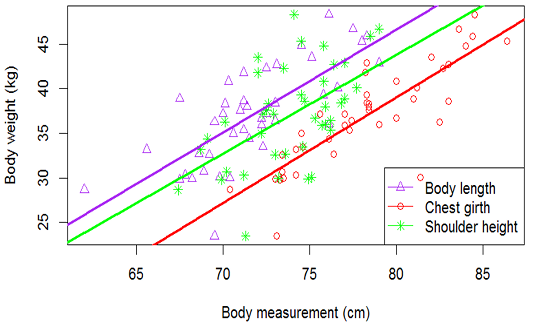
Figure 2 shows that regression model between BW and the three body measurements (BL, CG and SH) had identical regression coefficients indicated by parallel position of the three regression lines, but different intercept. Based on coefficient determination (R2), the accuracy of BW prediction using the three body measurements was quite different (0.55, 0.70 and 0.30 for BL, CG and SH, respectively) which CG was the best predictor for BW compared to BL and SH. This is supported by threre was no multicollinearity among body measurements in this study which means we can not replace a body measurements with other measurement to predict BW. On the contrary if there was multicollinearity between body measurements and the coefficient of regression were similar, we would use one of the body measurements to predict BW.