This results suggested that in the Okpara stream, H. fasciatus displayed a piscivorous feeding habit and foraged on a moderate food spectrum.
The current study provides valuable information on the feeding ecology of Hemichromis fasciatus, the dominant fish species of the Okpara stream in Benin.
Hemichromis fasciatus showed a trophic plasticity behavior with moderate niche breadth that favored seasonal variations of diet.
Currently, H. fasciatus constitutes a threat for the Okpara stream fish community for its high abundance coupled with its high level of predation.
Selected from the article's own text.
Abstract
Rachad Sidi Imorou, Alphonse Adite*, Stanislas P. Sonon, Hamidou Arame, Nambil K. Adjibade
Laboratoire d’Ecologie et de Management des Ecosystèmes Aquatiques (LEMEA), Département de Zoologie, Faculté des Sciences et Techniques, Université d’Abomey-Calavi, BP 526 Cotonou, Benin.
Abstract |The carnivorous cichlid Hemichromis fasciatus (Peters, 1852) displays a wide distribution in the freshwaters and brackish waters of Tropical Africa and particularly in the West African water bodies. In Okpara stream of Oueme River in Benin, Hemichromis fasciatus is the dominant fish species making numerically 29.20% of the fish community. We investigated on the feeding ecology of this cichlid to evaluate the level of predation and impact on the Okpara stream fish community. Hemichromis fasciatus individuals were sampled monthly from December 2015 to May 2017 using an experimental gill net and a seine. The dietary analysis showed that H. fasciatus foraged mainly on fishes that made 61.212% of the diet, but also ingested aquatic insects (26.8%), zooplankton (2.721%) and detritus (4.09 %). H. fasciatus showed a moderate diet breadth ranging between 1.20 and 13.77 (mean =5.7) and diet overlaps among size categories varied between Øjk=0.21 and Øjk=1, indicating an ontogenetic diet shift. The study revealed an eco-morphological trend of the feeding habit indicated mainly by the increase of fish consumption with SL (r=0.52) and GL (r=0.68), the increase of detritus consumption with GL (r=0.332) and the decrease of zooplankton consumption with SL (r=-0.648) and GL (r=-0.51). Hemichromis fasciatus displayed a trophic flexibility behavior that favored seasonal and spatial diet variations. The piscivorous feeding pattern was also shown by the relative gut length (GL/SL = 0.73) that fall in the carnivorous range. The dominance of H. fasciatus and its high level of predation depicted in this study constitute a threat for the fish community. The implementation of a rational management and exploitation scheme of this carnivorous cichlid is required to guaranty a balanced food web and the survival of the Okpara stream fish community. Keywords: Eco-morphology, Hemichromis fasciatus, management, Okpara stream, Piscivore.
Introduction
Hemichromis fasciatus (Peters, 1852) is a voracious carnivorous cichlid that displays a wide distribution in the freshwaters and brackish waters of Tropical Africa where the species, though less abundant compared to tilapiine species, shows a great fisheries and commercial importance. Also called the banded jewelfish and five-spot cichlid, H. fasciatus is widely distributed throughout West Africa where the species is known from most hydrographic basins, from Senegal to Angola , but also occurred in the Nile Basin, Lake Chad, and the upper Zambezi (Leveque et Paugy, 2006).
Taxonomic classsification indicated that H. fasciatus belongs to Animalia kingdom, Chordata phylum, Actinopterygii class, Perciformes order, Labroidei suborder, Cichlidae family, Hemichromis genus and Hemichromis fasciatus species (http://arctos.database.museum/name/Hemichromis%20fasciatus). Synonimies of H. fasciatus were Hemichromis elongates (Guichenot, 1861), Hemichromis leiguardii (Capello, 1870), Hemichromis desguezii (Rochebrune 1880), Hemichromis frempongi (Loiselle, 1979). Hemichromis fasciatus shows a cylindrical body with four to five large black glossy oval patches on the side of the body along the median line . The first one is confluent with the opercular spot and the last one on the caudal fin base. The upper profile of the snout is straight or concave. The pre-maxillary is extremely protrusible and the lower jaw is very prominent. The body height is 32.3 to 37% the standard length and the head length is 32.3 to 40% the standard length. Also, the species shows 28-30 scales at the lateral line and 7 to 9 gill rakers on the lower part of the first gill arch .
Hemichromis fasciatus occurs in habitats such as estuaries, lakes and lagoons . The species is also found in running waters such as streams and rivers that exhibit a low current velocity, a high water level of about three (3) meters, a substrate made up of blocks and plants and tolerates a temperature range of 15 °C to 33 °C in the natural environment. H. fasciatus is stenothermal and cannot survive at temperatures that vary greatly from this range ; . This cichlid is a voracious carnivore with diet essentially made up of fishes ; Adebesi 1981; : Paugy 1994; . Because of its carnivorous feeding habit, H. fasciatus is used in fish farming to regulate or to control the population of fishes of high reproductive potential such as Oreochromis niloticus. The species is also widely utilized as ornamental fish and raised and maintained in aquarium because of its colorful body.
In Benin, H. fasciatus was found not only in rivers and streams such as Couffo, Mono, Oueme, Zou, Okpara, Sô, Niger, Hlan etc., but also in lakes and lagoons such as Lake Nokoue, Porto-Novo lagoon, Lake Aheme, Lake Hlan, Coastal lagoon, Toho-Todougba lagoon, Lake Cele etc. , ; ; ; Laleye et al., 2004). Numerically, in all these ecosystems, H. fasciatus relative abundance has never exceeded 6% of the fish community. Indeed, numerical abundance of H. fasciatus in Southern Benin water bodies such as Lake Toho, Coastal lagoon, Sô river, “Whedo” from Oueme River, mangrove ecosystems and the ecotonal zone of the Mono River ranged between 0.37% and 6% (Jackson et al., 2013, ; 2017, . In contrast, Sidi Imorou et al. (2019) reported that in the Okpara stream, H. fasciatus was the most dominant fish making numerically 29.49% of the fish community. This abundance indicated a high predation in the Okpara fish community and thus, implies that H. fasciatus could negatively affect the food web and constituted a risk in term of species survival and ecosystem balance. However, in the Okpara stream, nothing is known on the bioecology of this carnivorous cichlid and in particular, data on the feeding ecology and resource utilization are scant and not documented.
The current study aims at studying the trophic ecology of H. fasciatus in order to evaluate the level of predation and provide dietary data that will contribute to design an appropriate management scheme for species survival, species conservation and ecosystem balance.
Materials and methods
Study Area
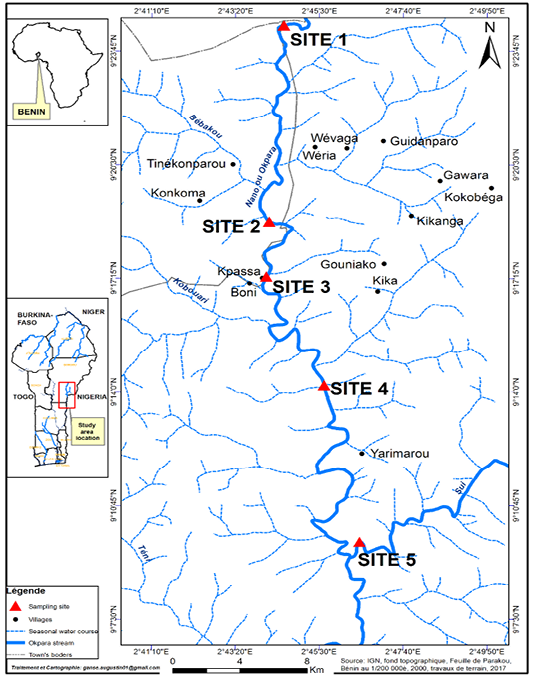
This study was implemented on the Okpara stream, the longest tributary of the Oueme River. The Okpara stream belongs to the northern hydrographic system and take source at the Southwest of Nikki city at an altitude of 450 m (Laleye et al., 2004). The Okpara stream is located between 8°14’- 9°45’ North and 2°35’-3°25’ East and extended on about 200 Km (Laleye et al., 2004). The climate is tropical with three main seasons, the dry season (November - April), the wet season (May –August) and the flood period (September - October). The annual average temperature was 26.6 °C and lower values were recorded in December and January. The mean rainfall was about 1200 mm with a peak (1300 mm) recorded in July, August or September ; . Most of the soils are tropical ferruginous and alluvial with deposits of sediments left by the stream ; Ogouwale, 2013). In general, the soil is covered by a wooded savanna characterized by the presence of Parkia biglobosa, Khaya senegalensis and Vitellaria paradoxa. Also, the vegetation included marshy meadows, bamboo and fallow bushes. Multi-species fisheries occur in the Okpara stream that appears to be the main source of fish resources for the surrounding populations and even for most cities of the northern region of Benin (Sidi et al., 2019). The stream provides water for irrigated agriculture and supply the surrounding populations with drinking water from a dam built by SONEB, the Benin water company (Sidi et al., 2019).
Sampling Sites
Five (05) sampling sites were selected (Figure 1). These sites were chosen according to localities, accessibility, fisheries importance and level of site degradations (Sidi et al., 2019). Site 1 is situated in Perere town at Okpara up stream and Site 2 is localized in Parakou town at Gadela village (Okpara up stream) about 2 km from SONEB dam. Site 3 is located at Kpassa village where a dam was built to serve as a source of drinking water for the populations of Tchaourou and Parakou towns and surrounding villages. Site 4 is situated around Okpara downstream at Yarimarou village (Tchaourou town) where the dam withdraws its water and Site 5 is also located around Okpara downstream at Sui village of Tchaourou. At all stations, samplings were done in the “aquatic vegetation habitat” at the edge of the stream and in the “open water habitat” characterized by a high depth and exempt of vegetation.
Hemichromis fasciatus individuals were collected once a month in all habitats from December 2015 to May 2017 at the five sampling sites. Experimental fishings have been done in the open water with an experimental gill net (25 m x 1.30 m, 30 mm-mesh; 25 m x 1.30 m, 15 mm-mesh) and in marginal aquatic vegetation with a seine (4.20 m-length, 2 m – width, 5 mm-mesh) . In addition, fish samplings were directly made in the fishermen artisanal captures and one third of each fisherman catches was sampled . After collection, the fish samples were first identified in situ using fish identification references such as Reed et al., (1967), Van Thielen et al., (1987), Skelton (1993), Paugy et al., (2004), Lévêque et al., (1990-1992). The fish assemblages were preserved in a cooler and then transported to the Laboratory of Ecology and Management of Aquatic Ecosystem (LEMEA) to confirm identifications. In the laboratory, each individual of H. fasciatus was preserved in 10% formalin and latter in 70% ethanol to facilitate stomach content analysis .
Stomach Content Analysis
In the laboratory, fish names were confirmed and each specimen was measured for total length (TL) and standard length (SL) to the nearest 0.1 cm and weighted to the nearest 0.1g. Hemichromis fasciatus individuals were then dissected, the digestive tract was unrolled and lengths were measured to the nearest 0.1 cm. After opening the gut, the stomach content was extracted and spread on a container for examination first under a binocular (model: Pierron) to identify large preys. Prey identifications were made to the lowest taxonomic level by using Needham (1962) identification key. Sometimes, water was added to facilitate separation of small items. To identify the plankton (phytoplankton and zooplankton), a sub-sample of known volume of the stomach contents was taken and examined under a photonic microscope ; Adite et al., 2005). Then the total gross volume was determined by the method of water displacement using a graduated burette ; . The volumes of small food resources (<0.002 ml) were estimated by spreading the food item on a glass slide. Then, the volume was visually approximated by comparison with a 0.01 ml drop of water delivered with a pipet onto a glass slide. In addition to the volume, the numerical method was used by counting each preys. To count the preys like insects parts, detritus and unidentified preys, the number 1 was attributed to their presence in the stomach whatever their quantity and weight .
Data Analysis
A total of 2,357 specimens of H. fasciatus were dissected. For each individual, the volume of each identified prey was recorded on Excel spreadsheet and the volumetric proportion was computed following the formula :
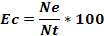
Where Pi is the volumetric proportion of item i, Vi is the volume of food item i and the total volume of food ingested by n stomachs, n is the total number of stomachs examined. The Coefficient of Emptiness (Ec), the ratio between the number of empty stomachs (Ne) and all examined stomachs (Nt) was calculated following the formula:
Also, the numeric frequency (%N) of the preys was computed following the formula:
%N = (ni/N)*100
Where ni is the number of individuals of a given prey i, and N the total number of all preys.
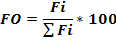
The relative importance of the prey in the diet of H. fasciatus was estimated by the occurrence frequency (FO) of prey consumed. This index is calculated according to the formula:
With
Where Ji = number of stomachs containing prey i, Nt = total number of stomachs examined.
According to Sorbe (1972), prey importance was classified as follows:
FO <10% = accidental prey
10% ≤ FO ≤ 50% = secondary prey
FO> 50% = preferential prey
To express the importance of prey in the stomach contents of a fish, Lauzanne (1975) combined the volumetric percentage (Pi) and the frequency of occurrence (FO) of the prey to generate the dietary index (DI):
This index varies from 0 to 100:
For values less than 10, the prey has secondary importance.
10 ≤ DI < 25 the prey is important.
25 ≤ DI ≤ 50, the prey is essential in diet.
DI >50, the prey is largely dominant.
The diet breadth (DB) is a measure of food spectrum. DB was determined using Simpson (1949) diet breadth formula:
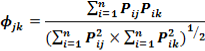
Where Pi is the proportion of food item i in the diet, and n is the total number of food items in the diet. DB ranges from 1, when only one resource is used, to n, when all resources are consumed in equal proportions. The diet overlap () between two groups of different classes was calculated following Pianka’s (1976) overlap index:
With, the dietary overlap between species j and species k, pij the proportion of resource i used by species j, pik the proportion of resource i used by species k, and n is the number of resource categories utilized.
Statistical Analysis
Seasonal (wet, flood, dry) variations in volumetric proportions were depicted with one-way analysis of variances (ANOVA1) using SPSS software . The values of diet breadth were submitted to one-way analysis of variance (ANOVA1) using SPSS software. Eco-morphological relationships have been explored through linear regression analysis (LRA) between body weight (W) and gut length (GL), standard length (SL) and gut length (GL). The data of W, SL and GL underwent logarithmic transformations before running the LRA. The ratio of gut length and standard length (GL/SL) was computed and compared to references indices in order to characterize the type of diet (herbivore, omnivore or carnivore).
Results
Internal Anatomy
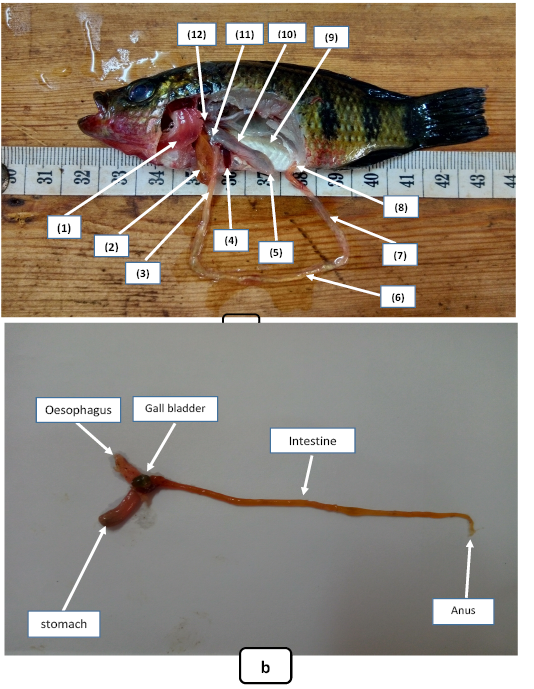
Hemichromis fasciatus possesses a short tubular esophagus extended from the posterior end of the pharynx to the anterior cardiac region of the stomach. The stomach is divided in three parts, (1) the cardiac, (2) the fundic and (3) the pyloric regions (Figure 2).
Diet Composition
In Okpara stream, the dietary analysis of 2,357 stomach contents of H. fasciatus showed that this cichlid ingested about 61 food items composed of various taxa such as aquatic insects, fishes, frogs, shrimps, mollusks, zooplankton and detritus (Table 1). Dominant prey categories were fishes with a volumetric proportion of 61.212%, followed by insects (26.8%), detritus (4.096%), zooplankton (2.995%) and frogs (1.062%) aggregating about 96.165% of the diet. The most dominant fishes in the diet were cichlids (13.545%) mainly Oreochromis and Tilapia, Alestidae (9.934%), Mormyridae (4.484%), unidentified fishes (16.82%), fish eggs (6.82%) and some minor fish items such as Cyprinidae (Barbus) and Clariidae. Dominant aquatic insects ingested were Odonata (14.988%) with families such as Libellulidae (7.769%) and Coenagrionidae (2.278%), Diptera (4.726%) composed mainly of Chironomidae (3.891%) and Ceratopogonidae (0.431%) (Table 1), Ephemeroptera, Trichoptera, Coleoptera etc. Zooplankton (2.995%) was constituted of Ploima, Copepoda and Cladocera (Table 1). Minor food resources consumed by H.
Table 1: Ingested preys by Hemichromis fasciatus collected in Okpara stream from December 2015 to May 2017
Prey categories
Orders
Families
Genera
Volumetric percentage
(%)
Numeric percentage
(%)
Occurrence frequency
(%)
Zooplankton
Ploima
Gastropodidae
Chromogaster
0.013
0.120
0.635
Copepoda
-
Unidentified
0.001
0.04014
0.317
Cladocera
-
Nauplius
0.528
5.921
2.540
Cladocera
Daphniidae
Daphnia
2.179
37.90
9.524
Total
Zooplankton
2.721
43.98
13.016
Insects
Coleoptera
Dytiscidae
Hydrovatus
0.059
0.04014
0.317
Elmidae
Macronychus Larvae
0.053
0.02007
0.317
Elmidae (unidentified)
0.080
0.10
1.587
Hdrophilidae
Hydrobius larvae
0.136
0.0803
0.952
Hydrocara
0.071
0.020
0.317
Unidentified Coleoptera
0.536
0.12043
1.905
Diptera
Chironomidae
Chironomus Larvae
0.328
0.46166
1.905
Chironomus Nymphea
0.490
0.86311
3.810
Chaoborus Larvae
0.572
2.52910
4.444
Chaoborus Nymphea
2.501
10.478
4.762
Ceratopogonidae
Dashyheleinae Larvae
0.286
1.365
2.540
Ceratopogoninae
0.145
0.622
2.222
Dixidae
Dixa Nymphea
0.168
0.18065
1.270
Culicidae
Culex Larvea
0.177
0.26094
2.222
Culicinae Larvea
0.059
0.2409
1.587
Odonata
Libellulidae
Libellula Larvea
2.088
0.723
4.762
Sympetrum Larvae
5.681
0.923
7.302
Coenagrionidae
Coenagrion Larvae
2.278
0.1606
2.857
Lestidae
Lestes
0.236
0.04014
0.635
Aeshnidae
Aeshna Larvea
0.354
0.0201
0.317
Cordulegastridae
Cordulegaster
0.177
0.0201
0.317
Unidentified Odonata
4.165
1.064
13.651
Plecoptera
Perloidae
-
0.006
0.0201
0.317
Ephemeroptera
Baetidae
Baetis Larvae
0.121
0.281
1.905
Baatopus Larvae
0.531
3.31
0.317
Unidentified Baetidea
1.245
4.82
7.937
Leptophlebiidae
Paraleptophlebia
0.024
0.14051
0.317
Unidentified Ephemeroptera
0.378
0.18065
2.540
Heteroptera
Hydrometridae
Hydrometra
0.189
0.04014
0.635
Gerridae
Gerris
0.28
0.14051
1.905
Corixidae
Corixa
0.153
0.12
0.635
Pleidae
Plea
0.218
0.56
0.952
Unidentified Heteroptera
0.177
0.161
1.905
Trichoptera
Hydroptilidae
Hydroptila Lavae
0.071
0.04014
0.635
Hydroptila etui
0.059
0.02007
0.317
Tricholeiochiton Larvae
0.032
0.04014
0.635
Philopotamidae
Philopotamus Larvare
0.354
0.06022
0.635
Unidentified Trichoptera
0.851
0.18065
2.539
Insects cocoon
0.236
0.16058
0.317
Unidentified Insects
1.234
0.42152
5.714
Total Insects
26.800
28.34
62.54
Fish
Alestidae
Brycinus
8.259
0.321
4.444
Unidentified Alestidae
1.675
0.08029
0.635
Cichlidae
Oreochromis
0.708
0.02007
0.317
Tilapia
12.837
0.522
5.714
Cyprinidae
Barbus
1.463
0.08029
0.635
Distichodontidae
3.009
0.14051
0.635
Mormyridae
Unidentified
0.708
0.02007
0.317
Marcusenius
3.776
0.02007
0.317
Clariidae
-
0.991
0.02007
0.317
Fish Larvae
-
-
3.430
3.111
4.762
Fish scale
-
-
0.558
0.08029
4.762
Fish eggs
6.820
21.12
4.762
Unidentified fish
-
16.978
0.56202
13.016
Total Fishes
61.212
26.82052
54.603
Frog
-
-
-
1.062
0.04014
0.635
Shrimp
-
-
-
0.708
0.06022
0.952
Mollusca
-
-
-
0.001
0.08029
0.635
Detritus
-
-
-
4.096
0.04014
13.016
Unidentified
-
-
-
3.4
0.20072
16.190
Total
-
-
-
100
100
-
Table 2: Seasonal variations of Volumetric percentage (%) of preys consumed by seasons of Hemichromis fasciatus from Okpara stream of Oueme river (North-Benin)
Prey categories
Orders
Families
Genera
Dry
Wet
Flood
Zooplankton
Ploima
Gastropodidae
Chromogaster
0.031
-
-
Copepoda
-
Unidentified
0.003
-
-
Cladocera
-
Nauplius
-
1.13
-
Cladocera
Daphniidae
Daphnia
-
4.66
-
Insect
Coleoptera
Dytiscidae
Hydrovatus
-
0.13
-
Elmidae
Macronychus Larvae
-
0.11
-
Elmidae (unidentified)
-
0.17
-
Hydrophilidae
Hydrobius larvae
-
0.29
-
Hydrocara
-
0.15
-
Unidentified Coleoptera
0.30
0.88
-
Diptera
Chironomidae
Chironomus Larvae
0.53
0.23
-
Chironomus Nymphea
1.01
0.15
-
Chaoborus Larvae
-
1.22
-
Chaoborus Nymphea
1.08
4.39
-
Ceratopogonidae
Dashyheleinae Larvae
-
0.61
-
Ceratopogoninae
0.05
0.26
-
Dixidae
Dixa Nymphea
-
0.36
-
Culicidae
Culex Larvea
-
0.38
-
Culicinae Larvea
-
0.13
-
Odonata
Libellulidae
Libellula Larvea
0.01
4
-
Sympetrum Larvae
-
12.15
-
Coenagrionidae
Coenagrion Larvae
3.69
1.59
-
Lestidae
Lestes
-
0.25
-
Aeshnidae
Aeshna Larvea
-
0.76
-
Cordulegastridae
Cordulegaster
-
0.38
-
Unidentified Odonata
2.84
6.64
-
Plecoptera
Perloidae
-
0.01
-
-
Ephemeroptera
Baetidae
Baetis Larvae
-
0.26
-
Baatopus Larvae
-
1.14
-
Unidentified Baetidea
-
2.66
-
Leptophlebiidae
Paraleptophlebia
-
0.05
-
Unidentified Ephemeroptera
0.0003
0.81
-
Heteroptera
Hydrometridae
Hydrometra
-
0.40
-
Gerridae
Gerris
-
0.56
0.18
Corixidae
Corixa
0.01
0.30
-
Pleidae
Plea
-
0.47
-
Unidentified Heteroptera
0.43
-
Trichoptera
Hydroptilidae
Hydroptila Lavae
-
0.15
-
Hydroptila etui
-
0.13
-
Tricholeiochiton Larvae
-
0.07
-
Philopotamidae
Philopotamus Larvare
-
0.76
-
Unidentified Trichoptera
1.48
0.26
1.05
Insects cocoon
-
0.5
Unidentified Insects
1.05
0.68
1.78
Fish
Alestidae
Brycinus
12.78
6.31
-
Unidentified Alestidae
-
-
14.87
Cichlidae
Oreochromis
1.51
-
Tilapia
25.55
3.23
6.28
Cyprinidae
Barbus
3.52
-
-
Distichodontidae
Unidentified
-
-
26.70
Mormyridae
Unidentified
1.70
-
-
Marcusenius
9.09
-
-
Clariidae
-
2.39
Fish Larvae
-
-
0.51
6.04
3.48
Fish scale
-
-
0.87
0.26
-
Fish eggs
-
-
3.24
11.71
-
Unidentified fish
-
18.74
8.81
45.02
Frog
-
-
-
1.70
0.76
-
Shrimp
-
-
-
0.57
1.01
-
Mollusca
-
-
-
0.003
-
-
Detritus
-
-
-
5.66
3.43
1.36
Unidentified
-
-
-
1.58
5
-
Total
-
-
-
100
100
100
fasciatus were frog (1.062%), shrimps (0.708%) and mollusks (0.001%).
Table 2 shows the volumetric proportions of food resource consumed by H. fasciatus during dry, wet and flood seasons in the Okpara stream. One-way analysis of variance (ANOVA 1) on the food items consumed by H. fasciatus, showed significant (p<0.05) seasonal variations for zooplankton (F2, 2355 = 20.136, p = 0.0001), for fish (F2, 2355 = 5.368, p = 0.005), for frogs (F2, 2355 = 5.805, p = 0.003), and for insects (F2, 2355 = 29.581, p = 0.000). Indeed, the results indicated that proportional consumption of zooplankton and aquatic insects were higher during the wet season. Also, proportional consumption of fishes and frogs were higher during the flooding. Nevertheless, there were no significant (p>0.05) seasonal dietary variations for shrimps (F2,2355=0.281, p=0.755), mollusks (F2,2355=0.461, p=0.631), fish eggs (F2,2355=1.849, p=0.158) and detritus (F2,2355=0.115, p=0.892).
Frequency of Occurrence and Dietary Index
The analysis of the occurrence frequencies of food resources revealed that aquatic insects occurred in 197 stomachs corresponding to a frequency of occurrence FO = 62.54%
while fishes occurred in 109 stomachs (FO=54.603%), making these two (2) food items, aquatic insects and fishes, the preferential food resources for H. fasciatus (Table 1). Detritus and zooplankton were found in 51 (FO=16.19%) and 41 (13.016%) stomachs, respectively, and therefore were qualified as secondary preys in the diet of this piscivorous cichlid (Table 1). Accidental food items like shrimps (FO=0.952%), frogs (FO=0.635%) and mollusks (FO=0.635%) occurred only in few stomachs, 3, 2 and 2 respectively. In addition, computed dietary index (DI) for each food category indicated that fishes with DI = 33.42 appeared to be the “essential prey” for H. fasciatus whereas aquatic insects with DI = 16.76 represented the “important prey items”. Detritus, zooplankton, frogs, shrimps and mollusks with DI <10 represented the preys of secondary importance (Table 3).
Table 3: Dietary index (DI) values for different categories of preys ingested by Hemichromis fasciatus from Okpara stream
Prey categories
Dietary index (DI)
Food importance
Fish
33.42
Essential prey
Insects
16.76
Important prey
Vegetal debris
0.533
Secondary prey
Zooplankton
0.35
Secondary prey
Frog
0.0067
Secondary prey
Shrimp
0.0067
Secondary prey
Mollusk
0.00636
Secondary prey
Unidentified
0.4848
Secondary prey
Empty Stomachs
Of a total of 2,357 stomachs of H. fasciatus examined, 2042 stomachs corresponding to 86.64% were empty (Table 3). In general, the coefficient of emptiness varied with seasons and life stages. Seasonally, the percentages of empty stomachs were higher during the flood and dry periods and reached 77.39% and 87.58%, respectively, whereas during the wet season, empty stomachs were reduced and did not exceed 57.10%. Ontogenetically, empty stomachs were higher in small juveniles and averaged 90.47, whereas moderate percentages, 87.10% and 86.26%, were recorded among adults and sub-adults, respectively (Table 4).
Table 4: Seasonal variations of emptiness coefficients (Ec) of H. fasciatus from Okpara stream
H. fasciatus life stage
Dry
Wet
Flood
Total
Nt
Ne
Ec (%)
Nt
Ne
Ec (%)
Nt
Ne
Ec (%)
N
Ec (%)
Small Juveniles
80
78
97.5
25
17
68.0
-
-
105
90.47
Juveniles
43
38
88.37
35
23
65.71
-
-
78
83.33
Sub-adults
20
18
90
16
9
51.82
60
50
83.33
96
87.10
Adults
1164
1139
97.87
859
516
60.08
55
39
70.91
2073
86.26
Total
1307
1145
87.58
935
534
57.10
115
89
77.39
2357
86.64
Table 5: Variation of diet breadth (DB) by season and length classes of Hemichromis fasciatus from Okpara’s stream
Seasons
Length Class (TL, cm)
Small juveniles (TL<3)
Juveniles (3≤TL<6)
Sub adults (6≤TL<8)
Adults (TL≥8)
Total
Wet
-
2.3
2.10
17.83
16.40
Flood
1
2.15
2.45
4.83
3.31
Dry
1.20
3.58
2.20
8.17
7.42
Total
1.20
3.58
4.25
13.77
17.41
Table 6: Matrix of diet overlaps by size classes of H. fasciatus from Okpara stream
Length class
[1 ; 3[
[3 ; 5[
[5 ; 7[
[7 ; 9[
[9 ; 11[
[11 ; 13[
[13 ; 15[
[15 ; 17[
[1 ; 3[
1
0.21
0.99
0.47
0.65
0.99
0.99
1
[3 ; 5[
1
0.26
0.86
0.85
0.32
0.24
0.21
[5 ; 7[
1
0.51
0.69
0.99
1
1
[7 ; 9[
1
0.95
0.57
0.5
0.47
[9 ; 11[
1
0.74
0.68
0.65
[11 ; 13[
1
0.99
0.99
[13 ; 15[
1
1
[15 ; 17[
1
Niche Breadth
In the Okpara stream, the the Diet breadth (DB) computed for the whole population of H. fasciatus was high and reached DB=17.41, indicating that this species consumed a wide range of food resources. Ontogenetically, the DB increased with fish size (Table 5) and ranged from 1.20 for small juveniles (TL<3cm) to 13.77 for adults (TL≥8 cm) (Table 5). Seasonal variations indicated that the DB was higher during the wet season and reached DB=16.40 whereas lower values, 3.31 and 7.42 were recorded during the flood and dry periods, respectively (Table 5).
Pianka’s Diet Overlaps
The diet similarities of H. fasciatus between different size classes were evaluated through Pianka’s diet overlaps index (). The matrix of diet overlaps gave ranging between 0.21 and 1 (Table 6). The lowest value ( = 0.21) was recorded for the similarity between the subpopulations of size classes “TL: 1-3 cm” and “TL: 3-5 cm”. The highest value ( = 1) was recorded for the similarities between the sizes classes “TL: 1-3 cm” and “TL: 15-17 cm”; TL: 5-7 cm” and “TL: 13-15 cm”; TL: 5-7 cm” and “TL: 15-17 cm”; TL: 13-15 cm” and “TL: 15-17 cm
Ecomorphological Correlates
Table 8 shows the matrix of correlation coefficients (r) from the regressions between the different food categories (fishes, insects, zooplankton, detritus, shrimps, frogs, mollusks) and standard length (SL)/ gut length (GL). Overall, the correlation coefficients (r) for the regressions between the food items and standard length (SL) ranged between r = -0.648 and r =0.866 and those with gut length (GL) ranged between r = -0.51 and r =0.866. The food items such as fishes, zooplankton, shrimps and detritus crossed with SL and GL exhibited the higher correlation coefficients (r) whereas aquatic insects displayed an insignificant (p>0.05) correlation when crossed with SL and GL.
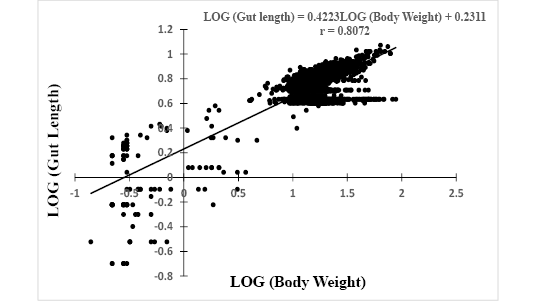
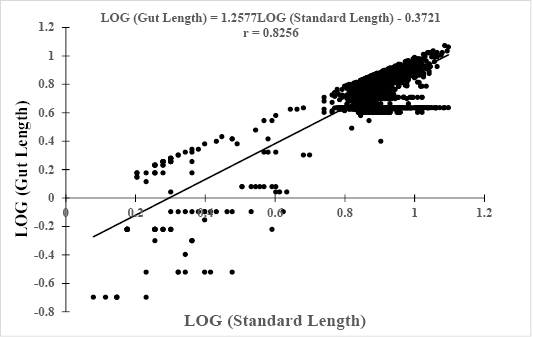
Also, the linear regressions between the standard length (SL) and gut length (GL) and between body weight (W) and gut length (GL) were established to evaluate the eco-morphological model of the food habit of H. fasciatus. The resulting regression equations were as follows:
Table 7: Volumetric percentage (%) of preys consumed by size classes (cm,TL) of Hemichromis fasciatus from Okpara stream, Oueme river (North-Benin)
The slopes, bsl-gl= 0.4223 and bw-gl= 1.2577 of both equations were positive with significant (p<0.05) correlation coefficients r = 0.81 and r = 0.83, respectively. In addition, the relative gut length (GL/SL) was computed and compared to reference published values. The computed ratio GL/SL ranged between 0.1 (3 cm SL) and 0.97 (12.2 cm SL) with a mean of 0.73 ± 0.17.
Table 8: Spearman correlation coefficient between standard length and volumetric percentages of prey consumed by H. fasciatus
Prey categories
SL
GL
Zooplankton
-0.648**
-0.51*
Fish
0.52**
0.68**
Frog
1.000
1.000
Shrimp
0.866
0.866
Detritus
0.279
0.332*
Mollusk
-1.00
-1.00
Insects
-0.026
-0.02
**. Correlation is significant at the 0.01 level.
*. Correlation is significant at the 0.05 level.
Discussion
Though foraging on about 59 food items, aggregation by taxa indicated that H. fasciatus consumed only seven (7) categories of food resources numerically dominated by fishes (61.21%), insects (26.8%), detritus (4.096%), zooplankton (2.995%), and frogs (1.062%) cumulating 96.165% of the diet (Table 1). This results suggested that in the Okpara stream, H. fasciatus displayed a piscivorous feeding habit and foraged on a moderate food spectrum. These findings agreed with those reported by Oronsaye (2009) and Adebisi (1981) in Nigeria, respectively in the Ikpoba dam and in the Ogoun River where this cichlid foraged mainly on fishes, insects, detritus and zooplankton. This carnivorous diet pattern was also reported by Ndour (2007) in the Maka anti-salt dam on Casamance in Senegal and by Atindana (2014) in Golinga reservoir of Ghana where H. fasciatus preferentially consumed fishes, fish larvae and fish parts. Likewise, in the hydroelectric dam lake of Ayame in Ivory Coast, fishes were highly ingested by H. fasciatus . Nevertheless, in contrast with the population of Okpara stream, insects were the preferential prey in the Mankessim Reservoir in Central Region of Ghana . These spatial changes in the dietary pattern were probably due to the differential availability of each food resource in these habitats, indicating that H. fasciatus displayed a trophic plasticity behavior . As reported by Gbaguidi et al. (2016), this feeding flexibility, even modest, enables this piscivorous cichlid to colonize most inland waters such as freshwater lakes, estuaries, lagoons, streams and rivers. This relative feeding flexibility depicted in H. fasciatus was also shown by the moderate diet breadth (DB) varying between 1.20 for small juveniles (TL<3cm) to 13.77 for adults (TL≥8 cm), and confirmed by the seasonal variations of diet (Table 3). Indeed, the results indicated that proportional consumption of zooplankton and aquatic insects were higher during the wet season where there was a proliferation of vegetation that boosted the colonization of insects. Likewise, proportional consumption of fishes and frogs were higher during the flooding where in general, these food resources were massively recruited ; ; .
The high percentage of empty stomachs (86.64%) recorded during this investigation is typical to most carnivorous fishes which digestive enzymes accelerate the digestion of the prey ingested. Also, because the gut length of carnivore is relatively short (GL/SL = 0.73) compared to herbivore, the transit of the digested preys is relatively quick, increasing the percentage of empty stomachs . In this study, the general trends of the occurrence frequencies (FO) of the food resource ingested by H. fasciatus agreed with those displayed by the volumetric proportion of each food item. Indeed, as shown by the volumetric percentage, aquatic insects with a frequency of occurrence FO = 62.54%, fishes with FO=54.603%, detritus (FO=16.19%) and zooplankton (FO=13.016%) were the main food resources recorded in most stomachs (Table 1). As results, aquatic insects and fishes appeared to be the preferential foods for H. fasciatus whereas detritus and zooplankton could be qualified as secondary preys . Accidentals food items like shrimps (FO=0.952%), frogs (FO=0.635%) and mollusks (FO=0.635%) occurred only in few stomachs, 3, 2 and 2 respectively. These feeding patterns were also confirmed by the greater dietary index DI = 33.42 of fishes qualified as “essential prey” for H. fasciatus, and aquatic insects with DI = 16.76 represented the “important prey items”. Detritus, zooplankton, frogs, shrimps and mollusks with DI <10 represented the preys of secondary importance (Table 2).
The relatively high diet overlaps (mean Øjk: 0.68± 0.29) recorded between size classes indicated that H. fasciatus showed moderate diet similarities between life stage categories. However, the lowest diet similarity () recorded between “small juvenile (TL<3 cm)” subpopulations and “large juveniles (3 cm<TL<5 cm)” indicated that H. fasciatus displayed an ontogenetic diet shift ; ; ; . This foraging strategy was also confirmed by the lowest Pianka’s diet overlaps Øjk =0.32, Øjk =0.24, Øjk =0.21 recorded between “large juvenile (3 cm<TL<5 cm)” subpopulations and adults size classes “TL: 11-13”, “TL: 13-15” and “TL: 15-17”, respectively. Indeed, earlier life stages such as larvae, small juveniles and large juveniles of fishes have a relatively less developed digestive tract, and as reported by Gbaguidi et al. (2016) and Adite et al. (2017), only live food resources such as phytoplankton and zooplankton were preferentially ingested. In contrast, large and tuff food items such as fishes, aquatic insects, shrimps, frogs, mollusks and detritus relatively dominated the diet of sub-adults and adults that showed fully developed digestive tracts (Table 7).
In this study, the increase of fish consumption with SL (r = 0.52) and GL (r = 0.68), the increase of shrimps consumption with SL (r = 0.866) and GL (r = 0.866), the increase of detritus consumption with GL (r = 0.332) and the decrease of zooplankton consumption with SL (r = -0.648) and GL (r = -0.51) suggested an eco-morphological trend of the feeding habit of H. fasciatus. This ecomorphological relationships agreed with that reported by Gbaguidi et al. (2016; 2017) with the cichlid Sarotherodon galilaeus and the claroteid Chrysichthys nigrodigitatus surveyed in man-made lakes of the Southern Benin. Nevertheless, in the current research, and in contrast with S. galilaeus and C. nigrodigitatus, proportional consumptions of aquatic insects were insignificantly (p>0.05) correlated with SL (r = -0.03) and GL (r = -0.02).
With regards to food habit, when considering the general model of food consumed, fishes, making 61.21% of the stomach, dominated the diet of H. fasciatus, suggesting that this cichlid is an ichtyophage specialist. Nevertheless, the 38.79% remaining were mainly shared by insects (26.8%), detritus (4.096%), zooplankton (2.995%), suggesting that, in addition to fishes, this cichlid incorporated invertebrates, mainly aquatic insects in its diet. These feeding habits were also shown and confirmed by the eco-morphological analysis in which the computed ratios (GL/SL) of standard length (SL) to gut length (GL) varying between 0.1 and 0.97 (mean of 0.73 ± 0.17) was consistent with the range 0.5 - 2.4 reported by Al-Hussaini (1947) and Kapoor et al. (1975) for teleost carnivores. This finding agreed with that reported by Paugy (1994) for H. fasciatus from the Baoulé River in Mali (upper Senegal basin) where the relative intestine length (GL/SL) averaged 0.78. Also, the ratio recorded in the present study agreed with those reported by Paugy (1994) for other specialist piscivorous fishes such as Hydrocynus forskalii, Hydrocynus vittatus, Ichthyoborus besse, Lates niloticus showing respectively GL/SL ratios 0.85, 1.06, 1.10 and 0.52 that fall in the range 0.5 - 2.4 of carnivorous species.
Conclusion
The current study provides valuable information on the feeding ecology of Hemichromis fasciatus, the dominant fish species of the Okpara stream in Benin. This cichlid displayed mainly a piscivorous food habit, but also foraged intensively on aquatic insects. The feeding trend depicted was also shown by the relative gut length that fall in the range of carnivorous species. Hemichromis fasciatus showed a trophic plasticity behavior with moderate niche breadth that favored seasonal variations of diet. Niche overlaps between size classes revealed ontogenetic diet shifts. Currently, H. fasciatus constitutes a threat for the Okpara stream fish community for its high abundance coupled with its high level of predation. A rational management and exploitation of this cichlid is required to guaranty the survival of the fish community.
acknowledgements
The authors present their gratitude to the “Laboratoire d’Ecologie et de Management des Ecosystèmes Aquatiques, Département de Zoologie, Faculté des Sciences et techniques, Université d’Abomey-Calavi” for providing us logistic assistances. We express our gratitude to Okpara’s fishermen for their assistance during this fisheries investigation. Also we are grateful to Amoussouga Illary and Mitobaba Aurel for their assistance in laboratory works.
Conflict of interest
There is no conflict of interest.
authors contribution
All mention authors have contributed to this paper during the sampling, data analysing manuscript writing and revision.
References
• Adebisi AA (1981). Analyses of the stomach contents of the piscivorous fishes of the upper ogun river in Nigeria. Hydrobiologia 79: 167-177. https://doi.org/10.1007/BF00006124[CrossRef]
• Adite A (2007). Ecologie de Heterotis niloticus (Osteoglossiformes: Osteoglossidae) du Système fluvio-lacustre rivière Sô-lac Hlan (Sud-Bénin): Conservation et Intérêt pour l’aquaculture. Ph.D. Dissertation, Faculté des Scienes et Techniques, Université d’Abomey-Calavi, Abomey-Calavi.
• Adite A, Imorou Toko I, Gbankoto A (2013). Fish assemblage in the degraded mangrove ecosystems of the coastal zone, Benin, West Africa: Implications for Ecosystem restoration and resources conservation. J. Env. Protect. 4: 1461-1475. https://doi.org/10.4236/jep.2013.412168[CrossRef]
• Adite A, Arame H, Sossoukpe E, Adjibade KN (2017). Comparative trophic ecology of two sympatric tilapia, Oreochromis niloticus (Linné, 1758) and Sarotherodon melanotheron (Rüppell, 1852) from Lake Toho, Southern Benin: Food competition and risk of species replacement. Int. J. Fisheries Aquat. Stud. 5(6): 365-375.
• Adite A, Arame H, Sossoukpe E, Adjibade KN (2017). Comparative trophic ecology of two sympatric tilapia, Oreochromis niloticus (Linné, 1758) and Sarotherodon melanotheron (Rüppell, 1852) from Lake Toho, Southern Benin: Food competition and risk of species replacement. Int. J. Fisheries Aquat. Stud. 5(6): 365-375
• Adite A, Van Thielen R (1995). Ecology and Fish Catches in the Natural Lakes of Benin, West Africa. Environmen. Biol. Fishes. 43: 381-391.http://dx.doi.org/10.1007/BF00001173[CrossRef]
• Adité A, Winemiller KO, Fiogbé ED (2005). Ontogenetic, seasonal, and spatial variation in the diet of Heterotis niloticus (Osteoglossiformes: Osteoglossidae) in the Sô River and lakes Hlan, Benin, West Africa. Environ. Biol. Fishes. 73:367-378. https://doi.org/10.1007/s10641-004-5563-9[CrossRef]
• Agbabiaka LA (2012). Food and feeding habits of Tilapia zillii (Pisces: Cichlidae) in River Otamiri South-eastern Nigeria. Biosci. Discovery. 3(2): 146-148.
• Albaret JJ (1994). Les poissons : biologie et peuplements. In: Environnement et Ressources aquatiques de Côte d’Ivoire. Tome II. Les Milieux lagunaires (Durand J.R., Dufour P., Gui- ral D. & S.G. Zabi, eds), pp. 239-279. Paris: Orstom.
• Al-Hussaini AH (1947). The feeding habits and the morphology of the alimentary tract of some teleosts living in the neighbourhood of the Marine Biological Station, Ghardaqa, Red Sea. Publucation of Marine Biological Station. Ghardaqa (Red Sea) 5: 1–61.
• Atindana SA, Blay J, Yankson K (2016). Investigation on Food Ecology of three Cichlid Species in the Mankessim Reservoir, Central Region of Ghana. Int. J. Fisheries Aquacult. 8(5): 55-61. https://doi.org/10.5897/IJFA2015.0535[CrossRef]
• Atindana SA, Bulley R, Alhassan EH, Abarike ED, Yeboah AA, Akongyuure DN, Abobi SM (2014). Stomach content analyses of tilapia zillii and hemichromis fasciatus in the golinga reservoir in the tolon district of the Northern region of Ghana. Proceedings of the 32nd biennial conference of the Ghana Anim. Sci. Assoc. Pp 23 – 28.
• Blahoua Kassi G, Adou YE, Gogbé ZM, N’Douba V (2017). Régime Alimentaire De Hemichromis Fasciatus (Perciformes, Cichlidae) Dans Le Lac De Barrage Hydroélectrique d’Ayamé 2 (Côte d’Ivoire). European Scient. J. edition. 13 (30) ISSN: 1857 – 7881 (Print) e - ISSN 1857- 7431. https://doi.org/10.19044/esj.2017.v13n30p126[CrossRef]
• Bowen SH (1983). Detrivory in neotropical fish communities. Environ. Biol. Fishes. 9: 137-144. https://doi.org/10.1007/BF00690858[CrossRef]
• Castillo-Rivera M (2013). Influence of rainfall pattern in the seasonal variation of fish abundance in a tropical estuary with restricted marine communication. J. Water Res. Protect. 5: 311-319. https://doi.org/10.4236/jwarp.2013.53A032[CrossRef]
• Daget J (1952). Mémoires sur la biologie des poissons du Niger Moyen. I. Biologie et croissance des espèces du genre Alestes. Bulletin de l’Institut Français d’Afrique Noire. 14: 191-225.
• Dossou-Yovo E (2009). Modélisation du fonctionnement hydrologique dans le bassin versant de l’Okpara à l’exutoire de Kaboua dans un contexte de changement global : contribution à la gestion intégrée des ressources en eau. Thèse d’Ingénieur Agronome, Faculté des Sciences Agronomiques, Abomey-Calavi, Bénin. 106pp.
• Fagade SO, Olaniyan CIO (1973). The food and feeding interrelationships of the fishes of lagoon. J. Fish Biol. 5: 205-227. https://doi.org/10.1111/j.1095-8649.1973.tb04449.x[CrossRef]
• Gbaguidi HMAG, Adite A, Abou Y (2017). Trophic ecology and establishment of the silver catfish, Chrysichthys nigrodigitatus (Pisces: Siluriformes: Claroteidae) introduced in an artificial pond of Benin, West Africa. J. Fisheries Aquat. Sci. 12: 42-53. https://doi.org/10.3923/jfas.2017.42.53[CrossRef]
• Gbaguidi HMAG, Adite A, Sossoukpe E (2016). Feeding Ecology and Establishment of the Naturally Colonized Freshwater Cichlid, Sarotherodon galilaeus (Pisces: Actinopterigii: Perciformes) from a Manmade Lake, South-Benin, West Africa. Nat. Res. 7: 337-355. https://doi.org/10.4236/nr.2016.76030[CrossRef]
• Hazoume RUS (2017). Diversité, organisation trophique et exploitation des poissons de la rivière Sô au Benin (Afrique de l’Ouest). Thèse de doctorat de l’Université d’Abomey-Calavi, Benin, 162p.
• Hazoume RUS, Chikou A, Koudenoupo C, Houndonougbo P, Adite A, Bonou C, Mensah GA (2017). Composition et distribution des communautés ichtyologiques le long de la rivière So en relation avec les paramètres environnementaux. Afriq. Sci. AS-1708
• Insae (2004). Cahier des villages et quartiers de ville Département du Borgou; Institut National de la Statistique et de l’Analyse Économique, République du Benin/UNICEF/UNFPA/DDC. 23p.
• Jackon AT, Adite Alphonse, Roach K A, Winemiller KO (2013). Fish assemblages of an African river floodplain: a test of alternative models of community structure. Ecol. Freshwat. Fish. 22: 295-306. https://doi.org/10.1111/eff.12026[CrossRef]
• Juanes F, Buckel JA, Scharf FS (2002). Feeding ecology of piscivorous fishes. Handbook of fish biology and fisheries. J. Fish Biol. 1: 267-283. https://doi.org/10.1002/9780470693803.ch12[CrossRef]
• Kapoor BG, Smith H, Verighina IA (1975). The alimentary canal and digestion in teleosts. In: Russel F.S. & Yonge M., Eds. Adv. Marine Biol. England: Academic Press. Pp. 109-239. https://doi.org/10.1016/S0065-2881(08)60281-3[CrossRef]
• Konan KJ, ATSE CB, Kouassi JN (2008). Habitudes et stratégies alimentaires de Tylochromis jentinki jentinki (Cichlidae) dans la lagune Ebrie (Cote d’Ivoire). Cybium. 32 (1):3-8.
• Konan YA, Bamba M, Koné T (2014). Aspects qualitatifs et quantitatifs de l’alimentation de Clarias buettikoferi (Siluriformes; Clariidae) dans la forêt des marais Tanoé-Ehy (Côte d’Ivoire). Cybium. 38 (1) : 061-068
• Koné T, Kouamélan EP, Ouattara NI, Kicho AV (2007). Régime alimentaire de Pomadasys jubelini (Pisces, Haemulidae) dans une lagune Ouest africaine (lagune Ebrié, Côte d’Ivoire). Sci. Nat. 4 (1): 65-73. https://doi.org/10.4314/scinat.v4i1.42131[CrossRef]
• Kora O (2006). Monographie de la commune de Parakou. Afrique Conseil, 44p.
• Kouamélan EP, Gourène G, Teugels GG, Thys van den Audenaerde DFE (1997). Diversité morphologique du tube digestif chez 39 espèces de poissons africains et relation avec la classification ichtyologique. J. African Zool. 111: 109-119.
• Kouamélan EP, Teugels GG, Gourène G, OlleVier F, Thys Van Den Audenaerde DFE (2000). Habitudes alimentaires de Mormyrops anguilloides (Mormyridae) en milieu lacustre et fluvial d’un bassin ouest-africain. Cybium. 24: 67-79.
• Lacroix E (2004). Pisciculture en zone tropicale, GFA Terra System, 225p.
• Lagler KF, Bardach JE, Miller RR (1962). Ichthyology. John Wiley and Sons Inc. New York, USA, 230 pp.
• Lalèyè P, Chikou A, Philippart J-C, Teugels G, Vandewalle P (2004). Étude de la diversité ichtyologique du bassin du fleuve Ouémé au Bénin (Afrique de l’Ouest). Cybium. 28(4): 329-339.
• Lauzanne L (1975). Régime alimentaire d’Hydrocyon forskalii (Pisces, Characidae) dans le lac Tchad et ses tributaires. Cahier. ORSTOM Série Hydrobiol. 9: 105-121.
• Levêque C, Paugy D (2006). Les poissons des eaux continentales africaines : diversité, écologie et utilisation par l’homme. IRD Éditions, 573p. ISBN : 2-7099-1589-8.
• Lévêque C, Paugy D, Teugels GG (eds) (1990-1992). Faune des Poissons d’Eaux douces et saumâtres de l’Afrique de l’Ouest. 910 p. Paris: ORSTOM.
• Matthes A (1964). Les poissons du lac Tumba et de la région d’Ikela. Étude systématique et écologique. Ann. Mus. Roy. Af. Cent. 126 :204p, 6 p.
• Montchowui E, Niyonkuru C, Ahouansou Montcho S, Chikou A, Lalèyè P (2007). L’ichtyofaune de la rivière Hlan au Bénin (Afrique de l’Ouest). Cybium. 31(2): 173-176. https://doi.org/10.4314/ijbcs.v2i2.39733[CrossRef]
• Moreau Y (1988). Physiologie de la nutrition. In: Biologie et écologie des poissons d’eau douce africains (Levêque C., Bruton M.N. & Ssentongo G.W., eds), Pp. 137-152. Paris: ORSTOM.
• Morgan GA, Grieggo OV, Gloeckner GW (2001). SPSS for Windows: An introduction to use and interpretation in research. Lawrence Erlbaum Associates, Publishers, Mahwah, New Jersey.
• Murphy BR, Willis DW (1996). Fisheries Techniques. Second edition. American Fisheries Society, Bethesa, Maryland.
• N’guessan AG, Boussou KC, Yoboue AN, ASSI SR, Konan KF (2018). Spatial Variability in the Feeding Strategy of the Cichlid Fish Hemichromis fasciatus from Two Rivers in the Northwestern of Guinea Republic. Int. J. Sci. Res. 7(7) ISSN (Online): 2319-7064,.
• Ndour I (2007). Comparaison des populations de poissons en amont/aval du barrage anti-sel de Maka sur la casamance au Senegal. Diplôme d’Etude Approfondies (DEA), Université CHEIKH ANTA DIOP de Dakar / Faculté des Sciences et Techniques.
• Needham GJ, Needham PR (1962). A Guide to the Study of Fresh-Water Biology. Holden Day, San Francisco.
• Niyonkuru C, Laleye PA (2010). Impact of acadja fisheries on fish assemblage in lake Nokoue, Benin, West Africa. Knowledge Manag. Aquat. Ecosyst. 399: 05. https://doi.org/10.1051/kmae/2010033[CrossRef]
• Ogouwalé R (2013). Changements climatiques, dynamique des états de surface et prospectives sur les ressources en eau dans le bassin versant de l’Okpara à l’exutoire de Kaboua. Thèse de Doctorat Unique, Faculté des Lettres, Arts et Sciences Humaines, Université d’Abomey-Calavi, Bénin. 203pp.
• Okpeicha SO (2011). Biodiversité et exploitation des poissons du barrage de la SUCOBE dans la commune de Savè au Bénin. Master en hydrobiologie. Faculté des Sciences Techniques/UAC.
• Oronsaye CG (2009). Food, feeding habits, and biological control potentials of the ornamental fish in Ikpoba dam, Benin– city. Nigeria J. Res. Prod. 15(2): 1-6.
• Paugy D (1994). Ecologie des poisons tropicaux d’un cours d’eau temporaire (Baoulé, haut basin du Senegal au Mali):Adaptation au milieu et plasticité du régime alimentaire. Rev. d’Hydrobiol. Trop. 27: 157-172.
• Paugy D, Lévêque C (2006). Régimes alimentaires et réseaux trophiques. In: Les Poissons des Eaux continentales africaines : Diversité, Écologie, Utilisation par l’Homme (Lévêque C. & Paugy D., eds), pp. 191-216. Paris: IRD.
• Paugy D, Lévêque C, Duponchelle F (2006). La reproduction. In: Les Poissons des Eaux continentales africaines : Diversité, Écologie, Utilisation par l’Homme (Lévêque C. & Paugy D., eds), pp. 148-175. Paris: IRD.
• Paugy D, Lévêque C, Teugels GG (2003). Poissons d’eaux douces et saumâtres de l’Afrique de l’Ouest. Collection faune et flore tropicales, n° 40, MARC/MNHN/IRD, tome 1, Paris, 457 p.
• Paugy D, Lévêque C, Teugels GG (2003). Poissons d’Eaux saumâtres de l’Afrique de l’Ouest. Tome 1. 457 p. Edition IRD.
• Paugy D, Leveque C, Teugles GG (2004). Poissons d’eaux douces et saumâtres de l’Afrique de l’Ouest. Publications Scientifiques du Museum, MRAC. IRD Editions.
• Pianka ER (1976). Competition and niche theory. Chapter 7; p 114-141 in R.M. May (ed). Theoretical Ecology Principles and Applications. Blackwell. London.
• Pouilly M (1993). Habitat, ecomorphologie et structuredes peuplements de poissons dans troispetits cours d’eau tropicaux de Guinee. Rev. Hydrobiol. Trop. 26: 313-325.
• Reed W, Burchard J, Hopson AJ, Jenness J, Yaro I (1967). Fish and Fisheries of Northern Nigeria. Ministry of Agriculture Northern Nigeria.
• Rosecchi E, Nouaze Y (1987). Comparaison de cinq indices alimentaires utilisés dans l’analyse des contenus stomacaux. Rev. Travaux de l’Institut de Pêches Marit. 49(3-4): 111-123.
• Sánchez-Hernández, J.; Servia, M. J.; Vieira-Lanero, R. & Cobo, F. 2012. Ontogenetic Dietary Shifts in a Predatory Freshwater Fish Species: The Brown Trout as an Example of a Dynamic Fish Species. In: Turker, H. ed. New Advances and Contributions to Fish Biology. InTech, p.271-298. https://doi.org/10.5772/54133[CrossRef]
• Scharf BJ (2014). Ontogenetic Diet Shifts and Prey Preference of a Generalist Predatory Fish” (2014). Graduate Theses and Dissertations. http://scholarcommons.usf.edu/etd/5304
• Scharf FS, Juanes F, Rountree RA (2000). Predator size-prey size relationships of marine fish predators: interspecific variation and effects of ontogeny and body size on trophic niche breadth. Marine Ecol. Prog. Series. 208: 229-248. https://doi.org/10.3354/meps208229[CrossRef]
• Sene N (1994). Contribution à l’étude qualitative du régime alimentaire de quelques poissons dans l’estuaire du Sine-Saloum. Mémoire de DEA de Biologie Animale, Dakar, UCAD, 61pp.
• Sidi Imorou R, Adite A, Adjibade NK, Arame H, Sonon PS, Abou Y (2019). Fish biodiversity and community structure of the Okpara stream from the Oueme River, Benin, West Africa: A risk of high predation and ecosystem alteration, J. Bio. & Env. Sci. 1-18.
• Skelton PHA (1993). Complete Guide to the Freshwater Fishes of Southern Africa. Southern Book Publishers.
• Sorbe J-C (1972). Régime alimentaire de micromesistws poutassou (Risso, 1826) dans le sud du Golfe de Gascogne. Rev. Travaux de l’Institut de Pèches Maritime. 44(3): 245-255.
• Sturmbauer C, Mark W, Dallinge R (1992). Ecophysiology of aufwuchs-eating cichlids in Lake Tanganyika: niche separation by trophic specialization. Environ. Biol. Fishes 35: 283-290. https://doi.org/10.1007/BF00001895[CrossRef]
• Trewavas E (1983). Tilapiine fishes of the genera Sarotherodon, Oreochromis and Danakilia. British Museum of Natural History. London, UK. 583 p. https://doi.org/10.5962/bhl.title.123198[CrossRef]
• Van Thielen R, Hounkpe C, Agon G, Dagba L (1987). Guide de détermination des Poissons et Crustacés des Lagunes et Lacs du Bas-Bénin. Direction des Pêches, Cotonou.
• Verighina IA (1990). Basic adaptations of the digestive system in bony fishes as a function of diet. J. Ichthyol. 30: 897-907.
• Winemiller KO (1990). Spatial and Temporal Variation in Tropical Fish Trophic Network; Ecol. Monograp. 60(3): 331-367.
• Winemiller KO, Kelso-Winemiller LC (2003). Food habits of tilapiine cichlids of the Upper Zambezi River and floodplains during the descending phase of the hydrological cycle. J. Fish Biol. 63: 120-128. http://dx.doi.org/10.1046/j.1095-8649.2003.00134.x.[CrossRef]
• Wootton RJ (1990). Ecology of Teleost Fishes (Fish and Fisheries series). Chapman & Hall. 404 pp. https://doi.org/10.1007/978-94-009-0829-1[CrossRef]