
Globally, Tuta absoluta (TLM) (Lepidoptera: Gelechiidae) has emerged as a devastating pest of tomatoes. While insecticides are the primary means of management, there is also a potential for other control measures. The effectiveness of pull (attractant) and push (repellent) plants were evaluated against TLM in tomatoes under field conditions. Six plants, i.e., spearmint Mentha spicata L., celery Apium graveolenus L., sweet basil Ocimum basilicum L., garden cress Lepidium sativum L., marigold Tagetes erecta L. and coriander Coriandrum sativum L., along with a control were evaluated. Treatment plants were grown in subsequent rows in tomatoes. Weekly observations were taken on infestation percentage of TLM on both treatment plants and tomatoes, from transplanting till harvesting. Results indicated the pull (garden cress, marigold, celery, and coriander) or push (spearmint) role of plants against TLM. The highest overall infestation of TLM was recorded on garden cress (6.13±0.55%), followed by marigold (4.95±0.42%), whereas coriander (4.03±0.33%) suffered the lowest infestation. No infestation was recorded on spearmint and sweet basil. Significant impact of treatments was observed on TLM infestation on tomato leaves and fruits. The highest TLM infestation on leaves (14.83±0.53%) and fruits (5.41±0.27%) was recorded in the control, followed by garden cress treatment (12.90±0.46 and 5.04±0.24%, respectively), whereas spearmint treatment suffered the lowest (5.38±0.11% and 3.14±0.14%, respectively) infestation. The highest (426±6.13 maunds / acre) and lowest (395.60±7.93 maunds / acre) tomato yield was recorded in spearmint and control treatments, respectively. Therefore, spearmint and garden cress should be used as push (repellent) and pull (attractant) plants in tomatoes against TLM.
Research Article · Volume 57, Issue 6, 21 October 2025 · Open Access
Pull-Push Strategy for the Management of Tuta absoluta (Lepidoptera: Gelechiidae) in Tomatoes
· · · · ·
Affiliations & Notes ⌄
- 1Department of Entomology, Faculty of Crop Protection, Sindh Agriculture University, Tandojam, Pakistan 2Department of Plant Pathology, Faculty of Crop Protection, Sindh Agriculture University, Tandojam, Pakistan 3Institute of Plant Protection, Agriculture Research Center, Tandojam * Corresponding author: aagilal@sau.edu.pk
Article Info ⌄
- Journal:
- Pakistan Journal of Zoology
- Published:
- 21 October 2025

From the article
- A highly significant influence of the planting of treatment push and pull plants was observed on overall mean T. absoluta infestations on tomato leaves (F = 108.78, P < 0.001) and fruits (F = 16.69, P < 0.001).
- The overall mean TLM infestation observed on tomato fruits grown with sweet basil (4.85±0.22%), celery (4.38±0.20%), garden cress (5.04±0.24%), and marigold (4.89±0.22%) was not significantly different from each other, whereas mean infestation recorded in tomato fruits in the coriander treatment was 4.21±0.20%.
- It was concluded that among the ornamental and medicinal plants evaluated for their role as push (repellent) and pull (attractant) against T. absoluta in tomato, spearmint and garden cress were identified as repellent (push) and attractant (pull).
- Therefore, it is suggested to intercrop spearmint (push component) in tomatoes along with border cropping of garden cress (pull component) to reduce the infestation of T. absoluta to maximize the tomato yield.
Selected from the article's own text.
Abstract
INTRODUCTION
The pestiferous moth, Tuta absoluta (Lepidoptera: Gelechiidae) (TLM), is continuously increasing its geographic and host range ; ; . This necessitates the application of adequate and timely management tools to restrict its further spread and combat damage to plants. In this regard, the use of a synthetic pheromone ; ; and light traps have shown potential for the early detection and monitoring of T. absoluta ; ; ; . The use of these traps not only helps in the population monitoring of T. absoluta ; ; but also help in its mass collection and destruction ; ; ; . However, synthetic insecticides are still the main weapons of growers to reduce losses to T. absoluta ; . But repeated and injudicious pesticide applications along with the short developmental time of T. absoluta have helped the pest to develop multiple insecticide resistance, hence making the application of these materials less effective ; ; . Besides resistance development, the use of synthetic pesticides has also been found detrimental to humans and the environment including the destruction of non-target insects, especially predators and pollinators . Therefore, there is a need to develop non-chemical tools for the management of the moth that not only keep populations below economic threshold levels but are also safe to humans and the environment.
Recently the concept of push and pull strategy has received much attention in the management of many lepidopteran pests, especially fall armyworm Spodoptera frugiperda in many countries of the world ; ; . This strategy was basically developed by the International Centre of Insect Physiology and Ecology and its partners to manipulate distribution and abundance of stem borer pests of crops along with their natural enemies using the behavior modifying stimuli from companion crops . The strategy involves the use of trap plants (pull) to attract the target pests, and the planting of intercrop (push) plants to repel potential pests away from the main host crop . Since its inception, it has been used against many serious pests of crops such as S. frugiperda (Lepidoptera: Noctuidae) ; ; ; ; , Bactrocera minax (Diptera: Tephritidae) , Frankliniella occidentalis (Thysanoptera: Thripidae) , Empoasca flavescens F. (Hempitera: Cicadellidae) , and in brassica vegetable crops and against fruit orchard pests . Considering the huge potential of push-pull strategy, Giorgini et al. (2019) also suggested its use in the management of T. absoluta.
Therefore, considering the increasing invasion of TLM in Sindh, Pakistan, the hazards of synthetic insecticides and the huge potential of push-pull crops, this study was conducted to identify the ornamental or medicinal plants that have potential to work either as attractants or repellents against TLM in tomatoes in order to reduce its damage and, perhaps, take advantage of the additional benefits of such crops.
MATERIALS AND METHODS
Study location and cultivation of tomato
The study was conducted at a farmer’s field located at district Shaheed Benazir Abad, Sindh. The Local tomato variety, Desi Local, was cultivated at its recommended dose of 150 grams per acre. All the recommended agronomic practices were used as per standards with no pesticide applications used during the entire study. The size of individual replicated was maintained at 100 ft2.
Treatments
Six ornamental/ medicinal plants were cultivated in between rows of tomatoes to determine their attraction or repellence so that they could be selected for a push or pull role in the management of TLM. The treatment plants used were: (1) Spearmint, Mentha spicata L., (2) Celery, Apium graveolenus L., (3) Sweet basil, Ocimum basilicum L., (4) Garden cress, Lepidium sativum L., (5) Marigold, Tagetes erecta L., (6) Coriander, Coriandrum sativum L., (7) Control. Seedlings of all the above plants were either raised in the field or purchased from the local market according to their availability. Afterwards, the seedlings of each of the above plants were intercropped within tomato on alternate rows. The distance between treatment plants was maintained at 1 to 1.50 feet.
Experimental design, data collection and analysis
The experiment was arranged in a RCBD design as five replications were maintained for the individual treatment crop used. Data collection for the infestation rate of TLM was done by randomly selecting five tomato plants from each replication by observing the damage symptoms from all above-ground parts of the plants. Moreover, five treatment plants per replication were also randomly observed to record the infestation of T. absoluta based on its characteristic mining damage symptoms. Data collection began at the transplanting of tomato with treatment plants and continued on a weekly basis to harvesting. Yield data was also obtained by recording the entire harvesting of fruits. ANOVA along with LSD was used for the analysis of data.
RESULTS
The weekly mean infestation percentage of T. absoluta recorded on various push and pull plants cultivated with tomato is given in Figure 1. There was a highly significant difference (F= 5.82, P < 0.001) among various treatment plants with respect to the infestation. TLM started its infestation on various push pull plants during the third week of their cultivation. Significantly, the maximum infestation of TLM was recorded on garden cress, followed by marigold, whereas spearmint and sweet basil suffered no T. absoluta infestation during the entire experiment. The initial mean infestation percentage of TLM on various cultivated plants, i.e., garden cress, celery, and marigold during the fourth week of their cultivation was 1.20±0.58, 1.00±0.48, and 0.80±0.37%, respectively, whereas T. absoluta infestation on coriander (0.60±0.24%) was recorded during week five. TLM infestation exhibited a gradual increase on the above-mentioned four plants and reached its peak during the 21st and 22nd week of cultivation. Accordingly, the maximum (16.60±2.54%) weekly mean infestation was observed on garden cress, followed by marigold (12.40±2.25%), respectively. Maximum TLM infestation was recorded on celery (11.20±1.93%), which was followed by coriander (9.60±1.69%).
Figure 2 describes the results for the overall T. absoluta mean infestation on various treatment plants. A highly significant difference was recorded among various push pull plants (F = 196.01, P < 0.001) with respect to TLM infestation, as highest (6.13±0.55%) and lowest (4.03±0.33%) infestation was recorded on garden cress and coriander, respectively. There was no significant difference in the overall mean infestation recorded on marigold (4.95±0.42%) and celery (4.91±0.38%). No T. absoluta infestation was observed on spearmint and sweet basil during the experiment.
Figure 3A shows the influence of various push and pull plants on weekly mean T. absoluta infestation percentage on tomato leaves during the entire period of growth during which there was a highly significant difference (F = 2.04, P < 0.0001) among various push pull plant treatments. TLM started its infestation on tomatoes at transplanting and then exhibited a gradual increase in all the treatments due the availability of larger succulent leaves for feeding. The maximum level of TLM infestation was recorded during the 16th and 17th week of tomato transplanting. Control treatment cultivated tomatoes leaves suffered the highest (30.45±3.79%,) weekly mean T. absoluta infestation during week seventeen, whereas tomatoes grown with spearmint (9.15±0.95%) showed the lowest infestation, followed by coriander (14.53±1.46%). The maximum mean TLM infestation recorded on tomatoes leaves grown with celery, sweet basil, marigold, and garden cress was 17.17±1.97, 19.20±2.34, 24.20±3.05 and 28.35±3.38%, respectively. A decline in TLM was recorded in all treatments after week eighteen of tomato transplantation.
Results regarding the impact of push and pull plants on weekly mean T. absoluta infestation percentage on tomato fruits are shown in Figure 3B as TLM appeared from weeks 4 to 6 in different push and pull plant treatments. Statistically, no significant (F = 0.52, P > 1.000) difference was recorded in the mean weekly infestation on tomato fruits grown with various treatment plants. Since the first infestation on tomato fruits, T. absoluta infestation exhibited a gradual rise in all the treatments. Accordingly, tomato fruits in control treatments suffered the highest (13.15±2.19%) weekly mean infestation during week twentieth of the transplanting, followed by 11.48±1.61 and 11.10±1.52% infestations observed in garden cress and marigold treatments, respectively. Among the remaining treatments, i.e., basil, coriander, and spearmint, the maximum mean weekly infestation recorded was 10.98±1.48, 9.55±1.29 and 7.45±0.93%, respectively.
Figure 4 illustrates the overall mean T. absoluta percentage infestation on leaves and fruits of tomato grown with various treatment plants. A highly significant influence of the planting of treatment push and pull plants was observed on overall mean T. absoluta infestations on tomato leaves (F = 108.78, P < 0.001) and fruits (F = 16.69, P < 0.001). Overall, the highest mean T. absoluta infestation percentage on tomato leaves (14.83±0.53%) and fruits (5.41±0.27%) was recorded in the control treatment, followed by garden cress, with percentage overall mean infestations of 12.90±0.46 and 5.04±0.24% on tomato leaves and fruits, respectively. Moreover, the lowest levels of T. absoluta on tomato leaves (5.38±0.11%) and fruits (3.14±0.14%) was recorded in the spearmint treatment. On tomato leaves, overall mean TLM infestation recorded in celery (8.86±0.27%) and coriander (8.08±0.25%) was not significantly different from each other, whereas in sweet basil and marigold, mean infestations recorded was 10.19±0.33 and 11.51±0.40%, respectively. The overall mean TLM infestation observed on tomato fruits grown with sweet basil (4.85±0.22%), celery (4.38±0.20%), garden cress (5.04±0.24%), and marigold (4.89±0.22%) was not significantly different from each other, whereas mean infestation recorded in tomato fruits in the coriander treatment was 4.21±0.20%. However, overall, the highest mean infestation of T. absoluta (5.41±0.27%) was recorded in control treatment tomato fruits.
The impact of various push and pull plants on the infestation of TLM on tomato leaves and fruits also showed a highly significant (F = 3.33, P < 0.001) impact on the fruit yield of tomatoes (Fig. 5). Due to the lower infestation of T. absoluta on tomato leaves and fruits in spearmint, it produced the highest tomato fruit yield (426±6.13 maunds per acre) but was not significantly different from yields recorded in the coriander (417.4±5.04 Maunds/acre), celery (416.00±4.11 maunds per acre), and sweet basil (410.00±4.79 maunds per acre) treatments. The lowest tomato yield was recorded in the control treatment (395.60±7.93 maunds per acre), but it was not significantly different from the yields obtained in the garden cress (402.4±5.66 maunds per acre) and marigold (405.00±5.00 maunds per acre) treatments.
DISCUSSION
Among the various local ornamental and medicinal plants evaluated for their role as push (repellent) and pull (attractant) for T. absoluta it was shown that the highest pest infestation was recorded in Garden cress, followed by marigold, celery, and coriander, whereas no infestation was recorded on spearmint and sweet basil plants. Moreover, based on the infestation of TLM on tomato leaves and fruits, it was observed that the planting of garden cress was found to attract and enhance the infestation in tomatoes, whereas spearmint was found to repel it, hence the tomatoes grown with spearmint showed the lowest infestation on both tomato leaves and fruits. It was found that garden cress had a significant role as an attractant (pull) and spearmint as a repellent (push) against T. absoluta in tomatoes. Because of the increased spread and damage of T. absoluta in various regions of the world and the inefficiency of synthetic insecticides to manage the pest, it has been emphasized that alternative novel methods of control need to be evaluated. These include the identification of herbivore-induced plant volatiles from cultivated or wild tomato varieties that not only attract its antagonists but may also deter females from ovipositing ; . This would enhance and support IPM strategies, such as push-pull ; . A study was conducted to determine the shared volatiles from four host plants of TLM, i.e., tomato, aubergine, sweet pepper, and watermelon, to develop an attractant for females . It was observed from Y-tube olfactometer experiments that T. absoluta females were attracted to volatiles from tomatoes, whereas repelled by watermelon volatiles. The attraction of T. absoluta females towards tomato volatiles may be because of the high concentrations of terpenes (70%) as compared to other hosts, whereas green leaves volatiles were abundant in watermelon that may have repelled the females. Hence, the shared compounds in all four hosts of T. absoluta without green leaf volatiles proved to attract females of T. absoluta and can be used as pull-component in its management .
A push-pull strategy is a relatively a new approach in the management of noxious pests such as insects that uses repellent and attractant crops or semiochemicals to divert pests away from the main hosts and may also attract their natural enemies . Moreover, two types of push-pull strategies have been proposed by various researchers: (i) intercropping repellent non-crop plants or flowering non-crop plants to attract natural enemies of the target pests along with the cultivation of attractive trap crops ; ; ; ; and (ii) repellent semiochemicals along with attractive pheromone traps ; . Therefore, a push-pull strategy basically involves two components, a push component to drive the pest away from the main host crop using repellent stimuli or to attract its natural enemies with intercrops, and a pull component that act simultaneously to direct the pests towards other areas using attracting stimuli such as traps or trap crops ; . Therefore, this strategy uses the concept of cultivating inter and/ or trap crops that have the capability to efficiently manage populations of many important economic pests. Such pests, push-pull strategy has been successfully used against stem borer Chilo partellus (Lepidoptera: Crambidae) in sorghum and maize , cotton bollworm Helicoverpa armigera (Lepidoptera: Noctuidae), pollen beetle Meligethes aeneus (Coleoptera: Nitidulidae) in rape oilseed, grain aphid Sitobion avenae (Hemiptera: Aphididae) in wheat, and pea leaf weevil Sitona lineatus (Coleoptera: Curculionidae) in beans ; ; . Recently, a study in Uganda confirmed the successful use of push-pull strategies in the management of S. fruigiperda in many maize growing areas of the world where the interplanting of edible legumes significantly lowers moth infestations in comparison to mono-cropped maize . Similarly, a climate adaptive push pull strategy where intercropping of drought tolerant Greenleaf desmodium, Desmodium intortum, with maize along with border cropping of Brachiaria cv Mulatio II substantially reduced S. frugiperda infestation in Mexico and eastern Africa ; ; .
The same effect has been found in wheat where the moth performed poorly while feeding on pea and faba bean plants with respect to its larval, pre-oviposition period and mean generation time, all leading to lower larval consumption on the plants. However, S. frugiperda showed strong preference for maize as compared to wheat . Cui et al. (2021) evaluated the effectiveness of three types of attractants against Bactrocera minax in two citrus orchards and found the reduction in percentage infestation in navel orange and satsuma mandarin orchards from 95.0 to 75.4% and 89.6 to 72.4%, respectively as an in-house prepared attractant was found more attractive than the two available commercial attractants. Moreover, the use of the in-house attractant (pull component) along with leaf extracts of Xanthium sibiricum as the repellent (push component) further reduced the B. minax infestation up to 7.6 and 5.6% in navel and satsuma orchards, respectively. Moreover, the further addition of green luring balls as visual cues also reduced the infestation of B. minax in both orchards. In another study, the combined use of alarm pheromone (push) to repel and aggregation pheromone (pull) to mass trap Frankliniella occidentalis was found effective on hot peppers under greenhouse conditions . Niu et al. (2022) also found that the semiochemicals obtained from Tagetes erecta acted as a repellent and Flemingia macrophylla as an attractant were found to effectively manage the population of tea green leaf hopper Empoasca flavescens. Moreover, effectiveness of push and pull strategies has also been reported in the management of pests in fruit tree orchards by Byers and Levi-Zada (2022).
It has also been demonstrated that push-pull strategies not only divert pests from the main host crop, but also mediated their natural enemies to enhance the efficiency of pest management programs. Sobhy et al. (2022) evaluated the headspace volatiles collected from D. intortum, D. uncinatum, and Brachiaria mulato II against S. frugiperda and its parasitoid wasps based on bioassays and electrophysiological recording along with recording of pest populations, plants damage, and parasitism in field conditions. It was found that the presence of Desmodium spp. volatiles were found to lower the fecundity and damage of S. frugiperda on maize, while attracting its parasitoids, hence suggesting the intercropping of Desmodium spp. and border cropping of Brachiaria. da Silva et al. (2022) also confirmed that incorporating the push-pull strategy in brassica crops not only reduce the density of the pest species but also promotes the abundance and diversity of the natural enemies, thus managing pest populations naturally with little use of synthetic chemicals.
CONCLUSION
It was concluded that among the ornamental and medicinal plants evaluated for their role as push (repellent) and pull (attractant) against T. absoluta in tomato, spearmint and garden cress were identified as repellent (push) and attractant (pull). Moreover, infestations of T. absoluta were also recorded on marigold, celery, and coriander, indicating that it is also increasing its host range besides tomatoes. Although T. absoluta did not infest sweet basil plants intercropped with tomatoes, their cultivation in tomatoes did not prove repellent as no significant decline in infestation was recorded on tomatoes. Therefore, it is suggested to intercrop spearmint (push component) in tomatoes along with border cropping of garden cress (pull component) to reduce the infestation of T. absoluta to maximize the tomato yield.
Declarations
Funding
The study received no external funding.
Statement of conflict of interest
The authors have declared no conflict of interest.
Figures
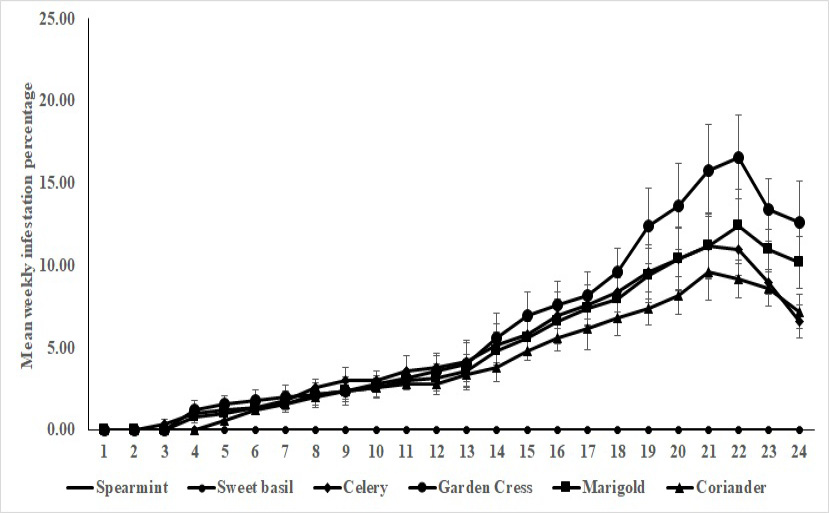
Mean weekly percentage infestation of Tuta absoluta on various push and pull plants grown with tomatoes (LSD = 2.5952).
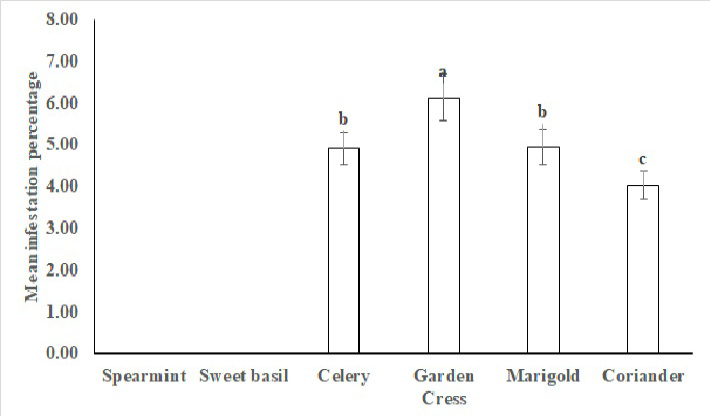
The overall mean percentage infestation of Tuta absoluta on various push and pull plants grown with tomatoes. *Means followed by same letters are not significantly different from each other (LSD = 0.5297, P < 0.001).
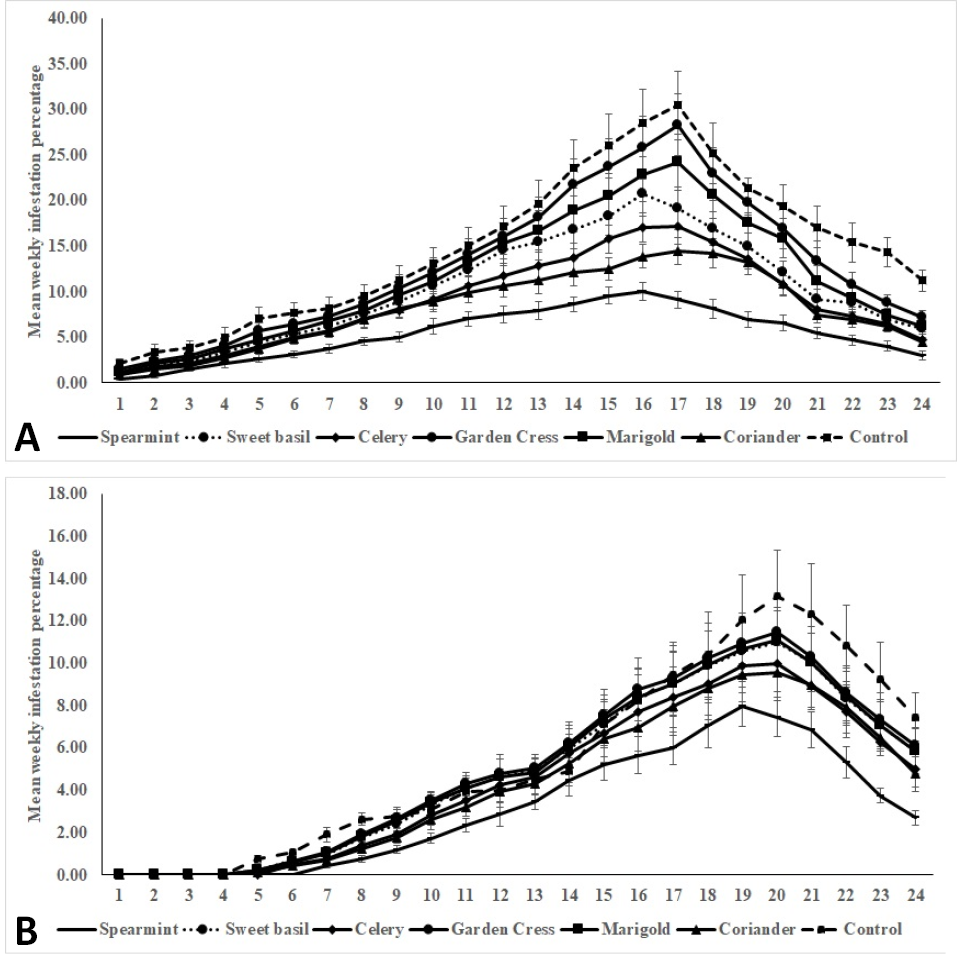
Impact of various push and pull plants on weekly mean percentage infestation of Tuta absoluta on tomato leaves (A) and fruits (B) (LSD for A=4.1158, B= 2.4770).
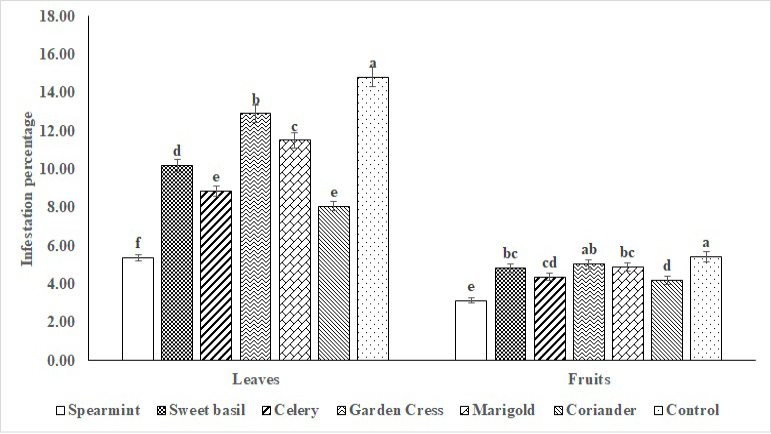
Impact of various push and pull plants on overall mean percentage infestation of Tuta absoluta on tomato leaves and fruits. *Means followed by same letters are not significantly different from each other (LSD Leaves = 0.8401, Fruits = 0.5056).
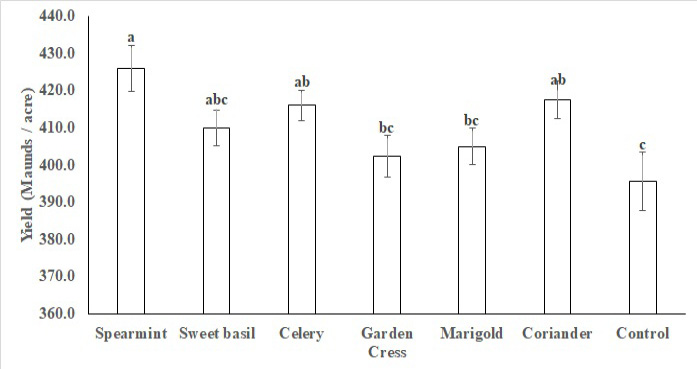
Impact of various push and pull plants on yield of tomatoes. *Means followed by same letters are not significantly different from each other (LSD = 16.346).
References
- Abd El-Ghany, A., Nesreen, M., Abdel-Razek, A.S., Ebadah, I. and Mahmoud, Y.A., 2016. Evaluation of some microbial agents, natural and chemical compounds for controlling tomato leaf miner, Tuta absoluta (Meyrick) (Lepidoptera: Gelechiidae). J. Pl. Prot. Res., 56: 372–379. https://doi.org/10.1515/jppr-2016-0055[CrossRef]
- Abdelmaksoud, N.M., Abdel-Aziz, N.F., Sammour, E.A., Agamy, E.A.E.M., El-Bakry, A.M. and Kandil, M.A.H., 2020. Influence of insect traps and insecticides sequential application as a tactic for management of tomato leafminer, Tuta absoluta (Meyrick), (Lepidoptera: Gelechiidae). Bull. Nat. Res. Cent., 44: 1-9. https://doi.org/10.1186/s42269-020-00376-y[CrossRef]
- Anastasaki, E., Drizou, F. and Milonas, P.G., 2018. Electrophysiological and oviposition responses of Tuta absoluta females to herbivore-induced volatiles in tomato plants. J. Chem. Ecol., 44: 288-298. https://doi.org/10.1007/s10886-018-0929-1[CrossRef]
- Ben-Issa, R., Gomez, L. and Gautier, H., 2017. Companion plants for aphid pest management. Insects, 8: 112. https://doi.org/10.3390/insects8040112[CrossRef]
- Borden, J.H., Birmingham, A.L. and Burleigh, J.S., 2006. Evaluation of the push-pull tactic against the mountain pine beetle using verbenone and non-host volatiles in combination with pheromone-baited trees. For. Chron., 82: 579-590. https://doi.org/10.5558/tfc82579-4[CrossRef]
- Byers, J.A. and Levi-Zada, A., 2022. Modelling push-pull management of pest insects using repellents and attractive traps in fruit tree orchards. Pest Manage. Sci., 78: 3630-3637. https://doi.org/10.1002/ps.7005[CrossRef]
- Castresana, J. and Puhl, L., 2017. Comparative study among a variety of solar-powered LED traps to capture tomato leafminers Tuta absoluta adults by mass trapping in tomato greenhouses in the Province of Entre Ríos, Argentina. Idesia, 35: 87-95. https://doi.org/10.4067/S0718-34292017000400087[CrossRef]
- Chang, P.E.C. and Metz, M.A., 2021. Classification of Tuta absoluta (Meyrick, 1917) (Lepidoptera: Gelechiidae: Gelechiinae: Gnorimoschemini) based on cladistic analysis of morphology. Proc. entomol. Soc. Washington, 123: 41-54. https://doi.org/10.4289/0013-8797.123.1.41[CrossRef]
- Chen, Y., Mao, J., Reynolds, O.L., Chen, W., He, W., You, M. and Gurr, G.M., 2020. Alyssum (Lobularia maritima) selectively attracts and enhances the performance of Cotesia vestalis, a parasitoid of Plutella xylostella. Sci. Rep., 10: 6447. https://doi.org/10.1038/s41598-020-62021-y[CrossRef]
- Cherif, A., Harbaoui, K., Zappala, L. and Grissa-Lebdi, K., 2018. Efficacy of mass trapping and insecticides to control Tuta absoluta in Tunisia. J. Pl. Dis. Prot., 125: 51-61. https://doi.org/10.1007/s41348-017-0140-6[CrossRef]
- Chermiti, B. and Abbes, K., 2012. Comparison of pheromone lures used in mass trapping to control the tomato leafminer Tuta absoluta (Meyrick, 1917) in industrial tomato crops in Kairouan (Tunisia). OEPP/EPPO Bull., 42: 241-248. https://doi.org/10.1111/epp.2561[CrossRef]
- Cocco, A., Deliperi, S. and Delrio, G., 2012. Potential of mass trapping for Tuta absoluta management in greenhouse tomato crops using light and pheromone traps. Int. Org. Biol. Integ. Cont. West Palaeartic Reg. Sec. Bul., 80: 319-324.
- Cook, S.M., Khan, Z.R. and Pickett, J.A., 2007. The use of push-pull strategies in integrated pest management. Ann. Rev. Ent., 52: 375-400. https://doi.org/10.1146/annurev.ento.52.110405.091407[CrossRef]
- Cui, Z., Si, P., Liu, L., Chen, S., Wang, Y., Li, X., Zhou, J.J. and Zhou, Q., 2022. Push-pull strategy for integrated control of Bactrocera minax (Diptera, Tephritidae) based on olfaction and vision. J. appl. Ent., 146: 1243–1251. https://doi.org/10.1111/jen.13067[CrossRef]
- da Silva, V.F., dos Santos, A., Silveira, L.C.P., Tomazella, V.B. and Ferraz, R.M., 2022. Push-pull cropping system reduces pests and promotes the abundance and richness of natural enemies in brassica vegetable crops. Biol. Cont., 166: 104832. https://doi.org/10.1016/j.biocontrol.2021.104832[CrossRef]
- Desneux, N., Han, P., Mansour, R., Arnó, J., Brévault, T., Campos, M.R., Chailleux, A., Guedes, R.N., Karimi, J., Konan, K.A.J. and Lavoir, A.V., 2022. Integrated pest management of Tuta absoluta: practical implementations across different world regions. J. Pest Sci., 95: 17-39. https://doi.org/10.1007/s10340-021-01442-8[CrossRef]
- Filho, M.M., Evaldo, F.V., Gulab, N.N., Athula, M., Ales, S. and Jerrold, M., 2000. Initial studies of mating disruption of the tomato moth, Tuta absoluta (Lepidoptera: Gelechiidae) using synthetic sex pheromone. J. Braz. chem. Soc., 11: 621-628. https://doi.org/10.1590/S0103-50532000000600011[CrossRef]
- Giorgini, M., Guerrieri, E., Cascone, P. and Gontijo, L., 2019. Current strategies and future outlook for managing the Neotropical tomato pest Tuta absoluta (Meyrick) in the Mediterranean Basin. Neotrop. Entomol., 48: 1-17. https://doi.org/10.1007/s13744-018-0636-1[CrossRef]
- Grant, C., Jacobson, R., Ilias, A., Berger, M., Vasakis, E., Bielza, P., Zimmer, C.T., Williamson, M.S., ffrench-Constant, R.H., Vontas, J., Roditakis, E. and Bass, C., 2019. The evolution of multiple-insecticide resistance in UK populations of tomato leafminer, Tuta absoluta. Pest Manage. Sci., 75: 2079-2085. https://doi.org/10.1002/ps.5381[CrossRef]
- Guera, O.G.M., Castrejón-Ayala, F., Robledo, N., Jiménez-Pérez, A., Sánchez-Rivera, G., Salazar-Marcial, L. and Flores Moctezuma, H.E., 2021. Effectiveness of push–pull systems to fall armyworm (Spodoptera frugiperda) management in maize crops in Morelos, Mexico. Insects, 12: 298. https://doi.org/10.3390/insects12040298[CrossRef]
- Hailu, G., Niassy, S., Zeyaur, K.R., Ochatum, N. and Subramanian, S., 2018. Maize–legume intercropping and push–pull for management of fall armyworm, stemborers, and striga in Uganda. Agron. J., 110: 2513-2522. https://doi.org/10.2134/agronj2018.02.0110[CrossRef]
- Hassan, N. and Al-Zaidi, S., 2010. Tuta absoluta. Pheromone mediated management strategy. Int. Pest Cont., 52: 158-160.
- Jallow, M.F., Dahab, A.A., Albaho, M.S., Devi, V.Y., Jacob, J. and Al-Saeed, O., 2020. Efficacy of mating disruption compared with chemical insecticides for controlling Tuta absoluta (Lepidoptera: Gelechiidae) in Kuwait. Appl. Entomol. Zool., 55: 213-221. https://doi.org/10.1007/s13355-020-00673-y[CrossRef]
- Khan, Z.R., Midega, C.A., Amudavi, D.M., Hassanali, A. and Pickett, J.A., 2008. On-farm evaluation of the ‘push–pull’technology for the control of stemborers and striga weed on maize in western Kenya. Field Crops Res., 106: 224-233. https://doi.org/10.1016/j.fcr.2007.12.002[CrossRef]
- Khan, Z.R., Midega, C.A., Bruce, T.J., Hooper, A.M. and Pickett, J.A., 2010. Exploiting phytochemicals for developing a push–pull crop protection strategy for cereal farmers in Africa. J. exp. Bot., 61: 4185-4196. https://doi.org/10.1093/jxb/erq229[CrossRef]
- Khan, Z.R., Midega, C.A., Hooper, A. and Pickett, J., 2016. Push-pull: Chemical ecology-based integrated pest management technology. J. chem. Ecol., 42: 689-697. https://doi.org/10.1007/s10886-016-0730-y[CrossRef]
- Khan, Z.R., Pickett, J.A., Berg, J.V.D., Wadhams, L.J. and Woodcock, C.M., 2000. Exploiting chemical ecology and species diversity: stem borer and striga control for maize and sorghum in Africa. Pest Manage. Sci. Pest. Sci., 56: 957-962. https://doi.org/10.1002/1526-4998(200011)56:11<957::AID-PS236>3.0.CO;2-T[CrossRef]
- Kim, C.Y., Khan, F. and Kim, Y., 2023. A push-pull strategy to control the western flower thrips, Frankliniella occidentalis, using alarm and aggregation pheromones. PLoS One, 18: e0279646. https://doi.org/10.1371/journal.pone.0279646[CrossRef]
- Landis, D.A., Wratten, S.D. and Gurr, G.M., 2000. Habitat management to conserve natural enemies of arthropod pests in agriculture. Annu. Rev. Ent., 45: 175-201. https://doi.org/10.1146/annurev.ento.45.1.175[CrossRef]
- Liu, H., Cheng, Y., Wang, Q., Liu, X., Fu, Y., Zhang, Y. and Chen, J., 2022. Push–pull plants in wheat intercropping system to manage Spodoptera frugiperda. J. Pest Sci., 96: 1579–1593. https://doi.org/10.1007/s10340-022-01547-8[CrossRef]
- Lobos, E., Occhionero, M., Werenitzky, D., Fernandez, J., Gonzalez, L.M., Rodriguez, C., Calvo, C., Lopez, G. and Oehlschlager, A.C., 2013. Optimization of a trap for Tuta absoluta Meyrick (Lepidoptera: Gelechiidae) and trials to determine the effectiveness of mass trapping. Neotrop. Ent., 42: 448-457. https://doi.org/10.1007/s13744-013-0141-5[CrossRef]
- Mansour, R., Cherif, A., Attia-Barhoumi, S., Zappalà, L. and Grissa-Lebdi, K., 2019. Tuta absoluta in Tunisia: ten years of invasion and pest management. Phytoparasitica, 47: 461-474. https://doi.org/10.1007/s12600-019-00748-9[CrossRef]
- Midega, C.A., Pittchar, J.O., Pickett, J.A., Hailu, G.W. and Khan, Z.R., 2018. A climate-adapted push-pull system effectively controls fall armyworm, Spodoptera frugiperda (JE Smith), in maize in East Africa. Crop Prot., 105: 10-15. https://doi.org/10.1016/j.cropro.2017.11.003[CrossRef]
- Msisi, D., Matojo, N.D. and Kimbokota, F., 2021. Attraction of female tomato leaf miner, Tuta absoluta (Meyrick, 1917) (Lepidoptera: Gelechiidae) to shared compounds from hosts. Phytoparasitica, 49: 153-162. https://doi.org/10.1007/s12600-020-00848-x[CrossRef]
- Niu, Y., Han, S., Wu, Z., Pan, C., Wang, M., Tang, Y., Zhang, Q.H., Tan, G. and Han, B., 2022. A push–pull strategy for controlling the tea green leafhopper (Empoasca flavescens F.) using semiochemicals from Tagetes erecta and Flemingia macrophylla. Pest Manage. Sci., 78: 2161-2172. https://doi.org/10.1002/ps.6840[CrossRef]
- Pickett, J.A., Woodcock, C.M., Midega, C.A. and Khan, Z.R., 2014. Push–pull farming systems. Curr. Opin. Biotechnol., 26: 125-132. https://doi.org/10.1016/j.copbio.2013.12.006[CrossRef]
- Proffit, M., Birgersson, G., Bengtsson, M., Reis, R., Witzgall, P. and Lima, E., 2011. Attraction and oviposition of Tuta absoluta females in response to tomato leaf volatiles. J. chem. Ecol., 37: 565-574. https://doi.org/10.1007/s10886-011-9961-0[CrossRef]
- Roda, A.L., Brambila, J., Barria, J., Euceda, X. and Korytkowski, C., 2015. Efficiency of trapping systems for detecting Tuta absoluta (Lepidoptera: Gelechiidae). J. econ. Ent., 108: 2648-2654. https://doi.org/10.1093/jee/tov248[CrossRef]
- Roditakis, E., Vasakis, E. and Garcia-Vidal, L., 2018. A four-year survey on insecticide resistance and likelihood of chemical control failure for tomato leaf miner Tuta absoluta in the European/Asian region. J. Pest Sci., 91: 421-435. https://doi.org/10.1007/s10340-017-0900-x[CrossRef]
- Scheidegger, L., Niassy, S., Midega, C., Chiriboga, X., Delabays, N., Lefort, F., Zürcher, R., Hailu, G., Khan, Z. and Subramanian, S., 2021. The role of Desmodium intortum, Brachiaria sp. and Phaseolus vulgaris in the management of fall armyworm Spodoptera frugiperda (JE Smith) in maize cropping systems in Africa. Pest Manage. Sci., 77: 2350-2357. https://doi.org/10.1002/ps.6261[CrossRef]
- Shahini, S., Bërxolli, A. and Kokojka, F., 2021. Effectiveness of bio-insecticides and mass trapping based on population fluctuations for controlling Tuta absoluta under greenhouse conditions in Albania. Heliyon, 7: e05753. https://doi.org/10.1016/j.heliyon.2020.e05753[CrossRef]
- Sobhy, I.S., Tamiru, A., Chiriboga Morales, X., Nyagol, D., Cheruiyot, D., Chidawanyika, F., Subramanian, S., Midega, C.A., Bruce, T.J. and Khan, Z.R., 2022. Bioactive volatiles from push-pull companion crops repel fall armyworm and attract its parasitoids. Front. Ecol. Evol., 10: 883020. https://doi.org/10.3389/fevo.2022.883020[CrossRef]
- Tarusikirwa, V.L., Machekano, H., Mutamiswa, R., Chidawanyika, F. and Nyamukondiwa, C., 2020. Tuta absoluta (Meyrick) (Lepidoptera: Gelechiidae) on the offensive in Africa: Prospects for integrated management initiatives. Insects, 11: 764. https://doi.org/10.3390/insects11110764[CrossRef]
- Verheggen, F. and Fontus, R.B., 2019. First record of Tuta absoluta in Haiti. Ent. Gen., 38: 349-353. https://doi.org/10.1127/entomologia/2019/0778[CrossRef]
- Xie, H.C., Chen, J.L., Cheng, D.F., Zhou, H.B., Sun, J.R., Liu, Y. and Francis, F., 2012. Impact of wheat–mung bean intercropping on English grain aphid (Hemiptera: Aphididae) populations and its natural enemy. J. eco. Ent., 105: 854-859. https://doi.org/10.1603/EC11214[CrossRef]
- Xu, Q., Hatt, S., Lopes, T., Zhang, Y., Bodson, B., Chen, J. and Francis, F., 2018. A push–pull strategy to control aphids combines intercropping with semiochemical releases. J. Pest Sci., 91: 93-103. https://doi.org/10.1007/s10340-017-0888-2[CrossRef]
- Yeboah, S., Ennin, S.A., Ibrahim, A., Oteng-Darko, P., Mutyambai, D., Khan, Z.R., Mochiah, M.B., Ekesi, S. and Niassy, S., 2021. Effect of spatial arrangement of push-pull companion plants on fall armyworm control and agronomic performance of two maize varieties in Ghana. Crop Prot., 145: 105612. https://doi.org/10.1016/j.cropro.2021.105612[CrossRef]
Services
Article usage statistics
Loading…