T. vulgaris have several beneficial effects including antifungal, antimicrobial, carminative, antiseptic, and antioxidant activities. Phenolic compounds of its essential oils like thymol and carvacrol was noticed to have antioxidant and hepatoprotective potency (Baranauskienė et al., 2003). As well another study represented by Fachini-Queiroz et al. (2012) clarified that thymol and carvacrol of TEO have a modulatory effect on the inflammatory response. This study estimated the protective effects of TEO against CCl4 intoxicated rats. CCl4 is a known hepatotoxic substance which metabolized by cytochrome P-450 enzyme into trichloromethyl peroxide and chloroform (Avasarala et al., 2006). The free radical production conquers the antioxidant system of the liver and leads to oxidative destruction of cell membranes and stimulates the immune cells to liberate inflammatory mediators such as cyclooxygenase enzyme, interleukins, and cytokines which ultimately lead to leukocytes infiltration and damaged liver (Ferguson et al., 2004).
As displayed in our results, CCl4-treated rats displayed a considerable reduction in RBCs count, Hb content, and PCV which could be referred to as the disturbing hematopoiesis, erythrocytes destruction, reducing the erythrocyte formation rate as erythropoiesis is controlled by erythropoietin hormone which is primarily liberated by the kidney and liver (Meral and Kanter, 2003). On the other hand, CCl4 intoxication induced macrocytic hypochromic anemia as CCl4 increase the lipid peroxidation, proteins degradation in the cell membrane, alterations of membrane-bound enzymes, and also increase osmotic fragility of erythrocyte (Makni et al., 2012). Treating the rats with TEO (5 mg/kg b.w) modulates the toxic effect of CCl4 on erythrocyte as thymol prohibited the lipid peroxidation and able to scavenge the free radicals, subsequently, it could diminutive the hemolytic effect generated by CCl4 administration (Alam et al., 1999).
Leukogram in CCl4 exposed group showed a significant decrease in total leukocytes, lymphocytes, neutrophils, and increase in toxic neutrophils numbers which related to increased synthesis and release of TGF-β1 and other inflammatory biomarkers after CCl4 toxicity which suppress the immune responses (Guo et al., 2000). Furthermore, the neutrophilia is attributed to the capability of CCl4 enhanced production of Interleukin- 1β, and TNF-α from kupffer cell that stimulates other inflammatory mediators as granulocyte macrophage colony stimulating factor (GM-CSF) that accountable to differentiation and maturation of neutrophils (Wills and Asha, 2007). Elevation of toxic neutrophils may be imputed to the free radicals liberation during CCl4 metabolism which had an adverse effect on circulating white blood cell membranes and its content and could also induce several ultra-structural abnormalities in both cytoplasm and nucleus of leukocytes (Sinha et al., 2006). Treating CCl4 intoxicated rats with a high dose of TEO significantly elevated total leukocytes and lymphocyte count which could be correlated to the known anti-inflammatory effects of thymol (Chan et al., 2005).
The CCl4 group showed significantly higher serum activities of ALT, AST, and ALP as CCl4 cause an increase in cell membrane permeability and motivate hepatic cell damage resulted in the release of liver enzymes into the blood (Mir et al., 2010). The treatment of intoxicated rats with TEO (5 mg/kg b.w) significantly reduced ALT, AST, and ALP serum activities. This referred to the antioxidant power and free radical scavenging ability of thymol and carvacrol (Hazzit et al., 2006).
The serum total protein and albumin levels represented a highly significant decrease in CCl4 treated rats. These results may be due to the impaired liver function and hepatic cell damage caused by CCl4 (Kazeem et al., 2011). The dropping in the A/G ratio is imputed to the decrease in albumin which cannot be compensated by unchanged serum globulin. Thymol and carvacrol could increase the absorption of protein and globulin in the lower intestine which leads to their concentrations in serum (Rahimi et al., 2011). This also has been observed in the TEO5-CCl4 group which showed significant elevation in proteingram, unlike CCl4 intoxicated group due to its antioxidant and hepatoprotective efficacy (Hazzit et al., 2006).
In our work, hepatic MDA and NO levels were significantly higher in the CCl4 group. The treatment of rats with TEO (5 mg/kg b.w) significantly decreased the elevation in MDA and NO levels caused by CCl4 toxicity. This correlated to the protective, antioxidant, and free radical scavenging roles of thyme oil against CCl4 mediated liver injury (Ložienė et al., 2007). The antioxidants play an important role in the detoxification process of various toxic chemicals and xenobiotics (Olakunle Ajiboye, 2010). For example, GSH can promptly scavenge free radicals to conserve the biological systems from oxidative hurt (El-Sayed et al., 2015). As well, superoxide dismutase (SOD) can catalyze superoxide radicals into molecular oxygen and hydrogen peroxide (Coballase-Urrutia et al., 2011). As presented in the CCl4 group, the hepatic SOD, GSH-Px, GSH, and serum TAC levels were significantly exhausted due to the free radical production in the case of CCl4 intoxication (Cuciureanu et al., 2009). When we treated CC14 intoxicated rats with TEO (5 mg/kg b.w), a significant elevation in hepatic antioxidants was noticed. Moreover, the rats received TEO (5 mg/kg b.w) alone showed a remarkable increase in SOD and GSH activities, also in serum TAC level. These are assigned to the antioxidant properties and free radical scavenging of thymol and carvacrol (El-Nekeety et al., 2011).
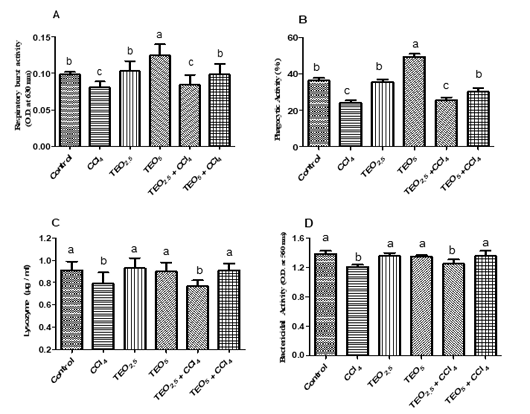
In our results, CCl4 reduced the respiratory burst activity via inactivation of NADPH oxidase enzyme (Bishayi et al., 2002). NADPH oxidase enzyme present on phagocytic cell membranes which converted molecular oxygen into superoxide anion (O2−) that reduced redox dye NBT during a process known as the respiratory burst (Dügenci et al., 2003). TEO could stimulate the respiratory burst activity by an indirect method based on the reduction of Fe3+ to Fe2+ in a process known as ferric reducing antioxidant power which has been clarified by Miguel (2010). CCl4 also suppresses phagocytic activity through the release of numerous free radicals that adversely affect the leukocytes, or through stimulation of TGF-β1 production which down-regulate several immune responses (Sinha et al., 2006). The treated normal or intoxicated rats with TEO (5 mg/kg b.w) showed higher phagocytic activity as it was previously reported that carvacrol able to stimulate human natural killer cell and monocytes activities (Chan et al., 2005). As well, Ran et al. (2016) reported that Zebrafish fed 200 and 400 mg/kg of Next Enhance 150 (Essential oil product contain an equal volume of thymol and carvacrol) showed significantly higher respiratory burst and phagocytic activities of head kidney macrophages.
Lysozyme has an important role in innate immunity. It attacks the bacterial cell membrane and hydrolysis of N-acetylglucosamine and N-acetylmuramic acid causing lysis of bacterial cell wall (Bowden et al., 2004). CCl4 administration significantly reduces serum lysozyme level via suppression of macrophages maturation that produces lysozyme (Bishayi et al., 2002). Both TEO5 treated group’s revealed a significant elevation in lysozyme level. Miguel (2010) reasoned this to the ability of TEO to stimulate macrophages activity to produce lysozyme. In the present work, CCl4 treated rats showed significantly lower bactericidal activity. TEO (5 mg/kg b.w) can correct the reduction in bactericidal activity caused by CCl4 toxicity. This may be attributed to the ability of TEO to stimulate the immune cell phagocytic and respiratory burst activities and also elevated the serum lysozyme activity which has been confirmed in our results.
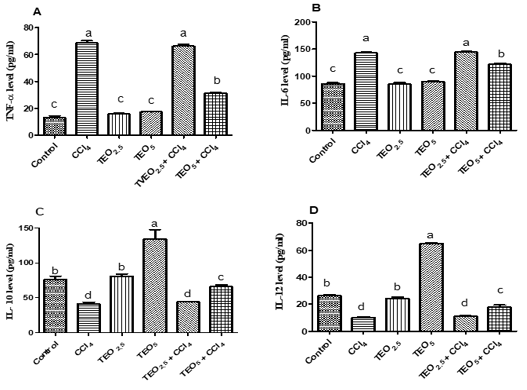
The exposure to CCl4 was reported to activate NF-κB with subsequent enhancing production of proinflammatory cytokines as TNF-α and IL-1β which are considered major hepatotoxicity mediators (Geier et al., 2002). In this experiment, CCl4 significantly elevated TNF-α and IL-6 levels and suppresses IL-10 and IL-12 secretion. This imputed to the CCl4 ability to stimulate the synthesis of TGF-β1 which interferes the macrophages activity to produce IL-12 and limits the main cellular immune responses (Guo et al., 2000). Treatment with TEO (5mg/ kg b.w) significantly decreased TNF-α and IL-6 but increase IL-10 and IL-12 serum levels. Also, Ocaña and Reglero (2012) reported that thyme extracts down-regulate TNF-α, IL-6, and IL-1B, beside an up-regulation of the IL-10 expression level of human macrophages. Chan et al. (2005) also revealed that the thymol has anti-inflammatory effects and it could stimulate the production of IL-12 from the immune cells.
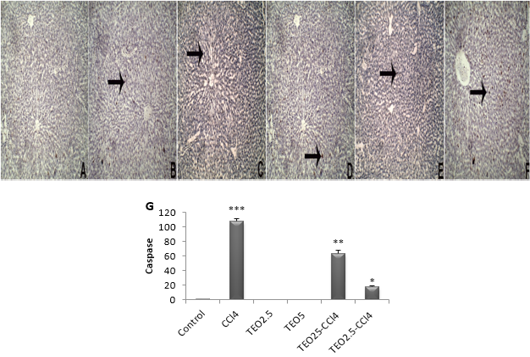
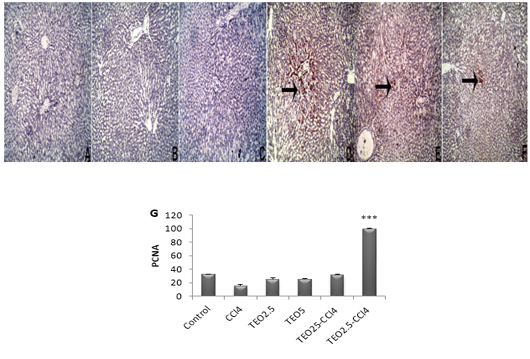
One of the master apoptotic pathways is the mitochondrial apoptotic pathway (Tischner et al., 2010). Cytochrome C could activate caspase-3 to start cell apoptosis (Cusack et al., 2013). In this study, CCl4-generated hepatic apoptosis and the treatment with TEO could alleviate the apoptotic injury. The exposure of hepatocytes to hepatotoxic substances increased ROS production and promoted mitochondrial damage that subsequently, elevated the circulating levels of cytochrome C and caspase-3 as previously reported in CCl4-induced acute liver injury (Wu et al., 2016). The density of positive cells immunostained with PCNA antibody in the liver section was used as an indicator to evaluate the possible roles of TEO to stimulate hepatic regeneration. Our results strongly exhibited that TEO administration contributes to faster recovery following CCl4-mediated hepatic damage through promoting endogenous regeneration and suppressing apoptotic cell death (Zhu et al., 2013).