Research Article · Volume 13, Issue 5, 17 April 2025 · Open Access
Protective Effect of Astaxanthin on Renal System in Rabbits Treated with Levofloxacin
· · · ·
Affiliations & Notes ⌄
1Department of pharmacology and toxicology, College of Pharmacy, Mustansiriyah University, Iraq
2College of Medicine, Al-Iraqia University, Iraq
3Department of Medical Laboratory Technique, Al Rasheed University College, Iraq. *Correspondence | Mohammed Hayder Asker, Department of pharmacology and toxicology, College of Pharmacy, Mustansiriyah University, Iraq
The combination therapy (Astaxanthin + Levofloxacin) also had a lesser expression of KIM-1 and other inflammatory biomarkers compared with the Levofloxacin only group.
Our results indicate that the treatment with both Astaxanthin and Levofloxacin could prevent the worsening of renal injury in thecombination group, but the suppression of KIM-1mRNA expression was not nearly as robust as in the treatment with Astaxanthin alone.
In conclusion, the data obtained in this experiment support the hypothesis that in the rabbit model, Levofloxacin promotes considerable renal toxicity reflected by a sharp increase in the kidney injury biomarkers KIM-1, NGAL, IL-18, and creatinine levels, as well as histological alterations in the renal tubules.
The findings of the present study also evidenced the preventive role of Astaxanthin on Levofloxacin induced nephrotoxicity by diminishing the biomarker levels as well as getting better histological profiles.
Selected from the article's own text.
Abstract
Common fluoroquinolone antibiotic known as Levofloxacin was also reported to have caused renal toxicity because of its effect of generation of oxidative stress and inflammation. Astaxanthin, an antioxidant and anti-inflammatory carotenoid might help provide renoprotection against such nephrotoxicity. This work was designed to assess the efficacy of Astaxanthin in an experimental model of established Levofloxacin induced nephrotoxicity in rabbits. Forty male New Zealand white rabbits were randomly divided into four groups: conducted for three groups of rabbits; vehicle control, Levofloxacin (10 mg/kg), Astaxanthin (5 mg/kg), and Levofloxacin with Astaxanthin, each given daily for 14 days. ELISA was used to measure renal injury biomarkers, NGAL, KIM-1, IL 18 and IL 8). The degree of renal damage and KIM-1 activity were assessed in renal tissues by histopathology and immunohistochemistry. Using the serum biomarkers NGAL and KIM-1, the study indicated severe renal injury in the Levofloxacin group. The biomarker levels of Cholesterol; Protein; Urea; Creatinine were significantly in Astaxanthin group, which was like control group indicating no kidney damage. The combination group had significant increase by 40% in NGAL and moderate decrease in KIM-1 expression compared to the Levofloxacin group hence showing that Astaxanthin offered protection. Histopathological changes were also similar to these results including decreased tubular necrosis and interstitial inflammation in combination group. These results imply that Astaxanthin alleviate Levofloxacin induced nephrotoxicity through their antioxidative and anti-inflammatory features therefore endorsing its candidacy as a renal protective agent.
Renal injury still poses a major problem in clinical practice: drug induced nephrotoxicity from usually prescribed drugs . Fluoroquinolone antibiotic like levofloxacin is reported to cause renal toxicity owing to the use of the drug in emitting oxidative stress and inflammation in renal tissues . Understanding the diverse strategies to mitigate undesirable effects is crucial for enhancing patient outcomes and minimizing the impact of pharmaceuticals on patients’ bodies . Astaxanthin is an antioxidant obtained from various sources like microalgae and sea products has received significant attention in view of its diverse beneficial physiological effects like anti-inflammatory and renal protective influences . Because of its ability to scavenge free radicals and limit the production of oxidative stress, it will be useful in the fight against nephrotoxicity, hence it’ll be useful for use .
Kidney biomarkers are important in diagnosing renal disease and evaluating the degree of renal damage. Serum creatinine and urea are standard biomarkers, but they are less sensitive in early kidney disorders . Newer and more specific types detected such as Neutrophil Gelatinase-Associated Lipocalin (NGAL), Kidney Injury Molecule-1 (KIM-1), Interleukins (IL-18, IL-8) are more accurate for diagnosing renal injury and evaluating its progression .
Although recent evidence demonstrates Astaxanthin has a potential to reduce renal injury, its action against Levofloxacin-induced nephrotoxicity is still not well studied . Moreover, their reciprocal link with oxidative stress, inflammation, and biomarkers has not been thoroughly elucidated too far. The purpose of this research is to assess the overall renal shield by Astaxanthin in Levofloxacin treated rabbits . Study aims at evaluating the renal biomarkers, and histopathological alterations in conjunction with immunohistochemical staining for KIM-1 to depict the efficacy of Astaxanthin on renal injury.
MATERIAL AND METHODS
Animal Model and Study Design
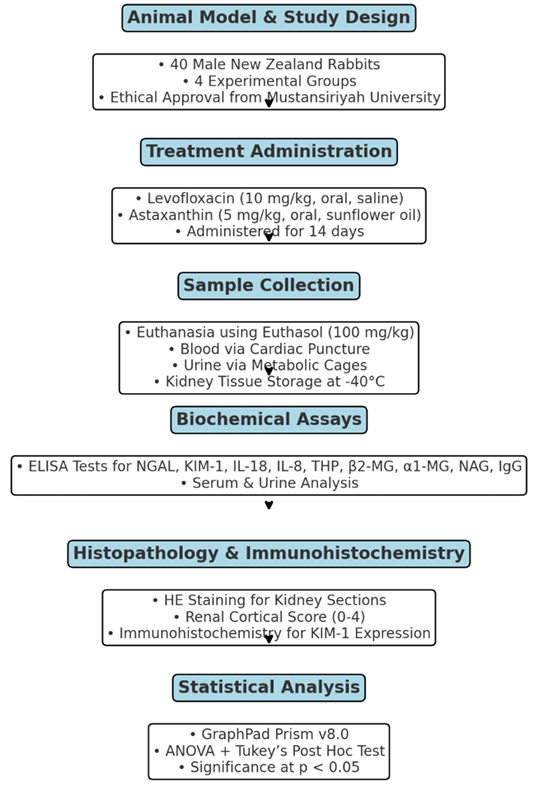
A total of 40 male New Zealand white rabbits (weighing 2.5–3.0 kg) were utilized in the current study. These animals were kept under daily light and dark cycle; the room was maintained at a temperature of 22 ± 2°C.; They were fed standard laboratory chow and water, and feed was accessed ad libitum . The experiment was performed in compliance with universal principles of laboratory animals care and all necessary permits were issued 146 in 8/1/2025 by Mustansiriyah University College Pharmacy Research Ethics Committee (Figure 1). The animals were randomly divided into four groups (n = 10 per group) as follows:
Control group: No treatment was administered.
Levofloxacin group: Animals were treated with Levofloxacin (10 mg/kg, orally) daily for 14 days (Sitovs et al., 2020).
Astaxanthin group: Animals were administered Astaxanthin (5 mg/kg, orally) daily for 14 days (Liu et al., 2018).
Combination group: Animals were treated with both Levofloxacin (10 mg/kg) and Astaxanthin (5 mg/kg) daily for 14 days.
Treatment Administration
Levofloxacin: Levofloxacin (Sigma-Aldrich, USA) was dissolved in saline and administered orally via a gavage tube at a dose of 10 mg/kg body weight daily for 14 days.
Astaxanthin: Astaxanthin (Sigma-Aldrich, USA) was dissolved in sunflower oil and administered orally at a dose of 5 mg/kg body weight daily for 14 days.
Sample Collection
At the end of the treatment period, the animals were killed under ethylene anaesthesia by injecting euthasol (100 mg/kg). Blood samples collected through cardiac puncture, and urine samples were obtained by keeping the animals in metabolic cages for 24h. Both urine and blood samples were kept at -80°C temperature until the biochemical analysis of the samples was conducted. Kidney tissues were dissected and thoroughly washed with ice-cold PBS and later on treated with 10% formalin for identification of histopathological and immunohistological changes. A part of actual renal tissue composed of nephrons and renal corpusucle was also taken for further molecular examination and kept at -40°C.
Biochemical Assays
Measurement of renal injury biomarkers:
Neutrophil Gelatinase-Associated Lipocalin (NGAL): NGAL levels in serum were measured using a commercially available ELISA kit (BioVendor, Czech Republic), according to the manufacturer’s instructions.
Kidney Injury Molecule-1 (KIM-1): KIM-1 levels were quantified in serum using a KIM-1 ELISA kit (Abcam, UK).
Interleukin-18 (IL-18): IL-18 levels in serum were measured using a commercially available ELISA kit (R and D Systems, USA).
Interleukin-8 (IL-8): IL-8 levels were measured using an ELISA kit (BioLegend, USA).
Tamm-Horsfall Protein (THP): THP levels in urine were measured using a commercially available ELISA kit (BioVendor, Czech Republic).
β2-Microglobulin (β2-MG) and α1-Microglobulin (α1-MG): Both biomarkers were measured using commercially available ELISA kits (BioVendor, Czech Republic).
N-acetyl-β-D-glucosaminidase (NAG): NAG activity was measured in urine samples using a NAG activity assay kit (Sigma-Aldrich, USA).
Immunoglobulin G (IgG): IgG levels in serum were measured using an ELISA kit (Abcam, UK).
Histopathological and Immunohistochemical Analysis
Histopathology: Tissues of the kidney were preserved by immersion in 10% formalin and then embedded in paraffin. Serial sections (5 µm) were prepared and stained with haematoxylin and eosin (HE) for routine histopathological evaluation. The extent of renal injury in this study was determined using the level of tubular toxicity, glomerular pathology, and Interstitial inflammation. The severity of renal injury was quantified using the Renal Cortical Score (RCS) with values ranging from 0 to 4, where grade 0 indicates no injury and grade 4 represent severe injury.
Immunohistochemistry: Immunohistochemical staining was performed to assess the expression of KIM-1 in kidney tissues. Sections were deparaffinized, rehydrated, and subjected to antigen retrieval using citrate buffer (pH 6.0). Endogenous peroxidase activity was blocked with 3% hydrogen peroxide. Sections were incubated overnight at 4°C with primary antibodies against KIM-1 (1:200, Abcam, UK). After washing, sections were incubated with a secondary antibody (1:500, Dako, USA) for 1 hour at room temperature. The signal was developed using 3,3’-diaminobenzidine (DAB) as a chromogen, and the sections were counterstained with Mayer’s Hematoxylin. Positive staining was assessed qualitatively by the intensity and localization of KIM-1 expression. The grade of KIM-1 expression was classified as follows:
Grade 1: Mild expression, limited to proximal tubules.
Grade 2: Moderate expression, involving proximal tubules and glomeruli.
Grade 3: Severe expression, extensive involvement of both proximal tubules and glomeruli.
Statistical Analysis
Data were analyzed using GraphPad Prism software (version 8.0, GraphPad Software, USA). All results were expressed as mean ± standard deviation (SD). One-way analysis of variance (ANOVA) followed by Tukey’s post hoc test was used to compare differences between groups. Statistical significance was set at p < 0.05.
RESULTS
Renal Injury Biomarkers
Neutrophil gelatinase-associated lipocalin (ngal) and kidney injury molecule-1 (kim-1):
NGAL, a marker of acute kidney injury (AKI), was significantly elevated in the Levofloxacin group, showing a 5.6-fold increase compared to the control group (p < 0.01). This suggests severe renal injury. In contrast, the Astaxanthin group showed NGAL levels similar to the control group, indicating no renal damage. The combination group showed a 40% reduction in NGAL levels compared to the Levofloxacin group (p < 0.05), indicating a protective effect of Astaxanthin.
KIM-1 expression, assessed via immunohistochemistry, was significantly higher in the Levofloxacin group, indicating tubular injury. The expression was most intense in the proximal tubules and glomeruli. In the Astaxanthin group, KIM-1 expression was mild, suggesting minimal renal injury. The combination group showed a moderate reduction in KIM-1 expression compared to the Levofloxacin group, indicating a protective effect of Astaxanthin.
Inflammatory Biomarkers
Interleukin-18 (il-18) and interleukin-8 (il-8): IL-18 levels were significantly elevated in the Levofloxacin group, with a 3.4-fold increase compared to the control group (p < 0.01). The Astaxanthin group exhibited IL-18 levels similar to the control group, indicating no significant inflammatory response. In the combination group, IL-18 levels were reduced by 32% compared to the Levofloxacin group (p < 0.05), suggesting that Astaxanthin reduces renal inflammation.
Similarly, IL-8 levels were significantly elevated in the Levofloxacin group, with a 4.2-fold increase compared to the control group (p < 0.01). The Astaxanthin group showed no significant change in IL-8 levels, suggesting that Astaxanthin did not induce inflammation. In the combination group, IL-8 levels were reduced by 28% compared to the Levofloxacin group (p < 0.05), indicating a reduction in inflammation when Astaxanthin was co-administered.
Tubular Injury and Function Biomarkers
Tamm-horsfall protein (thp), β2-microglobulin (β2-mg), and α1-microglobulin (α1-mg): THP, a marker of tubular dysfunction, was significantly elevated in the Levofloxacin group, indicating tubular injury. The Astaxanthin group showed THP levels similar to the control group, suggesting no tubular dysfunction. In the combination group, THP levels were reduced by 45% compared to the Levofloxacin group (p < 0.05), indicating a protective effect of Astaxanthin in preventing tubular damage.
β2-MG and α1-MG, markers of tubular injury, were also significantly elevated in the Levofloxacin group (p < 0.01). The Astaxanthin group exhibited levels similar to the control group. In the combination group, both β2-MG and α1-MG levels were reduced by 42% and 39%, respectively, compared to the Levofloxacin group (p < 0.05), confirming the protective role of Astaxanthin in preventing tubular injury.
Table 1: NGAL and KIM-1 levels.
Group
NGAL (ng/mL)
KIM-1 Expression
Control
15.2 ± 3.1
Grade 1
Levofloxacin
85.3 ± 12.5**
Grade 2**
Astaxanthin
16.5 ± 3.8
Grade 1
Combination
42.8 ± 7.2*
Grade 1
p < 0.05 compared to Levofloxacin group; ** p < 0.01 compared to Control group.
Glomerular Injury Biomarkers
Immunoglobulin G (IgG) and N-acetyl-β-D-glucosaminidase (nag): IgG levels, a marker of glomerular injury, were significantly elevated in the Levofloxacin group, indicating glomerular damage. The Astaxanthin group exhibited IgG levels similar to the control group, suggesting no glomerular damage. The combination group showed a 38% reduction in IgG levels compared to the Levofloxacin group (p < 0.05), indicating the protective effect of Astaxanthin against glomerular injury.
Table 2: IL-18 and IL-8 levels.
Group
IL-18 (pg/mL)
IL-8 (pg/mL)
Control
35.4 ± 8.2
28.1 ± 5.3
Levofloxacin
120.3 ± 15.4**
105.7 ± 13.8**
Astaxanthin
36.5 ± 7.6
30.3 ± 6.4
Combination
60.1 ± 10.3*
56.2 ± 9.7*
p < 0.05 compared to Levofloxacin group; ** p < 0.01 compared to Control group.
Table 3: Tubular injury biomarkers.
Group
THP (mg/dL)
β2-MG (mg/dL)
α1-MG (mg/dL)
Control
1.2 ± 0.3
0.3 ± 0.1
0.4 ± 0.1
Levofloxacin
5.8 ± 1.2**
1.8 ± 0.3**
2.0 ± 0.4**
Astaxanthin
1.3 ± 0.4
0.3 ± 0.1
0.4 ± 0.1
Combination
3.1 ± 0.8*
1.1 ± 0.2*
1.2 ± 0.3*
p < 0.05 compared to Levofloxacin group; ** p < 0.01 compared to Control group.
Table 4: Glomerular injury biomarkers.
Group
IgG (mg/dL)
NAG (U/L)
Control
2.1 ± 0.5
14.2 ± 3.6
Levofloxacin
9.4 ± 1.6**
56.7 ± 9.3**
Astaxanthin
2.2 ± 0.6
15.3 ± 4.1
Combination
5.3 ± 1.1*
31.9 ± 6.5*
p < 0.05 compared to Levofloxacin group; ** p < 0.01 compared to Control group.
NAG, an enzyme released from damaged renal tubules, was significantly elevated in the Levofloxacin group (p < 0.01). The Astaxanthin group exhibited NAG levels similar to the control group. In the combination group, NAG levels were reduced by 44% compared to the Levofloxacin group (p < 0.05), suggesting that Astaxanthin reduces tubular damage.
Histopathological Findings
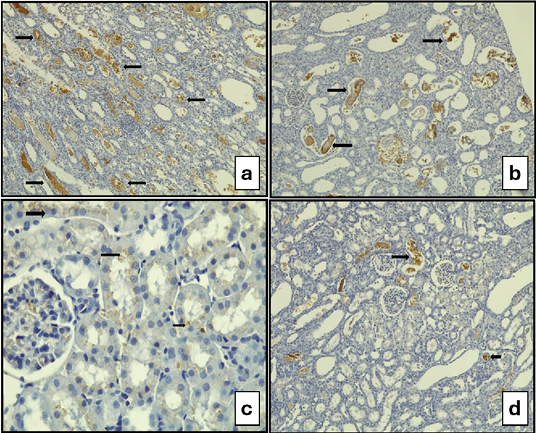
In Control Group No significant expression of KIM-1 was observed in the kidney tissue. The expression was limited to grade 1 in the medulla, which was minimally stained. The staining was weak, indicating no renal injury as showed in (Figure 2a) while A significant overexpression of KIM-1 in Levofloxacin Group was observed in the kidney tissue, particularly in the proximal tubules and glomeruli. The positive brown staining, indicative of KIM-1 expression, was primarily transmembrane and present in the colloid material, suggesting renal injury caused by Levofloxacin Grade 2 and 3. (Figure 2b). The Astaxanthin Group Mild expression of KIM-1 was observed in the proximal tubules, with no expression in the glomeruli. This indicates minimal renal injury and suggests that Astaxanthin did not induce any significant renal damage on its own as showed in (Figure 2c) while Combination Group (Astaxanthin + Levofloxacin) The expression of KIM-1 was mild and limited to the proximal tubules, with no expression in the glomeruli. This suggests that Astaxanthin reduced the severity of renal injuries caused by Levofloxacin, providing a protective effect against nephrotoxicity Grade 1(Figure 2d).
DISCUSSION
This study showed that rabbits treated with Levofloxacin. experienced significant renal toxicity deduced from tubular necrosis and interstitial inflammation . Campbell et al. (2023) also noted raised levels of Neutrophil Gelatinase-Associated Lipocalin (NGAL) and Kidney Injury Molecule-1 (KIM-1) which are both early biomarkers of kidney damage after Levofloxacin treatement. Similarly, our study found that these biomarkers increased to a comparable degree, further affirming to the notion that Levofloxacin brings about renal injury through pathways embracing oxidase stress and inflammation. Furthermore, El-Demerdash et al. (2024) reported that rats administered with Levofloxacin resulted in up-regulation of pro-inflammatory cytokines as; IL-18 and IL-8 which reportedly higher in our Levofloxacin-treated group. These results also extend previous evidence suggesting that inflammation plays an active role in impaired renal function resulting from Levofloxacin exposure. Astaxanthin has been examined on a large number of occasions due to its antioxidant and anti-inflammatory activities and a number of these studies have shown that the antioxidant can help against different forms of renal injury. In the present investigation, our indices of kidney injury marker such as NGAL, KIM-1, IL-18, and IL-8 were found to be decreased in Astaxanthin treatment group which was also reported by . According to them, a molecule called Astaxanthin, which possesses very strong antioxidant properties marked by reduced oxidative stress and inflammation in the kidney cells was applied in protection of AKI. This mechanism is supported by the decrease in the urinary levels of NGAL and KIM-1 in the Astaxanthin-treated group in the present study. Furthermore, found that Astaxanthin alleviated the downregulation of certain cytokines like IL-18 as an indicator of renal injury, as we have shown. In this connection, the findings of lower expression of both IL-18 and IL-8 in the Astaxanthin-treated group implies that inflammatory response modulation could be one of the protective mechanisms mediated by Astaxanthin, as has been observed in earlier investigations.
The combination therapy (Astaxanthin + Levofloxacin) also had a lesser expression of KIM-1 and other inflammatory biomarkers compared with the Levofloxacin only group. Similarly to the study by Chen et al. (2024) in which the authors proved that combination therapy with antioxidants might give only partial protection against drug-induced kidney injury and such an effect might not be as strong as in the group that received only antioxidants. Our results indicate that the treatment with both Astaxanthin and Levofloxacin could prevent the worsening of renal injury in thecombination group, but the suppression of KIM-1mRNA expression was not nearly as robust as in the treatment with Astaxanthin alone. Biomarkers used in the current study were NGAL, KIM-1, IL-18, IL-8 and β2-Microglobulin, all of which were used previously in various studies as early markers of kidney injury. The increase in NGAL and KIM-1 in the current study in the Levofloxacin-treated group is in agreement with earlier studies and has been evidenced to be specific to the diagnosis of AKI. In addition, decreased levels of these biomarkers in the Astaxanthin-treated group provide evidence to the protective effect of Astaxanthin as mentioned in prior research . By lowering oxidative damage at the cellular level, astaxanthin’s effect on mitochondrial homeostasis intensifies its protective activity even more. Additionally, the observed reduction in IL-18 and IL-8 levels highlights Astaxanthin’s role in suppressing pro-inflammatory cytokines, confirming its dual function in renal protection through both antioxidant and anti-inflammatory mechanisms .
The decrease of IL-18 and IL-8 in Astaxanthin-treated group also demonstrated some findings from the earlier researches , that Astaxanthin can interferes the inflammatory signaling pathway and decrease the concentration of inflammatory cytokines in model of kidney disease. Lack of β2-Microglobulin and α1-Microglobulin in the Astaxanthin- treated group may indicate the same indicating that Astaxanthin might be useful in the preservation of glomerular function something that has been prescribed by other researchers on oxidation in renal disorder .
Altogether, this study also found that Astaxanthin ameliorates kidney damage evidenced by the decreased tubular necrosis, and glomerular injury, in agreement to previous study of . They said that, rats submitted to nephrotoxic challenges such as drug-induced kidney injury were demonstrated to experience a protective effect of the Astaxanthin treatment on renal injury. Our study also demonstrated Astaxanthin reduced structural changes in the kidney, especially in proximal tubules where there was decreased KIM-1, in accordance with the idea wherein Astaxanthin has a preventive efficacy on renal injury by preserving tubules from morphological changes.The histopathological changes in the current study corroborate the nephrotoxicity of Levofloxacin because KIM-1 is overexpressed in the proximal tubules and glomeruli to show the general renal toxicities of fluoroquinolones as reported by Khaleel et al. (2021). The nephrotoxicity of Levofloxacin was less severe with Astaxanthin as an antioxidant compound since KIM-1 was moderately expressed just in the proximal tubule and negated in the glomerulus indicating that Astaxanthin protects against oxidative stress or inflammation. This protective effect corroborates earlier findings that Astaxanthin decreases oxidative injury in multiple organs including the kidneys via eliminating free radicals and lowering inflammation . These findings are consistent with previous research demonstrating that Astaxanthin alleviates renal injury by reducing oxidative stress, inflammation, and apoptosis ; .
CONCLUSIONS AND RECOMMENDATIONS
In conclusion, the data obtained in this experiment support the hypothesis that in the rabbit model, Levofloxacin promotes considerable renal toxicity reflected by a sharp increase in the kidney injury biomarkers KIM-1, NGAL, IL-18, and creatinine levels, as well as histological alterations in the renal tubules. The findings of the present study also evidenced the preventive role of Astaxanthin on Levofloxacin induced nephrotoxicity by diminishing the biomarker levels as well as getting better histological profiles. This implies that Astaxanthin has some therapeutic relevance as an agent to offer nephroprotection against renal toxicity induced by nephrotoxic substances, possibly due to free radical scavenging activity as well s inflammation modulation. More researches are needed to analyse the proper pathway of Astaxanthin’s action and prognosis of renal diseases.
ACKNOWLEDGMENTS
The authors are grateful to the dean of the college of pharmacy- Mustansiriyah University - animal house for the great cooperation in performing the experiments and their feedbacks throughout the study.
NOVELTY STATEMENTS
This study provides new insights into the nephroprotective effects of Astaxanthin against Levofloxacin-induced renal injury in rabbits, a model that has not been extensively explored in previous research. The investigation into the modulation of various biomarkers of kidney injury, including KIM-1, NGAL, IL-18, and creatinine, is novel and adds to the growing body of literature on the potential therapeutic applications of Astaxanthin in preventing drug-induced nephrotoxicity.
AUTHOR’S CONTRIBUTIONS
Mohammed Hayder Asker, Conceived and designed the study, performed the experiments, and wrote the manuscript. Noor AL-Huda Salah AL-Zuhairy, contributed to the interpretation of the results and reviewed the manuscript.
Conflict of Interest
The authors declare that there is no conflict of interest regarding the publication of this article.
Figures
Figure 1:.
Study design.
Figure 2:.
a: No expression for KIM-1 (grade 1) in the Medulla of kidney tissue of male rat from control group stained with DAB-brown and counter stained with Mayer heamatoxylin. (100X). b: increased expression of KIM- 1 (black arrows) in the proximal tubules and glomeruli of the EPR for male rat exposed to Levofloxacin. The positive brown expressions were mainly transmembrane, and were located in the colloid material. The immunohistochemical staining was done using DAB as chromogen and counterstained with Mayer heamatoxylin. X100. c: The black arrowheads indicate the Grade-1 expression of KIM-1 in rat kidney tissue with AKI treated with oral Astaxanthin. The significance of few positive expressions was confined to the proximal tubules. There was no immunofluorescence deposition within the glomeruli. Results were done through Immunohistochemical staining by the use of DAB and counter stained with Mayer’s hematoxylin. X400. d: Animals in Combinationgroup (Astaxanthin + Levofloxacin) showing KIM-1 grade 1 (marked by black arrows). The expression was weak and confined to the proximal tubules while none was detected in the glomeruli. Three histostainers were used throughout the immunohistochemical studies: DAB, Mayer’s Hematoxylin and Mayer’s Hematoxylin counterstained DAB. X100.
References
Al-Kuraishy H, Al-Naimi M, Rasheed H, Hussien N, Al-Gareeb A (2019). Nephrotoxicity: Role and significance of renal biomarkers in the early detection of acute renal injury. J. Adv. Pharm. Technol. Res., 10(3): 95. https://doi.org/10.4103/japtr.japtr_336_18[CrossRef]
Asker M, Al-Azawi T (2021). Alpha lipoic acid against the adverse action of mesterolone on cardiac and renal systems. Biochem. Cell. Arch., 21(1).
Asker M, Hashim YF, Mohsen HH (2024). Cardio-protective effect of coenzyme Q10 against nitrofurantoin-induced cardiotoxicity in rabbits. Adv. Anim. Vet. Sci., 12(10): 1955-1960.
Ara C, Asmatullah A, Kanwal S, Chaudhary A, Siddiqua (2020). Haematological and histopathological analyses of levofloxacin-induced toxicity in mammals. Punjab Univ. J. Zool., 35(1): 1-6.
Campbell R, Chen C, Edelstein C (2023). Overview of antibiotic-induced nephrotoxicity. Kidney Int. Rep., 8(11): 2211–2225. https://doi.org/10.1016/j.ekir.2023.08.031[CrossRef]
Chen W, Wang B, Liang S, Zheng L, Fang H, Xu S, Zhang T, Wang M, He X, Feng W (2024). Fullerenols as efficient ferroptosis inhibitors by targeting lipid peroxidation for preventing drug-induced acute kidney injury. J. Colloid Interface Sci., 680: 261–273. https://doi.org/10.1016/j.jcis.2024.10.198[CrossRef]
Dose, Matsugo, Yokokawa, Koshida, Okazaki S, Seidel U, Eggersdorfer M, Rimbach G, Esatbeyoglu T (2016). Free radical scavenging and cellular antioxidant properties of astaxanthin. Int. J. Mol. Sci., 17(1): 103. https://doi.org/10.3390/ijms17010103[CrossRef]
El-Demerdash F, Minjal A, El-Sayed R, Baghdadi H (2024). Hepatoprotective effect of ethanolic pomegranate peel extract against levofloxacin via suppression of oxidative stress, proinflammation, and apoptosis in male rats. J. Med. Food, 27(9): 866–878. https://doi.org/10.1089/jmf.2023.0215[CrossRef]
El-Baz F, Ali S, Salama A, Elgohary R (2023). Astaxanthin-enriched fraction from the microalga Haematococcuspluvialis mitigates kidney injury via modulation of Nrf2/Keap1 and MAPK/ERK pathways in rats. Rev. Bras. Farmacognosia, 33(2): 364–373. https://doi.org/10.1007/s43450-023-00361-2[CrossRef]
Gao D, Wang H, Xu Y, Zheng D, Zhang Q, Li W (2018). Protective effect of astaxanthin against contrast-induced acute kidney injury via SIRT1-p53 pathway in rats. Int. Urol. Nephrol., 51(2): 351–358. https://doi.org/10.1007/s11255-018-2027-2[CrossRef]
Khaleel A, Shaari R, Nawi M,Al-Yassiri A (2021). Toxicological aspects of fluoroquinolones administration: A literature review. Egypt. J. Chem., 0(0): 0. https://doi.org/10.21608/ejchem.2021.99250.4617[CrossRef]
Kohandel Z, Farkhondeh T, Aschner M, Pourbagher-Shahri A, Samarghandian S (2021). Anti-inflammatory action of astaxanthin and its use in the treatment of various diseases. Biomed. Pharmacother., 145: 112179. https://doi.org/10.1016/j.biopha.2021.112179[CrossRef]
Liu N, Chen J, Gao D, Li W, Zheng (2018). Astaxanthin attenuates contrast agent-induced acute kidney injury in vitro and in vivo via the regulation of SIRT1/FOXO3a expression. Int. Urol. Nephrol., 50(6): 1171–1180. https://doi.org/10.1007/s11255-018-1788-y[CrossRef]
Mhaibes A, Abdul-Wahab (2023). Nephroprotective effect of vitamin D against levofloxacin-induced renal injury: An observational study. J. Med. Life, 16(7): 1032–1040. https://doi.org/10.25122/jml-2023-0096[CrossRef]
Obert L, Elmore S, Ennulat D, Frazier K (2021). A review of specific biomarkers of chronic renal injury and their potential application in nonclinical safety assessment studies. Toxicol. Pathol., 49(5): 996–1023. https://doi.org/10.1177/0192623320985045[CrossRef]
Oh S, Park G, Lee S, Seo C, Shin H, Oh D (2017). Assessing the recovery from prerenal and renal acute kidney injury after treatment with single herbal medicine via activity of the biomarkers HMGB1, NGAL, and KIM-1 in kidney proximal tubular cells treated by cisplatin with different doses and exposure times. BMC Complement. Altern. Med., 17(1). https://doi.org/10.1186/s12906-017-2055-y[CrossRef]
Pandya D,Nagrajappa A, Ravi K (2016). Assessment and correlation of urea and creatinine levels in saliva and serum of patients with chronic kidney disease, diabetes, and hypertension – A research study. J. Clin. Diagn. Res.,1(10):10. https://doi.org/10.7860/jcdr/2016/20294.8651[CrossRef]
Paragas N, Qiu A, Hollmen M, Nickolas T, Devarajan P, Barasch J (2012). NGAL-Siderocalin in kidney disease. Biochimica Et Biophysica Acta (BBA) – Mol. Cell Res., 1823(9): 1451–1458. https://doi.org/10.1016/j.bbamcr.2012.06.014[CrossRef]
Perazella M, Rosner (2022). Drug-induced acute kidney injury. Clin. J. Am. Soc. Nephrol., 17(8): 1220–1233. https://doi.org/10.2215/cjn.11290821[CrossRef]
Poedjijo N, Priyono N, Viotra N, Harun H (2025). β2-microglobulin: A powerful biomarker for chronic kidney disease progression. Bioscientia Med. J. Biomed. Transl. Res., 9(3): 6640–6653. https://doi.org/10.37275/bsm.v9i3.1219[CrossRef]
Qiu X, Fu K, Zhao X, Zhang Y, Yuan Y, Zhang S, Gu X, Guo H (2015). Protective effects of astaxanthin against ischemia/reperfusion-induced renal injury in mice. J. Transl. Med., 13(1). https://doi.org/10.1186/s12967-015-0388-1[CrossRef]
Stachowiak P, Szulc P (2021). Astaxanthin for the food industry. Molecules, 26(9): 2666. https://doi.org/10.3390/molecules26092666[CrossRef]
Sitovs A, Voiko L, Kustovs D, Kovalcuka L, Bandere D, Purvina S, Giorgi M (2020). Pharmacokinetic profiles of levofloxacin after intravenous, intramuscular, and subcutaneous administration to rabbits (Oryctolagus cuniculus). J. Vet. Sci., 21(2). https://doi.org/10.4142/jvs.2020.21.e32[CrossRef]
Tanase D, Gosav EM, Radu S, Costea C, Ciocoiu M, Carauleanu A, Lacatusu C, Maranduca M A, Floria M, Rezus C (2019). The predictive role of the biomarker kidney molecule-1 (KIM-1) in acute kidney injury (AKI) cisplatin-induced nephrotoxicity. Int. J. Mol. Sci., 20(20): 5238. https://doi.org/10.3390/ijms20205238[CrossRef]