
Chronic obstructive pulmonary disease (COPD) is the major cause of morbidity and mortality around the world. Evaluation of expressed of proinflammatory cytokine and chemokine as biomarker was obtained in moderate, severe and very severe COPD patients and established their relationship with lung obstruction. Samples were collected between April and August 2017, total 35 COPD patients with lung obstruction (FEV1/FVC< 70) were enrolled as well as age and sex matched healthy subjects were also recruited as control group. Expression of IL-6 and IL-8 in serum samples were evaluated by Enzyme-linked immunosorbent assay. Correlation between serum inflammatory cytokines (IL-6 and IL-8) level and post predicted FEV1%, FVC% and FEV1/FVC was analyzed. Results of serum IL-6 and IL-8 showed significant difference among control and GOLD stages II, III and IV (both P< 0.05). The level of IL-6 was highest in GOLD stage II and lowest in stage III significantly (P< 0.05). However, serum IL-8 was highest in GOLD stage IV and lowest in control significantly (P< 0.05). Over left groups were not significantly different with each other (P> 0.05). Both IL-6 and IL-8 were negatively correlated with FEV1%, FVC% and FEV1/FVC. Our investigation suggested the level of serum IL-8 was elevated in COPD as compared to control and was associated with disease severity of COPD patients as compared to control. It may be potential biomarker for evaluation of disease severity.
Research Article · Volume 53, Issue 1, 12 December 2020 · Open Access
Prevalence of Proinflammatory Cytokines in Relation to Chronic Obstructive Pulmonary Disease in Faisalabad District
· · ·
Affiliations & Notes ⌄
- 1Department of Zoology, Government College for Women University, Faisalabad, Punjab, Pakistan 2Department of Zoology, University of the Punjab, Lahore, Punjab, Pakistan 3Shalimar Degree College for Boys, Lahore, Pakistan , * Corresponding author: younas.rida@gmail.com
Article Info ⌄
- Journal:
- Pakistan Journal of Zoology
- Published:
- 12 December 2020

From the article
- Minimum values of FEV1%, FVC% and FEV1/FVC were observed in very severe COPD stage when compared with severe and moderate group.
- Serum IL-8 concentration was greater in very severe, severe and moderate groups as compared to control and showed increment in the level of IL-8 with disease severity.
- Correlation of IL-6 and IL-8 with FEV1%, FVC% and FEV1/FVC revealed non-significant negative correlation with serum IL-6 and significant with serum IL-8.
- Our investigation suggested the level of serum IL-8 was elevated in COPD as compared to control and is associated with disease severity of COPD patients as compared to control.
Selected from the article's own text.
Abstract
INTRODUCTION
Chronic obstructive pulmonary disease (COPD) is fourth current leading cause of mortality worldwide . Globally, nearby three million deaths occur from COPD per annum and its increasing prevalence will influence up to four million and five lacks deaths annually by 2030 due to high smoking rate and aging . Long term exposure to tobacco smoke, noxious particles and gases and air pollutants are major risk factors for COPD. However, host/ genetic factors, poor lung growth during childhood and air way hyper responsiveness cannot be ignored ; ; .
It is preventable and treatable disease which can be characterized by air flow limitation and persistent respiratory symptoms. It may involve bronchiolitis, small airway obstruction, reduced lung elasticity and destruction of lung parenchyma. There are mostly three pathological mechanisms (chronic obstructive bronchiolitis, emphysema and mucus plugging) involved in patients with COPD .
Chronic inflammation is the modified response of lung inflammation which is normal and developed in COPD patients under the reaction of inhalation of cigarette smoke/ noxious particles. This cause structural modifications in peripheral airways and reduces lung elastic recoil, which in turn diminished the ability of air corridor to stay open during expiration. Airflow limitation/ chronic airflow obstruction cause loss of gas exchange surfaces/ alveoli. Chronic airflow limitation and inflammation both play an important role in pathophysiology of .
Interleukin-6 (IL-6) is the proinflammatory cytokine, which not only play role in COPD lung inflammation but also associated with active state of epithelial cells. Both IL-6 and IL-8 are involved in maintaining persistent inflammation in COPD . Interleukin -8 (IL-8), a proinflammatory cytokine belongs to chemokine (CXCL8) family and play selective role for neutrophils recruitment and degranulation through chemo attraction in COPD . Higher levels of IL-8 have been observed in COPD patients . Expression of IL-8 is stimulated by airway epithelial cells from exposure to cigarette smoke. As primary human alveolar type II cells and bronchial epithelial cells are studied to release IL-8 in response to smoke extract by .
Patients with COPD possess chronic cough, sputum production and history of risk factors for disease . Proper diagnosis is done by spirometery test clinically and presence of FEV1/FVC < 0.70 ensure the presence of persistent airflow limitation with significant symptoms. Evaluation of expressed proinflammatory cytokine and chemokine as biomarker was obtained in moderate, severe and very severe COPD patients and established their relationship with lung obstruction.
MATERIALS AND METHODS
Before conducting research plan it was compiled with medical principles and approved by Ethics Committee of Government College Women University Faisalabad (GCWUF). Sampling for this project was completed between months of April to August (2017) from Chest Department of District Head Quarter (DHQ) Hospital Faisalabad. Written/oral informed consent was obtained from volunteers before performing pulmonary function test. According to American Thoracic society COPD patients with post bronchodilator Forced Expiratory Volume in 1 second/Forced Vital Capacity (FEV1/FVC) ≤ 70 exhibit confirmed airflow limitation which is not fully reversible . In this study patients with COPD (n=35) were diagnosed on exhibiting lung obstruction (FEV1/FVC< 70) and classified into Global Initiative Lung Disease (GOLD) stages II, III and IV. Age and sex matched healthy individuals (n=12) were enrolled as control group. Exclusion criteria exclude patients with tuberculosis, interstitial lung disease, lung cancer, pneumonia, cardiovascular disease, hepatitis and asthma COPD overlap syndrome. Lung function test was performed according to published instructions . Pre and post bronchodilator spirometery was performed after 15 min of nebulization through spirometer (Spirolab III Colour TUK MIR009). For nebulization, 0.5% w/v salbutamol (Ventolin® Glaxosmith Kline, Pakistan) diluted with 0.9% normal saline (PALASALINE Ostuka group, Japan) in 2:1 ratio was used as bronchodilator. Following to spirometery, 3cc blood was drawn through venipuncture using sterile, disposable plastic syringes (Clinic®) and collected in gel and clot activator vacutainers (BOLTON scientific limited). Serum was separated by centrifugation (CMC Laboratory centrifuge MODEL: YJ03-043-4000) at 3000 rpm for 10 min and stored in labeled vials for further processing. Concentrations of IL-6 and IL-8 were detected through sandwich type of ELISA using commercially available kits (Human IL-6 ELISA kit Reference No. 10140 and Human IL-8 ELISA Kit Reference No. 95419, Glory Science Co., Ltd.) according to manufacturer’s instructions. All COPD patients were male as females are found to be less affected with COPD. The major reason may be non-smoking attitude exhibited by Pakistani females. Obtained data was statistically analyzed through Graph pad Prism V 6.0 by applying one way analysis of variance (ANOVA) and Tukey’s multiple comparison test. To find out correlation between cytokines and pulmonary functions, Pearson’s method of correlation was used. Classification of COPD patients with GOLD criteria.
GOLD II: Moderate 50% < FEV1< 80%
GOLD III: Severe 30% <FEV1< 50%
GOLD IV: Very Severe FEV1< 30%
RESULTS
Prevalence of COPD was found in middle and old age male population. No female was observed affected with chronic obstructive lung disease. Lung function test showed varied degree of airway obstruction among moderate, severe and very severe COPD groups. Comparison of post predicted FEV1%, FVC% and FEV1/FVC was found significantly higher (P<0.0001) among all groups. Multiple comparison of FEV1%, FVC% and FEV1/FVC was significantly lowest in group IV when compared with group II and III (P<0.0001). However, FEV1% and FVC% were lower in group III than group II with less significant variation (P=0.0001, P=0.0235 respectively). However, FEV1/FVC showed no significant variation among group II and III (P=0.0648) (Table I). Levels of serum IL-6 presented statistical variation among control and COPD groups (F= 4.929, P<0.0050). However, no significant variation was found in IL-6 concentrations between control and COPD groups in multiple comparison test (P>0.05). In contrast, group II and III displayed significant difference among their means (P<0.0041). Maximum levels of IL-6 were observed in group II than control and other groups. However, they were also higher in group IV as compared to control which concentration was found higher than group III (Table I).
Serum IL-8 concentration also showed significant variation among control and COPD groups (F= 3.260, P< 0.0305). Levels of IL-8 among control and COPD groups showed no significant variation (P> 0.05) except control and group IV which disclosed significant variation only (P< 0.0228). Lowest IL-8 concentration was found in control as compared to all COPD groups. However, highest levels were seen in group IV than group III, II and control,
Table I. Concentrations of cytokines and recorded pulmonary function parameters.
| IL-6 (pg/ml) | IL-8 (pg/ml) | FEV1% | FVC% | FEV1/FVC | ||||
| Control | 64.08±1.897 | 529.6±25.57 | - | - | - | |||
| GOLD II | 94.00±19.96 | 560.0±53.39 | 52.80±1.114 | 78.00±1.049 | 65.80±1.594 | |||
| GOLD III | 53.85±0.965 | 625.8±21.58 | 40.60±1.270 | 67.40±1.887 | 60.35±1.062 | |||
| GOLD IV | 72.50±11.70 | 715.0±80.29 | 19.80±1.474 | 39.60±2.301 | 49.60±1.551 | |||
| Correlation between cytokines and lung function parameters | ||||||||
| Lung function | IL-6 (pg/ml) | IL-8 (pg/ml) | ||||||
| R | p | r | p | |||||
| FEV1% | -0.0794 | 0.6500 | -0.3879 | 0.0213* | ||||
| FVC % | -0.1464 | 0.4013 | -0.3459 | 0.0418* | ||||
| FEV1/FVC | -0.0852 | 0.6262 | -0.4656 | 0.0048** | ||||
Values are (Mean±SEM) Significant level P < 0.05.
Table II. ANOVA and Tukey’s multiple comparisons between different groups.
| ANOVA groups | F | P | Control vs. GOLD II | Control vs. GOLD III | Control vs. GOLD IV | GOLD II vs. GOLD III | GOLD II vs. GOLD IV | GOLD III vs. GOLD IV |
| IL-6 (pg/ml) | 4.929 | 0.0050** | 0.0683 | 0.5899 | 0.8115 | 0.0041** | 0.3008 | 0.1471 |
| IL-8 (pg/ml) | 3.260 | 0.0305* | 0.9789 | 0.2782 | 0.0228* | 0.8003 | 0.2208 | 0.3936 |
| FEV1% | 85.52 | <0.0001 **** | - | - | - | <0.0001 *** | <0.0001 **** | <0.0001 **** |
| FVC% | 59.15 | <0.0001 **** | - | - | - | 0.0235* | <0.0001 **** | <0.0001 **** |
| FEV1 /FVC | 25.76 | <0.0001 **** | - | - | - | 0.0648 | <0.0001 **** | <0.0001 **** |
Significant level P < 0.05 with 95% CI.
while it was also higher in group III than II and control (Table I).
We found insignificant negative/indirect correlation with serum levels of IL-6 with post predicted FEV1% (Fig. 1), FVC% (Fig. 2) and FEV1/FVC (r= -0.0794, 0.1464 and 0.0852) (P> 0.05). However, serum levels of IL-8 established significant negative correlation with FEV1%, FVC% and FEV1/FVC (r= -0.3879, -0.3459 and -0.4656) (P< 0.05) (Table II).
DISCUSSION
Inflammations in peripheral airways are associated with accelerated decline in FEV1 and FEV1/FVC in COPD . Measurement of FEV1 play key role not only in diagnosis of COPD but also comfort in determination of disease severity . In current study spirometery was not performed among control subjects so, comparison was completed between COPD groups and significant difference was obtained in their means. Minimum values of FEV1%, FVC% and FEV1/FVC were observed in very severe COPD stage when compared with severe and moderate group. While, FEV1% and FVC% were lower in severe than moderate group but FEV1/FVC was higher in moderate than severe group. Decrease in FEV1% predicted is accompanied with larger wall and smaller luminal area of airways representing poor ventilation through airways consequence in airflow limitation and gas trapping during expiration . In subjects with obstructive pulmonary disease small airways collapses while proceeding expiration and results in gas trapping and decreased FVC value is obtained. However, higher FEV1 is associated with better ventilatory function of airways and fluent expiration with greater FVC .
In COPD inflammation is an abnormal response to noxious particles or gases (Pauwelst et al., 2001) which activate neutrophils, macrophage and CD8 immune cells. These cells are responsible for the release of multiple mediators, protease, cytokines and chemokine . In present study level of serum IL-6 was higher in all COPD groups as compared to control except the level found in severe group. Relatively higher level of IL-6 in healthy subjects indicates its role in healthy routine when no clinical respiratory symptoms are present. Some researchers reported active production of IL-6 in healthy individuals on increased sensation of fatigue during and after exercise ; ; . We do not observe the increment in the level of IL-6 according to disease severity. Only moderate and severe group showed significance with each while control group exhibited non-significant difference with all COPD groups. Our results are in accordance with they also found higher level of IL-6 in control than subjects exposed to sulfur mustard gas with long term pulmonary complications. So, our results proved that level of IL-6 does not increase with disease progression and is independent of COPD inflammation.
Serum IL-8 concentration was greater in very severe, severe and moderate groups as compared to control and showed increment in the level of IL-8 with disease severity. We found significant difference in control and severe group only while, other groups does not show difference with each other. Our results are in accordance with Huang et al. (2016) they also found higher levels of IL-8 in patients with acute exacerbation of COPD and asthma chronic obstructive pulmonary disease overlap syndrome than asthmatic patients. Another study also reported higher concentration of IL-8 in severe group as compared to mild and moderate COPD patients .
Correlation of IL-6 and IL-8 with FEV1%, FVC% and FEV1/FVC revealed non-significant negative correlation with serum IL-6 and significant with serum IL-8. Our results are in concordance with Morello et al. (2017) they also found negative correlation of plasma IL-8 with FEV1/FVC in COPD. Similarly, Huang et al. (2016) also observed same results between plasma IL-8 and FEV1%, FVC% and FEV1/FVC. Another research study also reported negative correlation of serum levels of IL-6 and FEV1% and FEV1/FVC in COPD patients .
CONCLUSION
Our investigation suggested the level of serum IL-8 was elevated in COPD as compared to control and is associated with disease severity of COPD patients as compared to control. It may be potential biomarker for evaluation of disease severity in COPD and differentiate between COPD and healthy individuals. Negative/indirect correlation of FEV1% with IL-6 and IL-8 indicted their promising role in the development of lung obstruction.
ACKNOWLEDGMENT
Special thanks to laboratory technician Mr. Ammar from Human Care Laboratory and Dr. Usman, Head of Chest Department, District Head Quarter Hospital, Faisalabad to facilitate sampling and his staff Dr. Sadiq as well as ward boy Sagheer to perform spirometry. This study supported by in House GRG Project No. GRG /ST/43/15 funded by Govt. College for Women University, Faisalabad, Punjab, Pakistan.
Statement of conflict of interest
Authors have declared no conflict of interest in this study.
Figures
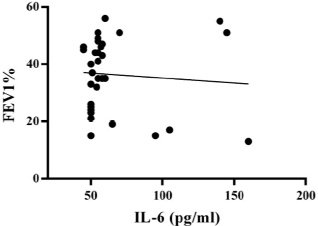
Correlation between IL-6 (pg/ml) in FEC1% in COPD.
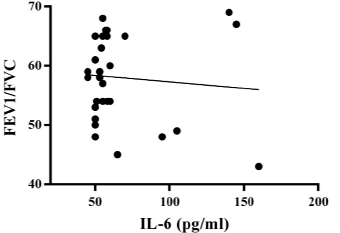
Correlation between FEV1/FVC and IL-6 (pg/ml) in COPD.
References
- Aaron, S.D., Tan, W.C., Bourbeau, J., Sin, D.D., Loves, R.H. and MacNeil, J., 2017. Diagnostic instability and reversals of chronic obstructive pulmonary disease diagnosis in individuals with mild to moderate airflow obstruction. Am. J. Respir. Crit. Care Med., 196: 306-314. https://doi.org/10.1164/rccm.201612-2531OC[CrossRef]
- Albert, P., Agusti, A., Edwards, L., Tal-Singer, R., Yates, J. and Bakke, P., 2012. Bronchodilator responsiveness as a phenotypic characteristic of established chronic obstructive pulmonary disease. Thorax, 67: 701-708. https://doi.org/10.1136/thoraxjnl-2011-201458[CrossRef]
- Ardestani, M.E. and Zaerin, O., 2015. Role of serum interleukin 6, albumin and C-reactive protein in COPD patients. Tanaffos, 14: 134.
- Barczyk, A., Pierzchała, W., Kon, O.M., Cosio, B., Adcock, I.M. and Barnes, P.J., 2006. Cytokine production by bronchoalveolar lavage T lymphocytes in chronic obstructive pulmonary disease. J. Allergy clin. Immunol., 117: 1484-1492. https://doi.org/10.1016/j.jaci.2006.02.013[CrossRef]
- Barnes, P.J., Shapiro, S. and Pauwels, R., 2003. Chronic obstructive pulmonary disease: Molecular and cellular mechanisms. Eur. Respir. J., 22: 672-688. https://doi.org/10.1183/09031936.03.00040703[CrossRef]
- Buist, A.S., McBurnie, M. A., Vollmer, W.M., Gillespie, S., Burney, P. and Mannino, D.M., 2007. International variation in the prevalence of COPD (the BOLD Study): a population-based prevalence study. The Lancet, 370: 741-750. https://doi.org/10.1016/S0140-6736(07)61377-4[CrossRef]
- Celli, B.R., MacNee, W., Agusti, A., Anzueto, A., Berg, B. and Buist, A.S., 2004. Standards for the diagnosis and treatment of patients with COPD: a summary of the ATS/ERS position paper. Eur. Respir. J., 23: 932-946. https://doi.org/10.1183/09031936.04.00014304[CrossRef]
- Elbehairy, A.F., Ciavaglia, C.E., Webb, K.A., Guenette, J.A., Jensen, D. and Mourad, S.M., 2015. Pulmonary gas exchange abnormalities in mild chronic obstructive pulmonary disease. Implications for dyspnea and exercise intolerance. Am. J. Respir. Crit. Care Med., 191: 1384-1394. https://doi.org/10.1164/rccm.201501-0157OC[CrossRef]
- El-Shimy, W.S., El-Dib, A.S., Nagy, H.M. and Sabry, W., 2014. A study of IL-6, IL-8, and TNF-α as inflammatory markers in COPD patients. Egypt. J. Bronchol., 8: 91. https://doi.org/10.4103/1687-8426.145698[CrossRef]
- GOLD report. Global Initiative for Chronic Obstructive Lung Disease. 2018. Global strategy for the diagnosis, management and prevention of chronic obstructive pulmonary disease report. https://goldcopd.org/wp-content/uploads/2017/11/GOLD-2018-v6.0-FINAL-revised-20-Nov_WMS.pdf
- Hogg, J.C., Chu, F., Utokaparch, S., Woods, R., Elliott, W.M. and Buzatu, L., 2004. The nature of small-airway obstruction in chronic obstructive pulmonary disease. N. Engl. J. Med., 350: 2645-2653. https://doi.org/10.1056/NEJMoa032158[CrossRef]
- Hollander, C., Sitkauskiene, B., Sakalauskas, R., Westin, U. and Janciauskiene, S.M., 2007. Serum and bronchial lavage fluid concentrations of IL-8, SLPI, sCD14 and sICAM-1 in patients with COPD and asthma. Respir. Med., 101: 1947-1953. https://doi.org/10.1016/j.rmed.2007.04.010[CrossRef]
- Huang, A.X., Lu L.W., Liu W.J. and Huang, M., 2016. Plasma inflammatory cytokine IL-4, IL-8, IL-10, and TNF-α levels correlate with pulmonary function in patients with asthma-chronic obstructive pulmonary disease (COPD) overlap syndrome. Med. Sci. Monit., 22: 2800. https://doi.org/10.12659/MSM.896458[CrossRef]
- Jonsdottir, I., Schjerling, P., Ostrowski, K., Asp, S., Richter, E. and Pedersen, B., 2000. Muscle contractions induce interleukin-6 mRNA production in rat skeletal muscles. J. Physiol. (Lond.)., 528: 157-163. https://doi.org/10.1111/j.1469-7793.2000.00157.x[CrossRef]
- Lozano, R., Naghavi, M., Foreman, K., Lim, S., Shibuya, K. and Aboyans, V., 2012. Global and regional mortality from 235 causes of death for 20 age groups in 1990 and 2010: A systematic analysis for the Global Burden of Disease Study 2010. The Lancet, 380: 2095-2128.
- Masubuchi, T., Koyama, S., Sato, E., Takamizawa, A., Kubo, K. and Sekiguchi, M., 1998. Smoke extract stimulates lung epithelial cells to release neutrophil and monocyte chemotactic activity. Am. J. Pathol., 153: 1903-1912. https://doi.org/10.1016/S0002-9440(10)65704-5[CrossRef]
- Miller, M., Hankinson, J., Brusasco, V., Burgos, F., Casaburi, R. and Coates, A., 2005. Standardisation of spirometry. Eur. Respir. J., 26: 319-338.
- Morello Gearhart, A., Cavallazzi, R., Peyrani, P., Wiemken, T.L., Furmanek, S.P. and Reyes-Vega, A., 2017. Lung cytokines and systemic inflammation in patients with COPD. Univ. Louisville. J. Respir. Infect., 1: 4. https://doi.org/10.18297/jri/vol1/iss4/4[CrossRef]
- Nybo, L., Secher, N.H. and Nielsen, B., 2002. Inadequate heat release from the human brain during prolonged exercise with hyperthermia. J. Physiol. (Lond.), 545: 697-704. https://doi.org/10.1113/jphysiol.2002.030023[CrossRef]
- Oppenheim, J.J., Zachariae, C.O., Mukaida, N. and Matsushima, K., 1991. Properties of the novel proinflammatory supergene intercrine cytokine family. Annu. Rev. Immunol., 9: 617-648. https://doi.org/10.1146/annurev.iy.09.040191.003153[CrossRef]
- Pauwels, R., Buist, A., Calverley, P., Jenkins, C. and Hurd, S., 2001. Committee GS (2001) global strategy for the diagnosis, management, and prevention of chronic obstructive pulmonary disease. NHLBI/WHO Global Initiative for Chronic Obstructive Lung Disease (GOLD) Workshop summary. Am. J. Respir. Crit. Care Med., 163: 1256-1276. https://doi.org/10.1164/ajrccm.163.5.2101039[CrossRef]
- Pourfarzam, S., Ghazanfari, T., Yaraee, R., Ghasemi, H., Hassan, Z.M. and Faghihzadeh, S., 2009. Serum levels of IL-8 and IL-6 in the long term pulmonary complications induced by sulfur mustard: Sardasht-Iran Cohort Study. Int. Immunopharmacol., 9: 1482-1488. https://doi.org/10.1016/j.intimp.2009.09.002[CrossRef]
- Qin, S., Larosa, G., Campbell, J.J., Smith, H., Kassam, N. and Shi, X., 1996. Expression of monocyte chemoattractant protein-1 and interleukin-8 receptors on subsets of T cells: Correlation with transendothelial chemotactic potential. Eur. J. Immunol., 26: 640-647. https://doi.org/10.1002/eji.1830260320[CrossRef]
- Robson-Ansley, P.J., Milander, L.d., Collins, M. and Noakes, T.D., 2004. Acute interleukin-6 administration impairs athletic performance in healthy and trained male runners. Can. J. appl. Physiol., 29: 411-418. https://doi.org/10.1139/h04-026[CrossRef]
- Schermer, T.R., Robberts, B., Crockett, A.J., Thoonen, B.P., Lucas, A. and Grootens, J., 2016. Should the diagnosis of COPD be based on a single spirometry test? NPJ Prim. Care. Respir. Med., 26: 16059. https://doi.org/10.1038/npjpcrm.2016.59[CrossRef]
- Stern, D.A., Morgan, W.J., Wright, A.L., Guerra, S. and Martinez, F.D., 2007. Poor airway function in early infancy and lung function by age 22 years: A non-selective longitudinal cohort study. The Lancet, 370: 758-764. https://doi.org/10.1016/S0140-6736(07)61379-8[CrossRef]
- Tashkin, D.P., Altose, M.D., Bleecker, E.R., Connett, J.E., Kanner, R.E. and Lee, W.W., 1992. The Lung Health Study: airway responsiveness to inhaled methacholine in smokers with mild to moderate airflow limitation. Am. J. Respir. Crit. Care Med., 145: 301-310. https://doi.org/10.1164/ajrccm/145.2_Pt_1.301[CrossRef]
- Wang, W., Ma, D., Li, T., Ying, Y. and Xiao, W., 2014.People with older age and lower FEV1% pred tend to have a smaller FVC than VC in pre-bronchodilator spirometry. Respir. Physiol. Neurobiol., 194: 1-5. https://doi.org/10.1016/j.resp.2014.01.003[CrossRef]
- Wedzicha, J.A. and Donaldson, G.C., 2014. Rapid FEV1 decline, early COPD, and angiotensin-converting enzymes? Chest, 145: 671-672. https://doi.org/10.1378/chest.13-2696[CrossRef]
- Zhang, J., Wu, L. and Qu, J.M., 2011. Inhibited proliferation of human lung fibroblasts by LPS is through IL-6 and IL-8 release. Cytokine, 54: 289-295. https://doi.org/10.1016/j.cyto.2011.02.018[CrossRef]
Services
Article usage statistics
Loading…