
The main objective of the present study was to evaluate the efficacy of an outdoor rehabilitation program performed in a garden setting for elderly patients affected with chronic obstructive pulmonary disease (COPD). The elderly patients suffering from COPD were randomly divided into an observation group (n=30) and a treatment group (n=30). Accordingly, the patients in the observation group were given a medication-assisted treatment plan for stable COPD based on established guidelines and indoor rehabilitation training for pulmonary function. Outdoor-based rehabilitation therapy was also delivered to the patients in the treatment group in a specially designed garden setting under the guidance of therapists. The training included outdoor-assisted walking training, unassisted walking training, outdoor ladder training, and horizontal bar training. Ultimately, exercise capacity, lung function, symptoms, psychological state, and the Body-Mass Index, Airflow Obstruction, Dyspnea, and Exercise (BODE) comprehensive index of the patients before and after the treatment were assessed. After treatment, the intra-group 6-minute walk test (6MWT), forced expiratory volume in 1 second (FEV1), FEV1/forced vital capacity (FVC), the Medical Research Council (MRC) Dyspnea Scale, the Hamilton Depression Rating Scale (HAM-D), the Hamilton Anxiety Rating Scale (HAM-A), and the Body-Mass Index, Airflow Obstruction, Dyspnea, and Exercise (BODE) index were found significantly different in each group (P<0.05). Moreover, the results of the 6MWT, the FEV1/FVC, the HAM-D, the HAM-A, and the BODE comprehensive index between the two groups were different in a significant manner (P<0.05). Functional training based on rehabilitation performed in a garden setting for elderly patients with stable COPD alleviated patients’ symptoms, increased exercise capacity, improved respiratory muscle function, reduced symptoms of depression and anxiety, enhanced rehabilitation outcomes, and promoted quality of life. Thus, it was suggested as an effective auxiliary exercise rehabilitation method.
Short Communication · Volume 52, Issue 6, 20 September 2020 · Open Access
Effect of a Rehabilitation Garden on Rehabilitation Efficacy in Elderly Patients with Chronic Obstructive Pulmonary Disease
· · · · · · · · ·
Affiliations & Notes ⌄
- 1The Fifth People’s Hospital of Foshan, Foshan, China 2Foshan University, Foshan, China 3The First Affiliated Hospital of Guangzhou University of Chinese Medicine, Guangzhou, China 4Guangzhou Polytechnic College of Sports, Guangzhou, China 5Foshan Association of Rehabilitation Medicine, Foshan, China Yan Wen and Liu Lian have contributed equally to this article and are first authors. , * Corresponding authors: vikingsaga@163.com
- 2453298958 @qq.com
Article Info ⌄
- Journal:
- Pakistan Journal of Zoology
- Published:
- 20 September 2020

From the article
- The inter-group comparison showed no significant differences in the 6MWT, the FVC, the FEV1, the FEV1/FVC, the MRC Dyspnea Scale, the HAM-D, the HAM-A, and the BODE comprehensive index before treatment (P>0.05).
- The results of this study indicated that both groups of elderly patients with COPD had experienced some degrees of improvement in exercise capacity, lung function, dyspnea, depression and anxiety, and the BODE comprehensive index after treatment.
Selected from the article's own text.
Abstract
Subjects and methods
A total number of 70 patients with COPD admitted to the Fifth People’s Hospital of Foshan, Foshan, China, from July 2018 to March 2019, were randomly divided into an observation group (n=30) and a treatment group (n=30) using the PEMS3.1 software with reference to clinical trial protocols. As well, there were no significant differences in terms of gender, age, height, weight, and duration of disease between the two groups (P>0.05) (Table I).
Table I.- Patient general information in both groups.
| Groups | Treatment (n=30) | Observation (n=30) |
| Age (y) | 63.74±3.24 | 64.10±3.56 |
| Gender (M/F) | 14/16 | 15/15 |
| Height (cm) | 165.27±5.12 | 164.98±5.47 |
| Weight (kg) | 57.98±7.65 | 58.11±6.97 |
| Duration of disease (y) | 2.14±0.21 | 1.99±0.19 |
There was no significant difference in terms of age, gender, height, weight, and duration of disease between the two study groups (P>0.05).
The inclusion criteria (Jeckins et al., 2018) were patients: (i) in the stage II of stable COPD (i.e. moderate) as defined in the Guidelines for the Diagnosis and Treatment of COPD (2011 edition) issued by the Ministry of Health with forced expiratory volume in 1 second (FEV1)/forced vital capacity (FVC)<70%, 50%≤FEV1<80% of the predicted value; (ii) who agreed to participate in the study and complete the trial; (iii) aged between 60 and 70 years; and (iv) with stable COPD for more than four weeks and no history of smoking, and hospitalized for the first time. This study was approved by the ethics committee of the cited hospital and all the subjects also signed an informed consent.
The exclusion criteria were patients: (i) with respiratory diseases other than COPD, (ii) with other cardiopulmonary diseases, (iii) with severe organ dysfunction or malignant tumors, (iv) with other disorders causing walking difficulty, and (v) with no ability to perform the study-related tests for any reasons.
A stable COPD medication-assisted treatment plan was designed based on the established guidelines for the observation group. The patients were thus asked to perform indoor function training for pulmonary rehabilitation including: (i) aerobic exercise i.e. indoor cycling ergometry (medium speed, rest for 1 min after every 4 min of exercise, 15 min/day); (ii) breathing exercises, namely, abdominal breathing exercise, pursed lip breathing, chest breathing exercise, and relaxation shoulder strap exercise repeated 10 times with each exercise; and (iii) cough training and resistance breath training for 15 min/day.
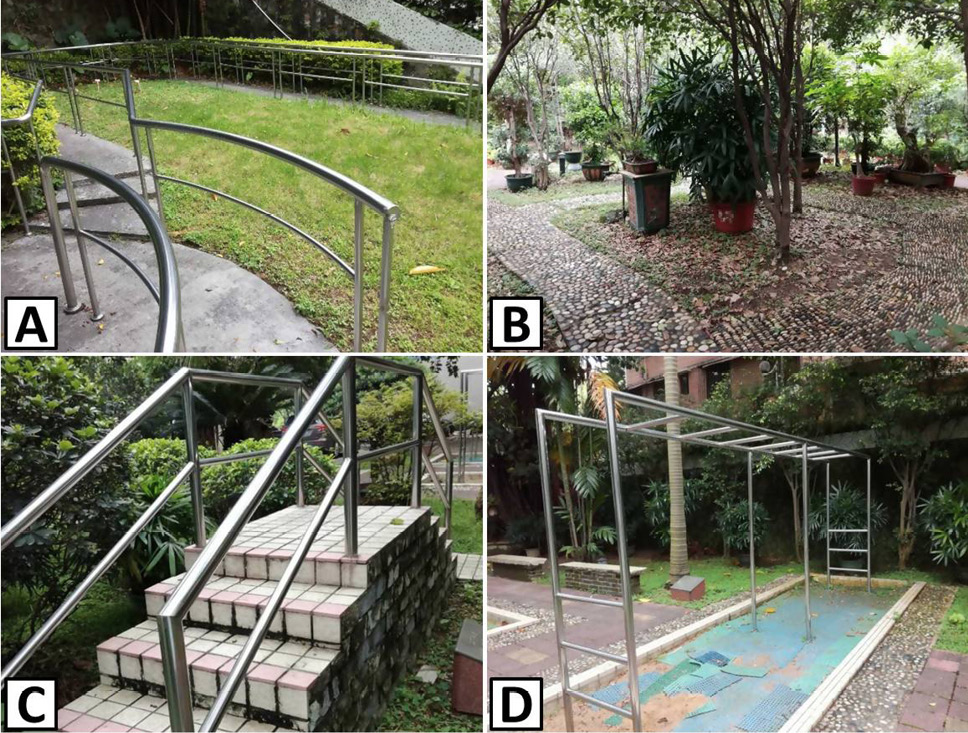
The patients in the treatment group also carried out the following outdoor rehabilitation training in the rehabilitation garden under the guidance of therapists: (i) outdoor-assisted walking training, namely, the patients performed walking training along a circular path with stainless steel handrails and plants on both sides (Fig. 1A). The training distance was 500 m per training and was done twice daily; (ii) unassisted walking training i.e. the patients performed walking training barefooted on a cobblestone path with an uneven surface (Fig. 1B). The training distance was 250 m per training and the exercise was performed twice daily; (iii) outdoor stair training, that is, the patients went up and down stairs on a 5-step stair with handrails on both sides (Fig. 1C). The training time was 10 min and the exercise was performed twice daily; and (iv) horizontal bar training, namely, the patients performed horizontal bar training in the rehabilitation garden with the help of therapists (Fig. 1D) including horizontal ladder movements, pull-ups, overhanging chest-expanding, and left-lifting (according to their abilities). The training time was 15 min, and the exercise was performed twice daily. The therapeutic effects were consequently observed after four weeks.
The exercise capacity was assessed using the 6-minute walk test (6MWT) and the pulmonary function test (PFT) was conducted via a spirometer which included measurements of the forced vital capacity (FVC) as well as the forced expiratory volume in 1 second (FEV1) and one second rate (FEV1/FVC). Symptom assessment was also performed through the Medical Research Council (MRC) Dyspnea Scale . Moreover, psychological state was assessed using the Hamilton Depression Rating Scale (HAM-D) and the Hamilton Anxiety Rating Scale (HAM-A) . A comprehensive assessment was further made through BODE index, comprised of body mass index (B), airflow obstruction (O), dyspnea (D), and exercise (E) variables .
All the data were processed using the IBM SPSS Statistic software (version 21.0). The measurement data were also expressed as mean±standard deviation (SD). Comparison between normally distributed groups was correspondingly carried out by independent sample t-test and within-group comparisons were performed through paired t-test. The Wilcoxon rank-sum test was additionally utilized whenever normal distribution was not satisfied or equal variance was not assumed. Consequently, the Chi-square test was employed for the count data and the significance level was set by 0.05.
Results
The inter-group comparison showed no significant differences in the 6MWT, the FVC, the FEV1, the FEV1/FVC, the MRC Dyspnea Scale, the HAM-D, the HAM-A, and the BODE comprehensive index before treatment (P>0.05). However, the intra-group comparison demonstrated significant differences in the 6MWT, the FEV1, the FEV1/FVC, the MRC Dyspnea Scale, the HAM-D, the HAM-A, and the BODE comprehensive index after treatment (P<0.05) although no significant difference was observed in the FVC (P>0.05). The inter-group comparison similarly revealed a statistical significance in the 6MWT, the FEV1/FVC, the HAM-D, the HAM-A, and the BODE comprehensive index after treatment (P<0.05), with no significant differences in the FVC, the FEV1, and the MRC Dyspnea Scale (P>0.05) (Table II).
Discussion
The results of this study indicated that both groups of elderly patients with COPD had experienced some degrees of improvement in exercise capacity, lung function, dyspnea, depression and anxiety, and the BODE comprehensive index after treatment. The functional improvement of the patients in the treatment group with additional rehabilitation training in a garden setting was also more significant compared with that in the observation group, with statistical differences in the 6MWT, the FEV1/FVC, the HAM-D, the HAM-A, and the BODE index between the groups (P<0.05). It has been argued that, psychological states such as anxiety, depression, and lack of self-confidence may amplify patients’ feelings of painful dyspnea, raise their awareness of the problem, and prevent them from excessive activities during the process of clinical rehabilitation training. Studies had also reported that as the levels of anxiety had increased, patients had become more sensitive to discomfort. Moreover, as some patients with COPD had experienced pain and dyspnea, anxiety and panic developed because of that had led to more anxiety, limiting their physical activity even further ; .
A rehabilitation garden has a good plant landscape and a humanized rehabilitation environment. The research team thus designed the rehabilitation facilities and constructed the landscape nodes, types of spaces, and the composition of the landscape elements of the outdoor gardens in this rehabilitation garden. The rehabilitation garden was accordingly designed to meet the needs of rehabilitation training, while accommodating the physiological and psychological needs of elderly patients with COPD. The circular path, cobblestone path, five-step stair, rehabilitation horizontal bar, and other facilities were additionally designed and applied specifically to the rehabilitation of the patients suffering from COPD ; .
Table II.- Changes in each index before and after treatment in both study groups.
| Groups | Treatment (n=30) | Observation (n=30) | ||
| Before treatment | After treatment | Before treatment | After treatment | |
| 6MWT (m) | 445.54±21.32 | 532.95±28.32*∆ | 452.71±19.79 | 496.24±32.01* |
| FVC (L) | 2.64±0.75 | 2.81±0.63#▲ | 2.57±0.98 | 2.78±0.52# |
| FEV1 (L) | 1.62±0.37 | 1.90±0.71*▲ | 1.59±0.56 | 1.89±0.49* |
| FEV1/FVC (%) | 58.52±7.65 | 65.84±7.85*∆ | 59.03±6.99 | 62.27±9.14* |
| MRC Dyspnea Scale (point) | 1.27±0.22 | 1.01±0.45*▲ | 1.31±0.19 | 1.12±0.27* |
| HAM-D (point) | 10.84±1.87 | 6.87±1.64*∆ | 11.52±2.04 | 7.63±2.01* |
| HAM-A (point) | 11.01±1.98 | 7.24±1.87*∆ | 10.85±2.14 | 6.99±1.54* |
| BODE comprehensive index (point) | 4.75±1.37 | 2.83±1.05*∆ | 4.59±1.28 | 3.17±1.62* |
Comparison of each index between two study groups before treatment, P>0.05; intra-group comparisons in each index after treatment, *P<0.05, #P>0.05; and inter-group comparisons in each index after treatment, ∆P<0.05, ▲P>0.05.
FVC, forced vital capacity; FEV, forced expiratory volume; 6MWT, 6-minute walk test; HAM-D, Hamilton Depression Rating Scale; HAM-A, Hamilton Anxiety Rating Scale; BODE, Body-Mass Index, Airflow Obstruction-Dyspnea-and Exercise
The exercise capacity of knee joints, lung function, dyspnea, depression and anxiety, and the BODE comprehensive index also showed good levels of improvement after targeted outdoor rehabilitation training in the rehabilitation garden. One possible reason for the results is that rehabilitation training performed in the comfortable natural environment of the rehabilitation garden could reduce patients’ fears and anxiety regarding their disease, thus stimulating their interest in rehabilitation training, increasing patience, compliance, and initiative, and building optimism for disease recovery. Active participation in garden training activities had been similarly reported to augment rehabilitation amount and time, and subsequently raise generalized comprehensive exercise variables and strengthen respiratory function ; .
In summary, the functional training conducted outdoors in the rehabilitation garden designed for elderly patients with stable COPD alleviated the symptoms of COPD in the patients in the stable stage, increased exercise capacity, improved respiratory muscle function, reduced symptoms of depression and anxiety, enhanced rehabilitation, and augmented quality of life. Therefore, it is an effective method assisting sports rehabilitation and is worthy of clinical applications. The small sample size was, however, one limitation of this study. Comparison with other sports rehabilitation methods, use of indices associated with acute exacerbation, number of hospital admissions, and hospitalization days should be also included in future studies to track the long-term rehabilitation effects of outdoor rehabilitation for patients suffering from stable COPD.
Acknowledgements
The study was funded by the National Key R&D Program of China (2018YFC2002300) and the 13th Five-Year Key Specialty Construction Project of Foshan (No. FSZDZK135033).
Statement of conflict of interest
The authors declare no conflict of interest.
Figures
Lung function rehabilitation set in the rehabilitation garden.
References
- Borge, C.R., Mengshoel, A.M., Moum, T. and Wahl, A.K., 2016. Qual. Life Res., 25: 2041-2051. https://doi.org/10.1007/s11136-016-1227-4[CrossRef]
- Carbone, S., Postacchini, R. and Gumina, S., 2015. Knee Surg. Sports Traumatol. Arthrosci., 23: 1473-1480. https://doi.org/10.1007/s00167-014-2844-5[CrossRef]
- Casillas, J.M., Joussain, C., Gremeaux, V., Hannequin, A., Rapin, A., Laurent, Y. and Benaïm, C., 2015. Clin. Rehabil., 29: 175-183. https://doi.org/10.1177/0269215514540922[CrossRef]
- Choi, J.Y., Rha, D.W. and Park, E.S., 2016. Yonsei med. J., 57: 769-775. https://doi.org/10.3349/ymj.2016.57.3.769[CrossRef]
- Gibellino, F., Mammana, L. and Rodo, A., 2016. Chest, 149: A491. https://doi.org/10.1016/j.chest.2016.02.512[CrossRef]
- Huang, W., Liu, L., Murong, J., Wang, Z., Cui, S. and Yan, W., 2019. Ekoloji, 28: 4413-4417.
- Im, E.A., Park, S.A. and Son, K.C., 2018. Compl. Therap. Med., 37: 29. https://doi.org/10.1016/j.ctim.2018.01.008[CrossRef]
- Jenkins, A.R., Holden, N.S. and Jones, A.W., 2018. Chest, 153: 1281-1282. https://doi.org/10.1016/j.chest.2018.01.054[CrossRef]
- Kadiri, S., Robertson, A., Kerr, A. and Bishay E.S., 2017. Lung Cancer, 103: S48. https://doi.org/10.1016/S0169-5002(17)30156-3[CrossRef]
- Kawagoshi, A., Kiyokawa, N., Sugawara, K., Takahashi, H., Sakata, S., Satake, M. and Shioya, T., 2015. Respir. Med., 109: 364-371. https://doi.org/10.1016/j.rmed.2015.01.008[CrossRef]
- Kotrach, H., Dajczman, E., Tremblay, G., Baltzan, M., Wardini, R., Levitz, S., Rotaple, M., Abcarius, F., Stathatos, M., Zeng, C., Trottier, S., Lynch, D., Langlois, S., Wolkove, N. and Sounan C., 2015. Chest, 148: 709A-709B. https://doi.org/10.1378/chest.2257078[CrossRef]
- Lai, Y., Huang, J., Yang, M., Su, J., Liu, J. and Che, G., 2017. J. Surg. Res., 209: 30-36. https://doi.org/10.1016/j.jss.2016.09.033[CrossRef]
- Moore, E., Palmer, T., Newson, R., Majeed, A., Quint, J.K. and Soljak, M.A., 2016. Chest, 150: 837-859. https://doi.org/10.1016/j.chest.2016.05.038[CrossRef]
- Oh, Y.A., Park, S.A., Ahn, B.E., 2018. Compl. Therap. Med., 36: 54-58. https://doi.org/10.1016/j.ctim.2017.11.019[CrossRef]
- Schultz, K., Jelusic, D., Wittmann, M., Krämer, B., Huber, V., Fuchs, S., Lehbert, N., Wingart, S., Stojanovic, D., Göhl, O., Alma, H.J., de Jong, C., van der Molen, T., Faller, H. and Schuler, M., 2018. Eur. Respirat. J., 51: 1702000. https://doi.org/10.1183/13993003.02000-2017[CrossRef]
- Theodorakopoulou, E.P., Gennimata, S.A., Harikiopoulou, M., Kaltsakas, G., Palamidas, A., Koutsoukou, A., Roussos, C., Kosmas, E.N., Bakakos, P. and Koulouris, N.G., 2017. Respir. Physiol. Neurobiol., 238: 47-54. https://doi.org/10.1016/j.resp.2017.01.008[CrossRef]
- Wen, Y., Lian, L., Jiayin, M., Zhijun, W., Shuyi, C. and Wenzhu, H., 2019. Acta Med. Mediter., 35: 29-32.
- Yan, W., Liu, L., Murong, J., Wang, Z., Cui, S. and Huang, W., 2019. Ekoloji, 28: 4289-4293.
Services
Article usage statistics
Loading…