
Abstract | The present study describes the prevalence of peste des petits ruminants (PPR) virus antibodies in sheep, goats and camels at Hail, Bagaa, Shenan and Ghazalah, Saudi Arabia. Serum samples (n=400), collected during 2012–2013 from sick and clinically healthy herds, were subjected to antibodies detection using c-ELISA. Out of examined animals, 83 (62.9%) goats and 70 (33.2%) sheep were detected positive against PPRV antibodies, whereas camels appeared to be seronegative. Based upon the seasonal variations in the antibodies detection, environment appeared to be a significant factor on the level of antibodies in the tested small ruminants population. Taken together, results indicate the seropositivity of PPRV in the region and warrant future large-scale surveillance studies to better assess the situation of the disease in the region.
Short Communication · Volume 3, Issue 3, 3 July 2016 · Open Access
Prevalence of PPR-virus Antibodies in Sheep, Goats and Camels in Hail, Saudi Arabia
· ·
Affiliations & Notes ⌄
- 1Veterinary Laboratories, Ministry of Agriculture. Saudi Arabia
- 2Department of Biology (Microbiology), Faculty of Arts & Science, Northern Borders University, Saudi Arabia
- 3Home address: University of Nyala, Faculty of Veterinary Science, Department of Microbiology, Sudan. Email: muazm20@gmail.com
Article Info ⌄
- Journal:
- Hosts and Viruses
- Published:
- 3 July 2016

From the article
- Abstract | The present study describes the prevalence of peste des petits ruminants (PPR) virus antibodies in sheep, goats and camels at Hail, Bagaa, Shenan and Ghazalah, Saudi Arabia.
- Peste des petits ruminant (PPR) is Office International des Epizooties (OIE) notifiable and economically important transboundary viral disease of sheep and goats.
- The research estimated the sero-prevalence in sick and clinically healthy sheep, goats and camels at Hail district, Saudi Arabia during 2012–2013.
- Global distribution of peste des petits ruminants virus and prospects for improved diagnosis and control.
Selected from the article's own text.
Abstract
**Correlation is significant at the level 0.01 (2-tailed)
PPR is an emerging and geographically spreading disease of small ruminants and camel particularly in Africa and Asia. Although the disease is thought to have been reported in Saudi Arabia in the 1990 (Abu-Elzein et al., 1990), epidemiological information about the spread of PPR in the county is generally scarce. In this study, prevalence of the disease in the Northern regions of the country was estimated. The research estimated the sero-prevalence in sick and clinically healthy sheep, goats and camels at Hail district, Saudi Arabia during 2012–2013. The prevalence reported in this study was lower (38.2%) than reported previously in the country at Al-Hasa in 1988 and 2007 ; ; and higher than that reported in the Al-Qassim region in 2005 . Variations may be due to seasonal effects, host population density, disease control programs and the social environment that can influence the contact rates ; ; . The high percentage of positivity was found in goats (62.9%) and Hail locality (45.7%) in the wet cold season. This rate of variation among species may be related to the fact that sheep succumb easily to drought and other environmental stresses. Spatial heterogeneity in PPR sero-prevalence has been reported in many areas where PPR is endemic ; , and factors such as differences in sample size, age, prevailing management practices, humidity or season influence the occurrence of the disease .
Our findings provide evidences of widespread of PPR in Hail district, Saudi Arabia likely due to continued transmission within local sheep and goat flocks accompanied with low incidence of mortality related to a particular strains, transmission of PPRV from camels and gazelles to goats may be possible ; and/or continuous introduction of virus strains from imported animals from Africa. Further large-scale studies are needed to better identify the situation of the disease, risk factors and the genetic nature of the PPRV, which can help in the implementation of disease control strategies.
Figures
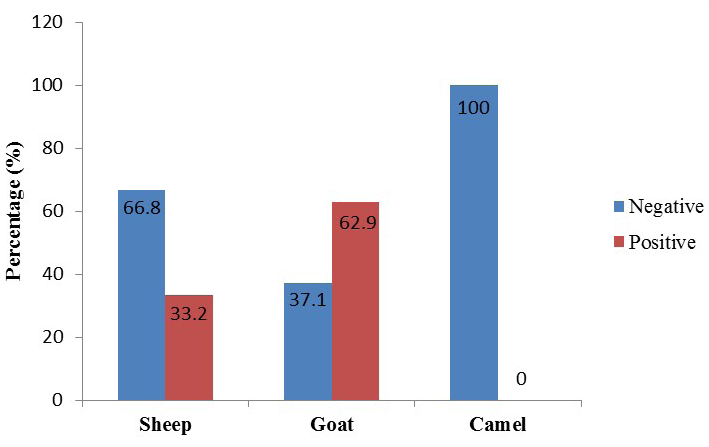
Seroprevalence of PPR antibodies in sheep, goats and camels as detected by c-ELISA
References
- • Abraham, G., Sintayehu, A., Libeau, G., Albina, E., Roger, F., Laekemariam Y. 2005. Antibody seroprevalences against peste des petits ruminants (PPR) virus in camels, cattle, goats and sheep in Ethiopia. Prev Vet Med. 70: 51–57. http://dx.doi.org/10.1016/j.prevetmed.2005.02.011[CrossRef]
- • Abu Elzein, E.M.E., Hassanien, M.M., Alafaleq, A.I., Abdelhadi, M.A., Housawi F.M.T. 1990. Isolation of PPR virus from goats in Saudi Arabia. Vet. Rec. 127: 309-310.
- • AL-Afaleq, A., Abu-Elzein, E., Al-Naeem, A and Mahmoud, A. 2004. Serosurveillance for peste des petits ruminants (PPR) and rinderpest antibodies in naturally exposed Saudi sheep and goats. Veterinarski Arh. 74 (6): 459-465.
- • Albina, E., Kwiatek, O., Minet, C., Lancelot, R., Servan, R., Libeau, G. 2013. Peste des Petits ruminants, the next eradicated animal disease. Vet Microbiol. 165(1–2): 38–44. http://dx.doi.org/10.1016/j.vetmic.2012.12.013[CrossRef]
- • Al-Dubaib, M. A. 2009. Peste des petitis ruminants morbillivirus infection in lambs and young goats at Qassim region, Saudi Arabia. Trop Anim Health Prod. 41(2): 217-20. http://dx.doi.org/10.1007/s11250-008-9178-6[CrossRef]
- • Balamurugan, P., Arnab, S., Kaushal,K.R., Gnanavel, V., Paramanandham, K., Veerakyathappa, B., Raj, K. S. 2012. Prevalence of peste des petits ruminants among sheep and goats in India Vinayagamurthy J. Vet. Sci. 13(3): 279-285. http://dx.doi.org/10.4142/jvs.2012.13.3.279[CrossRef]
- • Banyard, A.C., Parida, S., Batten, C., Oura, C., Kwiatek, O., Libeau, G. 2010. Global distribution of peste des petits ruminants virus and prospects for improved diagnosis and control. J Gen Virol. 91: 2885–2897. http://dx.doi.org/10.1099/vir.0.025841-0[CrossRef]
- • Balamurugan, V., Sutopa D. S., Raju, I., Nagalingam, M., Hemadri, D., Govindaraj,G., Singh, N., Keduzol, L., Maitryee, D., Sharma, K., Gajendragad, H. 2014. Prevalence of peste des petits ruminants in goats in North-East India. Virus Dis. 25(4): 488–492. http://dx.doi.org/10.1007/s13337-014-0237-5[CrossRef]
- • Bhanuprakash, V., Indrani, B. K., Hosamani, M., Singh, R. K. 2006. The current status of sheep pox disease. Comp Immunol Microbiol. Infect Dis. 29: 27–60. http://dx.doi.org/10.1016/j.cimid.2005.12.001[CrossRef]
- • Bird, B. H., Ksiazek, T. G, Nichol, S. T., Maclachlan, N. J. Rift Valley fever virus. 2009; 234: 883–93.
- • Bowden, T. R., Babiuk, S. L., Parkyn, G. R., Copps, J. S., Boyle, D. B. 2008. Capripoxvirus tissue tropism and shedding: A quantitative study in experimentally infected sheep and goats. Virology. 371: 380–393. http://dx.doi.org/10.1016/j.virol.2007.10.002[CrossRef]
- • Housawi, F., Abu Elzein,E., Mohamed,G., Gameel,A., Al-Afaleq,A., Hegazi,A., Al-Bishr, B. 2004. Emergence of Peste des Petits Ruminants in Sheep and Goats in Eastern Saudi Arabia Revue Élev. Méd. vét. Pays trop. 57 (1-2) : 31-34.
- • Boshra, H., Truong, T., Babiuk, S., Hemida, M. G. 2015. Seroprevalence of Sheep and Goat Pox, Peste Des Petits Ruminants and Rift Valley Fever in Saudi Arabia. PLOS ONE. 13: 1-12. http://dx.doi.org/10.1371/journal.pone.0140328[CrossRef]
- • Gibbs, P.J.E., Taylor, W.P., Lawman, M.P., Bryant, J. 1979. Classification of the peste des petits ruminants virus as the fourth member of the genus Morbillivirus. Intervirology. 11:268–74. http://dx.doi.org/10.1159/000149044[CrossRef]
- • Gur, S., Albayrak, H. 2010. Seroprevalance of peste des petits ruminants (PPR) in goitered gazelle (Gazella subgutturosa subgutturosa) in Turkey. J Wild Dis: 46: 673–677. http://dx.doi.org/10.7589/0090-3558-46.2.673[CrossRef]
- • Libeau, G., Préhaud, C., Lancelot, R., Colas, F., Guerre, L., Bishop, D.H., Diallo, A. 1995. Development of a competitive ELISA for detecting antibodies to the Peste des Petits Ruminants virus using a recombinant nucleoprotein. Res Vet Sci. 58(1): 50-5. http://dx.doi.org/10.1016/0034-5288(95)90088-8[CrossRef]
- • Losos, G.J. 1989. Infectious tropical diseases of domestic animals. Longman Sci. Techn. Can.12: 549–56.
- • OIE: Office de internationale Epidemiologie. 2002. Peste des petits ruminants-Saudi Arabia: OIE (Archive no. 20020408.3902). (International Society for Infectious Diseases).
- • Saeed, I.K., Yahia, A.H., Magdi, A.B., Zakia, A.M., Halima, M.O., Khalid, M.T. 2015. Mixed infection of peste des petits ruminants virus (PPRV) and other respiratory viruses in dromedary camels in Sudan, an abattoir study .Trop Anim Health Prod. 47: 995-998. http://dx.doi.org/10.1007/s11250-015-0798-3[CrossRef]
- • Simon, M., John, M. G., Eunice, K.N., George, C., Gitao, L., Njenga, M., Gidraph, G., Wairire, N.M, Raphael, G., and Ricky, I. 2015. Sero-epidemiology of Peste des petits ruminants virus infection in Turkana County, Kenya. Veterinary Research. 11: 87.
- • Singh, R.P, Saravanan, P., Sreenivasa, B.P, Singh, R.K., Bandyopadhyay, S.K. 2004. Prevalence and distribution of peste des petits ruminants virus infection in small ruminants in India. Rev sci tech Off Int Epiz.23: 807–19. http://dx.doi.org/10.20506/rst.23.3.1522[CrossRef]
- • Taylor, W.P., Barrett, T. 2007. Diseases of Sheep. 4th ed. Oxford, UK: Blackwell publishing. Chapter 61: 460–9. http://dx.doi.org/10.1002/9780470753316.ch61[CrossRef]
Services
Article usage statistics
Loading…