
Peste des petits ruminant’s virus (PPRV) causes a highly contagious disease in both domestic, wild ruminants and camels. Sera from non-vaccinated sheep (n=683), goats (n=624) and camels (n=155) of all ages and sexes were collected in a cross-sectional study in Hail, Bagaa, Shenan and Ghazalah. Saudi Arabia. The seroprevalece was determined by NP-epitopes based competitive ELISA. The overall prevalence was 59.9%, goats had a significantly higher sero-prevalence of 75.3% compared to 59.4% obtained from sheep, whereas camels were seronegative. The prevalence of PPR was increasing from 27.9% in 2011 to 77.3% in 2016. Seropositivity was higher in wet seasons (60.9 to 61.4%) to 56.7% in dry hot season. Species, year and location appeared to be having significant effect (p<0.01) on the frequency of circulating antibodies in the study. The results highlight that PPR in Hail is alarming and warrants mass vaccination along with appropriate control measures.
Research Article · Volume 3, Issue 1, 21 February 2017 · Open Access
High Seroprevalence of PPRV-Antibodies among Sheep and Goats in Hail, Saudi Arabia
· ·
Affiliations & Notes ⌄
- 1Veterinary Laboratories, Ministry of Environment, Water and Agriculture, Saudi Arabia
- 22Department of Biology (Microbiology), Faculty of Arts and Science, Northern Borders University, Saudi Arabia
- 33Sudan University of Sciences and Technology, Veterinary Medicine and Surgery, Sudan. muazm20@gmail.com
Article Info ⌄
- Journal:
- Veterinary Sciences: Research and Reviews
- Published:
- 21 February 2017
From the article
- Out of tested sera eight hundred and seventy-six (59.9%) were found positive for PPRV-antibodies, 470 (75.3%) from goats, compared to 406 (59.4%) obtained from sheep.
- Species, year and location appeared to be having significant effect (p< 0.01) on the frequency of circulating antibodies in the study (Table 2).
- The study showed overall prevalence of 59.9%, high sero-prevalence rates in goats (75.3%) and sheep (59.4%), whereas camels were seronegative.
- Seropositivity was higher in wet seasons (60.9 to 61.4%) to 56.7% in dry hot season.
Selected from the article's own text.
Abstract
Introduction
Peste des petits ruminants (PPR) is a highly infectious and often fatal viral disease of sheep, goats and wild small ruminants. The disease is caused by PPR virus (PPRV), classified under genus Morbillivirus in the family Paramyxoviridae ; . Its transmitted by direct contact with infectious animals shedding the virus in both ocular-nasal discharges and in fecal matter ; . After first identification, the virus spread to sub- Saharan Africa, the Middle East, Turkey and the Indian subcontinent. During the last decade, the disease has been reported for the first time in China, Kenya, Uganda, Tanzania, Morocco and Tunisia ; . The first report in Saudi Arabia was in 1990 , later it was reported in eastern and central region ; ; . We recorded evidence of spreading PPR in smaller population of non-vaccinated sheep and goats in Hail during 2012–2013 , the present study was proposed to evaluate the status of the disease in larger population during 2011-2016 surveys.
Materials and Methods
Sera Collection
ELISA
The NP-epitopes based competitive ELISA kit (310 rue Louis Pasteur, 34790 Grabels, FRANCE, http://www.id-vet.com/produit/id-screen-PPR-competition) was used for detection of PPRV-antibodies according to the manufacturer’s protocol .
Statistical Analysis
The prevalence of PPR and the associations between variables and seropositivity were estimated. Pearson correlation was performed to assess statistical significance of seroprevalence with discrete variables. Statistical analysis was performed using SPSS-22 (Statistical Package for Social Sciences 22).
Table 1: Cross tabulations of the results* species, year, season and location
| Result Species | Sheep | Goat | Camel | Total | ||||
| Positive | Count | 406 | 470 | 0 | 876 | |||
| % within Result | 46.3% | 53.7% | 0.0% | 100.0% | ||||
| Negative | Count | 277 | 154 | 155 | 586 | |||
| % within Result | 47.3% | 26.3% | 26.5% | 100.0% | ||||
| Total | Count | 683 | 624 | 155 | 1462 | |||
| % within Result | 46.7% | 42.7% | 10.6% | 100.0% | ||||
| Year | 2011 | 2012 | 2013 | 2014 | 2015 | 2016 | ||
| Positive | Count | 36 | 77 | 33 | 185 | 283 | 262 | 876 |
| % within Result | 4.1% | 8.8% | 3.8% | 21.1% | 32.3% | 29.9% | 100.0% | |
| Negative | Count | 93 | 94 | 45 | 88 | 189 | 77 | 586 |
| % within Result | 15.9% | 16.0% | 7.7% | 15.0% | 32.3% | 13.1% | 100.0% | |
| Total | Count | 129 | 171 | 78 | 273 | 472 | 339 | 1462 |
| % within Result | 8.8% | 11.7% | 5.3% | 18.7% | 32.3% | 23.2% | 100.0% | |
| Season | Wet cold | wet moderate | Dry hot | |||||
| Positive | Count | 420 | 239 | 217 | 876 | |||
| % within Result | 47.9% | 27.3% | 24.8% | 100.0% | ||||
| Negative | Count | 270 | 150 | 166 | 586 | |||
| % within Result | 46.1% | 25.6% | 28.3% | 100.0% | ||||
| Total | Count | 690 | 389 | 383 | 1462 | |||
| % within Result | 47.2% | 26.6% | 26.2% | 100.0% | ||||
| Location | Hail | Bagaa | Shenan | Ghazalah | ||||
| Positive | Count | 603 | 158 | 60 | 55 | 876 | ||
| % within Result | 68.8% | 18.0% | 6.8% | 6.3% | 100.0% | |||
| Negative | Count | 289 | 153 | 73 | 71 | 586 | ||
| % within Result | 49.3% | 26.1% | 12.5% | 12.1% | 100.0% | |||
| Total | Count | 892 | 311 | 133 | 126 | 1462 | ||
| % within Result | 61.0% | 21.3% | 9.1% | 8.6% | 100.0% | |||
Table 2: Significant difference between the prevalence and species, season, year and location
| Result | Species | Season | Year | Location | ||
| Result | Pearson Correlation | 1 | -.188** | -.032 | .270** | -.187** |
| Sig. (2-tailed) | .000 | .221 | .000 | .000 | ||
| N | 1462 | 1462 | 1462 | 1462 | 1462 | |
| Species | Pearson Correlation | -.188** | 1 | -.108** | .033 | .064* |
| Sig. (2-tailed) | .000 | .000 | .207 | .014 | ||
| N | 1462 | 1462 | 1462 | 1462 | 1462 | |
| Season | Pearson Correlation | -.032 | -.108** | 1 | -.355** | -.090** |
| Sig. (2-tailed) | .221 | .000 | .000 | .001 | ||
| N | 1462 | 1462 | 1462 | 1462 | 1462 | |
| Year | Pearson Correlation | .270** | .033 | -.355** | 1 | -.094** |
| Sig. (2-tailed) | .000 | .207 | .000 | .000 | ||
| N | 1462 | 1462 | 1462 | 1462 | 1462 | |
| Location | Pearson Correlation | -.187** | .064* | -.090** | -.094** | 1 |
| Sig. (2-tailed) | .000 | .014 | .001 | .000 | ||
| N | 1462 | 1462 | 1462 | 1462 | 1462 | |
*: Correlation is significant at the 0.05 level (2-tailed); **: Correlation is significant at the 0.01 level (2-tailed)
Results
Out of tested sera eight hundred and seventy-six (59.9%) were found positive for PPRV-antibodies, 470 (75.3%) from goats, compared to 406 (59.4%) obtained from sheep. However, all camel samples were seronegative (Figure 2 and 3).
The prevalence of PPR was found to be higher in 2016 (77.3%) compared to 27.9% in 2011 (Figure 4). The positivity was higher in wet moderate season (61.4%) followed by 60.9% in wet cold and 56.7% in dry hot season (Table 1). Species, year and location appeared to be having significant effect (p< 0.01) on the frequency of circulating antibodies in the study (Table 2).
Discussion
Seroprevalence of antibodies clarifies the status of the PPR especially in non-vaccinated flocks. The present investigation provided data about infection in Hail district in goats, sheep and camels during 2011-2016 where vaccination is not practiced. We reported evidence of spreading PPR in the region in relatively small population .
The study showed overall prevalence of 59.9%, high sero-prevalence rates in goats (75.3%) and sheep (59.4%), whereas camels were seronegative. Our results further suggest that the incidence was increasing from 27.9% in 2011 onwards to 77.3% in 2016. Species, year and location are significant variables associated with PPRV. Seropositivity was higher in wet seasons (60.9 to 61.4%) to 56.7% in dry hot season. Ameen and Ajayi (2013) reported that clinical conditions of small ruminants was influenced by seasonality, with high percentage of PPR (9.59%) on dry season. Obi (1983) and Okoli (2003) who recorded 25.1% of PPR in dry season. The results obtained varied from previously recorded data ; ; , which may be due to seasonal effects, host population density, age, prevailing management practices and the social environment that can influence the contact rates ; ; ; . Field and laboratory observations indicate that PPR is less severe in sheep than in goats ; . Seronegative camel sera may be related to sample size and/or the circulating virus strain.
Saudi Arabia serves as a major center for international trade, where hundreds of thousands of ruminants are imported every year changing prevalence in a short period of time. Increasing prevalence of PPR in Hail district is alarming and necessitate systematic and intensive serological surveillance programme along with measurement of clinical prevalence, implementing intensive vaccination campaigns and effective control measures/strategies for PPR.
Acknowledgments
The authors gratefully acknowledge the outstanding staff of the Veterinary Laboratory. Hail, Ministry of Environment, Water and Agriculture, Saudi Arabia
Conflict of Interests
The authors declare that they have no conflict of interest.
Author’s Contribution
Mahmoud, A.Z., M. Abdellatif collected and tested sera, performed statistical analysis and wrote the manuscript. A. Abdalla supervised the study and corrected the manuscript, all read and approved it for submission.
Figures
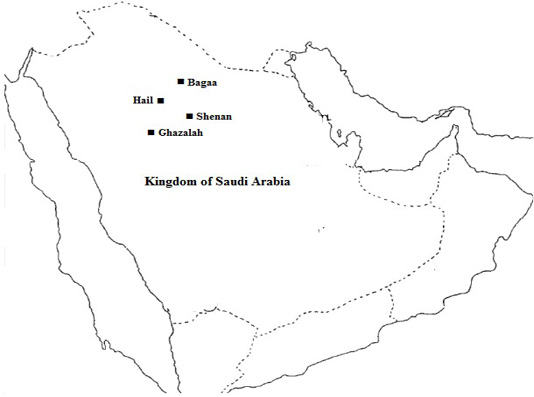
Map of Kingdom of Saudi Arabia showing area where sera were collected
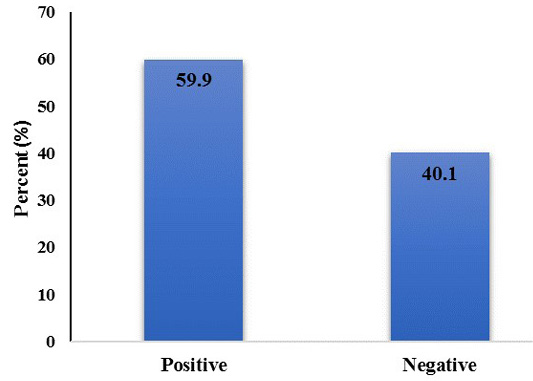
Seroprevalence of PPR antibodies as detected by c-ELISA
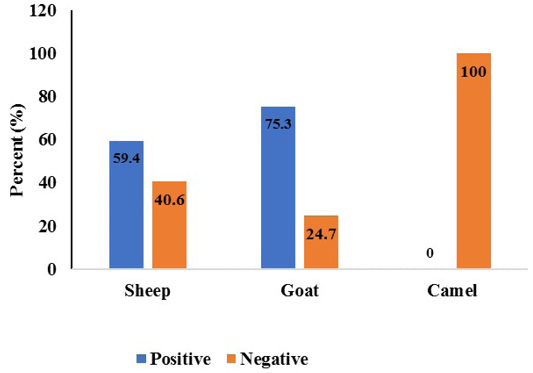
Seroprevalence of PPR antibodies among sheep, goats and camels as detected by c-ELISA
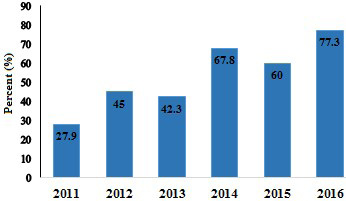
Seroprevalence of PPR during 2011 onwards to 2016
References
- • Abu Elzein, E.M.E., Hassanien, M.M., Alafaleq, A.I., Abdelhadi, M.A., Housawi F.M.T. Isolation of PPR virus from goats in Saudi Arabia. Veterinary Record, 1990; 127: 309-310.
- • Al-Afaleq, A., Abu-Elzein, E., Al-Naeem, A., Mahmoud, A. Serosurveillance for peste des petits ruminants (PPR) and rinderpest antibodies in naturally exposed Saudi sheep and goats. Veterinarski Archive, 2004; 74 (6): 459-465.
- • Albina, E., Kwiatek, O., Minet, C., Lancelot, R., Servan de Almeida, R., Libeau, G. Peste des petits ruminants, the next eradicated animal disease. Veterinary Microbiology, 2013; 165(1): 38-44. https://doi.org/10.1016/j.vetmic.2012.12.013[CrossRef]
- • Al-Dubaib, M.A. Peste des petitis ruminants morbillivirus infection in lambs and young goats at Qassim region, Saudi Arabia. Tropical Animal Health Production, 2009; 41(2): 217-220. https://doi.org/10.1007/s11250-008-9178-6[CrossRef]
- • Ameen, S.A., Ajayi, J.A. Studies on influence of seasonality on clinical conditions of small ruminants in Ogbomoso areas of Oyo State. International Journal of Applied Agricultural and Apicultural Research, 2013; 1: 18-21.
- • Banyard, A.C., Parida, S., Batten, C., Oura, C., Kwiatek, O., Libeau, G. Global distribution of peste des petits ruminants virus and prospects for improved diagnosis and control. Journal of General Virology, 2010; 91: 2885-2897. https://doi.org/10.1099/vir.0.025841-0[CrossRef]
- • Boshra, H., Truong, T., Babiuk, S., Hemida, M.G. Seroprevalence of Sheep and Goat Pox, Peste des petits ruminants and Rift Valley fever in Saudi Arabia. PLoS One, 2015; 13: 1-12. https://doi.org/10.1371/journal.pone.0140328[CrossRef]
- • Bowden, T.R., Babiuk, S.L., Parkyn, G.R., Copps, J.S., Boyle, D.B. Capripoxvirus tissue tropism and shedding: A quantitative study in experimentally infected sheep and goats. Virology, 2008; 371: 380-393. https://doi.org/10.1016/j.virol.2007.10.002[CrossRef]
- • Bhanuprakash, V., Indrani, B.K., Hosamani, M., Singh, R.K. The current status of sheep pox disease. Comparative Immunology, Microbiology and Infectious Diseases, 2006; 29: 27-60. https://doi.org/10.1016/j.cimid.2005.12.001[CrossRef]
- • Gibbs, P.J.E., Taylor, W.P., Lawman, M.P., Bryant, J. Classification of the peste des petits ruminants virus as the fourth member of the genus Morbillivirus. Intervirology, 1979; 11: 268-274. https://doi.org/10.1159/000149044[CrossRef]
- • Housawi, F., Abu Elzein, E., Mohamed, G., Gameel, A., Al-Afaleq, A., Hegazi, A., Al-Bishr, B. Emergence of peste des petits ruminants in sheep and goats in Eastern Saudi Arabia. The Revue d’élevage et médecine vétérinaire des pays tropicaux, 2004; 57 (1-2): 31-34.
- • Lefèvre, P.C., Diallo, A. Peste des petites ruminants. Revue Scientifique et Technique, 1990; 9: 951-965.
- • Libeau, G., Préhaud, C., Lancelot, R., Colas, F., Guerre, L., Bishop, D.H., Diallo, A, Development of a competitive ELISA for detecting antibodies to the Peste des petits ruminants virus using a recombinant nucleoprotein. Research in Veterinary Science, 1995; 58(1): 50-55. https://doi.org/10.1016/0034-5288(95)90088-8[CrossRef]
- • Mahmoud, A.Z., Abdellatif, M., Shazali. Prevalence of PPR-virus antibodies in sheep, goats and camels in Hail, Saudi Arabia. British Journal of Virology, 2016; 3(3s): 86-89. https://doi.org/10.17582/journal.bjv/2016.3.3s.86.89[CrossRef]
- • Munir, M., Zohari, S., Berg, M. 2013. Molecular biology and pathogenesis of peste des petits ruminants virus. Springer Briefs in Animal Sciences. https://doi.org/10.1007/978-3-642-31451-3[CrossRef]
- • Obi, T.U. Studies on the epidemiology of PPR in Southern Nigeria. Tropical Veterinarian, 1983; 1: 209-217.
- • Okoli, C.I. Incidence and modulating effects of environmental factors on trypanosomosis, peste des petit ruminants (PPR) and bronchopneumonia of West African dwarf goats in Imo state, Nigeria. Livestock Research for Rural Development, 2003; 9: 15.
- • Shaila, M.S., Shamaki, D., Forsyth, M.A., Diallo, A., Goatley, L., Kitching, R.P., Barrett T. Geographic distribution of peste des petits ruminants viruses. Virus Research, 1996; 43(2):149-153. https://doi.org/10.1016/0168-1702(96)01312-3[CrossRef]
- • Singh, R.P., Saravanan, P., Sreenivasa, B.P., Singh, R.K., Bandyopadhyay, S.K. Prevalence and distribution of peste des petits ruminants virus infection in small ruminants in India. Revue Scientifique et Technique (International Office of Epizootics), 2004; 23: 807-819. https://doi.org/10.20506/rst.23.3.1522[CrossRef]
- • Taylor, W.P. The distribution and epidemiology of PPR. Preventive Veterinary Medicine, 1984; 2: 157-166. https://doi.org/10.1016/0167-5877(84)90059-X[CrossRef]
Services
Article usage statistics
Loading…