
Bovine luteinizing hormone receptor (bLHR) gene in mammals is important for several reproduction function such as steroidogenesis, follicular growth, oocytes maturation, ovulation and corpus luteum formation. The aim of this study was to identify the polymorphisms in the exon 11 of bLHR/HhaI gene (SNP g.1553C>T) and its association with service per conception (S/C) of Pasundan cows of West Java, Indonesia. Total of 147 Pasundan cows were used in this study. The PCR-RFLP analysed three genotypes of CC (0.11), CT (0.57) and TT (0.32) were detected in the Pasundan bLHR/HhaI gene with T allele as the dominant allele (0.61). Observed (Ho) and expected (He) heterozygosity had similar values of 0.48. The polymorphic informative content (PIC) was 0.37 and was of moderate category (0.25<PIC<0.50). The Chi-square value (χ2) was 5.71, which reveals that studied population is under the Hardy-Weinberg equilibrium (χ2<5.991). The number of effective allele (ne) was 1.92. It showed that Pasundan bLHR/HhaI had two common alleles. Based on the sequencing analysis results of 46 samples, it showed that new mutation at g.1626G>T was only detected in one individual sample. Polymorphism of bLHR/HhaI gene in the present study was not significantly associated with S/C of Pasundan cows, since the genotype TT of the studied animal was found in the lowest of S/C value than other genotype.
Research Article · Volume 53, Issue 3, 26 March 2021 · Open Access
Polymorphism in the Exon 11 of Bovine Luteinizing Hormone Receptor Gene and its Association with Service per Conception in Pasundan Cows
· ·
Affiliations & Notes ⌄
- 1Research Center for Biotechnology, Indonesian Institute of Sciences, Bogor-Jakarta Rd. Km. 46, Cibinong, Bogor, West Java, Indonesia 16911 2Department of Animal Sciences, Faculty of Animal Science, Bogor Agricultural University, Agatis Rd., Dramaga Campus, Bogor, West Java, Indonesia 16680 , * Corresponding author: syahruddinsaid01@gmail.com
Article Info ⌄
- Journal:
- Pakistan Journal of Zoology
- Published:
- 26 March 2021

From the article
- They concluded that most of Bos indicus breeds had higher T allele frequency than Bos taurus breeds.
- Bovine luteinizing hormone receptor (bLHR/HhaI) gene in the Pasundan cattle had moderate polymorphic level (PIC=0.37) and can be used as molecular selection in the breeding program.
- The T allele in bLHR/HhaI gene of Pasundan herds was higher than C allele and similar to the previous studies in Bos indicus breeds.
- This study shows that polymorphism of bLHR/HhaI gene was not significantly associated to S/C in Pasundan cows.
Selected from the article's own text.
Abstract
INTRODUCTION
Pasundan cattle is one of Indonesian native cattle which is well adapted at West Java province of Indonesia. The cattle originated as a result of cross breeding between Bali cattle (Bos javanicus) and Bos indicus cattle (Madura and Ongole) about a hundred years ago . This breeds was decided to be one of Indonesian indigenous cattle since 2014 based on Agriculture Ministry Decree No: 1051/Kpts/SR.120/10/2014 . Most farmers in West Java believe that the reproductive traits of Pasundan cattle are better than those of crossbred cattle. Unfortunately, there is very limited literature available on reproductive traits of Pasundan cattle. Data from Department of Animal Husbandry of West Java province showed that the reproductive traits of Pasundan cattle are age at first calving 30-40 months, age at sex maturity of bull 25-30 months, gestation length 8.5-10 months, age at first oestrus 18-24 months and calving interval 1.1-1.3 years .
Reproductive traits such as service per conception (S/C) have been neglected in Pasundan cattle. It has been known that reproductive traits have low heritability . There are many reasons such as genetic, physiology, nutrition and management for reproductive decline in cows . Reproductive traits of Pasundan cattle can be improved with good breeding practices management and through molecular selection.
Selection for reproductive traits can be conducted with focus on genetic characterization of the reproductive gene. One of the candidate genes that has potential for selection of reproductive traits in cattle is bovine luteinizing hormone resceptor (bLHR) gene (Nogueira et al., 2010; which is located on chromosome 11 and consists of 11 exons (Huhtataniemi, 2000; . The bLHR gene in livestock is important for secretion of luteinizing hormone (LH) which is important for follicullar development such as ovulation, corpus luteum formation and preimplantation embryonic development . Previous studies showed that LHR gene is associated with polycystic ovary syndrome in humans (Bassiouny et al., 2014), fertility traits in buffalo ; , super-ovulation traits and service per conception (S/C) in cattle ; and non-gonadal tissues during estrous cycle in sheep .
Wohlres-Viana et al. (2016) have identified single nucleotide polymorphism (SNP) in the 1st, 5th, 6th, 9th, 10th and 11th exon of bLHR gene in Gir and Holstein cattle with most of the SNPs in exon 11 in each breed. One of SNPs C/T occured at position 1327 (GenBank: NM_174381.1) or 1553 (GenBank: XM_01969469.1) in the exon 11 of bLHR gene and can be identified with HhaI restriction enzyme ; . Moreover, Wohlres-Viana et al. (2016) reported that the transition mutation at nucleotide position at 1327 or 1553 had amino acid changes from Alanine (Ala) to Valine (Val).
Unfortunately, no study has been conducted to investigate the polymorphism of bLHR gene and its association with reproductive traits in Indonesian native cattle. The objective of the present study was to identify the genetic polymorphism of bLHR/HhaI gene in Pasundan cattle using polymerase chain reaction and restriction fragment length polymorphism (PCR-RFLP) methods and determine its association with S/C of Pasundan cattle.
MATERIALS AND METHODS
Blood samples and DNA extraction
A total of 147 Pasundan cows from West Java province were used for blood sampling. Blood samples (3-5 mL) were taken from coccygeal vein by using venoject and collected in vaccutainer tubes containing anticoagulant (K2EDTA). The blood samples were used for the DNA extraction using the Genomic DNA Mini kit (Geneaid Biotech Ltd., Taiwan) according to the manufactures instruction. The extracted DNA was appropriately labeled and stored at -200C for PCR and RFLP analyses.
PCR analysis
PCR was performed in a Mastercyler® gradient machine (Eppendorf, Germany) with a pair of primers Marson et al. (2008) i.e bLHR-F: 5’- CAA ACT GAC AGT CCC CCG CTT T -3’ and bLHR-R: 5’- CCT CCG AGC ATG ACT GGA ATG GC -3’ to amplify the bLHR gene. These primers were used to amplify the bLHR gene product of 303 bp (Fig. 1). The PCR reagents were as follows: 5.0 μL of PCR master mix (Thermo Scientific, USA); each 0.20 μL of forward and reverse primers (200 ng/μL); 2.0 μL of DNA samples; and ddH2O up to 10 μL. The PCR program was set up as follows: initial denaturation at 95°C for 5 min followed by 37 cycles and of denaturation at 95°C for 45 seconds; annealing at 55°C for 45 seconds; initial extension at 72°C for 45 seconds and final extension at 72°C for 5 min. The PCR product was visualized using 1.0% agarose gel. The gel was stained with GelRedTM (Biotium, USA). Total 3.0 μL of 100 bp DNA ladder was used as molecular size marker. Electrophoresis (110 V; 30 minutes) analysis was used for visualization of PCR product with GBOX Documentation System (Syngene, UK).
RFLP analysis
The RFLP analysis was done for genotyping of bLHR gene in this study. The reaction mixture consisted of 4.20 μL of PCR product, 0.25 μL of HhaI restriction enzyme (Promega, USA), 0.10 μL acetylated BSA buffer, 1.0 μL buffer 10x and ddH2O up to 10 μL. The mixture reactions was incubated at 37°C for 1 h. Digested products were analyzed using electrophoresis (110 V; 1 h) on 2.0% agarose gel with 3.0 μL of 100 bp DNA ladder. The digested product was stained with GelRedTM and captured with GBOX Documentation System. Three genotypes of CC (155 bp and 148 bp), CT (303 bp, 155 bp and 148 bp) and TT (303 bp) were identified based on sequence (GenBank: XM_01969469.1) analysis. However, DNA fragment of 148 bp was not detected in this study because the distance between another fragment was very small (7 bp), and hence this fragment was not clearly separated.
Sequencing analysis
The DNA sequencing was performed using 46 samples of animal. Total of 30 μl PCR product of each sample were used for sequencing analysis. The PCR products of individual cattle were sequenced using ABI Prims 3100-Avant Genetic Analyzer in the 1st BASE Laboratory, Malaysia. The Pasundan bLHR gene sequences were aligned and compared with the Bos indicus bLHR gene (GenBank: XM_01969469.1) using MEGA ver 6.0 programs .
Data analysis
The genotype data obtained in this study were used for calculating genetic diversity parameters such as genotype and allele frequencies , expected and observed heterozygosity , polymorphic informative content ; , number of effective allele and Chi-square value . Morever, data of service per conception (S/C) were analyzed by applying linear mixed model as follows:
Yi = μ + Gi + ei
Where, Yi is the dependent variable (S/C), μ is the overall mean, Gi is the fixed effect of ith genotype (CC, CT and TT) and ei is the random residual effect.
RESULTS AND DISCUSSION
The amplified DNA bLHR gene (amplicons) product showed a single of band 303 bp (Fig. 2). The length of amplicons are similar to sequence target from GenBank reference (Fig. 1). The visualization of PCR-RFLP results showed that three genotypes of CC, CT and TT were clearly observed (Fig. 3). Two alleles of C (0.39) and T (0.61) were identified in the bLHR gene in this study (Table I). Previous studies reported that high C allele frequencies were observed in Bos taurus breeds such as East Anatolian Red (0.75), South Anatolian Red (0.70), Turkish Grey (0.71), Anatolian Black (0.61), Zavot (0.69), Turkish Holstein (0.99) and 0.91 for Japanese Holstein , 2017; . Several studies reported that high T allele frequencies occured in Bos indicus breeds such as Gir (0.77), Kenana (0.55) and 0.58 for Erashy ; . Other studies also reported that high C allele frequencies were reported in Bos indicus breeds of Butana (0.56) and 0.58 for composite breed of 50% Zebu x 50% British ; . They concluded that most of Bos indicus breeds had higher T allele frequency than Bos taurus breeds.
The observed (Ho) and expected (He) values were similar (0.48) which means that population used in this study was in genetic equilibrium (Table I). The Chi-square (χ2) test value in this study (5.71) was lower than χ2 table (5.99) and indicated that the population studied was under Hardy-Weinberg equilibrium. The PIC value in this study was 0.37. According to Selvaggi and Dario (2011), the PIC values consisted of three categories low (PIC<0.25), moderate (0.25<PIC<0.50) and high (PIC>0.50). In diploid gene, moderate PIC value can be used as an indicator of molecular selection conducted based on the polymorphism information. The number of effective allele (ne) in this study was 1.92 and explained that C and T alleles are common alleles in bLHR gene of Pasundan cattle with T allele as the dominant allele.
Table I. The statistical analysis for bLHR/HhaI gene polymorphism in Pasundan cattle.
| Genotype frequency (N) | Allele frequency | He | Ho | PIC | ne | χ2 | |||
| CC | CT | TT | C | T | |||||
| 0.11(16) | 0.57(84) | 0.32(47) | 0.39 | 0.61 | 0.48 | 0.48 | 0.37 | 1.92 | 5.71* |
N, number of observation; Ho, observed heterrozigosity; He, observed heterozigosity; PIC, polymorphism informative content; ne, number of effective allele; χ2, Chi-square value; *, under Hardy-Weinberg equilibrium (χ22; 0.05 = 5.991).
Table II. Association of bLHR/HhaI gene polymorphism with service per conception (S/C) in Pasundan cows.
| Genotype | N | S/C |
| CC | 7 | 2.57±1.51 |
| CT | 23 | 2.39±1.44 |
| TT | 5 | 2.00±0.71 |
N, number of observation.
The sequencing results showed that the transition mutation occured at position g.1553C>T in the exon 11 of bLHR gene in Pasundan cattle (Fig. 4). Moreover, the novel SNP at g.1626G>T occured only in one individual sample of Pasundan cow (Fig. 5) and has never been reported previously. The rare T allele in the SNP at g.1626G>T reveals that the genetic drift occured in this allele. Preliminary study with 50 Pasundan cows showed that SNP at g.1553C>T in the bLHR gene was not associated with S/C (Table II). Genotype of TT in this study had the lowest S/C value than other genotypes. Arslan et al. (2017) reported that most of the genotype CC in Friesian Holstein cows had low S/C value. However, in this study, animals with CC genotype had the highest S/C compareed with other genotypes. The T allele in the bLHR/HhaI gene may be influencing the reproductive traits of Bos indicus cattle, including Pasundan cows.
CONCLUSION
Bovine luteinizing hormone receptor (bLHR/HhaI) gene in the Pasundan cattle had moderate polymorphic level (PIC=0.37) and can be used as molecular selection in the breeding program. The T allele in bLHR/HhaI gene of Pasundan herds was higher than C allele and similar to the previous studies in Bos indicus breeds. This study shows that polymorphism of bLHR/HhaI gene was not significantly associated to S/C in Pasundan cows. Further study is needed to confirm the effect of SNP at g.1553C>T associated with reproductive traits in a large number of samples as genetic markers.
ACKNOWLEDGMENT
Authors thank Bureau of Research and Development for the Region of West Java province (BP2D Jawa Barat) for financial support and the Pasundan Breeding Center (BPPIBT-SP Ciamis, Jawa Barat) for blood sample collection and record data support. Authors would like to thank Novi Cahya Lestari for her technical assistance and to all members of Animal Research Group at the Research Center for Biotechnology of the Indonesian Institute of Sciences.
Statement of conflict of interest
The authors have declared no conflict of interest.
Figures

Primer position (underline) and HhaI restriction site (5’...GCG||T...3’) in the bLHR gene (Bos indicus) according to GenBank: XM_01969469.1 with y=C/T.

Primer position (underline) and HhaI restriction site (5’...GCG||T...3’) in the bLHR gene (Bos indicus) according to GenBank: XM_01969469.1 with y=C/T.

Primer position (underline) and HhaI restriction site (5’...GCG||T...3’) in the bLHR gene (Bos indicus) according to GenBank: XM_01969469.1 with y=C/T.
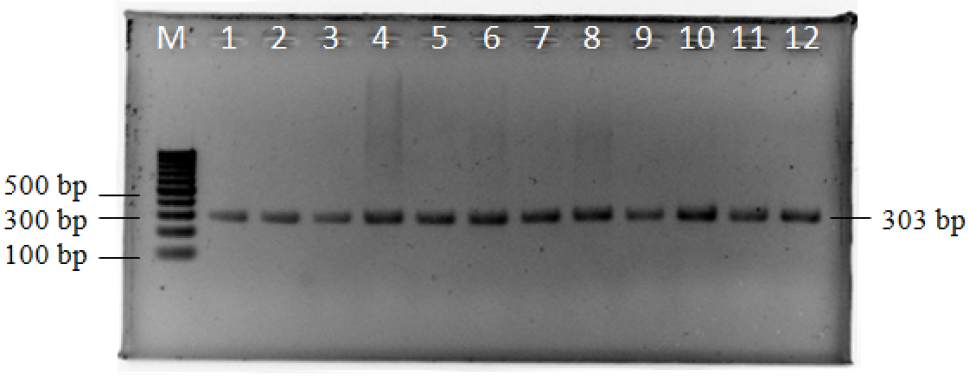
The amplification product of bLHR gene on 1% agarose gel. M, marker (DNA ladder 100 bp); lanes 1-12, number of sample.
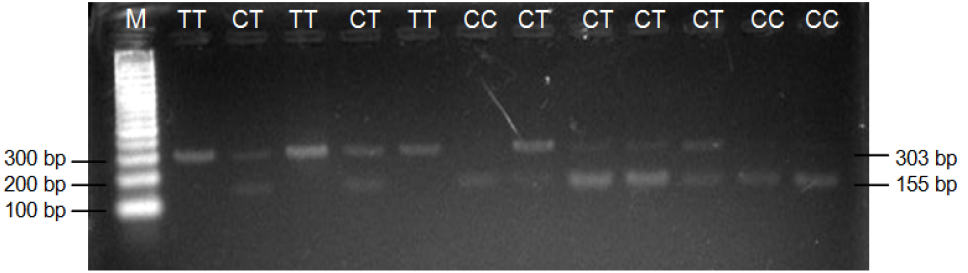
The fragments of bLHR gene using PCR-RFLP method with HhaI restriction enzyme on 2% agarose gel showed three genotypes of CC (155 bp), CT (303 bp and 155 bp) and TT (303 bp). M, marker (DNA ladder 100 bp).
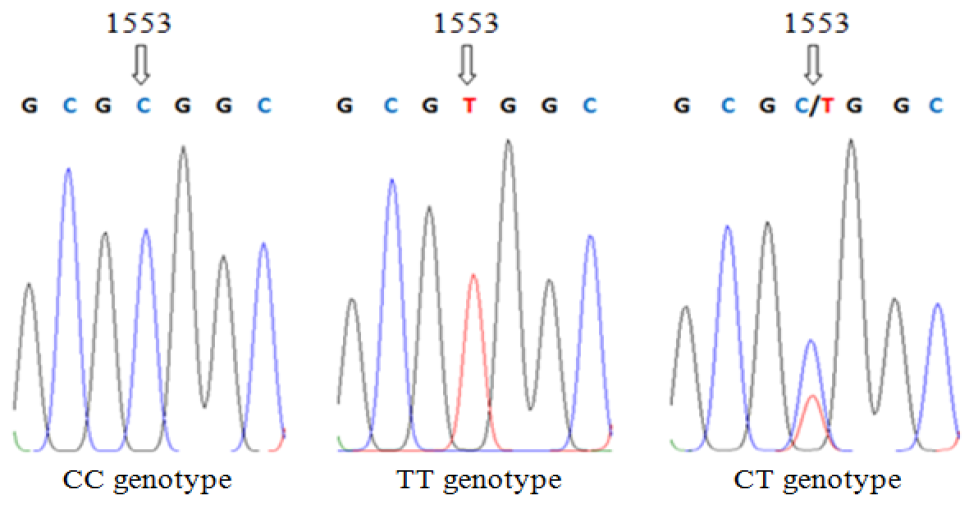
Part of chromatogram showing characteristics of SNP at g.1553C>T in the exon 11 of Pasundan bLHR gene.
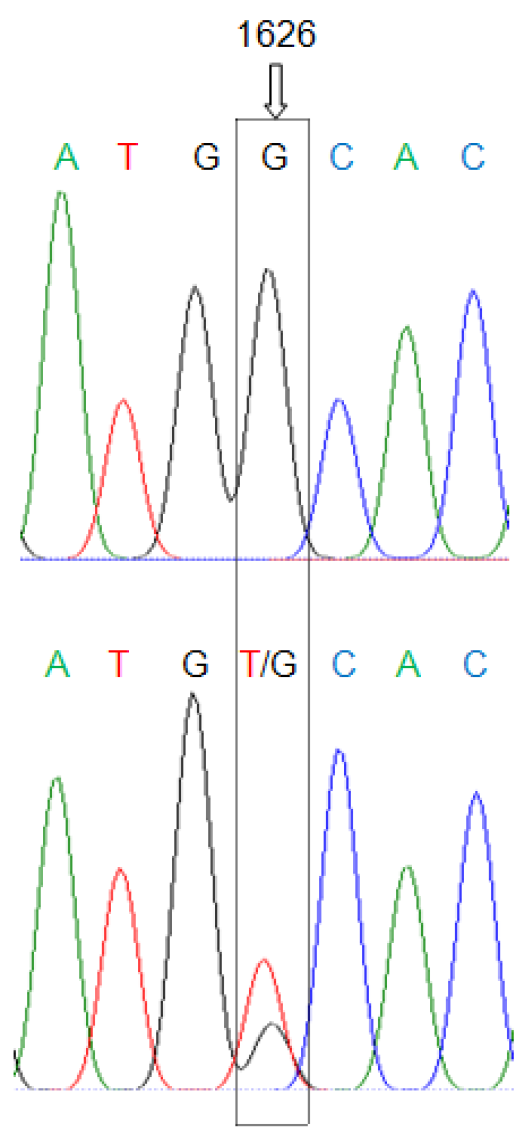
Part of chromatogram of new SNP at g.1626G>T in Pasundan bLHR gene in one individual sample.
References
- Anonymous, 2014. Agriculture Ministry Decree No.1051/Kpts/SR.120/10/2014 about establishment of Pasundan cattle breed. https://www.dkpp.jabarprov.go.id. (article in Indonesian).
- Anonymous, 2017. Characteristics of Pasundan cattle. Department of Animal Hosbandry of West Java. https://www.jabar.litbang.pertnian.go.id. (article in Indonesian)
- Arslan, K., Akyuz, B. and Agaoglu, O.K., 2015. Investigation of STAT5A, FSH and LHR genes polymorphisms in Turkish indigenous breeds (East Anatolian Red, South Anatolian Red, Turkish Grey, Anatolian Black and Zavot). Russian J. Genet., 51: 1088-1095. https://doi.org/10.1134/S1022795415110022[CrossRef]
- Arslan, K., Akyuz, B., Akcay, A., Ilgar, E.G., Macun, H.C. and Cinar, M.U., 2017. Association of number of artificial inseminations per pregnancy in Holstein dairy cows with polymorphism in luteinizing hormone receptor and follicle stimulating hormone receptor genes. Slov. Vet. Res., 54: 91-98.
- Basiouny, Y.A., Rabie, W.A., Hassan, A.A. and Darwish, R.K., 2014. Association of the luteinizing hormone/choriogonadotropin receptor gene polymorphism with polycystic ovary syndrome. Gynecol. Endocrinol., 30: 428-430. https://doi.org/10.3109/09513590.2014.895982[CrossRef]
- Hastings, N., Donn, S., Derecka, K., Flint, A.P. and Woolliams, J.A., 2006. Polymorphisms within the coding region of the bovine luteinizing hormone receptor gene and their association with fertility traits. Anim. Genet., 37: 583-585. https://doi.org/10.1111/j.1365-2052.2006.01532.x[CrossRef]
- Hildebrand, C.E., Torney, D.C. and Wagner, R.P., 1992. Informativeness of polymorphic DNA markers. Los Alamos Sci., 20: 100-102.
- Huhtaniemi, I., 2000. Mutations of gonadotrophin and gonadotrophin receptor genes: what do they teach us about reproductive physiology? J. Reprod. Fertil., 119: 173-186. https://doi.org/10.1530/reprod/119.2.173[CrossRef]
- Kaps, M. and Lamberson, W.R., 2004. Biostatistics for animal sciences. CABI Publishing; London (UK). pp. 562. https://doi.org/10.1079/9780851998206.0000[CrossRef]
- Marson, E.P., Ferraz, J.B.S., Meirelles, F.V., Balieiro, J.C.C. and Eler, J.P., 2008. Effects of polymorphisms of LHR and FSHR genes on sexual precocity in a Bos taurus x Bos indicus beef composite population. Genet. mol. Res., 7: 243-251. https://doi.org/10.4238/vol7-1gmr418[CrossRef]
- Marsters, P., Kendall, N.R. and Campbell, B.K., 2015. Pre-translational regulation of luteinizing hormone receptor in follicular somatic cells of cattle. Anim. Reprod. Sci., 163: 63-74. https://doi.org/10.1016/j.anireprosci.2015.09.019[CrossRef]
- Nei, M. and Tajima, F., 1981. Genetic drift and estimation of effective population size. Genetics, 98: 625-640.
- Nei, M. and Kumar, S., 2000. Molecular evolution and phylogenetics. Oxford University Press, New York (USA). pp. 333.
- Nougueira, M.F.G., Fernandes, P., Ereno, R.L., Simoes, R.A.L., Junior, J.B. and Barros, C.M., 2010. Luteinizing hormone receptor (LHR): basic concepts in cattle and other mammals. Anim. Reprod., 7: 51-64.
- Omer, N.N., Gornas, N., Rahmatalla, S.A. and Ahmed, M.K.A., 2016. Genetic characterization of indigenous Sudanese cattle using FSHR and LHR genes. Am. Sci. Res. J. Eng. Technol. Sci., 24: 1-9.
- Othman, O.E. and Abdel-Samad, M.F., 2013. RFL polymorphism of three fertility genes in Egyptian buffalo. J. appl. Biol. Sci., 7: 94-101.
- Said, S., Putra, W.P.B., Anwar, S., Agung, P.P. and Yuhani, H., 2017. Phenotypic, morphometric characterization and population structure of Pasundan cows at West Java, Indonesia. Biodiversitas, 18: 1638-1645.
- Selvaggi, M. and Dario, C., 2011. Analysis of two Pit-1 gene polymorphisms: Single nucleotide polymorphisms (SNPs) distribution patterns in Podolica cattle breed. Afri. J. Biotechnol., 10: 11360-11364.
- Shete, S., Tiwari, H. and Elston, R.C., 2000. On estimating the heterozygosity and polymorphic information content. Theor. Popul. Biol., 57: 265-271. https://doi.org/10.1006/tpbi.2000.1452[CrossRef]
- Shirasuna, K., Kawashima, C., Murayama, C., Aoki, Y., Masuda, Y., Kida, K., Matsui, M., Shimizu, T. and Miyamoto, A., 2011. Relationships between the first ovulation postpartum and polymorphism in genes relating to function of immunity, metabolism and reproduction in high-producing dairy cows. J. Reprod. Dev., 57: 135-142. https://doi.org/10.1262/jrd.10-100T[CrossRef]
- Sosa, A.S.A., Mahmoud, K.G.M., Kandiel, M.M.M., Eldebaky, H.A.A., Nawito, M.F. and Abou El-Roos, M.E.A., 2016. Genetic polymorphism of luteinizing hormone receptor gene in relation to fertility of Egyptian buffalo. Biol. Technol., 12: 1-10.
- Tamura, K., Stecher, G., Peterson, D., Filipski, A. and Kumar, S., 2013. MEGA6: Molecular evolutionary genetic analysis version 6.0. Mol. Biol. Evol., 30: 2725-2729. https://doi.org/10.1093/molbev/mst197[CrossRef]
- Tiezzi, F., Pretto, D., De Marchi, M. and Penasa, M., 2013. Heritability and repeatability of milk coagulation properties predicted by mid-infrared spectroscopy during routine data recording, and their relationships with milk yield and quality traits. Animal, 7: 1592-1599. https://doi.org/10.1017/S1751731113001195[CrossRef]
- Wang, L.H., Zhang, W., Gao, Q.X. and Wang, F., 2012. Expression of the luteinizing hormone receptor (LHR) gene in ovine non-gonadal tissues during estrous cycle. Genet. mol. Res., 11: 3766-3780. https://doi.org/10.4238/2012.October.15.8[CrossRef]
- Walsh, S.W., Wlliam, E.J. and Evans, A.C.O., 2011. A review of the causes of poor fertilty in high milk producing dairy cows. Anim. Reprod. Sci., 123: 127-138. https://doi.org/10.1016/j.anireprosci.2010.12.001[CrossRef]
- Weir, B.S., 1996. Genetic data analysis: Method for discrete population genetic data. 2nd Ed. Sinauer Associated; Sunderland (USA). pp. 445.
- Wohlres-Viana, S., Arashiro, E.K.N., Reis, D.R.L., Fernandes, L.E., Peixodo, M.G.C.D., Machado, M.A. and Viana, J.H.M., 2016. Polymorphisms and alternative splicing of the luteinizing hormone receptor of dairy cattle. Genet. mol. Res., 15: 1-12. https://doi.org/10.4238/gmr.15027046[CrossRef]
- Yu, Y., Pang, Y., Zhao, H., Xu, X., Wu, Z., An, L. and Tian, J., 2012. Association of a missense mutation in the luteinizing hormone / choriogonadotropin receptor gene (LHCGR) with superovulation traits in Chinese Holstein heifers. J. Anim. Sci. Biotechnol., 3: 1-5. https://doi.org/10.1186/2049-1891-3-35[CrossRef]
Services
Article usage statistics
Loading…