
Zephyranthes citrina Baker commonly known as yellow rain lily, is a bulbous weed of Amaryllidaceae. In the present study, phytoconstituents from methanolic flower extract of this plant were identified through GC-MS. A total of 13 compounds were found in the extract. These included heptacosan-9-ol (15.01%), 2-hexanamine (13.28%), n-hexadecanoic acid (10.38%), eicosane (10.37%), 4H-pyran-4-one, 2,3-dihydro-3,5-dihydroxy-6-methyl (9.69%), cyclohexane, 1,1’-(2-propyl-1,3-propanediyl)bis-(8.81%), hexadecane-1,2-diol (6.34%), pentadecanoic acid, 14-methyl-, methyl ester (5.76%), methyl linolenate (5.38%), octadecanoic acid (4.04%), methyl (Z)-5,11,14,17-eicosatetraenoate (3.56%), methyl linoleate (4.38%), and linoleic acid (2.94%). These compounds possess various biological activities as reported in the previous literature.
Research Article · Volume 29, Issue 2, 27 June 2023 · Open Access
Phytochemical Profile of Yellow Rain Lily (Zephyranthes citrina Baker) Flowers
· · ·
Affiliations & Notes ⌄
- 1Department of Horticulture, Faculty of Agricultural Sciences, University of the Punjab, Lahore, Pakistan
- 2Department of Plant Pathology, Faculty of Agricultural Sciences, University of the Punjab, Lahore, Pakistan. *Correspondence | Malik F.H. Ferdosi, Department of Horticulture, Faculty of Agricultural Sciences, University of the Punjab, Lahore, Pakistan
- 3Email: fiaz.iags@pu.edu.pk, malikferdosi@yahoo.com
Article Info ⌄
- Journal:
- Pakistan Journal of Weed Science Research
- Published:
- 27 June 2023
From the article
- Other abundantly occurring compounds identified in the present study were n-hexadecanoic acid (10.38%), eicosane (10.37%), and 4H-pyran-4-one, 2, 3-dihydro-3, 5-dihydroxy-6-methyl (9.69%).
- Moderately abundant compounds in the flower extract were cyclohexane, 1,1’-(2-propyl-1, 3-propanediyl) bis- (8.81%), hexadecane-1, 2-diol (6.34%), pentadecanoic acid, 14-methyl-, methyl ester (5.76%), methyl linolenate (5.38%), octadecanoic acid (4.04%), and methyl linoleate (4.38%).
- Two compounds namely methyl (Z)-5, 11, 14, 17-eicosatetraenoate (3.56%), and linoleic acid (2.94%) were recognized as less abundant ones (Table 1).
- It concludes that flowers of yellow rain lily contain important bioactive compounds such as n-hexadecanoic acid, eicosane, octadecanoic acid, methyl linoleate and methyl linolenate.
Selected from the article's own text.
Abstract
Introduction
Plants are popular source of food and have also been considered as the origin of medicines in many cultures around the world. They are an excellent source of phytochemicals exhibiting important biological activities ; , 2022). These phytochemicals work as antioxidants and help to protect the human body against free radical damages ; , 2020). These compounds also have antimicrobial, insecticidal, anticancer and anti-inflammatory activities (Javaid et al., 2021a; . Using medicinal plants to treat different ailments is traditional in many countries like Japan, Pakistan, India, Thailand, China and Sri Lanka ; . Currently, the use of plants to treat various diseases is increasing worldwide, due to the fact that use of plant products are safe for use . Pharmacological properties of medicinal plants are due to a large number of phytoconstituents belonging to various groups such as flavonoids, saponins, tannins, steroids, glycosides, alkaloids and terpenoids ; .
Yellow rain lily (Zephyranthes citrina) is a bulbous herb of family Amaryllidaceae (Figure 1). Although native to America but it is also cultivated as an ornamental plant for its beautiful flowers . The name “rain lily” is due to its tendency of blooming during rainy season. Only a few studies have been carried out regarding its biological and pharmacological activities. Its antimicrobial, antiprotozoal and cytotoxic activities are generally due to presence of alkaloids in different parts of this plant ; ; . Like other species of the genus Zephyranthes, Z. citrina also contains many Amaryllidaceae alkaloids. So far, more than 20 alkaloids have been reported from this plant including galanthine, haemanthamine, lycorine, haemanthidine, narcissidine, vittatine, oxomaritidine, maritidine, zephyramine, lycorenine and galanthaine . However, majority of the earlier studies were carried out on phytochemical analysis of bulbs of this plant while such studies on its flowers are rare. The objective of the present study was to identify bioactive phytoconstituents in flowers of yellow rain lily through GC-MS analysis.
Materials and Methods
Flowers of yellow rain lily were harvested during September 2022 from a grassy lawn of Botanical Garden, Punjab University Lahore, Pakistan. After washing with water, fresh flowers were dried in an electric oven at 40 ºC. The dried flowers were thoroughly crushed with the help of pastel and mortal. The crushed flowers were soaked in methanol (analytical grade) and left for 2 weeks for extraction of compounds. After that, it was filtered and stored in a closed test tube.
Phytochemicals present in methanolic flower extract of yellow rain lily were identified through GC-MS analysis following the procedure explained by Javaid et al. (2021a). Gas chromatography (GC) was carried out on 7890B Model Machine of Agilent Technologies with a DB-5ms column of dimensions 30 m × 0.25 μm × 0.25 μm. Helium gas was used as a carrier material. After injecting 1 µL of the methanolic extract, with an initial temperature of the oven set at 80 ºC, it was increased to 300 ºC at a rate of 10 ºC min-1. MS analysis was done on 5977A Model Machine with scan range of 50–500 m/z. The sample was run for 40 min. NIST library 2020 was used for phytochemical analysis. Identified compounds were set in an increasing order of retention times. Peaks heights was used for measurement of relative abundance of the compounds.
Results and Discussion
The chromatogram of GC-MS analysis is presented in Figure 2 that represents occurrence of 13 compounds in the flower extract of yellow rain lily whose details are given in Table 1. Heptacosan-9-ol (15.01%) was the predominant compound in the flower extract. The second major compound was 2-hexanamine (13.28%). Other abundantly occurring compounds identified in the present study were n-hexadecanoic acid (10.38%), eicosane (10.37%), and 4H-pyran-4-one, 2, 3-dihydro-3, 5-dihydroxy-6-methyl (9.69%). Among these, n-hexadecanoic acid has been found in many other plant species namely Tagetes erecta , Chenopodium murale , Vinca major (Javaid et al., 2021b) and others. Being an important biomolecule, it has many biological activities. It has antifungal activity and can control the growth of many species of genus Candida as reported by Souza et al. (2015). Moreover, its cytotoxic , and anti-inflammatory have also been reported. Eicosane was also identified as an abundant compound in this study. Previously, Ahsan et al. (2017) identified this compound from a Streptomyces strain and found very effective against Rhizoctonia solani, isolated from tobacco leaves suffering from target leaf spot disease.
Table 1: List of compounds in methanolic flower extract of rain lily identified by GC-MS analysis.
| S. No. | Names of compounds | Molecular formula | Molecular weight | Retention time (min) | Peak area (%) |
| 1 | 4H-Pyran-4-one, 2, 3-dihydro-3, 5-dihydroxy-6-methyl- | C6H8O4 | 144.12 | 11.702 | 9.69 |
| 2 | 2-Hexanamine | C6H15N | 101.19 | 17.627 | 13.28 |
| 3 | Pentadecanoic acid, 14-methyl-, methyl ester | C17H34O2 | 270.45 | 25.383 | 5.76 |
| 4 | n-Hexadecanoic acid | C16H32O2 | 256.42 | 25.873 | 10.38 |
| 5 | Methyl linoleate | C19H34O2 | 294.47 | 27.702 | 4.38 |
| 6 | Methyl linolenate | C19H32O2 | 292.45 | 27.782 | 5.38 |
| 7 | Linoleic acid | C18H32O2 | 280.44 | 28.202 | 2.94 |
| 8 | Methyl (Z)-5, 11, 14, 17-eicosatetraenoate | C21H34O2 | 318.49 | 28.277 | 3.56 |
| 9 | Octadecanoic acid | C18H36O2 | 284.47 | 28.588 | 4.04 |
| 10 | Hexadecane-1, 2-diol | C16H34O2 | 258.44 | 32.674 | 6.34 |
| 11 | Heptacosan-9-ol | C27H56O | 396.7 | 34.870 | 15.01 |
| 12 | Eicosane | C20H42 | 282.54 | 36.416 | 10.37 |
| 13 | Cyclohexane, 1, 1'-(2-propyl-1, 3-propanediyl) bis- | C18H34 | 250.46 | 36.947 | 8.81 |
Moderately abundant compounds in the flower extract were cyclohexane, 1,1’-(2-propyl-1, 3-propanediyl) bis- (8.81%), hexadecane-1, 2-diol (6.34%), pentadecanoic acid, 14-methyl-, methyl ester (5.76%), methyl linolenate (5.38%), octadecanoic acid (4.04%), and methyl linoleate (4.38%). Octadecanoic acid is a part of many vegetable oils. This compound and its derivatives are known to possess antibacterial activity ; . Methyl linoleate has been reported as urine acidifier and uric acid inhibitor . Likewise, methyl linolenate is recognized nematicidal, anti-inflammatory, antiandrogenic, anticancer and antihistaminic compound .
Two compounds namely methyl (Z)-5, 11, 14, 17-eicosatetraenoate (3.56%), and linoleic acid (2.94%) were recognized as less abundant ones (Table 1). The later compound and possesses antioxidant activity . It concludes that flowers of yellow rain lily contain important bioactive compounds such as n-hexadecanoic acid, eicosane, octadecanoic acid, methyl linoleate and methyl linolenate.
Acknowledgement
Authors are grateful to the management of Faculty of Agricultural Sciences for providing fascililities to complete this research work.
Novelty Statement
In this paper, phytochemical analysis of flowers of yellow rain lily, collected from Lahore, was carried. Previously, there is not any such study from this region.
Author’s Contribution
Malik F.H. Ferdosi: Conceived the idea, collected the materials and supervised GC-MS analysis part.
Arshad Javaid: Supervised the work, added discussion and finalized the paper.
Iqra Haider Khan: Contributed in paper writing.
Muhammad Kaleem Naseem: Contributed in paper writing.
Conflict of interest
The authors have declared no conflict of interest.
Figures
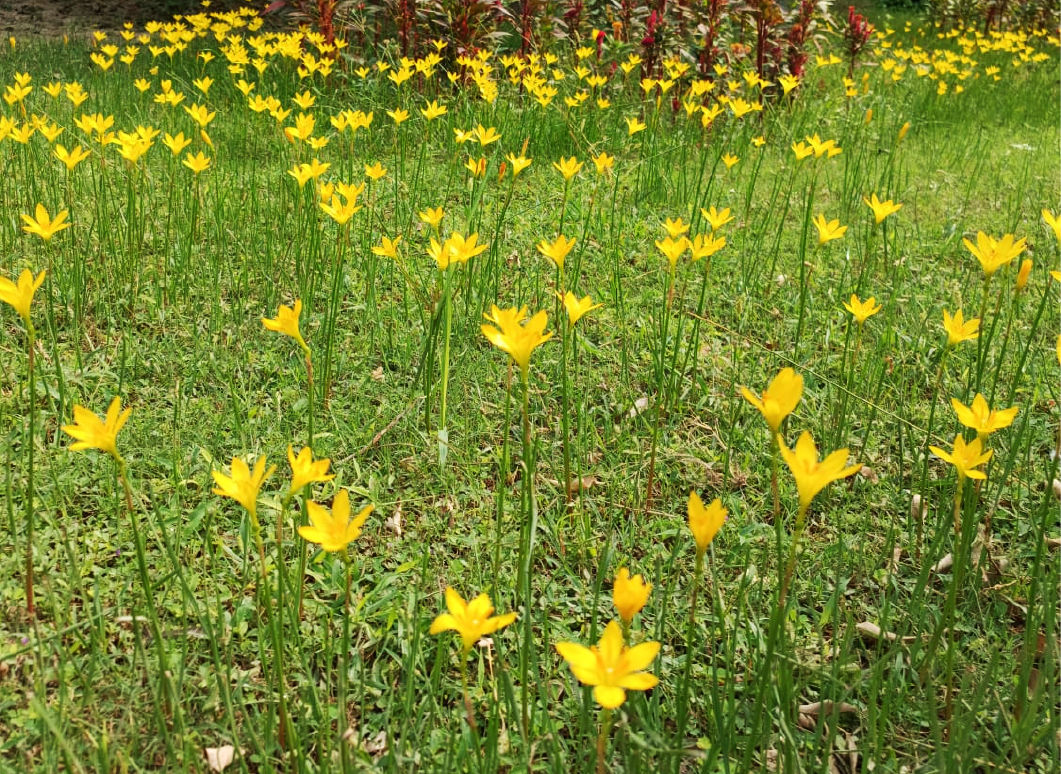
Rain lily plants growing in a grassy lawn.
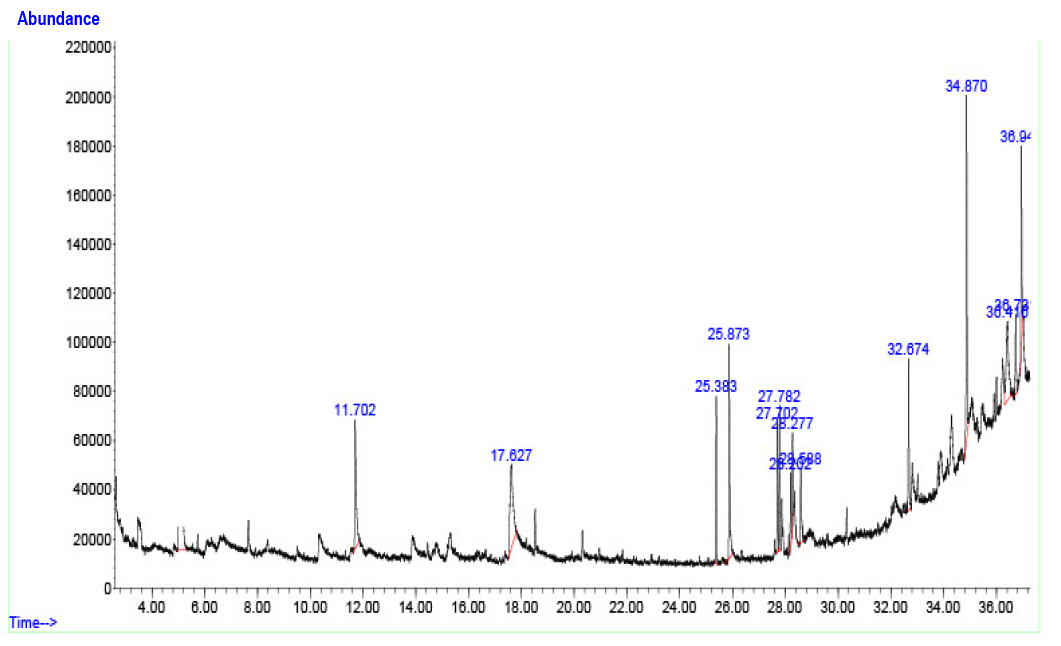
GC-MS chromatogram of methanolic flower extract of yellow rain lily.
References
- Abdala, S., D. Martín-Herrera, D. Benjumea and S.D. Gutiérrez. 2012. Diuretic activity of some Smilax canariensis fractions. J. Ethnopharmacol., 140(2): 277-281. https://doi.org/10.1016/j.jep.2012.01.017[CrossRef]
- Ahsan, T., J. Chen, X. Zhao, M. Irfan and Y. Wu. 2017. Extraction and identification of bioactive compounds (eicosane and dibutyl phthalate) produced by Streptomyces strain KX852460 for the biological control of Rhizoctonia solani AG-3 strain KX852461 to control target spot disease in tobacco leaf. AMB Express, 7(1): Article 54. https://doi.org/10.1186/s13568-017-0351-z[CrossRef]
- Aparna, V., D. Vijayan, P. Mandal and P. Karthe. 2012. Anti-Inflammatory property of n-hexadecanoic acid: structural evidence and kinetic assessment. Chem. Biol. Drug Des., 80: 434-439.
- Boots, A.W., G.R. Haenen and A. Bast. 2008. Health effects of quercetin: From antioxidant to nutraceutical. Eur. J. Pharmacol., 585: 325-337. https://doi.org/10.1016/j.ejphar.2008.03.008[CrossRef]
- Devi, J.A.I. and A.K. Muthu. 2014. Gas chromatography- mass spectrometry analysis of bioactive constituents in the ethanolic extract of Saccharum spontaneum Linn. Int. J. Pharm. Pharmaceut. Sci., 6: 755-759.
- Duke, J.A., 1992. Handbook of phytochemical constituents of GRAS herbs and other economic plants. Boca Raton, FL. CRC Press.
- Ferdosi, M.F.H., I.H. Khan and A. Javaid. 2022. Composition of essential oil isolated from marigold (Tagetes erecta L.) flowers cultivated in Lahore, Pakistan. Bangladesh J. Bot., 51(4): 683-688. https://doi.org/10.3329/bjb.v51i4.63486[CrossRef]
- Herrera, M.R., A.K. Machocho, R. Brun, F. Viladomat, C. Codina and J. Bastida. 2001. Crinane and lycorane type alkaloids from Zephyranthes citrina. Planta Med., 67(2): 191-193. https://doi.org/10.1055/s-2001-11495[CrossRef]
- Ivanova, E.P., S.H. Nguyen, Y. Guo, V.A. Baulin, H.K. Webb, V.K. Truong, J.V. Wandiyanto, C.J. Garvey, P.J. Mahon, D.E. Mainwaring and R.J. Crawford. 2017. Bactericidal activity of self-assembled palmitic and stearic fatty acid crystals on highly ordered pyrolytic graphite. Acta Biomater., 59: 148-157. https://doi.org/10.1016/j.actbio.2017.07.004[CrossRef]
- Jabeen, N., I.H. Khan and A. Javaid. 2022. Fungicidal potential of leaf extract of Datura metel L. to control Sclerotium rolfsii Sacc. Allelopathy J., 56(1): 59-68. https://doi.org/10.26651/allelo.j/2022-56-1-1387[CrossRef]
- Javaid, A., S.F. Naqvi and I.H. Khan. 2021a. Ethyl acetate extract of Chenopodium murale root, a source of bioactive compounds. Pak. J. Weed Sci. Res., 27(1): 93-100. https://doi.org/10.28941/pjwsr.v27i1.926[Full text][CrossRef]
- Javaid, A., M.F.H. Ferdosi, I.H. Khan, A. Shoaib, H.M. Saeed and M.A.U. Hassan. 2021b. Biochemical analysis of flowers of Vinca major, a medicinal weed plant of hilly areas of Pakistan. Pak. J. Weed Sci. Res., 27: 537-546. https://doi.org/10.28941/pjwsr.v27i4.1014[Full text][CrossRef]
- Javaid, A., F.A. Chaudhury, I.H. Khan and M.F.H. Ferdosi. 2022. Potential health-related phytoconstituents in leaves of Chenopodium quinoa. Adv. Life Sci., 9(4): 574-578.
- Khan, I.H. and A. Javaid. 2013. Antifungal activity of Melia azedarach L. fruit extract against Sclerotium rolfsii, the cause of collar rot disease of chickpea. Mycopath, 11(1): 9-13.
- Khan, I.H. and A. Javaid. 2019. Antifungal, antibacterial and antioxidant components of ethyl acetate extract of quinoa stem. Plant Prot., 3(3): 125-130. https://doi.org/10.33804/pp.004.03.3422[CrossRef]
- Khan, I.H. and A. Javaid. 2020. Anticancer, antimicrobial and antioxidant compounds of quinoa inflorescence. Adv. Life Sci., 8(1): 68-72.
- Khan, I.H. and A. Javaid. 2022. Hexane soluble bioactive components of leaf extract of quinoa. J. Anim. Plant Sci., 32(2): 309-314.
- Kohelová, E., J. Maříková, J. Korábečný, D. Hulcová, T. Kučera, D. Jun and L. Cahlíková. 2021. Alkaloids of Zephyranthes citrina (Amaryllidaceae) and their implication to Alzheimer’s disease: Isolation, structural elucidation and biological activity. Bioorg. Chem., 107: 104567. https://doi.org/10.1016/j.bioorg.2020.104567[CrossRef]
- Krishna, A.N.V., B.V. Raman, K.R. Babu and C. Apparao. 2012. Antioxidant activity and GC-MS analysis of Phragmytes vallatoria leaf ethanoic extract. Int. Res. J. Pharm., 3: 252-254.
- Michel, J., N.Z. Abd Rani and K. Husain. 2020. A review on the potential use of medicinal plants from Asteraceae and Lamiaceae plant family in cardiovascular diseases. Front. Pharmacol., 11: Article 852. https://doi.org/10.3389/fphar.2020.00852[CrossRef]
- Naqvi, S.F., I.H. Khan and A. Javaid. 2020. Hexane soluble bioactive components of Chenopodium murale stem. Pak. J. Weed Sci. Res., 26(4): 425-432. https://doi.org/10.28941/pjwsr.v26i4.875[Full text][CrossRef]
- Naqvi, S.F., I.H. Khan and A. Javaid. 2022. Detection of compounds and efficacy of n-butanol stem extract of Chenopodium murale L. against Fusarium oxysporum f. sp. lycopesici. Bangladesh J. Bot., 51(4): 663-668. https://doi.org/10.3329/bjb.v51i4.63483[CrossRef]
- Paul, D. and S.N. Sinha. 2016. An update on biological activities of medicinal plant Ipomoea quamoclit L. Trop. Plant. Res., 3(1): 186-190.
- Prakash, J. and S. Vedanayaki. 2019. In vitro cytotoxicity studies of methanolic bulb extract of Zephyranthes citrina on cervical cancer (Hela), breast cancer (MCF-7) and oral cancer (SCC-9). J. Pharmaceut. Sci. Res., 11(6): 2353-2356.
- Ravi, L. and K. Krishnan. 2017. Cytotoxic potential of n-hexadecanoic acid extracted from Kigelia pinnata leaves. Asian J. Cell Biol., 12: 20-27. https://doi.org/10.3923/ajcb.2017.20.27[CrossRef]
- Silva, L.L.D., M. Nascimento, D.H.S. Silva, M Furlan and B.V. da Silva. 2002. Antibacterial activity of a stearic acid derivative from Stemodia foliosa. Planta Med., 68(12): 1137-1139. https://doi.org/10.1055/s-2002-36346[CrossRef]
- Singh, U.P., L. Gohain, S. Maurya, A. Singh, V.B. Pandey and A.K. Singh. 2010. Antifungal activity of two alkaloids of Zephyranthes citrina and their field efficacy against powdery mildew (Erysiphecichora cearum) of balsam. Arch. Phytopathol. Plant Prot., 43(3): 302-311. https://doi.org/10.1080/03235400701804067[CrossRef]
- Singh, A., A. Mishra, R. Chaudhary and V. Kumar. 2020. Role of herbal plants in prevention and treatment of parasitic diseases. J. Sci. Res., 64(1): 50-58. https://doi.org/10.37398/JSR.2020.640106[CrossRef]
- Souza, T.B.D., A.C.O. Bretas, R.J. Alves, T.F.F. Magalhaes and M.A.R. Stoianoff. 2015. Synthesis and antifungal activity of palmitic acid-based neoglycolipids related to papulacandin D. Quim. Nova, 38: 1282-1288. https://doi.org/10.5935/0100-4042.20150156[CrossRef]
Services
Article usage statistics
Loading…