
Comparative analysis of divergence in serum chemical derivatives among yaks living in ecological habitats at different altitudes was performed to determine the physiological adaptation basis in blood metabolites of yaks at extreme high altitudes due to long-term natural selection of plateau ecological environment. Twenty serum samples from yaks were collected, including 10 from those living on the Qinghai–Tibet Plateau at altitudes above 5000 m for a long time and 10 from those living in ecological regions at altitudes of ~4000m. Results revealed 592 metabolites in all samples, of which the highest proportion was attributed to amino acids and their metabolites (18.58%), followed by organic acids and their derivatives (16.20%). Meanwhile, 89 significantly different metabolites (SDMs) were identified between groups, of which 55 were significantly upregulated (e.g., 3-methylcrotonyl glycine, 2-hydroxy-3, and 5-dinitrobenzoic acid, etc.) in the yaks living at extremely high altitude. In addition, 28 metabolites (fumaric acid, serotonin, glycochenodeoxycholic acid, and all trans-retinal) were enriched in 55 KEGG signaling pathways and mainly attributed to organismal systems and metabolism. This work further clarified that long-term natural selection at extremely high altitude prompts animals to have visible physiological adaptations in serum. In addition, the serum of yak living at high altitudes is rich in a series of metabolites (e.g., lysophosphatidylethanolamine, γ-linolenic acid, and 12-hydrox) that are helpful for the treatment of cerebrovascular diseases and respiratory diseases and could contribute to the drug development of anti-plateau in the future.
Research Article · Volume 57, Issue 1, 12 January 2025 · Open Access
Physiological Adaptability of Yak in Extreme High-Altitude Habitat Using Serum Metabolite Analysis
Affiliations & Notes ⌄
- 1The State Key Laboratory of Barley and Yak Germplasm Resources and Genetic Improvement was jointly established by the province and the ministry, Lhasa, Tibet, 850032 2Institute of Animal Husbandry and Veterinary Medicine Tibet Academy of Agriculture and Animal Husbandry Sciences, Lhasa, Tibet, 850009 * Corresponding author: tibetzq@126.com
Article Info ⌄
- Journal:
- Pakistan Journal of Zoology
- Published:
- 12 January 2025

From the article
- A total of 592 metabolic-related chemical derivatives were identified from 20 samples (Supplementary Table I), and the highest proportion was attributed to amino acids and their metabolites (110/592), including L-citrulline, 4-hydroxy-L-glutamic acid, and N-acetyl-beta-alanine.
- In this study, 89 SDMs were identified among yak populations distributed at different altitudes by serum metabolite analysis.
- Several chemical derivatives known to be related to cerebrovascular diseases and cardiopulmonary function were found to be enriched in the serum of yaks living at extremely high altitudes.
- This finding indicated that the physiologically adaptation of animals was developed due to natural selection by living in high-altitude environments for long term.
Selected from the article's own text.
Abstract
INTRODUCTION
Altitude adaptation refers to the ability of animals or plants developed by natural selection that allows them to habituate in a plateau environment (thin air, low oxygen content, strong ultraviolet rays, and low pressure) for long term. The key point of altitude adaptation is that the body can maximize the uptake and use of limited oxygen to satisfy daily physiological processes in a low-oxygen environment ; .
As one of the main livestock species in the Qinghai–Tibet Plateau, domestic yaks (Bos grunniens) were domesticated from wild yaks about 7,000 years ago and have become the main members of livestock development in this region with an important role in the local economy . They have excellent plateau adaptability due to their long-term habitation in highland ecoregions by long-term natural selection. To date, the genetic and phenotypic adaptation basis of yak plateau adaptation has not been explored using genetics , cytogenetics , and physiology .
As a new favorite tool of frontier omics research, metabolome has been widely applied for screening various disease markers and analyzing biological bases ; , especially blood metabolism analysis . In the livestock and agri-food section, metabolomics is widely used to analyze animal meat quality and nutritional content . Recent studies have attempted to explain the plateau adaptability of yaks using metabolomic analysis ; however, they ignored evolutionary differences between species. The current work identified serum metabolite differences among yaks living at different altitudes using metabolomic analysis. The findings will help us deeply understand the physiological metabolic basis of the intraspecific altitude adaptability of yaks.
MATerIALS AND METHODS
Animal and sample collection
The study protocol was approved by the Institutional Animal Care and Use Committee of the Tibet Academy of Agricultural and Animal Husbandry Science (No. 20220301). Twenty male yaks (body weight = 200 ± 8.34 kg, 4–5 years old) were obtained from 4 local dominant populations living at differential altitudes (5 yaks per population), namely, Riwoqe (LWQ, altitude 4,000 m), Maizhokunggar (SB, altitude 3,900 m), Ngari (CWL, altitude 5,000 m), and Gerze (AL altitude 5,300 m). The yaks grazed on natural grassland all year round and did not receive any supplements. In July (warm season), 5 mL of jugular blood samples were collected using evacuated tubes without anticoagulant (Bokan Bio-engineering Co., Ltd., Shenyang, China) between 6:00 and 6:30 before grazing in the morning. The blood samples were centrifuged at 2,500 × g for 15 min at 4℃ after being maintained in a slanted position for 15 min at room temperature. The obtained serum samples were stored in 1.5 mL plastic tubes (Eppendorf, Axygen, California, USA), snap-frozen in liquid N2, and stored at −80℃ for metabolomic analyses.
Metabolomic analyses
After the serum samples were thawed on ice, a mixture of 300 μL of methanol and 50 μL of thawed serum was prepared, vortexed for 3 min, and centrifuged at a rotation seeped of 12000 rpm for 10 min at 4℃. Afterward, 200 μL of supernatant was collected, maintained at −20℃ for 30 min, and centrifuged at 4℃ for 3 min at 12000 rpm. Finally, 150 μL of supernatant was taken for subsequent analysis. Liquid Chromatograph Mass Spectrometer (LC-MS) was carried out using an LC-ESI-MS/MS system consisting of an ultra-performance liquid chromatography (ExionLC AD, https://sciex.com.cn, AB SCIEX, US) with a tandem mass spectrometry (QTRAP® System, https://sciex.com, AB SCIEX, US). In brief, 2 μL aliquot of each sample was injected onto a 2.1 × 100 mm C18 1.8 μm column (Waters ACQUITY UPLC HSS T3), heated to 40℃, and gradient eluted using mobile phase A (0.1% formic acid in the water) and mobile phase B (0.1% formic acid in acetonitrile) at 0.4 mL/min. The gradient program was as follows: 95:5 V/V at 0 min, 10:90 V/V at 10.0 min, 10:90 V/V at 11.0 min, 95:5 V/V at 11.1 min, and 95:5 V/V at 14.0 min. Positive and negative modes were used in electrospray ionization with a triple quadrupole-linear ion trap mass spectrometer. The following parameters were used: source temperature 500 °C; capillary voltage, 5.5 kV for positive mode and 4.5 kV for negative mode; ion source gas I and II at 55 and 60 psi, respectively; and curtain gas at 25 psi with high-level collision-activated dissociation. For repeatability and accuracy, instrument tuning and mass calibration were performed with 10 and 100 μmol/L polypropylene glycol solutions in triple quadrupole and linear ion trap modes, respectively .
Data statistics
MS data were processed with Analyst 1.6.3 (AB SCIEX, US) and Multi Quant (3.0.3, AB SCIEX, US) software and further subjected to principal components analysis (PCA) and partial least squares-discriminant analysis (OPLS-DA) by statistics function prcomp 3.5.0 and Metabo Analyst R package 1.0.1 within R (1.0.1), respectively. Metabolites with variable importance (VIP) value ≥ 1 in the projection of OPLS-DA and absolute Log2FC (fold change) ≥ 1 or ≤ 0.5 were considered as differential metabolic regulators between groups. The identified metabolites were clustered using hierarchical cluster analysis (HCA) by Complex Heatmap package 2.2.0 with R, annotated using the KEGG compound database (http://www.kegg.jp/kegg/compound/), and mapped to KEGG Pathway database (http://www.kegg.jp/kegg/pathway.html) ; ; .
RESULTS AND DISCUSSION
A total of 592 metabolic-related chemical derivatives were identified from 20 samples (Supplementary Table I), and the highest proportion was attributed to amino acids and their metabolites (110/592), including L-citrulline, 4-hydroxy-L-glutamic acid, and N-acetyl-beta-alanine. The second highest proportion was ascribed to organic acids and their derivatives (93/574), such as 4-guanidinobutyric acid, quinoline-4-carboxylic acid, and 2-hydroxy-3,5-dinitrobenzoic. On the contrary, the lowest proportions were attributed to sphingolipids (1/592, sphingosine 1-phosphate) and glycerides (2/592).
Correlation analysis of metabolite expression among all individuals (Supplementary Table II and Fig. 1A) showed that the highest inter-individual correlation was recorded within population, indicating that the significant serum physiological difference between populations was due to their independent ecological habitat. PCA results (Fig. 1B) also revealed that all CWL and AL yaks constructed a single cluster based on metabolite doses. Meanwhile, SB and LWQ yaks formed another cluster. This finding showed that habitat altitude difference led to visible divergence of metabolism types and doses in animals blood.
In this work, 89 significantly different metabolites (SDMs) were found between yaks living in an extreme high-altitude habitat and those living in a low-altitude habitat, including 55 upregulated (e.g., 3-methylcrotonyl glycine, 2-hydroxy-3, 5-dinitrobenzoic acid, and γ-linolenic acid (C18:3N6) and 34 downregulated (e.g., 8-epidermal glycoside, DL-carnitine, and 20-carboxyarachidonic acid) (Supplementary Table III and Fig. 2A). In particular, glycerophospholipids (14/89) accounted for the highest proportion, mainly including a series of lysophosphatidylcholine and lysophosphatidylethanolamine and their isomers.
Functional enrichment results of SDMs showed that 28 SDMs (e.g., fumaric acid, serotonin, glycochenodeoxycholic acid, and all trans-retinal) were enriched in 55 KEGG signaling pathways (Supplementary Table IV and Fig. 2B), mainly organismal systems (16/55), metabolism (26/55), human diseases 8/55), environmental information processing (3/55), and cellular processes (2/55). Only three pathways were significantly enriched (P<0.05), namely, tyrosine metabolism, biosynthesis of unsaturated fatty acids, and thermogenesis. A large number of pathways related to the digestion and metabolism of energy substances were identified, such as cholesterol metabolism, linoleic acid metabolism, pyruvate metabolism, glucagon signaling pathway, carbon metabolism, protein digestion and absorption, and arachidonic acid metabolism. Several immune and disease signaling pathways were also included, such as diabetic cardiomyopathy and autoimmune thyroid disease.
Identifying SDMs in the serum of yaks living in different altitude habitats will help us clearly understand the physiological evolutionary basis of plateau adaptation, especially the physiological role of some widely recognized metabolites, such as 3-methylindole, prostaglandin E2, and 12-hydroxydodecanoic acid.
3-Methylindole (3-methylindole, skatole), commonly known as stinky feces, is the tryptophan produced by anaerobic bacteria in the intestines of animals. It causes pulmonary edema in many animals, including goats and cattle ; . In particular, 3-methylindole can selectively attack Clara cells and cause lung damage . This compound is involved in tryptophan metabolism (TMB), and increased levels of TMB metabolites were found to be positively correlated with heart failure ; . As the active ingredient in animal serum, 3,4,5-trimethoxycinnamic acid (TMAC) has been applied to treat insomnia, headache, and epilepsy ; . In theory, TMCA has a sedative effect by inhibiting norepinephrine (NE) in murine blue spot (LC) . Rapid heart rate and arrhythmia are the most important clinical manifestations of altitude sickness in animals ; . In this study, the yaks living at high altitudes had lower levels of 3-methylindole and higher 3, 4, 5-trimethoxycinnamic acid compared with those living at low altitudes.
Prostaglandin E2 (PGE2) is the main metabolize product of arachidonic acid (AA) through catalytic synthesis via epoxidation metabolic pathway . It regulates water reabsorption of the header with autocrine or paracrine system ; . PGE2 also promotes water reabsorption in the collecting duct by inhibiting arginine vasopressin, which is consistent with the diuretic effect of PGE2 in vivo ; . Clinical analysis showed that PGE2 has the effect of relieving asthma symptoms. When released from asthma airways, it induces bronchiectasis and inhibits allergen-induced bronchoconstriction and inflammatory mediator release ; . Endogenous pyrogen PGE2 promotes the firing rate of most temperature-insensitive neurons in the ventromedial preoptic area of the hypothalamus and suppresses that of temperature-sensitive neurons ; .
Lysophosphatidylethanolamine is produced by phosphatidylethanolamine (PE) through phospholipase A reaction and is one of the components of cell membrane . An increase in the activity of phosphatidylethanolamine acyltransferase is accompanied by the quality of phosphatidylethanolamine in heart cells, which is beneficial for the functional development of heart cells . In addition, the high variability of lysophosphatidylethanolamine has been associated with the plaque volume of lipids and fibrosis (non-calcified), which may lead to coronary atherosclerosis . Recent studies have confirmed that lysophospholipids protect some cells from inflammation and oxidative stress by mediating the expression of related cytokines . The corresponding chelate of lysophosphatidylethanol regulates mitochondrial membrane phospholipid metabolism to influence the level of oxidative stress during hepatic cell-associated metabolic processes ; . Therefore, lysophosphatidylethanolamine plays a crucial role in the development and related functions of cardiac cells.
γ-Linolenic acid γ (GLA) belongs to polyunsaturated fatty acids (PUFAs), which are components of the body’s tissue biofilm and participate in various metabolisms and physiological and biochemical activities of cells . The balance of GLA and arachidonic acid derivatives can effectively affect the inflammatory response . In addition, GLA can kills cancer cells by cancerous mitochondrial dysfunction and oxidative stress . The intake of GLA in erythrocyte plasm strongly increases the concentrations of GLA and dihigh GLA in plasma lipids, cholesterol esters, and erythrocyte membranes, greatly improving the oxygen transport capacity of red blood cells . Supplementation of GLA changes the composition of fatty acids in plasma and erythrocyte membrane to improve the deformability of erythrocytes and thus enhance their ability to transport oxygen .
As a saturated fatty acid, 12-hydroxydodecanoic acid is one of the metabolites of lauric acid by omega hydroxylation ; . Cytochrome P450 can inhibit omega hydroxylation to transport oxygen to the thermodynamically touch-difficult terminal carbon, suggesting that inhibiting omega hydroxylation could enhance the ability of red blood cells to transport oxygen to perform their normal cellular functions under a hypoxic condition . These findings remind us that the concentration of 12-hydroxydodecanoic acid in the blood of high-altitude yak populations is related to their ability to survive under a hypoxic environment. In addition, the oxidative decomposition of 12-hydroxydodecanoic acid in myocardial cells regulates the oxidation of mitochondrial fatty acids, generating rich energy to satisfy the ATP demand of maintaining the continuous contractive activity of the heart and preventing heart damage and heart failure caused by cardiac function changes under hypoxic conditions .
Carnitine, abbreviated as carnitine, is a quaternary ammonium cationic complex , which includes the isomeric form L-carnitine with biological activity and D-carnitine with abiotic activity . In general, carnitine refers to L-carnitine. Carnitine supplementation can improve the activity of mitochondrial respiratory chain enzymes, especially the activities of the starting and end enzymes and the terminal oxidase, thereby indirectly improving myocardial oxidative phosphorylation ; . Clinically, carnitine supplementation can remarkably improve the work ability and oxygen consumption per stroke under the anaerobic threshold and significantly reduce respiratory entropy, blood lactic acid value after exercise, and carbon dioxide production, thus delaying exercise fatigue and improving the aerobic exercise ability of the body . This finding suggests that the relatively high carnitine content in the blood of yaks living at high altitudes is their adaptive evolution that ensures their long-term survival in a hypoxic environment.
Fumaric acid (FA) is a naturally occurring organic acid that has clinical effects on a variety of skin diseases and is an important intermediate metabolite of the TCA cycle ; . FA is metabolized to succinic acid through oxidation and reduction pathways under hypoxia conditions to enhance myocardial contraction and reduce the release of lactate dehydrogenase (cell necrosis index) to protect the heart ; . As an intermediate product of glycolysis, fructose-1,6-diphosphate (FDP) can effectively protect and promote the recovery of tissue function from hypoxia or ischemia. FA and FDP enter the cell through the same transporter. Under hypoxic conditions, increasing the FA level can significantly inhibit the transport and metabolism of FDP but does not protect hypoxic or ischemic tissues, thereby weakening the contractility of myocardium and leading to heart failure . The current study found that the serum FA concentration in yaks living at high altitudes was significantly lower compared with that in yaks living at low altitudes, suggesting that the low blood FA levels may be an adaptive evolution of yaks living at an extremely high altitude under hypoxic conditions.
As the amide form of vitamin B3, niacinamide (NAM) is rich in many foods, including meat, fish, eggs, and legumes. Supplementation with NAM helps maintain the energy balance of cows and improve their immune function under heat stress by improving their antioxidant levels ; . In addition, NAM is a precursor to nicotinamide adenine dinucleotide (NAD+), which is an important coenzyme for redox reactions in adenosine triphosphate (ATP) production and other metabolic processes . Vitamin B3 deficiency mainly leads to pellagra and skin sun sensitivity. In animal models, NAD+ deficiency leads to ultraviolet sensitivity in the skin, impairs DNA damage response, and increases genomic instability and cancer incidence ; . Hence, NAM prevents UV-induced ATP depletion and enhances cellular energy and DNA repair activity in vitro and in vivo. NAM has been clinically found to reduce UV-mediated immunosuppression levels and high skin cancer risk of non-melanoma incidence ; . NAM may also reduce the release of pro-inflammatory mediators by inhibiting the MAPK and AKT/NF-κB signaling pathways to reduce lung damage .
Triiodothyronine (T3) is normally found in animal serum; two-thirds of its secretion comes from the thyroid gland, and the remaining one-third comes from the conversion of thyroxine to T3. Hence, it can be used to diagnose various thyroid diseases . T3 can cause smooth muscle relaxation and affect the regulation of the cardiovascular system, indicating its possible use as a novel vasodilator ; . A series of studies suggested that T3 can enhance myelination in the brain by inducing oligodendrocyte maturation . Cattles exposed to cold stress have shown changes in the concentration of CORT, T3, and T4 in blood circulation to maintain temperature stability and then adapt to changes in the external environment through the regulation of hypothalamus pituitary adrenal and hypothalamus pituitary thyroid axes . The concentrations of T3 and T4 significantly increased in fat tailed sheep and rats exposed to low temperature ; , suggesting that high T3 in the serum of yaks living at high altitudes can help them resist cold environments.
As an active metabolite produced in the intestinal microbiota of the host, trimethylamine oxide (TMAO) affects the health of the host . An elevated TMAO level in the blood can be used to directly assess the prognosis of patients with heart failure, and the gut–TMAO–heart failure axis can be used as a new target for heart failure treatment . At present, a large number of studies are attempting to reduce the level of TMAO by improving the intestinal microbiota to treat cardiovascular diseases ; ; .
CONCLUSION
In this study, 89 SDMs were identified among yak populations distributed at different altitudes by serum metabolite analysis. Several chemical derivatives known to be related to cerebrovascular diseases and cardiopulmonary function were found to be enriched in the serum of yaks living at extremely high altitudes. Some examples include lysophosphatidylethanolamine, GLA, and 12-hydroxydodecanoic acid. This finding indicated that the physiologically adaptation of animals was developed due to natural selection by living in high-altitude environments for long term. This work helps us understand the natural selection and evolution of plateau adaptability in yaks and provides a theoretical basis for the future development of drug precursors to resist plateau environmental discomfort.
ACKNOWLEDGMENT
Thanks for the support from Wuhan Metware Biotechnology Co., Ltd on data analysis. Special thanks to relevant experts from Lanzhou University and Southwest University for their suggestions on writing and typesetting.
Funding
This study was funded by Integration and demonstration of key technologies for the breeding of improved yak breeds in Chawula (QYXTZX-NQ2022-01); Yak and sheep breeding in Tibetan areas and integrated demonstration of efficient and healthy breeding (2022YFD1302100).
Institutional review board statement
This study was approved by Institutional Animal Care and use Committee of Institute of Animal Husbandry and Veterinary Medicine, approval code: 20220301, approval date: March 6, 2022.
Data availability statement
The metabolome data of all samples are provided in supplementary documents.
Ethical statement
The study protocol was ap-proved by the Institu-tional Animal Care and Use Committee of the Tibet Academy of Agricultural and Animal Husbandry Science (No. 20220301).
Supplementary material
There is supplementary material associated with this article. Access the material online at: https://dx.doi.org/10.17582/journal.pjz/20230119050142
Statement of conflicts of interest
The authors have declared no conflict of interest.
Figures
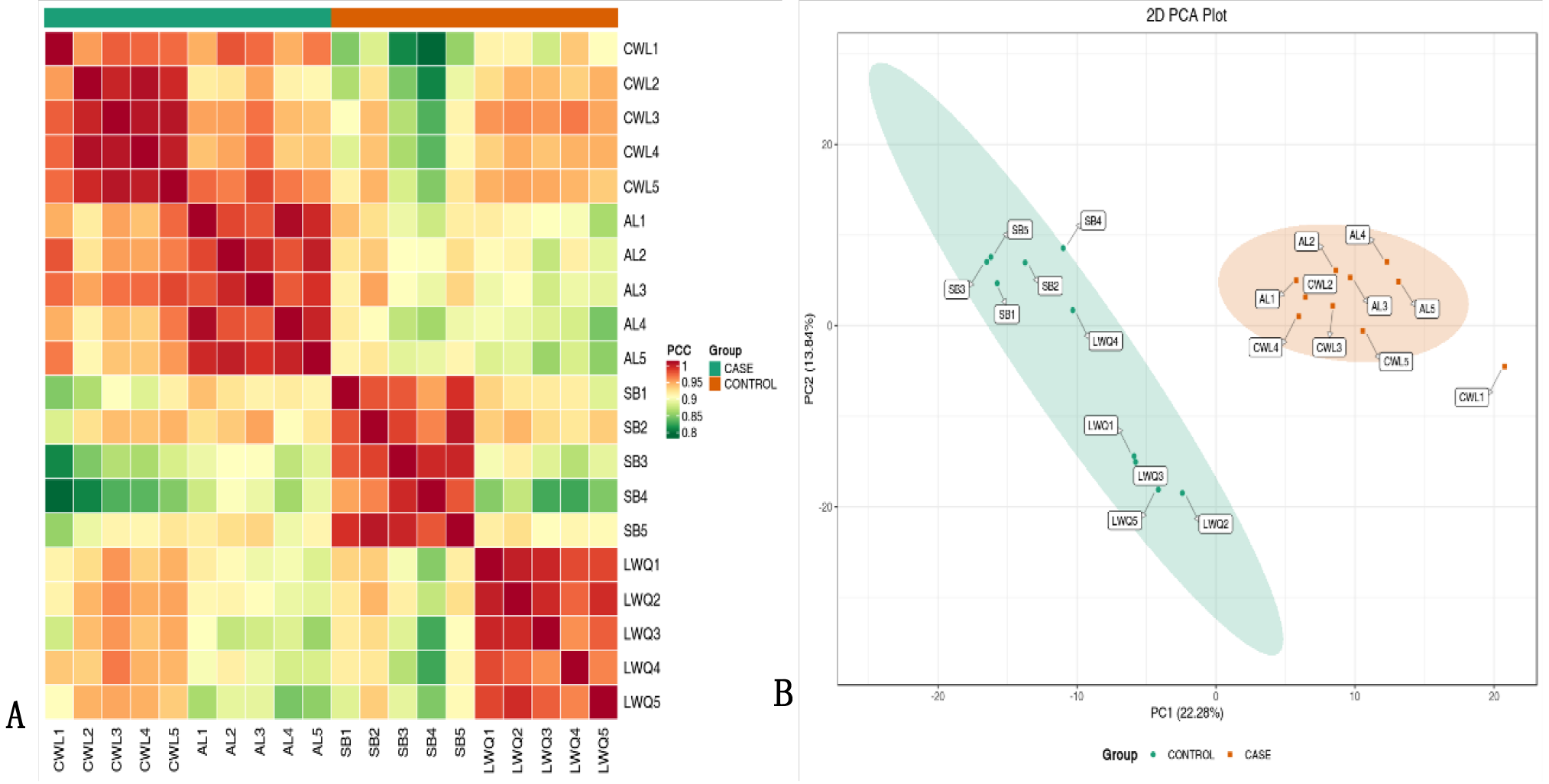
Correlation among all individual samples and principal component analysis based on blood metabolite profiles. A is correlation analysis of all animals, PCC is the value of correlation coefficient r2, and B is the principal component analysis of all animals.
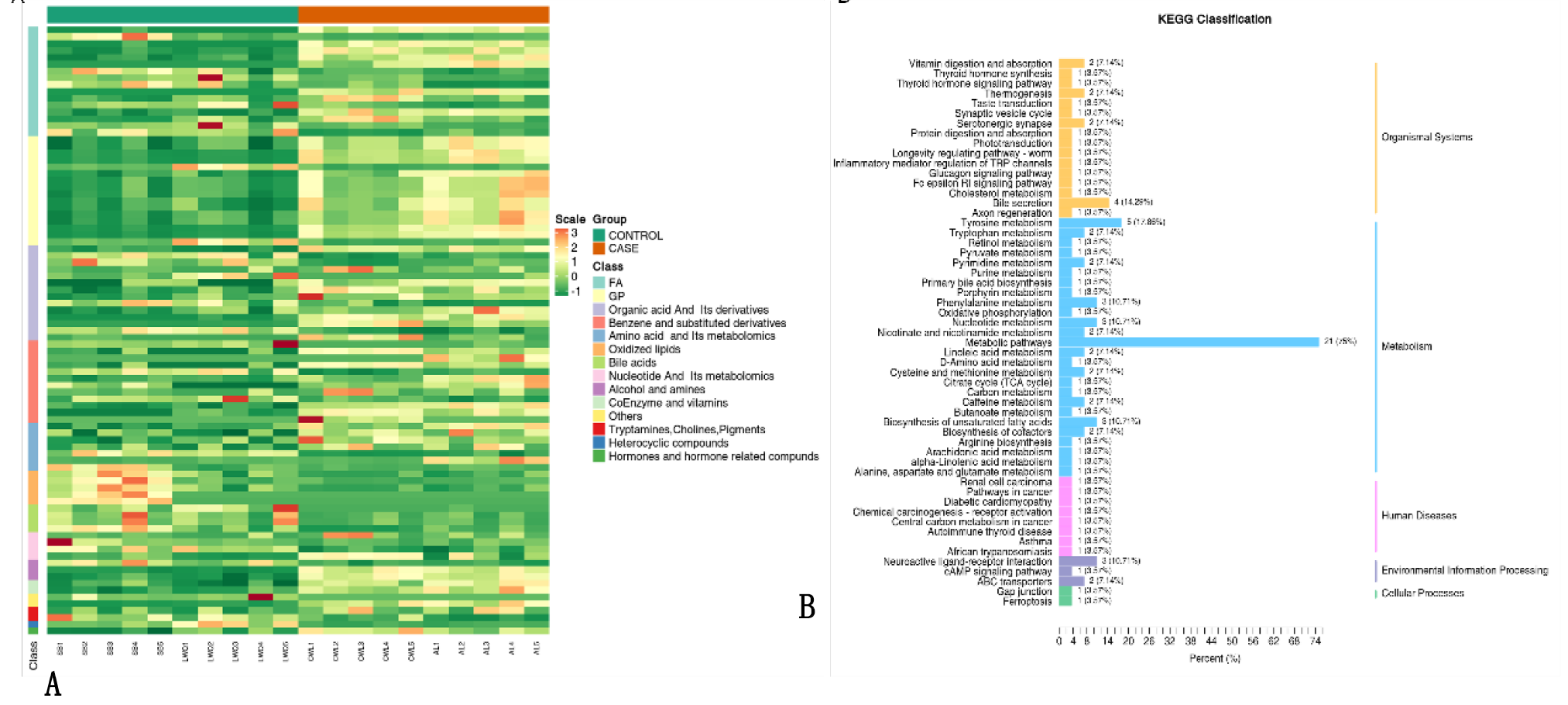
KEGG functional enrichment of significantly differentially expressed chemical derivatives in the serum of wild blood yak vs. domestic yak. A is the heatmap of significantly different metabolites between groups and B is the KEGG enrichment of significantly different metabolites and their classification of KEGG pathways.
References
- Abdellatif, M., Sedej, S. and Kroemer, G., 2021. Nad(+) metabolism in cardiac health, aging, and disease. Circulation, 144: 1795-1817. https://doi.org/10.1161/CIRCULATIONAHA.121.056589[CrossRef]
- Artegoitia, V.M., Foote, A.P., Lewis, R.M. and Freetly, H.C., 2017. Rumen fluid metabolomics analysis associated with feed efficiency on crossbred steers. Sci. Rep., 7: 2864. https://doi.org/10.1038/s41598-017-02856-0[CrossRef]
- Bennett, B.J., de Aguiar, V.T., Wang, Z., Shih, D.M., Meng, Y., Gregory, J., Allayee, H., Lee, R., Graham, M., Crooke, R., Edwards, P.A., Hazen, S.L. and Lusis, A.J., 2013. Trimethylamine-n-oxide, a metabolite associated with atherosclerosis, exhibits complex genetic and dietary regulation. Cell Metab., 17: 49-60. https://doi.org/10.1016/j.cmet.2012.12.011[CrossRef]
- CaJacob, C.A., Chan, W.K., Shephard, E. and Ortiz, D.M.P., 1988. The catalytic site of rat hepatic lauric acid omega-hydroxylase. Protein versus prosthetic heme alkylation in the omega-hydroxylation of acetylenic fatty acids. J. biol. Chem., 263: 18640-18649. https://doi.org/10.1016/S0021-9258(18)37333-2[CrossRef]
- Carlson, J.R. and Bray, T.M., 1983. Nutrition and 3-methylindole-induced lung injury. Adv. Nutr. Res., 5: 31-55. https://doi.org/10.1007/978-1-4613-9937-7_3[CrossRef]
- Carlson, J.R., Dickinson, E.O., Yokoyama, M.T. and Bradley, B., 1975. Pulmonary edema and emphysema in cattle after intraruminal and intravenous administration of 3-methylindole. Am. J. Vet. Res., 36: 1341-1347.
- Carraturo, F., Libralato, G., Esposito, R., Galdiero, E., Aliberti, F., Amoresano, A., Fontanarosa, C., Trifuoggi, M. and Guida, M., 2020. Metabolomic profiling of food matrices: Preliminary identification of potential markers of microbial contamination. J. Fd. Sci., 85: 3467-3477. https://doi.org/10.1111/1750-3841.15418[CrossRef]
- Chen, C.Y., Wu, C.H., Wu, K.C., Shiao, L.R., Chuang, C.M., Leung, Y.M. and Chow, L., 2021. A basal level of gamma-linolenic acid depletes ca(2+) stores and induces endoplasmic reticulum and oxidative stresses to cause death of breast cancer bt-474 cells. Chin. J. Physiol., 64: 202-209. https://doi.org/10.4103/cjp.cjp_30_21[CrossRef]
- Chung, K.F., 2005. Evaluation of selective prostaglandin e2 (pge2) receptor agonists as therapeutic agents for the treatment of asthma. Sci. Stke, 2005: pe47. https://doi.org/10.1126/stke.3032005pe47[CrossRef]
- Coutinho-Wolino, K.S., de F, C.L., de Oliveira, L.V., Mafra, D. and Stockler-Pinto, M.B., 2021. Can diet modulate trimethylamine n-oxide (tmao) production. Eur. J. Nutr., 60: 3567-3584. https://doi.org/10.1007/s00394-021-02491-6[CrossRef]
- Dalton, S., Hughes, B.P. and Barritt, G.J., 1984. Effects of lysophospholipids on ca2+ transport in rat liver mitochondria incubated at physiological ca2+ concentrations in the presence of mg2+, phosphate and atp at 37 degrees c. Biochem. J., 224: 423-430. https://doi.org/10.1042/bj2240423[CrossRef]
- Danzi, S. and Klein, I., 2014. Thyroid disease and the cardiovascular system. Endocrinol. Metabol. Clin. N. Am., 43: 517-528. https://doi.org/10.1016/j.ecl.2014.02.005[CrossRef]
- Dawczynski, C., Hackermeier, U., Viehweger, M., Stange, R., Springer, M. and Jahreis, G., 2011. Incorporation of n-3 pufa and gamma-linolenic acid in blood lipids and red blood cell lipids together with their influence on disease activity in patients with chronic inflammatory arthritis a randomized controlled human intervention trial. Lipids Hlth. Dis., 10: 130. https://doi.org/10.1186/1476-511X-10-130[CrossRef]
- Ding, Y., Zhang, N., Li, J., Jin, Y. and Shao, B., 2018. Molecular cloning and expression of ghrelin in the hypothalamus-pituitary-gastrointestinal tract axis of the yak (Bos grunniens) in the qinghai-tibetan plateau. Anat. Histol. Embryol., 47: 583-590. https://doi.org/10.1111/ahe.12400[CrossRef]
- Djarova, T., Bardarev, D., Boyanov, D., Kaneva, R. and Atanasov, P., 2013. Performance enhancing genetic variants, oxygen uptake, heart rate, blood pressure and body mass index of elite high altitude mountaineers. Acta Physiol. Hung., 100: 289-301. https://doi.org/10.1556/APhysiol.100.2013.3.5[CrossRef]
- Duarte, F.S., Marder, M., Hoeller, A.A., Duzzioni, M., Mendes, B.G., Pizzolatti, M.G. and De Lima, T.C., 2008. Anticonvulsant and anxiolytic-like effects of compounds isolated from polygala sabulosa (polygalaceae) in rodents: In vitro and in vivo interactions with benzodiazepine binding sites. Psychopharmacology, 197: 351-360. https://doi.org/10.1007/s00213-007-1037-z[CrossRef]
- Fania, L., Mazzanti, C., Campione, E., Candi, E., Abeni, D. and Dellambra, E., 2019. Role of nicotinamide in genomic stability and skin cancer chemoprevention. Int. J. mol. Sci., 20. https://doi.org/10.3390/ijms20235946[CrossRef]
- Ferrari, R., Merli, E., Cicchitelli, G., Mele, D., Fucili, A. and Ceconi, C., 2004. Therapeutic effects of l-carnitine and propionyl-l-carnitine on cardiovascular diseases: A review. Annls N. Y. Acad. Sci., 1033: 79-91. https://doi.org/10.1196/annals.1320.007[CrossRef]
- Fotheringham, J., Xu, F.Y., Nemer, M., Kardami, E., Choy, P.C. and Hatch, G.M., 2000. Lysophosphatidylethanolamine acyltransferase activity is elevated during cardiac cell differentiation. Biochim. biophys. Acta, 1485: 1-10. https://doi.org/10.1016/S1388-1981(00)00025-1[CrossRef]
- Gharib, H., 1974. Triiodothyronine. Physiological and clinical significance. J. Am. med. Assoc., 227: 302-304. https://doi.org/10.1001/jama.227.3.302[CrossRef]
- Ha, X.Q., Li, J., Mai, C.P., Cai, X.L., Yan, C.Y., Jia, C.X. and He, S., 2021. The decrease of endothelial progenitor cells caused by high altitude may lead to coronary heart disease. Eur. Rev. med. Pharmacol. Sci., 25: 6101-6108.
- Hardin, C.D., Lazzarino, G., Tavazzi, B., Di Pierro, D., Roberts, T.M., Giardina, B. and Rovetto, M.J., 2001. Myocardial metabolism of exogenous fdp is consistent with transport by a dicarboxylate transporter. Am. J. Physiol. Heart Circul. Physiol., 281: H2654-H2660. https://doi.org/10.1152/ajpheart.2001.281.6.H2654[CrossRef]
- Hassouneh, R., Nasrallah, R., Zimpelmann, J., Gutsol, A., Eckert, D., Ghossein, J., Burns, K.D. and Hebert, R.L., 2016. Pge2 receptor ep3 inhibits water reabsorption and contributes to polyuria and kidney injury in a streptozotocin-induced mouse model of diabetes. Diabetologia, 59: 1318-1328. https://doi.org/10.1007/s00125-016-3916-5[CrossRef]
- He, S., Jiang, H., Zhuo, C. and Jiang, W., 2021. Trimethylamine/trimethylamine-n-oxide as a key between diet and cardiovascular diseases. Cardiovasc. Toxicol., 21: 593-604. https://doi.org/10.1007/s12012-021-09656-z[CrossRef]
- He, X., Zhong, J., Wang, S., Zhou, Y., Wang, L., Zhang, Y. and Yuan, Y., 2017. Serum metabolomics differentiating pancreatic cancer from new-onset diabetes. Oncotarget, 8: 29116-29124. https://doi.org/10.18632/oncotarget.16249[CrossRef]
- Hu, L., Ma, Y., Liu, L., Kang, L., Brito, L.F., Wang, D., Wu, H., Liu, A., Wang, Y. and Xu, Q., 2019. Detection of functional polymorphisms in the hsp70 gene and association with cold stress response in inner-mongolia sanhe cattle. Cell Stress Chaperone., 24: 409-418. https://doi.org/10.1007/s12192-019-00973-5[CrossRef]
- Huang, A. and Owen, K., 2012. Role of supplementary l-carnitine in exercise and exercise recovery. Med. Sport Sci., 59: 135-142. https://doi.org/10.1159/000341934[CrossRef]
- Huang, M., Zhang, X., Yan, W., Liu, J. and Wang, H., 2022. Metabolomics reveals potential plateau adaptability by regulating inflammatory response and oxidative stress-related metabolism and energy metabolism pathways in yak. J. Anim. Sci. Technol., 64: 97-109. https://doi.org/10.5187/jast.2021.e129[CrossRef]
- Ide, T., Iwase, H., Amano, S., Sunahara, S., Tachihara, A., Yagi, M. and Watanabe, T., 2017. Physiological effects of gamma-linolenic acid and sesamin on hepatic fatty acid synthesis and oxidation. J. Nutr. Biochem., 41: 42-55. https://doi.org/10.1016/j.jnutbio.2016.12.001[CrossRef]
- Iijima, S., Otsuka, F., Kikuchi, H., Yamada, K., Nakajima, T., Yahiro, K. and Kondo, A., 2000. Oral supplementation with gamma-linolenic acid extracted from mucor circinelloides improves the deformability of red blood cells in hemodialysis patients. Nephron, 86: 122-128. https://doi.org/10.1159/000045729[CrossRef]
- Ji, Q.M., Xin, J.W., Chai, Z.X., Zhang, C.F., Dawa, Y., Luo, S., Zhang, Q., Pingcuo, Z., Peng, M.S., Zhu, Y., Cao, H.W., Wang, H., Han, J.L. and Zhong, J.C., 2021. A chromosome-scale reference genome and genome-wide genetic variations elucidate adaptation in yak. Mol. Ecol. Resour., 21: 201-211. https://doi.org/10.1111/1755-0998.13236[CrossRef]
- Johnson, C.H., Ivanisevic, J. and Siuzdak, G., 2016. Metabolomics: Beyond biomarkers and towards mechanisms. Nat. Rev. Mol. Cell Biol., 17: 451-459. https://doi.org/10.1038/nrm.2016.25[CrossRef]
- Kandel, S., Sauveplane, V., Compagnon, V., Franke, R., Millet, Y., Schreiber, L., Werck-Reichhart, D. and Pinot, F., 2007. Characterization of a methyl jasmonate and wounding-responsive cytochrome p450 of Arabidopsis thaliana catalyzing dicarboxylic fatty acid formation in vitro. Febs J., 274: 5116-5127. https://doi.org/10.1111/j.1742-4658.2007.06032.x[CrossRef]
- Kawashima, K., Miyako, D., Ishino, Y., Makino, T., Saito, K. and Kano, Y., 2004. Anti-stress effects of 3,4,5-trimethoxycinnamic acid, an active constituent of roots of Polygala tenuifolia (onji). Biol. Pharm. Bull., 27: 1317-1319. https://doi.org/10.1248/bpb.27.1317[CrossRef]
- Kuhn, A., Landmann, A. and Bonsmann, G., 2017. Fumaric acid esters: A new therapeutic option for skin manifestations in lupus erythematosus? Br. J. Dermatol., 176: 301-302. https://doi.org/10.1111/bjd.14938[CrossRef]
- Lannoy, M., Valluru, M.K., Chang, L., Abdela-Ali, F., Peters, D., Streets, A.J. and Ong, A., 2020. The positive effect of selective prostaglandin E2 receptor ep2 and ep4 blockade on cystogenesis in vitro is counteracted by increased kidney inflammation in vivo. Kidney Int., 98: 404-419. https://doi.org/10.1016/j.kint.2020.02.012[CrossRef]
- Laplante, A., Vincent, G., Poirier, M. and Des Rosiers, C., 1997. Effects and metabolism of fumarate in the perfused rat heart. A 13c mass isotopomer study. Am. J. Physiol., 272: E74-E82. https://doi.org/10.1152/ajpendo.1997.272.1.E74[CrossRef]
- Lee, C.I., Han, J.Y., Hong, J.T. and Oh, K.W., 2013. 3,4,5-trimethoxycinnamic acid (tmca), one of the constituents of polygalae radix enhances pentobarbital-induced sleeping behaviors via gabaaergic systems in mice. Arch. pharm. Res., 36: 1244-1251. https://doi.org/10.1007/s12272-013-0167-6[CrossRef]
- Li, Y., Wei, Y., Zheng, F., Guan, Y. and Zhang, X., 2017. Prostaglandin E2 in the regulation of water transport in renal collecting ducts. Int. J. mol. Sci., 18. https://doi.org/10.3390/ijms18122539[CrossRef]
- Li, Y.Y. and Zhang, X.Y., 2021. Role of prostaglandin E2 in the modulation of renal water transport. Sheng Li Xue Bao, 73: 681-689.
- Liedtke, A.J., Nellis, S.H., Whitesell, L.F. and Mahar, C.Q., 1982. Metabolic and mechanical effects using L- and d-carnitine in working swine hearts. Am. J. Physiol., 243: H691-H697. https://doi.org/10.1152/ajpheart.1982.243.5.H691[CrossRef]
- Liu, G., Chen, S., Zhong, J., Teng, K. and Yin, Y., 2017. Crosstalk between tryptophan metabolism and cardiovascular disease, mechanisms, and therapeutic implications. Oxida. Med. Cell. Longev., 2017: 1602074. https://doi.org/10.1155/2017/1602074[CrossRef]
- Lv, S., Wang, Y., Zhang, W. and Shang, H., 2022. Trimethylamine oxide: A potential target for heart failure therapy. Heart, 108: 917-922. https://doi.org/10.1136/heartjnl-2021-320054[CrossRef]
- Makide, K., Kitamura, H., Sato, Y., Okutani, M. and Aoki, J., 2009. Emerging lysophospholipid mediators, lysophosphatidylserine lysophosphatidylthreonine, lysophosphatidylethanolamine and lysophosphatidylglycerol. Prostag. Oth. Lipid Mediat., 89: 135-139. https://doi.org/10.1016/j.prostaglandins.2009.04.009[CrossRef]
- Nagaraj, M., Horing, M., Ahonen, M.A., Nguyen, V.D., Zhou, Y., Vihinen, H., Jokitalo, E., Liebisch, G., Nidhina, H.P. and Olkkonen, V.M., 2022. Golm1 depletion modifies cellular sphingolipid metabolism and adversely affects cell growth. J. Lipid Res., 63: 100259. https://doi.org/10.1016/j.jlr.2022.100259[CrossRef]
- Nazifi, S., Saeb, M., Rowghani, E. and Kaveh, K., 2003. The influences of thermal stress on serum biochemical parameters of Iranian fat-tailed sheep and their correlation with triiodothyronine (T3), thyroxine (T4) and cortisol concentrations. Comp. clin. Pathol., 12: 135-139. https://doi.org/10.1007/s00580-003-0487-x[CrossRef]
- Park, G.C., Kim, J.M., Park, H.Y., Han, J.M., Shin, S.C., Jang, J.Y., Jung, D., Kim, I.J., Lee, J.C. and Lee, B.J., 2017. Tsh-independent release of thyroid hormones through cold exposure in aging rats. Oncotarget, 8: 89431-89438. https://doi.org/10.18632/oncotarget.19851[CrossRef]
- Popp, J.D., McAllister, T.A., Kastelic, J.P., Majak, W., Ayroud, M., VanderKop, M.A., Karren, D., Yost, G.S. and Cheng, K.J., 1998. Effect of melengestrol acetate on development of 3-methylindole-induced pulmonary edema and emphysema in sheep. Can. J. Vet. Res. Rev. Can. Res. Vet., 62: 268-274.
- Qiu, Q., Wang, L., Wang, K., Yang, Y., Ma, T., Wang, Z., Zhang, X., Ni, Z., Hou, F., Long, R., Abbott, R., Lenstra, J. and Liu, J., 2015. Yak whole-genome resequencing reveals domestication signatures and prehistoric population expansions. Nat. Commun., 6: 10283. https://doi.org/10.1038/ncomms10283[CrossRef]
- Ragavan, M., Kirpich, A., Fu, X., Burgess, S.C., McIntyre, L.M., and Merritt, M.E., 2017. A comprehensive analysis of myocardial substrate preference emphasizes the need for a synchronized fluxomic/metabolomic research design. Am. J. Physiol. Heart Circ. Physiol., 312: H1215-H1223. https://doi.org/10.1152/ajpheart.00016.2017[CrossRef]
- Ranels, H.J. and Griffin, J.D., 2005. Effects of prostaglandin e2 on the electrical properties of thermally classified neurons in the ventromedial preoptic area of the rat hypothalamus. BMC Neurosci., 6: 14.
- Razquin, C., Ruiz-Canela, M., Toledo, E., Hernandez-Alonso, P., Clish, C.B., Guasch-Ferre, M., Li, J., Wittenbecher, C., Dennis, C., Alonso-Gomez, A., Fito, M., Liang, L., Corella, D., Gomez-Gracia, E., Estruch, R., Fiol, M., Lapetra, J., Serra-Majem, L., Ros, E., Aros, F., Salas-Salvado, J., Hu, F.B. and Martinez-Gonzalez, M.A., 2021. Metabolomics of the tryptophan-kynurenine degradation pathway and risk of atrial fibrillation and heart failure: potential modification effect of mediterranean diet. Am. J. clin. Nutr., 114: 1646-1654. https://doi.org/10.1093/ajcn/nqab238[CrossRef]
- Rigoulet, M., Bouchez, C.L., Paumard, P., Ransac, S., Cuvellier, S., Duvezin-Caubet, S., Mazat, J.P. and Devin, A., 2020. Cell energy metabolism: an update. Biochim. biophys. Acta Bioenerg., 1861: 148276. https://doi.org/10.1016/j.bbabio.2020.148276[CrossRef]
- Saleem, F., Ametaj, B.N., Bouatra, S., Mandal, R., Zebeli, Q., Dunn, S.M. and Wishart, D.S., 2012. A metabolomics approach to uncover the effects of grain diets on rumen health in dairy cows. J. Dairy Sci., 95: 6606-6623. https://doi.org/10.3168/jds.2012-5403[CrossRef]
- Salzano, A., Cassambai, S., Yazaki, Y., Israr, M.Z., Bernieh, D., Wong, M. and Suzuki, T., 2020. The gut axis involvement in heart failure: Focus on trimethylamine n-oxide. Heart Fail. Clin., 16: 23-31. https://doi.org/10.1016/j.hfc.2019.08.001[CrossRef]
- Samuel, S., Zhang, K., Tang, Y.D., Gerdes, A.M. and Carrillo-Sepulveda, M.A., 2017. Triiodothyronine potentiates vasorelaxation via pkg/vasp signaling in vascular smooth muscle cells. Cell Physiol. Biochem., 41: 1894-1904. https://doi.org/10.1159/000471938[CrossRef]
- Sergeant, S., Rahbar, E. and Chilton, F.H., 2016. Gamma-linolenic acid, dihommo-gamma linolenic, eicosanoids and inflammatory processes. Eur. J. Pharmacol., 785: 77-86. https://doi.org/10.1016/j.ejphar.2016.04.020[CrossRef]
- Song, C.W., Kim, D.I., Choi, S., Jang, J.W. and Lee, S.Y., 2013. Metabolic engineering of Escherichia coli for the production of fumaric acid. Biotechnol. Bioeng., 110: 2025-2034. https://doi.org/10.1002/bit.24868[CrossRef]
- Steiber, A., Kerner, J. and Hoppel, C.L., 2004. Carnitine: A nutritional, biosynthetic, and functional perspective. Mol. Asp. Med., 25: 455-473. https://doi.org/10.1016/j.mam.2004.06.006[CrossRef]
- Sun, X., Zheng, N., Bu, D., Pan, L., Qin, J., Wang, X., Zhang, X., Yuan, Y. and Cheng, J., 2014. Effects of nicotinamide on the blood hormone levels, antioxidant status and immune function of cows in heat stress. J. China Agric. Univ., 19: 101-109.
- Tan, S.H., Koh, H., Chua, J.Y., Burla, B., Ong, C.C., Teo, L., Yang, X., Benke, P.I., Choi, H., Torta, F., Richards, A.M., Wenk, M.R. and Chan, M.Y., 2022. Variability of the plasma lipidome and subclinical coronary atherosclerosis. Arterioscler. Thromb. Vasc. Biol., 42, 100-112. https://doi.org/10.1161/ATVBAHA.121.316847[CrossRef]
- Touat, M., Sourisseau, T., Dorvault, N., Chabanon, R.M., Garrido, M., Morel, D., Krastev, D.B., Bigot, L., Adam, J., Frankum, J.R., Durand, S., Pontoizeau, C., Souquere, S., Kuo, M.S., Sauvaigo, S., Mardakheh, F., Sarasin, A., Olaussen, K.A., Friboulet, L., Bouillaud, F., Pierron, G., Ashworth, A., Lombes, A., Lord, C.J., Soria, J.C. and Postel-Vinay, S., 2018. Dna repair deficiency sensitizes lung cancer cells to nad+ biosynthesis blockade. J. clin. Invest., 128: 1671-1687. https://doi.org/10.1172/JCI90277[CrossRef]
- Towers, C.V., Briggs, G.G. adn Rojas, J.A., 2004. The use of prostaglandin E2 in pregnant patients with asthma. Am. J. Obstet. Gynecol, 190: 1777-1780, 1780. https://doi.org/10.1016/j.ajog.2004.02.056[CrossRef]
- Trifonova, O.P., Balashova, E.E., Maslov, D.L., Grigoriev, A.I., Lisitsa, A.V., Ponomarenko, E.A. and Archakov, A.I., 2020. Blood metabolome analysis for creating a digital image of a healthy person. Biomed. Khim, 66: 216-223. https://doi.org/10.18097/pbmc20206603216[CrossRef]
- Tsukahara, T., Hara, H., Haniu, H. and Matsuda, Y., 2021. The combined effects of lysophospholipids against lipopolysaccharide-induced inflammation and oxidative stress in microglial cells. J. Oleo Sci., 70: 947-954. https://doi.org/10.5650/jos.ess21069[CrossRef]
- Wang, X., Zhang, A., Wang, P., Sun, H., Wu, G., Sun, W., Lv, H., Jiao, G., Xu, H., Yuan, Y., Liu, L., Zou, D., Wu, Z., Han, Y., Yan, G., Dong, W., Wu, F., Dong, T., Yu, Y., Zhang, S., Wu, X., Tong, X. and Meng, X., 2013. Metabolomics coupled with proteomics advancing drug discovery toward more agile development of targeted combination therapies. Mol. Cell. Proteomics, 12: 1226-1238. https://doi.org/10.1074/mcp.M112.021683[CrossRef]
- Wishart, D.S., Guo, A., Oler, E., Wang, F., Anjum, A., Peters, H., Dizon, R., Sayeeda, Z., Tian, S., Lee, B.L., Berjanskii, M., Mah, R., Yamamoto, M., Jovel, J., Torres-Calzada, C., Hiebert-Giesbrecht, M., Lui, V.W., Varshavi, D., Varshavi, D., Allen, D., Arndt, D., Khetarpal, N., Sivakumaran, A., Harford, K., Sanford, S., Yee, K., Cao, X., Budinski, Z., Liigand, J., Zhang, L., Zheng, J., Mandal, R., Karu, N., Dambrova, M., Schioth, H.B., Greiner, R. and Gautam, V., 2022. Hmdb 5.0: The human metabolome database for 2022. Nucleic Acids Res., 50: D622-D631. https://doi.org/10.1093/nar/gkab1062[CrossRef]
- Xu, F.Y., Kardami, E., Nemer, M., Choy, P.C. and Hatch, G.M., 2000. Elevation in phosphatidylethanolamine is an early but not essential event for cardiac cell differentiation. Exp. Cell Res., 1; 256: 358-364. https://doi.org/10.1006/excr.2000.4849[CrossRef]
- Yi, X., Liang, Y., Huerta-Sanchez, E., Jin, X., Cuo, Z.X., Pool, J.E., Xu, X., Jiang, H., Vinckenbosch, N., Korneliussen, T.S., Zheng, H., Liu, T., He, W., Li, K., Luo, R., Nie, X., Wu, H., Zhao, M., Cao, H., Zou, J., Shan, Y., Li, S., Yang, Q., Asan, Ni, P., Tian, G., Xu, J., Liu, X., Jiang, T., Wu, R., Zhou, G., Tang, M., Qin, J., Wang, T., Feng, S., Li, G., Huasang, Luosang, J., Wang, W., Chen, F., Wang, Y., Zheng, X., Li, Z., Bianba, Z., Yang, G., Wang, X., Tang, S., Gao, G., Chen, Y., Luo, Z., Gusang, L., Cao, Z., Zhang, Q., Ouyang, W., Ren, X., Liang, H., Zheng, H., Huang, Y., Li, J., Bolund, L., Kristiansen, K., Li, Y., Zhang, Y., Zhang, X., Li, R., Li, S., Yang, H., Nielsen, R., Wang, J. and Wang, J., 2010. Sequencing of 50 human exomes reveals adaptation to high altitude. Science, 329: 75-78. https://doi.org/10.1126/science.1190371[CrossRef]
- Zendedel, A., Kashani, I.R., Azimzadeh, M., Pasbakhsh, P., Omidi, N., Golestani, A., Beyer, C. and Clarner, T., 2016. Regulatory effect of triiodothyronine on brain myelination and astrogliosis after cuprizone-induced demyelination in mice. Metab. Brain Dis., 31: 425-433. https://doi.org/10.1007/s11011-015-9781-y[CrossRef]
- Zeng, H.F., Xu, J., Wang, X.L., Li, S.J. and Han, Z.Y., 2022. Nicotinamide mononucleotide alleviates heat stress-induced oxidative stress and apoptosis in bmecs through reducing mitochondrial damage and endoplasmic reticulum stress. Ecotox. environ. Saf., 235: 113441. https://doi.org/10.1016/j.ecoenv.2022.113441[CrossRef]
- Zeng, J.Y., Robertson, I.D., Ji, Q.M., Dawa, Y.L. and Bruce, M., 2019. Evaluation of the economic impact of brucellosis in domestic yaks of tibet. Transbound. Emerg. Dis., 66: 476-487. https://doi.org/10.1111/tbed.13049[CrossRef]
- Zhang, B., Du H, Sun, M., Wu, X., Li, Y., Wang, Z., Xiao, Y. and Peng, F., 2022. Comparison of lauric acid and 12-hydroxylauric acid in the alleviation of drought stress in peach (Prunus persica L.) Batsch). Front. Pl. Sci., 13: 1025569. https://doi.org/10.3389/fpls.2022.1025569[CrossRef]
- Zhang, Q., Li, J., Zhong, H. and Xu, Y., 2021. The mechanism of nicotinamide on reducing acute lung injury by inhibiting mapk and nf-kappab signal pathway. Mol. Med., 27: 115. https://doi.org/10.1186/s10020-021-00376-2[CrossRef]
- Zhang, X., Liu, C., Liu, C., Wang, Y., Zhang, W. and Xing, Y., 2019. Trimetazidine and l-carnitine prevent heart aging and cardiac metabolic impairment in rats via regulating cardiac metabolic substrates. Exp. Gerontol., 119: 120-127. https://doi.org/10.1016/j.exger.2018.12.019[CrossRef]
Cited by 1 article
In journals published by ResearchersLinks.
Services
Article usage statistics
Loading…